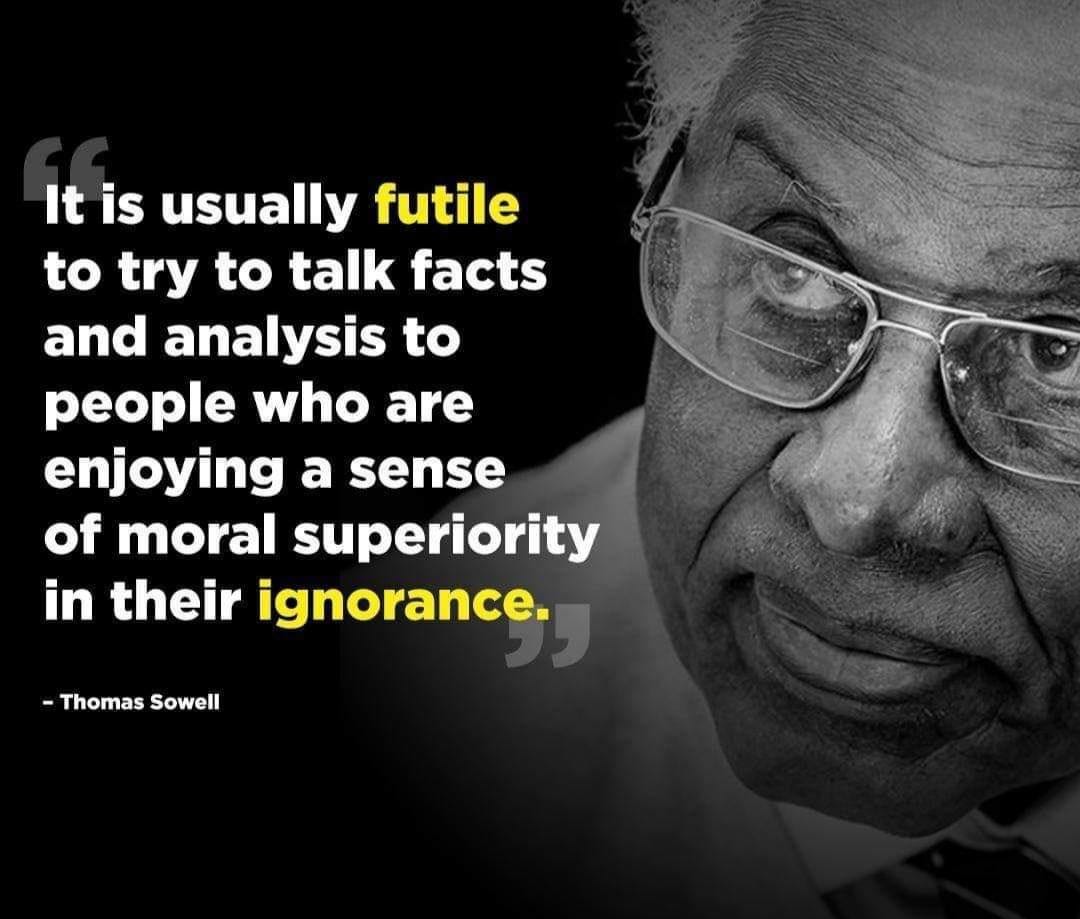
The Futility of Facts Against Moral Self-Congratulation: A Summary of Thomas Sowell’s Perspective
Thomas Sowell’s observation—that it is usually futile to present facts and analysis to people who derive satisfaction from a sense of moral superiority rooted in their ignorance—distills a recurring obstacle to rational discourse. This insight reflects the central thesis of his 1995 book *The Vision of the Anointed: Self-Congratulation as a Basis for Social Policy*, as well as remarks in his later columns. Sowell identifies a dominant intellectual and political mindset in which elites in academia, media, and government view themselves as morally and intellectually superior to those who disagree. This self-conception, which he terms the “vision of the anointed,” insulates its adherents from empirical challenge and substitutes moral posturing for evidence-based reasoning.
The mechanism operates through a fundamental asymmetry in motivation. Adherents of the anointed vision attribute society’s problems to insufficient compassion or intelligence on the part of others. They believe they alone possess both the superior virtue and the ready solutions needed to correct these problems. Because their identity and authority rest on this presumed moral elevation—a “special state of grace,” in Sowell’s words—contradictory evidence is not welcomed as a means of refinement. Instead, it is perceived as a threat to their self-image and social standing. Critics are therefore frequently dismissed not on substantive grounds but as morally deficient or lacking compassion. Ignorance, in this context, is not merely a lack of information; it enables the comforting clarity of binary moral judgments that more rigorous analysis would complicate or undermine.
Sowell contrasts this unconstrained vision with a more constrained understanding of human nature and social processes. The constrained perspective recognizes inherent limits to knowledge, the decisive role of incentives, and the unavoidable trade-offs that accompany any policy choice. Under this framework, ideas and policies are judged by their observable results rather than by the intentions or moral status of their advocates. Humility before evidence replaces confidence in one’s own superior rectitude. When outcomes fail to match expectations, the proper response is revision or abandonment, not rationalization or attacks on the character of dissenters.
The consequences of the anointed approach are substantial. Policies driven by self-congratulation rather than tested results tend to persist long after evidence of their ineffectiveness or harm has accumulated. Public discourse becomes polarized, as participants invest more in preserving their moral positioning than in discovering workable solutions. Institutions charged with producing and transmitting knowledge—universities, media, and government agencies—risk subordinating empirical inquiry to the maintenance of prevailing narratives. Sowell documents these patterns across domains such as welfare policy, criminal justice, education, and economic regulation, where repeated failures have often been met with renewed insistence on the original vision rather than with reconsideration.
Ultimately, Sowell’s analysis affirms that the advancement of human well-being depends on restoring the authority of facts, incentives, and demonstrated consequences over the seductive appeal of moral self-congratulation. Rational persuasion may indeed prove difficult with those who have staked their identity on a particular vision, yet the alternative—allowing policy and culture to be shaped by insulated moral certainty—carries far greater costs. The disciplined pursuit of evidence, however imperfect and incremental, remains the only reliable path to sounder decisions and more accurate understanding of the social world.