
kubectl scale deployment kube-prometheus-stack-operator -n monitoring --replicas=0
kubectl scale statefulset prometheus-kube-prometheus-stack-prometheus -n monitoring --replicas=0
With the Operator down, nothing is watching. You can work without anything fighting you.
1
2
The correct order:
- Scale the Operator down first
- Scale the StatefulSet to zero
- Do your maintenance
- Scale the StatefulSet back up
- Scale the Operator back up last
1
3
The kube-prometheus-stack Operator continuously watches the StatefulSet.
When it sees a deviation from the desired state, it reconciles it back immediately.
You are fighting the Operator. The Operator will win every time.
1
1
🧵 I scaled my Prometheus StatefulSet to zero for maintenance.
30 seconds later it was back at 1 replica.
I scaled it to zero again. It came back again.
I was not losing my mind.
1
5

Jun 13
Pod is just a container; Deployment adds replica management and rolling updates; StatefulSet gives stable DNS, stable storage, and ordered rollout. That's the core distinction.
17

Jun 12
90% of Kubernetes interviews in 2026 come down to these 7 points. Can you explain them without buzzwords?
1. Pod vs Deployment vs StatefulSet: when you need stable identity, volumes, rollouts, and why
2. Services DNS: ClusterIP vs Headless vs LoadBalancer, and how traffic actually reaches a pod
3. Requests/limits: scheduling vs throttling vs OOMKilled, and how you size for spiky workloads
4. Probes: startup vs readiness vs liveness, and what breaks during deploys if you misuse them
5. Config secrets: env vs volumes, reload patterns, and what not to put in etcd
6. Ingress gateways: TLS termination, path routing, timeouts, and where mTLS usually lives
7. Debugging: kubectl logs/exec/describe/events, ephemeral containers, and reading why a pod is Pending or CrashLoopBackOff
1
7
43
2,174


Jun 9
Kubernetes gives you several ways to run a Pod, and on the surface Deployments, StatefulSets, and DaemonSets all seem to do the same thing. These all run containers, but they exist for different reasons, and which type to choose isn't always clear.
The article below discusses all three. Deployments handle stateless apps like web servers and APIs where any Pod can serve any request. StatefulSets give databases stable identities and dedicated storage. DaemonSets run one Pod per node for agents.
The framing of whether your app needs to remember who it is, whether it must run on every node, or whether it's just a typical service can help to understand the differences. Check this out from Halil Furkan.
lckhd.eu/Lagj1J
#Kubernetes #StatefulSet #DaemonSet #Deployment
1
10
47
2,747

Jun 6
You got the huge discount on K8s certs. You did KodeKloud, Udemy, and boot camp courses and got shiny CKA, CKAD, and CKS certs.
Then you walk into the job interview.
"Tell me about a time something broke in production. How did you fix it?
What did you put in place so it never happened again?"
You go blank.
They follow up with another question.
"How do you run applications across multiple environments? What's your stack? Walk me through it end to end."
You freeze again. Because your cert prep never taught you that.
It taught you to pass an exam with basic labs and MCQs.
Interviews are looking for your real world experience.
→ Can you debug ImagePullBackOff at 2 AM when ECR creds expired and rotate them with IRSA External Secrets so it never happens again
→ Can you explain why a StatefulSet won't mount after a node drain, fix the topology constraints, and walk through PV reclaim policies without sweating
→ Can you architect a path-to-prod across dev, staging, and prod with ArgoCD, Helm, Kustomize overlays, and proper secrets management instead of copy-pasting YAML
→ Can you handle a canary release poisoning 30% of traffic, do a manual rollback under pressure, and then roll out Flagger Prometheus so the next release isn't a coin flip
→ Can you sit in a war room when the ALB controller OOMs under load and actually fix it, not just panic-restart pods
This is the gap I have been trying to fill with LivingDevOps.
I make you live like a real-world DevOps engineer.
That is the only way to learn and get better at modern DevOps.
If you want to make it into DevOps or SRE, with or without ML and AI skills, then you should be Living DevOps too.
→ You learn it by breaking real clusters
→ By running production-grade projects end to end
→ By writing post-mortems
→ By owning an incident from page to RCA to permanent fix
→ By building real AIOps workflows and MLOps pipelines, not the dummy ones
Go check out LivingDevOps. It's just a Google search away.

5
10
41
3,222

Jun 5
📝 What Makes StatefulSets Special
Stable Pod Identity
→ postgres-0, postgres-1
Stable Network Identity
→ postgres-0.postgres.default.svc.cluster.local
Dedicated Persistent Storage
→ data-postgres-0, data-postgres-1
Ordered Lifecycle
→ Pods start, update, scale, and terminate in sequence
🔹 Why It Matters
Stateful applications need more than just storage. They require stable identities and predictable behavior to function correctly.
That’s why databases and distributed systems like PostgreSQL, MySQL, ZooKeeper, Kafka, RabbitMQ, and Elasticsearch are commonly deployed using StatefulSets.
💡 In short:
Deployment = stateless apps (web servers, APIs)
StatefulSet = stateful apps (databases, queues, distributed systems)
1
4
144

Jun 3
Day 5 of learning Go after office hours.
Started with implementing Raft algo & project design is:
N number of nodes (Go servers) inside a K8s StatefulSet with a gateway service deployed separately routing requests from the clients to the leader of that cluster.
Gateway service can ping the current leader but if it changed, the node will respond with the new leaders address & the service will send a new req to the new leader. (You can loosely say its acting like a reverse proxy. We can also route the req from the follower internally to the new leader but I want to keep that limited to Gateway)
Each node will have its own persistence (sql DB) & a log file (for recording ops from client).
It's a fairly simple setup & I aim to learn some DevOps too with it projects on orchestration & deployments.
(Design diagram in comments)
34
10
289
15,231

Yeah, everyone wants k8s until they have to troubleshoot a StatefulSet at 3 am
2
50

May 28
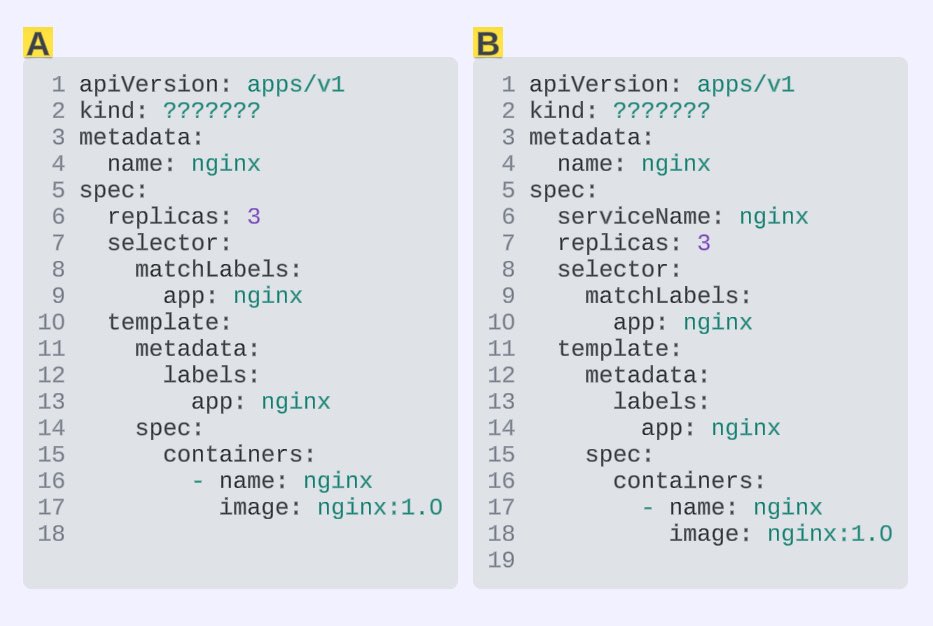
Answer:
Based only on what appears in the manifests:
A = Deployment
B = StatefulSet
The clue is
serviceName: nginx
serviceName is used by a StatefulSet to keep a stable identity for the app’s Pods.
May 27

Kubernetes quiz
Which manifest is a Deployment and which one is a StatefulSet?
2
14
1,007

May 28
- Using the `latest` tag is a no go
- A bare pod is usually not how one should run pods, they should be managed by a higher-level abstraction, like a Deployment or a StatefulSet
1
3
719

May 28
A is clearly Deployment manifest that's for sure and that's why B is StatefulSet
and that's how i got to know that "serviceName: nginx" is used because StatefulSets need it to link the Pods to a headless Service so Kubernetes can give each Pod a stable DNS identity
May 27
Kubernetes quiz
Which manifest is a Deployment and which one is a StatefulSet?
1
4
230

B has service name so B one is statefulset other is deployment
1
4
1,256
May 27
Kubernetes quiz
Which manifest is a Deployment and which one is a StatefulSet?
13
9
106
23,773


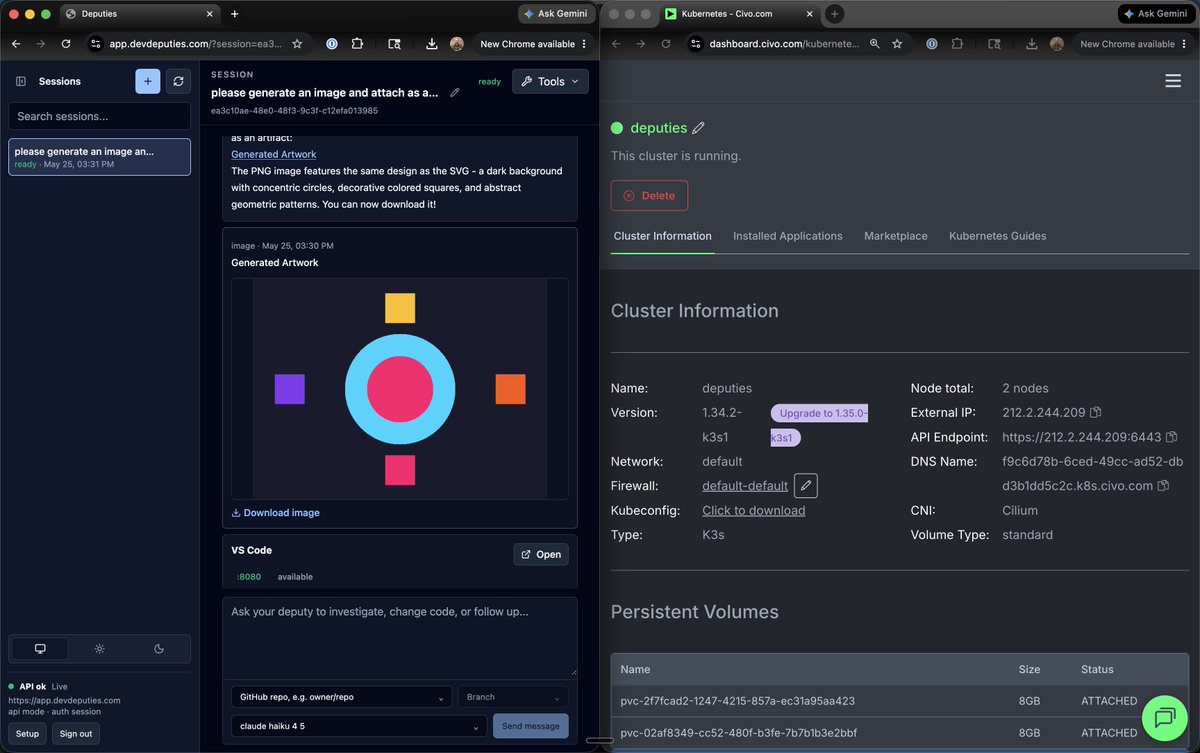
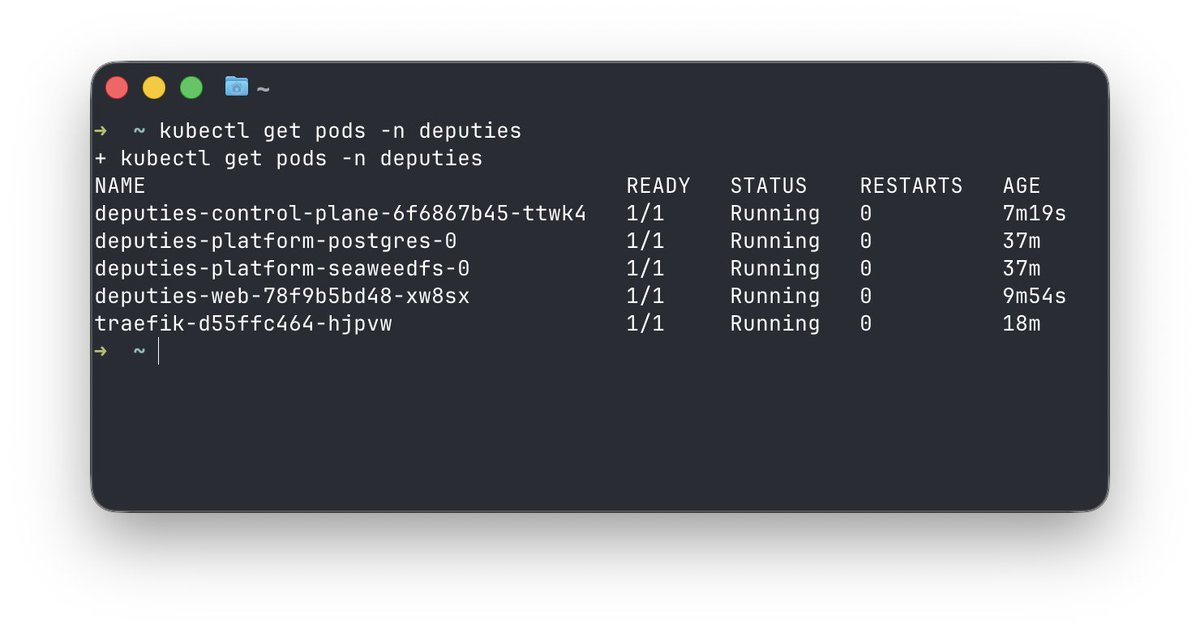
Running in an actual @CivoCloud cluster with a managed Postgres Civo object store for artifacts!
Things I uncovered when deploying to a real cluster instead of my local KinD cluster:
- Real cloud PVCs include lost found. Postgres needs PGDATA in a subdir, not the mount root
- I was previously connecting without SSL to an in cluster postgres statefulset. Most DB providers will need explicit SSL URL params

1
3
959

May 23
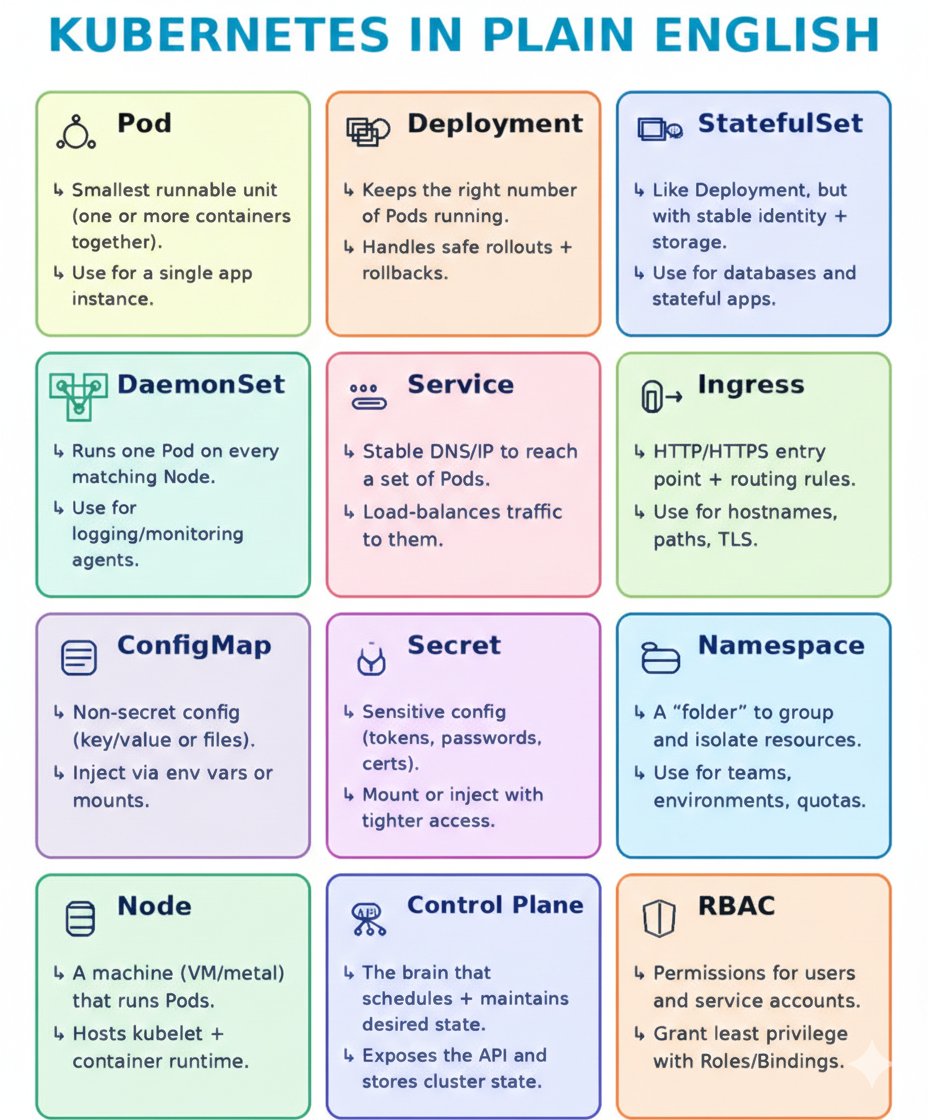
☸️ Kubernetes in Plain English
📦 Pod
→ Runs your application containers
🚀 Deployment
→ Keeps apps running
→ Handles rolling updates safely
💾 StatefulSet
→ For databases & apps needing persistent storage
🛰️ DaemonSet
→ Runs one Pod on every node
→ Perfect for logging & monitoring agents
🌐 Service
→ Gives Pods a stable network endpoint
🔀 Ingress
→ Manages external HTTP/HTTPS access
📝 ConfigMap
→ Stores non-sensitive configuration
🔐 Secret
→ Stores passwords, tokens & certificates
📂 Namespace
→ Separates resources between teams/environments
🖥️ Node
→ The machine where Pods run
🧠 Control Plane
→ The brain of the cluster
🛡️ RBAC
→ Controls who can access what
Master these basics once…
and Kubernetes becomes MUCH easier ⚡
2
19
100
3,514