
I think a stopclock should be introduced in football with 25 min to be played in each half.
Jun 14

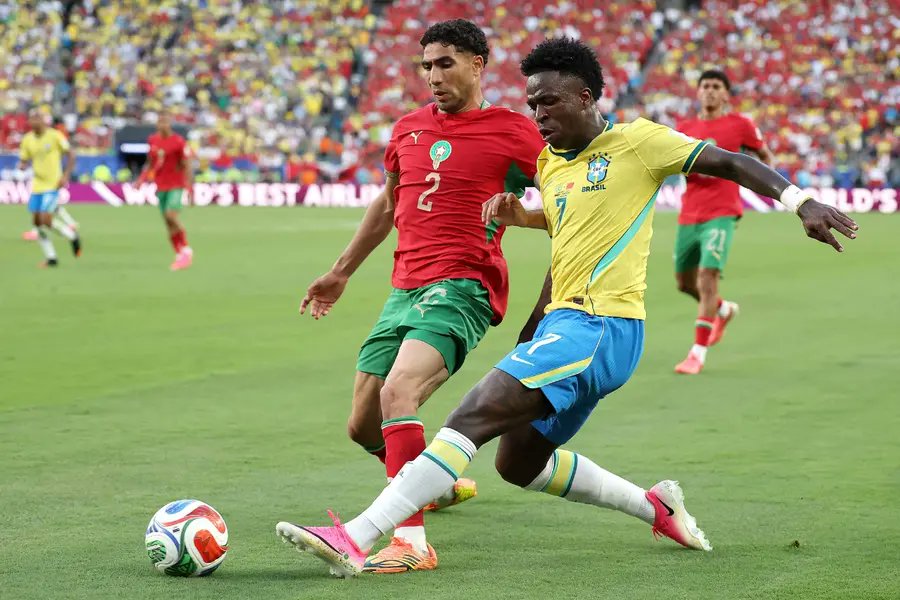
🚨 𝗦𝗧𝗔𝗧: The ball was in play for 59 minutes and 13 seconds during Brazil vs Morocco.
The highest active playing time of any match at the 2026 World Cup so far.
— @OptaJoe
1
109


Jun 11
what do you mean they don't even stop the clock for the mandated *3 minute break* what is football's problem with stopclock
1
59

May 28
How can you be a 2nd Gen British immigrant plugged into Nigerian Twitter and you're still putting out "they are stealing our jobs" tweets.
& a lot of people are still kiki-ing with her.
If you think it's so easy to get a CoS when you have an 18-24 month stopclock in a country where 95% of roles won't sponsor you and those that do, will hire a British Grad before you, then you should probably try applying as a Nigerian and clicking "I need visa sponsorship".
1
10
18
1,479

May 3
Yoo brooo... what reset in hiphop history is greater than the flood 50 brought with GRodt?? It was a complete stopclock! Also an undisputed classic.
1
2
97

Apr 4
The tipping point is the Gulf. Right now US is on a stopclock driven by domestic political, geopolitical and global market constraints. Iran is playing Brun’s victory by survival and points game with all the breathing room while its financial jugular is intact. Shielding the Gulf enables throttling Iranian exports, as the regime shifts to survival compression but lashing out loses efficacy and its force projection capacity begins to rapidly decay. That flips the script. France’s obstruction of 1. is making reversing that leverage dynamic difficult, and it’s courting alliance fracture.

1
2
12
819
Apr 1
If the point is several months strangulation of the regime’s financial lifeline, as opposed to destroying the island or achieving one hundred percent efficacy and leverage, then a combination of bespoke strikes disabling Kharg’s 77 mw power plant, substations and scada centers, and vessel interdiction in open waters for the remaining output, should get the job done. Stacking reversible damage to infrastructure and vbss ops to degrade output seems more sensible than taking and holding that island toward a limited end.
In any case, even granting there’s a way to accomplish throttling Iranian exports without taking Kharg, the issue that remains is escalation mgmt and market blowback. Iran still effectively holds both Hormuz and critical Gulf infrastructure hostage. Once those exports are choked the regime is on something much closer to a stopclock and that can trigger use it or lose it escalation.
Right now they’re playing the victory by survival and points game Itai Brun has already laid out so well -- parsing out the admin’s own 2-3 weeks rhetoric and gauging congressional appetite to block WPR efforts beyond 60-90 days. Dashing that hope risks unconstrained fires at desalination plants, export terminals and refineries and even the UAE’s Barakah pressurized water nuclear reactor.
US and Israeli assets are insufficient to effectively blanket the roughly thousand mile littoral with an anti access umbrella. That’s what the whole multinational maritime taskforce was requested by Washington to prioritize: ensuring critical soft sites across the rear are defended, likely before clearing and capturing the island chains. We’re seeing UK increasingly step up to that Gulf defensive plate, but France and other key European players are refusing to commit Hormuz maritime tasking until the end of the conflict, which is what has Potus incandescent.
Overlaying weapons engagement zones for instance from Abu Musa, the Tunbs, and Sir Abu Nu’ayr creates overlapping cover across key maritime approaches off the UAE. That kind of anti access setup enhances early warning and response timelines against saturation attacks from Iranian coastal missile and drone fires. But clearing and taking key island positions to establish a waterward defensive shield over the Gulf requires surging littoral defenses -- the preclearance for Tehran’s financial jugular.
That’s what’s creating serious, potentially irreversible tensions between this admin with Nato. The longer the coalition drags its feet on surging defensive assets for the littoral, the longer the global energy market remains destabilized, as it’s delaying the US clearing the island chains, likely for the Emirates to ultimately hold and man an integrated defense system over the waterway.
China and Russia view Nato fracture as a win. It’s also fairly clear that they have aggressively pursued elite capture and ideological subversion campaigns. Take a look at Helga Zepp Larouche’s proximity to Beijing and Roger Stone’s rapprochement with her late husband in 2015 or 2016 for instance. Take a look at the sophisticated game the Russians played in that period with the whole Russia hoax fiasco. The same applies for the infestation of Iranian track-II operatives at the ICG since Giustra, Soros and Pinchuk walked in between 2005-2008. This component clarifies how adversaries recognized political will as the center of gravity long before stoking tensions.
Certain interests now likely view hamstringing Trump as a way to tip the midterms, with the mindset that this is a strategically valuable approach for Nato on a longer horizon. That may account for some of the foot dragging and narrative ‘war of choice’ framing -- textbook active measures styled spin doctoring of int’l law. Those kinds of agendas have a shelf life. They are ultimately only capable of partial effect before evaporating; hard constraints and structural dynamics tend to surface in clarifying ways sooner than later. Hopefully, not too late.
2
8
45
2,900

sometimes i start a stopclock . its never more than a few minutes
1
2
78

Mar 18
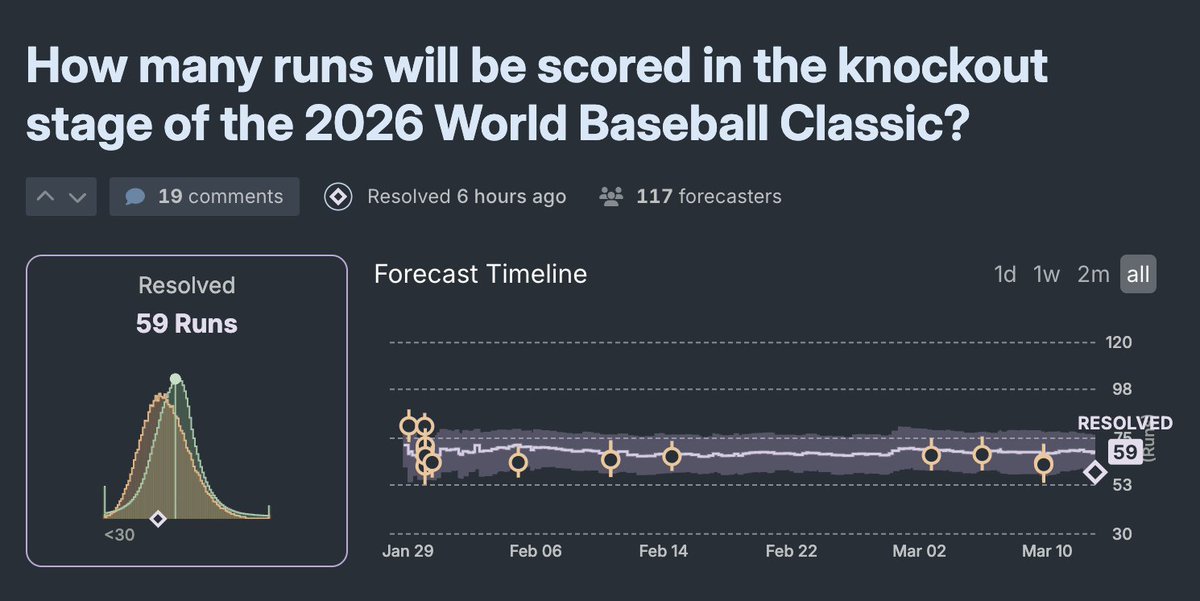
My WBC forecast
I had claude build a montecarlo based on previoius tournaments which we shifted slightly to account for the new stopclock rules and checked against the prediction markets. There was a model of how scores would go in different matches.
1
4
555
Mar 18
Once (if) US interdicts the Iranian shadow fleet of 400-430 vessels Xi’s on a stopclock. Beijing has a massive 9oo to 95o million barrel strategic reserve that it can tap to survive the immediate shock, but it offers little more than 78 days of cushion. On its northern routes, it would likely max Russia's supply, though there's little capacity left to squeeze with their ESPO pipeline and the Kozmino port running near peak. The reopening rail loading facilities in Siberia offer little extra than 150-300 kbpd. There are unknown reserves, and the CCP could also throttle domestic consumption to stretch out the timeline, but rough cut, it is unlikely to more than double Xi's window -- so 80-160 days.
6
235
Mar 18
Mar 8: “Now the Qataris, whose LNG game is shot to pieces, and the Chinese, who are on a stopclock before their reserves dry out and have to kiss the ring to buy American, are doing an international law song and dance. Hah! They should have thought long and hard about that when their support for Iran and its proxy militias brought the region to the brink. Now cry and cry harder!”
O Laffan.
Look at the bright side, Trump did just suspend the Jones Act for 60 days earlier today. The waiver helps domestic US shipping by allowing foreign vessels to move US product between ports, but should free up US flagged LNG carriers and ease overall export logistics.
Qatar may start pulling mtpa from Golden Pass’s Train 1, which is just coming online with around 5. The $10 bn JV is 70 percent QE and 30 ExxonMobile. No sustained commercial output yet but first cargo likely late this month or early April.
77 just got taken offline by the Iranian drone attack on Ras Laffan’s LNG hub which was aiming for nameplate cap of 110 this year, though Qatar Energy had already shut it down and declared force majeaur.
Mar 8

The Chinese and Qataris played a frankly stupid game thinking they can control escalation. What did they think would happen when the Iranians decided to hold American presence in the region hostage by tethering the safety of US armed forces and personnel to Israel’s self defense? The got used to Obama and Biden era “Don’t – OK, Do” diplomacy. They thought they could threaten US forces and Trump would fold like a cheap suit because he sent a sweet, soft spoken man as an envoy. They were dead wrong. They misread the entire situation. Now the Qataris, whose LNG game is shot to pieces, and the Chinese, who are on a stop clock before their reserves dry out and have to kiss the ring to buy American, are doing an international law song and dance. Hah! They should have thought long and hard about that when their support for Iran and its proxy militias brought the region to the brink. Now cry and cry harder!
7
12
67
8,381

Mar 5
Stopclock make the sport 100x better.
Mar 5

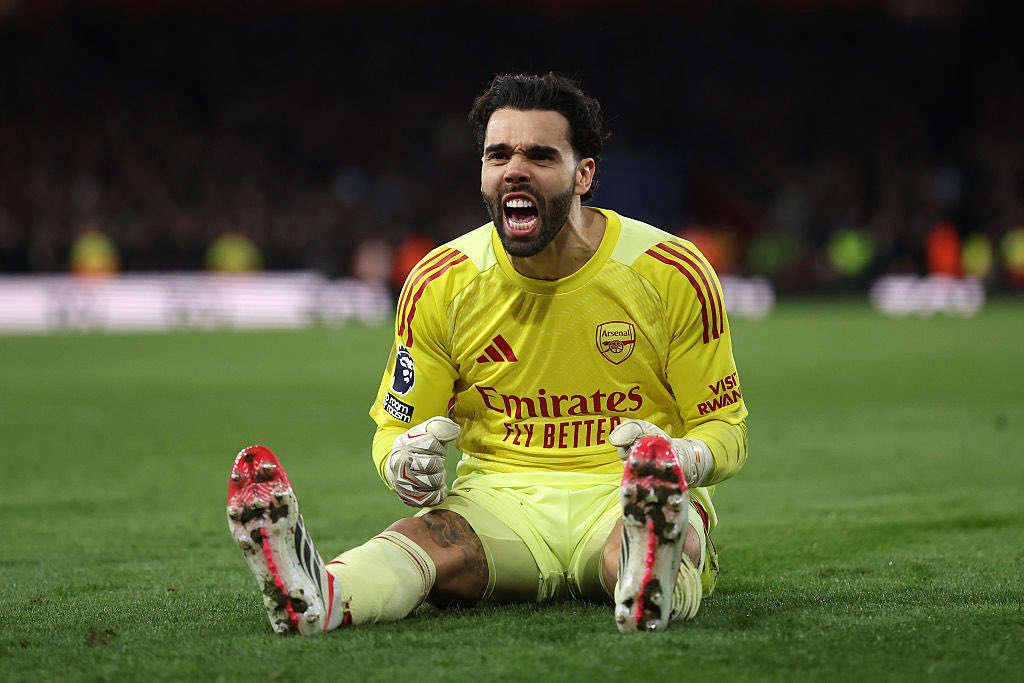
The total time of Arsenal’s restarts at Brighton was 30 minutes 51 seconds, their most in a PL game this season
55
44
2,905
118,561

Feb 21
14
124
1,607

Jan 26
Your stopclock moment is waning already.
Anyone who supoorts the constitution over the articles is a fucking nimrod. Anyone who picks Hamilton over almost anyone else in that cohort is begging for everything that followed, a corrupt central state with unnecessary high stakes.
1
10
1,190

14 Nov 2025
I've been monitoring it using old stopclock and it seems 2 minutes are missing per 20 minutes. That's a lot when added up. No idea why or what the hell is going on but it looks like somehow the time we see digitally is not the same as when using old methods.
3
72

That would be legitimately fun especially when things to tits up (soon)
Prepare a list of questions to ask, and 30-45'' stopclock to reply each and I'll tell you how and why you're wrong
Player profiling, tactics, how to platform good players, internal politics, benchmarks
1
5
582

28 Jun 2025
ICC New Rules Explained: स्टॉप क्लॉक से लेकर नई गेंद तक...आईसीसी ने क्रिकेट में किए ये 8 बड़े बदलाव
#ICCRules #ICCNewRules #Cricket #ICC #StopClock #DRS #NoBall #CricketShorts #TestCricket #T20I #ODICricket #CricketUpdates #SportsNews
2
239

27 Jun 2025
Major changes in ICC Rules 👀 | Cheezy Buzz by @Cheeziouspak | Zalmi TV
#ICC #Rules #StopClock #CheezyBuzz #ZalmiTV
2
131

27 Jun 2025
ICC New Rules: Stop Clock, Short Run, Concussion Updates & More
Read in Details: newslivetv.com/icc-new-rules…
#ICCRules #StopClock #ShortRunRule #CricketUpdates #DRSChanges #ConcussionRule #ODIRules #T20Rules #CricketNews #WTC2025 #ICCNewRules #NewsLive
1
208

27 Jun 2025
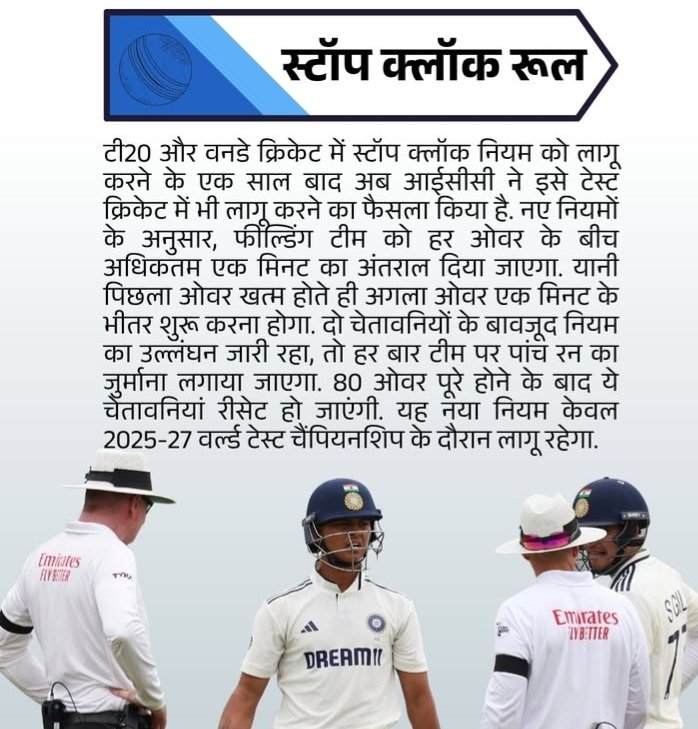
Stop Clock Rule in Tests 🕒
ICC to apply Stop Clock Rule in Test cricket after T20 & ODI
🔹 1-minute gap allowed between overs
🔹 Delay 2 warnings, then 5-run penalty each time
🔹 Warnings reset after 80 overs
🔹 Rule valid only in 2025–27 WTC
#Cricket #StopClock #WTC2025 #ICC
2
28