
Japan Photonics Series
[Part 2. Japan’s Optical I/O Targets 'Data-Movement Distance,' Not GPUs]
Read previous:
Part 1: x.com/superposition_V/status…
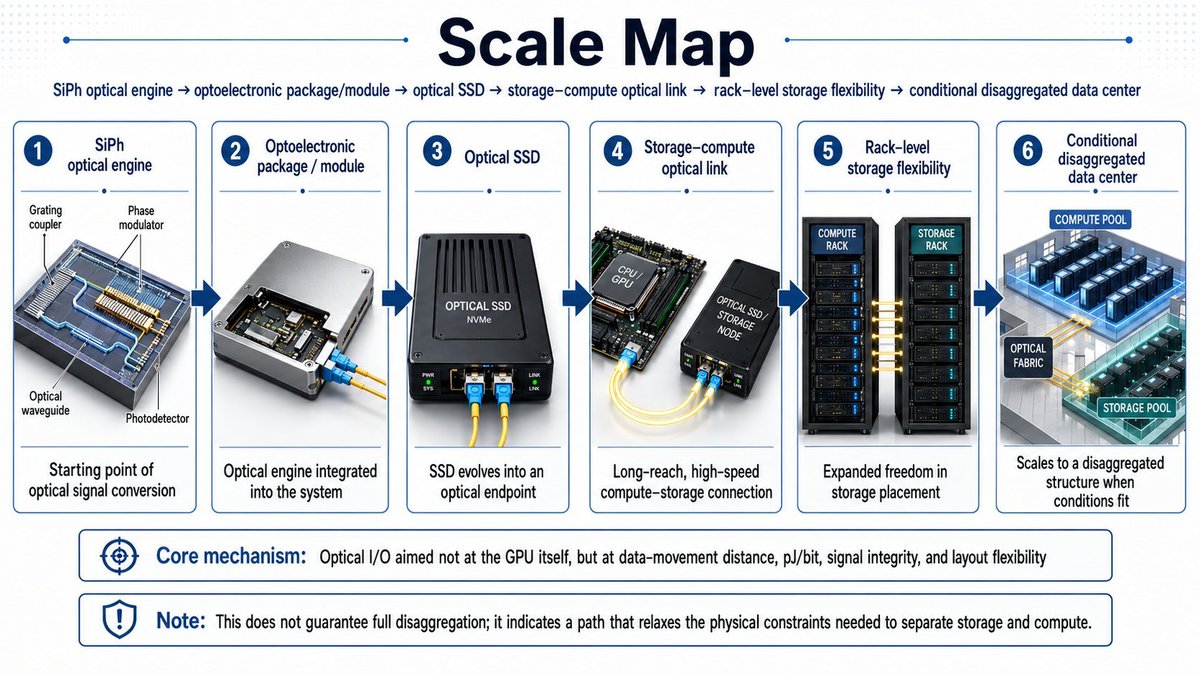
The realistic battlefield of storage–compute optical I/O shown by AIO Core, Kioxia, and KyoceraIf we treat the data center as one giant computer, bottlenecks do not only appear inside compute chips.
No matter how fast a GPU is, the processor waits if data does not arrive on time. The real problem of AI infrastructure is no longer just "how fast can we compute?"
It is increasingly "how far, how efficiently, and how reliably can we move data between memory, storage, and networks?"
#OpticalIO #StorageCompute #SiliconPhotonics #AIOCore #Kioxia #Kyocera #DataCenter #CPO #JapanTech #AIInfrastructure

[Part 1. Japan’s Photonics-Electronics Convergence Stack]
Why Japan is not merely building optical components, but trying to reorganize the infrastructure of data movement
The most expensive thing in a data center is not always the computation itself.
As AI systems scale, data has to move constantly — from memory to compute, chip to chip, server to server, rack to rack. This invisible movement consumes power, creates heat, adds latency, and limits real performance.This is where photonics-electronics convergence matters.
It is not about replacing electrons with light everywhere. Logic and most computation stay electronic. The real question is simpler: at what point does electrical interconnect become too expensive, and optical transmission become the cheaper system-level choice?
1. PETRA is a map, not proof of a master plan
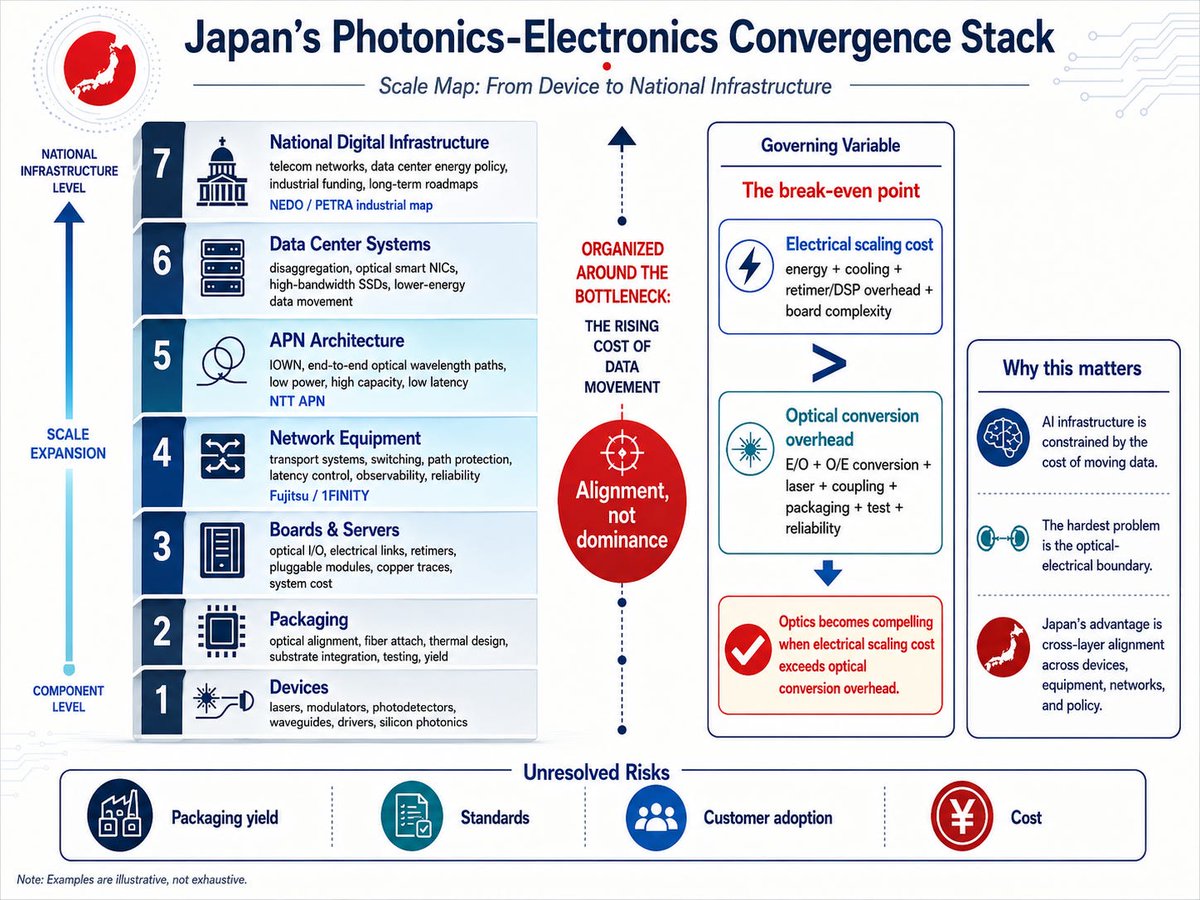
Look at PETRA (Photonics Electronics Technology Research Association). Its members include AIO Core, OKI, Sumitomo Electric, NEC, Fujikura, Fujitsu, Furukawa Electric, Mitsubishi Electric, NTT, NTT Innovative Devices, and 1Finity Inc.
This list is not a national command center. It is an industrial map. It shows which players are gathering around the same problem — the rising cost of data movement.
It does not prove market dominance or unified execution. It only shows alignment across layers.
2. The governing variable is the break-even point
Photonics is often called faster or lower-power. Those statements are directionally true, but too broad.The real governing variable is not raw speed.
It is the economic break-even point where the total cost of scaling electrical interconnect (power, heat, retimers, board complexity) exceeds the overhead of optical conversion (laser, coupling loss, packaging, test).Electrical interconnect wins at short, simple distances.
Optics becomes compelling when distance and bandwidth make electrical scaling too expensive.This is a system-economics problem, not just an optical story.
#PhotonicsElectronics #IOWN #APN #SiliconPhotonics #JapanTech #DataCenter #CPO #OpticalInterconnect #AIInfrastructure
4
11
60
19,203