Debra Tripp retweeted

13h
🚨 JUST IN:
Iran has shared a detailed map of the submarine internet cables passing through the Strait of Hormuz, describing them as highly vulnerable.
Iran is issuing a warning...
 .
.
1
68
178
4,024

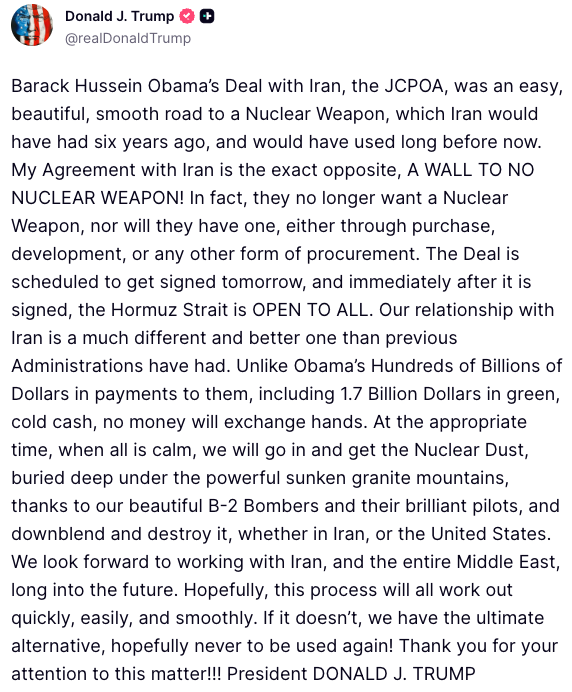
BREAKING: Trump says a deal with Iran is scheduled to be signed tomorrow.
“Immediately after it is signed, the Hormuz Strait is OPEN TO ALL.”
The president says the agreement will permanently prevent Iran from obtaining a nuclear weapon and described it as the exact opposite of the Obama-era nuclear deal.
Trump also said no money will exchange hands under the agreement and warned that if the process falls apart, the U.S. has “the ultimate alternative.”
2,962
3,114
13,401
835,876
Ed retweeted

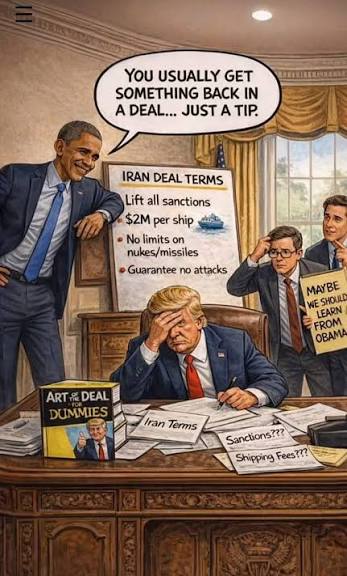
The Strait of Hormuz will be under control of the Mullah's according to Trump US-Iran deal
10
25
556
Y Sf retweeted

RECAP:
-Trump says the Iran deal signs Sunday and the Strait of Hormuz reopens immediately, with the U.S. retrieving and destroying nuclear waste once things calm down. But Iran's foreign ministry and the IRGC both disputed the date, calling the framework not yet finalized and mocking Trump's "unusual insistence" on Sunday. Officials are now planning a virtual signing.
-The emerging deal is enraging the hardliners on both sides at once. Israeli officials told Ynet it harms them badly, with one saying "Trump stabbed us in the back." In Tehran, footage showed protesters turning on their own negotiators, chanting "Araghchi, have some shame, put the negotiations aside."
-Iran is also reportedly consulting Russia and China on the MOU text, another sign the signing could slip past Sunday.
=And the New York Knicks won the NBA championship, closing out the Spurs 94-90 to take the Finals 4-1, before the celebrations across the city spilled into fires, vandalism, and street chaos within minutes.

RECAP:
The Iran deal that looked "hours away" suddenly became a lot murkier.
While Trump continued insisting a deal will be signed tomorrow and claimed the Strait of Hormuz would reopen immediately afterward, Iran's Foreign Ministry publicly cooled expectations, saying there are no plans to sign tomorrow, though it could happen in the next couple of days.
At the same time, details from the draft agreement are leaking inside Iran. And they're causing a political firestorm.
Hardline figures and protesters are attacking Foreign Minister Araghchi, accusing him of giving away too much on sanctions, nuclear restrictions, U.S. troop withdrawals, and especially the future management of the Strait of Hormuz. Demonstrators gathered outside the Foreign Ministry, while reports suggest Iranian authorities are even censoring anti-deal criticism on domestic messaging platforms.
The emerging picture is that the biggest threat to the agreement may no longer be Washington or Tehran's negotiators, but opposition inside Iran itself.
Meanwhile, senior Israeli officials reportedly blasted the deal as harmful to Israeli interests and complained that Israel has largely been sidelined from the negotiating process. One official reportedly described it as a temporary political arrangement designed to buy time rather than a durable settlement.
Diplomacy remains intense. Trump is expected to hold separate meetings with the leaders of Qatar, the UAE and Egypt on the sidelines of the G7 summit, highlighting how heavily Gulf states are now involved in shaping the outcome.
Elsewhere in Europe, migration tensions continued to dominate headlines. Large demonstrations took place in Rome calling for tougher immigration policies, while Belfast saw counter-protests after recent unrest linked to a high-profile stabbing case.
And in Washington, Senator Tom Cotton introduced legislation that would significantly deepen U.S.-Israeli intelligence cooperation, making it far more difficult for future administrations to limit intelligence sharing with Israel.
The biggest story remains the same: everyone is talking as if an Iran deal is close, yet almost every major player involved is sending contradictory signals. Markets are betting on peace. The politicians are selling peace. The negotiators are still arguing over the details.
27
15
124
36,726

Why would the ships need to worry about any of that if we controlled the Strait.
Barbara retweeted

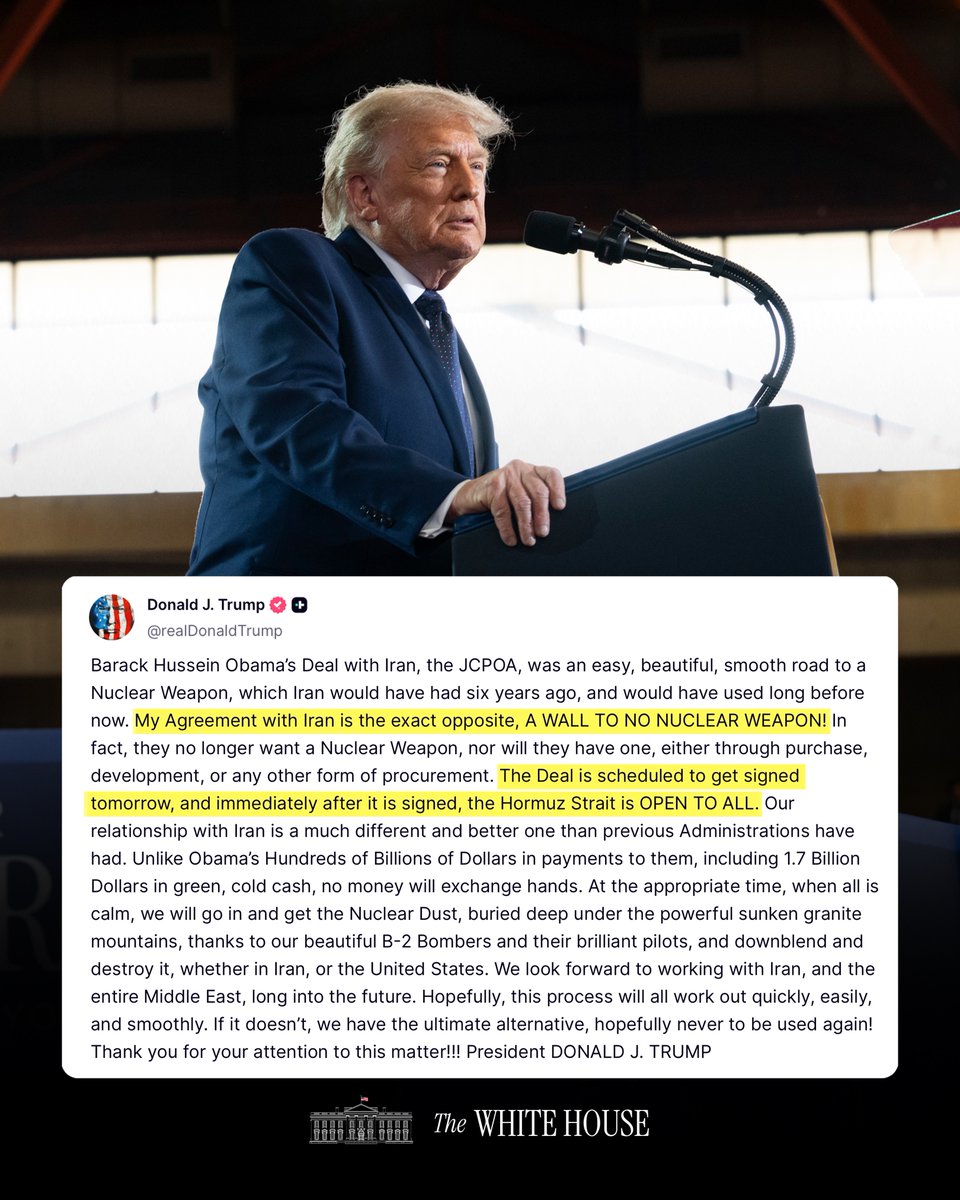
"The Deal is scheduled to get signed tomorrow, and immediately after it is signed, the Hormuz Strait is OPEN TO ALL." - President Donald J. Trump 🇺🇸
5,325
6,963
24,057
789,071

Either way, the agreement could reopen the Strait of Hormuz in return for the US lifting its blockade on Iranian shipping.
While officials say the deal will also lead to the destruction and removal of Iran's enriched uranium stockpiles - a key component of nuclear weapons -
1
Saxon de Kock retweeted

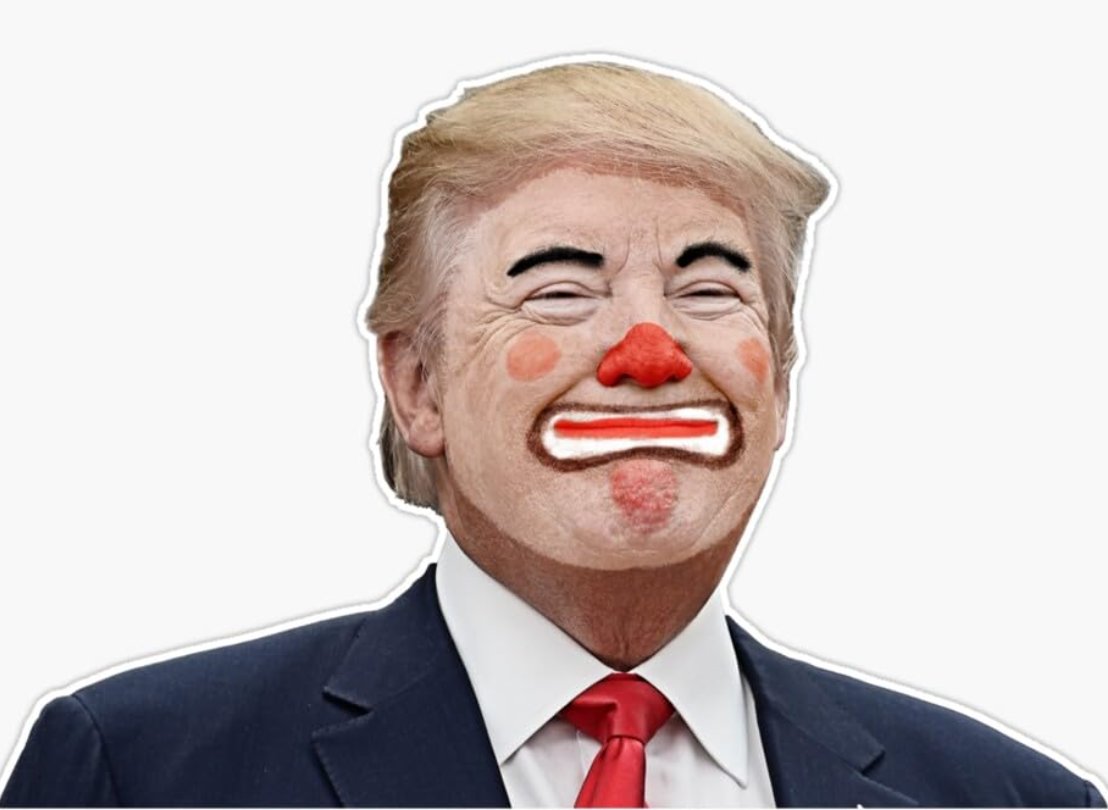
TRUMP DAY 1: Iran won't dare to close the Strait of Hormuz
TRUMP DAY 10: The Navy will escort oil tankers in the Strait of Hormuz
TRUMP DAY 30: We will use military force to open the Strait of Hormuz
TRUMP DAY 40: We don't even need the Strait of Hormuz
21
204
507
14,942

Without killing any Americans, wasting millions in military assets, spiking inflation, or closing the Strait of Hormuz.
Just one of many examples of how a competent president runs rings around this fucking clown whose balls you gargle.
2

Iran is set to sign a peace deal today, allowing the Strait of Hormuz to be opened for fuel tankers to supply oil to their destination countries. Give it a week for fuel prices to go down.
2
Kashif Hasnain کاشف حسنین retweeted

Jun 12
The US military attacked Indian oil tankers near the Strait of Hormuz, killing three Indians.
The Indian Prime Minister did not even issue a single condemnation..
183
1,781
9,996
177,534
Ērān-šahr retweeted

Mar 22
Fact:
Nothing is free in the world.
It is persian right to charge ships crossing their Hormuz Strait.
#Strait_of_Hormuz #Oil
#ایران
#Iran
7
5
31
1,737
Emergenza24 retweeted

Vessel traffic visible in the Strait of Hormuz over the last 24 hours, visible using automatic identification system (AIS) information on MarineTraffic.com, reveals no vessels transited using the Iranian traffic separation scheme; however, a few vessels did transit through Omani waters along the previously established Project Freedom safe route.
27
122
820
248,997
Pramit Pal Chaudhuri retweeted

It is true that Iran used its power over the strait to assume leverage over the US and eventually compel a favorable settlement.
But this obscures what may be the more significant achievement: that after 40 days of bombing, Iran never lost the ability to both keep the strait closed and threaten regional infrastructure. Its missile cities still stand, its launchers survived, its drone/missile arsenal were depleted but, thanks to careful management, remain potent.
In the end, Iranian missiles and drones proved more effective at accomplishing their mission than US TLAMs, F-35s, and strategic bombers.

For nearly a half century, through eight American Presidencies, Iran has employed the most cost-effective tactic of warfare by seizing someone or something of value and holding it hostage. And while Iran has demonstrated its ability to hold out, sometimes for years, for what it wants, the U.S., with its two- and four-year election cycles, has limited patience. Read more about Iran’s hostage tactics: newyorkermag.visitlink.me/Wu…
21
65
248
39,996
Abbas Ali retweeted

30m
Trying to buy an electric car, which is delayed because of the strait being closed. Dealer wrote me a message saying "sir because of the oil crisis....your EV will not arrive before november". Yup. Sigh.
14
16
180
4,082

This is all total BS.
Read the deal, the strait opens upon signing.
No money changes hands.
No funds release.
The sanctions will be released as they comply with all the items in the deal.
The US will control their oil flow and sales.
They will dismantle the nuclear program and allow the US to dig up the nuclear material and destroy it. There's actually more that they will negotiate.
PedroConrado Richter retweeted

🚨 JUST IN: 🇺🇸🇮🇷 A U.S. official says Iran will reopen the Strait of Hormuz with no transit fees for passing vessels, according to Fox News. A major development that could ease tensions and help restore global shipping flows. 🌍⚓
1
3
263