

⠀
/ oh we're so gonna [ redacted ] superkey .
⠀
1
30

hey
guesswhat
myfucking
lookalike
gavemehis
superkey
togiveto
you
[ @KEYLOVER99 leleleleleeeee ]
1
2
32

"superkey" precedes "windows key" actually
"superkey", "menu key", and "command key", are all correct. "Windows key" is brand-specific, thus, it is the made up bullshit.
5
127
3,558

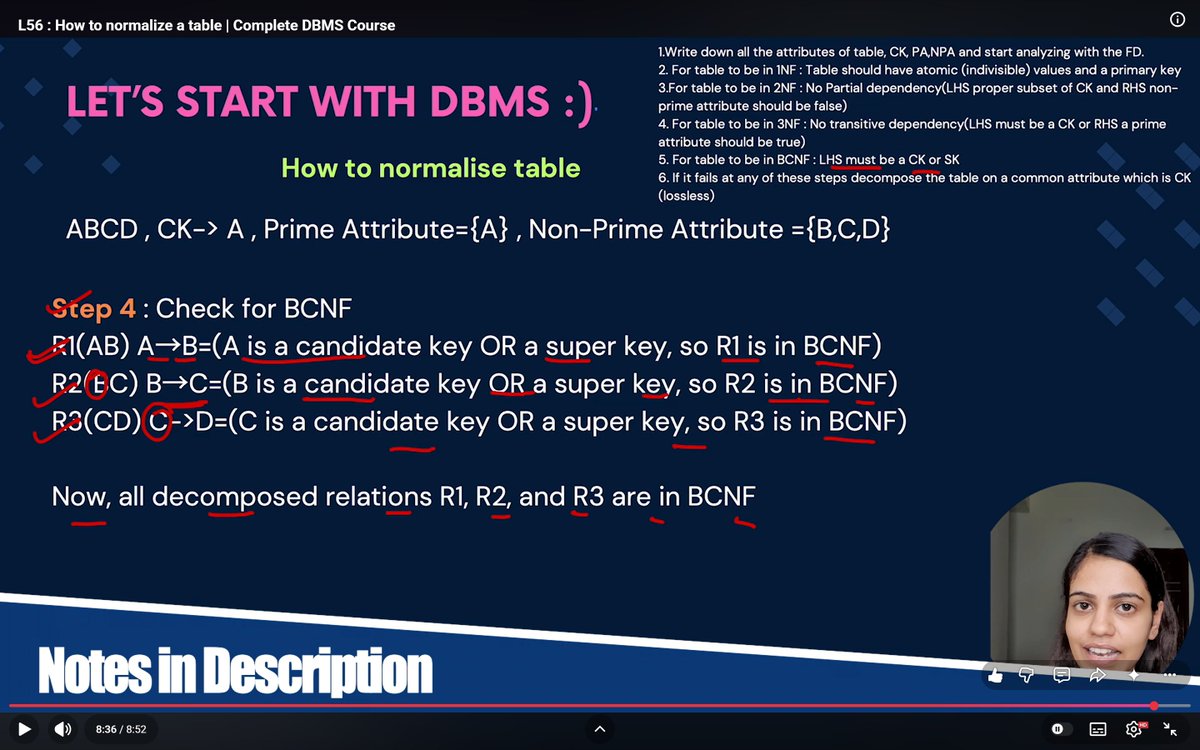
L56
algorithm to normalize a database relation:
1. find candidate keys.
2. 1nf: atomic values.
3. 2nf: zero partial dependencies.
4. 3nf: for x->y, x is a superkey or y is prime.
5. bcnf: x must be a superkey.
decompose on violations.
#DBMS #SQL #Databases

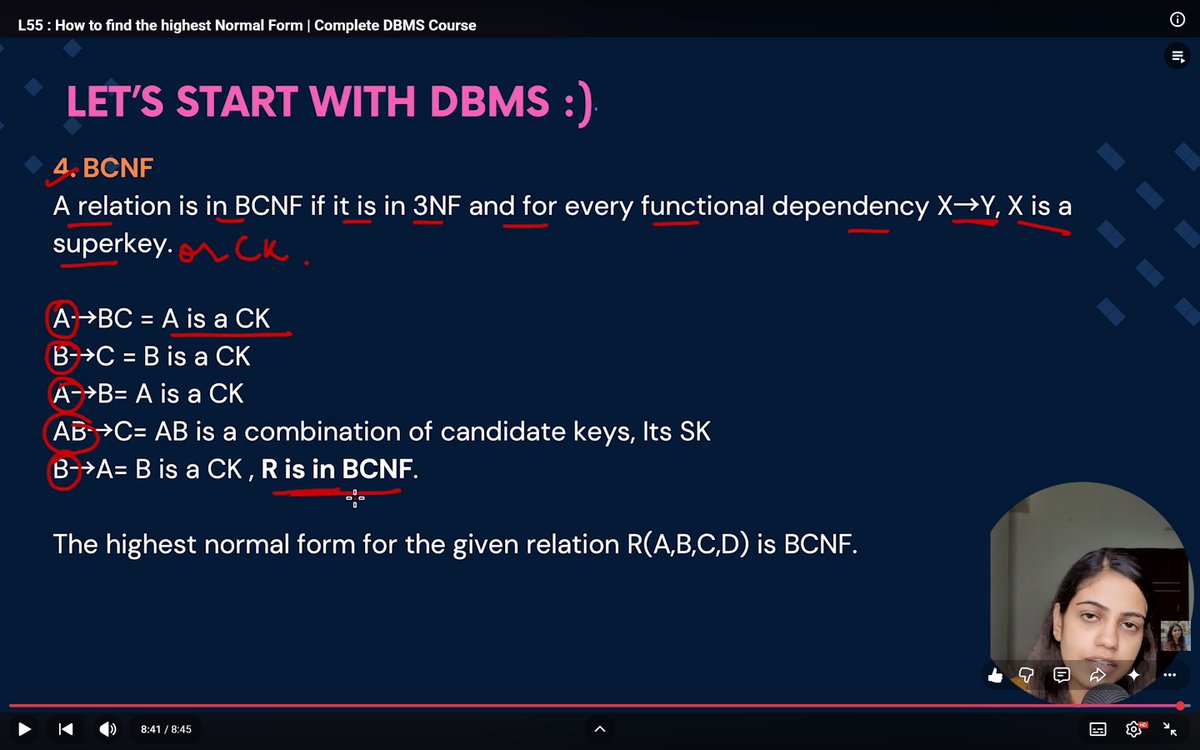
L55
find the highest normal form sequentially:
1. compute candidate keys.
2. classify prime vs non-prime attributes.
3. evaluate:
• 2nf: zero partial dependencies
• 3nf: for x->y, x is superkey or y is prime
• bcnf: x must be a superkey
#DBMS #SQL #Databases
2
119
L55
find the highest normal form sequentially:
1. compute candidate keys.
2. classify prime vs non-prime attributes.
3. evaluate:
• 2nf: zero partial dependencies
• 3nf: for x->y, x is superkey or y is prime
• bcnf: x must be a superkey
#DBMS #SQL #Databases
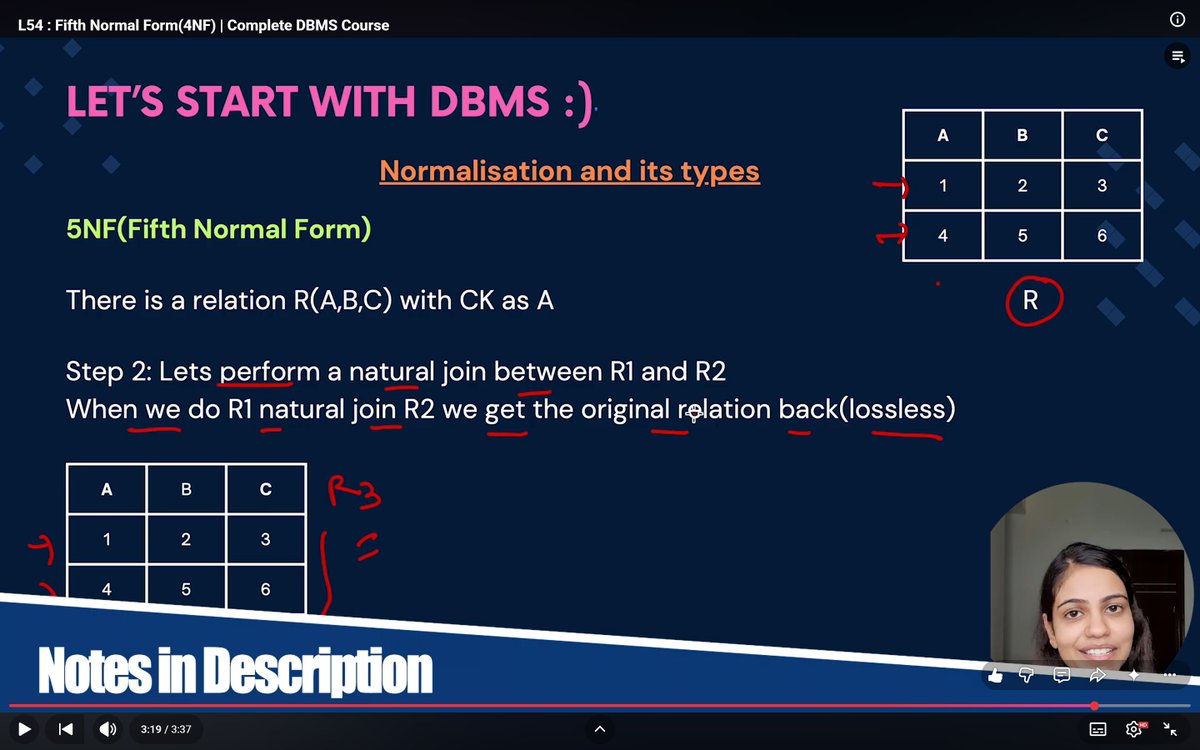
L54
5nf (project-join normal form) requires a schema to be in 4nf where every join dependency is implied by candidate keys.
it resolves anomalies where a relation must be losslessly decomposed into 3 or more tables, rather than 2.
#DBMS #SQL #Databases
2
77
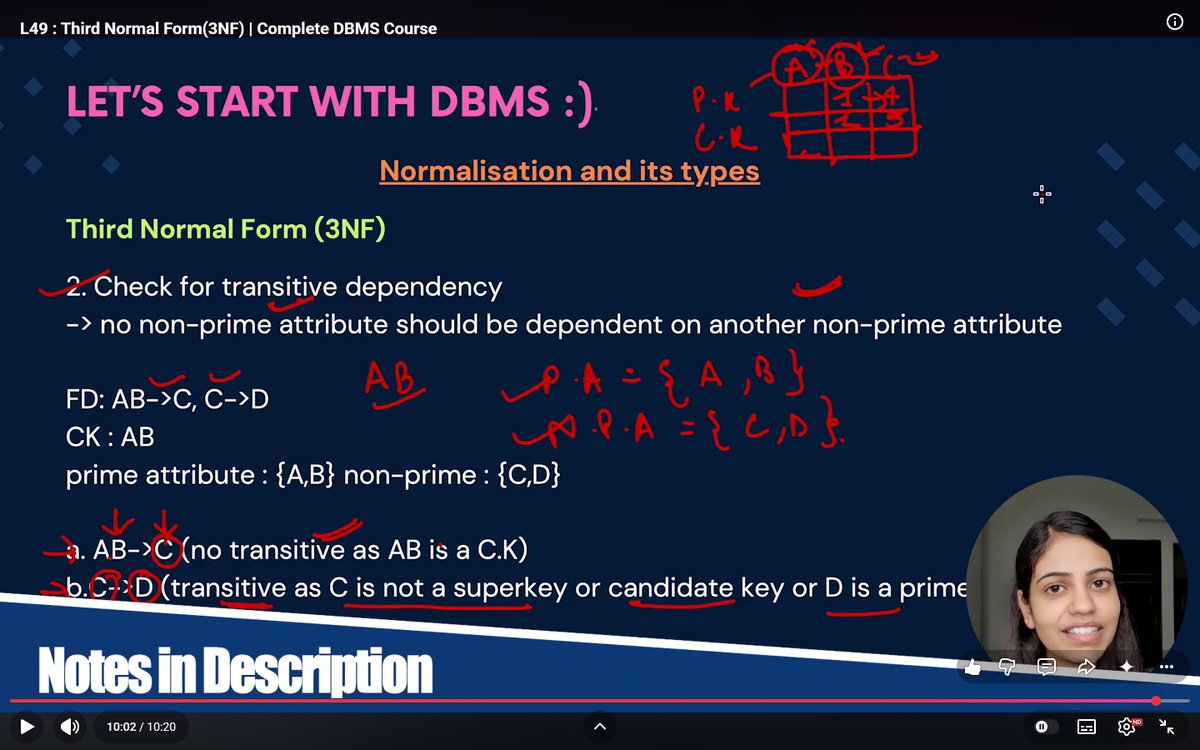
L49
3nf requires a schema to be in 2nf with zero transitive dependencies.
for every functional dependency (x -> y), one rule must mathematically hold:
1. x is a superkey.
2. y is a prime attribute.
fix violations by decomposing.
#DBMS #SQL #Databases
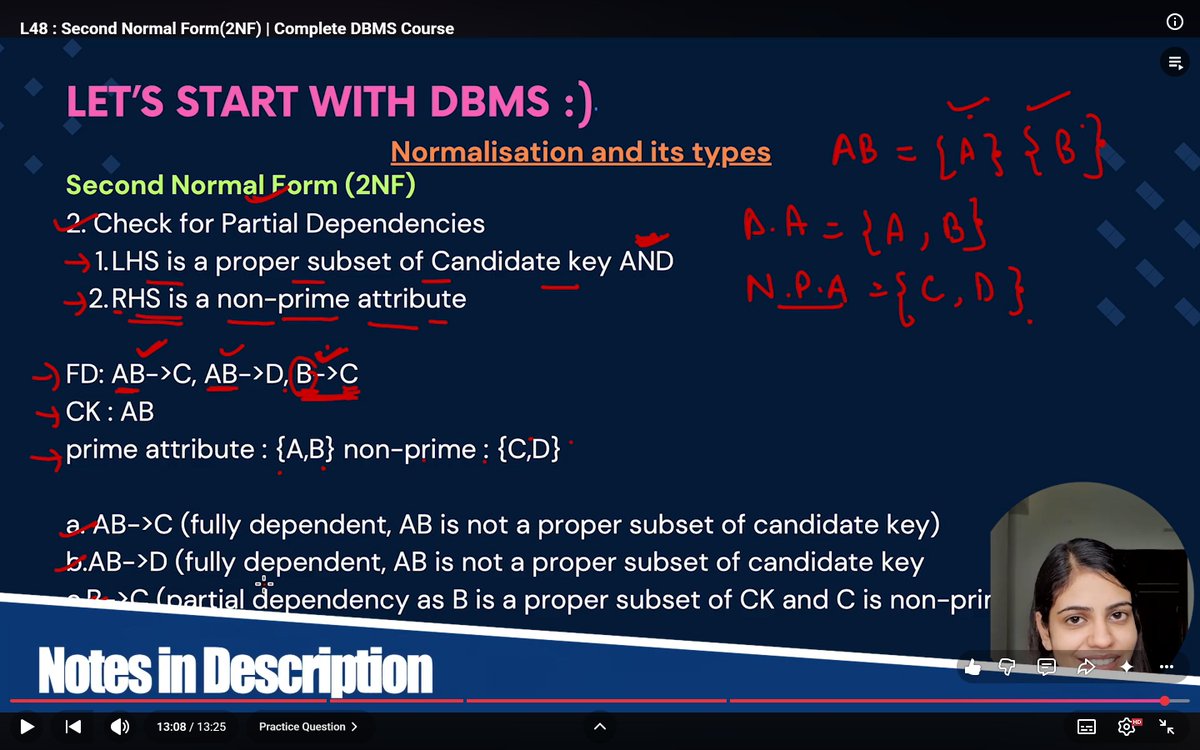
L48
2nf requires a schema to be in 1nf with zero partial dependencies.
partial dependency: a non-prime attribute depends on a proper subset of a candidate key. (this occurs only when a candidate key is composite.)
fix by decomposing.
#DBMS #SQL #Databases
2
51
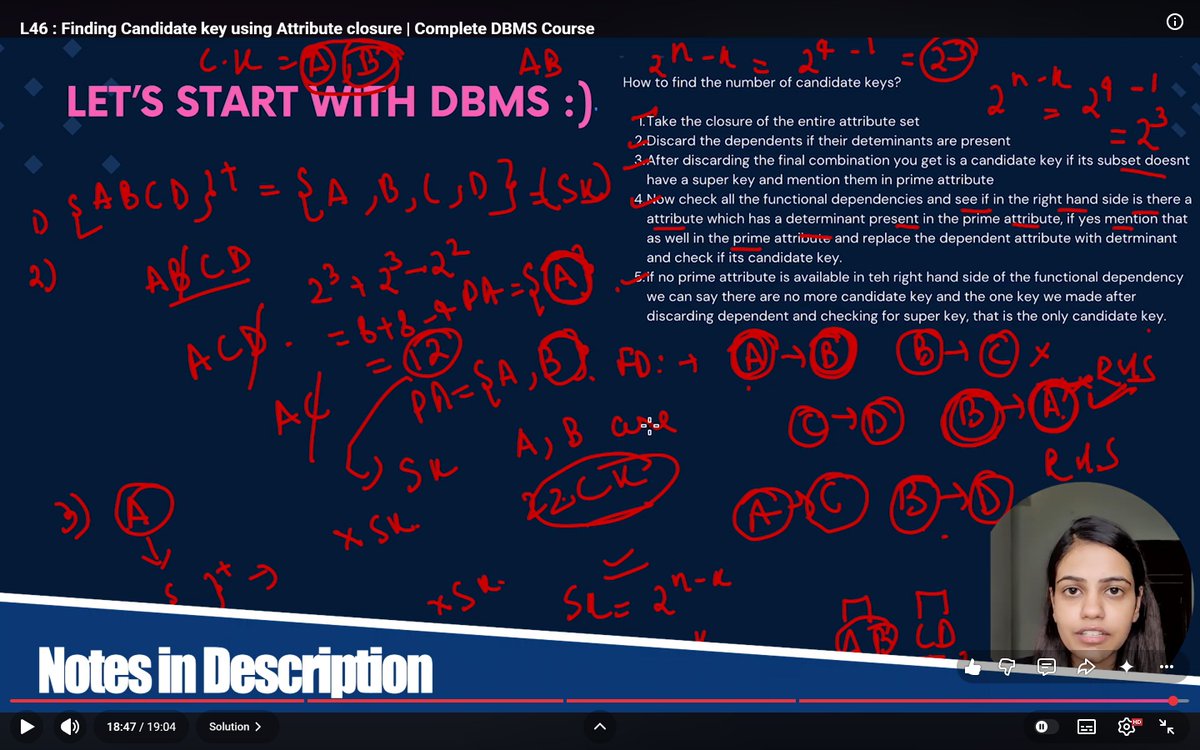
L46
a candidate key is a minimal superkey (no proper subset is a superkey).
derivation approach:
1. base set: find attributes never on the rhs of fds.
2. compute closure.
3. use cyclic fds to derive alternate candidate keys.
#DBMS #SQL #Databases
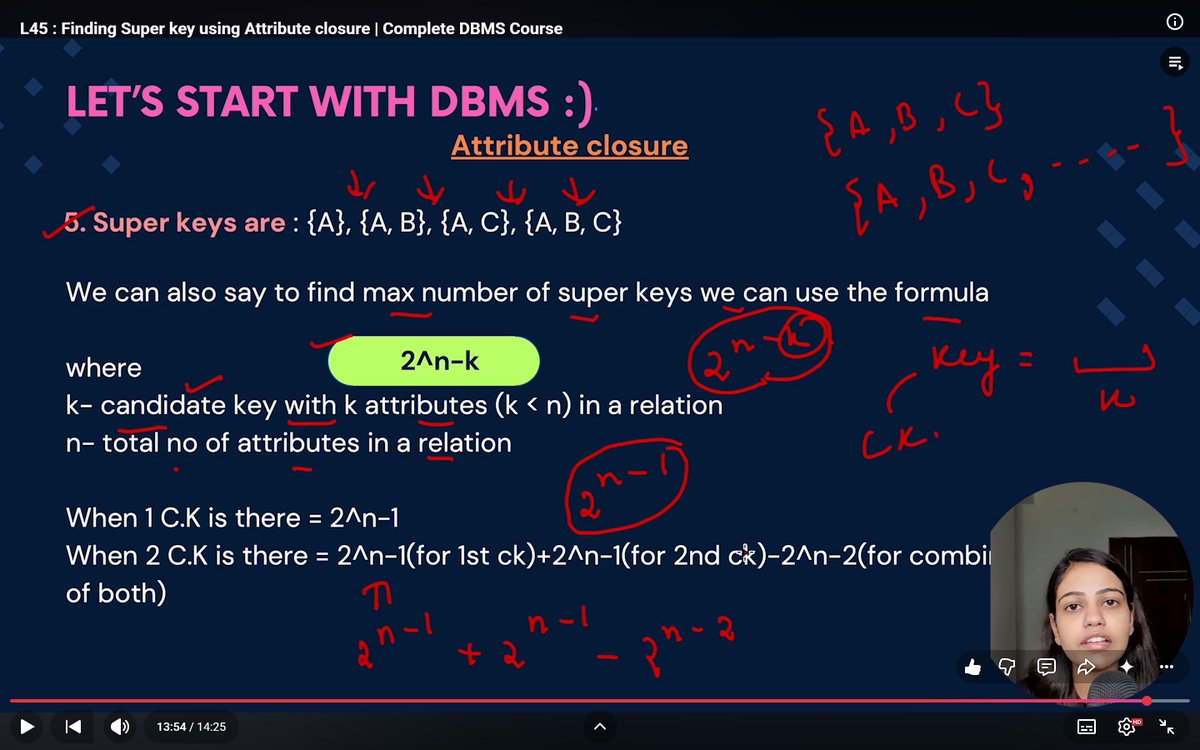
L45
A Super Key is an attribute set whose closure contains all relation attributes. Any superset of a candidate key is a super key.
Total Super Keys = 2^(n-k) (for a single candidate key)
(n = total attributes, k = CK attributes)
#DBMS #SQL #Databases
3
61


Mar 29
I'd probably agree, if I could figure out how to get keyboard shortcuts that utilise the superkey to actually just work... Like they do on any other DE... Even MATE...
1
3
389


youre gonna give me that superkey, sin. whenever you like it or not.

16
50
735
9,277

sometimes i like to chuck my superkey at the elk and he scream loud as fuuuuuck
3
4
163

can you get the superkey stuff from the normal key it just has a rare chance or no
3
8
435

⚡Introducing: SuperKey - JMeter Command Center
Do anything right from the command center. ⌨️
No more right clicks or even clicks. 🖱️
Here is the quick demo:
github.com/QAInsights/superk…
@TheASF @ApacheJMeter
2
191

Feb 12
My hyperkey setup is critical in my daily AI flow (I use Superkey). In Raycast I map hyperkey shortcuts to apps.
✦T - Terminal
✦F - Browser
✦E - IDE (never use this)
✦O - Obsidian
✦D - Tableplus
✦S - Slack
13
49
20,479

Feb 10
superkey 🥙⛵🛠.
كؤد▬خصم▬فؤغا▬فؤجا▬فؤقا▬فؤغاكلوسيت▬كلوسيت▬كلوست▬كلوزيت▬كؤبون▬كلؤزت▬فؤغاكلوست▬فؤغاكلوزىت▬

5

18 Dec 2025
go our little superkey🥺 you did amazing with that US tour!!! now go have a good meal and good rest and be with your commega babies





35
255
10,090