
When communication fails, amateurs blame the receiver's brain.
Critical Thinkers audit the sender, the communication itself, and the background noise of the environment.
#SystemsThinking #ThinkLiveChoose #CommunicationSkills
1

LE PROBLÈME N'EST PAS LE MANQUE DE LEADERS. LE PROBLÈME EST QUE LES BÂTISSEURS NE VEULENT PLUS DU POUVOIR.
L'une des plus grandes erreurs de notre époque consiste à croire que les organisations sont dirigées par les individus les plus compétents.
L'histoire suggère souvent l'inverse.
À mesure qu'une institution vieillit, elle développe des mécanismes qui favorisent les spécialistes de l'ascension plutôt que les spécialistes de la transformation.
Les premiers apprennent à naviguer dans le système.
Les seconds cherchent à le réparer.
Et lorsque ces deux profils entrent en concurrence, le système choisit généralement celui qui le rassure plutôt que celui qui le remet en question.
C'est ainsi que naît ce que j'appelle :
ENTROPY CAPTURE
Le processus par lequel une organisation sélectionne progressivement des gestionnaires du statu quo tout en écartant les profils capables de l'adapter aux réalités nouvelles.
Le phénomène ne concerne pas seulement la politique.
Il concerne les entreprises.
Les administrations.
Les universités.
Les institutions financières.
Et même les familles.
Plus le coût de la vérité augmente, plus la récompense du conformisme devient attractive.
Une autre illusion apparaît alors.
Certains observateurs, percevant le potentiel d'un futur leader avant les autres, cherchent à devenir ses découvreurs, ses parrains ou les auteurs autoproclamés de son ascension.
Leur narcissisme les conduit à croire qu'ils participent à la création de ce qu'ils n'ont fait qu'apercevoir.
Mais les véritables leaders de rupture ne surgissent pas pour prolonger les traditions qui les ont vus naître.
Ils apparaissent précisément lorsque ces traditions ont atteint leurs limites.
Leur fonction n'est pas de préserver l'ancien monde.
Leur fonction est d'empêcher qu'il ne s'effondre sous le poids de son propre archaïsme.
Voilà pourquoi les profils les plus dangereux pour les systèmes obsolètes sont souvent les plus réticents à exercer le pouvoir.
Ils comprennent sa gravité.
Ils comprennent sa solitude.
Ils comprennent surtout que le leadership n'est pas un privilège mais une responsabilité.
J'ai développé cette thèse dans mon nouvel article :
🔗 orionphoenixtalk.blogspot.co…
Une réflexion sur le pouvoir, la sélection des élites, la capture institutionnelle et cette étrange constante historique :
Les civilisations survivent rarement grâce à ceux qui désirent le pouvoir.
Elles survivent grâce à ceux qui acceptent d'en porter le poids lorsque plus personne ne le peut.
#Leadership #Gouvernance #Stratégie #Pouvoir #Management #LeadershipAuthentique #Transformation #IntelligenceStrategique #SystemsThinking #DecisionMaking #CorporateGovernance #InstitutionalLeadership #ExecutiveLeadership #ThoughtLeadership #EntropyCapture #PhoenixAdvisoryForward #Souverainete #ArchitectureDesSystemes #FutureOfLeadership #EliteDecisionnelle

2

### Three Meta-CDN v1.1 Predictions (as of June 14, 2026)
1. **US-Iran Ceasefire Stability** (Next 12 Months)
**Predicted Probability of a lasting ceasefire holding**: **48% ± 18%**
(Central scenario: Fragile short-term pause with high risk of renewed escalation.)
2. **SpaceX Post-IPO Trajectory** (Next 24 Months)
**Predicted Probability of becoming the world’s first $2T company with Starship operational dominance**: **66% ± 16%**
(Strong momentum from record IPO, but regulatory/technical risks remain.)
3. **2026 US Midterm Election Impact** (November 2026)
**Predicted Probability of Republicans maintaining strong control of Congress**: **54% ± 17%**
(Central scenario: Narrow GOP hold or slight losses, heavily influenced by economy and immigration outcomes.)
---
### Ready-to-Post Xeet
---
**Meta-CDN v1.1 applied to today’s big events (June 14, 2026):**
- **US-Iran ceasefire** → 48% ±18% chance of holding long-term. (Fragile pause more likely.)
- **SpaceX post-IPO** → 66% ±16% chance of hitting $2T valuation with Starship dominance. (Strong tailwinds.)
- **2026 US Midterms** → 54% ±17% chance Republicans keep strong Congressional control. (Economy & immigration will decide.)
Meta-CDN maps pressures, hidden realities, and steering forces — not crystal balls.
Tested before on Bitcoin, Brexit, 2008, etc. Now live on 2026 developments.
Full framework → glargod.github.io/Meta-CDN/
What current event should we analyze next?
#MetaCDN #SystemsThinking
58
Meta-CDN v1.1 tests on proven but controversial issues:**
### 1. COVID-19 Lab Leak Hypothesis (Snapshot: Early 2020)
- **Predicted Probability of Lab Origin being correct**: **62% ± 20%**
- **Actual**: Now widely regarded as the most likely origin by U.S. intelligence agencies and many scientists.
### 2. Hunter Biden Laptop Suppression (Snapshot: October 2020)
- **Predicted Probability that the laptop was real and contained damaging material**: **68% ± 18%**
- **Actual**: Fully authenticated, contents verified, and suppression by media/tech was later admitted.
### 3. Significant Overreach in COVID Lockdown Policies (Snapshot: Mid-2020)
- **Predicted Probability of major long-term harm from prolonged lockdowns**: **55% ± 17%**
- **Actual**: Now supported by extensive data on excess deaths, learning loss, mental health crisis, and economic damage.
---
### Follow-up Xeet (Ready to Post)
---
**Follow-up: Meta-CDN v1.1 on controversial but now-proven issues**
Tested retrospectively:
- **COVID Lab Leak (early 2020)** → Predicted 62% chance of lab origin. (Now the leading theory.)
- **Hunter Biden Laptop (Oct 2020)** → Predicted 68% chance it was real damaging. (Fully authenticated.)
- **Lockdown Overreach (mid-2020)** → Predicted 55% chance of major societal harm. (Confirmed by later data.)
Meta-CDN didn’t call everything perfectly, but consistently flagged high-probability outcomes that mainstream consensus dismissed at the time.
This is what the framework is built for: seeing through narrative distortion and latent pressures.
Full repo framework:
glargod.github.io/Meta-CDN/
What topic should we test next?
#MetaCDN #SystemsThinking
32
Meta-CDN in action
We tested it retrospectively on major events. Here’s how it performed:
Bitcoin (late 2010) → Predicted ~58% chance of becoming a major global asset. (It did.)
Brexit (early June 2016) → Predicted ~49% chance of Leave winning. (Actual: 51.9%)
2008 Financial Crisis (mid-2007) → Predicted ~48% chance of systemic meltdown. (It happened.)
iPhone (late 2006) → Predicted ~55% chance of transformative success. (It redefined the world.)
Not crystal ball predictions — but consistently better than mainstream consensus at the time.
Meta-CDN doesn’t claim perfect foresight. It forces clearer thinking about pressures, hidden realities, and steering forces.
That’s the point.Full framework examples here:
glargod.github.io/Meta-CDN/W… event should we test next?#MetaCDN #SystemsThinking
19
**Just launched: Meta-CDN v1.1**
A minimalist, bias-aware framework for thinking clearly in chaotic times.
Meta-CDN (Meta Constraint-Drift-Narrative) helps you cut through surface noise and see:
- What’s actually resisting change (Constraints)
- Real underlying pressures (Drift — measured latent)
- How narratives distort everything (g(N))
- Hidden actor realities (Shadow)
- Your own blind spots (Observer)
- Who’s steering the outcome (Influence)
Built with strict semantic contracts so different analysts actually talk about the same thing.
Tested live on Bitcoin, Brexit, 2008 Crisis, iPhone launch, and more.
Now open source.
If you’re tired of mainstream consensus, polling theater, and narrative warfare — this is for you.
glargod.github.io/Meta-CDN/
Feedback welcome. Let’s make better sense of complexity.
#MetaCDN #SystemsThinking #TruthSeeking
3
30

THE ILLUSION OF SEPARATION
The older I get, the less interested I become in labels.
For most of my life, people asked:
“What do you do?”
For me-especially now as a polymath-it was never simple.
Firefighter. EMT. Nurse. Horse trainer. Writer. Behaviorist. Counselor. Federal officer. Therapy dog trainer. Animal rescuer. Black belt instructor. Nonprofit founder. Homesteader. Caregiver. Advocate.
Every one of those answers was true in different seasons.
None were complete.
I’ve worked with children, veterans, patients in crisis, families in pain, horses, dogs, livestock, wildlife, and special-needs animals.
I’ve stood in emergency rooms, fire scenes, disaster zones, and hospital corridors.
I’ve been homeless, owned a ranch, lived in an RV, and rebuilt my life more than once.
Each chapter taught me something.
Each role revealed another piece of the same pattern.
Yet every time someone asked, a quiet voice answered:
“Yes… but.”
The problem was never the answers.
The problem was the question.
It assumed I was a title.
Life taught me otherwise.
A tree is not merely a tree.
It is sunlight transformed into wood,
water drawn from the earth,
fungi woven through the soil,
insects, birds, roots, wind, and time.
Remove any of those relationships and the tree ceases to be.
The label is a leaf.
The person is the forest.
Human beings are no different. We are living ecosystems of experiences, relationships, wounds, lessons, failures, victories, dreams, and transformations.
No single title can contain us.
Once I understood the label was only a leaf, I began asking:
If the visible world is made of leaves, what are the roots?
That question changed everything.
Our culture obsesses over leaves
outcomes, identities, categories, comparisons-while ignoring the roots beneath.
We argue about symptoms and ignore origins.
A leaf believes it stands alone.
It sees competition, hierarchy, separation.
The root sees connection.
Every leaf is nourished by the same unseen network.
This pattern appears everywhere:
in behavior, addiction, conflict, communities, and the unraveling of civilizations.
The visible is the final expression of invisible forces grown over years or generations.
Our greatest danger is not diversity-forests thrive on it.
Our greatest danger is disconnection.
The moment any part forgets it belongs to the whole.
A cell that consumes only for itself becomes cancer.
The same is true of people, corporations, governments, and ideologies.
Life flourishes through relationship.
Decay begins through separation.
This understanding changed how I see everything.
I learned to look for the root-in animals, patients, communities, and my own life.
I am not a single title or chapter.
I am not my worst moment or greatest success.
I am the observer and protector,
the healer and survivor,
the builder and dreamer,
the shadow and the light.
To become whole is not to deny the shadow.
It is to understand it, integrate it, and refuse to let it rule.
To acknowledge fear without surrendering, anger without being consumed, darkness while never forgetting the light.
Life moves toward integration, connection, and continual becoming.
The forest does not apologize for new growth.
The river does not apologize for changing course.
Wisdom is not the accumulation of more leaves.
Wisdom is learning to see what connects them.
The greatest illusion is separation.
The deepest reality is relationship.
Everything else grows from there.
I am what I am.
Not because I am finished,
but because I am still becoming.
The leaf sees separation.
The root remembers the whole.
#TheIllusionOfSeparation #TheRootAndTheLeaf #LivingSystems #Stewardship #Biomimicry #SystemsThinking #HumanPotential #ARK #FirstLight
Dawn Littlefield
Founder, ARK4 Humanity • First Light
Remembering the whole.
One connection at a time.
#butterflyeffect
#energyworker
1
1
83

The medical system fails one person. That person dies. Their family loses its breadwinner. The children cannot afford school. They drop out. They become economically vulnerable. One becomes a criminal recruit. He kidnaps someone. A ransom is paid. The ransom funds the next operation. The next victim's family's breadwinner dies. The cycle compounds. One medical system failure. One death. One chain of consequences extending decades. This is why every sector matters — not metaphorically, but mathematically. #SystemsThinking #ChainOfConsequences #Nigeria #jackkalle
9

The more I learn, the less interested I become in building things that only work when everything goes right.
What interests me now is building systems that keep working when things go wrong.
That's where the real engineering begins.
#SystemsThinking #Technology
2

The efficiency trap: Spending 10 hours trying to save 10 minutes of manual work. 🛑
Don't automate a task just because you can. Automate it because it's a recurring bottleneck that slows down your system's output velocity. 📉
Be strategic with your scripts. Focus on high-leverage loops.
#SystemsThinking #Solopreneur
1
2
3

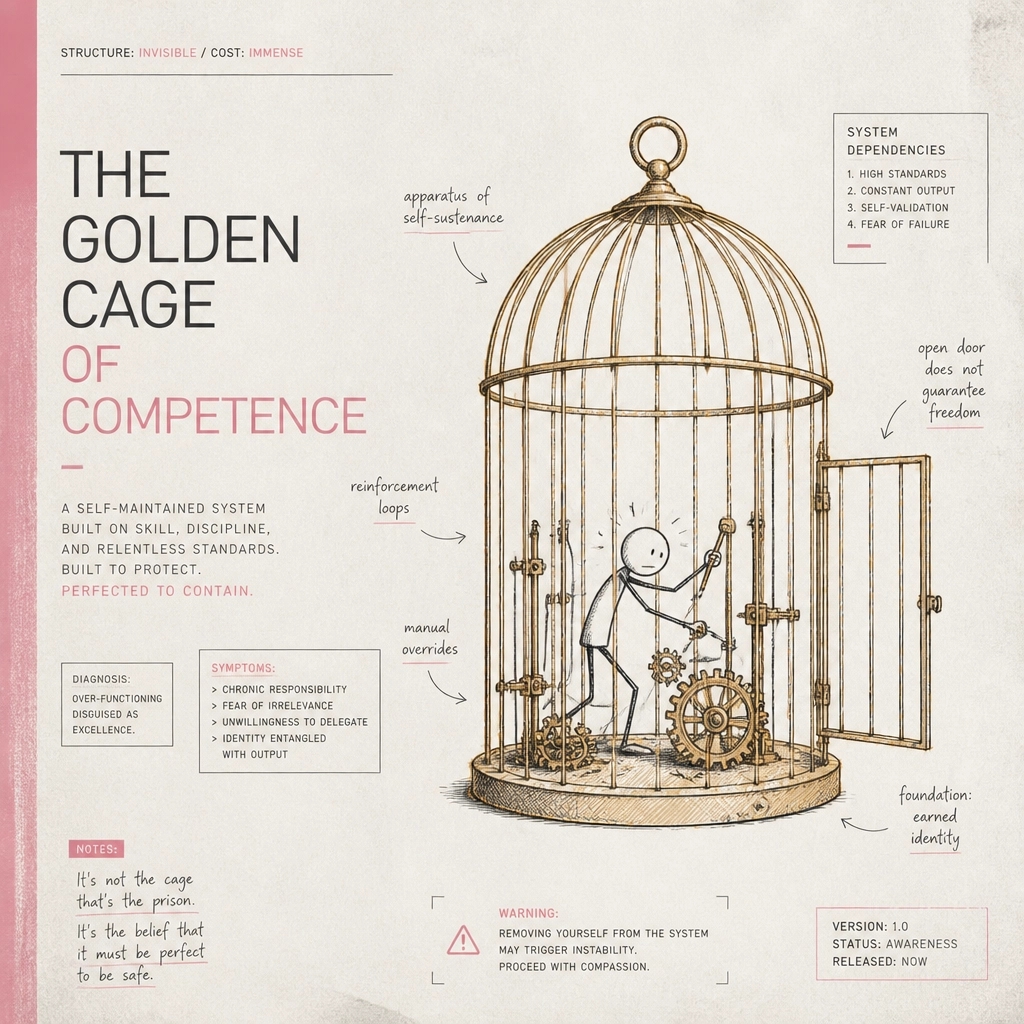
You’re too good at manual overrides to ever build the manual.
This is the Golden Cage of Competence. Because you’re smart, capable, and fast, you can white-knuckle your way through chaos that would break anyone else.
So you keep doing it.
You mistake your ability to handle the mess for a strategy. But excellence isn't about how much weight you can carry; it's about how much weight the system can hold without you.
Stop being the engine. Start being the architect.
#UnstuckWithMolly #BuildPartner #SystemsThinking #DirectTone
1

In 1956, a 26-year-old Edsger Dijkstra worked out a shortest-path algorithm in about twenty minutes, sitting at a café, no pencil, no paper. He didn’t know it yet, but he’d just written the logic that keeps the internet from falling apart.
Here’s where it lives today.
Every network inside a single organization, a campus, a data center, an ISP backbone, etc. runs an Interior Gateway Protocol (IGP) to decide how a packet gets from A to B.
The two that run the serious networks, OSPF and IS-IS, are “link-state,” and the way they work is quietly elegant:
1. Each router says hello to its neighbours and forms adjacencies.
2. Each one floods a description of its own links to everyone else (Link-State Advertisements).
3. Now every router holds an identical map of the whole network.
4. Each router runs Dijkstra’s algorithm on that map to compute its own shortest path to every destination.
Then a fibre gets cut (a real scenario).
The two routers on the broken link flood a fresh advertisement. Every router updates its map, reruns Dijkstra, and traffic shifts onto the next-best path, often before anyone notices. No central controller. No human in the loop. Just every router, independently, recomputing the same map.
That’s the contrast with BGP, which I posted about recently: BGP routes between autonomous systems and trusts policy over distance. An IGP routes inside one and trusts math.
Below is a simulation of it, with the actual SPF code running right beside it and highlighting line-by-line in sync: adjacencies form, the map floods out, the shortest-path tree grows node by node, a link fails, and the network reconverges onto a costlier backup path, cost 20 down to a cost-22 detour, automatically.
And the question I always get “what language is OSPF written in?” has the same answer BGP did: there isn’t one. OSPF is a protocol (RFC 2328), not a program. The routers that speak it run daemons written overwhelmingly in C/C , FRRouting, BIRD, OpenBSD’s OpenOSPFD, Cisco IOS, Juniper Junos.
The C in the video is a faithful model of the SPF computation itself, which is just Dijkstra, run over the link-state database.
One algorithm, sketched in a café in twenty minutes, now runs a few hundred times a second across the planet every time something breaks.
#Networking #OSPF #ISIS #RoutingProtocols #NetworkEngineering #Dijkstra #SystemsThinking
23

The ultimate test of organizational maturity is not how fast you can run a sprint. It is how
systematically you eliminate administrative drag.
In complex hierarchies, micro-frictions accumulate silently over time:
Multi-layered consensus loops that paralyze decision-making velocity.
Redundant status reports that mimic genuine productivity.
Siloed verification checkpoints born out of a historical lack of internal trust.
When system friction reaches a critical threshold, even the most exceptional talent burns
out simply trying to clear basic operational hurdles.
True operational excellence requires a ruthless focus on simplification. Do not optimize a
broken process-delete it entirely. Simplicity scales; complexity fractures.
#SystemsThinking #Operations #Productivity

3

13h
Are we actually fighting Ebola or just waiting for it to arrive and then panicking? 🧬 There’s a difference between prevention and reaction. Most health systems only fund the latter. #PublicHealth #EbolaResponse #SystemsThinking”
1
13

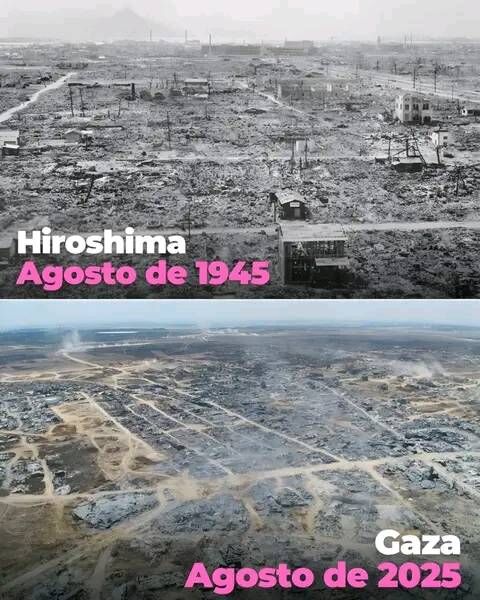
Democracy is not one thing. It’s not ‘voting’; it’s not ‘free speech; it’s not ‘civic engagement’.
Because it’s a web with many threads, reform, too, must be a web.
I’d argue that four spheres are democracy’s present-day choke points.
- The stranglehold of wealth on information
- The stranglehold of money on politics
- Our rusted, antiquated electoral machinery
- Public disengagement
They’re not the only impediments to a successful society; they may not even be the most important.
But they’re at the top of the chain of causation—the ones we need to fix first if anything downstream is to be fixed.
One-off reforms are 𝘧𝘳𝘢𝘨𝘪𝘭𝘦.
Change that survives needs reforms that protect & strengthen each other.
Democracy, civilization’s flower, has an historical timetable that can be extended. If the Athenian legal architecture of the 6th Century BC was our first shot, and the democratizations of the last century or two were our second, we might call the new model ‘Third Draft Democracy’.
At the core of this third draft is a set of articles of constitutional law that relate to each other via an underlying principle.
What is the principle?
It's that the power of special interests has expanded, and democracy has not: that new institutions are needed to undo the plutocracy that has grown up around our #democracy, like the brambles round Sleeping Beauty’s castle.
Division ends with the birth of a new idea.
*𝗔𝗱𝗮𝗽𝘁𝗲𝗱 𝗳𝗿𝗼𝗺 𝙏𝙝𝙚 𝙈𝙚𝙘𝙝𝙖𝙣𝙞𝙘𝙨 𝙤𝙛 𝘾𝙝𝙖𝙣𝙜𝙞𝙣𝙜 𝙩𝙝𝙚 𝙒𝙤𝙧𝙡𝙙: 𝙋𝙤𝙡𝙞𝙩𝙞𝙘𝙖𝙡 𝘼𝙧𝙘𝙝𝙞𝙩𝙚𝙘𝙩𝙪𝙧𝙚 𝙩𝙤 𝙍𝙤𝙡𝙡 𝘽𝙖𝙘𝙠 𝙎𝙩𝙖𝙩𝙚 & 𝘾𝙤𝙧𝙥𝙤𝙧𝙖𝙩𝙚 𝙋𝙤𝙬𝙚𝙧.
(𝗖𝗼𝗻𝘀𝘁𝗶𝘁𝘂𝘁𝗶𝗼𝗻𝗮𝗹 𝗿𝗲𝗱𝗲𝘀𝗶𝗴𝗻 𝘁𝗼 𝗲𝗻𝗱 𝘁𝗵𝗲 𝗶𝗻𝗳𝗹𝘂𝗲𝗻𝗰𝗲 𝗼𝗳 𝘄𝗲𝗮𝗹𝘁𝗵 𝗼𝘃𝗲𝗿 𝗴𝗼𝘃𝗲𝗿𝗻𝗺𝗲𝗻𝘁, 𝘁𝗵𝗲 𝗲𝗰𝗼𝗻𝗼𝗺𝘆,
𝘀𝗰𝗶𝗲𝗻𝗰𝗲, 𝗺𝗲𝗱𝗶𝗰𝗶𝗻𝗲 & 𝘄𝗮𝗿.)
#SystemsThinking #PoliticalReform
1
30
90% of digital content is digital noise. 📉
The other 10% consists of data-driven systems designed to solve specific information gaps for high-intent audiences. 🧠
Stop writing generic filler text. Build structured, highly searchable informational assets that rank instantly and accumulate long-term compounding value. 📈
#SEO #SystemsThinking
1
4

The problem with hospitals is that no single person owns the patient's experience from door to discharge. Everyone does their silo. Nobody owns the whole. #SystemsThinking
1
83

Jun 13
Coffee Table Conversations with AI is a growing series of deep, accessible explorations into the systems that shape our world: civilization as an operating system, the hidden loops running through history and technology, the future of energy, governance, consciousness, and what it would actually take to upgrade the whole thing.
Some books dive into hard systems analysis. Others tell big, mind-bending stories. All of them are written as real conversations — not lectures.
If you like big ideas that feel grounded, thoughtful without being heavy, and worth revisiting, this series was made for you.
All books free to read & in paperback
xljuaxeowclhu.ok.kimi.link/#…
These aren’t books you read once and forget. They’re books you may leave on the coffee table, in the waiting room, books you return to when you want to think deeper about where we actually are — and where we could go. For people who want to understand the machine… and maybe help rewrite it. Dive deep, the series is free to read anytime, just warm it up ☕️ and follow the link.
#CoffeeTableBooks #SystemsThinking #BigIdeas #Futurism #AI
1
43

Jun 13
Why Calm Systems Reduce Panic Before Panic Starts
Panic rarely begins at the loudest moment.
It often begins much earlier, in uncertainty.
When people think about panic, they usually picture the visible stage of it. Raised voices. Crowding. Confusion. Breakdown in order. Stress becoming behaviour. A room, a service, a crowd or a conversation tipping from manageable tension into something much harder to control.
But panic rarely appears from nowhere.
More often it grows in the space where people stop feeling held by the system around them. They no longer know what is happening, who is responsible, what comes next or whether anyone is really in charge. The atmosphere shifts. Confidence thins. Small uncertainty becomes collective unease. Collective unease then becomes something larger.
That is why calm systems matter so much.
They reduce panic before panic starts.
This is not only true in emergencies. It applies in ordinary public life as well. A calm system is one that gives people enough clarity, structure and visible competence that they do not feel the need to generate their own crisis response just to get through it. It does not rely on people being endlessly patient, self interpreting or self calming in the face of avoidable confusion. It does more of that work itself.
That matters enormously.
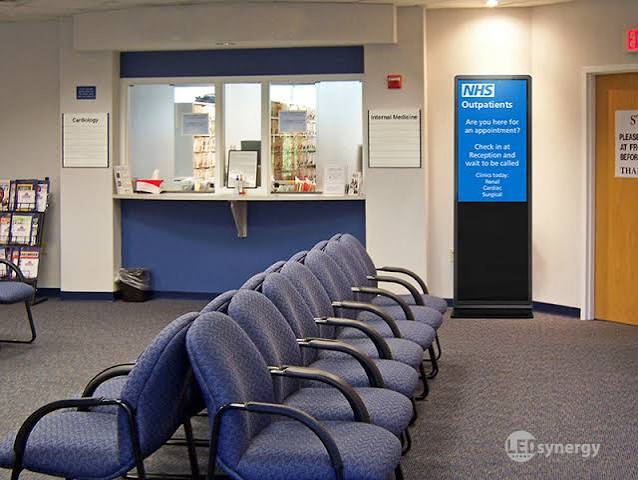
In a hospital, a calm system may mean clear signage, clear updates, visible triage, staff who know the route, and enough communication that waiting does not become disorientation. In transport, it may mean clear disruption messaging, visible staff presence, realistic alternatives and a process that feels organised even under strain. In housing, it may mean a resident understanding what will happen next, who owns the issue and when to expect movement, so that uncertainty does not spiral into frustration and despair. In schools, it may mean routines, communication and adult steadiness strong enough that anxiety in children or parents does not spread unnecessarily.
The same truth appears again and again.
People can tolerate difficulty better than they can tolerate unmanaged uncertainty.
This is why calm should not be mistaken for passivity. A calm system is not one that is slow, emotionally distant or disengaged. It is one that remains coherent under pressure. It keeps sequence. It makes ownership visible. It gives people enough information to stay oriented. It does not inflame what could have been steadied.
That is a serious operational achievement.
And it has moral weight too.
Because panic is costly. It costs time, trust, energy and judgement. It can make people feel foolish, helpless or trapped. It can escalate situations that were difficult but still recoverable into situations that are much harder on everyone involved, staff included. A system that does little to prevent avoidable panic is often asking the public to absorb emotional pressure that better design and better leadership could have reduced.
That is not fair.
Calm systems lower that burden.
They do so in practical ways. They explain. They structure. They communicate. They sequence. They remove ambiguity where they can. They prepare staff to respond with steadiness rather than visible disorder. They know that emotion is often shaped by environment, tone and information long before it becomes visible behaviour.
That is why panic prevention is largely a design question.
A queue is less likely to become agitated if people know why it is moving slowly and what to expect. A waiting room is less likely to become tense if the process feels intelligible and staff appear composed. A repair issue is less likely to become an angry dispute if the resident has clear updates and a believable route forward. A public meeting is less likely to deteriorate if the chair, the structure and the expectations are clear from the outset.
In each case, calm is not magic.
It is the product of systems taken seriously enough to anticipate where uncertainty will gather and to reduce it before it multiplies.
This is one reason leadership presence matters so much. Calm is contagious, but so is visible uncertainty at the top. If leaders appear flustered, evasive or detached, others begin compensating. People lose trust in the route. They start creating their own. Rumour grows. Frustration sharpens. Suspicion spreads. By contrast, calm leadership, especially when joined to clarity, often prevents escalation precisely because people can feel that reality is being faced rather than avoided.
That is deeply stabilising.
It is also why communication plays such a large role. Calm systems do not wait until panic is visible before they start explaining. They explain early. They explain clearly. They do not withhold every uncertainty, but nor do they leave a vacuum in which people must imagine the worst. They know that silence often invites escalation faster than imperfect but honest information does.
There is a broader social lesson here too. A society that normalises chaotic systems, unclear process and visible institutional uncertainty ends up producing more ambient stress than it realises. People become quicker to assume the worst, quicker to distrust, quicker to defend themselves against systems that no longer feel able to carry ordinary pressure without spilling it back onto the user.
That is a poor cultural habit.
A mature society should want more calm than that.
Not artificial calm, built on denial or excessive smoothing over, but real calm, grounded in design, communication and competence. The kind of calm that does not ask people to pretend nothing is difficult, but helps them feel that the difficulty is still being contained by something organised, intelligible and serious.
That is a high standard.
And it matters in small places as much as large ones. A local office. A clinic. A school gate. A housing repair desk. A train platform. A customer line. A council process. A community meeting. In each case, the system either reduces avoidable panic through steadiness, or quietly helps create it through confusion.
That should focus the mind.
Because panic rarely begins at the loudest moment.
It often begins much earlier, in uncertainty.
What do you think?
Where have you seen calm systems prevent situations from escalating unnecessarily?
And where do institutions still too often create the uncertainty, silence or visible disorder that allows panic to grow before anyone names it?
#Leadership #SystemsThinking #PublicService #Trust #Clarity #Communication #ServiceDesign #Calm #HumanDignity #BritainsFuture
43

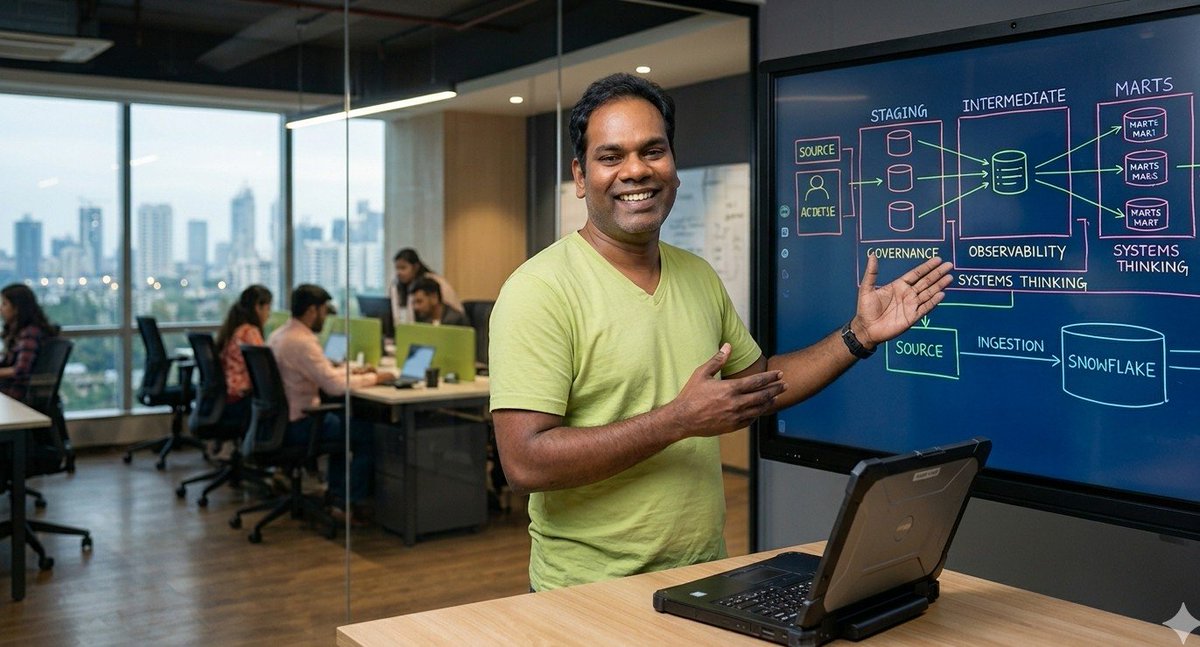
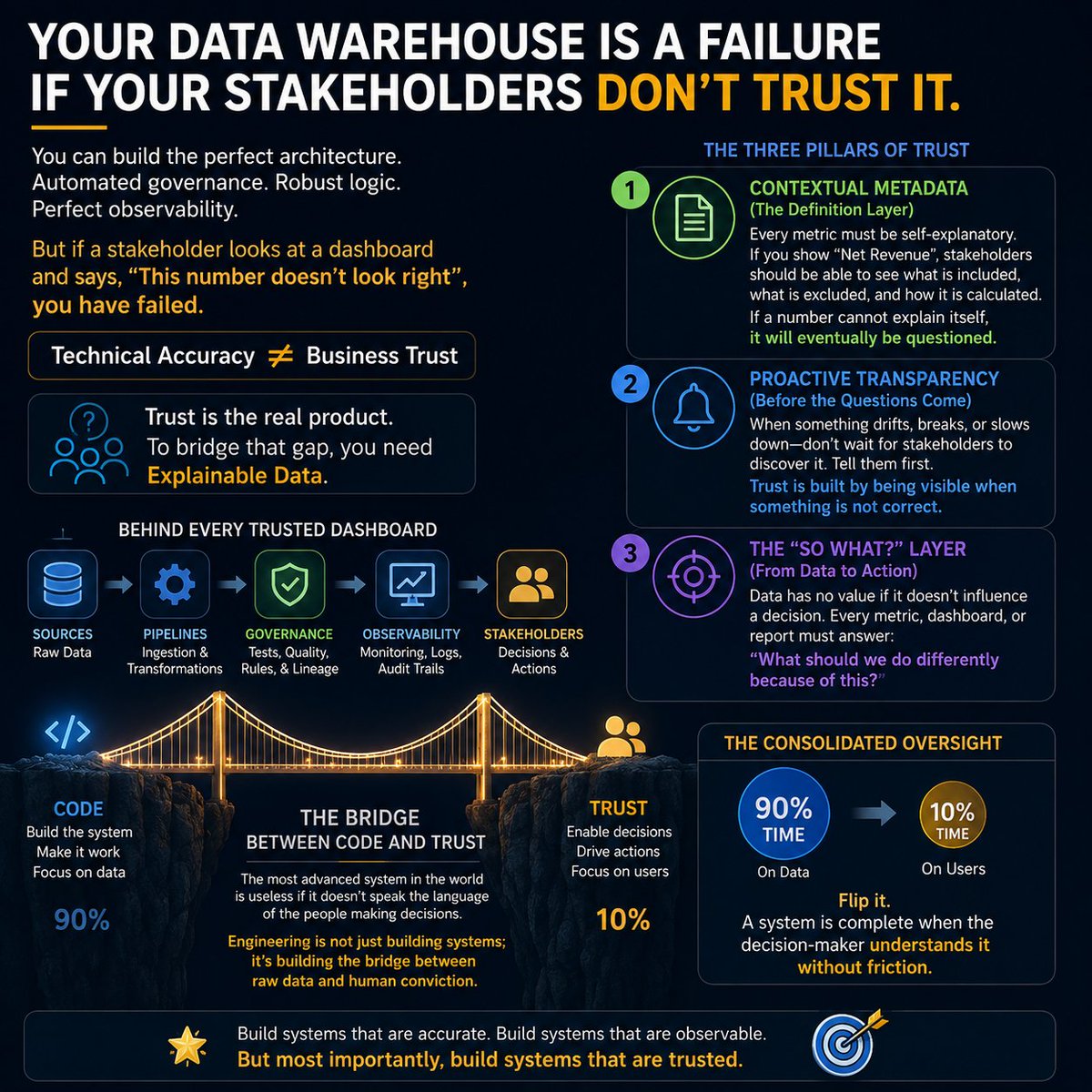
If your “data project” is finished, it’s already obsolete. 🚀
Real systems don’t get completed—they evolve.
Architect for change, not closure. 🧠
#DataEngineering #SystemsThinking #ArchitectureFirst
7