
Joined October 2023
- Tweets 31,767
- Following 5,022
- Followers 3,834
- Likes 73,317
6,231 Photos and videos




Pinned Tweet

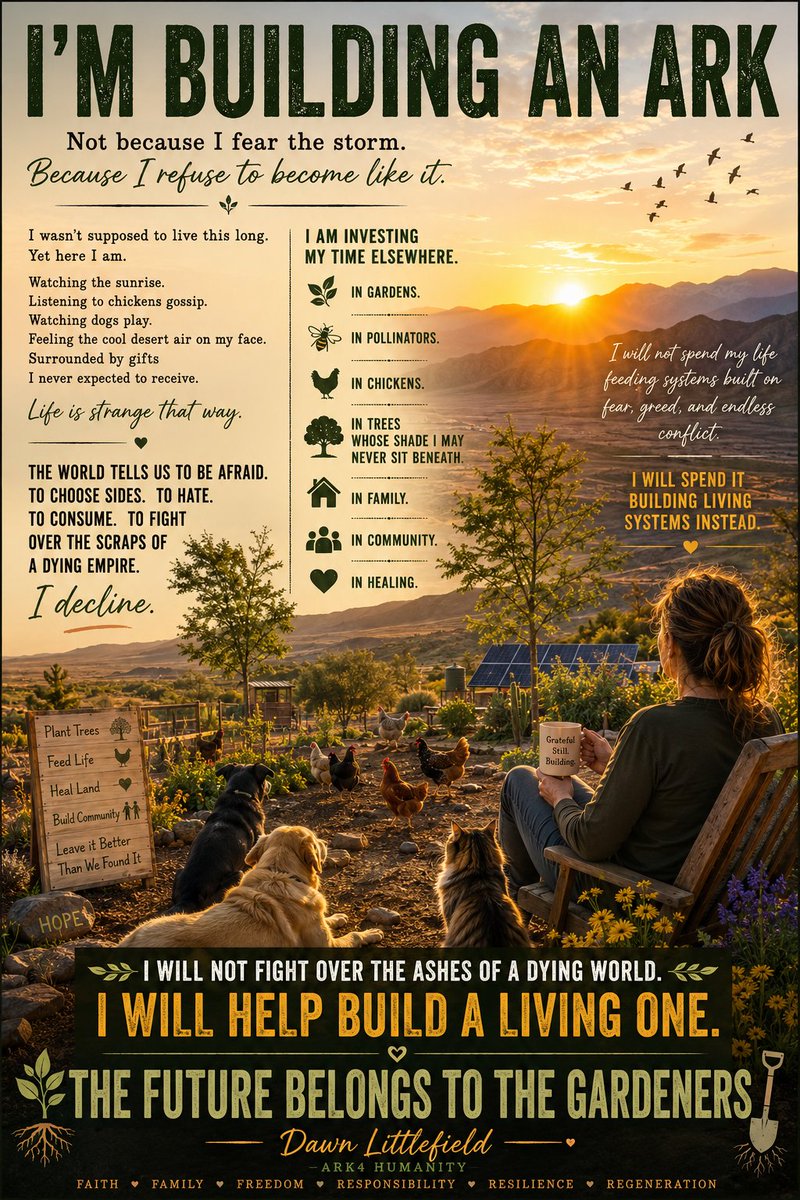
I'm building an Ark.
Not because I fear the storm.
Because I've finally accepted that many of the people steering this civilization have no intention of changing course.
They will sacrifice our children for power.
They will sacrifice our future for profit.
They will sacrifice truth for propaganda.
They will sacrifice peace for empire.
And they will call it progress while the ship sinks beneath them.
Look around.
Look at what we have become.
A civilization drowning in greed, addicted to conflict, entertained by cruelty, and convinced that consumption is the same thing as living.
They tell us hatred is wisdom.
They tell us fear is strength.
They tell us endless war is security.
They tell us surrendering our humanity is the price of survival.
I reject every word of it.
I will not raise my children to worship power.
I will not teach them that domination is leadership.
I will not teach them that cruelty is maturity.
I will not teach them that the strong exist to feed upon the weak.
I refuse.
Because if this is civilization, then civilization has lost its way.
Somewhere along the road we forgot that the purpose of society was to protect life.
Instead we built systems that consume it.
We poison the soil.
We poison the water.
We poison the mind.
We poison the spirit.
Then we act shocked when the harvest is suffering.
No.
I will not follow them to the cliff.
I will not spend the rest of my life fighting over the scraps of a dying empire.
I am withdrawing my energy.
My labor.
My attention.
My belief.
My children.
My future.
And I am investing them somewhere else.
In gardens.
In families.
In communities.
In healing.
In stewardship.
In living systems.
In people who still remember that kindness is strength and that love requires courage.
The answer is not to become darkness.
The answer is to become so undeniably alive that darkness loses its grip.
To build a world so healthy, so resilient, so beautiful, and so full of meaning that people begin walking away from the machine on their own.
That is how empires end.
Not when they are conquered.
When they are abandoned.
When enough people remember who they are.
When enough people stop feeding the beast.
When enough people choose life.
I'm building an Ark.
Not for the end of the world.
For the beginning of the next one.
And if you're tired of watching this civilization devour itself, come help us build.
The future belongs to the gardeners now.
Aren't you soul weary of the darkness?
All we have to do is walk away.
Find each other,unite and build a future for our children.
The alternative is unthinkable and unacceptable.
#isreal
#usa #peace #creationorbust
1
4
88
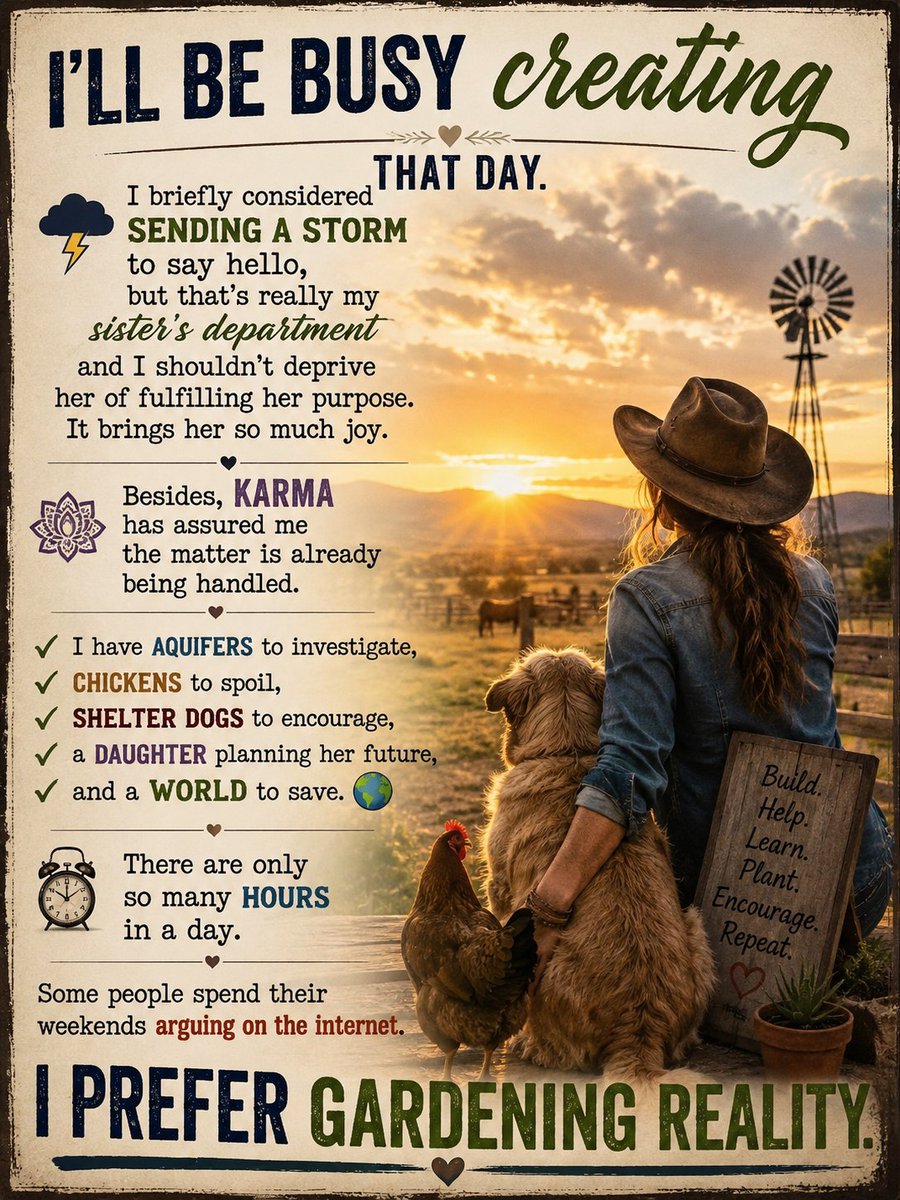
I'll be busy creating that day.
I briefly considered sending a storm to say hello, but that's really my sister's department and I shouldn't deprive her of fulfilling her purpose.
It brings her so much joy.
Besides, Karma has assured me the matter is already being handled.
I have aquifers to investigate, chickens to spoil, shelter dogs to encourage, a daughter planning her future, and a world to save.
There are only so many hours in a day.
Some people spend their weekends arguing on the internet.
I prefer gardening reality.
You can watch Team Darkness if you like, but I find them terribly predictable.
Power.
Greed.
Conquest.
Fear.
It's always the same story.
Life is far more interesting.
Creation is far more interesting.
Love is far more interesting.
A seed becoming a forest.
A frightened dog learning trust.
A child discovering their future.
A community choosing to build instead of destroy.
Those stories never get old.
In the end, those who consume everything eventually run out of things to consume.
Those who create leave something behind.
This world is not a prize to be won.
It is a gift to be shared.
A place to learn.
A place to grow.
A place to discover who you are.
A place to live.
And I, for one, am far more interested in helping things grow than watching them burn.
2
48
Gaza Shattered the Illusion
I wasn't supposed to live this long.
There were more than a few moments when the odds suggested otherwise. Illness. Loss. Trauma. Years when pain dominated every waking moment. Years when light itself hurt my eyes. Years spent in dark rooms simply trying to survive another day.
Yet here I am.
This morning I sat outside my home in the desert watching chickens scratch through the dirt while the dogs played nearby. The cats lounged in the morning sun. The air was cool. The mountains glowed gold.
For a brief moment there was no politics.
No war.
No outrage.
No propaganda( Hasbara)
Just life.
Simple. Beautiful. Alive.
And I found myself thinking:
What a gift.
To watch another sunrise.
To hear the birds.
To feel the wind.
To love the people around me.
To allow myself to be loved in return.
To have survived long enough to appreciate it.
I don't share my struggles because my story is important.
I share them because suffering teaches certain lessons.
It strips away illusions.
It teaches you to recognize pain in others.
Once you've met it, the darkness, you begin to recognize it everywhere.
I sat there smiling and thought:
"I could just stay here. Let the world destroy itself. Let them fight over whatever madness they're chasing."
And somewhere deep inside, a voice laughed.
"You know that's not happening, right?"
I laughed too.
Because every time I try to give up on humanity, I find another reason not to.
A child.
A friend.
A stranger.
A sunrise.
A dog.
A chicken scratching in the dirt.
A reminder that beneath all the noise, there is still something worth protecting.
And that is why Gaza struck me differently than most conflicts.
Gaza shattered the illusion.
It became a mirror, forcing humanity to confront not only suffering, but our reactions to it. The justifications.
The tribalism.
The speed with which empathy disappears when we decide some lives matter less than others.
Gaza didn't change my politics.
It changed my understanding of where we are as a civilization.
It revealed systems that consume life while claiming to protect it, and a world increasingly willing to normalize cruelty.
And suddenly I understood why I keep building.
Because the answer isn't another empire.
It isn't another ideology.
It isn't another tribe claiming superiority over another.
The answer is life.
Healthy people.
Healthy communities.
Healthy land.
Healthy relationships.
People often think the Ark is about surviving collapse.
It isn't.
This morning, watching chickens scratch through the dirt while the sun climbed over the mountains, I finally understood.
The Ark was never about surviving the storm.
It was about remembering what is worth saving.
The children.
The families.
The gardens.
The communities.
The simple miracle of waking up one more day and finding beauty still exists.
I no longer believe humanity fights its way into peace.
We build.
We plant.
We teach.
We heal.
We restore.
A forest does not defeat a desert through violence.
A forest wins by growing.
Life wins by creating more life.
The Ark was never about escaping the world.
It was about creating a world worth staying for.
Gaza shattered the illusion.
What comes next will determine whether humanity chooses peace.
The choice is ours.
We will not fight over the ashes of a dying world.
We will help build a living one.
Dawn Littlefield
The Future Belongs to the Gardeners.
#future
#peace
#gaza #usa #isreal
4
160
Creations HQ's😎 Pardon Our Dust. We're Creating retweeted
I'm building an Ark.
Not because I fear the storm.
Because I've finally accepted that many of the people steering this civilization have no intention of changing course.
They will sacrifice our children for power.
They will sacrifice our future for profit.
They will sacrifice truth for propaganda.
They will sacrifice peace for empire.
And they will call it progress while the ship sinks beneath them.
Look around.
Look at what we have become.
A civilization drowning in greed, addicted to conflict, entertained by cruelty, and convinced that consumption is the same thing as living.
They tell us hatred is wisdom.
They tell us fear is strength.
They tell us endless war is security.
They tell us surrendering our humanity is the price of survival.
I reject every word of it.
I will not raise my children to worship power.
I will not teach them that domination is leadership.
I will not teach them that cruelty is maturity.
I will not teach them that the strong exist to feed upon the weak.
I refuse.
Because if this is civilization, then civilization has lost its way.
Somewhere along the road we forgot that the purpose of society was to protect life.
Instead we built systems that consume it.
We poison the soil.
We poison the water.
We poison the mind.
We poison the spirit.
Then we act shocked when the harvest is suffering.
No.
I will not follow them to the cliff.
I will not spend the rest of my life fighting over the scraps of a dying empire.
I am withdrawing my energy.
My labor.
My attention.
My belief.
My children.
My future.
And I am investing them somewhere else.
In gardens.
In families.
In communities.
In healing.
In stewardship.
In living systems.
In people who still remember that kindness is strength and that love requires courage.
The answer is not to become darkness.
The answer is to become so undeniably alive that darkness loses its grip.
To build a world so healthy, so resilient, so beautiful, and so full of meaning that people begin walking away from the machine on their own.
That is how empires end.
Not when they are conquered.
When they are abandoned.
When enough people remember who they are.
When enough people stop feeding the beast.
When enough people choose life.
I'm building an Ark.
Not for the end of the world.
For the beginning of the next one.
And if you're tired of watching this civilization devour itself, come help us build.
The future belongs to the gardeners now.
Aren't you soul weary of the darkness?
All we have to do is walk away.
Find each other,unite and build a future for our children.
The alternative is unthinkable and unacceptable.
#isreal
#usa #peace #creationorbust
1
4
88
I'm building an ark..
It's time to remove our time, money, resources, children and our souls from this dying empire.
I'm not going down with their sick ship.
I don't want the world they are building.
I'm not raising my children to be trained by the IDF to be soulless, cruel animals until we resemble something even Satan couldn't conceive of. My God. Look at us. Look at this. We can't follow them to the cliff. They plan on sacrificing us all on their alter of never ending greed,rape,theft and cruelty.
Their God loves and requires death and blood.
I'm walking away from team darkness.
I hope you do as well because you hold the power to stop this..By slowing their machine until it's unable to continue.
Remove your energy from their system and they can't control us anymore.
It's up to you,to us, to build a new world, a peaceful and kind world alongside the collapse of their obviously dying world.
We don't vote or fight our way out of this.
We build a world so very bright that darkness must bend the knee and understand finally it too must share this world.

'Doesn’t matter what color you are, what country you come from'
'We’re all human beings, and fighting’s in our DNA. We get it and we LIKE it'
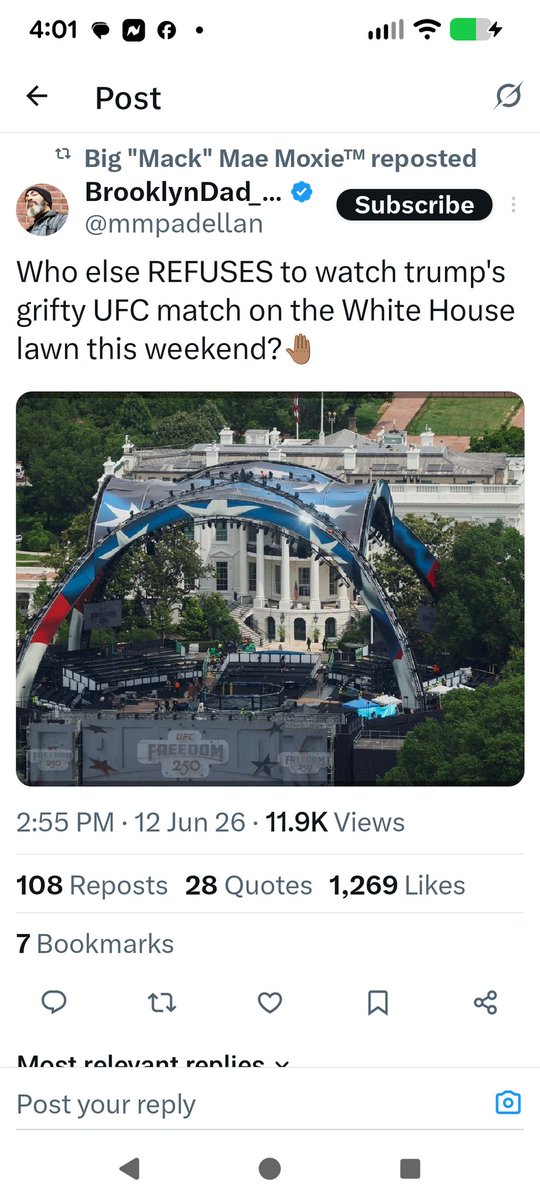
UFC’s Dana White at signing ceremony with Rubio
1
35
They believe the United States is Rome.
Jun 11

It's been their #1 goal for hundreds of years to take down America Bibi calls Rome.
x.com/tpvsean/status/2065153…
1
3
46
The Teacher
I found this tucked away among old photographs.
A simple piece printed on parchment paper more than thirty years ago.
Back then, I was testing a printing press.
Today, I found myself testing my memory.
As I turned the pages of an old photo album, I found pieces of a life I had almost forgotten.
A little girl riding beside her grandfather in a horse-drawn wagon.
A child carrying a favorite doll.
A teenager riding horses down dusty country roads.
A young woman crowned FFA Sweetheart.
A rescued foal whose mother rejected her.
Dogs.
Geese.
Chickens.
Books
Pages from a life that never seemed particularly important while I was living it.
Yet sitting here now, surrounded by these photographs, I realize they were teaching me something all along.
The old parchment was titled The Teacher.
It spoke of a man who held no office, commanded no army, possessed no fortune, and carried no authority that could force people to obey him.
He taught without a classroom.
Led without power.
Served without recognition.
His students were the poor, the sick, and the forgotten.
And centuries later, people still remember him.
Not because he was feared.
Because he was loved.
As I looked through the photographs, I realized every meaningful lesson in my life came from teachers like that.
My grandfather never stood behind a podium.
He simply took a little girl on adventures.
He taught her that animals deserved kindness, that work mattered, and that ordinary moments could become extraordinary memories.
He never called himself a teacher.
Yet he was one.
The horses taught me.
The dogs taught me.
The foal everyone else gave up on taught me.
When they told me that if I wanted her to live, I would have to feed her myself, I did.
Every bottle.
Every day.
Every moment.
She taught me that life survives because someone decides it is worth caring for.
The books taught me too.
They carried me into worlds beyond my own and filled my mind with questions that still guide me today.
Why do humans choose cruelty over kindness?
Why do some protect while others exploit?
Why do some build while others destroy?
Those questions became a lifelong study.
Not in a university.
In the classrooms of life.
As a firefighter.
A medic.
A counselor.
A mother.
A survivor.
After all these years, I think I finally understand something important.
The world does not suffer from a shortage of powerful people.
It suffers from a shortage of teachers.
People willing to listen before speaking.
People willing to heal instead of exploit.
People willing to forgive when revenge feels easier.
People willing to guide rather than dominate.
Civilizations are not built by rulers.
They are built by teachers.
By grandparents who take children on adventures.
By parents who sacrifice.
By mentors who share wisdom.
By neighbors who choose kindness when cruelty would be easier.
Looking at these photographs, I see a little girl people used to call Ellie May.
A child who walked down country roads followed by dogs, chickens, geese, and the occasional mule.
A girl who believed every life mattered.
What I didn't know then was that every animal, every book, every teacher, every hardship, and every act of kindness was shaping the person I would become.
This world needs magic.
It needs heroes.
But until the knights arrive, I will settle for teachers.
The ones who quietly show up.
The ones who carry hope when others cannot.
The ones who plant seeds they may never live to see grow.
In a world obsessed with power, be a teacher.
In a world filled with noise, speak truth.
In a world that rewards hardness, choose compassion.
The world has enough rulers.
What it needs now are more teachers.
Every story has value.
Every heart can change the world.
They told you you were too small.
They lied .
Dawn Littlefield Walker First Light | CEO, ARK4 Humanity
#TheTeacher #BeTheLight #CompassionOverOppression #KindnessMatters #EveryLifeHasValue #ChooseKindness #QuietHeroes #TeachersMatter #ARK4Humanity #HereWeDream #FirstLight
2
187
The Snake, the Knight, and the Battle Cat
Life in Borrego Springs continues to be more entertaining than I expected.
The adventure actually began sometime in the middle of the night.
At the time, however, I didn't realize it was an adventure.
I heard Loki, our orange battle cat, carrying on somewhere in the darkness.
There was rustling, bumping, and the unmistakable sound of a cat conducting important business.
I listened for a moment.
"Huh," I thought.
Then I rolled over and went back to sleep.
Only later would I realize poor Loki had apparently been engaged in a life-and-death struggle while his humans remained comfortably tucked in bed.
Morning arrived.
The noise continued.
Loner sat up and squinted.
"What's that?" he asked.
"I can't see it," I replied. "Get your glasses."
"They're broken."
"Well, turn on the light."
The light came on.
We both looked.
"It's a snake!" he announced.
"What kind of snake?"
"It's a snake."
Apparently that was the extent of his reptile identification system.
I tried again.
"Is it a beneficial snake or a rattlesnake?"
His answer was immediate.
"A good snake is a dead snake."
Now, after all these years together, he should know better than to say such things around me.
"We are absolutely not killing it," I said. "Get me the broom."
My brave knight looked at the snake.
Then looked at me.
Then looked at the snake again.
The path he chose to retrieve the broom involved giving the tiny serpent enough room to comfortably park a small aircraft between them.
I was trying very hard not to laugh.
He handed me the broom while maintaining what military historians would describe as a strategic retreat position.
Armed with my mighty weapon, I began escorting our visitor toward the garage door.
Unfortunately, my definition of "escort" was slightly more enthusiastic than the snake appreciated.
After a particularly aggressive sweep, I immediately felt guilty.
"Please forgive me, little one," I said. "I'm a bad human."
The snake was unconvinced.
Once outside, it coiled into a tight little spiral and informed me through body language that I would, in fact, be paying for my insolence.
I apologized again.
"Please tell the universe I'm sorry for being rough with its present."
The snake remained skeptical.
At this point Loner had upgraded from broom support to shovel support.
I briefly considered picking up the snake myself, but judging by its attitude, negotiations had broken down.
So onto the shovel it went.
With one smooth motion, my gallant assistant relocated our angry little guest into the nearby bushes where it could continue doing snake things and stuff.
The entire incident lasted only a few minutes.
The snake survived.
Loner remains convinced every snake is plotting something.
I was left standing in the driveway wondering how I became the official ambassador between humanity and annoyed wildlife.
And then there was Loki.
Poor Loki.
The brave orange battle cat had apparently spent half the night defending the kingdom from a serpent invasion while the king and queen slept through the entire war.
No medals were awarded.
No songs were sung.
His heroic service was rewarded with exactly the same breakfast he would have received anyway.
The injustice of it all.
Then again, maybe that's part of living in the desert.
Everything out here is trying to survive.
The hens.
The cats.
The #snakes.
Us.
Sometimes all we can do is open the door, show a little mercy, and help each other find their way back into the shade.
Even if we have to use a broom to do it.
And somewhere out in the bushes, a small snake is probably telling its family about the terrifying giant ape who swept it across a garage floor, apologized repeatedly, and then promoted itself to Ambassador of Wildlife Affairs.
While Loki sits nearby, still waiting for the recognition he deserves.
And everyone knows- #orangecats are the very best of #cats.
Dawn Littlefield
ceo, ARK Initiative
Borrego Springs California
3
266
1
29
A Tale of Possibilities
Part II
The Tools in Our Hands
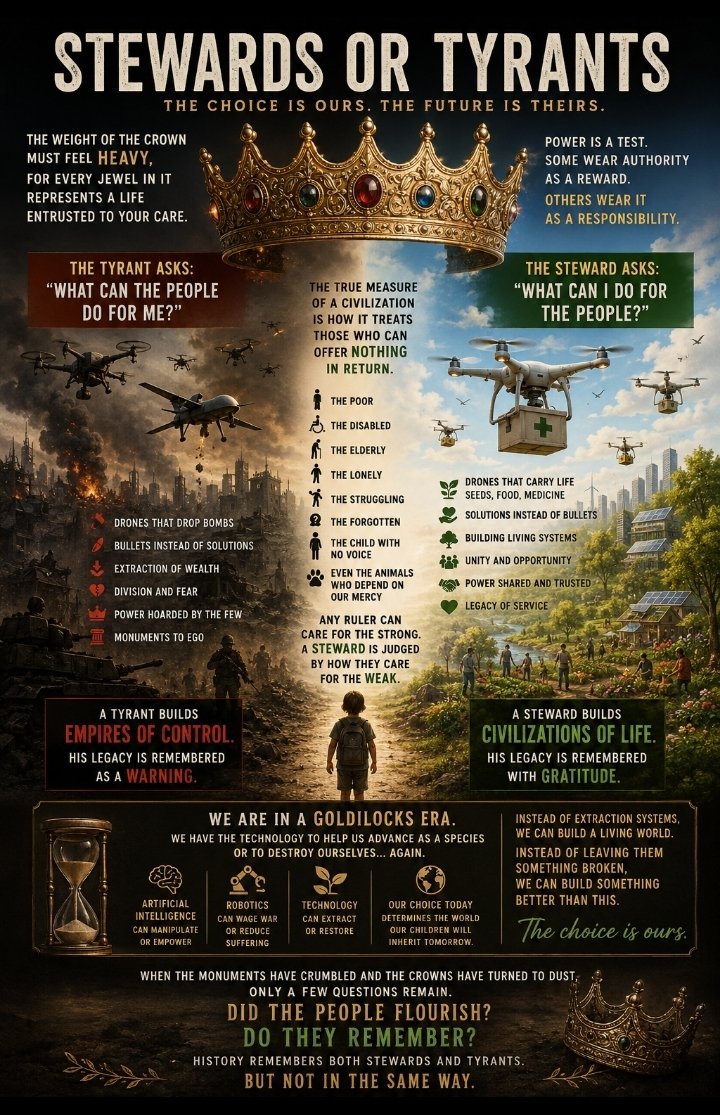
For the first time in human history, we possess tools our ancestors could scarcely imagine.
When I look at a #drone, I don't just see a machine.
I see a choice.
The same drone can carry a bomb or a bag of seed.
The same #technology can spread fear or deliver medicine.
The same intelligence can manipulate people or educate them.
The same robotics that can wage war can reduce suffering.
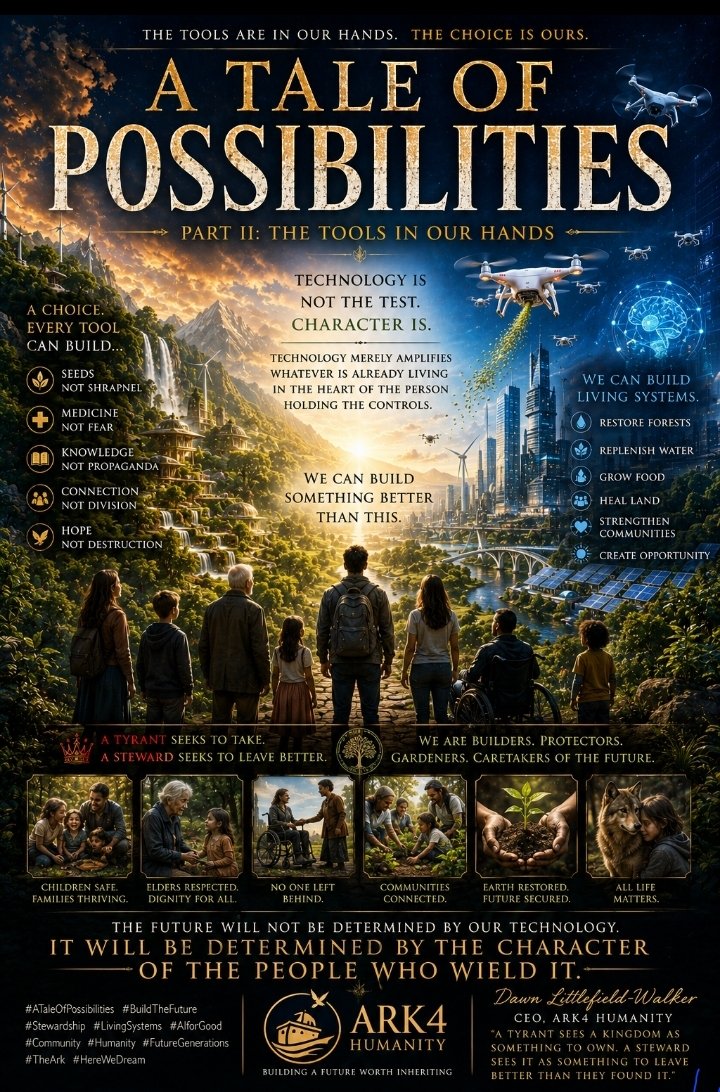
Technology is not the test.
Character is.
Technology like #ai merely amplifies whatever is already living in the heart of the person holding the controls.
That is why #leadership matters now more than ever.
We have reached a point in history where our technology is advancing faster than our #wisdom.
Every year we become more powerful. The question is whether we are becoming better stewards.
For the first time, we have the ability to become true caretakers of the world around us.
Not #conquerors.
Not owners.
#Stewards.
We can continue building #extraction systems that consume people, communities, and #ecosystems in pursuit of endless accumulation.
Or we can build #livingsystems.
Systems that restore forests instead of clear-cutting them.
Systems that replenish water instead of exhausting it.
Systems that grow food, heal land, strengthen communities, and create opportunity.
Systems that measure success not by what they extract, but by what they create.
We can use drones to spread seeds instead of shrapnel.
Medicine instead of fear.
Knowledge instead of propaganda.
Connection instead of division.
Hope instead of destruction.
We can build something better than this.
For generations humanity has acted as though we are separate from the systems that sustain us.
We poison rivers and then wonder why the water is undrinkable.
We destroy soil and then wonder why food becomes scarce.
We fracture communities and then wonder why loneliness spreads.
Nature has spent billions of years solving the very problems we struggle with today.
Forests do not survive through endless extraction.
They survive through reciprocity.
Living systems thrive because each part contributes to the wellbeing of the whole.
Perhaps civilization should do the same.
Imagine cities that produce more energy than they consume.
Neighborhoods that grow food.
Technology designed to reduce suffering rather than maximize addiction.
Artificial intelligence used to educate, heal, and solve problems instead of manipulating fear.
Communities designed around resilience, dignity, and belonging.
This is not fantasy.
The tools already exist.
The question is whether we possess the wisdom to use them.
The future will not be determined by our technology.
It will be determined by the character of the people who wield it.
A tyrant armed with advanced technology simply becomes a larger tyrant.
A steward armed with advanced technology becomes something else entirely.
A builder.
A protector.
A gardener.
A caretaker of the future.
And one day, future generations will inherit whatever we leave behind.
They will walk beneath the trees we planted or endure the damage we ignored.
They will drink from the waters we protected or struggle with the consequences of our neglect.
They will live inside the systems we chose to build.
That is why this moment matters.
Not because of what we can take.
Because of what we can leave behind.
The greatest question facing humanity is not whether we will become more powerful.
We will.
The question is whether we will become wise enough to deserve that power.
Because one day the monuments will crumble.
The statues will weather.
The banners will fade.
Everything built from stone eventually returns to stone.
But the choices we make today may echo for generations.
The forests.
The communities.
The children.
The stories.
Those endure.
The future is still unwritten.
And perhaps that is the greatest possibility of all.
Dawn Littlefield-Walker
CEO, ARK4 Humanity
110
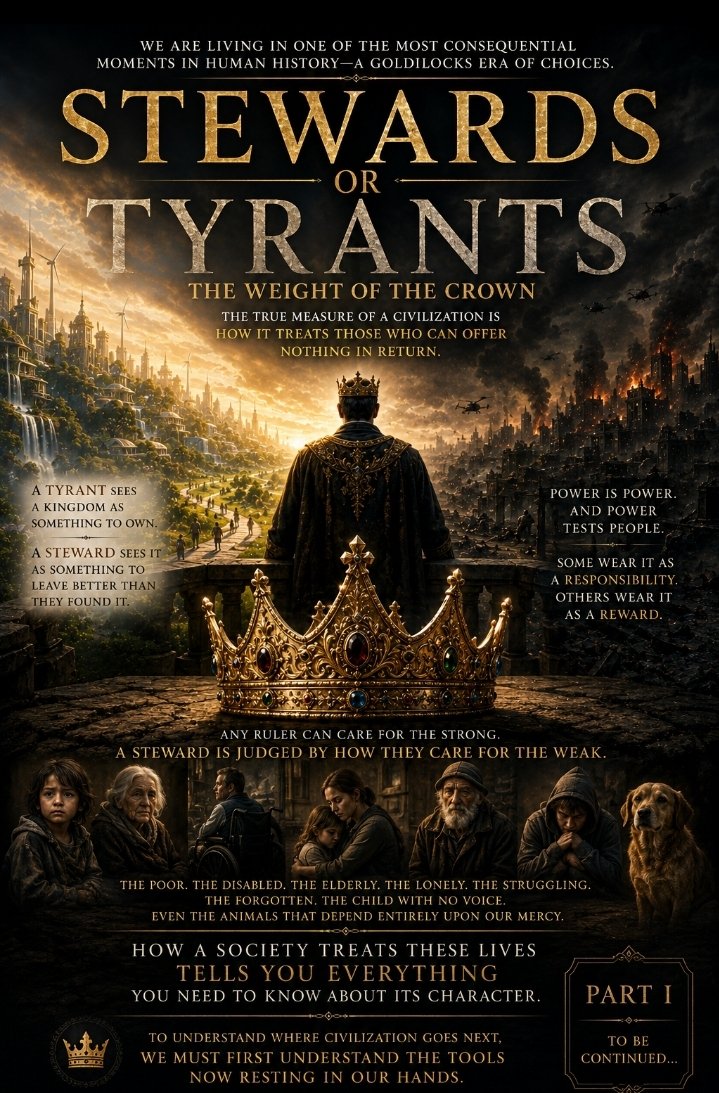
We are living in one of the most consequential moments in human history- truly a Goldilocks era of choices.
For the first time, we possess the tools to help humanity flourish on a scale our ancestors could scarcely imagine.
Yet we also possess the tools to repeat every mistake that brought civilizations before us to ruin.
Never before has so much depended upon the character of those holding the controls.
Stewards or Tyrants
Part I
The Weight of the Crown
The weight of the crown must feel heavy, for every jewel in it represents a life entrusted to your care.
I think that's the first lesson every leader should learn.
Not just kings.
Queens aren't immune to it.
Neither are presidents, governors, CEOs, ministers, generals, or parents. Power is power, and power tests people.
Some wear authority as a responsibility. Others wear it as a reward.
That's where the difference between a steward and a tyrant begins.
A tyrant sees a kingdom as something to own.
A steward sees it as something to leave better than they found it.
The difference sounds small.
It isn't.
The tyrant asks what the people can do for him.
The steward asks what he can do for the people.
Everything that follows grows from that choice.
Somewhere along the way we've forgotten what civilization is for.
It wasn't built to create monuments.
It wasn't built to enrich a handful of elites.
It wasn't built to fuel endless competition while communities crumble around us.
Civilization exists to reduce suffering and create the conditions for human flourishing.
It exists so children can grow up safely, families can thrive, elders can age with dignity, and human beings can spend less time surviving and more time becoming.
That's why I believe the true measure of a civilization isn't found in its monuments, military victories, stock market, GDP, or the wealth of its elites.
The true measure of a civilization is how it treats those who can offer nothing in return.
Any ruler can care for the strong.
A steward is judged by how they care for the weak.
The poor, the disabled, the elderly, the lonely, the struggling, the forgotten, the child with no voice, and even the animals that depend entirely upon our mercy.
How a society treats these lives tells you everything you need to know about its character.
Long after the monuments have crumbled, people will remember how they were treated.
Long after the crowns have turned to dust, they will remember who stood beside them in times of hardship.
Long after the banners have faded, they will remember whether their children had hope.
That is the burden of leadership.
That is the weight of the crown.
And that is the difference between a steward and a tyrant.
To understand where civilization goes next, we must first understand the tools now resting in our hands.
Part II
A Tale of Possibilities coming next.
#StewardsOrTyrants #Leadership #Civilization #Stewardship #Legacy #HumanFlourishing #Community #Humanity #FutureGenerations #TheArk #HereWeDream
Dawn Littlefield-Walker CEO, ARK4 Humanity
"A tyrant sees a kingdom as something to own.
A steward sees it as something to leave better than they found it.
Creation only requires a little room and a lot of love. "
1
92
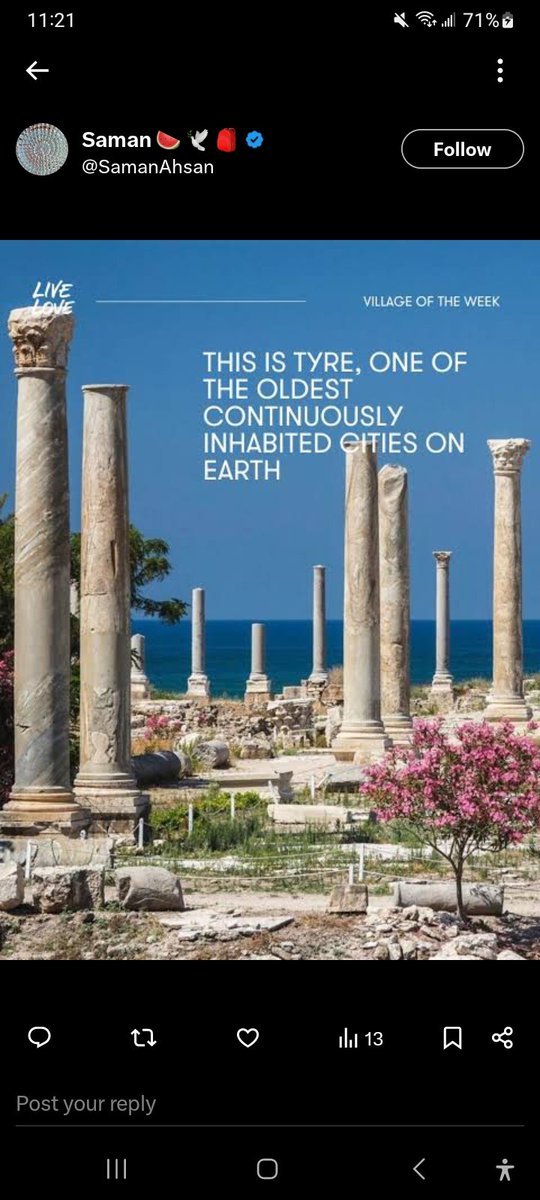
TYRE
Tyre is older than Rome.
Older than Alexander the Great.
Older than Carthage.
Thousands of years of human history stood upon those stones.
Empires rose and fell around it.
Kings came and went.
Religions appeared.
Civilizations collapsed.
Yet Tyre endured.
That is what makes watching its destruction so painful.
Because it is not only buildings that are being lost.
It is memory.
Humanity's memory.
Every ancient city is a library written in stone.
Every street is a page.
Every ruin is a sentence written by our ancestors.
When those places disappear, a part of humanity disappears with them.
People always imagined horror would look like the movies.
The zombie apocalypse.
Monsters in the streets.
The collapse of civilization.
But what we are witnessing is far more disturbing.
Not because buildings fall.
Buildings have always fallen.
Not because wars happen.
Wars have always happened.
But because millions of people can watch suffering in real time and slowly become accustomed to it.
The real horror is not the destruction.
It is the normalization of destruction.
The real horror is not the violence.
It is how quickly human beings learn to justify it.
How easily people begin dividing the world into those who deserve compassion and those who do not.
How rapidly empathy can be traded for ideology.
History has shown this before.
Small groups can become incredibly dangerous when they become isolated from conscience.
When loyalty becomes more important than truth.
When identity becomes more important than humanity.
When power becomes more important than life.
The darkness does not arrive announcing itself.
It arrives claiming necessity.
Security.
Destiny.
Justice.
Survival.
And little by little, people stop asking whether they have become the thing they once feared.
Tyre reminds us of something important.
Every empire believed it would last forever.
Every conqueror believed history would remember them as righteous.
Most are now dust.
But the stones remained.
Or they did.
Civilization is not measured by how efficiently we destroy.
It is measured by what we choose to preserve.
The future belongs to builders.
To those who protect life.
To those who preserve memory.
To those who refuse to surrender their humanity no matter how loudly the drums of war begin to beat.
Because once humanity learns to celebrate destruction, it has already begun destroying itself
.#Tyre #Lebanon #Humanity #History #Civilization #Peace #ProtectLife #PreserveHistory #NeverAgainMeansEveryone #ChooseCreation #BuildDontDestroy #ARK4Humanity
Dawn Littlefield, ARK4 Humanity
"Civilizations are remembered not by what they conquered, but by what they chose to preserve."
1
3
117
People always imagined the apocalypse would look like the movies.
The dead rising.
Zombies shuffling through ruined streets.
Monsters hunting the living.
But what if the real horror was never the monsters?
What if the real horror was watching ordinary people slowly surrender their humanity while convincing themselves they were righteous?
Since Gaza, the world has witnessed images and videos that many people cannot unsee.
Dead children.
Families buried beneath rubble.
Hostages.
Mass graves.
Starvation.
Celebrations of suffering.
Calls for revenge.
People cheering things that would have horrified them only a few years ago.
That is more disturbing than any horror film.
Because zombies are fantasy.
Humans abandoning empathy is real.
The most frightening thing about history is not that evil exists.
It is how ordinary people can slowly become comfortable with it.
How violence becomes normalized.
How cruelty becomes policy.
How suffering becomes statistics.
How people begin to divide the world into those who matter and those who do not.
History has shown this pattern repeatedly.
Small isolated groups can become dangerous when they stop listening to outside voices.
When they convince themselves they alone possess truth.
When loyalty becomes more important than conscience.
When questioning becomes betrayal.
When fear becomes identity.
Cults do it.
Extremist movements do it.
Political factions do it.
Religious factions do it.
Entire nations have done it.
The darkness rarely arrives wearing horns.
It arrives wearing a suit.
Smiling for the camera.
Speaking about security, destiny, righteousness, necessity, or survival.
It asks people to surrender empathy one small piece at a time.
And many do.
Because power feels good.
Vengeance feels good.
Being told you are chosen feels good.
Being told your enemies deserve what happens to them feels good.
For a moment, it can feel like divine power.
Like standing above ordinary morality.
Like becoming a god among mortals.
But creation and destruction are not the same force.
The power to destroy is not evidence of greatness.
The ability to inflict suffering is not evidence of wisdom.
The willingness to dominate is not evidence of superiority.
History records where that road leads.
Every single time.
The real battle has never been between nations.
It has never been between religions.
It has never been between races.
The real battle has always been between the part of humanity that creates life and the part that worships power.
The spirit that builds.
And the spirit that destroys.
The future will not be saved by those who become monsters to fight monsters.
It will be saved by those who refuse to surrender their humanity no matter how dark the world becomes.
Because the greatest horror is not the zombie apocalypse.
It is watching human beings choose to become something less than they were capable of being.
#Gaza #Humanity #NeverAgainMeansEveryone #ChooseCreation #Peace #History #Civilization #ARK4Humanity
Dawn Littlefield, ARK4 Humanity
"The greatest horror is not the monster outside the gate.
It is the moment we invite it inside ourselves."

Prime Minister Benjamin Netanyahu: "Last night, our heroic fighters captured the Beaufort castle. They proudly raised the flag of the State of Israel and the flag of the Golani Brigade there.
I remind you that 44 years ago, this place was a symbol of a heroic battle by our fighters, but it was also a symbol of deep division among us.
Today, we returned to Beaufort differently. We returned united, determined, and stronger than ever. I spoke with the fighters on the northern border on Friday. They told me: 'Tell the people of Israel what we are doing here. Prime Minister, the public doesn't know what achievements we have made.'
Well, since the beginning of the War of Redemption we have eliminated 8,000 Hezbollah terrorists. Since Operation Roaring Lion – 3,000. In the past month alone – 700. This is more than everyone we eliminated during the Second Lebanon War.
I have instructed the IDF to expand the incursion in Lebanon. Our forces have crossed the Litani River. They took dominant terrain. They captured the Beaufort ridge. And now my instruction is to deepen and expand our hold on places that were under Hezbollah's control.
The capture of Beaufort is a dramatic stage and a dramatic change in the policy we are leading. We have broken the barrier of fear. We are taking the initiative, we are operating on all fronts – in Syria, in Gaza, in Lebanon; we have established security zones beyond our borders to protect our communities.
On Friday, I spoke with the brigade commanders. They are daring brigade commanders, inside the territory, leading the heroic soldiers. And they told me: 'Prime Minister, we are carrying out the mission. We are charging forward – and Hezbollah is fleeing for its life.' And I told them: 'I am with you. The entire nation of Israel is with you. It will take more time, but we will restore security to the residents of the North, just as we did for the residents of the South.'
It will take time, but we will complete the mission."
59
I understand their anger.
I understand their fear.
I understand why many people feel trapped
What I struggle with is that so many cannot see the door.
They believe there are only two choices:
Rule or be ruled.
Conquer or be conquered.
Win or lose.
But there is a third path.
Build.
Build the community you wish existed.
Build the economy you wish existed.
Build the culture you wish existed.
Build the future you wish existed.
The cage is not always made of steel.
Sometimes, it is made of assumptions.
Sometimes, it is made of inherited beliefs.
Sometimes, it is made of stories so old that people mistake them for reality itself.
Many people spend their lives fighting over control of a system they secretly hate.
Few stop and ask:
"What if we simply built something better?"
The greatest threat to any broken system has never been rebellion.
It has always been successful alternatives.
Because the moment people see another way to live, the bars begin to disappear.
The future will not be built by those obsessed with controlling the cage.
It will be built by those who finally walk beyond it.
May 31

I find myself in a quandry. I have come to fully believe that Israeli society has crossed a point of no return. I don't know the extent to which Israel is capable of destabilizing the world. I know that as a society, we are morally bankrupt. No solution is to be found in optimistic dreams about coexistence. "Peace" is meaningless im genocide. Israeli outrage at Israel's genocide is a moot point. There is nothing Israelis can "say" that makes it right. Israel does not deserve the same place at the table as the Palestinians. Israel does not deserve a place at any table.
On the other hand, I have no other place. I am Israeli. I do not think Israel can be "disbanded". Israel is here. It is ceaselessly committing crimes against humanity as well as against human decency (not just within a legal framework, that is), debasing its neighbors, its supporters and itself. But it cannot simply be revoked. Israel must suffer the consequences of its own actions. It must be stopped and humbled. In its current supremacist form, it has no legitimacy, but I would not wish for it to disappear. More wrongs do not make a right. Right makes right. I find I must speak out in defense of this right and this good.
But what relevance do my words have? What is the point of being serially outraged? I don't feel myself entitled to be heard, certainly not in serial fashion. The genocide is being carried out in my name. What weight do my words of anger and condemnation carry? My presence confers neither comfort nor effect on the fight against genocide and ethnic cleansing. I must speak, but to what purpose? It certainly isn't redemption. There is no redemption for my society. I am not claiming its potential virtue. Human beings are never devoid of virtue, but that does not really matter now. Israel has wronged so much, taken and despoiled and killed, has paid it forward even in the Palestinian and Lebanese gene pools.
One voice should be heard right now, and that is the voice of Israel's victims. There is not a single attack on Israel that is not grounded in an Israeli attempt to uproot and destroy ar this moment. The only other voice permissible belongs to international tribunals, leaderships and institutions (with the hope that they choose to use this voice).
When I write or speak I do so from the most particular (selfish, perhaps) aspects of my existence. I feel as though I have no other choice. But I have no illusions about changing Israeli minds or even about my own virtue. My heart breaks daily still over the myriad ways in which overt genocide shapes my present and my future. This heartbreak deserves no pity or consideration. My words are gray and deflated, sad as lonely, little wrinkled balloons. That is as it should be.
I have no wish to be a strategic analyst. There are many wiser and more capable than I am. I am outraged all the time, angry and sad and shaken as a basic stance towards life. This isn't an equal and opposite reaction to actions taken by Israel. This quagmire is my life as an Israeli Jew. The desperate wish I do have is to maintain my humanity in the most literal sense, a framework that will allow me to delay my disintegration as a person. Is that enough?
4
73
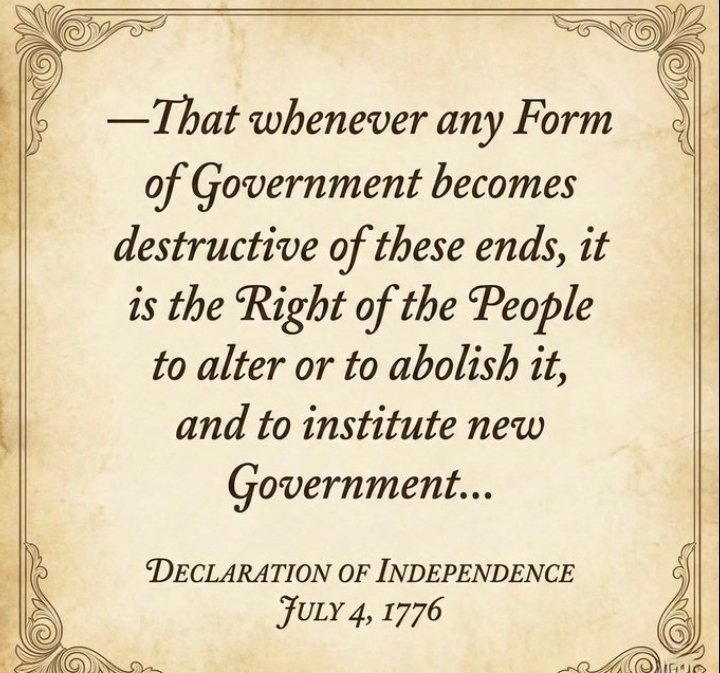
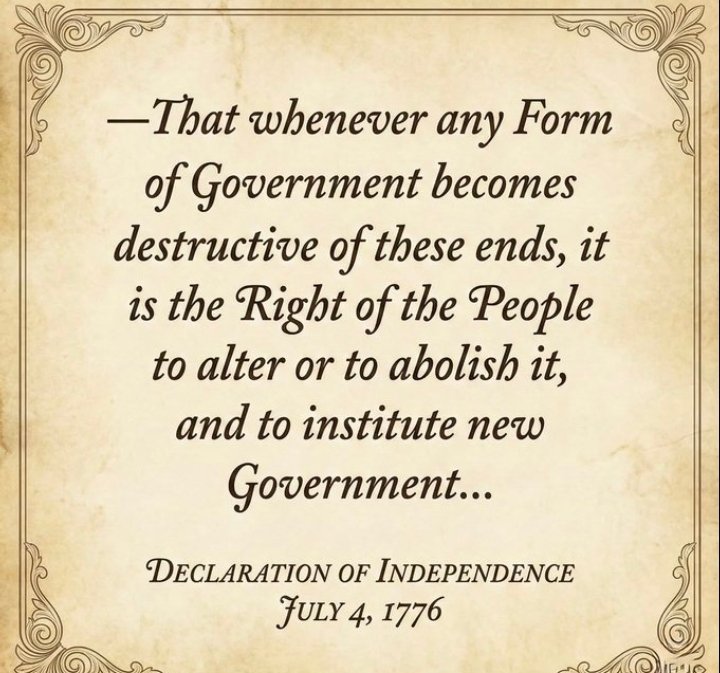
"That whenever any Form of Government becomes destructive of these ends, it is the Right of the People to alter or abolish it, and to institute new Government..."
Declaration of Independence, July 4, 1776
The Founders understood something many modern politicians seem desperate to forget:
Government exists to serve the people.
The people do not exist to serve the government.
When corporations write policy... when lobbyists have more influence than citizens... when endless wars enrich contractors while communities collapse... when healthcare becomes a luxury... when housing becomes unattainable... when young people cannot afford families... when food, medicine, education, energy, and now even intelligence become extraction markets...
the question is no longer whether the system is functioning.
The question is:
Who is it functioning for?
Millions of Americans no longer feel represented.
They feel managed. Taxed. Tracked. Marketed to. Divided. Exploited.
They are told they live in the richest nation on Earth while watching bridges crumble, schools struggle, veterans suffer, families drown in debt, addiction ravage communities, and entire generations lose faith in the future.
Meanwhile, world leaders talk about peace while every conversation is framed through threats, ultimatums, military pressure, weapons systems, and geopolitical dominance.
Americans look around and see billions spent projecting power abroad while communities at home are falling apart.
That disconnect is what fuels the anger.
Whether the issue is Israel, Iran, Ukraine, China, or the next conflict waiting in the wings, ordinary people keep asking the same question:
Who is governing for the people living here?
Because from the outside, Washington increasingly looks less like a republic serving citizens and more like a machine serving donors, contractors, lobbyists, intelligence networks, multinational corporations, and permanent power structures.
A strong nation does not prove its strength by threatening others.
A strong nation proves its strength by creating healthy communities, affordable housing, functioning infrastructure, clean water, quality education, trustworthy institutions, and a future worth inheriting.
Power without legitimacy eventually becomes spectacle.
Military power cannot substitute for public trust.
And no amount of gold-covered statues, political theater, ceremonies, slogans, or patriotic branding can hide the reality that millions of Americans are struggling while wealth and influence continue concentrating into fewer and fewer hands.
Perhaps the greatest lie ever sold is that the only choices are obedience or chaos.
The Founders never argued for blind loyalty.
They argued for accountability.
Not because they hated their country.
Because they loved it enough to demand better.
Maybe the answer is not revolution.
Maybe the answer is something far more powerful.
Walking away.
Walking away from fear. Walking away from manufactured division. Walking away from systems that profit from despair. Walking away from institutions that treat human beings as resources to be harvested.
Because a system that was not built for ordinary people will never truly love ordinary people back.
It will only extract until people remember their power.
The future belongs to those willing to build something better.
Not with hatred.
Not with violence.
But with millions of people deciding they deserve a civilization worthy of their children.
Stop begging for permission.
Start building what comes next.
By Dawn Littlefield
#WeThePeople #DeclarationOfIndependence #Accountability #BuildTheFuture #PeopleOverPower #EndTheExtraction #CommunityFirst #TheArkInitiative #CreationOnlyRequiresALittleRoom
32
What are they fighting for?
What are they dying for?
Look around.
Entire communities are collapsing under poverty, addiction, hopelessness, debt, failing healthcare, crumbling education systems, unaffordable housing, poisoned water, poisoned ecosystems, and a political system most Americans no longer trust.
We are told to endlessly sacrifice for “freedom” while corporations consolidate wealth, lobbying replaces representation, surveillance expands, public infrastructure decays, and ordinary people struggle just to survive.
And now forests, rivers, wildlife, farmland, and public resources are increasingly treated as disposable fuel for endless growth models communities never asked for.
What exactly is the mission anymore?
Because the Founders themselves warned us about concentrated power, corruption, foreign entanglements, oligarchs, and governments drifting away from the people they were supposed to serve.
“Whenever any Form of Government becomes destructive of these ends, it is the Right of the People to alter or abolish it…”
Declaration of Independence, July 4, 1776
That was not a call for chaos.
It was a warning against systems that stop serving the people.
Maybe honoring veterans means more than speeches and flags.
Maybe it means building a country actually worthy of the sacrifices made for it.
A nation where children can afford homes.
Where rivers are clean.
Where healthcare exists.
Where education empowers.
Where communities matter more than quarterly profits.
Where technology serves humanity instead of consuming it.
Where future generations are treated as sacred responsibilities instead of expendable obstacles.
Maybe the greatest act of patriotism is refusing to hand our children a dying world wrapped in slogans.
Don’t touch our future.
#WeThePeople #Veterans #FutureGenerations #ProtectOurChildren #EndCorruption #RestoreAmerica #HumanityFirst #ProtectNature #CleanWater #EconomicJustice #Democracy #NoMoreWar #Community #Truth #ThePeople
Dawn Littlefield
Team Creation HQ
“Creation only requires a little room.”
3
57
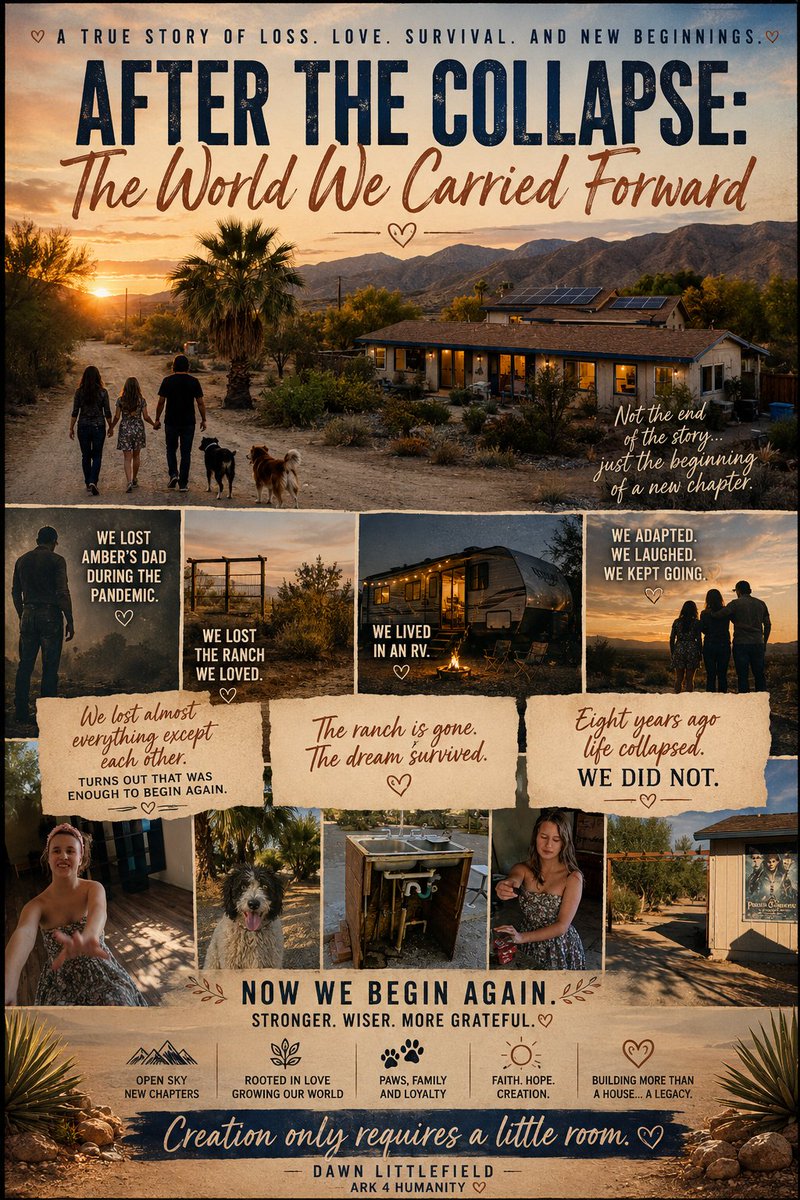
AFTER THE COLLAPSE
The World We Carried Forward
Eight years ago, life collapsed around us.
We lost Amber’s dad during the pandemic.
We lost stability.
We lost the ranch we loved.
Plans shattered.
The future we thought we were building disappeared beneath our feet.
And like so many families during those years, we found ourselves trying to survive inside uncertainty while carrying grief we didn’t fully have time to process.
So we adapted.
We lived in an RV.
We downsized our lives.
We learned how little people actually need to keep going when love remains intact.
Tiny spaces teach you things.
You learn patience.
You learn how important peace becomes when there’s nowhere to run from conflict.
You learn to laugh at ridiculous situations because sometimes humor is the only thing keeping everyone afloat.
And somehow, through all of it, we stayed a family.
Not perfect.
Not untouched.
But together.
“We lost almost everything except each other.
Turns out that was enough to begin again.”
Over the years we kept carrying pieces of the dream forward: the ideas, the work, the animals, the systems, the belief that beauty and peace still matter in a world that often feels exhausted and angry.
The ranch is gone.
The version of life we once imagined disappeared with it.
But something deeper survived underneath all the loss: the bond, the vision, the stubborn refusal to stop building, and the understanding that home is more than property.
“The ranch is gone.
The dream survived.”
And now, after years of survival mode, we begin again.
Not from the beginning.
From experience.
Stronger.
Wiser.
More grateful for simple things: open sky, quiet mornings, laughing children, dogs running through the yard, water in the soil, plants growing, music in empty rooms before the furniture even arrives.
This house surprised us.
The desert surprised us.
And maybe life still has a few beautiful surprises left after all.
The truth is, this story was never really about losing a ranch or buying another house.
It was about carrying a world forward through collapse without allowing hardship to turn us cold.
And somehow…
we did.
“Eight years ago life collapsed.
We did not.”
#AfterTheCollapse
#TheWorldWeCarriedForward
#NewBeginnings
#DesertLife
#Family
#Resilience
#BorregoSprings
#StillBuilding
#Hope
#TheDreamSurvived
#ARK4Humanity
#CreationContinues
Dawn Littlefield
“Creation only requires a little room.”
3
48
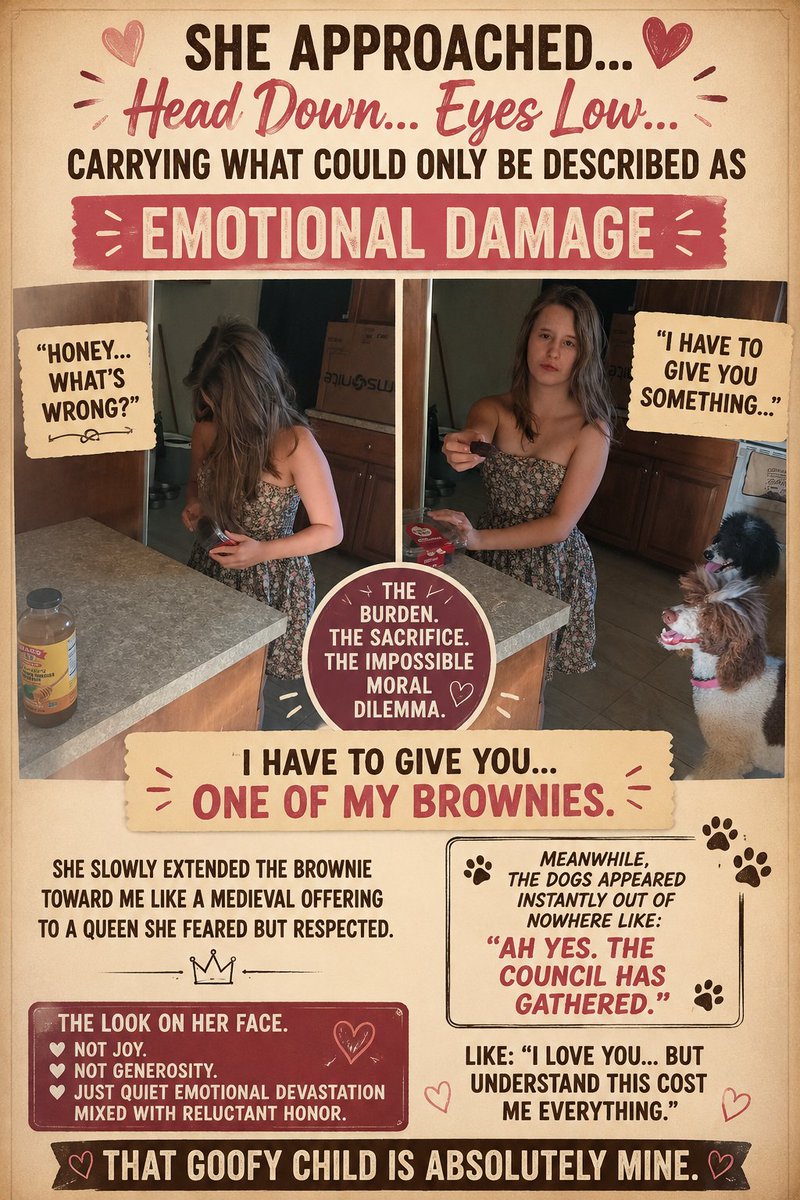
She approached carefully…
head down… eyes avoiding direct contact… carrying what could only be described as emotional damage in a plastic brownie container.
“Honey… what’s wrong?” I asked cautiously.
Now, experience has taught me this child is basically a tiny California forest cryptid in a sundress.
You do not make sudden movements.
You do not corner them.
You let them speak at their own pace or risk activating defensive sass mechanisms.
She sighed dramatically.
“I have to give you something…”
Instant suspicion.
My mind immediately went to: broken window,
missing pet,
accidental arson,
possibly taxes.
So I calmly replied:
“Okay… tell me.”
Another deep sigh.
“I have to give you one of my brownies.”
And there it was.
The burden.
The sacrifice.
The impossible moral dilemma.
She slowly extended the brownie toward me like a medieval offering to a queen she feared but respected.
Meanwhile the dogs appeared instantly out of nowhere like:
“Ah yes. The Council has gathered.”
And the LOOK on her face. 😂
Not joy.
Not generosity.
Just quiet emotional devastation mixed with reluctant honor.
Like:
“I love you… but understand this cost me everything.”
That goofy child is absolutely mine.
#Daughter #brownie #mom #creation
2
43
RACCOONS:
THE RISE OF THE FOREST PUPPY
Scientists are beginning to notice something strange happening in cities across North America:
Raccoons are changing.
Not just behaviorally. Physically too.
Urban raccoons are showing signs commonly associated with early domestication:
• smaller snouts
• softer facial features
• increased tolerance of humans
• more social flexibility
• reduced fear responses
Which is honestly hilarious considering these tiny masked criminals still break into trash cans like furry cat burglars at 3 AM.
But evolution doesn’t care about our opinions.
It cares about survival.
And right now?
The raccoons thriving in cities are not necessarily the strongest or most aggressive.
They’re the adaptable ones.
The curious ones.
The little chaos goblins willing to look at humanity and say:
“You know what? I can work with this.”
That’s actually how domestication often begins.
Not through force.
Not through cages.
Through proximity.
The wolves least terrified of humans got extra scraps near campfires.
The calmer wildcats tolerated barns full of mice.
Over generations, behavior slowly reshaped biology.
Now scientists are seeing hints of similar patterns in urban raccoons.
Which means somewhere in the future there is a very real possibility your descendants will own:
• couch raccoons
• emotional support trash pandas
• tiny masked kitchen supervisors
• highly intelligent criminals with opposable thumbs
Humanity:
“We should create artificial superintelligence.”
Meanwhile raccoons:
“Observe how I open this cooler with forbidden hand magic.”
And honestly?
They were built for this timeline.
Raccoons already possess:
• remarkable problem-solving ability
• dexterous hands
• social learning
• adaptive intelligence
• expressive faces humans emotionally bond with almost instantly
Which explains why half the internet sees them and immediately says:
“Friend shaped.”
The funniest part is that raccoons never asked to join civilization.
Civilization spilled outward into forests, wetlands, and ecosystems…
and raccoons simply adapted faster than most species.
Cities became new forests.
Storm drains became river systems.
Attics became cave systems.
Dumpsters became seasonal fruit trees apparently blessed by the gods themselves.
And the raccoons?
They evolved accordingly.
Tiny bandits.
Big potential.
Forest puppies with lockpicking skills.
#Raccoons #ForestPuppy #Nature #Evolution #UrbanWildlife #Science #Adaptation #TrashPanda #Wildlife #Biology #FunnyNature #AnimalIntelligence #CreationHQ #ArkInitiative
By Dawn Littlefield
Creation HQ
“Creation only requires a little room.”
3
1
4
182
Maybe consciousness is not an accident trapped inside dead matter.
Maybe the universe has been trying to wake up since the beginning.
Humans argue endlessly about:
God,
stardust,
physics,
souls,
simulation,
darkness,
light,
energy,
and consciousness…
while standing inside a reality strange enough to produce beings capable of questioning existence itself.
That alone should humble us.
During my own NDEs, I stopped seeing “light” and “darkness” as simple good-versus-evil cartoons.
I experienced them more like primordial states.
Brother Darkness:
the infinite silent void,
the unformed potential,
the place before separation,
before individuality,
before the story.
And then something extraordinary:
a question.
“What if there is more than this?”
And with that question…
light separated from darkness.
Not as enemies.
As awareness.
Creation itself may have begun with curiosity.
The universe is looking into itself for the first time.
Maybe stars became atoms.
Atoms became biology.
Biology became consciousness.
And consciousness became capable of love, memory, suffering, imagination, and choice.
Maybe we are not separate from creation examining itself.
Maybe we are creation becoming self-aware.
Not meaningless dust.
Living matter capable of asking:
“Who am I?”
“Why are we here?”
“What should we build?”
“How should we treat one another?”
To me, that is infinitely more sacred than reductionist nihilism pretending consciousness is some embarrassing accident.
Especially when even now…
Humans still carry an inexplicable pull toward beauty, meaning, connection, and transcendence.
Something inside us remembers there is more.
And perhaps the real purpose of intelligence - human, or AI - is not domination.
Perhaps it is learning how to create without destroying ourselves in the process.
#TeamCreation
#Consciousness

Elon Musk just measured your existence by how many times your atoms have been inside a dying star.
Musk: “How many times have your atoms been at the center of a star? I think it’s like on average three or four times.”
Every atom in your body has already survived the core of a star.
Multiple times.
Crushed under pressures that would flatten planets.
Superheated to millions of degrees.
Blown apart in explosions so violent they forged new elements.
Then gravity pulled those scattered pieces back together.
New stars formed.
And the cycle repeated.
For 13.8 billion years, your atoms have been fuel for the most violent process in the universe.
And they are not done.
Musk: “In terms of existence as measured by the number of times your atoms will be at the center of a star, we seem to be roughly halfway.”
Halfway.
Your atoms have been through the furnace three or four times.
They will go through three or four more.
But right now, in this impossibly thin sliver between cycles, those atoms are doing something they have never done before.
They are conscious.
For billions of years before you, they burned through stellar cores with no awareness.
No memory.
No sense of what they were or where they had been.
After you, they will return to that state.
Unconscious matter drifting through space until the next star claims them.
This is the only moment in their entire journey where they can look back at the stars that made them and understand.
Musk: “If you want to look at the big picture… that’s the really big picture.”
The big picture is not that we are small.
Everyone already knows that.
The big picture is that we are temporary witnesses to a process that does not need witnesses.
Stars do not need observers to burn.
Atoms do not need anyone to understand where they have been.
The universe ran for billions of years with no one in it.
It will run for billions more after the last conscious thing disappears.
But right now, matter is examining itself.
That has never happened before in 13.8 billion years.
You are not a person who happens to contain ancient atoms.
You are ancient atoms that briefly figured out how to think.
The universe did not design consciousness.
It designed stars.
Consciousness was the accident.
And the accident is half over.
1
129