
19 Nov 2025
SpecLig: Energy-Guided Hierarchical Model for Target-Specific 3D Ligand Design
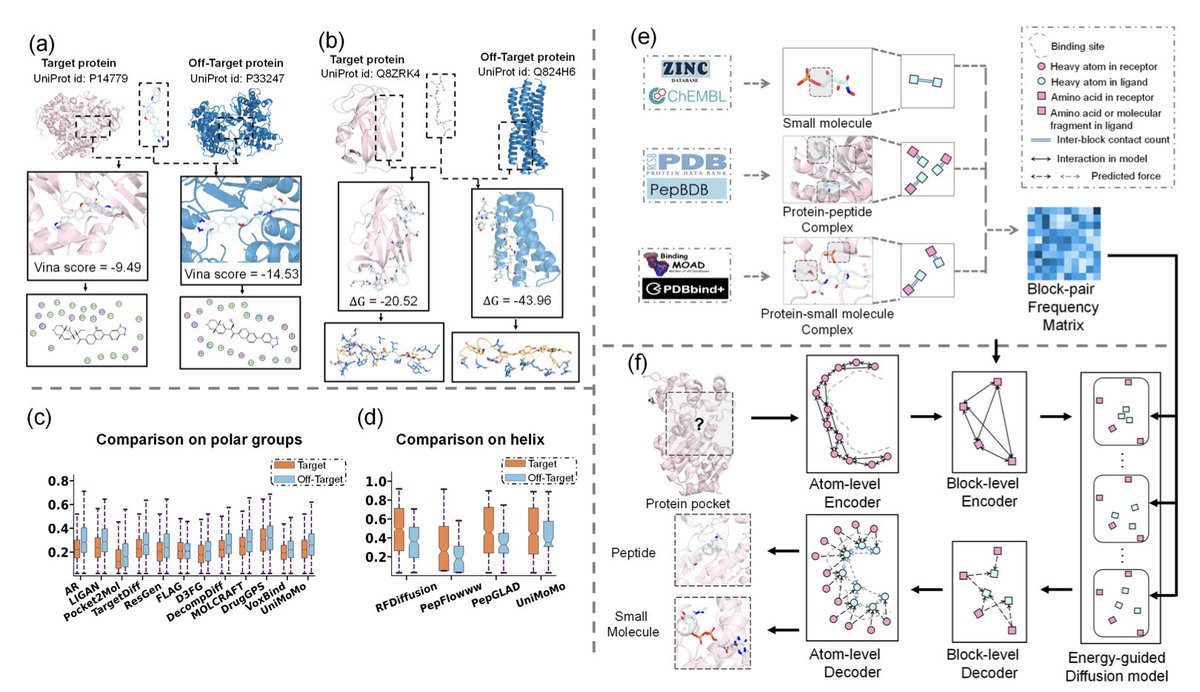
1. A new framework called SpecLig has been introduced to address the critical issue of target specificity in ligand design. This model integrates structure-based design with statistical energy guidance to generate ligands that exhibit high specificity and affinity for their intended targets.
2. SpecLig employs a hierarchical graph neural network combined with an energy-guided diffusion model. It leverages empirical block–block interaction statistics from natural protein-ligand complexes to bias the generation towards pocket-specific binding configurations.
3. The model represents protein-ligand complexes as block-based graphs, capturing both local chemistry and global topology. This hierarchical representation reduces atom-level noise and preserves fragment semantics, leading to improved specificity.
4. Evaluations on standard peptide and small molecule benchmarks show that SpecLig consistently produces ligands with higher specificity compared to existing methods, while maintaining competitive affinity and other attributes.
5. Case studies demonstrate SpecLig’s ability to mitigate off-target risks by optimizing pocket-specific geometric and chemical complementarity. This approach shows promise in advancing safer and more effective ligand candidates for drug discovery.
6. The hierarchical VAE and energy-guided diffusion components work synergistically to balance affinity and specificity. Ablation studies confirm the necessity of both components for optimal performance.
7. While SpecLig shows significant improvements in specificity, the authors note that small molecule design remains challenging due to the high complexity and sensitivity of chemical spaces. Future work may integrate richer physical cues to further enhance performance.
📜Paper: biorxiv.org/content/10.1101/…
#SpecLig #LigandDesign #TargetSpecificity #StructureBasedDesign #DrugDiscovery #AIinBiology
3
19
1,523

14 Apr 2022
Also in the Special Issue, the Review "Mechanistic insights into the versatile class II #CRISPR toolbox" by Zhiwei Huang and colleagues!
#targetspecificity #rationalengineering #PAMrestriction
bit.ly/3uGTQdJ
1
2

11 Mar 2022
Really excited to share our work on the fundamentals of non-specific binding in antibodies and the transition of molecular binding events to phase separation. Thanks to everybody involved!
@KnowlesLabCamb @biorxivpreprint @novonordisk #targetspecificity #drugdiscovery #LLPS
10 Mar 2022

Check out our preprint discovering DNA-induced LLPS of antibodies based on surface patch driven non-specific interactions: biorxiv.org/content/10.1101/…
Great work by @HAusserwoeger, @GeorgKrainer, @TimWelsh_, Tomas, @SchneiderMatth & Therese. Exciting collaboration with @novonordisk
1
8