
May 21
NAK Nation — Thursday Analysis Post 🏔️
Breaking — Judge Gleason Issues Order On Four Pending Motions
On May 19, 2026, Judge Sharon Gleason filed Document 252 in the Pebble Mine case. A five-page order resolving four pending motions.
37 days before oral argument.
Here is what happened and why it matters.
Four Motions. Three PLP Wins. One Neutral.
Motion One. PLP's request to file its Second Corrected Opening Brief. Granted without opposition. PLP's primary briefing is now in its final accepted form before the court.
Motion Two. PLP's Motion to Lift EPA's Protective Order Designations on certain documents in the administrative record. Granted in full.
Motion Three. PLP's Motion to File an Overlength Reply Brief. Granted.
Motion Four. PLP's Motion to Seal Portions of the Joint Appendix. Denied as moot based on the ruling in Motion Two.
Three rulings directly favor PLP. One is neutral procedural housekeeping. EPA's position was rejected on both contested motions.
Motion Two — The Most Significant Ruling
The documents at issue were scholarly journal articles already publicly available and State of Alaska agency documents. EPA opposed PLP's motion and proposed a compromise that would allow only the first page and cited pages of each document into the public record.
Judge Gleason rejected EPA's proposed compromise explicitly.
Her exact language. The Court finds that this proposed restriction is unreasonable given that the public could otherwise access the entirety of these documents and the import of the cited material could be lost if only the cited page itself and not the surrounding pages was available to the public.
She granted PLP's motion with respect to the entirety of the articles and other materials referenced by any party in their briefing.
EPA lost this motion entirely. Its proposed compromise was specifically called unreasonable by the judge.
There is one additional finding in this ruling worth noting carefully.
Judge Gleason documented that EPA failed to file the confidentiality designated materials with the Court when it filed the administrative record in this case. PLP had to file those missing materials itself.
EPA failed to properly include materials in its own administrative record filing. PLP corrected EPA's failure. Judge Gleason noted it in her order.
That is a small but precise example of exactly the kind of administrative and procedural inadequacy the plaintiffs have been documenting throughout their briefs.
Motion Three — The Word That Matters
Judge Gleason granted PLP's request to file a 77-page overlength reply brief. She had previously noted in an earlier order that more concise briefing is often more persuasive.
Despite that prior observation she granted the overlength request. Her stated reasoning is worth reading carefully.
The Court was persuaded by PLP's reply memorandum and in particular the fact that PLP is responding not only to EPA's brief but also to the three intervenor groups' briefs.
She was persuaded.
That is her word. Not simply granted. Not found acceptable. Persuaded.
A federal judge 35 days before oral argument chose the word persuaded to describe her reaction to PLP's briefing argument. She also explicitly acknowledged the structural asymmetry PLP faces. One plaintiff responding simultaneously to EPA plus three separate intervenor groups. She recognized that asymmetry and granted PLP the pages needed to address it fully.
Why This Order Matters Beyond The Headlines
I want to explain something that is easy to miss if you are only reading the surface of this order.
PLP is not making one argument before Judge Gleason. They are making five independent arguments each grounded in EPA's own documents. And the real power of their case is not any single argument. It is the combination of all five pointing at the same agency action from five different directions simultaneously.
Think of it like building a legal case the way a prosecutor builds a criminal case. One piece of circumstantial evidence is debatable. Five independent pieces of evidence all pointing in the same direction start to form a pattern that is very difficult to explain away. That is how PLP has constructed this case. Not one silver bullet. Five converging vulnerabilities in the same agency action.
EPA's strongest strategic response to that kind of case is to argue each argument in isolation. Take them one at a time. Make each one look like a small debatable issue that can be fixed on remand. Keep them separated so the pattern never becomes visible.
What Judge Gleason did today makes that strategy harder for EPA.
By rejecting EPA's attempt to limit the record to isolated excerpts she is allowing the full context of each document to be visible. By granting PLP the pages needed to respond to EPA and three intervenor groups simultaneously she is allowing PLP to connect the dots between all five arguments rather than being forced to compress and fragment them. By expanding public access to the complete record she is allowing the full picture of EPA's analytical gaps to be seen rather than a carefully curated selection of pages.
In plain language she is allowing PLP to present the complete case. Not pieces of it. All of it. Together. In context.
That is the procedural environment where layered multi-argument cases are most powerful. And it is the procedural environment Judge Gleason created today.
What This Order Does Not Mean
I want to be direct about this because it matters.
This order does not decide the merits. It does not tell us how Judge Gleason will rule on June 25 or in her written opinion afterward. It does not mean the veto is going to be vacated. It does not mean PLP wins.
Federal judges regularly grant procedural latitude in major complex cases. Gleason is known for thoroughness. These rulings are consistent with how she manages difficult APA litigation generally.
What this order tells us is that the judge is engaged with this case at a granular level. She is reading PLP's arguments carefully. She found PLP's reasoning persuasive on a contested procedural question. She rejected EPA's proposed restrictions as unreasonable. She documented EPA's administrative record filing failure. And she is creating the procedural environment in which PLP's strongest litigation posture can be fully presented.
That is not nothing. It is just not a merits ruling.
The Bottom Line
35 days out. The record is complete. The briefs are filed. The motions are resolved.
And the judge managing this case just rejected EPA's attempts to limit the record, granted PLP the space to present its complete case, used the word persuaded to describe her reaction to PLP's briefing, and documented EPA's failure to properly file its own administrative record materials.
Stay locked in NAK Nation. 🇺🇸🏔️
#NAKNation #PebbleMine #TheVetoUnravels #JudgeGleason #June25 #NorthernDynasty #PLP #EPA #CriticalMinerals #AlaskaComeback #CleanWaterAct #APA #Document252 #DocketUpdate #PermittingReform #Alaska #ThreeStreams #LoperBright #Sackett #Vacatur
7
5
36
2,495
May 21
NAK Nation — Thursday Analysis Post 🏔️
Breaking — Judge Gleason Issues Order On Four Pending Motions
On May 19, 2026, Judge Sharon Gleason filed Document 252 in the Pebble Mine case. A five-page order resolving four pending motions.
37 days before oral argument.
Here is what happened and why it matters.
Four Motions. Three PLP Wins. One Neutral.
Motion One. PLP's request to file its Second Corrected Opening Brief. Granted without opposition. PLP's primary briefing is now in its final accepted form before the court.
Motion Two. PLP's Motion to Lift EPA's Protective Order Designations on certain documents in the administrative record. Granted in full.
Motion Three. PLP's Motion to File an Overlength Reply Brief. Granted.
Motion Four. PLP's Motion to Seal Portions of the Joint Appendix. Denied as moot based on the ruling in Motion Two.
Three rulings directly favor PLP. One is neutral procedural housekeeping. EPA's position was rejected on both contested motions.
Motion Two — The Most Significant Ruling
The documents at issue were scholarly journal articles already publicly available and State of Alaska agency documents. EPA opposed PLP's motion and proposed a compromise that would allow only the first page and cited pages of each document into the public record.
Judge Gleason rejected EPA's proposed compromise explicitly.
Her exact language. The Court finds that this proposed restriction is unreasonable given that the public could otherwise access the entirety of these documents and the import of the cited material could be lost if only the cited page itself and not the surrounding pages was available to the public.
She granted PLP's motion with respect to the entirety of the articles and other materials referenced by any party in their briefing.
EPA lost this motion entirely. Its proposed compromise was specifically called unreasonable by the judge.
There is one additional finding in this ruling worth noting carefully.
Judge Gleason documented that EPA failed to file the confidentiality designated materials with the Court when it filed the administrative record in this case. PLP had to file those missing materials itself.
EPA failed to properly include materials in its own administrative record filing. PLP corrected EPA's failure. Judge Gleason noted it in her order.
That is a small but precise example of exactly the kind of administrative and procedural inadequacy the plaintiffs have been documenting throughout their briefs.
Motion Three — The Word That Matters
Judge Gleason granted PLP's request to file a 77-page overlength reply brief. She had previously noted in an earlier order that more concise briefing is often more persuasive.
Despite that prior observation she granted the overlength request. Her stated reasoning is worth reading carefully.
The Court was persuaded by PLP's reply memorandum and in particular the fact that PLP is responding not only to EPA's brief but also to the three intervenor groups' briefs.
She was persuaded.
That is her word. Not simply granted. Not found acceptable. Persuaded.
A federal judge 35 days before oral argument chose the word persuaded to describe her reaction to PLP's briefing argument. She also explicitly acknowledged the structural asymmetry PLP faces. One plaintiff responding simultaneously to EPA plus three separate intervenor groups. She recognized that asymmetry and granted PLP the pages needed to address it fully.
Why This Order Matters Beyond The Headlines
I want to explain something that is easy to miss if you are only reading the surface of this order.
PLP is not making one argument before Judge Gleason. They are making five independent arguments each grounded in EPA's own documents. And the real power of their case is not any single argument. It is the combination of all five pointing at the same agency action from five different directions simultaneously.
Think of it like building a legal case the way a prosecutor builds a criminal case. One piece of circumstantial evidence is debatable. Five independent pieces of evidence all pointing in the same direction start to form a pattern that is very difficult to explain away. That is how PLP has constructed this case. Not one silver bullet. Five converging vulnerabilities in the same agency action.
EPA's strongest strategic response to that kind of case is to argue each argument in isolation. Take them one at a time. Make each one look like a small debatable issue that can be fixed on remand. Keep them separated so the pattern never becomes visible.
What Judge Gleason did today makes that strategy harder for EPA.
By rejecting EPA's attempt to limit the record to isolated excerpts she is allowing the full context of each document to be visible. By granting PLP the pages needed to respond to EPA and three intervenor groups simultaneously she is allowing PLP to connect the dots between all five arguments rather than being forced to compress and fragment them. By expanding public access to the complete record she is allowing the full picture of EPA's analytical gaps to be seen rather than a carefully curated selection of pages.
In plain language she is allowing PLP to present the complete case. Not pieces of it. All of it. Together. In context.
That is the procedural environment where layered multi-argument cases are most powerful. And it is the procedural environment Judge Gleason created today.
What This Order Does Not Mean
I want to be direct about this because it matters.
This order does not decide the merits. It does not tell us how Judge Gleason will rule on June 25 or in her written opinion afterward. It does not mean the veto is going to be vacated. It does not mean PLP wins.
Federal judges regularly grant procedural latitude in major complex cases. Gleason is known for thoroughness. These rulings are consistent with how she manages difficult APA litigation generally.
What this order tells us is that the judge is engaged with this case at a granular level. She is reading PLP's arguments carefully. She found PLP's reasoning persuasive on a contested procedural question. She rejected EPA's proposed restrictions as unreasonable. She documented EPA's administrative record filing failure. And she is creating the procedural environment in which PLP's strongest litigation posture can be fully presented.
That is not nothing. It is just not a merits ruling.
The Bottom Line
35 days out. The record is complete. The briefs are filed. The motions are resolved.
And the judge managing this case just rejected EPA's attempts to limit the record, granted PLP the space to present its complete case, used the word persuaded to describe her reaction to PLP's briefing, and documented EPA's failure to properly file its own administrative record materials.
Stay locked in NAK Nation. 🇺🇸🏔️
#NAKNation #PebbleMine #TheVetoUnravels #JudgeGleason #June25 #NorthernDynasty #PLP #EPA #CriticalMinerals #AlaskaComeback #CleanWaterAct #APA #Document252 #DocketUpdate #PermittingReform #Alaska #ThreeStreams #LoperBright #Sackett #Vacatur
1
2
45
2,350
May 21
🏔️ NAK Nation 🏔️
Welcome back to The Veto Unravels.
Chapter 4
The Three Streams — Where Things Stand Today
On Monday I introduced you to Judge Sharon Gleason. Today I want to step back from the courtroom and look at the broader picture across all three streams as we move toward June 25.
This chapter is important for both new readers and longtime followers because the court case is only one part of the story. The legal, administrative, and legislative environments are all evolving simultaneously. Understanding how those streams interact is essential for understanding why the regulatory landscape surrounding Pebble looks materially different today than it did when the veto was issued.
A Quick Reminder About The Three Streams Framework
The framework is simple. Three separate processes are moving at the same time.
The court stream. The administrative stream. The legislative stream.
None independently guarantees a specific outcome within a specific timeframe. But each stream is moving in a direction that increases pressure on the legal and regulatory framework supporting the veto. And each stream reinforces the others.
A favorable court ruling strengthens the administrative stream. A finalized WOTUS rule reinforces the legal foundation of any court outcome. Legislative reform provides the long-term durability that neither litigation nor agency action can provide alone.
The streams are not just parallel. They are mutually reinforcing.
Stream One — The Court
Oral argument is scheduled for June 25 before Judge Sharon Gleason in Anchorage Alaska. The briefing record closed April 15 2026. Every major argument from every party is now fully before the court.
As discussed in Chapter 3 Judge Gleason is known for methodical technically rigorous administrative law opinions. She studies records carefully and tends to issue detailed written decisions rather than quick bench rulings. Northern Dynasty noted in its April 23 2026 press release that the court moved quickly after DOJ requested a continuance and the hearing was promptly reset. That suggests active engagement with the case and a desire to keep it moving.
The key structural point for investors is this. The plaintiffs do not need to prevail on every argument. They need one sufficiently serious defect that justifies relief under the APA. And they have presented multiple independent theories grounded in EPA's own record administrative findings and litigation positions.
That does not guarantee success. Courts often reject arguments that careful analysts initially considered persuasive. But multiple independent grounds for relief materially improve the plaintiffs' litigation posture compared to a case dependent on a single narrow theory.
Judge Gleason's ruling will likely arrive weeks or months after oral argument. Given the complexity of the case and her history of detailed opinions late summer to early fall 2026 remains a reasonable working estimate though timing ultimately depends on the court.
What A Favorable Court Ruling Would Mean
A plaintiff-favorable ruling could vacate the veto outright or remand portions of it back to EPA for reconsideration under current law. Either outcome would materially alter the regulatory posture surrounding the project.
It would reopen pathways for renewed permitting activity. It would reduce a major layer of legal uncertainty surrounding the asset. And it would likely influence how Section 404c authority is applied in future critical mineral disputes under the post-Sackett and post-Loper Bright framework.
Any ruling favorable to the plaintiffs would almost certainly be appealed by environmental intervenors and potentially accompanied by a request for a stay pending appeal. But stays are not automatic. The parties seeking one would still need to satisfy the governing legal standard including likelihood of success and irreparable harm.
That appellate process matters. But it also exists within a broader environment that is changing outside the courtroom simultaneously.
Stream Two — The Administrative Stream
The second stream is the Trump EPA's ongoing effort under Administrator Lee Zeldin to finalize a new Waters of the United States rule implementing the Supreme Court's Sackett decision.
This matters because the Pebble veto relied heavily on federal jurisdiction over wetlands within the defined veto area. Sackett significantly narrowed the scope of that jurisdiction by requiring a continuous surface connection to relatively permanent waters. The plaintiffs argue that under the Sackett framework the overwhelming majority of wetlands EPA relied upon for the veto would no longer qualify as jurisdictional waters of the United States.
If EPA finalizes a WOTUS rule closely aligned with Sackett it creates substantial tension between the legal theories underlying the original veto and the agency's own current jurisdictional framework. EPA cannot easily argue in one context for a materially narrower interpretation of federal jurisdiction while continuing to defend a veto premised on broader jurisdictional assumptions developed under a pre-Sackett framework. That does not automatically eliminate the veto on its own. But it materially complicates the long-term defense of it both legally and administratively.
The public record on the rule's progress has become increasingly specific in recent weeks.
On April 29 2026 Administrator Zeldin testified before the Senate Environment and Public Works Committee and confirmed under oath that everything EPA is doing falls within the legal boundaries Congress wrote into the Clean Water Act, referencing the WOTUS rule by name as actively moving forward.
On May 7 2026 Zeldin testified before the Senate Interior Environment and Related Agencies Appropriations Subcommittee. In his prepared opening statement he described EPA as working to create a durable and clear definition of waters of the United States faithfully abiding by the Supreme Court's decision in Sackett. During the hearing Senator Capito asked directly whether EPA was committed to following the best reading of the statute and locking in a durable standard. Zeldin responded with his clearest public commitment yet.
"It is absolutely our commitment. Following Sackett to the T. Making sure that every single word of every sentence of this definition is thought through, done correctly, and made as durable as possible."
And on Monday May 18, 2026 Zeldin posted publicly on X with language that is the most definitive status update he has provided on the rule to date.
"We are finalizing a new definition of Waters of the United States in line with the U.S. Supreme Court decision in Sackett that will eliminate the need to hire an attorney or consultant to tell you whether water on your property is a WOTUS subject to federal overreach."
We are finalizing. Those three words represent a meaningful progression from the rule is actively moving forward in April to the rule is in its final stage in May. Zeldin closed that post with four words worth noting. We are just getting started.
Senator Murkowski raised Alaska-specific concerns during the May 7 hearing about the draft rule's treatment of permafrost features and confirmed Alaska's delegation had communicated those concerns in writing. That exchange confirms the rule remains under active refinement with state-specific input still being considered. Fall 2026 remains the earliest realistic publication window.
The administrative stream extends beyond WOTUS alone. On May 12 2026 BLM rescinded the Biden administration's Public Lands Rule which had elevated conservation as a co-equal land use priority alongside mining and energy development. The following day Interior Secretary Burgum testified before the House Natural Resources Committee and stated that regulatory reform efforts aimed at accelerating domestic critical mineral development remain ongoing. Two words in that testimony deserve particular attention. Ongoing regulatory reform. Not completed. Ongoing. The Secretary of the Interior told Congress explicitly that what you have seen so far is not the end.
Stream Three — The Legislative Stream
The legislative stream may ultimately prove the most important for the long-term investment thesis because statutory reform creates durability that litigation and agency action alone cannot fully provide.
The SPEED Act and PERMIT Act have both passed the House of Representatives. Senate consideration is expected this summer although timing and final legislative language remain uncertain.
The PERMIT Act would prohibit preemptive vetoes before completion of the normal Army Corps permitting process. If enacted that would significantly constrain EPA's ability to use Section 404c authority in the manner used against Pebble.
The SPEED Act contains provisions designed to protect reconsideration processes already underway at the time of enactment. Because EPA initiated reconsideration of the Pebble veto in 2025 supporters of the project view those provisions as potentially important safeguards for the ongoing administrative process.
Legislation matters because it changes the permanence equation. Court rulings can be appealed. Agency rules can later be revised. But statutory reform requires Congress to reverse Congress. That higher level of durability matters for large-scale mining finance. Major long-duration resource projects require confidence not simply in near-term permitting outcomes but in the long-term stability of the governing legal framework.
We also know what happens when capital responds to regulatory certainty because we have a recent documented example. After Congress reversed a Minnesota mining ban a company committed 132 million dollars to a Minnesota mining project within days. Not weeks. Days. Capital does not wait for perfect certainty. It moves when the legal obstruction is removed and the direction of travel is clear.
Why The Streams Matter Together
The central point of the three streams framework is not that any single path is guaranteed.
It is that the legal, administrative, and legislative environments are all moving materially in the same direction at the same time.
A favorable court ruling increases pressure for legislative reform and strengthens the administrative reconsideration process. A finalized Sackett-aligned WOTUS rule narrows the jurisdictional theories available to defend the original veto. Legislative reform provides the long-term certainty that neither courts nor agency action can fully provide alone.
Each stream strengthens the others. That alignment is what makes the current moment materially different from the environment that existed when the veto was originally issued.
Every path leads home. Some paths are faster than others. But they all lead to the same place.
Starting Monday I begin the five-part breakdown of the plaintiff arguments of analytical significance. Those are the arguments Judge Gleason will evaluate on June 25 and understanding them is essential for understanding what matters during oral argument and why.
Stay locked in NAK Nation. 🇺🇸🏔️
#NAKNation #PebbleMine #TheVetoUnravels #JudgeGleason #June25 #ThreeStreams #SPEEDAct #PERMITAct #WOTUS #CriticalMinerals #NorthernDynasty #CopperDemand #CleanWaterAct #PermittingReform #Alaska #MineAmerica #Zeldin #Sackett #LoperBright #Burgum
4
6
30
1,330
May 20
🏔️ NAK Nation — Breaking News! 🏔️
Something happened today that NAK Nation needs to understand in context.
chinadaily.com.cn/a/202605/2…
This is not part of the series. But it connects directly to everything the series has been building toward.
What China Just Did
Today the Chinese government published new regulations implementing its revised Mineral Resources Law. Premier Li Qiang signed the decree personally. The regulations take effect June 15 2026. Ten days before oral argument in the Pebble Mine case.
The regulations consist of 8 chapters and 79 articles.
They cover improvements to the mining rights system. Rules on mineral resource exploration and exploitation. Ecological restoration requirements in mining areas. And what the Chinese government describes explicitly as safeguarding mineral resource security and improving the mineral resource reserve and emergency response system.
Read that last phrase carefully.
Mineral resource security. Reserve system. Emergency response.
China is not describing mining regulations in economic terms. It is describing them in national security terms. Strategic stockpiles. Emergency reserves. Safeguarding supply. That is the language of a country that understands exactly what it controls and is taking deliberate legal steps to protect and formalize that control.
Why The Timing Matters
Three weeks ago US Trade Representative Jamieson Greer told the Financial Times that American allies must pay a national security premium for critical minerals sourced outside China. His words were direct.
"There is a premium we pay and I call it the national security premium."
Two weeks ago Interior Secretary Doug Burgum told the Export-Import Bank conference that critical minerals are the backbone of the economy and committed the administration to reestablishing American dominance in critical minerals.
One week ago EPA Administrator Lee Zeldin appeared on a major podcast and described precisely why agencies can no longer stretch statutory language beyond what Congress authorized. He cited Loper Bright. He cited the major questions doctrine. He described the entire legal framework that governs the Pebble Mine case without mentioning it by name.
And today China formalized its control over its domestic mineral resource base in binding law signed by its Premier.
Every one of those developments points in the same analytical direction. The global competition for critical mineral supply security is not a future concern. It is happening right now. And it is intensifying.
What This Means In Plain Language
China currently dominates the global supply chain for many of the critical minerals the United States and its allies need for energy transition national defense and advanced manufacturing. That dominance did not happen by accident. It happened because China made deliberate long-term strategic decisions to develop control over mineral resources while the United States was doing things like issuing preemptive vetoes over the world's largest undeveloped copper deposit.
Today China took another deliberate step. It formalized that control in binding national law. Mineral resource security is now explicitly a legal obligation of the Chinese state codified in 79 articles signed by the Premier.
The United States response to that reality is playing out simultaneously across three streams that this series has been documenting for weeks. A federal court is being asked to determine whether a legally indefensible preemptive veto should have blocked development of 57 billion pounds of American copper in the first place. An EPA administrator is finalizing a new regulatory framework that will eliminate the jurisdictional foundation of that veto. And Congress is advancing legislation that would permanently prevent any future administration from using the same regulatory tool to block critical mineral development again.
The Juxtaposition Is Striking
China formalizes mineral resource security in binding law on June 15 2026.
The United States federal court hears oral argument on whether a preemptive veto that blocked the world's largest undeveloped copper deposit was lawful on June 25 2026.
Those two dates are ten days apart.
That juxtaposition is not a legal argument. It is not a factor Judge Gleason will consider in her ruling. Courts decide cases on the law not on geopolitical context.
But it is a powerful illustration of the broader stakes. While China is tightening its grip on its mineral supply base with binding national law the United States is still litigating whether it should have blocked its own flagship critical mineral project before anyone even submitted a permit application.
The asymmetry is its own argument.
The Bottom Line
Pro-development governments that understand the strategic value of critical minerals do not leave 57 billion pounds of domestic copper in the ground blocked by a legally indefensible preemptive veto.
The legal case is proceeding. The administrative stream is advancing. The legislative framework is being built. And today China reminded the world why all of it matters.
Stay locked in NAK Nation. 🇺🇸🏔️
#NAKNation #PebbleMine #TheVetoUnravels #CriticalMinerals #China #MineralResourceSecurity #NorthernDynasty #AlaskaComeback #CopperDemand #NationalSecurity #June25 #JudgeGleason #ThreeStreams #PermittingReform #AmericaFirst #AlaskaFirst #MineAmerica #Zeldin #Burgum #Greer #SPEEDAct #WOTUS #LoperBright
1
5
39
3,421
May 20
🏔️ NAK Nation — Wednesday Analysis Post 🏔️
They Keep Saying The Same Thing
Over the past nine days four senior officials have made public statements about Alaska resource development and American critical minerals policy.
Read these back to back slowly.
Secretary Burgum on May 13.
"Ongoing regulatory reform to cut red tape will continue."
EPA Administrator Zeldin on May 19.
"We are just getting started."
Senator Murkowski on Monday.
"This is also just the start."
Senator Sullivan on Monday.
"The Alaska Comeback continues."
These are not coordinated talking points from a single press release. They are four separate officials in four separate settings over nine days all saying the exact same thing in different words.
What you have seen so far is not the end.
There is more coming.
The direction of travel is set. The destination has not yet been reached.
For NAK Nation that consistency is not coincidence. It is a pattern. And the most important Alaska resource development case in the Clean Water Act's fifty year history has oral argument in 36 days.
Congressman Begich said it best.
"That kind of opportunity only exists because people were willing to reject the idea of decline, think long-term, and invest in Alaska's future."
That is the Pebble Mine investment thesis in one sentence.
Oral argument before Judge Gleason is 36 days away.
Chapter 4 of The Veto Unravels posts Thursday.
Stay locked in NAK Nation. 🇺🇸🏔️
#NAKNation #PebbleMine #TheVetoUnravels #AlaskaComeback #Burgum #Sullivan #Murkowski #Begich #CriticalMinerals #NorthernDynasty #ThreeStreams #June25 #JudgeGleason #PermittingReform #MineAmerica #AlaskaFirst #AmericaFirst #Zeldin #Sarah Palin
5
10
34
2,190
May 15
🏔️ NAK Nation — Friday Analysis Post 🏔️
The Silence Just Got Louder.......Shush
Ten days ago I wrote about the power of what people choose not to say.
I made a specific observation. Donald Trump Jr. hosted EPA Administrator Lee Zeldin on his podcast Triggered in May 2025. They talked for an entire episode. Not one word about Pebble Mine. Not a single mention of the world's largest undeveloped copper deposit sitting on Alaska state land. From the man whose opposition helped complicate things during the first Trump administration.
I called it a signal.
One piece of a larger pattern pointing in the same direction.
Yesterday, Zeldin was back on the Trump Jr.'s podcast called 'Triggered'.
What They Talked About
Sixty minutes. Zeldin and Trump Jr. covered a lot of ground.
Loper Bright and why it fundamentally changed how agencies interpret statutes. West Virginia v EPA and the major questions doctrine. Why the old Chevron-era approach of agencies stretching statutes because Congress had not explicitly prohibited something is no longer the governing framework. The Biden EPA's regulatory philosophy. Deregulatory reform. Energy dominance. Permitting backlogs. Executive authority. Economic growth alongside environmental stewardship.
And repeatedly throughout the interview Zeldin returned to the same phrase.
"The best reading of the law."
Not once. Repeatedly.
He described it as the governing standard for how the Trump EPA approaches agency decision making after Loper Bright. He explicitly stated that the old Chevron framework no longer controls. He argued agencies must now ground their actions in the actual statutory text Congress enacted rather than expansive interpretations built on silence or ambiguity.
Sixty minutes. Two people. One of them the EPA Administrator overseeing the exact agency now reconsidering the Pebble veto framework. The other the president's son with a well documented prior history with this specific project.
Not one word about Pebble Mine.
Why This Matters
Some of you will remember what I wrote on May 4.
One silence can be coincidence.
Two silences in the same setting with the same people across separate appearances starts looking like a pattern.
What makes today analytically significant is not simply that Pebble was omitted. It is what replaced it.
Zeldin spent the interview describing in plain language the exact legal doctrines now governing federal agency action.
Agencies must follow the best reading of the statute. Chevron deference is gone. Major agency actions require clear congressional authorization. Agencies cannot simply assume power because a statute does not explicitly forbid it.
Those are not abstract academic principles. Those are the exact legal standards Judge Gleason must apply on June 25. And they map directly onto the legal vulnerabilities at the heart of the Pebble veto. A veto issued before Loper Bright. Before Chevron deference was eliminated. Before agencies were required to defend not merely a reasonable interpretation of a statute but the best one.
Zeldin never mentioned Pebble Mine by name. Trump Jr. never brought it up.
But the governing legal framework discussed for an hour is the same framework sitting before Judge Gleason on June 25.
The Pattern
On May 4 I outlined multiple developments all pointing in the same direction. The Day One Executive Order prioritizing Alaska resource development. Zeldin personally approving reconsideration language regarding the veto. The Section 4 procedural framework protecting reconsideration authority.
Ongoing WOTUS revisions after Sackett. The administration-wide emphasis on permitting reform and domestic mineral production. The DOJ defending the veto in court while simultaneously operating inside a post-Loper Bright framework far less favorable to expansive agency authority than the framework that existed in January 2023.
Today adds another data point.
Two appearances. Roughly two hours of combined conversation between the EPA Administrator and the president's son. Zero mentions of Pebble Mine.
I cannot prove intent from silence alone. But patterns matter. And what I observe is an EPA Administrator repeatedly and publicly articulating a legal philosophy fundamentally hostile to broad Chevron-era agency expansion while never once publicly defending the legal theory underlying the Biden EPA's Pebble veto.
He does not need to say the name.
The legal framework says enough on its own.
Stay locked in NAK Nation. 🇺🇸🏔️
Have a great weekend!
#NAKNation #PebbleMine #Zeldin #TheVetoUnravels #NorthernDynasty #CriticalMinerals #AlaskaComeback #CopperDemand #LoperBright #June25 #JudgeGleason #CleanWaterAct #PermittingReform #ThreeStreams #AmericaFirst #AlaskaFirst #MineAmerica #DrainTheSwamp
4
36
1,851
May 14
🏔️ NAK Nation — Thursday Analysis Post 🏔️
As previously communicated X is discontinuing its Communities feature at the end of May. That includes the NAK Pebble Mine Community. If you have not already done so, please follow me directly on X now so you do not lose the connection to this analysis going forward.
While you’re at it, I’d also like to encourage NAK Nation to follow some of the other outstanding content creators in this community — Tye, Kris, Joseph, and others who have done exceptional work keeping everyone informed and engaged. This story is best understood from multiple perspectives, so these are voices worth following directly before the community disappears.
Welcome back to The Veto Unravels.
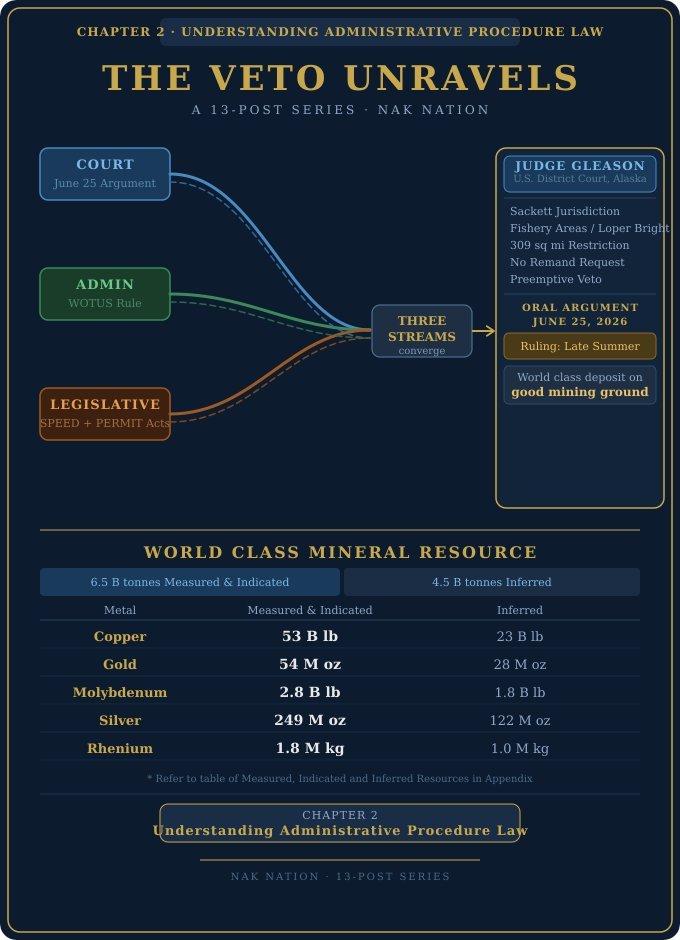
Chapter 2:
UNDERSTANDING ADMINISTRATIVE PROCEDURE LAW
Today I want to answer a question that almost everyone following this story has never had answered clearly.
What actually happens in a federal courtroom on June 25.
There is no jury. There are no witnesses. There is no new evidence. Nobody is testifying about salmon or copper or Alaska land rights.
What is happening on June 25 is something called oral argument before a federal judge on cross motions for summary judgment in an Administrative Procedure Act case. That sounds like a mouthful. Every part of it matters and I am going to explain each piece in plain language.
What Is An APA Case And Why Is This One Different From Other Court Cases
The Administrative Procedure Act is the federal law that governs how government agencies make decisions and how courts review those decisions. It was passed by Congress in 1946, and it is one of the most important laws in the American legal system that most people have never heard of.
Here is the simplest way to understand what an APA case is.
In an ordinary court case, a judge decides what happened. Who did what. Whether the facts support a legal claim. Witnesses testify. Evidence is introduced. The judge or jury weighs everything and reaches a conclusion about the facts.
An APA case is completely different. In an APA case the judge does not decide what happened. The “what” has already been established. In this case, the EPA issued a preemptive veto in January 2023. The judge's job is to decide whether the agency followed the rules when it made its decision. It is really that simple. It is all about “the how”. Specifically, how did the EPA come to a decision to invoke a preemptive veto on the Pebble Mine project.
Think of it like a hockey game. A referee makes a controversial call on the ice. In an ordinary court case, you are arguing about whether the call was right or wrong. Did the puck actually cross the line. Was the player actually offside. You are debating the play itself.
In an APA case you are not arguing about the play (what happened) at all. You are arguing about something more fundamental. Did the referee (EPA) have the authority to make that call in the first place. And when the referee (EPA) made it did the referee (EPA) follow the official rulebook of the game or were the rules stretched.
That is exactly what this case is. The Biden EPA made a call in January 2023. It issued a preemptive veto of the Pebble Mine. The plaintiffs are not primarily arguing the call was wrong on the science. The plaintiffs are arguing that the referee (EPA) exceeded its authority and did not follow the rulebook when making it.
And the rulebook in this case has two parts. The Clean Water Act written by Congress. And the Administrative Procedure Act governing how agencies must behave.
This is the first and only time the Biden EPA's 2023 preemptive veto has ever been challenged in court. Northern Dynasty PLP the State of Alaska and the Iliamna Native Corporations filed their lawsuits in 2024. Judge Gleason is the first judge in history to review whether what the Biden EPA did in January 2023 was lawful. That matters enormously as I will explain shortly.
What Is The Biden Veto And What Documents Are Being Reviewed
Let me make sure every reader understands exactly what this case is about before we go any further.
In January 2023 the Biden EPA issued what is called a Final Determination under Section 404c of the Clean Water Act. To be crystal clear, this was the preemptive veto of the Pebble Mine project. Preemptive means EPA issued it before PLP ever filed a complete permit application. Before the normal permitting process was finished. Before PLP had formally designated any specific disposal sites. It was the first and only preemptive veto in the fifty-year history of this law.
Along with the Final Determination the 2023 Biden EPA also published a 966-page document called the Response to Comments. That document contains EPA's official responses to every legal scientific and factual argument raised against the veto during the public comment period.
I want to stop here and make sure NAK Nation understands just how important these two documents are. They are not background reading. They are the foundation of this entire legal case.
The Final Determination is the Biden EPA's official legal justification for issuing the veto. Every argument the EPA made. Every legal standard it applied. Every factual conclusion it reached. It is all in that document.
Arguably, these two documents are the most important documents in this entire case. They are the dividing line between truth and deception. If you do not understand these documents, you do not understand the case. It is that simple. Every argument, every violation, every contradiction, and every act of misconduct exposed in this fight traces directly back to what is written in these pages.
Think of these documents as the foundation of a skyscraper: if the foundation is corrupt, cracked, or deliberately concealed, everything built on top of it becomes unstable. That is exactly why these documents matter. They are the foundation upon which this entire case stands or falls.
When Judge Gleason asks whether the Biden EPA followed the law she is measuring what EPA said and did in the Final Determination against the legal standards the Clean Water Act and the Supreme Court require.
The Response to Comments document is equally important and, in some ways, even more revealing. It is the document where EPA responded to every challenge raised during the public comment period including the specific legal arguments that PLP and others made against the veto before it was even issued. When challengers pointed out legal problems, EPA had a chance to address them.
What EPA wrote in response to those challenges and what it chose not to address are both analytically significant.
Some of the most important admissions in this entire case appear in that 966-page document. Admissions we will examine closely in Chapters 5 and 6.
Together the Final Determination and the Response to Comments are the administrative record at the heart of this lawsuit. They are the evidence Judge Gleason is working from. They represent everything the Biden EPA said and did when it issued the veto. And critically they are fixed evidence that are frozen in time. They cannot be altered or changed. They cannot be supplemented. There is no do over. What is in those documents is what EPA has to defend. And what is in those documents is what Judge Gleason will be measuring against the law.
The Clean Water Act Is Her Guide But Through A Completely Different Lens
Judge Gleason is not making this decision based on her personal views about mining or salmon or Alaska development. She is making it based on what the law actually says.
The primary legal text she will be working from is the Clean Water Act. Specifically, Section 404c which is the provision that gave EPA the authority to issue the veto in the first place.
Section 404c uses specific words. It authorizes EPA to veto a permit when the discharge of materials will have:
"unacceptable adverse effects on fishery areas including spawning and breeding areas"
Those words are not suggestions. They are the legal boundary of EPA's authority. Every single word in that phrase matters. What fishery areas means. What spawning and breeding areas mean. What unacceptable adverse effects means. What will have means.
Judge Gleason must read those words carefully, apply every available tool of legal interpretation and determine what they actually authorize. She is not asking whether EPA's environmental concerns were sincere. She is asking whether the specific words Congress wrote in the Clean Water Act authorized the EPA to do what it did.
This distinction is critical. The Clean Water Act is the official rulebook. Judge Gleason is the senior referee reviewing whether the agency followed it.
BUT………here is what makes this case unlike anything that has come before it. Judge Gleason is reading the Clean Water Act through a new lens that did not exist when the Biden EPA issued the veto.
Two Supreme Court decisions handed down after January 2023 fundamentally changed how courts must interpret and apply that statute. And because this is the first time the veto has ever been challenged in court it is also the first time it is being examined under these new legal standards.
The Biden EPA never had to defend its veto under these rulings. It issued the veto before they existed. Now for the first time a court is reviewing that veto using legal tools the agency never anticipated and never designed its veto to survive.
The Two Supreme Court Rulings That Changed Everything And Why Their Timing Is Critical
This is the part of the story that most retail investors following NAK have not fully absorbed. And it is arguably the most important analytical point in the entire series.
The Biden EPA issued its preemptive veto in January 2023.
Just four months later in May 2023 the Supreme Court decided Sackett v EPA unanimously. Nine to zero. Every single justice agreed. This ruling significantly narrowed which wetlands and waterways qualify as protected waters under the Clean Water Act. It eliminated the broad ecological connectivity theory EPA had been using to claim jurisdiction over vast areas of wetlands and replaced it with a strict requirement.
The government must now prove a continuous surface connection between a wetland and a relatively permanent water body for each specific water feature individually. Feature by feature. Not generally. Not approximately. Each one specifically.
The Biden EPA issued its veto under the rules in the old rulebook. The old rules no longer exist.
One year later in June 2024 the Supreme Court decided Loper Bright Enterprises v Raimondo. This ruling eliminated something called Chevron deference which had existed for forty years. Under Chevron deference courts were required to defer to an agency's interpretation of ambiguous statutes as long as that interpretation was reasonable. In plain language that meant agencies like EPA could stretch the meaning of words in the Clean Water Act and courts would generally accept it.
Loper Bright eliminated that deference entirely. Courts must now independently determine the best reading of every statutory term. Not a reasonable reading. The best reading.
The Supreme Court stated this explicitly in its own majority opinion.
"It therefore makes no sense to speak of a permissible interpretation that is not the one the court after applying all relevant interpretive tools concludes is best. In the business of statutory interpretation if it is not the best it is not permissible."
Read that again slowly. If it is not the best reading of the statute it is not permissible. Full stop.
The Biden EPA issued its veto in January 2023 before either of these Supreme Court decisions existed. It built the entire legal foundation of the veto on rules that the Supreme Court subsequently eliminated.
1.The significant nexus test for jurisdiction that Sackett abolished.
2.The broad deference to agency interpretation that Loper Bright removed.
This veto has never been challenged in court before. This is the first time. Which means this is also the first time any court has ever examined this veto through the lens of Sackett and Loper Bright. The Biden EPA designed its veto to survive under a legal framework that no longer exists. It never had to answer for what it did under the framework that actually governs today.
Judge Gleason is not reviewing the veto under the rules of January 2023. She is reviewing it under the rules of here and now in June of 2026. Rules that are fundamentally more demanding. Rules that require her to independently determine the best reading of every key statutory term in the Clean Water Act. Rules that require feature-by-feature jurisdictional proof rather than generalized assertions.
Going back to the hockey analogy. Imagine the referee made a call under one set of rules. The league then changed the rulebook significantly. And now for the first time the call is being reviewed by an official who must apply the new rulebook not the old one.
That is precisely the situation before Judge Gleason on June 25, 2026. And EPA's own DOJ lawyers in their February 2026 court brief made an admission that is now extraordinarily significant under Loper Bright. On page 76 of their 143-page brief defending the veto they wrote:
"EPA's definition of fishery areas is reasonable if not the best reading of the statute."
Not the best reading. Their words. In their own brief. Under Loper Bright that sentence alone may be the most consequential admission in the entire case. We will explore exactly why in Chapter 6.
What Oral Argument Actually Is
This case is decided entirely on the written record. The record is closed. No new information enters the room on June 25. What happens is the lawyers come before Judge Gleason and argue about what the existing record means legally under the Clean Water Act as read through the lens of Sackett and Loper Bright.
Oral argument is not a presentation. It is a conversation between the judge and the lawyers. Each side gets a limited amount of time to speak but the judge interrupts whenever she has a question. Those interruptions are not a bad sign. They are the entire point of the exercise.
Judge Gleason has been living with this case for over a year. By June 25 she will have read every brief every exhibit and every legal citation multiple times. She already knows the arguments. What she does not know yet is how the lawyers respond when she pushes back hard on the weakest parts of their positions. That is what oral argument reveals.
When Judge Gleason asks her questions she is evaluating the Biden EPA's veto against five specific legal standards that the Administrative Procedure Act establishes. She is asking whether the agency action was arbitrary and capricious. Whether it was contrary to law. Whether it was unsupported by the record. Whether it was procedurally improper. Or whether it exceeded the agency's statutory authority entirely. These are not abstract concepts. They are the precise legal tests she applies to the Final Determination and the Response to Comments. And the plaintiffs have built specific documented arguments against the Biden EPA's veto under each one of them.
In complex environmental cases like this one the judge also uses oral argument to clarify technical or factual disputes already contained in the administrative record. Judge Gleason is not deciding the salmon science. But she may ask pointed questions about how the scientific record was used to justify specific legal conclusions. Those questions will tell you which parts of the record she finds most problematic.
Why The Questions Are The Most Important Signal Of The Day
The questions Judge Gleason asks are more informative than anything the lawyers say.
A judge who has already made up her mind on a specific question moves past it quickly. A judge who is genuinely wrestling with a question presses both sides hard. She tests the arguments from multiple angles. She looks for weaknesses.
The first fifteen minutes of the government's presentation will be especially revealing. The issues Judge Gleason addresses first are the ones she is most focused on. If she opens immediately on the fishery areas argument that is where her analysis is most concentrated. If she opens on the jurisdictional question that is the issue she finds most pressing. If she opens directly on remedy she has already concluded there are errors and is thinking about what happens next.
Pay very close attention to how she asks her questions. Not just what she asks. A skeptical tone directed at the government is a signal. A skeptical tone directed at the plaintiffs is also a signal. Both matter enormously.
And here is the most important thing to understand about what is actually happening in that courtroom on June 25. Oral argument is not just about testing legal arguments. It is where Judge Gleason determines how to structure and justify her written ruling. Every question she asks is helping her build the architecture of the opinion she will eventually publish. When she presses DOJ hard on a specific point she is often working through how she will explain that point in writing. June 25 is where the shape of the ruling becomes visible for the first time.
A Note About The DOJ Lawyers
The DOJ lawyers arguing in court on June 25 are career government attorneys defending the Biden EPA's 2023 veto because that is their professional obligation regardless of which administration is currently in office. Their presence in the courtroom does not mean the Trump administration supports the veto. Career DOJ lawyers defend inherited agency actions. That is their job. Full stop.
If there is any doubt about where the Trump administration actually stands consider what happened on April 29, 2026. Administrator Zeldin testified before the Senate Environment and Public Works Committee and Chairman Shelley Moore Capito asked him directly:
"I think it is important to emphasize at this point that the Clean Air Act and Clean Water Act written by Congress all of what you are doing here falls within the boundaries of what we have directed you to do. Is that correct."
Zeldin answered:
"Yes ma'am."
That exchange is the governing legal framework of this entire case stated explicitly under oath before the United States Senate. Congress writes the law. Agencies operate within their boundaries. Courts enforce those boundaries. That is the Administrative Procedure Act. That is the Loper Bright framework confirmed under oath by the EPA Administrator himself on April 29, 2026. In the same testimony Zeldin specifically referenced the new Waters of the United States rule confirming it is actively moving forward.
The actions and the sworn testimony point in one direction. The DOJ lawyers in the courtroom are simply fulfilling their professional obligations. Those are two entirely separate things.
What You Are Actually Watching On June 25
You are watching a federal judge apply the Clean Water Act and the Administrative Procedure Act to determine whether the Biden EPA followed the law when it issued the most unprecedented regulatory veto in the fifty-year history of that statute.
She is doing it for the very first time. No court has ever examined this veto before. The Biden EPA issued it in January 2023 expecting it would be defended under a legal framework that no longer exists. Judge Gleason is reviewing it under a legal framework the agency never anticipated. Measuring every word in those fixed unchangeable documents against a legal standard far more demanding than anything in place when they were written.
That is the historic nature of what happens on June 25. The first legal challenge to a first of its kind veto. Reviewed for the first time under first of their kind Supreme Court standards. In a courtroom where the questions the judge asks will tell us everything about what is coming.
Coming Monday I will introduce you to Judge Sharon Gleason herself.
Stay locked in NAK Nation. 🇺🇸🏔️
#NAKNation #PebbleMine #TheVetoUnravels #OralArgument #JudgeGleason #June25 #CriticalMinerals #NorthernDynasty #AlaskaComeback #CopperDemand #CleanWaterAct #APA #LoperBright #Sackett #PermittingReform #ThreeStreams #SPEEDAct #Vacatur #RemandWithoutVacatur #SarahPalin #Alaska #AlaskaFirst #AmericaFirst #MineAmerica
7
10
39
2,422
May 13
🏔️ NAK Nation — Wednesday Analysis Post 🏔️
Something happened yesterday and today that NAK Nation needs to see.
This is not part of the series. This is the story unfolding in real time.
The Administrative Stream Just Moved
Yesterday May 12 2026 the Bureau of Land Management rescinded the Biden administration's Public Lands Rule. Also known as the Conservation and Landscape Health Rule. That rule had elevated conservation as a primary use of federal public lands placing it on equal footing with mining energy grazing and timber. In plain language it was one of the regulatory layers the Biden administration used to create a hostile environment for large scale resource development on federal lands.
House Natural Resources Committee Chairman Bruce Westerman was direct. The rescission unlocks resource-rich lands for key uses such as energy production mining grazing timber and outdoor recreation.
One regulatory layer removed. One more step in the same direction.
Then Burgum Testified
Today May 13 2026 Interior Secretary Doug Burgum testified before the House Natural Resources Committee. I want to quote him directly.
On the administration's regulatory agenda:
"We have eliminated burdensome ideological counterproductive regulations that undermined efficient land management while maintaining appropriate protections of our wildlife and environment. Ongoing regulatory reform to cut red tape will continue to secure supply chains unlock American energy reduce prices deliver better outcomes for the American people."
On critical minerals:
"Under this administration Interior along with the rest of the administration is committed to increasing our energy production reestablishing our position as dominant in critical minerals protecting our economic and national security."
Two Words Every NAK Investor Needs To Read Again
Go back and listen to Burgum's first quote. Not the whole thing. Just two words.
Ongoing regulatory reform.
He did not say we have completed our work. He did not say the obstacles have been removed. He said ongoing. That word is deliberate. It is the Secretary of the Interior testifying under oath before Congress that what you have seen so far is not the end. It is the continuation of a process that is still in motion.
The Public Lands Rule rescission happened yesterday. The WOTUS rule is being finalized. The SPEED Act and PERMIT Act are moving through the Senate. The Pebble Mine veto reconsideration is underway. Oral argument before Judge Gleason is 43 days away.
Every one of those things is part of the ongoing regulatory reform Secretary Burgum described today. And he told Congress explicitly that it will continue.
The Pattern Is Clear
The Day One Executive Order unleashing Alaska's resource potential. The Zeldin personal approval of veto reconsideration language. The WOTUS rulemaking. The Dalton Corridor land transfer. The permitting reform legislation. The April 29 Senate testimony where Zeldin confirmed everything EPA is doing falls within the legal boundaries Congress wrote into the Clean Water Act. And now the BLM Public Lands Rule rescission and Burgum's testimony about critical minerals dominance and ongoing regulatory reform.
Each action is a data point. Together they form a pattern that is directionally consistent and accelerating. And the man responsible for America's federal lands just told Congress under oath that it is not finished yet.
The world's largest undeveloped copper deposit. 57 billion pounds of copper. 71 million ounces of gold. Sitting on Alaska state land. Waiting.
Pro-business governments do not leave a trillion dollars worth of critical minerals in the ground. Full stop.
Chapter 2 of The Veto Unravels posts Thursday. Stay locked in NAK Nation. 🇺🇸🏔️
#NAKNation #PebbleMine #Burgum #BLM #PublicLandsRule #CriticalMinerals #NorthernDynasty #AlaskaComeback #CopperDemand #TheVetoUnravels #ThreeStreams #AdminStream #PermittingReform #AmericaFirst #AlaskaFirst #MineAmerica #Zeldin #SPEEDAct #WOTUS #June25 #JudgeGleason #DrillBabyDrill #SarahPalin #OngoingRegulatoryReform

.@SecretaryBurgum: "We have eliminated burdensome, ideological, counterproductive regulations that undermined efficient land management, while maintaining appropriate protections of our wildlife and environment. Ongoing regulatory reform to cut red tape will continue to secure supply chains, unlock American energy, reduce prices, deliver better outcomes for the American people."
5
12
44
2,553
May 11
🏔️ NAK Nation — Monday Analysis Post 🏔️
A quick reminder before I get into today's post.
As previously communicated X is discontinuing its Communities feature at the end of May. That includes the NAK Pebble Mine Community. If you have not already done so, please follow me directly on X now so you do not lose the connection to this analysis going forward.
While you’re at it, I’d also like to encourage NAK Nation to follow some of the other outstanding content creators in this community — Tye, Kris, Joseph, and others who have done exceptional work keeping everyone informed and engaged. This story is best understood from multiple perspectives, so these are voices worth following directly before the community disappears.
Now let me tell you what the next seven weeks are going to look like.
THE VETO UNRAVELS
That is the name of the series I am launching today.
I chose those three words carefully. Not because I am promising you a specific outcome. I am not a lawyer and I never oversell certainty that does not exist in a legal case. But because when you read the actual documents in this case the ones EPA filed the ones DOJ filed the ones PLP filed and the Supreme Court rulings that changed the legal landscape after the veto was issued what you find is remarkable.
This series has one purpose. To take the most important legal case in this project's history and explain it in plain language so that every person in this community understands exactly what is at stake and exactly what the documents actually show. The best investment decisions come from the best information. My job in this series is not to tell you what to think. It is to make sure you have access to the same documented evidence that the lawyers in this case are arguing about in front of a federal judge. Armed with that information you can draw your own conclusions. No hype. No agenda. Just the information you deserve to have.
The legal foundation underlying this veto has faced increasing pressure since the day it was issued. Not because of political pressure. Not because of advocacy. But because of legal questions embedded in EPA's own administrative record that the courts are now required to confront under a very different judicial framework than existed in January 2023.
For two years this community has watched and waited. You have held through dilution through political reversals through what felt like endless delay. You stayed because you believed in the asset. You believed in the deposit. And you believed that eventually the legal system would have to confront the legal and factual questions embedded in the record.
That reckoning is now 45 days away.
I have spent months reading the primary source documents in this case. EPA's Final Determination. The Response to Comments. The DOJ brief. The plaintiff briefs. The Supreme Court decisions that reshaped administrative law after the veto was issued. And what I found is a case that is materially stronger than most retail investors realize. Stronger than the promoters will tell you because they have obvious incentives. And stronger than many skeptics appreciate because the governing legal framework changed significantly after the veto was issued.
What I am going to do over the next thirteen posts is show you exactly what I found. In plain language. Grounded in the actual documents. No hype. No guarantees. Just the documented evidence the governing legal framework and the honest analysis they support.
By the time June 25 arrives you will understand this case better than most people who have followed this story for years. You will understand what Judge Gleason is being asked to decide. You will understand why several aspects of the veto's legal foundation are now genuinely vulnerable in a post-Sackett and post-Loper Bright environment. And you will be able to watch oral argument and understand in real time what the questions mean and where they may point.
That is what The Veto Unravels is.
Thirteen posts of document-based analysis for a community that has earned the right to understand exactly what is happening.
What Is Coming — All Thirteen Posts
Here is exactly what is coming and why each post matters.
Post 1 today. The three streams framework and why the court case is the near term catalyst but permitting reform is the permanent solution.
Post 2 Thursday May 15. What oral argument actually is. Most people following this story have never watched federal court litigation before. Before June 25 you need to understand what is actually happening in that room.
Post 3 Monday May 19. Who is Judge Sharon Gleason and how does she think. Her background. Her track record on complex cases. What her handling of this specific case may tell us about how she approaches agency legal errors.
Post 4 Thursday May 22. Where all three streams stand right now heading into the final stretch before June 25. The complete picture for new readers and a strategic refresher for veterans.
Post 5 Monday May 26. Argument One. A statement in EPA's own administrative record that became materially more important after the Supreme Court's Sackett decision four months later.
Post 6 Thursday May 29. Argument Two. EPA's own lawyers described their statutory interpretation in a specific way in their court brief. Under current Supreme Court doctrine that wording may carry far more significance than many investors realize.
Post 7 Monday June 1. Argument Three. A problem with how EPA drew a line on a map. 309 square miles. No separate economic analysis. 66 times larger than any prior action in the fifty year history of this law. This may represent one of the cleanest pathways to a ruling in the entire case.
Post 8 Thursday June 4. Arguments Four and Five. Something the government lawyers chose not to request in their brief. And something EPA did that had never been done before in the entire history of the Clean Water Act.
Post 9 Monday June 8. Inside the courtroom. What oral argument actually looks like in real time. What Judge Gleason is doing when she asks questions. How to interpret what you are watching as it happens.
Post 10 Thursday June 11. The specific questions Judge Gleason may ask on June 25 and what each question could signal about where the court's concerns are focused.
Post 11 Monday June 15. A recent public statement that describes in precise legal terms the exact framework now placing pressure on the Pebble veto. Pebble Mine was never mentioned directly. But the description fits perfectly.
Post 12 Thursday June 19. How the five arguments work together and why having multiple independent pathways to relief matters more than relying on any single argument alone.
Post 13 Monday June 23. Two days out. Everything you need to know for June 25. A complete guide to the hearing what to watch for and what every possible outcome means for the investment thesis.
Thirteen posts. Five major legal arguments. One judge. One courtroom. And a legal framework that looks materially different today than it did when the veto was issued in January 2023.
45 Days To Oral Argument
On June 25 2026 attorneys for Northern Dynasty and its partners will stand before United States District Judge Sharon Gleason in a federal courtroom in Anchorage Alaska and argue that the Biden EPA's preemptive veto of the Pebble Mine was unlawful.
45 days from now. On a Thursday.
Before I get into the courtroom I want to make sure NAK Nation understands where the court case fits in the bigger picture. Because this is not the only thing happening right now.
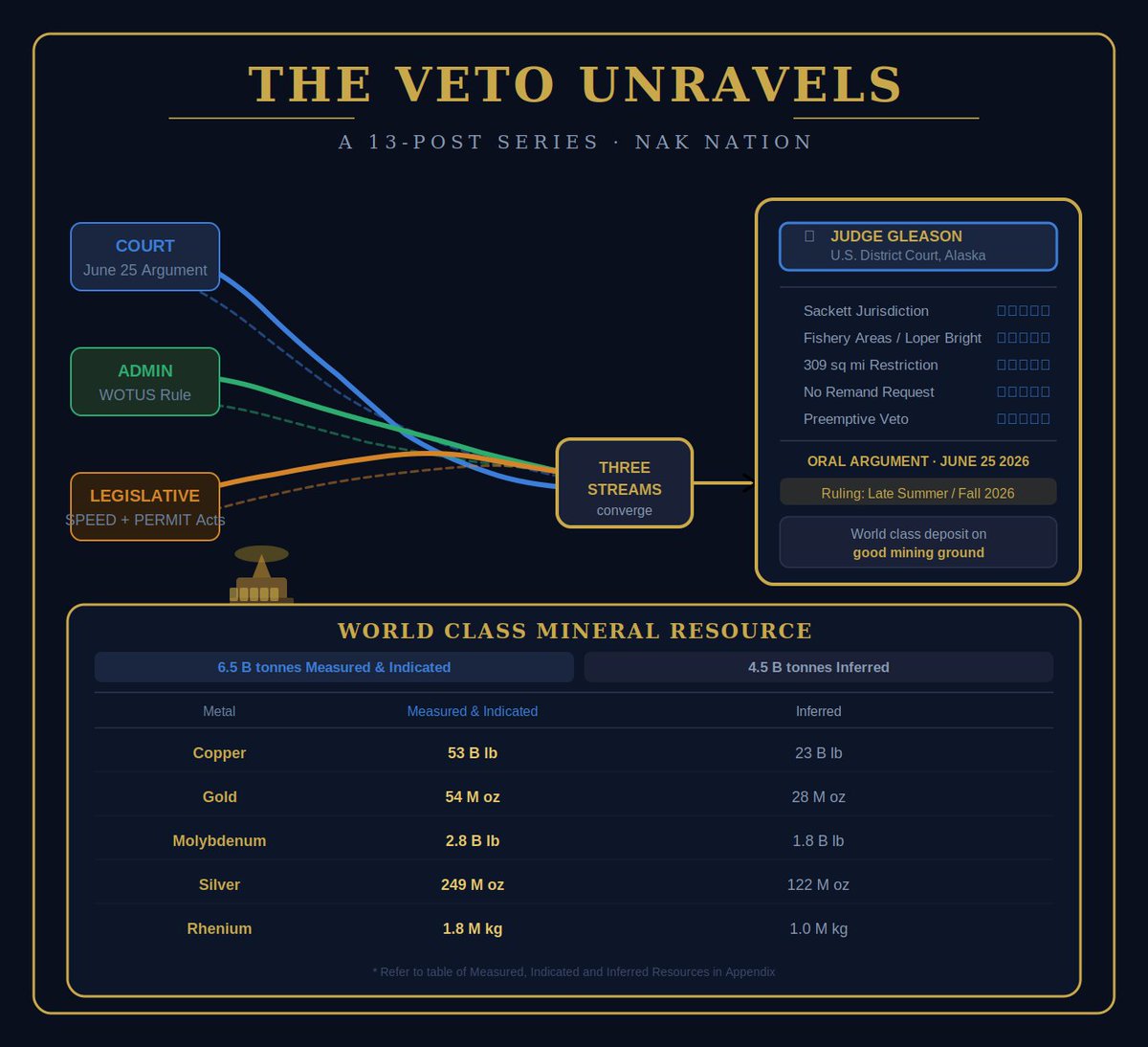
Chapter 1: The Three Streams
I have been writing for months about what I call the three streams framework. Three independent pathways all moving simultaneously toward the same destination. The removal of the Biden EPA's preemptive veto and the eventual development of the world's largest undeveloped copper deposit.
Stream One is the court case before Judge Gleason. Oral argument June 25. Written ruling to follow. Multiple significant legal arguments that I will walk through in detail over the coming weeks.
Stream Two is the administrative stream. The new WOTUS rule being finalized by the Trump EPA. If finalized in line with current proposals it could significantly complicate the jurisdictional foundation underlying portions of the veto. This stream advances regardless of what Judge Gleason ultimately decides.
Stream Three is the legislative stream. Permitting reform. The SPEED Act. The PERMIT Act. The Critical Mineral Dominance Act. All passed the House. Senate action expected this summer.
And here is the most important thing I want NAK Nation to understand about these three streams.
The legislative stream is the most important of the three. Not the court case.
I know that seems counterintuitive when oral argument is 45 days away and the courtroom is getting all the attention. But here is why the legislative stream matters most in the long run.
A court ruling can be appealed. A regulatory rule can be rewritten by a future hostile administration. But when Congress writes something into law it takes an act of Congress to undo it. The PERMIT Act would permanently ban preemptive vetoes of the kind EPA issued against Pebble Mine. The SPEED Act would protect issued permits from arbitrary revocation. Codified law is the only thing that provides the investor certainty needed to commit the five to ten billion dollars required to actually build this mine.
The court case is the near term catalyst. Permitting reform is the permanent solution.
But that does not mean winning in court does not matter. It matters enormously. And I want to be clear about why.
A favorable ruling from Judge Gleason could vacate portions of the veto outright narrow portions of it or send parts of it back to EPA under a materially different legal framework than existed when the veto was issued. Any of those outcomes could have major implications for the permitting path going forward.
It could allow PLP to resume movement through the permitting process without the same legal uncertainty hanging over every step. It could send a significant signal to capital markets that the regulatory landscape surrounding this project is changing. It could strengthen momentum behind the legislative stream by reinforcing concerns about the breadth of EPA's asserted authority. And
it could constrain how future administrations attempt to use similar veto theories against other critical mineral projects across the country.
In other words a court win does not replace permitting reform. But it accelerates everything. It clears the path. It builds the momentum. And it delivers a near term catalyst that the legislative stream alone cannot provide on the same timeline.
The court case is the near term catalyst. Permitting reform is the permanent solution. And right now both are moving forward simultaneously.
What Is Coming Thursday
Thursday I start with what oral argument actually is. Before you can understand what happens on June 25 you need to understand what is actually happening in that room and why it is so different from anything you have seen on television.
Do not miss a single post. Follow me directly on X. Follow Tye. Follow Kris. Follow Joseph. And share this with everyone in your network who follows this story.
The NAK Pebble Mine Community disappears at the end of May. The story does not.
Stay locked in NAK Nation. 🇺🇸🏔️
#NAKNation #PebbleMine #TheVetoUnravels #OralArgument #JudgeGleason #June25 #CriticalMinerals #NorthernDynasty #AlaskaComeback #CopperDemand #CleanWaterAct #PermittingReform #ThreeStreams #SPEEDAct #PERMITAct #WOTUS #SarahPalin #Alaska #AlaskaFirst #DrillBabyDrill #AmericaFirst #MineAmerica
10
8
43
5,054

30 Jun 2025
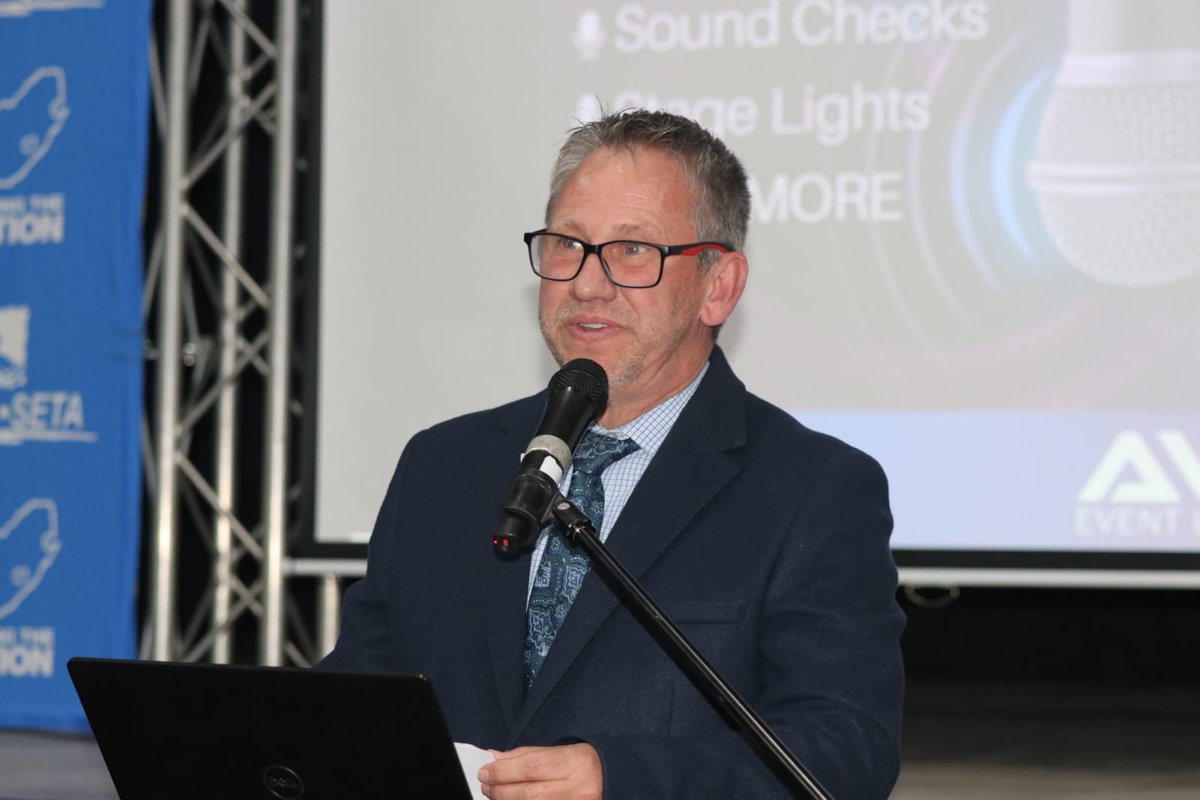
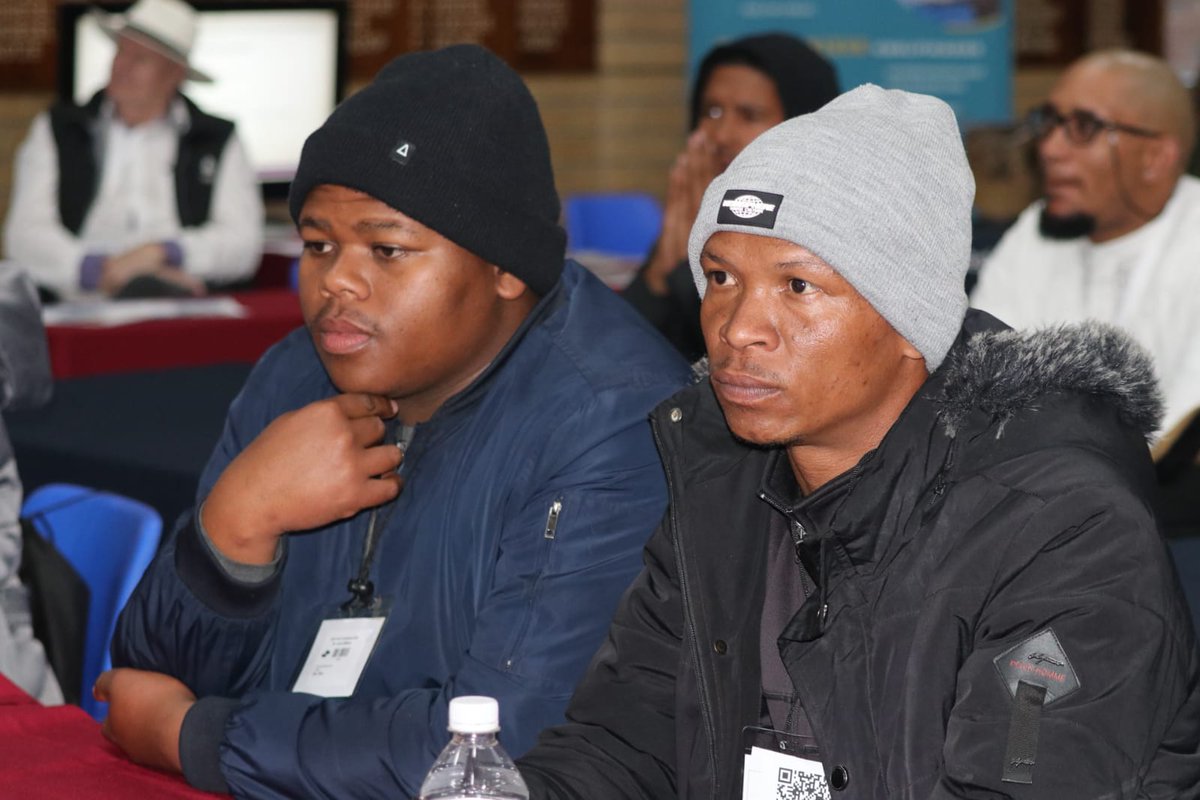
Delivering the keynote address, Director-General Mweli highlighted the central role of technical education in shaping the country's future. “Technical education is the now and the future,” he said. He reiterated the Department’s commitment to expanding and improving the quality of technical schools to meet both current industry demands and future skills needs.
#TechnicalEducation
#ThreeStreams
#GovZAUpdates

1
1
1,335

9 Jun 2023
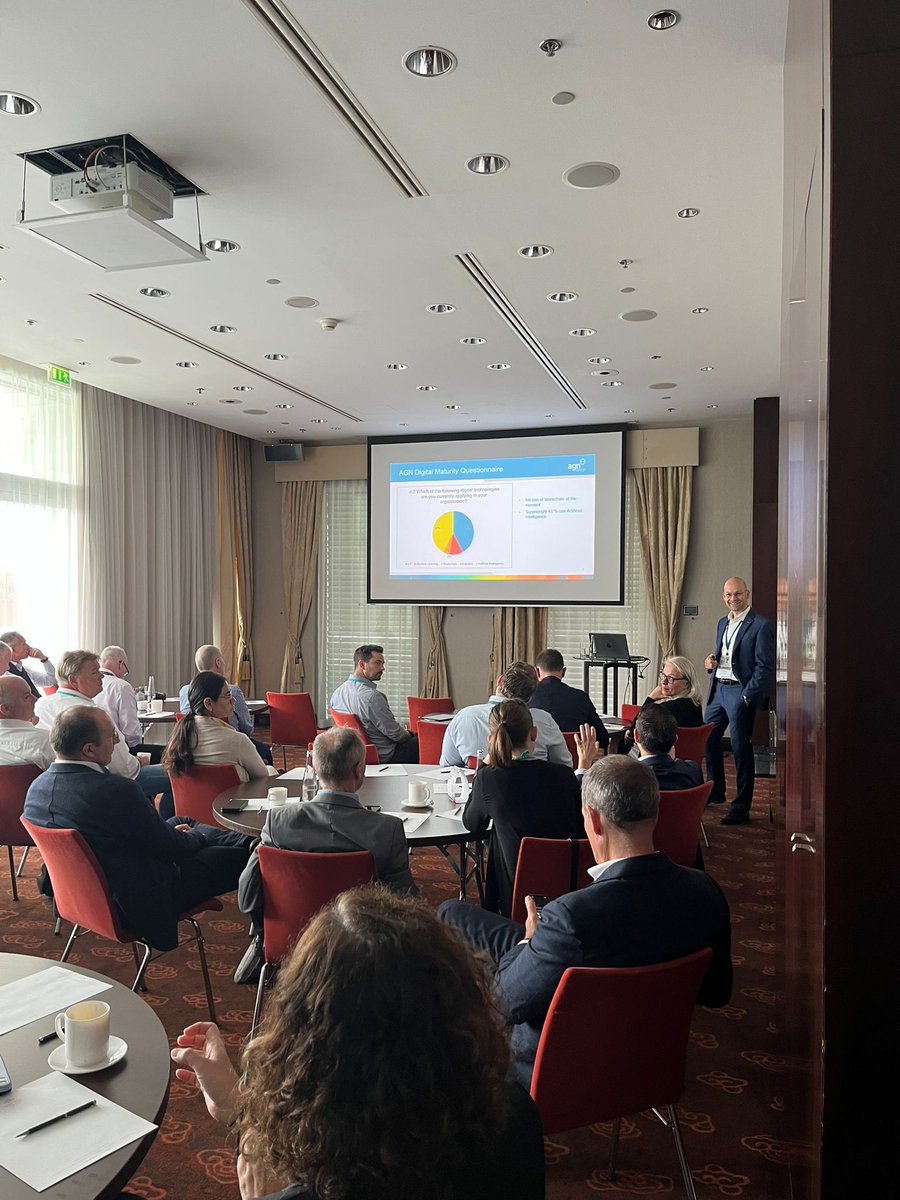
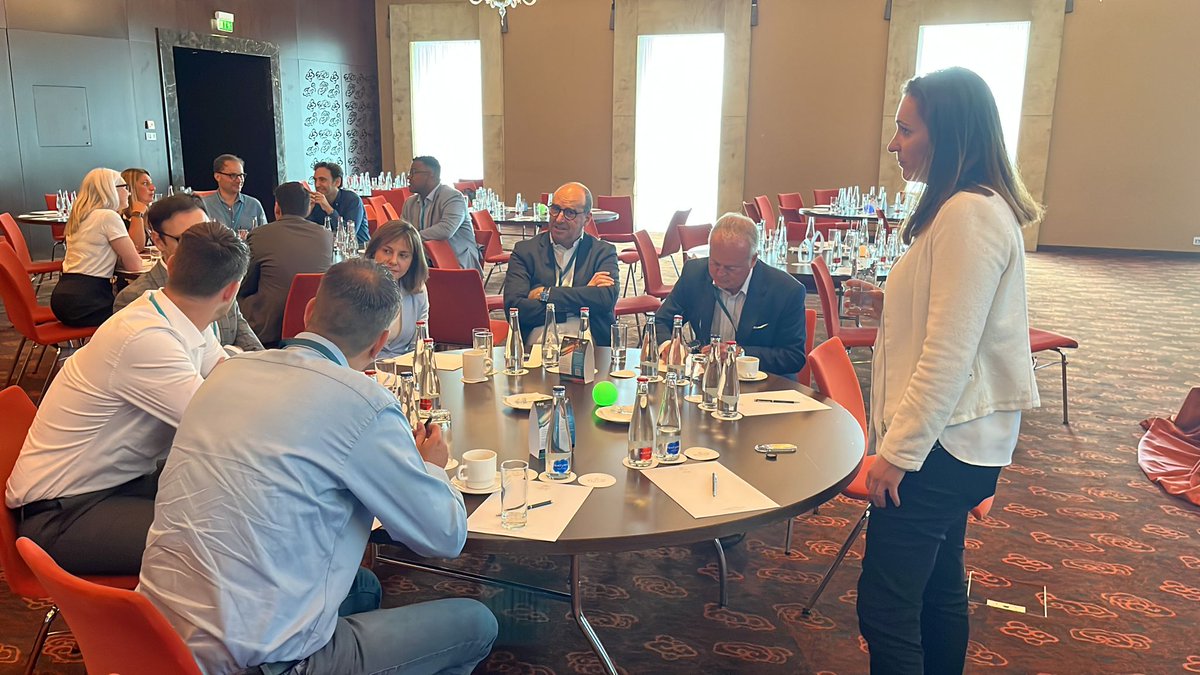
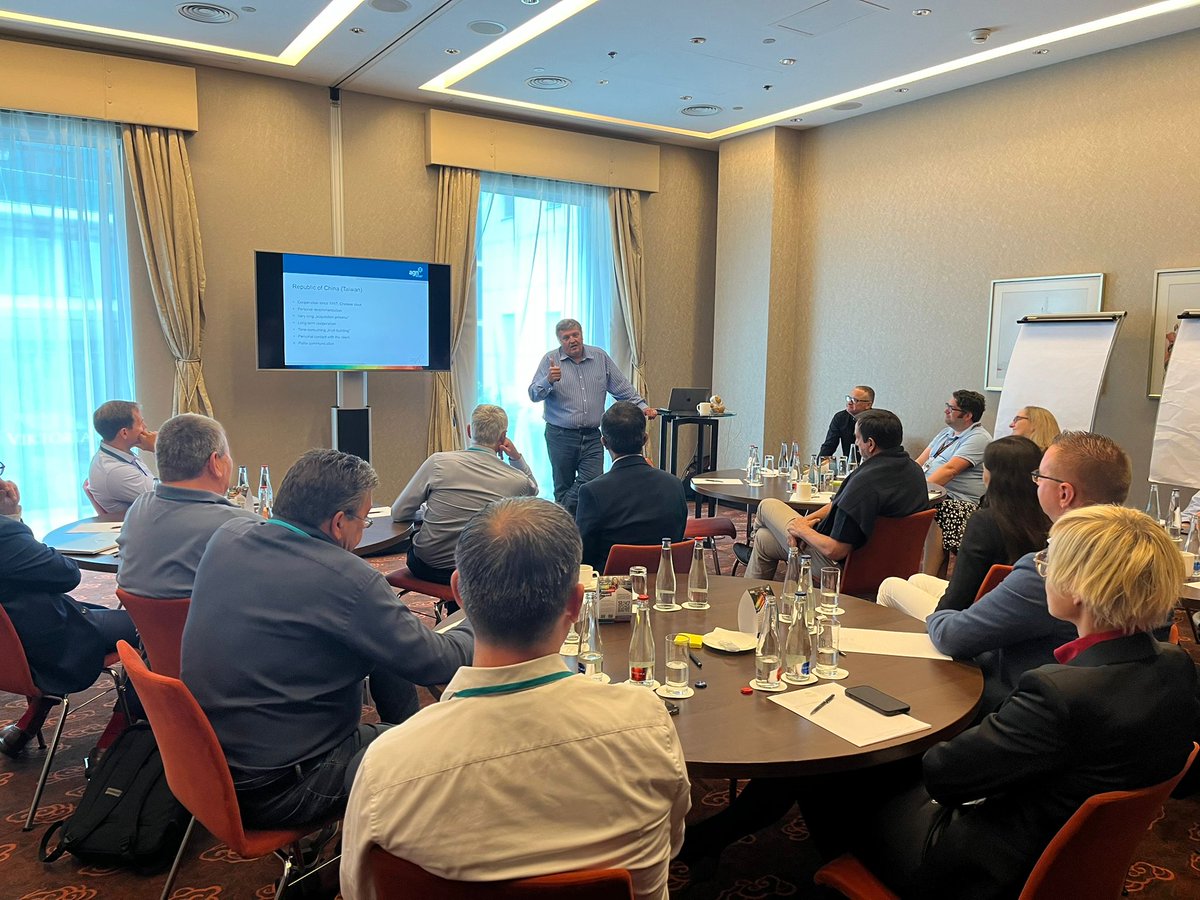
Happening now at the EMEA Regional Meeting in Bratislava; Mireia Rovira presents her session on #talentretention. Andreas Weinberger talks about #digitalmaturity. And Martin Felenda comments on his #businessdevelopment in Taiwan.
#AGNEMEARM2023 #threestreams #hottopics
2
62



26 Oct 2021
Weather Models Turn Bullish Sending Natural Gas Prices Soaring seekingalpha.com/article/446… $BRK.AX $RDFEF @TheMarketBullAU @Spark_Plus @TheASXInvestor #AAA_BRK #threestreams
9
29


5 Mar 2020
Aquaculture is so much more than just good for the planet, it’s good for people too.
The time to rethink how you consume is now, make the right choice.
At Three Streams, our fish are proudly farmed using a high standard of sustainability practices.
#AquaCulture #ThreeStreams
2
1

12 Feb 2019
This fellow has obviously never been to an @The_ACNA parish. Many, many of us have been doing the "catholic, evangelical, charismatic" thing for a while. #threestreams
1

And that is only the baseline. The neo-#Anglican trendy language of #ThreeStreams (catholic, evangelical, charismatic) is destructive.
1
1
I tell @The_ACNA again: #ThreeStreams is not #Anglican, and neither is #WomensOrdination. Ditch both if you want to follow God’s word. x.com/VictReactionary/status…
1
6 May 2017
We are! Setting up in progress! Visit our stand D64 in Hall 2 for delicious salmon and trout products. #ThreeStreams

#Hostex17 .. the fun begins tomorrow! Are you ready for the most epic #FandHA ever?… instagram.com/p/BTvle_5AXZA/
1
1
16 Dec 2016
Awesome sushi!! Great Festival #CapeTownSushiFestival #ScansaTradeSalmon #ThreeStreams fb.me/8kPaliFr7
1