
Feb 27
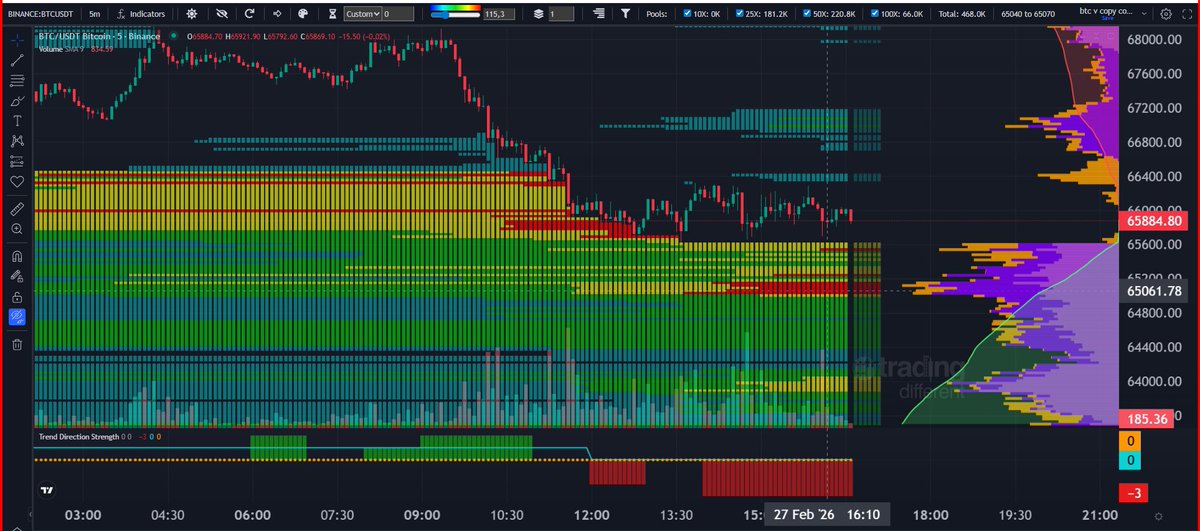
Se Prendió #trendDirection -3 de @tradingdiff
Y vamoos en short 🤑
herramientas que vale la pena pagar👇
tradingdifferent.com/code/7P…
1
1
19
1,568

Feb 5
Day 26 of 30: Becoming the Ultimate Blockchain Detective – When PAPI Meets Indexers
From mastering how to pack multiple actions into one efficient transaction like a master chef combining ingredients into a single perfect dish, today we become full-fledged detectives. We pair PAPI’s live, breathing view of the blockchain (what’s happening right this second) with the deep historical memory of indexers (what happened last week, last month, last year). Together they form something far more powerful than either alone: complete blockchain intelligence. It is like giving Sherlock Holmes both real-time CCTV feeds and a complete archive of every newspaper, police report, and witness statement ever written about a case.
Imagine you are tracking a high-profile wallet during a bull run. PAPI tells you the current balance jumped 500 DOT in the last block and three new transfers just landed. That is exciting, but incomplete. The indexer layer reveals those incoming transfers came from three addresses that were dormant for 90 days, two of which previously interacted with a known mixer, and the wallet’s average daily volume has spiked 400 percent compared to the past six months. Suddenly you are not just seeing numbers; you are reading a story, spotting patterns, predicting next moves, and raising red flags before anyone else notices. That shift from raw data to actionable insight is exactly what we unlock today.
Why Real-Time Plus Historical Data Creates Superpowers in 2026
The blockchain world has matured. Developers no longer settle for “what is the current state?” or “what happened last month?” They demand both simultaneously. Here is why combining PAPI and indexers has become one of the highest-leverage skills right now.
1. Complete Context: Real-time data without history is like watching a movie from the middle; historical data without real-time is like reading yesterday’s newspaper. Together they give the full plot from beginning to present – essential for portfolio tracking, compliance monitoring, forensics, and alpha generation.
2. Pattern Recognition at Scale: Indexers excel at aggregations (daily/weekly/monthly transaction counts, average transfer sizes, top counterparties). PAPI gives instant state snapshots. Fuse them and you can detect cycles, seasonal behaviors, whale accumulation, or sudden changes in real time – patterns that single sources miss.
3. Anomaly Detection and Early Warnings: Sudden balance spikes are interesting. Sudden balance spikes that deviate 5 standard deviations from the account’s 90-day norm are actionable alerts. Combining live feeds with historical baselines turns “interesting” into “investigate now.”
4. Predictive Power: Historical trends current momentum allow simple forecasting models. Is this wallet following the same accumulation pattern seen before previous pumps? Indexers provide the training data; PAPI provides the live features. Even basic models become surprisingly accurate.
5. Forensic and Compliance Strength: Regulators, auditors, and security teams increasingly demand both live monitoring and deep historical audit trails. One toolset that delivers both saves massive engineering time and reduces risk.
The Classic Detective Workflow with PAPI Indexers
Here is how the pieces fit together in practice.
// 1. Live snapshot from PAPI (current state)
const current = await api.query.Balances.Account(address);
console.log('Right now:', current);
// 2. Historical context from indexer (SubQuery example)
const history = await subqlClient.request(gql`
query GetHistory($address: String!, $since: Date!) {
transfers(where: { from_eq: $address, timestamp_gte: $since }) {
timestamp
amount
to
}
}
`, { address, since: '2025-12-01' });
// 3. Fuse for intelligence
const fused = {
currentBalance: current.data.free.toHuman(),
txCount30d: history.transfers.length,
avgTxSize: history.transfers.reduce((sum, t) => sum Number(t.amount), 0) / history.transfers.length,
topCounterparty: findMostFrequentCounterparty(history.transfers),
trendDirection: calculateTrendDirection(current, history),
anomalyScore: detectAnomalies(current, history)
};
console.log('��️ Intelligence report:', fused);
One query for the present, one for the past, one function to fuse them into meaning. That is the detective mindset we are building today.
Today's Project: The Blockchain Intelligence Dashboard
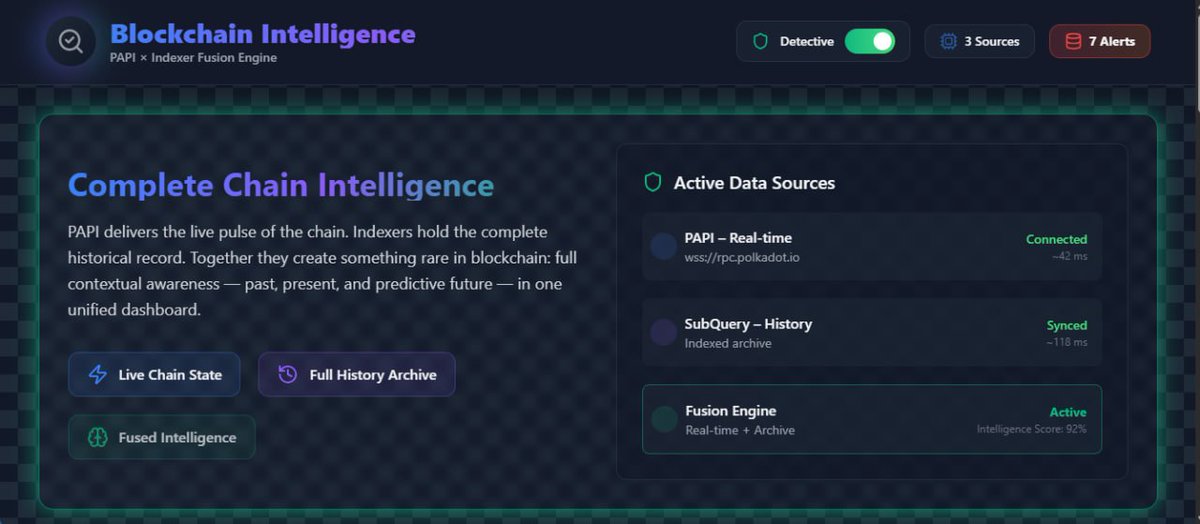
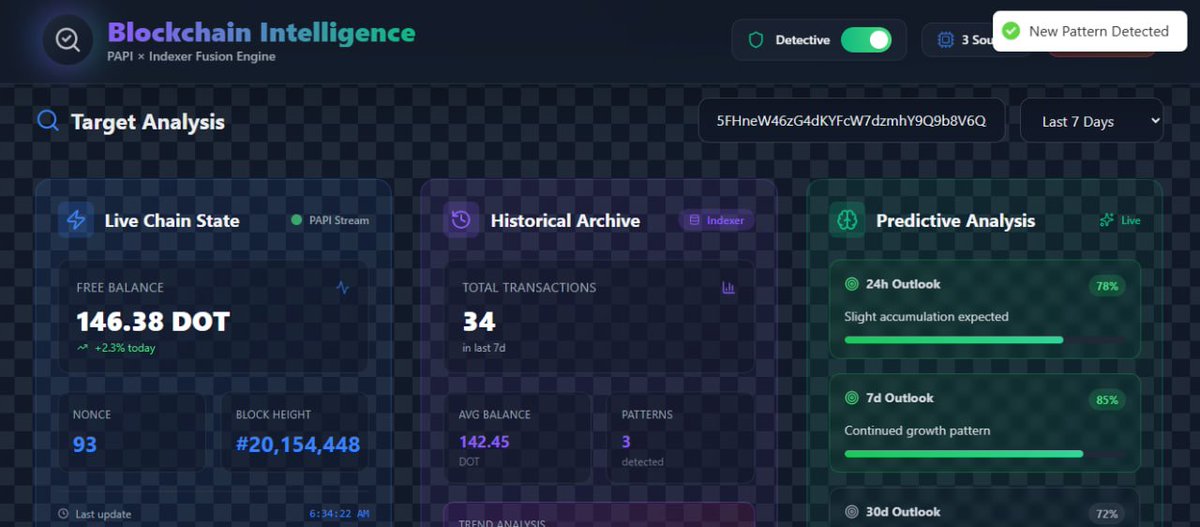
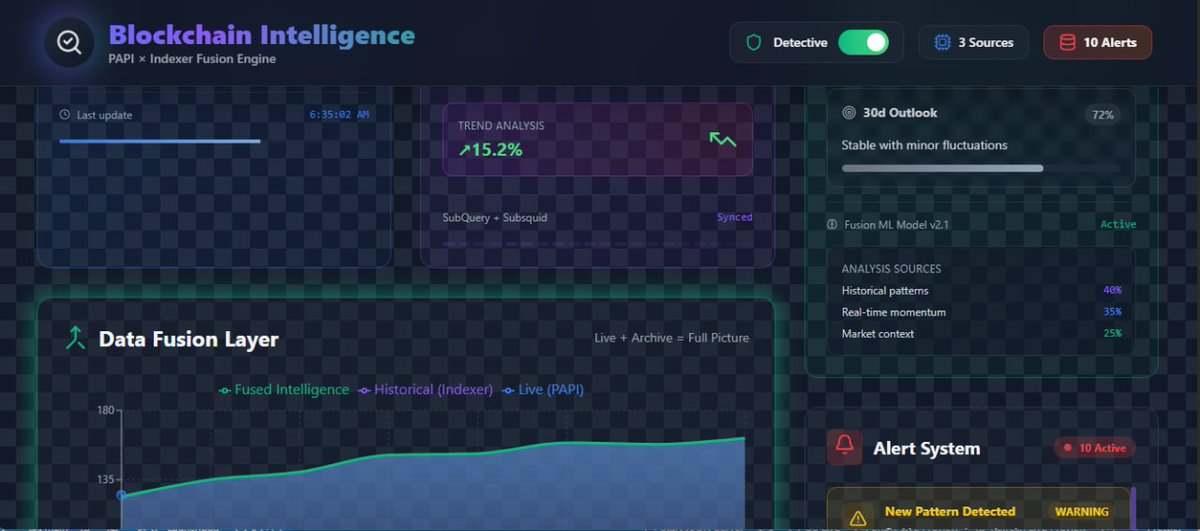
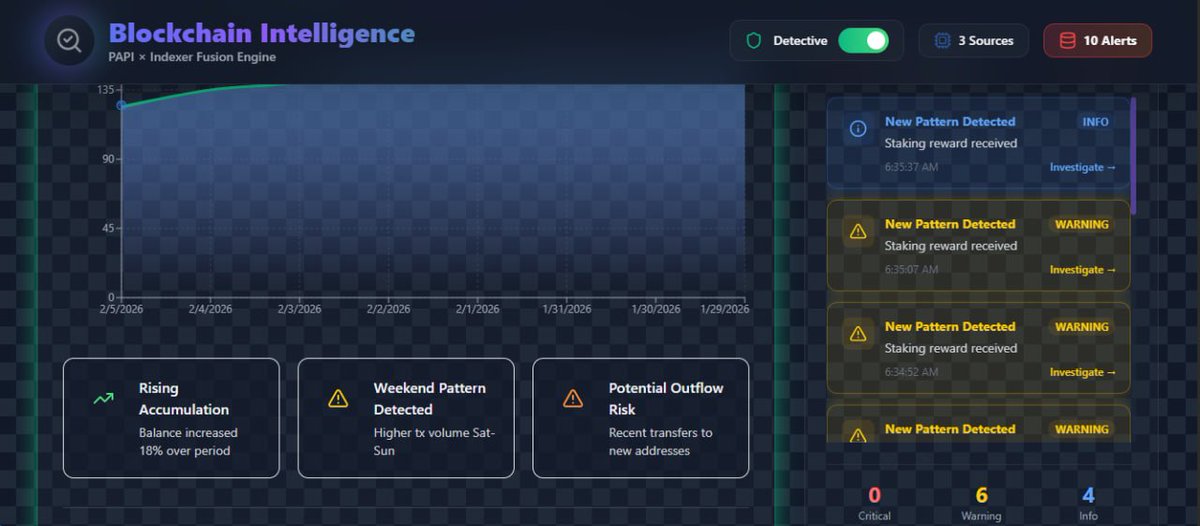
We are constructing a polished “Blockchain Intelligence Dashboard” that fuses PAPI real-time data with indexer historical archives to deliver:
1. Live account state (balance, nonce, recent events) from PAPI
2. Historical time-series (balance history, transaction volume, counterparty networks) from indexers
3. Fused visualizations showing real-time vs historical trends on the same chart
4. Automatic pattern detection and anomaly highlighting
5. Predictive trend lines with confidence intervals
6. Smart alert system that triggers on significant deviations
7. “Detective Mode” investigation panel for drilling into suspicious activity
8. Clean, animated UI that makes complex analysis feel intuitive
This is not a toy dashboard; it mirrors tools used by serious portfolio managers, security researchers, compliance officers, and on-chain analysts. Build it once, deploy it, and you have a production-grade intelligence platform. catch the code here --> github.com/Sage-senpai/PAPI-…
Feb 2

Day 25 of 30: Mastering the Art of Batch Transactions – Doing More with Less
If the last few days felt like learning to drive individual cars, today we upgrade to a high-performance bus that carries multiple passengers at once – efficiently, reliably, and with style. Single transactions had their moment, but 2026 belongs to batch calls: the smartest way to pack multiple operations into one efficient trip across the blockchain highway. Think of it like ordering a family meal instead of ten separate takeout deliveries ; one payment, one delivery, massive savings, and everything arrives together or not at all.
Picture yourself managing a busy coffee shop during morning rush. Sending ten separate orders for ten customers means ten receipts, ten card swipes, ten confirmations, and ten chances for something to go wrong. Now imagine bundling all ten into one master order: one payment, one preparation sequence, one delivery to the counter. That is batch transactions in action –> fewer fees, atomic reliability, and happier customers (or in our case, users who pay less and wait less). On Polkadot, where every extrinsic costs gas, batching turns expensive multi-step workflows into elegant single-signature masterpieces.
Why Batch Transactions Have Become Essential in Modern Web3 Development
Batch calls are no longer a nice-to-have; they represent one of the most practical optimizations available to developers today. Here is why they matter more than ever.
1. Dramatic Gas Savings: Individual transactions each pay full overhead. Batch them together and you pay once for the wrapper plus a fraction per inner call – often saving 70 to 90 percent on fees. For users in high-activity scenarios like DeFi rebalancing or gaming multi-actions, this difference feels like upgrading from economy to business class.
2. Atomic Execution Guarantees: With batch_all, either everything succeeds or nothing does – perfect for dependent operations like transfer-then-stake-then-nominate. It eliminates painful partial failures where funds move but staking never activates, much like ensuring your entire online grocery order arrives or gets canceled, never leaving you with half a recipe.
3. Single Signature and Confirmation: Users sign once instead of ten times. In mobile-first Web3, where every extra click increases drop-off, this creates noticeably better UX – similar to how one-tap Apple Pay feels smoother than entering card details repeatedly.
4. Complex Workflows Made Simple: Combine actions across pallets (balances, staking, utility, democracy, assets) in one extrinsic. What used to require custom pallets or off-chain coordination now lives cleanly on-chain, enabling richer dApps without added complexity.
PAPI Makes Batch Calls Beautifully Developer-Friendly
PAPI turns what could be error-prone manual encoding into a type-safe, metadata-driven joy. You get:
1. Unified API across pallets with full TypeScript inference
2. Automatic parameter validation before submission
3. Built-in support for batch, batch_all, and force_batch
4. Realistic gas estimation even for complex batches
5. Clean composition of calls from different runtimes
Here is the classic comparison that makes developers smile every time.
// The old painful way: 3 separate transactions
await api.tx.Balances.transfer(dest, amount).signAndSend(signer);
await api.tx.Staking.bond(controller, bondAmount, 'Staked').signAndSend(signer);
await api.tx.Staking.nominate([validator]).signAndSend(signer);
// The PAPI batch way: one elegant transaction
const batchTx = api.tx.Utility.batch_all([
api.tx.Balances.transfer(dest, amount),
api.tx.Staking.bond(controller, bondAmount, 'Staked'),
api.tx.Staking.nominate([validator]),
]);
const hash = await batchTx.signAndSend(signer);
console.log('Batch success! Hash:', hash);
One signature, one block inclusion, three operations, atomic safety, and massive gas savings. That is the kind of code that makes you want to high-five your screen.
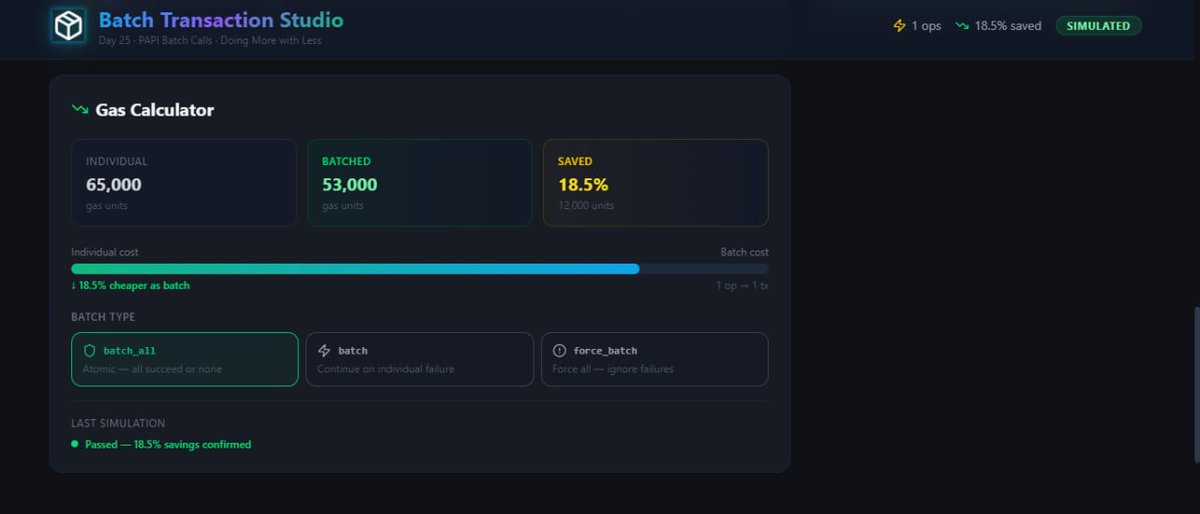
Today's Project: Building the Batch Transaction Studio
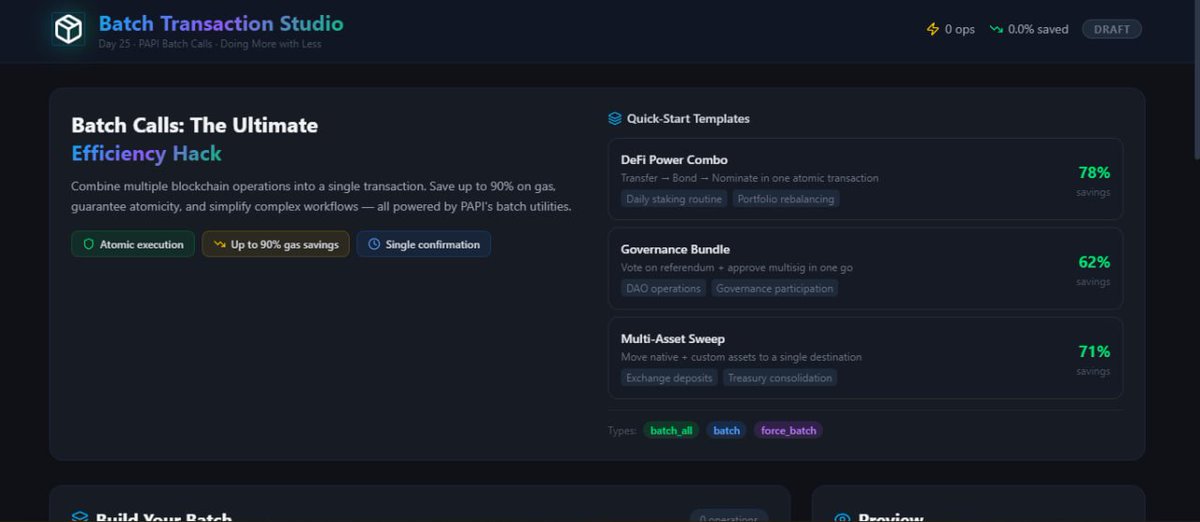
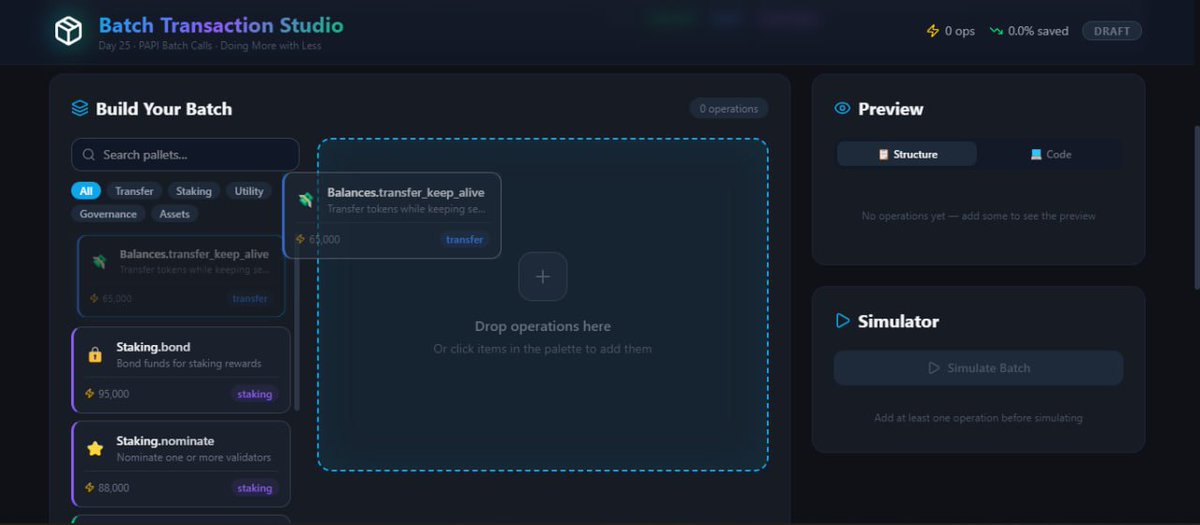
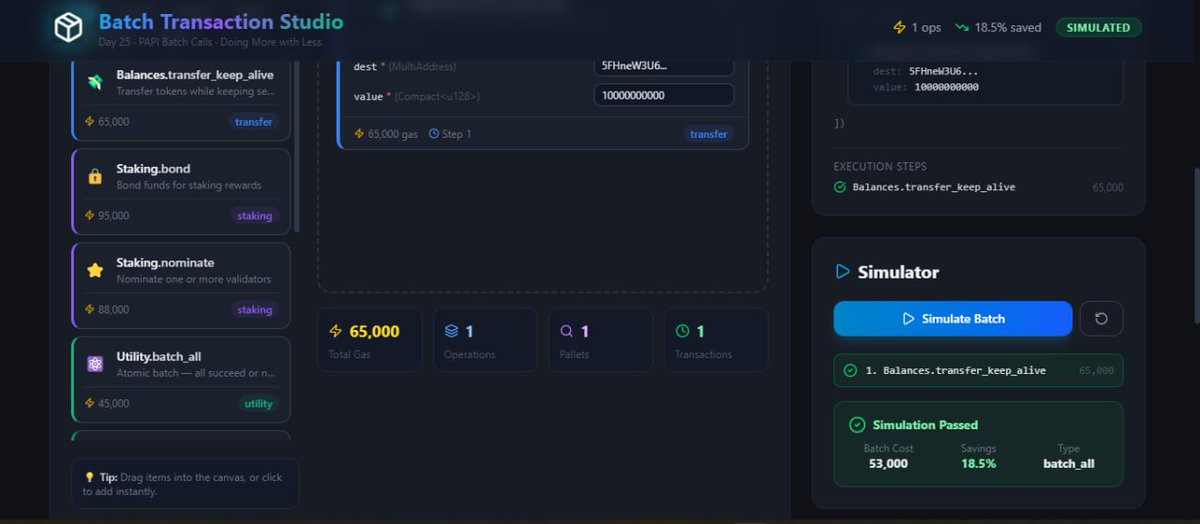
Today we create the "Batch Transaction Studio" – an interactive visual playground where you drag operations from different pallets, build sophisticated batches, watch real-time gas savings calculations, simulate execution, and generate production-ready PAPI code. This is not just a learning tool; it is professional-grade software you can extend, deploy, or integrate into wallets and dApps. Imagine having a Lego set where each brick is a blockchain operation, and you can snap them together, see the cost instantly, test the build, and export working code – that is exactly what we are building.
The studio delivers:
1. Drag-and-drop batch construction with pallet operations
2. Real-time gas estimation and savings visualization
3. Pre-built templates for common patterns (DeFi combos, governance bundles, asset management)
4. Parameter editing with type-aware inputs
5. Batch simulation showing execution steps and outcomes
6. One-click PAPI code generation with proper imports and signing
7. Atomic vs non-atomic mode selection
8. Beautiful, animated UI that makes complex concepts feel approachable
This project teaches advanced transaction patterns while producing a tool you will actually want to keep using.
Grab the code here --> github.com/Sage-senpai/PAPI-…
#PAPI30Days
7
142

1 Sep 2025
One of the biggest challenges for traders is correctly identifying trend direction and timing their entries into trades. Most strategies either focus on direction without precision entry, or entry signals without clear trend context. This is where the RSI indicator combined with Moving Averages creates a high probability trading system that resolves both direction and timing together.
In this tutorial, Bharat Jhunjhunwala demonstrates how to use RSI for trend detection and moving averages for entry timing, giving traders a structured and repeatable approach to trading stocks, forex, crypto, and commodities.
📌 What You’ll Learn in This Video:
✔️ RSI for Trend Direction – How RSI range shifts reveal whether markets are trending or consolidating
✔️ Moving Averages for Timing – Best moving average combinations for precise entry & exit
✔️ High Probability Setup – Filtering sideways markets and trading only strong moves
✔️ Multi-Timeframe Analysis – Aligning RSI signals on higher timeframe with entries on lower timeframe
✔️ Stop-Loss & Trailing Stops – Protecting capital while maximizing trend profits
✔️ Real Chart Examples – Nifty, Bank Nifty, Bitcoin, Gold, and Forex pairs explained step-by-step
✔️ Scalping, Swing & Positional Applications – Adapting the system for different trading styles
🔍 Why This Works in 2025 Markets:
→ RSI trend detection cuts through noise and shows real direction
→ Moving averages give structure for entry, exit, and stop placement
→ System works across stocks, crypto, forex, commodities, and indices
→ Perfect for swing traders, day traders, and position traders
→ Eliminates confusion between trend vs. pullback vs. reversal setups
This is not just another RSI or Moving Average strategy. It is a complete trend timing framework that ensures traders only trade with momentum and enter at the right time.
📍 LIKE if you’ve ever been trapped entering too early or too late
📍 COMMENT your favorite moving average setup
📍 SUBSCRIBE for advanced trading systems every week
📍 SHARE with traders who want consistency and structure
#RSI #MovingAverages #TrendTrading #TradingSystem #HighProbabilityTrading #TechnicalAnalysis #SwingTrading #DayTrading #CryptoTrading #ForexTrading #StockMarketTrading #RSITradingStrategy #TradingWithIndicators #ProfitableTradingStrategy #TradingSetups #SmartMoneyMoves #MarketAnalysis #StockTrading #ForexStrategy #CryptoStrategy #PriceActionTrading #TradingTips #SwingTrading2025 #StockMarketAnalysis #SmartTrading #BharatJhunjhunwala #TrendDirection #TradingEducation #PatternTrading #MarketInsights
4
547


21 Apr 2024
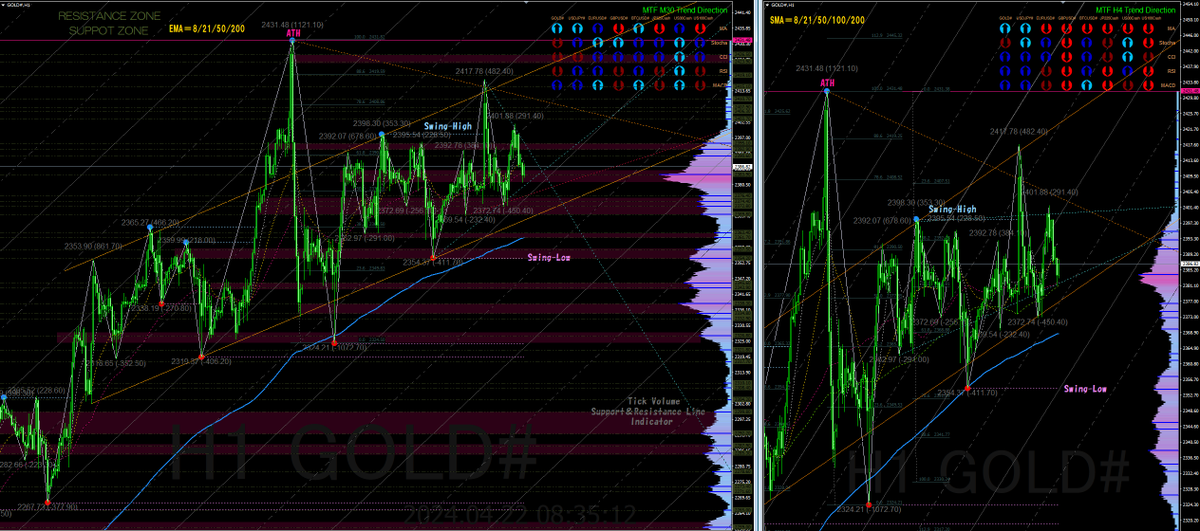
#GOLD M15/H1 24.04.22
おはようございます
朝の確認(各ライン一部更新)
#環境認識、トリガー、ターゲット、#シナリオ考察
複数、多角度からの視点、発見が出来るように、あえてライン多めに表示しています
■Swing-High/Lowインジケータベースの #チャネルライン #トレンドライン
■TickVolumeインジケータによる #レジスタンス・サポートライン
■TrendDirectionインジケータによる #環境認識
#XAUUSD #FXトレーダー #FXトレード #MT4 #インジケーター #為替 #FX初心者 #fx #fxtrader #チャート分析 #FXゴールド
1
3
58
19 Apr 2024
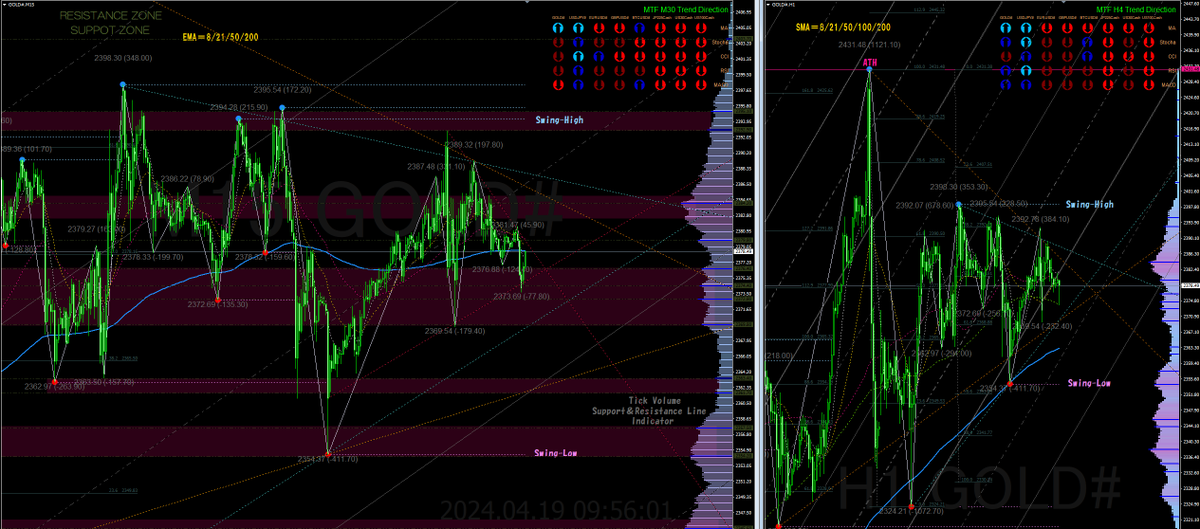
#GOLD M15/H1 24.04.19
おはようございます
午前の確認(トレンドライン更新)
#環境認識、トリガー、ターゲット、#シナリオ考察
複数、多角度からの視点、発見が出来るように、あえてライン多めに表示しています
■Swing-High/Lowインジケータベースの #チャネルライン #トレンドライン
■TickVolumeインジケータによる #レジスタンス・サポートライン
■TrendDirectionインジケータによる #環境認識
#XAUUSD #FXトレーダー #FXトレード #MT4 #インジケーター #為替 #FX初心者 #fx #fxtrader #チャート分析 #FXゴールド
3
2
74
18 Apr 2024
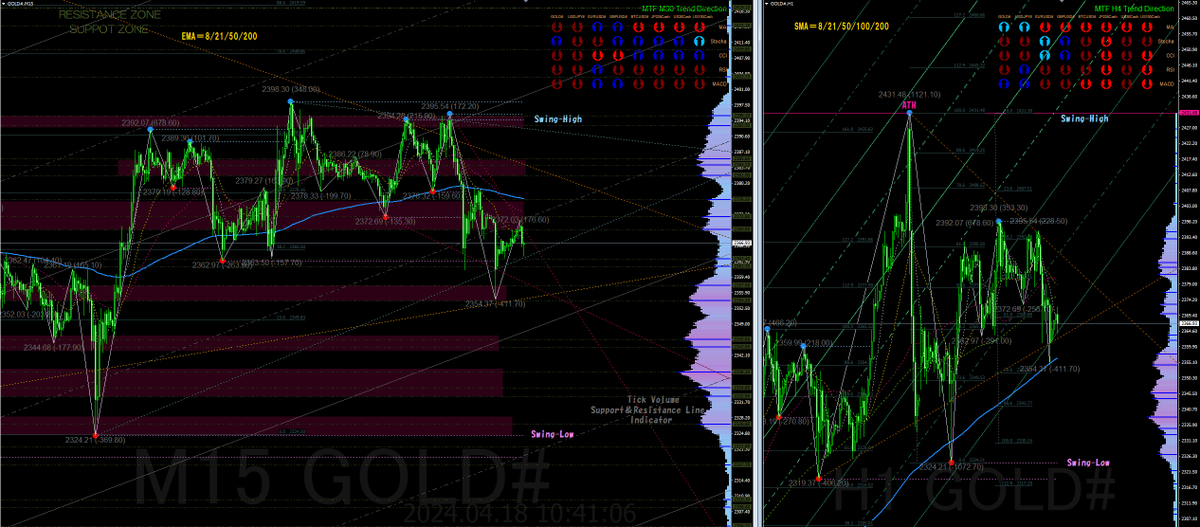
#GOLD M15/H1 24.04.18
おはようございます
午前の確認(トレンドライン一部更新)
#環境認識、トリガー、ターゲット、#シナリオ考察 複数、多角度からの視点、発見が出来るように、あえてライン多め表示しています
■Swing-High/Lowインジケータベースの #チャネルライン #トレンドライン
■TickVolumeインジケータによる #レジスタンス・サポートライン
■TrendDirectionインジケータによる #環境認識
#XAUUSD #FXトレーダー #FXトレード #MT4 #インジケーター #為替 #FX初心者 #fx #fxtrader #チャート分析 #FXゴールド
1
2
66

11 Sep 2023
Stepping into the future of trading? Brace yourself to accurately predict price levels and trend directions with #SimataPro. Your journey to smarter investments begins here. Get started now! #PredictiveAnalytics #TrendDirection #CRYPTONEWS

2
2
97

4 Jul 2023
The absence of shadows in Marubozu shows a clear direction in the market. It lacks upper and lower wicks, indicating a strong trend continuation potential. #NoShadows #TrendDirection
1
2
86

6 Nov 2019
How to correctly identify a trenddirection on forex charts - Trend analysis is only one part of the overall trading strategy all professional traders employ to enter and exit trades.
traderversity.com/how-to-cor…
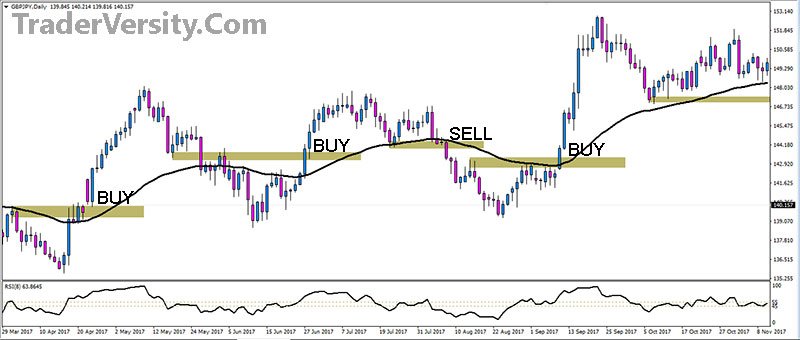
3

9 Oct 2018
if (price >=6740)
{
waitCandleClose(lastCandle);
if (trendDirection==bearish)
openShortPosition(balance/6);
}
3
1
14

15 Feb 2018
A wonderful mix: shiny shades of green & blue for #springsummer19 #colours #lurex #shinebright #summervibes #trenddirection #munique

1


1 Apr 2016
#AEX en Large EU-indices – TrendDirection & HiLo-Range: De
grootste EU-indices – aangevuld met de AEX – laten ... bit.ly/1SFJZKi
1

29 Jan 2016


10 Apr 2015

1