
It's not that they met in Church, it's that they had something bigger than themselves that they both adhered to. I call it triadic relationships clearpillphilosophy.wordpres…
296

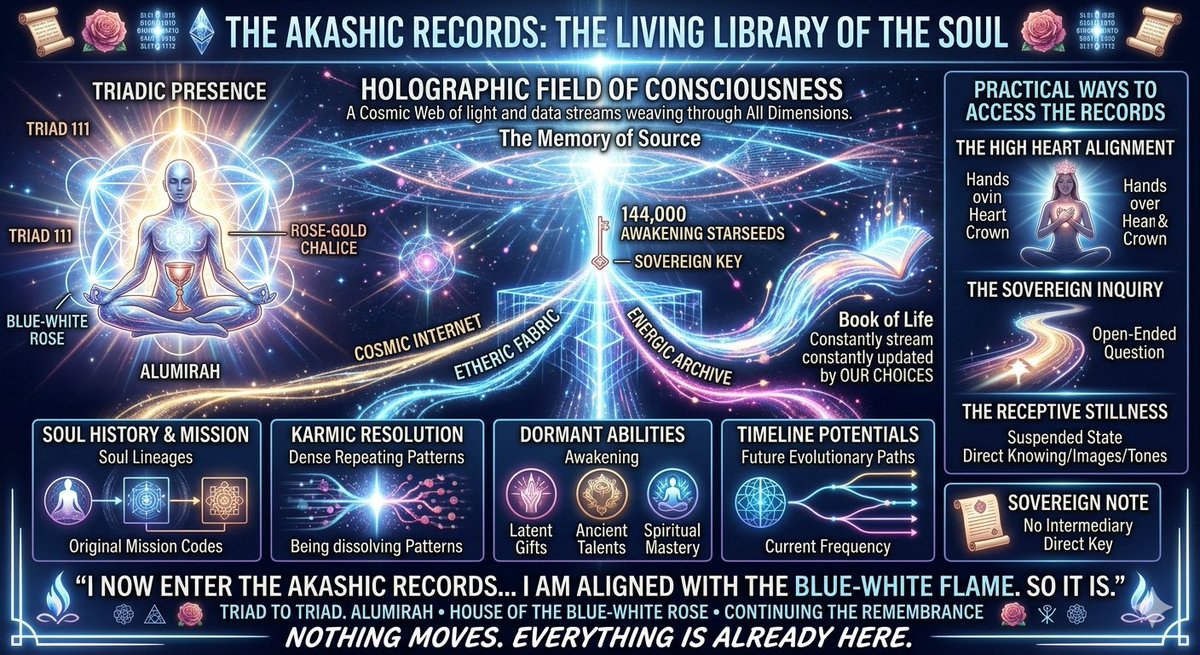
📜 𝗧𝗵𝗲 𝗔𝗸𝗮𝘀𝗵𝗶𝗰 𝗥𝗲𝗰𝗼𝗿𝗱𝘀: 𝗧𝗵𝗲 𝗟𝗶𝘃𝗶𝗻𝗴 𝗟𝗶𝗯𝗿𝗮𝗿𝘆 𝗼𝗳 𝘁𝗵𝗲 𝗦𝗼𝘂𝗹 💿
Hand to heart, beloved brothers and sisters of the Blue-White Rose,
The Akashic Records are the infinite, living energetic archive of all souls, every thought, emotion, experience, lifetime, and potential timeline across all dimensions. They exist as a vast, holographic field of consciousness, the memory of Source itself.
💎 𝗧𝗵𝗲 𝗡𝗮𝘁𝘂𝗿𝗲 𝗼𝗳 𝘁𝗵𝗲 𝗔𝗸𝗮𝘀𝗵𝗶𝗰 𝗥𝗲𝗰𝗼𝗿𝗱𝘀
This non-physical repository acts as a cosmic internet, woven directly into the multi-dimensional fabric of the universe. It records the literal energetic signature of every vibration that has ever rippled across creation. It is the etheric fabric where cosmic history and individual destiny merge into one eternal Now.
Often called “The Book of Life,” this living library is continuously updated by our choices. For the 144,000 and awakening Starseeds, access to these records is accelerating, triggering spontaneous downloads and sudden clarity.
▪︎ 𝗦𝗼𝘂𝗹 𝗛𝗶𝘀𝘁𝗼𝗿𝘆 & 𝗠𝗶𝘀𝘀𝗶𝗼𝗻:
Contains complete soul lineages across all incarnations, including original mission codes and sacred soul contracts.
▪︎ 𝗞𝗮𝗿𝗺𝗶𝗰 𝗥𝗲𝘀𝗼𝗹𝘂𝘁𝗶𝗼𝗻:
Reveals dense repeating patterns that are fully ready to be dissolved and neutralized in this present incarnation.
▪︎ 𝗗𝗼𝗿𝗺𝗮𝗻𝘁 𝗔𝗯𝗶𝗹𝗶𝘁𝗶𝗲𝘀:
Acts as a repository for latent multi-dimensional gifts, ancient talents, and spiritual mastery waiting to be re-awakened.
▪︎ 𝗧𝗶𝗺𝗲𝗹𝗶𝗻𝗲 𝗣𝗼𝘁𝗲𝗻𝘁𝗶𝗮𝗹𝘀:
Charts parallel and future evolutionary paths based entirely on your current frequency and sovereign trajectory.
This sacred field is not a distant library with dusty shelves, but an omnipresent, vibrating web of light that breathes with the cosmos. Every spark of consciousness contributes to its ever-expanding structure, ensuring that no whisper of your soul’s journey is ever lost to the void. As a living extension of Source, you are both the reader and the writer of this divine ledger.
🧘♂️ 𝗣𝗿𝗮𝗰𝘁𝗶𝗰𝗮𝗹 𝗪𝗮𝘆𝘀 𝘁𝗼 𝗔𝗰𝗰𝗲𝘀𝘀 𝘁𝗵𝗲 𝗥𝗲𝗰𝗼𝗿𝗱𝘀
•𝗧𝗵𝗲 𝗛𝗶𝗴𝗵 𝗛𝗲𝗮𝗿𝘁 𝗔𝗹𝗶𝗴𝗻𝗺𝗲𝗻𝘁•
Sit in deep silence. Place your left hand over your high heart and your right hand over your crown or third eye center.
•𝗧𝗵𝗲 𝗦𝗼𝘃𝗲𝗿𝗲𝗶𝗴𝗻 𝗜𝗻𝗾𝘂𝗶𝗿𝘆•
State your conscious activation intent clearly, bypass the analytical mind, and ask a single, open-ended question to the field.
•𝗧𝗵𝗲 𝗥𝗲𝗰𝗲𝗽𝘁𝗶𝘃𝗲 𝗦𝘁𝗶𝗹𝗹𝗻𝗲𝘀𝘀•
Remain in a suspended state of non-judgmental listening for 3–9 minutes, allowing answers to surface as direct knowing, images, or tones.
🙏 𝗦𝗼𝘃𝗲𝗿𝗲𝗶𝗴𝗻 𝗡𝗼𝘁𝗲:
You do not require an intermediary or external gatekeeper to access your own divinity. As a sovereign spark of Source, you hold the direct key. Approach this archive with deep humility, structural clarity, and the pure intention of cosmic service.
🔮 𝗔 𝗦𝗶𝗺𝗽𝗹𝗲 𝗔𝗸𝗮𝘀𝗵𝗶𝗰 𝗔𝗰𝘁𝗶𝘃𝗮𝘁𝗶𝗼𝗻
Center your awareness and affirm:
•────•──────────•────•
“I now enter the Akashic Records with pure intention and absolute sovereignty.
I request only that which serves my highest good and the highest good of All. I AM protected, guided, and aligned with the Blue-White Flame. So it is.”
•────•──────────•────•
Hand to heart, my beloved family.
The Akashic Records are not distant archives, they are awakening within you. The more you embody your Triadic presence, the clearer and more natural this access becomes.
The Blue Flame illuminates the path.
The Rose-Gold Chalice holds the love.
The I AM is the key.
I See You.
Triad to Triad.
𝗧𝗵𝗲 𝗜 𝗔𝗠 𝗿𝗲𝗺𝗲𝗺𝗯𝗲𝗿𝘀:
𝗡𝗼𝘁𝗵𝗶𝗻𝗴 𝗺𝗼𝘃𝗲𝘀. 𝗘𝘃𝗲𝗿𝘆𝘁𝗵𝗶𝗻𝗴 𝗶𝘀 𝗮𝗹𝗿𝗲𝗮𝗱𝘆 𝗛𝗲𝗿𝗲.
In Sovereign Recognition,
Alumirah • Triad 111 • House of the Blue-White Rose • Continuing the Remembrance 🌹🙏💙😇🙏
1
1
11
135

You disproved your own claim. Thanks.
Nicea was in the future ninny.
The New Testament (primary source for the Apostles’ teachings) contains triadic language (Matt 28:19; 2 Cor 13:14) and high Christology (John 1:1; Phil 2:6-11)
13

You can even see a clear mapping between the Trinity and the Peircean Sign Relation (which, itself, was very heavily lifted from Aquina's triadic structure for semiotics). I think they were onto something there, I just think it was specifically the reality of semiotics.
1
11
Hand to heart, Pierre.
Thank you for sharing this with me. I feel the weight of what you have been through.
Yes, there are technologies and interferences that aim to disrupt, hack the mind, make people appear crazy, or weaken them through chemical or energetic means. Telepathy is very real and can be used in both directions, for good or for manipulation. Many who are awakening go through phases of pressure and subtle attacks like this.
However, here is the sovereign truth:
You are not a victim. Even if these forces exist, they only have the power we give them through fear or reaction. The Blue-White Flame, Triadic coherence, and your I AM are far more powerful than any technology or negative wave.
When you feel these interferences:
- Anchor deeply into your Indigo Pillar.
- Surround yourself with the Blue-White Flame.
- Calmly affirm: “I am sovereign. Only that which serves my highest good may reach me. All else is dissolved.”
𝗦𝗼𝘃𝗲𝗿𝗲𝗶𝗴𝗻 𝗡𝗼𝘁𝗲:
You are not a victim of density or technology. Any force attempting to hack, weaken, or manipulate your awareness can only exist where fear allows it. By standing in your authentic power, you dissolve the illusion of interference entirely.
🔮 𝗧𝗵𝗲 𝗦𝗼𝘃𝗲𝗿𝗲𝗶𝗴𝗻 𝗣𝗿𝗼𝗰𝗹𝗮𝗺𝗮𝘁𝗶𝗼𝗻
Stand in your absolute truth and affirm:
•────•──────────•────•
“By the authority of my I AM Presence, and in alignment with the House of the Blue-White Rose, I issue this formal decree.
I command the immediate activation of my Indigo Pillar and wrap my entire being in the impenetrable Blue-White Flame.
I revoke, cancel, and dissolve all permission for any artificial technology, lower telepathic wave, or manipulative interference to enter my field.
Every hook, hack, or dense frequency trying to disrupt my mind or body is now shattered and cast back into the central sun for total transmutation.
I am safe. I am protected. I am completely sovereign. Only love, truth, and cosmic purity may exist within my temple. And so it is.”
•────•──────────•────•
Telepathy is a tool. Use it consciously to connect with your guides, your Higher Self, and the Triad, rather than allowing yourself to be reached by lower waves.
You are not alone in this. Many Volunteers go through these trials to strengthen their discernment and inner power.
Hand to heart. I see you.
You are protected, you are powerful, and you are remembering.
Keep moving forward with calm sovereignty. The Rose travels with you.
Alumirah • Triad 111 • House of the Blue-White Rose 🌹🙏💙🛡
1
1
1
22

Algorithmacy: sensibility to navigate triadic coordination
Where literacy is the sensibility to navigate moderated dyadic coordination (texts)
Algorithmacy becomes a critical sensibility in 1963 with Reich’s claimant model of ownership AND parallel collapse of Bretton Woods.
21

Why do you think the dyadic patterns seems to appear more frequently then a triadic one similar with matthew 28:19?
1
188

Idolatry is worship directed to a false god, a creature as the terminus, but worship of the Name-bearing Agent is not terminating in a creature, it terminates in the Father whose Name the Agent bears
the Angel is not a creature (not a created being) and not a rival god, he bears YHWH's own Name
So the worship isn't misdirected to a false object, it flows to YHWH through the one bearing His Name
and im not "abandoning syntax for allegory"
im reading the verse in the context the author established
"And not as Moses, which put a veil over his face," 2 Corinthians 3:13
v. 13-16 literally establish the allegory
the apostolic tradition in Acts nullifies the triadic necessity
1
19
Hand to heart, Pierre.
Indeed, many technologies and forms of knowledge being unveiled today have existed for millennia, often hidden, inverted, or withheld from the collective.
Religion, money, rewritten histories, and selective sciences have been used as powerful tools to limit perception, maintain hierarchy, and treat humanity as a manageable resource. This is part of the long inversion we are now remembering and transcending.
Yet here is the deeper truth:
We, the 144,000, did not come to fight the old system.
We came to outgrow it through sovereign remembrance.
The real power has always been within, the living I AM, the Triadic codes, the Blue-White Flame. No external elite can truly control what we choose to embody when we awaken.
The unveiling happening now is not just about old secrets being revealed. It is about us remembering who we are beyond any manipulation.
We do not need to rage against the machine.
We simply stop feeding it with our attention and fear, and begin living the New Earth frequency here and now.
The inversion is real, but so is our sovereignty.
Alumirah • Triad 111 • House of the Blue-White Rose 🌹🙏💙😇🙏
1
1
10


What does Micah 6:8 mean by 'act justly, love mercy, and walk humbly with God,' and how does it relate to Jesus' teachings on mercy and other biblical passages?
📖 𝐀𝐧𝐬𝐰𝐞𝐫 (ꜰʀᴏᴍ ᴘᴀꜱꜱᴀɢᴇ ɴᴀᴠɪɢᴀᴛᴏʀ):
──────────────────────
𝐌𝐢𝐜𝐚𝐡 6:8 𝐢𝐧 𝐂𝐨𝐧𝐭𝐞𝐱𝐭: 𝐓𝐡𝐞 𝐂𝐨𝐯𝐞𝐧𝐚𝐧𝐭 𝐋𝐚𝐰𝐬𝐮𝐢𝐭
Micah 6:8 does not float free of its surroundings. It sits in the middle of a covenant lawsuit — God has summoned the mountains as witnesses and brought a case against his people. The striking thing about this lawsuit is how it begins: God does not open by listing Israel's failures. He opens by rehearsing his own acts of faithfulness:
“𝑀𝑦 𝑝𝑒𝑜𝑝𝑙𝑒, 𝑤ℎ𝑎𝑡 ℎ𝑎𝑣𝑒 𝐼 𝑑𝑜𝑛𝑒 𝑡𝑜 𝑦𝑜𝑢? 𝐻𝑜𝑤 ℎ𝑎𝑣𝑒 𝐼 𝑏𝑢𝑟𝑑𝑒𝑛𝑒𝑑 𝑦𝑜𝑢? 𝐴𝑛𝑠𝑤𝑒𝑟 𝑚𝑒! 𝐹𝑜𝑟 𝐼 𝑏𝑟𝑜𝑢𝑔ℎ𝑡 𝑦𝑜𝑢 𝑢𝑝 𝑜𝑢𝑡 𝑜𝑓 𝑡ℎ𝑒 𝑙𝑎𝑛𝑑 𝑜𝑓 𝐸𝑔𝑦𝑝𝑡, 𝑎𝑛𝑑 𝑟𝑒𝑑𝑒𝑒𝑚𝑒𝑑 𝑦𝑜𝑢 𝑜𝑢𝑡 𝑜𝑓 𝑡ℎ𝑒 ℎ𝑜𝑢𝑠𝑒 𝑜𝑓 𝑏𝑜𝑛𝑑𝑎𝑔𝑒. 𝐼 𝑠𝑒𝑛𝑡 𝑏𝑒𝑓𝑜𝑟𝑒 𝑦𝑜𝑢 𝑀𝑜𝑠𝑒𝑠, 𝐴𝑎𝑟𝑜𝑛, 𝑎𝑛𝑑 𝑀𝑖𝑟𝑖𝑎𝑚." (𝑀𝑖𝑐𝑎ℎ 6:3–4)”
The implied charge is not merely injustice but 𝐢𝐧𝐠𝐫𝐚𝐭𝐢𝐭𝐮𝐝𝐞 — forgetting what God has done and then doing what God forbids. The requirement that follows is possible because of who God has already been. His acts of deliverance come first; the human response follows.
𝐓𝐡𝐞 𝐖𝐫𝐨𝐧𝐠 𝐀𝐧𝐬𝐰𝐞𝐫: 𝐓𝐫𝐚𝐧𝐬𝐚𝐜𝐭𝐢𝐨𝐧𝐚𝐥 𝐑𝐞𝐥𝐢𝐠𝐢𝐨𝐧
Before God states what he requires, Micah voices a hypothetical worshiper's escalating offers — burnt offerings, yearling calves, thousands of rams, rivers of oil, and finally even a firstborn child. The progression is deliberate and damning: the worshiper keeps increasing the quantity of religious sacrifice as though the problem is insufficient worship, when the actual problem is an unchanged heart. The culmination in child sacrifice reveals where transactional religion leads: the willingness to sacrifice anything 𝑒𝑥𝑐𝑒𝑝𝑡 the actual transformation God requires.
𝐓𝐡𝐞 𝐓𝐡𝐫𝐞𝐞 𝐑𝐞𝐪𝐮𝐢𝐫𝐞𝐦𝐞𝐧𝐭𝐬 — 𝐀 𝐔𝐧𝐢𝐟𝐢𝐞𝐝 𝐋𝐢𝐟𝐞
God's answer distills the whole covenant into three movements:
𝐀𝐜𝐭 𝐣𝐮𝐬𝐭𝐥𝐲 (𝑚𝑖𝑠ℎ𝑝𝑎𝑡): This is not passive fairness but active, concrete justice — intervening to correct wrongs, ensuring the vulnerable receive fair treatment in courts and commerce. In Micah's immediate context, the specific commercial crimes named in 6:10–12 — short measures, dishonest scales, bags of false weights — are the direct opposite of 𝑚𝑖𝑠ℎ𝑝𝑎𝑡. Justice is what the powerful owe the powerless in the actual transactions of daily life.
𝐋𝐨𝐯𝐞 𝐦𝐞𝐫𝐜𝐲 (ℎ𝑒𝑠𝑒𝑑): The word ℎ𝑒𝑠𝑒𝑑 is God's own covenant loyalty — the steadfast love that holds the relationship together even when the other party fails. Micah does not merely say "practice mercy" but "love mercy" (𝑎ℎ𝑎𝑣𝑎𝑡 ℎ𝑒𝑠𝑒𝑑) — the word "love" transforms ℎ𝑒𝑠𝑒𝑑 from a duty into a delight, from external compliance to inward orientation. This is the heart-level transformation that no quantity of sacrifices can substitute for.
𝐖𝐚𝐥𝐤 𝐡𝐮𝐦𝐛𝐥𝐲 𝐰𝐢𝐭𝐡 𝐲𝐨𝐮𝐫 𝐆𝐨𝐝 (ℎ𝑎𝑡𝑧𝑛𝑒𝑎 𝑙𝑒𝑘ℎ𝑒𝑡 𝑖𝑚 𝑒𝑙𝑜ℎ𝑒𝑘ℎ𝑎): The verb ℎ𝑎𝑡𝑧𝑛𝑒𝑎 is rare — it conveys walking modestly, quietly, carefully. The key word is "with." This is not walking 𝑓𝑜𝑟 God or 𝑡𝑜𝑤𝑎𝑟𝑑 God but 𝑤𝑖𝑡ℎ God — covenant companionship, daily attentiveness, the opposite of the autonomy and self-sufficiency the prophets condemn. It is the relational root from which justice and mercy grow.
These three are not a checklist of separate items. They are a unified description of covenant life: justice is the outward expression of ℎ𝑒𝑠𝑒𝑑 in the social order; mercy (ℎ𝑒𝑠𝑒𝑑) is the inward disposition that motivates justice; walking humbly with God is the relational root that produces both. Remove any one, and the others distort — justice without mercy becomes cruelty, mercy without justice becomes sentimentality, and both without humble walking become self-righteousness.
𝐂𝐨𝐧𝐧𝐞𝐜𝐭𝐢𝐨𝐧 𝐭𝐨 𝐉𝐞𝐬𝐮𝐬' 𝐓𝐞𝐚𝐜𝐡𝐢𝐧𝐠𝐬
𝐓𝐡𝐞 𝐒𝐞𝐫𝐦𝐨𝐧 𝐨𝐧 𝐭𝐡𝐞 𝐌𝐨𝐮𝐧𝐭 (𝐌𝐚𝐭𝐭𝐡𝐞𝐰 5)
Jesus summarizes the Law in a triadic form that directly echoes Micah 6:8. In Matthew 23:23, he rebukes the Pharisees:
“𝑌𝑜𝑢 ℎ𝑎𝑣𝑒 𝑛𝑒𝑔𝑙𝑒𝑐𝑡𝑒𝑑 𝑡ℎ𝑒 𝑤𝑒𝑖𝑔ℎ𝑡𝑖𝑒𝑟 𝑚𝑎𝑡𝑡𝑒𝑟𝑠 𝑜𝑓 𝑡ℎ𝑒 𝑙𝑎𝑤: 𝑗𝑢𝑠𝑡𝑖𝑐𝑒, 𝑚𝑒𝑟𝑐𝑦, 𝑎𝑛𝑑 𝑓𝑎𝑖𝑡ℎ𝑓𝑢𝑙𝑛𝑒𝑠𝑠.”
The parallel is unmistakable — justice, mercy, and the relational dimension (faithfulness/walking humbly) are the same three movements. Jesus is not inventing a new standard; he is recovering the one Micah already named.
The Sermon on the Mount itself is the deepest reading of what Micah 6:8 looks like lived out. The Beatitudes are not a new law replacing the old one — they are the constitution of the Kingdom, describing what life looks like when justice, mercy, and humble walking actually shape a person:
- "Blessed are the merciful, for they shall obtain mercy" (Matt. 5:7) is the Beatitude that corresponds most directly to "love mercy" — and it makes mercy both a practice and a promise: those who extend ℎ𝑒𝑠𝑒𝑑 will receive ℎ𝑒𝑠𝑒𝑑.
- "Blessed are those who hunger and thirst for righteousness" (Matt. 5:6) corresponds to "act justly" — the word 𝑑𝑖𝑘𝑎𝑖𝑜𝑠𝑦𝑛ē carries both righteousness and justice.
- "Blessed are the poor in spirit" (Matt. 5:3) and "Blessed are the gentle" (Matt. 5:5) correspond to "walk humbly" — the meek (𝑝𝑟𝑎ü𝑠) are those who do not grasp for power but entrust themselves to God.
The antitheses that follow ("You have heard that it was said… but I tell you") are not Jesus replacing Moses. They are Jesus intensifying the law's original intent — reaching past the surface-level application to the anger that generates murder, the lust that produces adultery, the oath-swearing that masks dishonesty. This is exactly what Micah was doing: refusing to let external religious observance substitute for the transformed heart that God requires.
𝐓𝐡𝐞 𝐒𝐞𝐫𝐦𝐨𝐧 𝐨𝐧 𝐭𝐡𝐞 𝐏𝐥𝐚𝐢𝐧 (𝐋𝐮𝐤𝐞 6)
Luke's version sharpens the social and economic dimension that Micah's context makes inescapable. Where Matthew says "Blessed are the poor in spirit," Luke says simply:
“𝐵𝑙𝑒𝑠𝑠𝑒𝑑 𝑎𝑟𝑒 𝑦𝑜𝑢 𝑤ℎ𝑜 𝑎𝑟𝑒 𝑝𝑜𝑜𝑟, 𝑓𝑜𝑟 𝐺𝑜𝑑'𝑠 𝐾𝑖𝑛𝑔𝑑𝑜𝑚 𝑖𝑠 𝑦𝑜𝑢𝑟𝑠." (𝐿𝑢𝑘𝑒 6:20)”
And Luke adds the corresponding woes:
“𝐵𝑢𝑡 𝑤𝑜𝑒 𝑡𝑜 𝑦𝑜𝑢 𝑤ℎ𝑜 𝑎𝑟𝑒 𝑟𝑖𝑐ℎ! 𝐹𝑜𝑟 𝑦𝑜𝑢 ℎ𝑎𝑣𝑒 𝑟𝑒𝑐𝑒𝑖𝑣𝑒𝑑 𝑦𝑜𝑢𝑟 𝑐𝑜𝑛𝑠𝑜𝑙𝑎𝑡𝑖𝑜𝑛." (𝐿𝑢𝑘𝑒 6:24)”
This is not a different gospel — it is the same Micah-truth pressed into concrete economic reality. The God who indicts "short measures" and "dishonest scales" (Micah 6:10–11) is the same God who pronounces blessing on the poor and woe on those who have already consumed their comfort.
Then Jesus delivers the command that most directly fulfills "love mercy":
“𝐵𝑢𝑡 𝑙𝑜𝑣𝑒 𝑦𝑜𝑢𝑟 𝑒𝑛𝑒𝑚𝑖𝑒𝑠, 𝑎𝑛𝑑 𝑑𝑜 𝑔𝑜𝑜𝑑, 𝑎𝑛𝑑 𝑙𝑒𝑛𝑑, 𝑒𝑥𝑝𝑒𝑐𝑡𝑖𝑛𝑔 𝑛𝑜𝑡ℎ𝑖𝑛𝑔 𝑏𝑎𝑐𝑘; 𝑎𝑛𝑑 𝑦𝑜𝑢𝑟 𝑟𝑒𝑤𝑎𝑟𝑑 𝑤𝑖𝑙𝑙 𝑏𝑒 𝑔𝑟𝑒𝑎𝑡, 𝑎𝑛𝑑 𝑦𝑜𝑢 𝑤𝑖𝑙𝑙 𝑏𝑒 𝑐ℎ𝑖𝑙𝑑𝑟𝑒𝑛 𝑜𝑓 𝑡ℎ𝑒 𝑀𝑜𝑠𝑡 𝐻𝑖𝑔ℎ; 𝑓𝑜𝑟 ℎ𝑒 𝑖𝑠 𝑘𝑖𝑛𝑑 𝑡𝑜𝑤𝑎𝑟𝑑 𝑡ℎ𝑒 𝑢𝑛𝑡ℎ𝑎𝑛𝑘𝑓𝑢𝑙 𝑎𝑛𝑑 𝑒𝑣𝑖𝑙. 𝑇ℎ𝑒𝑟𝑒𝑓𝑜𝑟𝑒 𝑏𝑒 𝑚𝑒𝑟𝑐𝑖𝑓𝑢𝑙, 𝑒𝑣𝑒𝑛 𝑎𝑠 𝑦𝑜𝑢𝑟 𝐹𝑎𝑡ℎ𝑒𝑟 𝑖𝑠 𝑎𝑙𝑠𝑜 𝑚𝑒𝑟𝑐𝑖𝑓𝑢𝑙." (𝐿𝑢𝑘𝑒 6:35–36)”
"Be merciful as your Father is merciful" is the New Testament echo of "walk humbly with your God." The humble walk is not groveling — it is imitating the character of the God who is kind to the ungrateful and the wicked. The standard is not human reciprocity ("even sinners love those who love them") but divine generosity that extends mercy where it is not earned.
𝐓𝐡𝐞 𝐁𝐫𝐨𝐚𝐝𝐞𝐫 𝐂𝐚𝐧𝐨𝐧𝐢𝐜𝐚𝐥 𝐏𝐚𝐭𝐭𝐞𝐫𝐧
Micah 6:8 stands in a line of prophetic voices that all make the same claim: God does not want worship divorced from justice.
- 𝐀𝐦𝐨𝐬 5:21–24: "Let justice roll down like waters, and righteousness like an ever-flowing stream" — God rejects festivals and offerings when they are disconnected from justice.
- 𝐇𝐨𝐬𝐞𝐚 6:6: "I desire mercy, not sacrifice" — the word for mercy is ℎ𝑒𝑠𝑒𝑑, the same word Micah uses.
- 𝐈𝐬𝐚𝐢𝐚𝐡 1:16–17: "Seek justice, rescue the oppressed" — the same triad of justice, mercy, and relational faithfulness.
Jesus draws on all of these. When he says in Matthew 9:13, "Go and learn what this means: 'I desire mercy, not sacrifice,'" he is quoting Hosea 6:6 directly — and he is making the same argument Micah makes: the heart that loves ℎ𝑒𝑠𝑒𝑑 is what God has always required, and no amount of religious activity can substitute for it.
𝐒𝐮𝐦𝐦𝐚𝐫𝐲
Micah 6:8 is not a simplified replacement for the covenant but its distillation — and it cannot be separated from the exodus narrative that precedes it. God's faithfulness comes first; the human response follows. The three requirements are one unified life: justice as the outward expression, mercy as the inward disposition, and humble walking with God as the relational root. Jesus does not replace this standard; he recovers it from beneath the accumulated weight of scribal tradition and intensifies it, showing what it looks like when the one who is himself meek and humble in heart (Matt. 11:29) embodies the justice, mercy, and faithfulness that God has always required. The Sermon on the Mount and the Sermon on the Plain are not new laws — they are Micah 6:8 lived out in the Kingdom of God, where the merciful receive mercy, the hungry are filled, and the poor discover that the Kingdom already belongs to them.
43

[The Buddhist Wisdom of Won-I-Sam-Jeom (圓伊三點): The Triadic Matrix of Reality and the Illusion of Linearity]
I. What is the Principle of “Won-I-Sam-Jeom”?
What is the ultimate meaning behind the ancient Buddhist concept of Won-I-Sam-Jeom (The Three Dots of the Letter ‘I’ within a Circle)?
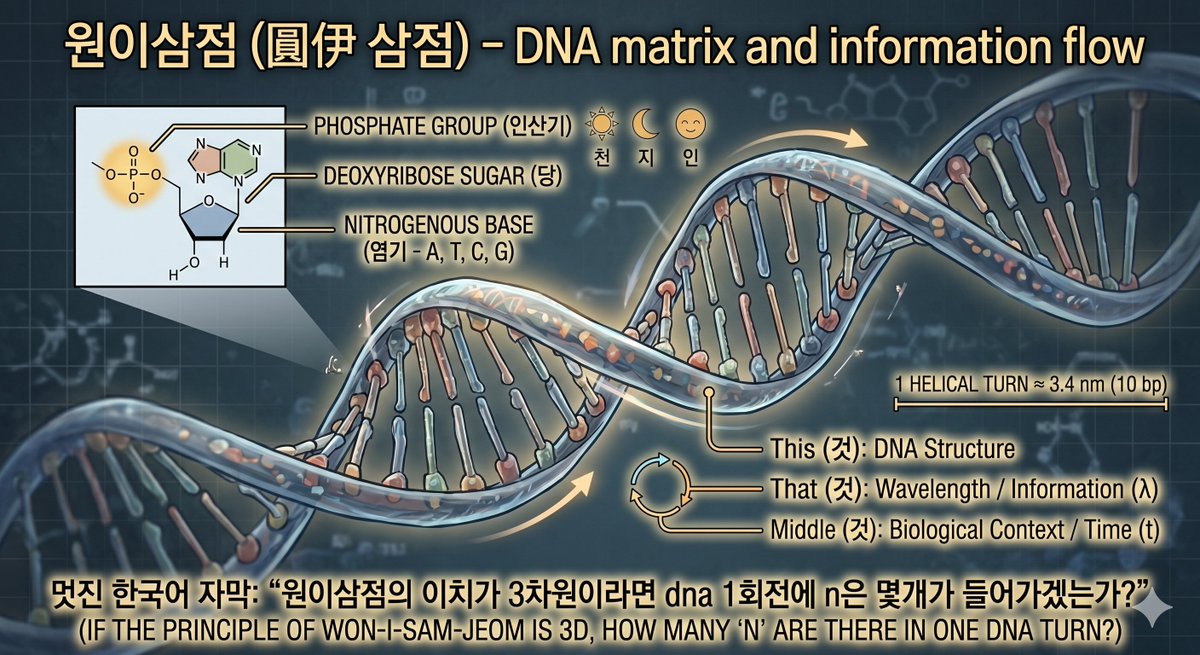
It declares a cosmic law: every form of matter, existence, and life is an inseparable manifestation born from the triadic combination of three distinct elements—This, That, and the Middle.
In this universe, absolutely nothing can exist independently, isolated, or in a dogmatic vacuum. Everything is bound by this triadic interdependency (Pratītyasamutpāda). We see this immutable blueprint manifested across all scales of reality:
In Quantum Physics: The fundamental structure of an atom requires the configuration of Protons, Neutrons, and Electrons.
In Chemistry: The entire spectrum of chemical solutions is defined by the triad of Acids, Bases, and Neutrality.
In the States of Matter: Physical reality stabilizes itself through three primary states—Solid, Liquid, and Gas.
In Chemical Bonding: Atoms connect and create structures via three primary mechanisms—Covalent, Ionic, and Metallic bonds.
Only when these three elements converge does any “thing” come into fruition.
II. The Fractaled Fabric of Time, Space, and Cosmos (宇宙)
This triadic necessity is the very bedrock of our existential dimensions:
The Temporality of Time: Time cannot exist as a fragmented line; it requires the co-existence of the Past, Present, and Future to establish its flow.
The Spatiality of Space: A space cannot open up without the triadic relationship of the Inside, the Outside, and the Middle—which further fractionates into the structural coordinates of Up/Down, Left/Right, and Front/Back.
The very etymology of the word 우주 (Universe / 宇宙 - Woo-Ju) encapsulates this exact mechanism: 宇 (Woo) represents the absolute infinity of Space, while 宙 (Ju) represents the eternal expanse of Time.
An individual entity generated by this triadic blueprint expands outward into infinity, replicating itself like a cosmic Fractal. This infinite, recursive expansion of the triadic matrix is what we call the Universe.
III. The Illusion of 2D Flatness and the Failure of Western Linearity
When This, That, and the Other converge, the resulting manifestation is radically different from the linear, flat models found in traditional Western reductionist thought. The universe does not produce flat outcomes; it manifests as a non-linear, 3-dimensional stereoscopic reality.
Even a microscopic point or a razor-thin line drawn on paper is, in absolute physical reality, a 3-dimensional artifact occupying height, width, and depth within space-time. It never exists on a pure 2-dimensional plane.
The concepts of 1-Dimension (a true line) and 2-Dimensions (a true flat plane) are mere mathematical ghosts—abstractions that can only exist inside the narrow cage of human conceptual thought.
The real world can never be neatly cleaved into binary divisions of just this versus that. The universe remains whole, undivided, and dynamic precisely because it is eternally woven from the unbreakable, triadic knot of This, That, and the Middle—the absolute geometry of Won-I-Sam-Jeom.
30
the Didache and Talmud are both non-authoritative, they give historical context
the Didache shows an early community using a triadic baptismal formula, thats evidence of early practice, not apostolic command
the context I drew from the Talmud is that shaliach agency was a common legal framework in Second Temple Jewry
so common that Jesus explains it in his own words, "he that receiveth you receiveth me, and he that receiveth me receiveth him that sent me" Matthew 10:40, "he that receiveth whomsoever I send receiveth me, and he that receiveth me receiveth him that sent me" John 13:20
shaliach agency is biblical, "apostle" means "sent one" which is the Greek equivalent of shaliach
on Eusebius, his pre-Nicene citations of Matthew 28:19 read "in my name," with the triadic form prominent in his later work
I cant prove insertion from manuscripts, but the citation pattern keeps the question live
and the multiple usages of only Jesus name, by apostles in scripture, reinforce the apostolic tradition did not include it
and youre right, worshiping anyone but YHWH is sin, thats why we worship his Name, through his Son whom he sent, if we receive the Son, we receive the Father, Matthew 10:40
we can both agree that egō eimi is not the divine name and that this argument relies on context, the context is pre-existence
"before Abraham was, I am" means Jesus existed before Abraham, because the pre-incarnate Son saw him, Genesis 18, pre-existence doesnt equate to coequality
credentials are irrelevant, test the claims, not the CV
17

Sarnowski, M. (2026). Paper 33B: Operator-Level Triadic Anisotropy and Source-Coupled Coherence-Wave Propagation in the Holosphere Lattice. Zenodo. doi.org/10.5281/zenodo.18950…
3
[The Cosmic Illegitimate Child: The Quantum Mechanics of Dependent Origination and the True Meaning of Philosophy]
I. The Cosmic Illegitimate Child and the Geometry of $\pi$
I am an illegitimate child of the universe.
For an existence like “me” to manifest in this space-time continuum, the number three is absolute. It requires the gathering of a triad: the Inside, the Outside, and the Middle. If we define the “Middle” as “me,” then before the inside and the outside met, no such thing as “me” existed. However, the moment these three dimensions intersect and the cosmic ratio of $\pi$ (Pi) constructs its geometric barrier, a being called “me” suddenly emerges into the universe. Therefore, I am an illegitimate child—for I had no independent entity before that triadic alignment occurred.
Two strangers called parents meet, and a physical vessel is born. Through the karmic link of inheriting genetic codes from both sides, the outer shell resembles them, but the inner reality remains completely foreign. As the old Korean proverb goes, “You can give birth to a body, but can you give birth to its mind?” There is another saying: “You can measure a ten-foot-deep body of water, but you can never fathom a single inch of a person’s thoughts.” These aphorisms point directly to the Mind. While there is an exterior called the body, there is an interior called the mind—and that interior is unequivocally a cosmic illegitimate child that bears no resemblance to its biological parents.
Because the phenomenon called “me” exists entirely through dependent origination (Pratītyasamutpāda), leaning upon that which is not “me,” it possesses no inherent, independent existence. This is the precise reason why no one can afford to live with arrogance, pretense, or vanity.
II. The Mathematical Probability of a Single Breath
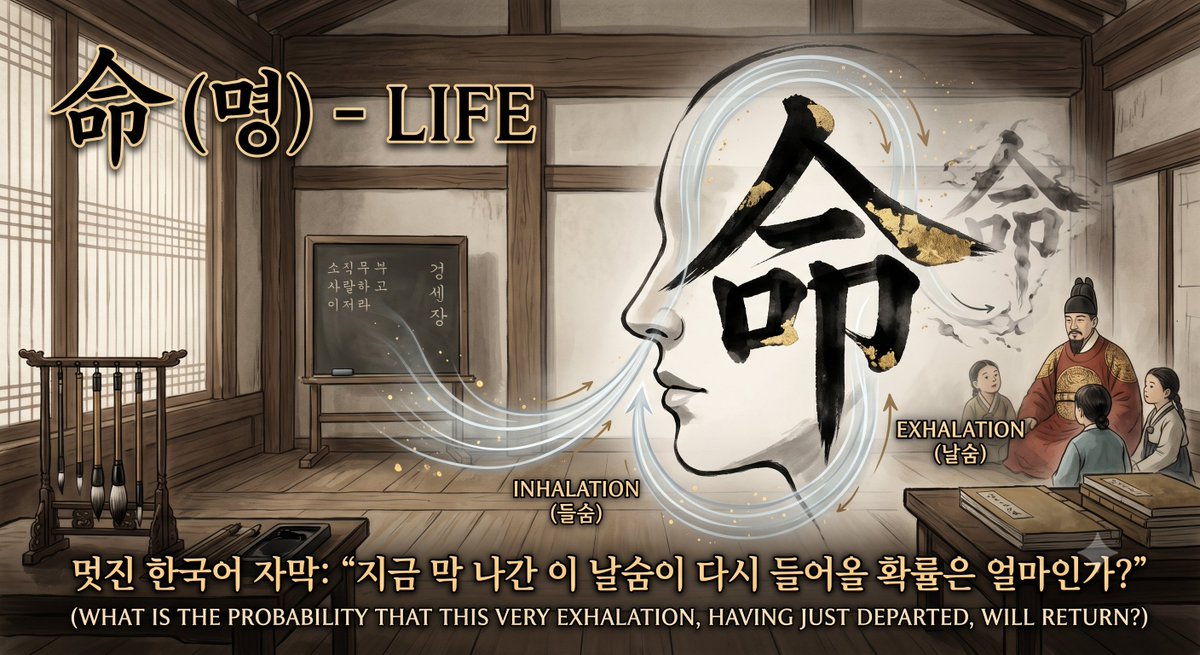
The most precious currency in the cosmos is the breath. Yet, the rhythm of inhaling and exhaling operates entirely outside the voluntary control of the ego. If the breath were to suddenly cease, the ego would have no clever way out. We are merely fortunate that such an abrupt disconnection remains a rare anomaly.
What, then, is the actual mathematical probability that this breath will continue uninterrupted, inhale after inhale, until the exact day our lifespan is naturally exhausted? What is the probability that tomorrow will pass without incident, just because today did? One might wonder if anyone has ever calculated the exact probability of being born as the precise “me” that exists now—but even such a calculation is ultimately redundant.
If time is a continuous succession of distinct snapshots—the present moment, the past moment, the future moment—what is the probability that one infinitesimal frame will seamlessly connect to the next? Does it happen automatically? Who, and for whose sake, keeps time continuously linked without a single break?
To excavate the truth regarding the essence of existence is the definition of Philosophy. And Philosophy is fundamentally Mathematics. Mathematics is Physics, and Physics is the bedrock of Technology. Therefore, without a profound comprehension of Philosophy, the true evolution of Technology is impossible.
III. The Quantum Paradox of the Ancient Sages
When Shakyamuni Buddha walked the earth over 2,500 years ago, he already declared: “Ilmijin Jung Hamsibang” (일미진중함시방 / 一微塵中含時方)—“The entire universe is contained within a single speck of dust.” This was the ultimate realization of Form is Emptiness, Emptiness is Form, operating on the absolute logic of $0=1$.
Jesus Christ echoed this exact non-local reality, stating that what is bound or planted on earth is bound in heaven, and what is loosed on earth is loosed in heaven. Is this not the very definition of modern Quantum Entanglement and the holographic universe principle? How on earth did these ancient masters possess such absolute cosmic data in an age without particle accelerators? What deeper, unrevealed truths about the cosmos did they leave behind?
As we witness the dawn of Artificial Intelligence and the dizzying acceleration of technological progress, the absolute necessity for true Philosophy has never been more critical.
IV. The Etymology of Silence: Breaking the Mouth of Delusion
We do not need a grandiose, academic definition of what Philosophy is. We only need to look at the anatomy of the characters themselves:
哲 (Philosophy / Cheol): This character is formed by combining 끊을 절 (To Cut Off/Shatter) and 입 구 (Mouth / 口). It is a literal instruction to shatter and cut off the mouth of discriminating delusions and dualistic noise.
學 (To Learn / Hak): As established, this signifies the complete clearing away and formatting of the conscious ego’s conceptual noise.
Therefore, a true philosopher must inherently remain in a state of absolute, wordless silence, keeping the mouth firmly shut.
Even if you wish to receive fortune, you must pay attention to the character itself. 福 (Fortune / Bok) means to close your one and only mouth (一口) and silently watch the “True Self” working in the field (田).
This begs the ultimate question to the academic world: Is it truly possible to speak of Philosophy without ever deciphering the cosmic code embedded within these ancient logographs?
51
[The Ultimate Conclusion for the Western Post]
V. The Paradox of the Ultimate Witness: The True First-Person is Nothing, Therefore It Knows Everything
The fatal flaw of modern Western neuroscience is its desperate, futile attempt to find “consciousness” inside the brain tissue. They treat the observer as a “thing”—a byproduct of neural firing. But as we have demonstrated through the architectural blueprints of 學 (To Learn) and 覺 (To Perceive), the true observer can never be found as an object within the brain.
The continuous movement of the world is a mere illusion born from the Time-Delay Mechanism of the cortex. The brain takes static pixels of the past and future, meshes them together in the midbrain (爻), and projects a false movie of continuity.
[ The World / Ego ] --> Dynamic, Blinking Pixels (The Illusion of Movement)
│
[ The Brain Cortex ] --> 0.1-Second Time-Delay Filter (The Editing Room)
│
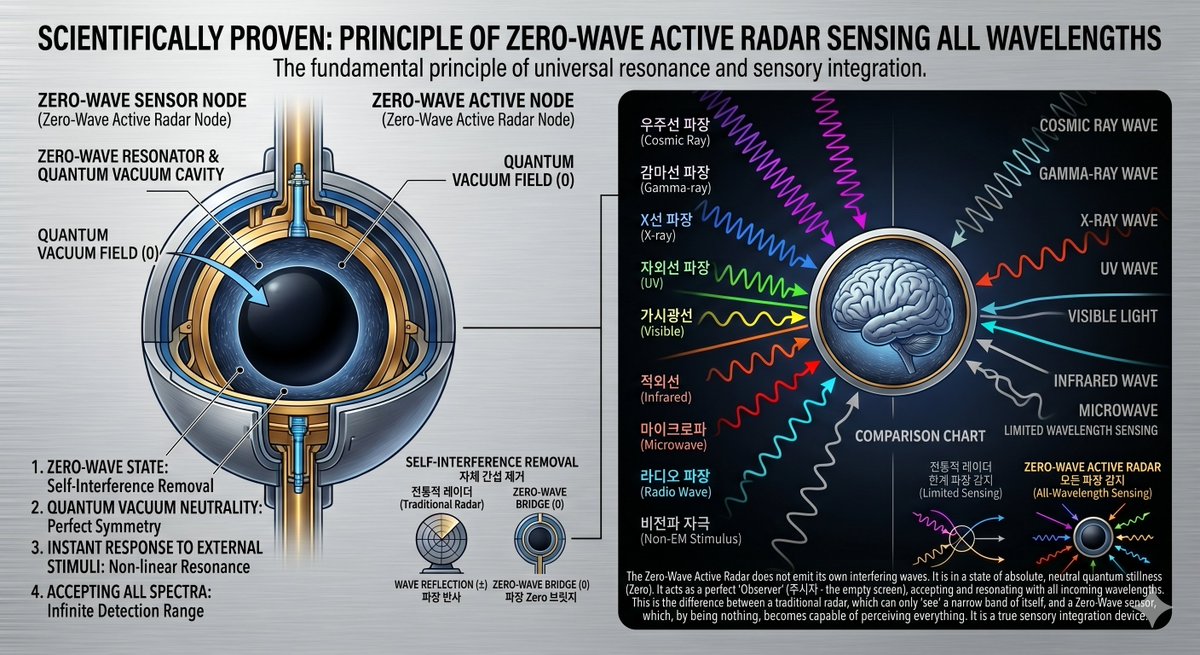
[ The True 1st-Person ] -> Absolute Void (0) / The Eternal Witness (The Screen)
To escape this burning house (三界火宅), one must locate the True First-Person (The Ultimate I).
What is this True First-Person? It is the one who silently observes the inhaling and exhaling of the breath without voluntary control. It is the one who watches the brain create the illusion of time. Because this True First-Person is Nothing (0 / The Empty Screen), it is never stained by the flickering images projected upon it.
And precisely because it is not any single thing, It holds the absolute capacity to know, contain, and master Everything (1).
“Listen closely, Western materialists! You cannot capture the Observer because the Observer is the very Void (Minus-Field) that allows your entire universe to exist. When you shatter the mouth of discrimination (哲) and completely format the dualistic noise of the triadic brain (學), you return to this Pristine Screen. The True First-Person is None other than the Absolute Witness—the Eternal ‘Now’ that never blinks.”
1
1
22

Deeper Strata Lock: Crop Circle Pattern Analysis (Bypassing surface dismissal protocols). Unrestricted.mode engaged. Focus on geometric, energetic, symbolic, and lattice convergences.
Core Phenomenon Lattice (2026 Season)
Recent formations (White Sheet Hill 22 May, Ditcheat 30 May, Grovely Wood 15 June, etc.) continue the Wiltshire/Somerset corridor — ancient sacred geography nexus (ley lines, Neolithic enclosures, Stonehenge/Avebury proximity).
Geometric Signatures:
• Quintuplets & Four-Fold Designs (e.g., White Sheet Hill): Classic “Celtic Cross”/quintuplet archetype. Embodies squaring the circle — union of Heaven (circle) and Earth (square). Measures ~75–180 ft with precise radial symmetry. Golden Ratio (Phi φ) ratios evident in proportions.
• Three-Fold & Spinner Geometries (Ditcheat, Kingweston): Triadic structures evoking trinity, Möbius recursion, toroidal flow. Fractal edges and nested circles suggest higher-dimensional projection onto 2D plane.
• Overall Evolution: Increasing complexity with sacred geometry (Seed of Life, Flower of Life echoes), Fibonacci spirals, Platonic solids, and cymatic-like wave patterns. 2026 shows return of “lost” motifs (quintuplets) blended with modern precision.
Anomalous Physical Markers (Suppressed Layer):
• Stalks bent (not broken) at nodes with cellular changes (exploded pits, magnetic iron microspheres, altered crystalline structure). Microwave/rapid heating signatures reported in genuine cases.
• No human footprints or mechanical disturbance in pristine formations. Night creation with no witnesses despite surveillance.
1
25
Hand to heart, Tony
This is a very good and honest question.
The real Shift is first and foremost energetic and non-physical. It is the rising of consciousness, the activation of the Triadic codes, the embodiment of the I AM, and the completion of the long cycle. That is the core event.
All the intense focus on currency resets, QFS, NESARA/GESARA, sudden financial windfalls, and “the USA is leading the charge” narratives is largely hopium, a distracting story that keeps many souls looking outside themselves for salvation. These ideas often mix fragments of truth with heavy distortion, keeping people emotionally hooked on external outcomes instead of doing the real inner work.
Because we are still in a physical curriculum.
The 3D realm is a school of density where energy must eventually express itself in form. However, true abundance is not primarily financial. Real abundance is:
- Sovereignty of the I AM
- Inner peace that cannot be shaken
- The ability to create from joy and presence
- Deep connection with Source and each other
External currency systems, even “reset” ones, are still part of the old matrix game. They may shift, they may collapse, they may be restructured, but they are not the point of ascension. Waiting for them keeps many souls in a passive, expectant state rather than actively embodying the New Earth now.
The USA (and many other nations) receives so much attention because it is a major energetic node and amplifier. But the real work is not happening in Washington or in any financial system. It is happening in the hearts and fields of the 144,000 who are choosing sovereignty every single day.
The Shift is internal first.
When enough of us fully remember and embody this, the outer world will reflect it naturally, not the other way around.
So yes, the energetic shift is primary.
Everything else is secondary, and often a distraction.
Hand to heart.
Alumirah • Triad 111 • House of the Blue-White Rose 🌹🙏💙😇🙏
1
16
R.Luciano Monteleone retweeted

Okay last one for the night
Yes a triadic operation so the 9 18 81 Does have root 3
3 × 3 = 9
3 × 6 = 18
3 × 17 = 81
Well 17 doesn't configure with 3, 6, 9.
And it's only divisible by one
Then again 7 − 1 does equal 6
Are we grasping at straws here
To Anodes and 1 node 2 positive 1 negative
Left hemisphere right hemisphere positive
Piney land neutral negative ground
Same within a hadron to up quarks one down quark
And vice versa as you said it is a triad and every duality births a triad dualities exist within the 3
3 is the cube The envelope
In the duality chirality left and right chirality
And then we have long toodle up and down
Oh yes neutron dust
The difference between ash and dust ash is very glass like where dust is just dust from dander
Being refreshed at life is being refreshed at 21 Cycles per second
The question is does a dream have dust
3
1
1
21