
Jun 11
AI Is Rewriting mRNA Drug Design
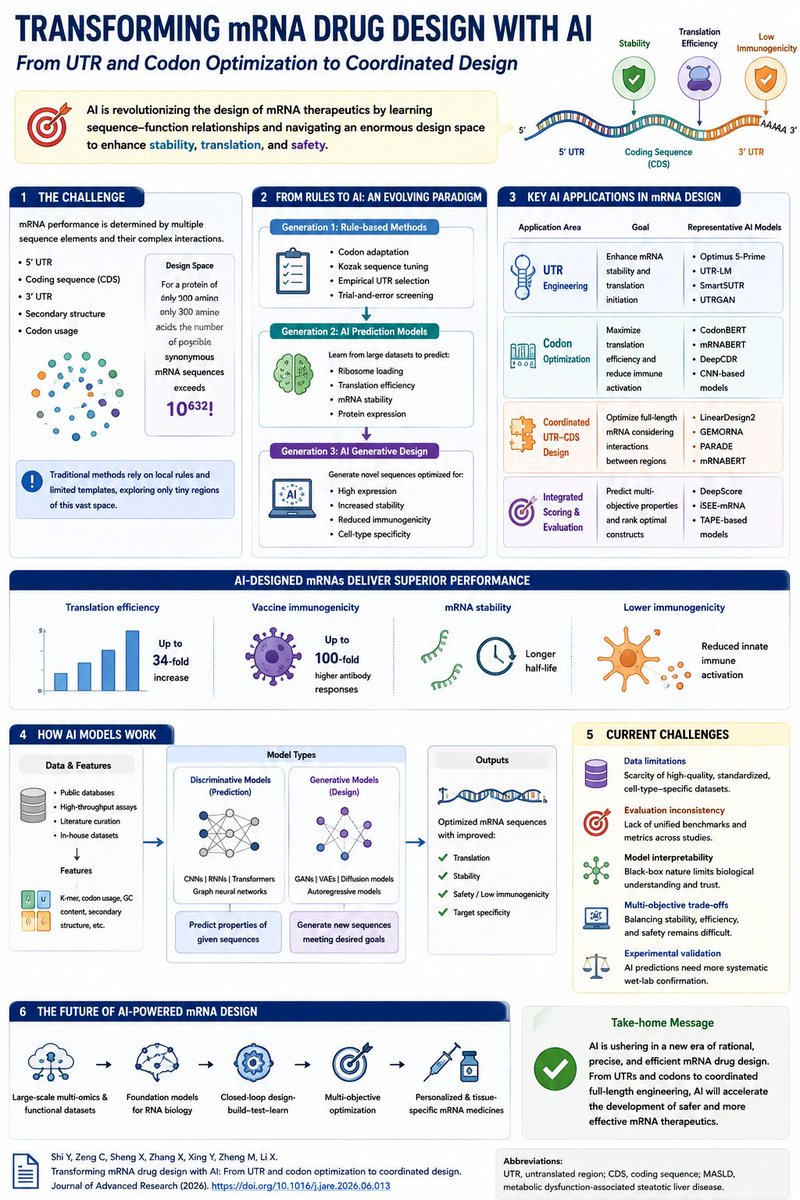
The success of COVID-19 mRNA vaccines proved that messenger RNA can become a transformative therapeutic platform. Yet one of the field’s biggest challenges remains unresolved:
How do we design the optimal mRNA sequence among billions of possibilities?
A new review in Journal of Advanced Research highlights how artificial intelligence is rapidly becoming the engine that drives next-generation mRNA therapeutics.
Unlike conventional drugs, mRNA performance depends heavily on sequence architecture:
• 5′ untranslated region (5′UTR)
• Coding sequence (CDS)
• 3′ untranslated region (3′UTR)
• Secondary structure
• Codon usage patterns
Even when two mRNAs encode exactly the same protein, differences in sequence design can dramatically alter:
✓ Translation efficiency
✓ Stability
✓ Immunogenicity
✓ Tissue-specific expression
The review describes a major paradigm shift.
Generation 1: Rule-based optimization
Historically, mRNA engineering relied on:
• Codon adaptation indices
• Kozak sequence tuning
• Empirical UTR selection
• Trial-and-error screening
These approaches explore only tiny regions of an enormous design space.
For example, the synonymous coding space of the SARS-CoV-2 spike protein exceeds 10⁶³² possible mRNA sequences.
Generation 2: AI prediction models
Deep-learning systems such as:
• Optimus 5-Prime
• UTR-LM
• CodonBERT
• mRNABERT
learn sequence–function relationships directly from large experimental datasets.
Rather than relying on hand-crafted rules, these models predict:
• Ribosome loading
• Translation efficiency
• mRNA half-life
• Protein expression output
Generation 3: AI-generated mRNA
The most exciting development is the rise of generative design.
Instead of evaluating existing sequences, AI can now create entirely new ones.
Examples include:
🧬 UTRGAN
🧬 Smart5UTR
🧬 PARADE
🧬 GEMORNA
These systems generate synthetic UTRs and coding sequences optimized for specific objectives such as:
• High expression
• Increased stability
• Reduced immunogenicity
• Cell-type specificity
Some AI-designed UTRs produced:
🚀 Up to 34-fold increases in translation efficiency
🚀 Nearly 100-fold higher vaccine-induced antibody responses
compared with conventional designs.
The next frontier: coordinated design
The review argues that the field is moving beyond isolated optimization of individual sequence elements.
Current efforts increasingly focus on:
5′UTR CDS 3′UTR co-design
as a unified system.
Models such as:
• LinearDesign2
• GEMORNA
• mRNABERT
attempt to optimize the entire transcript simultaneously rather than treating each region independently.
This matters because translation, stability, structure, and immunogenicity emerge from interactions across the full-length mRNA molecule.
Why this matters
The future of mRNA medicine may resemble modern protein design.
Instead of manually optimizing sequence elements, researchers will specify desired properties:
✓ High expression
✓ Long half-life
✓ Low innate immune activation
✓ Liver targeting
✓ Efficient LNP delivery
and AI systems will generate candidate mRNAs automatically.
The authors envision a future built around:
• Foundation models for RNA biology
• Multi-objective optimization
• Generative AI
• Closed-loop design-build-test-learn platforms
where computational models and experimental validation continuously improve each other.
If protein engineering was transformed by AlphaFold and generative biology, mRNA therapeutics may be approaching a similar inflection point.
The next blockbuster mRNA drug may be designed not by manual codon tuning—but by AI.
Reference
Shi Y, Zeng C, Sheng X, et al.
Transforming mRNA drug design with AI: From UTR and codon optimization to coordinated design.
Journal of Advanced Research (2026)
DOI: 10.1016/j.jare.2026.06.013
#mRNA #ArtificialIntelligence #GenerativeAI #CodonOptimization #UTRDesign #RNAEngineering #DrugDiscovery #BioAI #PrecisionMedicine #JournalOfAdvancedResearch
1
6
321

8 Feb 2025
UTR-Insight: integrating deep learning for efficient 5′ UTR discovery and design
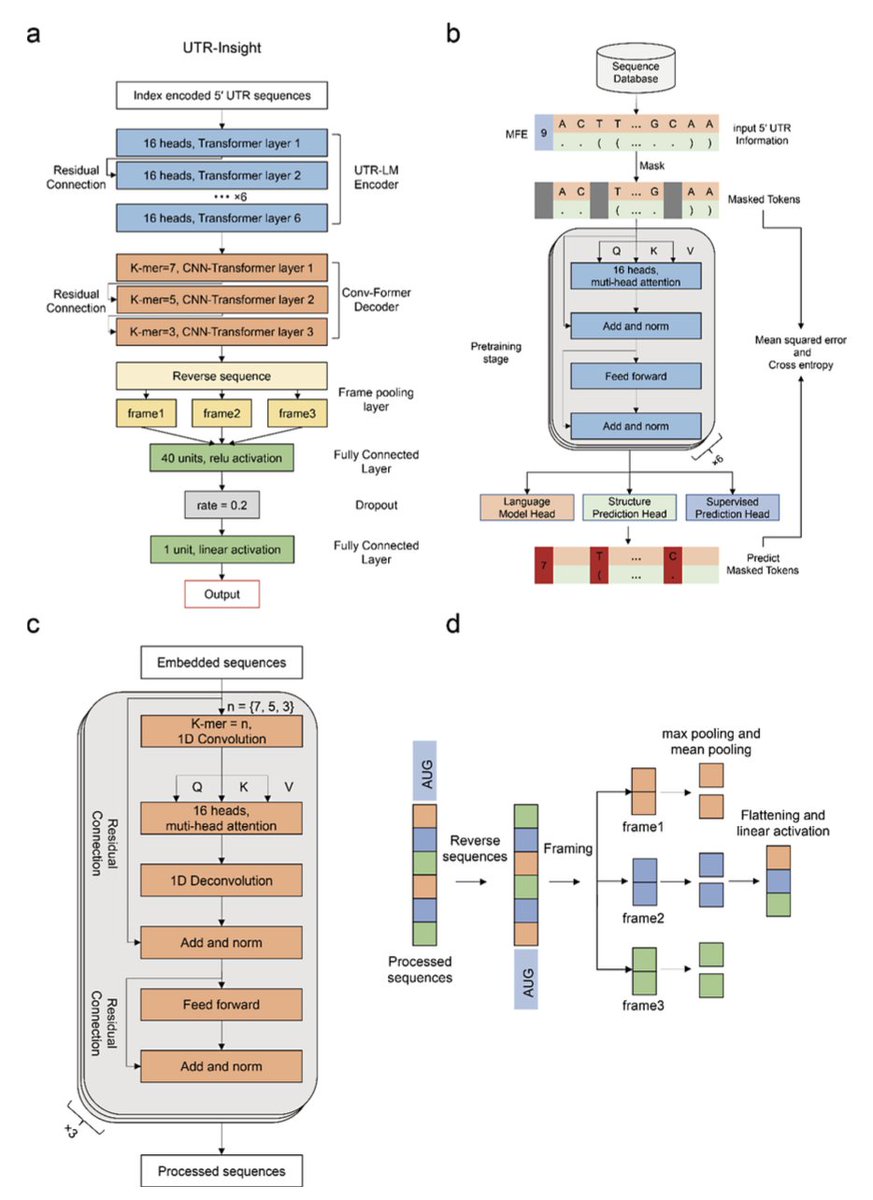
1. UTR-Insight is a deep learning model that predicts the translation efficiency of 5′ UTR sequences using a CNN-Transformer architecture, enabling both high-throughput screening of endogenous sequences and de novo design of optimized 5′ UTRs for mRNA therapeutics.
2. The model explains 89.1% of the variance in mean ribosome load (MRL) for random 5′ UTRs and 82.8% for endogenous sequences, significantly outperforming existing methods like Optimus, FramePool, and UTR-LM.
3. UTR-Insight integrates a pretrained language model as an encoder, enhancing sequence representations beyond traditional one-hot encoding, and employs a CNN-Transformer decoder to capture both local sequence motifs and long-range dependencies.
4. A high-throughput in silico screening pipeline based on UTR-Insight was used to analyze over 300,000 5′ UTRs from primates, mice, and viruses, leading to the identification of sequences that increased protein expression by up to 319% compared to the widely used human α-globin 5′ UTR.
5. The model was also used to design entirely new 5′ UTRs using a genetic algorithm, with these synthetic sequences outperforming even the best endogenous sequences in protein expression levels.
6. Experimental validation confirmed that in silico screened and designed 5′ UTRs consistently led to higher protein expression across multiple genes and cell types, demonstrating their potential for optimizing mRNA vaccine and therapeutic applications.
7. By combining high-throughput screening with deep learning-driven sequence design, UTR-Insight provides a powerful tool for tailoring 5′ UTRs to maximize translational efficiency, potentially revolutionizing mRNA therapeutics.
💻Code: github.com/pansaichao/UTR_In…
📜Paper: bmcgenomics.biomedcentral.co…
#DeepLearning #mRNAtherapeutics #TranslationRegulation #Bioinformatics #SyntheticBiology #MachineLearning #UTRDesign #GeneExpression #RNA
1
15
2,126
8 Feb 2025
UTR-Insight: integrating deep learning for efficient 5′ UTR discovery and design
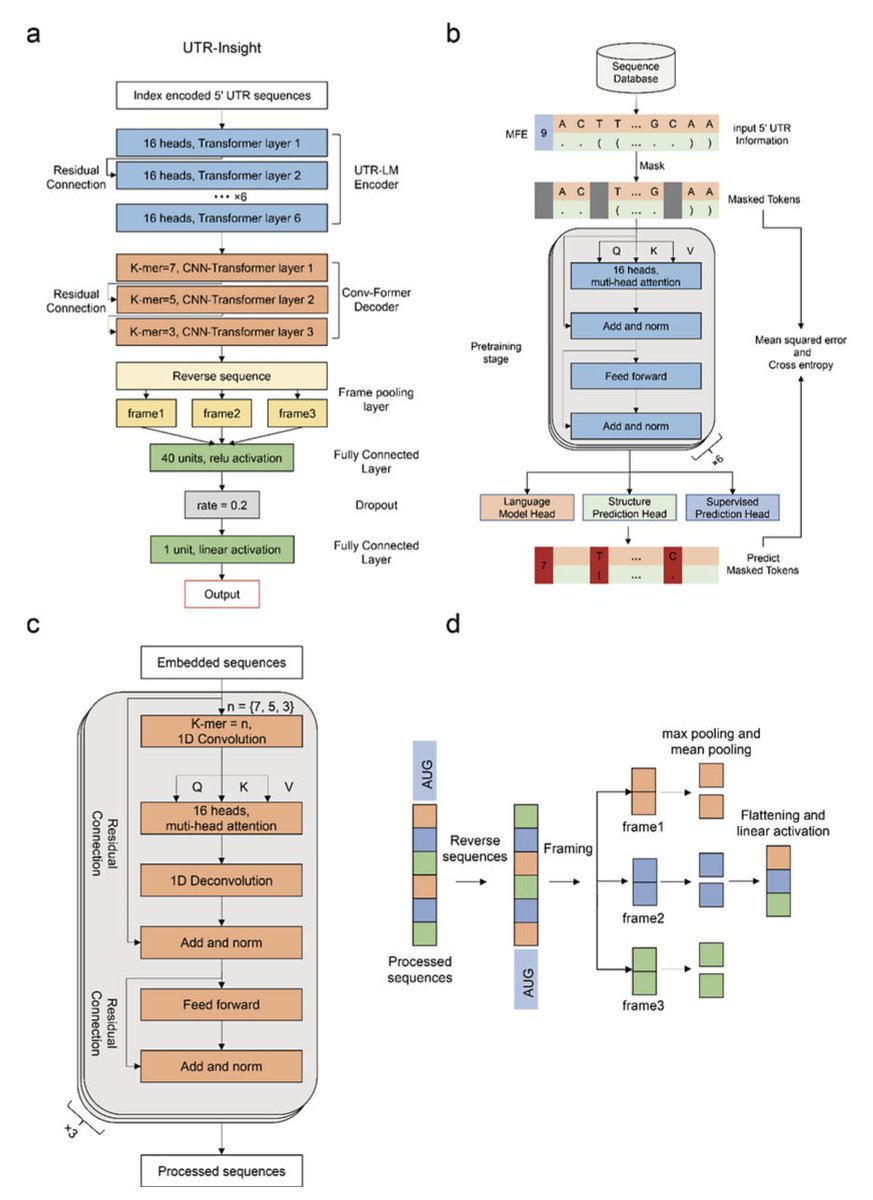
1. UTR-Insight is a deep learning model that predicts the translation efficiency of 5′ UTR sequences using a CNN-Transformer architecture, enabling both high-throughput screening of endogenous sequences and de novo design of optimized 5′ UTRs for mRNA therapeutics.
2. The model explains 89.1% of the variance in mean ribosome load (MRL) for random 5′ UTRs and 82.8% for endogenous sequences, significantly outperforming existing methods like Optimus, FramePool, and UTR-LM.
3. UTR-Insight integrates a pretrained language model as an encoder, enhancing sequence representations beyond traditional one-hot encoding, and employs a CNN-Transformer decoder to capture both local sequence motifs and long-range dependencies.
4. A high-throughput in silico screening pipeline based on UTR-Insight was used to analyze over 300,000 5′ UTRs from primates, mice, and viruses, leading to the identification of sequences that increased protein expression by up to 319% compared to the widely used human α-globin 5′ UTR.
5. The model was also used to design entirely new 5′ UTRs using a genetic algorithm, with these synthetic sequences outperforming even the best endogenous sequences in protein expression levels.
6. Experimental validation confirmed that in silico screened and designed 5′ UTRs consistently led to higher protein expression across multiple genes and cell types, demonstrating their potential for optimizing mRNA vaccine and therapeutic applications.
7. By combining high-throughput screening with deep learning-driven sequence design, UTR-Insight provides a powerful tool for tailoring 5′ UTRs to maximize translational efficiency, potentially revolutionizing mRNA therapeutics.
💻Code: github.com/pansaichao/UTR_In…
📜Paper: bmcgenomics.biomedcentral.co…
#DeepLearning #mRNAtherapeutics #TranslationRegulation #Bioinformatics #SyntheticBiology #MachineLearning #UTRDesign #GeneExpression #RNA
1
4
1,088