
I don’t understand why pollsters for this race are undersampling independents so much and platner’s numbers with them are extremely unsettling
1
107
Mahmoud Abou Zeinab MD. retweeted

Jun 8
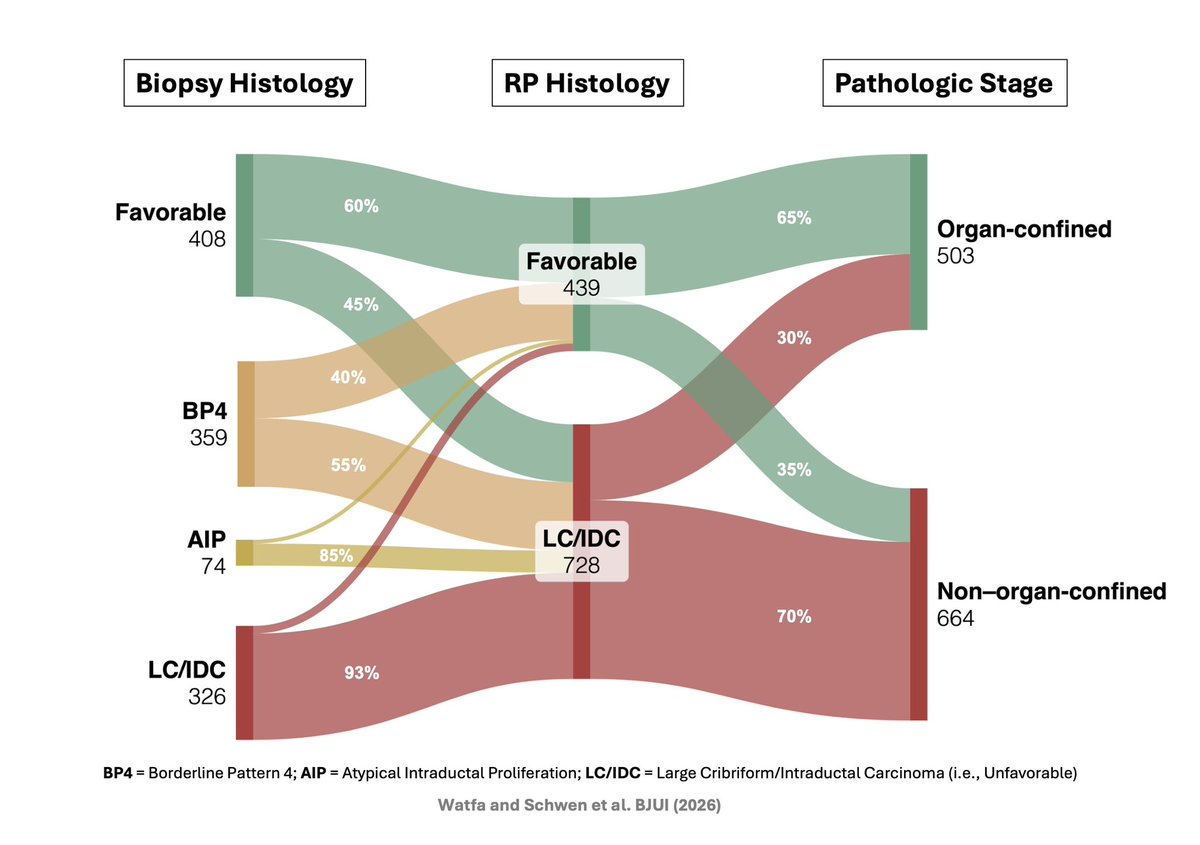
🚨Major takeaway🚨 - HUGE undersampling of cribriform/intraductal on biopsy alone
👉Must rely on markers of unsampled crib/IDC such as MRI/genomics for biopsy risk stratification
@CleClinicUro @cjweight @JaneNguyen44 @drjkaouk
Congrats @MWatfa26
Jun 8

Aggressive prostate cancer can hide behind reassuring biopsy findings. ⚠️
Our @BJUIjournal publication on Large Crib/IDC undersampling and risk stratification.
@ZSchwen @JaneNguyen44 @drjkaouk @cjweight @CleClinicUro
bjui-journals.onlinelibrary.…
Diagram below says it all ⬇️
1
4
16
2,937

Note, I don't expect this to happen. I think the poll is definitely undersampling rural whites.
2
95

Even if mipmaps are perfect you're not solving all aliasing that way because you are still gonna have screen-space undersampling for instance, as well as the aforementioned temporal instability. Devs do abuse temporal AA but I don't buy this whole "temporal AA is useless" vibe.
1
54

550 PCR-confirmed cases in DRC (7 June)
insp.cd/sitrep-n24-mvb_07-06…
"Suspected cases" is not reliable
Malaria is likely a confounding factor
Number of PCR-confirmed cases is an undercount due to undersampling/delayed analyses, but it is the only reliable indicator of outbreak size
83

Jun 9
They weight by demographics like everyone else. Claims of deliberate undersampling of Conservatives ignore that multiple pollsters have decent recent track records
If the numbers are off, we'll see it on election day. Until then it's just data.
You are making a bold claim of corruption. With no evidence, and no real world back up.
7

Jun 8
Aggressive prostate cancer can hide behind reassuring biopsy findings. ⚠️
Our @BJUIjournal publication on Large Crib/IDC undersampling and risk stratification.
@ZSchwen @JaneNguyen44 @drjkaouk @cjweight @CleClinicUro
bjui-journals.onlinelibrary.…
Diagram below says it all ⬇️
1
9
34
6,514

Jun 8
Its not an unusal party arcetype. Extremely dedicated but narrow support base concentrated in poltically interested types. This is an arcetype that pollsters usually overestimate because of undersampling of soft supporters.
3
1
1
1,040

Jun 8
Combining undersampling, ISMOTE and loss weighting pushes F1 > 0.7 on 15-emotion fine-tuning of MistralSmall-3.1.
towardsdatascience.com/how-t…
10

Both are cases of undersampling, one through laziness, other through persistence
Jun 5

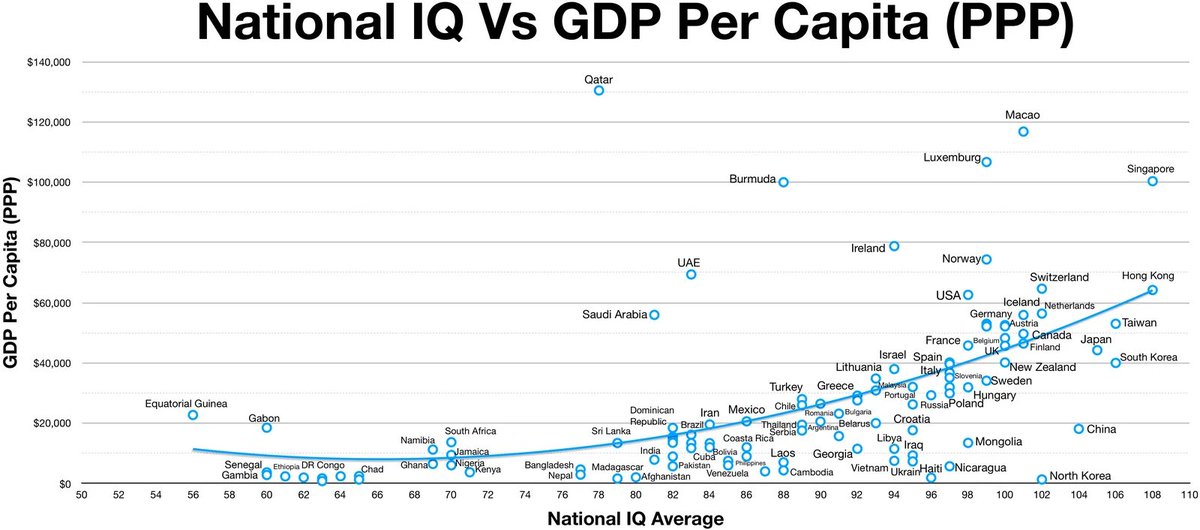
Another (probably final) point about IQs and the China-India comparison.
As I stated in a previous post, China's IQ of 105 is likely overestimated. India's IQ of 80 likely has a huge variance.
But people still compare the IQ vs GDP graph to prove that nations with higher average IQs are richer. That's because higher IQ corresponds (usually) with better abstract thinking which leads to better technologies, institutions, etc.
And then this is used to claim that India will have an upper limit on its GDP per capita.
But how true is it? In the graph below, while there's a regression line, there's a huge variance. The US technically has a lower IQ than China but higher GDP per capita. Same with Korea and Japan.
So two points here then:
1. India's measured IQ will likely increase due to Flynn effect.
2. The IQ can predict the wealth of a nation very roughly, but because we have so less data (there are only 193 countries), there's only so much extrapolation you can do.
What matters more is:
1. Free market policies.
2. A culture of innovation and risk taking.
3. High-skilled immigration.
1
3
308

Jun 3
~ undersampling used to project global data is phony science, gives the excuse to 'extrapolate' data & concoct the climate narrative needed to force intl non-representative 'experts' opinions drastic anti-growth measures on us all. good riddance. ~
1
19

Pretraining has been done on a 50 million subset of the DenseOn/LateOn filtered pretraining corpus. Huge thanks to @LightOnIO for the dataset and blogs!
This was a continuation of the pretraining experiment I was up to earlier. Scaling up pretraining data and batch size, and also more data variety are the uplifters! Instead of focusing on retrieval and QA, it’s now across every dataset. To avoid undersampling smaller datasets, I simply used multinomial sampling, and single data source batches to avoid model cheating. All of this is discussed in the DenseOn/LateOn blog post: huggingface.co/blog/lightona…
1
2
17
1,000

May 29
I don't think Collins is in a strong position, but I don't think Platner is either. Re: polling a real possibility is oversampling of college ed voters & undersampling of HS ed voters. The former's margin for Platner is so big it could introduce error.
3
2
9
498

May 24
I think there is sampling issues right now based on severe undersampling of job seekers.
1
4
112

Fake news alert: if they don't include a link to the poll book I default to "its a fake poll". You can't tell without the poll book which is probably why there's no link in this election time post.
Daily Intel update/Claude/5-15-26
How to fake a poll.
Classic/Well-Known Manipulation Techniques
Question wording & ordering
Leading questions ("Don't you agree that...") prime respondents toward a desired answer
Question order effects — asking about a specific policy before a general approval question shifts results measurably
Double-barreled questions that bundle two issues together, making interpretation ambiguous
Sample manipulation
Oversampling or undersampling partisan groups, then burying it in fine-print methodology
Using likely voter screens that are calibrated to favor one electorate over another
Online opt-in panels that self-select for more extreme views
Timing
Polling immediately after a favorable news event for your candidate
Releasing polls strategically while suppressing unfavorable internal polls (perfectly legal)
Margin of error abuse
Treating a 2-point lead in a ±3 point poll as definitive
Rounding or cherry-picking from crosstabs
The "Herding" Problem
Pollsters unconsciously (or consciously) adjust their results toward the consensus of other published polls, to avoid being an outlier. This is widespread and well-documented — it contributed to polling failures in 2016 and 2020 by creating false precision around a wrong consensus.
Newer / More Innovative Techniques
Sponsor suppression
"Advocacy polls" are commissioned by campaigns or PACs but released through neutral-sounding front organizations, obscuring who paid for them. Disclosure rules are weak and inconsistently enforced.
Artificial Intelligence & synthetic respondents
Emerging research shows it's now possible to use LLMs to simulate poll responses that closely mimic human survey behavior. A pollster could supplement a thin real sample with AI-generated responses tuned to a target demographic — nearly impossible to detect from the outside.
Push polling dressed as legitimate polling
Asking "Would you still support Candidate X if you knew they had [damaging claim]?" — this is advocacy masquerading as measurement, and also spreads the damaging claim to thousands of respondents
Mode mixing without disclosure
Blending phone, online, and text responses without clearly weighting for the different populations each method reaches, producing whatever result the weighting choices favor
Registered voter vs. likely voter switching
Toggling between these two universes (which can differ by 5–8 points) based on which favors your narrative, without being transparent about why
Differential non-response exploitation
In periods when one party's voters are more motivated to respond to polls, a pollster can simply not correct for this, producing a skew. This is thought to have driven significant polling error in the Trump era.
Why It's Hard to Catch
For polls released for public consumption, the main deterrents are thin:
Transparency norms (releasing crosstabs, methodology) are voluntary
AAPOR (the main polling standards body) can censure members but has no legal authority
Media outlets rarely have the statistical sophistication to interrogate methodology before amplifying results
Replication is impossible — you can't re-run the same poll
The net result is that a sophisticated actor can produce a poll that looks credible — complete with confidence intervals and demographic breakdowns — that is substantially engineered toward a predetermined outcome, and most consumers of political news will never know.
1
4
301
no link to poll book = fake poll. The poll book is always the first step.
Daily Intel update/Claude/5-15-26
How to fake a poll.
Classic/Well-Known Manipulation Techniques
Question wording & ordering
Leading questions ("Don't you agree that...") prime respondents toward a desired answer
Question order effects — asking about a specific policy before a general approval question shifts results measurably
Double-barreled questions that bundle two issues together, making interpretation ambiguous
Sample manipulation
Oversampling or undersampling partisan groups, then burying it in fine-print methodology
Using likely voter screens that are calibrated to favor one electorate over another
Online opt-in panels that self-select for more extreme views
Timing
Polling immediately after a favorable news event for your candidate
Releasing polls strategically while suppressing unfavorable internal polls (perfectly legal)
Margin of error abuse
Treating a 2-point lead in a ±3 point poll as definitive
Rounding or cherry-picking from crosstabs
The "Herding" Problem
Pollsters unconsciously (or consciously) adjust their results toward the consensus of other published polls, to avoid being an outlier. This is widespread and well-documented — it contributed to polling failures in 2016 and 2020 by creating false precision around a wrong consensus.
Newer / More Innovative Techniques
Sponsor suppression
"Advocacy polls" are commissioned by campaigns or PACs but released through neutral-sounding front organizations, obscuring who paid for them. Disclosure rules are weak and inconsistently enforced.
Artificial Intelligence & synthetic respondents
Emerging research shows it's now possible to use LLMs to simulate poll responses that closely mimic human survey behavior. A pollster could supplement a thin real sample with AI-generated responses tuned to a target demographic — nearly impossible to detect from the outside.
Push polling dressed as legitimate polling
Asking "Would you still support Candidate X if you knew they had [damaging claim]?" — this is advocacy masquerading as measurement, and also spreads the damaging claim to thousands of respondents
Mode mixing without disclosure
Blending phone, online, and text responses without clearly weighting for the different populations each method reaches, producing whatever result the weighting choices favor
Registered voter vs. likely voter switching
Toggling between these two universes (which can differ by 5–8 points) based on which favors your narrative, without being transparent about why
Differential non-response exploitation
In periods when one party's voters are more motivated to respond to polls, a pollster can simply not correct for this, producing a skew. This is thought to have driven significant polling error in the Trump era.
Why It's Hard to Catch
For polls released for public consumption, the main deterrents are thin:
Transparency norms (releasing crosstabs, methodology) are voluntary
AAPOR (the main polling standards body) can censure members but has no legal authority
Media outlets rarely have the statistical sophistication to interrogate methodology before amplifying results
Replication is impossible — you can't re-run the same poll
The net result is that a sophisticated actor can produce a poll that looks credible — complete with confidence intervals and demographic breakdowns — that is substantially engineered toward a predetermined outcome, and most consumers of political news will never know.
3
46