
4 Sep 2024
7
301

6 Jul 2023
Automotive #FunctionalSafety requires compliance with #ISO26262. We show you how to verify coding guidelines through static analysis with #PClintPlus and verify functional specifications through dynamic analysis with #VectorCAST: vctr.it/3JM2TkV
#VectorWebinar

2
281
31 May 2023
Logging, function development, function test, or injection of virtual camera images: See our latest #ADAS developments at the #AVTExpoStuttgart! vctr.it/435Zwgj
#VectorSmartLogger #DYNA4 #VectorCANoe #VectorCAST #PClintPlus #AVengineering

2
222

31 Mar 2023
<Tech stack Writeup from @vikgomat for aspiring embedded product developers>
The tools platforms vary wildly on what type of project you're working on, microcontroller platform, what industry/application you're focussed on etc.
A collection of S/W stack/Tools that you need to learn/understand to develop an embedded product.
1. OS
a. (most preferred)FreeRTOS freertos.org/
b. micrium OS silabs.com/developers/micriu…
c. (increasingly popular)Embedded Linux (ubuntu.com/blog/what-is-embe…), buildroot (buildroot.org/) or Jenkins (jenkins.io/doc/book/installi…)
2. Languages
a. C/Objective C
b. C
c. RUST
d. Python (for Embedded linux systems w/ python interpreter) or Writing Hardware In The Loop tests
e. shell scripting (auto running scripts in Embedded Linux)
f. some Javascript or Kotlin for supporting app development
3. Middleware
a. (up and coming!) ROS (Robotics Operating system, can be used for non robotic embedded products as well!) micro.ros.org/
b. Docker jfrog.com/knowledge-base/a-b…
c. CMake (cmake.org/) for package management, compiler, debugger management etc.
d. Data Interchange formats
4. Unit Testing Platforms
a. CMocka (SUCKS!)
b. Gtest (Promising!)
c. VectorCAST (only if you need industrial/safety approvals)
d. Pytest
5. Communication Protocols
a. I2C
b. UART
c. SPI
d. I2S
e. Bluetooth/BLE
f. Wifi (vendor dependent)
e. Zigbee (Vendor dependent)
f. LTE (each LTE Vendor might have their own stack)
6. IDEs
a. VSCode
b. Keil Microvision
c. Other Vendor dependent platforms are normally Eclipse derived
d. If you're hardcore you can use VIM
e. Clion
f. QT creator
7. Circuit design
a. Just a general understanding of resistors, capacitors, pullups, pull downs, inductors etc
b. Altium
8. Debugging
a. Be familiar with GDB and how GNU debugging works,
b. Be comfortable with using JTAG or Jlink debugger (you'll get better with practice)
9. Miscellaneous (must read for beginners !)
a. Becoming comfortable working with microcontroller pin tools and clocks -- these are vendor dependent, but will overall have the same patterns (again buy a cheap dev board and start practising!) (Start Here : www-mdp.eng.cam.ac.uk/web/li…)
b. Familiarity with Arduino and raspberry pi platforms -- Most serious application will likely not use them but its great if you're just starting out!!!
c. buy one of those arduino dev kits, with breadboards, LED's, buttons and sample arduino sketches that you can download and play with. This is MOST CRITICAL for students to get better at embedded development.
d. If you can source this book I'd very highly recommend this. amazon.com/Design-Patterns-E…. Embedded products will tend to have repeating drivers, devices, and learning to design reusable modules is very very important.
2
6
34
7,503

19 Aug 2022
記事を投稿しました! <エンジニア夏休み企画>【読書感想文】「はじめてのvectorCAST」 ベクタージャパン on #Qiita qiita.com/kaizen_nagoya/item…
2
2

8 May 2022
ライブ前最後の六合リハでした
良い感じに仕上がってますので、5/14のWildSideどうぞご期待ください🤘
今日のスネアはPearl HEP1450 Hybrid Exotic VectorCast 14″x5″
木や金属とも違う独特なアタック感が魅力
スピンタイト・テンションボルトはなかなか慣れなくて結局締めてません😅


1
13
16 Oct 2021
Business-critical software? RDBMS? Safety-critical aerospace/automotive applications? You can also be an app or web-based programmer, but you all still need one single thing: #SoftwareTesting
Sign up for the #VectorWebinar: vctr.it/3mZqwdd
#SoftwareQuality #VectorCAST
2

2 Jul 2021
We are looking for #geeks, experienced in medical software development using C, C and #UnitTesting on VectorCAST tool. If you fit the bill, here is a great opportunity for you! Apply now to #StayAhead: bit.ly/3AiytQK
#HGAY #SoftwareEngineerVectorCAST #Hiring #JobAlerts

4

15 Dec 2020
New - Snare Drum of the Month – December 2020 – @PearlDrumCorp
14×5″ Hybrid Exotic Vectorcast
mikedolbear.com/features/sdo…
1

12 Nov 2020
Limited Edition Pearl 14"x5" VectorCast Philharmonic Snare Drum with Bag for only $599! You'll find this drum at our competitors for $849 , but in honor of PASIC week we're blowing them out for $599 while supplies last at steveweissmusic.com/product/…
6
1 Oct 2020
#ISO26262 and HIS metrics Learn how to comply with these #automotive standards by combining Vector #Squore and #VectorCAST solutions Sign in for a free Vector webinar: vctr.it/2W4XRam

3
2 Jun 2020
Medical device software under Medical Device Regulation (MDR) A regulatory insight into safety and security A #VectorCAST webinar | Sign up for free know-how here: vctr.it/2WsyZdf
#medicalengineering #IEC62304 #cybersecurity #softwaretesting

1
20 Apr 2020
If there's something strange in your software code,
Who you gonna call?
#Bugbusters #VectorCAST #TestAutomation #Webinar
20 Apr 2020

Join our upcoming webinar with @vectorgrp where we will demonstrate VectorCAST test automation platform with CodeSonar SAST tool to create a fully integrated solution that optimizes the integrity of your software while saving time and cost. Register here: hubs.ly/H0p9MSX0

1
3

3 Apr 2020
Join our upcoming webinar with @vectorgrp where we will demonstrate VectorCAST test automation platform with CodeSonar SAST tool to create a fully integrated solution that optimizes the integrity of your software while saving time and cost. Register here: hubs.ly/H0p9S5F0

3
3
3 Apr 2020
System level #IntegrationTesting is critical in following the standard set by #ISO26262. Read about how #VectorCAST/QA can help you achieve this: vctr.it/2w72qHc

2
2
11 Feb 2020
Control flow graphs in #VectorCAST See visual representation of a selected unit with coverage information Watch the feature video: vctr.it/2UA8SAt
#Testing #SoftwareTesting #CodeTesting #UnitTesting #CodeCoverage
3
2
13 Nov 2019
The #VectorCAST test comparison report – How to compare the test case data of selected test cases within a subprogram: vctr.it/2CCt1eU
#testing #softwaretesting #codetesting #testautomation #automatedtests
1
5 Nov 2019
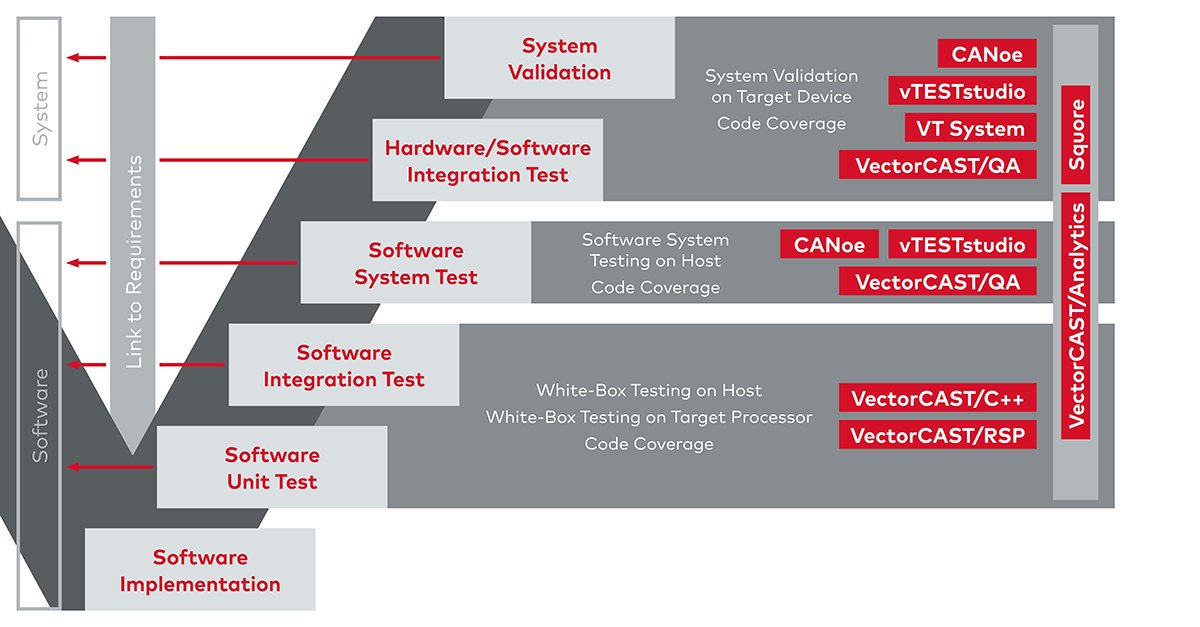
Oh, Vector offers solutions for #MedicalEngineering? All facts, in a fact sheet: vctr.it/2PQKDLQ
#embeddedsoftware #embeddedsystems #FDA #IEC62304 #testing #softwaretesting #blackboxtesting #whiteboxtesting #testautomation #VectorCAST
1
2
30 Oct 2019
How the Vector #SoftwareTesting Platform is used for complete verification and validation in airborne systems and equipment A Vector #Whitepaper|Download free knowledge here: vctr.it/31Ywvmn
#aerospace #DO178C #VectorCAST #whitepaper #testing

1
4

25 Oct 2019
Our next sponsor spotlight is-
✨Vector✨
Driven by their passion for technology, they develop solutions such as VectorCAST that help engineers to manage their demanding tasks.
@vectorgrp
Vector: vector.com/int/en/
VectorCAST: vectorcast.com/vc/index.html

1
3