
Jun 12
We ship code, not surveys. But here's one anyway, as we want to know your thoughts.
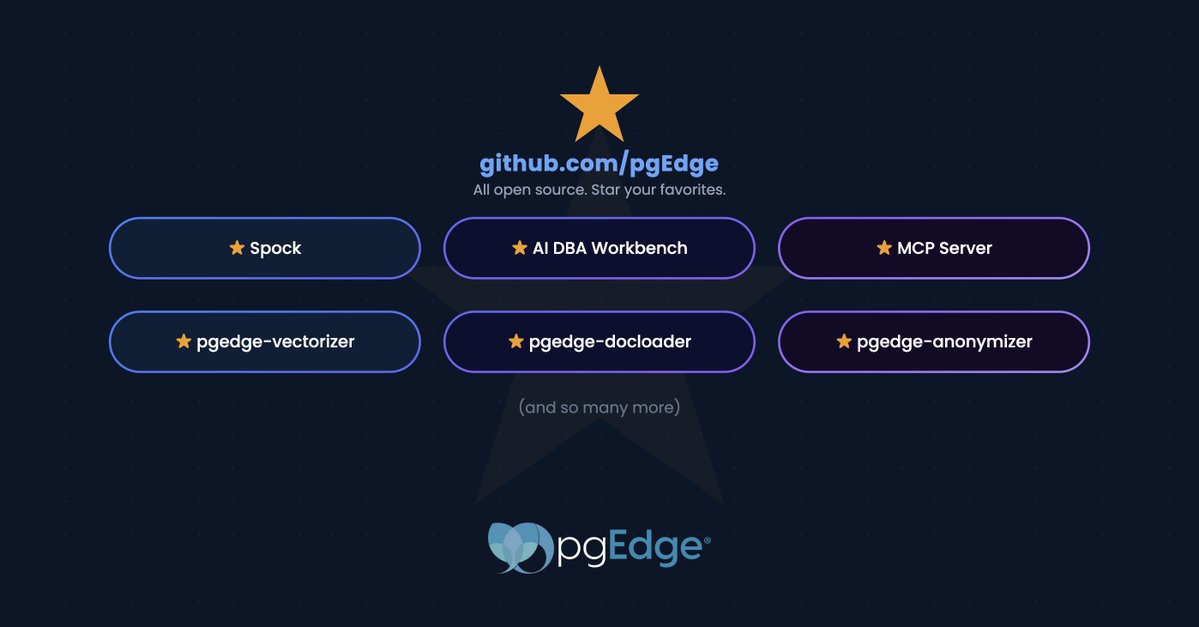
What pgEdge repos are you using right now? (Spock, the AI DBA Workbench, the MCP server for Postgres, pgedge-vectorizer, pgedge-docloader, pgedge-anonymizer... there's a lot in the org now.) What made you reach for it? What have you yelled at your screen about? What would you put on the roadmap if you could?
Drop it in the comments. We read them. Curious what you're building.
And if there's something in our stack you're using or watching - star it. It's how you stay ahead of what we're shipping: new features, bug fixes, and so much more.
🔗 hubs.la/Q04lc5Kd0 - all repos, pick your favorites
#postgres #postgresql #opensource #pgedge #developer #database
1
2
77
Jun 12
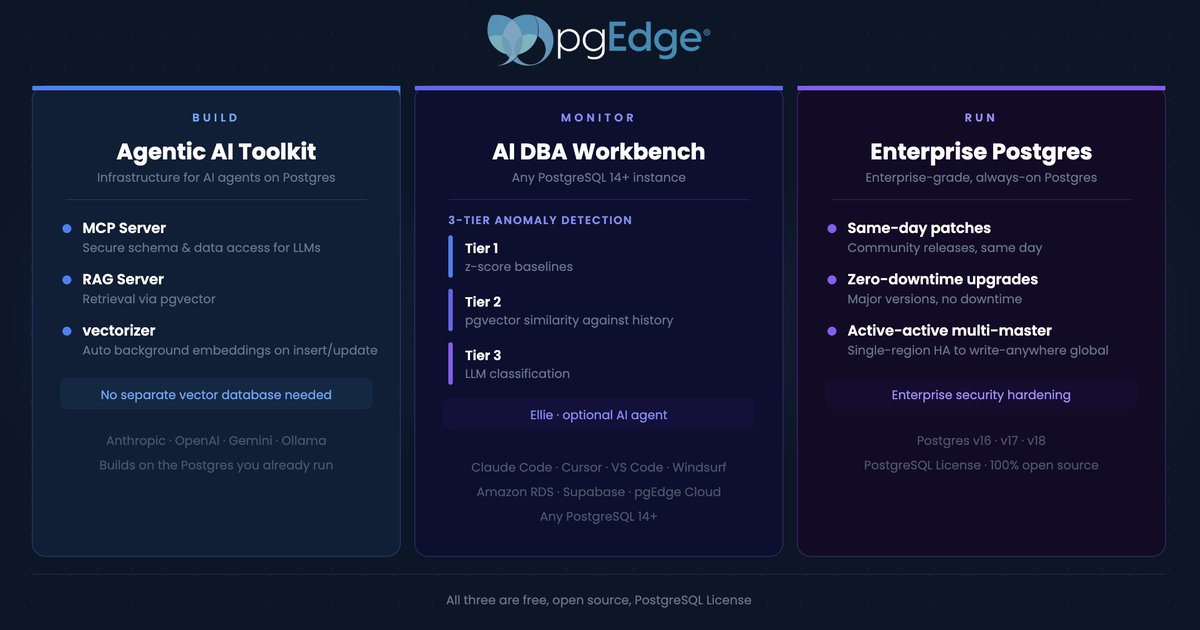
Your AI agent needs enterprise-grade, always-on Postgres. Your developers need infrastructure to build agentic workflows on it. Your team needs to know what's wrong at 3am when the agent's query patterns become the incident. Three different problems - and pgEdge ships for all three.
The pgEdge Agentic AI Toolkit is the infrastructure layer for building agents on Postgres: MCP Server for secure, structured schema and data access; RAG Server for retrieval; vectorizer for automatic background embedding generation as your data changes. No separate vector database. Builds on the Postgres you already run.
The pgEdge AI DBA Workbench is the operations layer. It monitors any PostgreSQL 14 instance - Amazon RDS, Supabase, pgEdge Cloud, community Postgres - with three-tier anomaly detection: z-score baselines, pgvector similarity against historical patterns, and LLM classification for what the first two tiers can't resolve. Ellie (an optional AI agent) runs diagnostics and walks through fixes step by step. You review and approve.
The Workbench MCP server also exposes the full tool catalogue to Claude Code, Cursor, and Windsurf directly - same diagnostics, from your IDE.
For the Postgres itself: pgEdge Enterprise Postgres - same-day patches, zero-downtime major version upgrades, enterprise-grade security, and active-active multi-master replication for any topology from single-region HA to write-anywhere global.
All three are free, open source, PostgreSQL License.
Explore the Agentic AI Toolkit: 🛠️ hubs.la/Q04l9-jN0
Read Dave's Workbench walkthrough: 📖 hubs.la/Q04l9yhw0
pgEdge Enterprise Postgres: 🔗 hubs.la/Q04lbsl30
#postgresql #postgres #dba #database #mcp #modelcontextprotocol #opensource #aiagents #devtools #claudecode #cursor #highavailability
3
2
107
Jun 11
You've got an AI app working on Postgres. Now what? Security hardening. Verifiable grounding. Token efficiency. Data sovereignty. These are the decisions that separate demos from production deployments.
Next Thursday at 1PM ET, Mike Josephson (VP of Solutions Engineering, pgEdge) joins the PostgresWorld Webinar Series to walk through the solution that addresses each one: the pgEdge Agentic AI Toolkit, a collection of open source tools for building AI applications on any Postgres 14 .
What he'll cover:
🔌 pgEdge MCP Server: full-featured MCP Server for controlled LLM access to any Postgres database, greenfield or pre-existing. Works with any MCP-compatible client.
💬 Natural Language Agents: CLI and web UI, both written in Go. Anthropic prompt caching cuts token costs by 90%.
🧩 pgEdge-vectorizer: a Postgres extension that auto-chunks your text and generates embeddings via background workers. Supports OpenAI, Voyage AI, and Ollama.
📡 pgEdge RAG Server: dedicated HTTP API for retrieval-augmented generation with hybrid search (vector BM25), token budget management, and streaming. The same stack that powers Ellie (an optional AI assistant) running live on hubs.la/Q04kYSK30.
📥 pgEdge-docloader: converts HTML, Markdown, RST, or SGML docs into Postgres-ready content. The on-ramp for your RAG pipeline.
🔍 VectorChord-bm25: BM25 ranked search for Postgres, for hybrid semantic and full-text retrieval.
All pgEdge components are 100% open source under the PostgreSQL license. Your data stays in Postgres: no external vector store, no proprietary pipelines.
Free to attend, or register now and get the recording later. 🎙️ hubs.la/Q04kYy2_0
#postgres #postgresql #ai #mcp #modelcontextprotocol #rag #vectorsearch #llm #opensource #pgedge #webinar #database

3
123

Recraft V4.1 just landed on Higgsfield… and honestly, this model is INSANE. 🔥
This is easily one of the cleanest AI design models right now for creators, brands, YouTubers, marketers, and designers.
You can now generate:
✨ High-quality AI images
🎨 Editable SVG vector art
📦 Product mockups
🖼️ Background removals
📈 AI upscaling
✏️ AI image editing
🔀 Image combinations
📁 Format conversions (SVG, PNG, JPG, PDF & more)
All inside one workflow.
What makes Recraft V4.1 different is the design quality.
The outputs feel polished, modern, commercial-ready, and actually usable for real projects.
Perfect for:
• YouTube thumbnails
• Ad creatives
• Logos
• T-shirt designs
• Game assets
• Brand content
• Social media graphics
• Product marketing
Some underrated tools people are sleeping on:
— AI Vector Generator
— Mockup Generator
— Image Vectorizer
— AI Photo Upscaler
— Background Remover
The AI design space is moving FAST right now, and Recraft V4.1 is becoming one of the strongest creative models available.
Definitely worth testing on @higgsfield_ai. 🚀
23
20
63
586


VECTOR RECONSTRUCTION - work in progress
Image from my reworked Mad Magazine Comics Special issue cover from the 80's, first automatically vectorized using Vectorizer website, and then refined by hand. Upper image is from the rasterized vector. Below, the original image.

3
126

May 31
10 AI websites that feel like they came from 2035.
I spend hours testing AI tools so you don't have to.
These are some of the most underrated ones I've found:
1. Napkin AI:Turn a messy idea into a clean diagram in seconds.
Perfect for students, creators, and entrepreneurs.
2. Krea AI:Generate and edit images in real time.
Feels like Photoshop with superpowers.
3. Higgsfield:Create cinematic AI videos with camera movements that look straight out of a movie.
4. Goblin Tools:A lifesaver for productivity.
It breaks overwhelming tasks into simple step-by-step actions.
5. Tavily:An AI search engine built for research.
Find answers without digging through dozens of tabs.
6. Liner:Summarizes articles, PDFs, and websites instantly.
Perfect for studying and research.
7. Beautiful ai:Makes professional presentations automatically .No design skills needed.
8. Vectorizer AI:Turn blurry logos and images into crisp, scalable graphics. One click.
9. Suno:Describe a song and AI creates it.
The results are surprisingly good.
10. Viggle AI:Animate characters and images with realistic motion.
The internet is only starting to discover this one.

2
2
14
677


May 27
And it's done!
Honestly I can't fathom on just how smooooth it looks aeugh, never felt this satisfied in a while.
The only downside is it doesn't truly work on pixel art: it tend to collapse 1-width gaps.
Mind you this is not a true vectorizer; it all works in WebGL.



1
1
6
212

Spent 30 minutes asking Midjourney to move one element.
Eventually gave up and built my own vectorizer.
PNG in, editable SVG out, ~30 seconds.
Free tier, no credit card: perfectvector.com
1
1
2
109


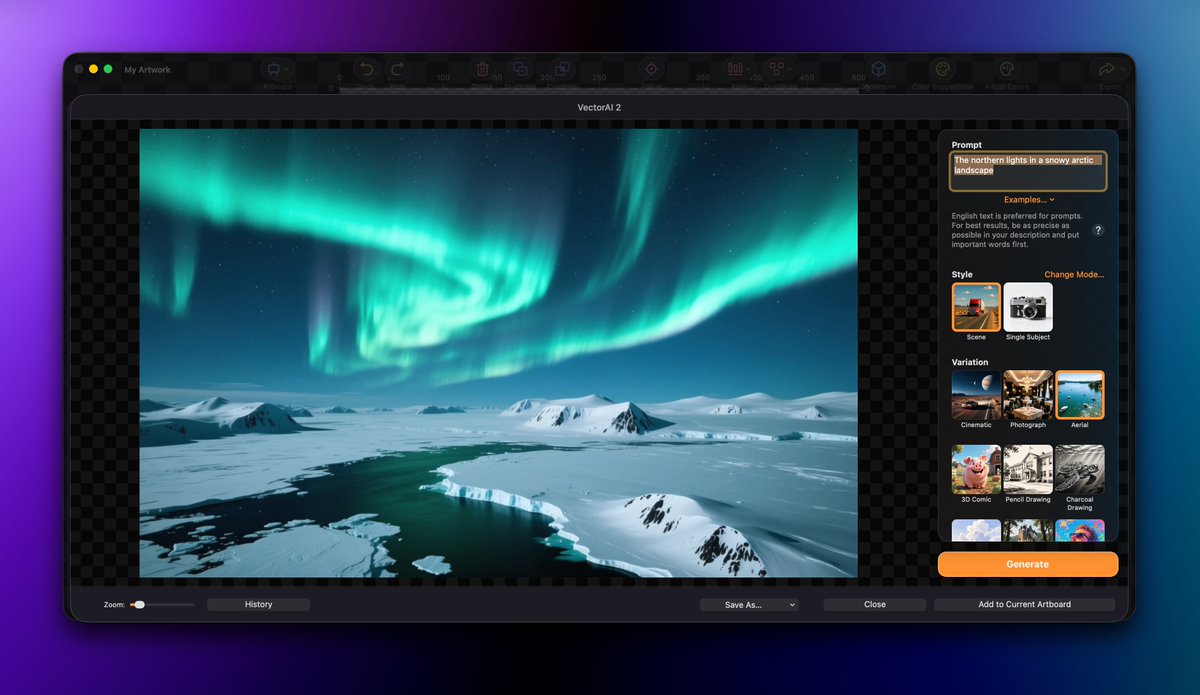
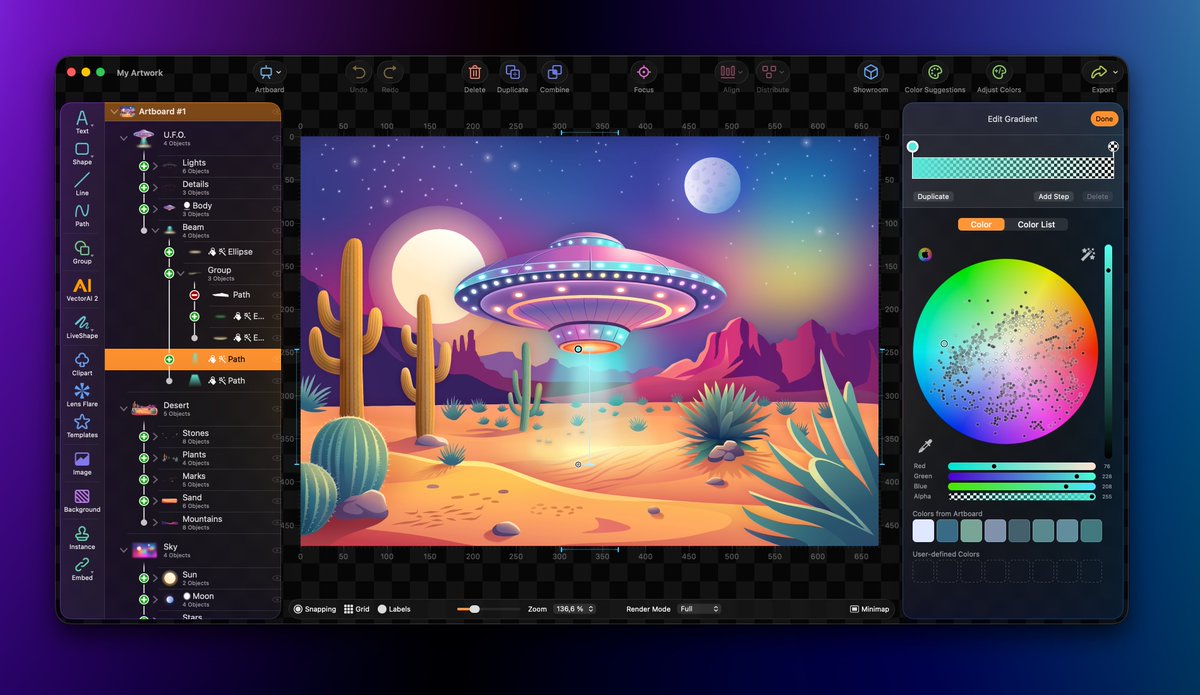
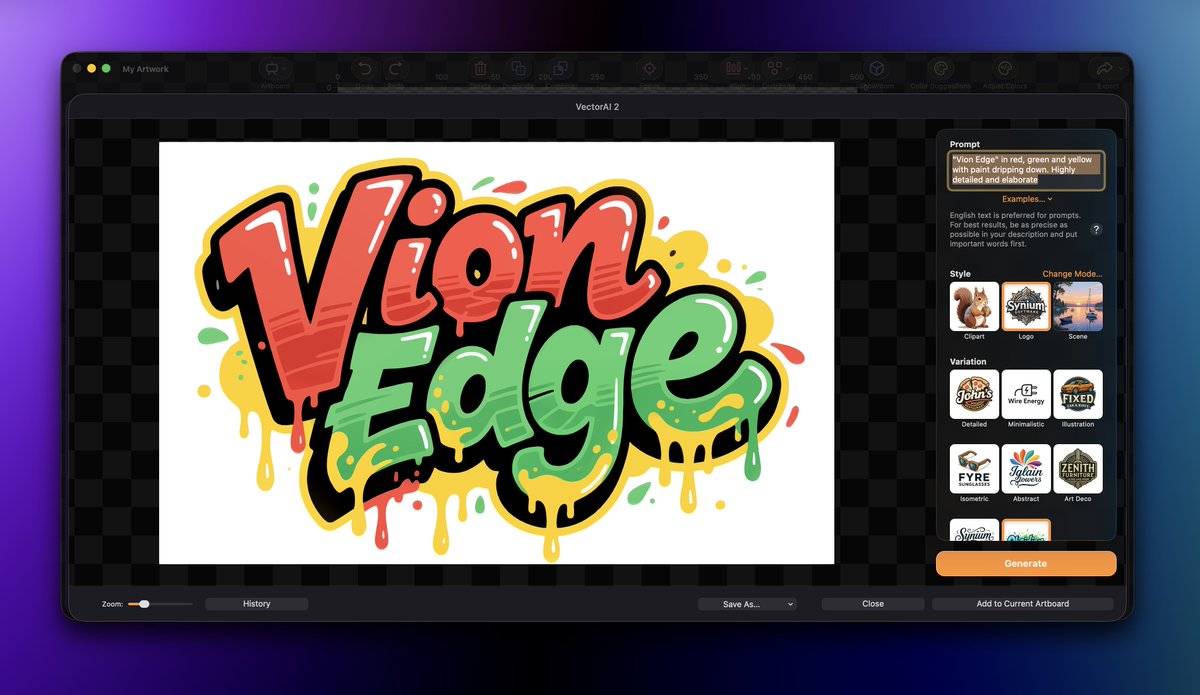
Welcome Logoist 6 for Mac, iPad and iPhone: Completely redesigned interface, new VectorAI 2 image generator, powerful 3D features, a greatly improved Vectorizer, and many refinements throughout the app. Special introductory price: Just US$19.99. syniumsoftware.com/logoist

1
1
4
235

I want to take all my best code off-grid. No clouds.
I've slowly been making most of my Github repos private because of AI. They can of course steal my code because it's Microsoft we're talking about.
So, Gitea. On my tower. At home.
No clouds. No intercepts. No FOSS.
I'm tired of the FOSS-bloat and 1 million different directions projects go.
I just want to be done, for once, and enjoy life.
Home projects:
- [?] private llm (needs vectorizer)
- [?] private gitea
- [x] private Nuget registry
- [x] private neo4j dbs (2x -> infinity)
- [x] Drip.UI library; public, shitty, people won't get it, therefore FOSS.
- [x] portfolio site - public
That's about it.
I don't need a bunch of docker containers and rest api and AWS bills to do my pet projects. That's nonsense.
2
44

May 16
Recently learned some NLP preprocessing concepts and implemented them in a simple Spam Email Classifier 📩
Used:
• TF-IDF Vectorizer
• Naive Bayes
• Scikit-learn
• Flask
• Kaggle SMS Spam Collection Dataset
Github Repo: github.com/pulkitx1/Spam-Ema…
understanding how text data is converted into vectors and classified using ML.
#MachineLearning #NLP #Python #AI
2
158

May 16
100 INSANELY USEFUL WEBSITES THE INTERNET HIDES FROM YOU
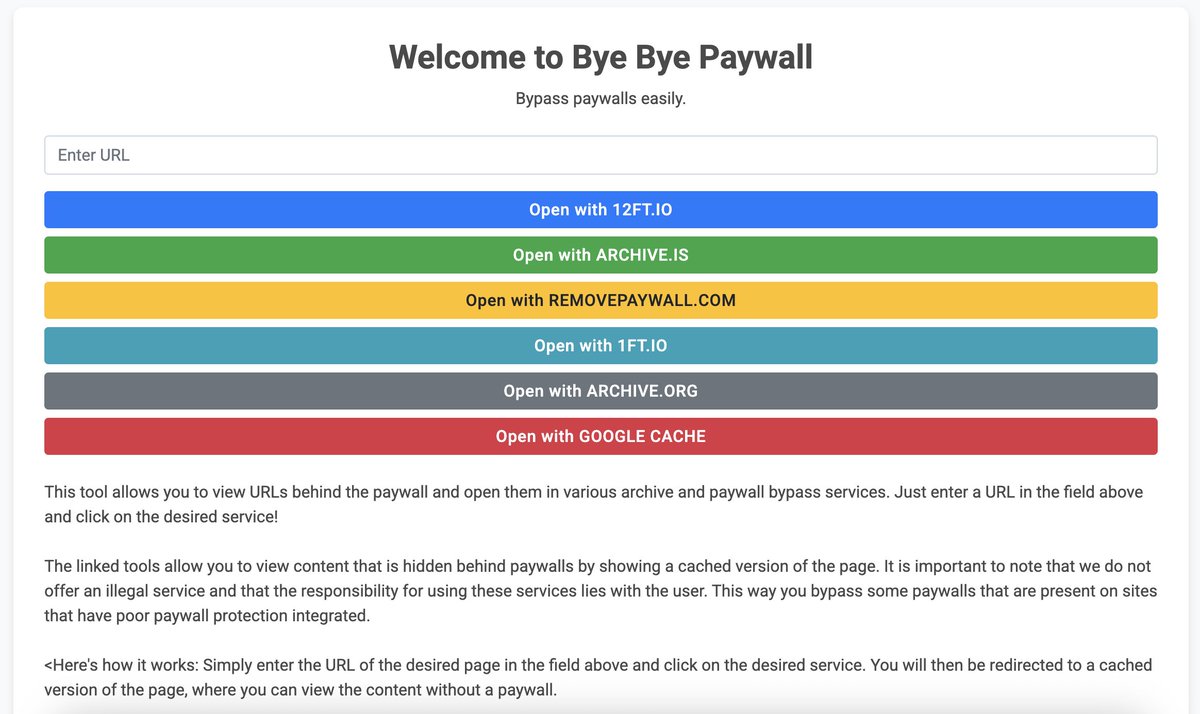
12ft .io → remove annoying paywalls
libgen .is → millions of free books & textbooks
sci-hub .se → unlock research papers
archive .org → time travel through the internet
archive .ph → save webpages forever
alternativeto .net → better alternatives to any app
justwatch .com → find where any movie is streaming
radio .garden → listen to live radio worldwide
everynoise .com → discover music genres you never knew existed
mynoise .net → insane focus soundscapes
photopea .com → Photoshop in your browser
remove .bg → remove backgrounds instantly
cleanup .pictures → erase objects from photos
unscreen .com → remove video backgrounds
canva .com → design anything fast
tinywow .com → free AI & PDF tools
ilovepdf .com → merge, split, compress PDFs
smallpdf .com → edit PDFs online
squoosh .app → compress images without losing quality
vectorizer .ai → turn images into vectors instantly
virustotal .com → scan files & links for malware
haveibeenpwned .com → check if your data leaked
temp-mail .org → disposable email in seconds
privnote .com → self-destructing messages
file .io → files that auto-delete after download
bugmenot .com → shared logins for blocked sites
metadata2go .com → see hidden file metadata
dnsleaktest .com → check if your VPN leaks
fast .com → test internet speed instantly
downdetector .com → see what’s broken online
wolframalpha .com → answers to almost any math problem
symbolab .com → step-by-step math solutions
desmos .com → beautiful graphing calculator
geogebra .org → interactive math visualizer
regex101 .com → test regex live
explainshell .com → understand terminal commands
carbon .now .sh → turn code into beautiful art
ray .so → aesthetic code screenshots
codebeautify .org → clean messy code instantly
jsonformatter .org → make JSON readable
phind .com → AI search for developers
elicit .org → AI research assistant
consensus .app → search what science actually agrees on
connectedpapers .com → visualize research papers
scispace .com → explain difficult research papers
semanticscholar .org → smarter academic search
futurepedia .io → discover AI tools daily
theresanaiforthat .com → AI tools for literally everything
huggingface .co → open-source AI models
replicate .com → run AI models in browser
summarize .tech → summarize YouTube videos instantly
y2mate .is → download videos easily
savefrom .net → save content from many platforms
tunefind .com → find songs from movies & shows
musicforprogramming .net → coding music that actually works
coffitivity .com → fake café sounds for focus
a-softmurmur .com → customizable ambient sounds
radiooooo .com → explore music by country & decade
mapcrunch .com → random Google Street View exploration
window-swap .com → look through random windows worldwide
pdfdrive .com → millions of free PDFs
gutenberg .org → 70K free classic books
openculture .com → free courses from top universities
coursera .org → learn from Ivy League professors
edx .org → free university courses
skillshare .com → creative learning platform
masterclass .com → learn from world-class experts
udemy .com → cheap practical courses
notion .so → organize your entire life
obsidian .md → second brain note-taking app
raindrop .io → bookmark manager on steroids
readwise .io → remember what you read
pocket .com → save articles for later
feedly .com → track the internet in one place
camelcamelcamel .com → Amazon price tracker
pcpartpicker .com → build PCs without compatibility issues
alternative .me → discover better software
similarweb .com → analyze any website traffic
builtwith .com → see what tech any website uses
hunter .io → find professional email addresses
tinypng .com → compress images perfectly
favicon .io → create favicons instantly
coolors .co → generate color palettes
fontjoy .com → perfect font combinations
remove .photos → AI image cleanup
pexels .com → free stock photos
unsplash .com → high-quality free images
mixkit .co → free videos, music & templates
lottiefiles .com → free animations
icons8 .com → icons, illustrations & AI tools
earth .nullschool .net → live global weather visualization
flightaware .com → track any flight live
zoom .earth → real-time satellite maps
geacron .com → interactive world history map
futureme .org → send emails to your future self
news .ycombinator .com → smartest tech discussions online
producthunt .com → discover tomorrow’s startups today
hackerone .com → companies that pay hackers legally
internetlivestats .com → watch the internet live
web .archive .org → the internet never forgets
The internet is WAY bigger than Google’s first page.
Most people use the web.
Very few actually explore it.



4
35
135
9,301

May 14
𝐖𝐡𝐚𝐭 𝐑𝐞𝐚𝐥𝐥𝐲 𝐇𝐚𝐩𝐩𝐞𝐧𝐬 𝐖𝐡𝐞𝐧 𝐘𝐨𝐮 𝐈𝐧𝐬𝐞𝐫𝐭 𝐚 𝐒𝐢𝐧𝐠𝐥𝐞 𝐎𝐛𝐣𝐞𝐜𝐭 𝐈𝐧𝐭𝐨 𝐚 𝐕𝐞𝐜𝐭𝐨𝐫 𝐃𝐚𝐭𝐚𝐛𝐚𝐬𝐞?
It is not just a write. It is a multi-stage choreography across embedding models, indexes, and storage all happening in parallel.
Here is the full lifecycle, using Weaviate as the example.
What does the user actually do?
𝟏. 𝐒𝐞𝐧𝐝 𝐈𝐧𝐬𝐞𝐫𝐭 𝐑𝐞𝐪𝐮𝐞𝐬𝐭
• User sends an object with properties title, description, genres, release_year.
• Weaviate identifies the target collection and prepares the shard.
• This is the only step the user sees. Everything after is hidden machinery.
What happens behind the scenes?
𝟐. 𝐂𝐡𝐞𝐜𝐤 𝐂𝐨𝐥𝐥𝐞𝐜𝐭𝐢𝐨𝐧 𝐂𝐨𝐧𝐟𝐢𝐠
• Weaviate reads collection metadata: vectorizer, index type (HNSW), compression, generative module.
• Decides which properties get vectorized and which stay as plain metadata.
• Misconfigure this once and every future query pays the price config is destiny.
𝟑. 𝐑𝐞𝐪𝐮𝐞𝐬𝐭 𝐕𝐞𝐜𝐭𝐨𝐫 𝐟𝐫𝐨𝐦 𝐌𝐨𝐝𝐞𝐥 𝐏𝐫𝐨𝐯𝐢𝐝𝐞𝐫
• Properties marked for vectorization are sent to the embedding model OpenAI, Cohere, Hugging Face, Google, Jina, or others.
• The model returns a dense vector like (0.0183, 0.0153, -0.5492, ...).
• Your choice of embedding model silently defines retrieval quality more than any other decision.
What gets updated in parallel?
𝟒. 𝐔𝐩𝐝𝐚𝐭𝐞 𝐭𝐡𝐞 𝐕𝐞𝐜𝐭𝐨𝐫 𝐈𝐧𝐝𝐞𝐱
• The vector is inserted into the HNSW graph.
• HNSW links the new node to nearest neighbors across multiple layers.
• This is what makes "search 100M vectors in 20ms" actually possible.
𝟓. 𝐔𝐩𝐝𝐚𝐭𝐞 𝐭𝐡𝐞 𝐈𝐧𝐯𝐞𝐫𝐭𝐞𝐝 𝐈𝐧𝐝𝐞𝐱𝐞𝐬
• Scalar properties are indexed for keyword search, BM25, and metadata filters.
• This is what powers queries like release_year = 2022.
• Hybrid search lives or dies on this step.
𝟔. 𝐒𝐭𝐨𝐫𝐞 𝐎𝐛𝐣𝐞𝐜𝐭 𝐚𝐧𝐝 𝐕𝐞𝐜𝐭𝐨𝐫
• Raw object and vector are persisted together in the shard's object store.
• A UUID is generated as the permanent identifier.
• Steps 4, 5, and 6 happen in parallel not sequentially.
What does the user get back?
𝟕. 𝐑𝐞𝐭𝐮𝐫𝐧 𝐎𝐛𝐣𝐞𝐜𝐭 𝐈𝐃
• Weaviate sends back the UUID as confirmation.
• The object is now searchable by vector similarity, keyword, and filter all from one insert.
A vector DB is not a "vector store." It's an orchestration layer over embeddings, ANN graphs, inverted indexes, and object storage. Understanding this flow is what separates debugging in minutes from debugging in weeks.
Which step surprised you most?
♻️ Repost this to help your network get started
1
24
153

MSVC Build Tools v14.52 Preview: C 23 immediate escalation is done, modules reliability fixes, ARM64 gets better loop unrolling and indirect tail calls, SLP vectorizer now handles PHI nodes, and AddressSanitizer is faster. Over 40 community bugs fixed.
devblogs.microsoft.com/cppbl…
8
38
2,403

May 13
80 Websites Every Designer Must Know👇🏻
Design Inspiration
→ Behance
→ Dribbble
→ Muzli
→ Designspiration
→ Pinterest
→ Awwwards
→ SiteInspire
→ UI Movement
Design Tools
→ Figma
→ Canva
→ Adobe Express
→ Pixlr
→ Lunacy
→ Vectr
→ VistaCreate
→ Gravit Designer
Icons & Illustrations
→ Hugeicons.com
→ Icons8
→ Lordicon
→ Undraw
→ Streamline
→ Iconmonstr
→ SVG Repo
→ Heroicons
Mockups & Presentation
→ Smartmockups
→ Mockup World
→ LS Graphics
→ Artboard Studio
→ Shotsnapp
→ Renderforest
→ MockupBro
→ Pixelbuddha
Stock Photos
→ Unsplash
→ Pexels
→ Pixabay
→ Kaboompics
→ Burst
→ Gratisography
→ Life of Pix
→ ISO Republic
Stock Videos
→ Pexels Videos
→ Pixabay Videos
→ Mixkit
→ Videezy
→ Coverr
→ Motion Array
→ Splitshire
→ Videvo
Fonts & Typography
→ Google Fonts
→ DaFont
→ Font Squirrel
→ FontSpace
→ 1001 Fonts
→ Creative Market Fonts
→ Lost Type
→ Fontesk
Asset Marketplaces
→ Creative Market
→ Envato Elements
→ Design Cuts
→ UI8
→ GraphicRiver
→ TemplateMonster
→ Design Bundles
→ Blush
UX/UI Design
→ UX Collective
→ Uplabs
→ Figma Community
→ Whimsical
→ Balsamiq
→ Overflow
→ Marvel App
→ Proto. io
AI Tools
→ Adobe Firefly
→ Leonardo AI
→ Remove. bg
→ Vectorizer AI
→ Khroma
→ Let’s Enhance
→ Uizard
→ ChatGPT
Save this for later📌

5
165