
Nobody wanted PostgreSQL in 1994. Now nobody can live without it.
In 1986 Professor Michael Stonebraker at UC Berkeley spent eight years building a database called POSTGRES. Funded by DARPA. Dozens of papers. A team of brilliant students.
Then Berkeley shut it down in 1994. Too much maintenance. Not enough research value. The code was left on a server and forgotten.
Two graduate students named Andrew Yu and Jolly Chen were not ready to let it die.
They took the abandoned code, added SQL support and released it to the world for free. No funding. Just two students who believed the database was worth saving.
They called it Postgres95. Two years later it was renamed PostgreSQL.
A global community of volunteers took it from there and never stopped.
Today PostgreSQL is the most advanced open source database on earth.
Notion runs on it. Shopify runs on it. Instagram was built on it. Apple uses it internally. Amazon built Aurora PostgreSQL because their customers demanded it.
Companies built on a PostgreSQL base have generated over $2.6 billion in acquisitions.
Stonebraker won the Turing Award in 2014. The Nobel Prize of computer science. Partly for the database his own university threw away.
Oracle charges enterprises hundreds of thousands of dollars a year for what two grad students rescued from a forgotten server and gave away for free.
Some things are too important to let die.


6
61
357
23,287

$NBIS Hidden gem many don’t know about (ClickHouse)
So I gained a lot of followers because of this company, and I already explained what Token Factory is and how it is important for $NBIS. However, there is one more asset Nebius owns that many investors either overlook or underestimate its potential.
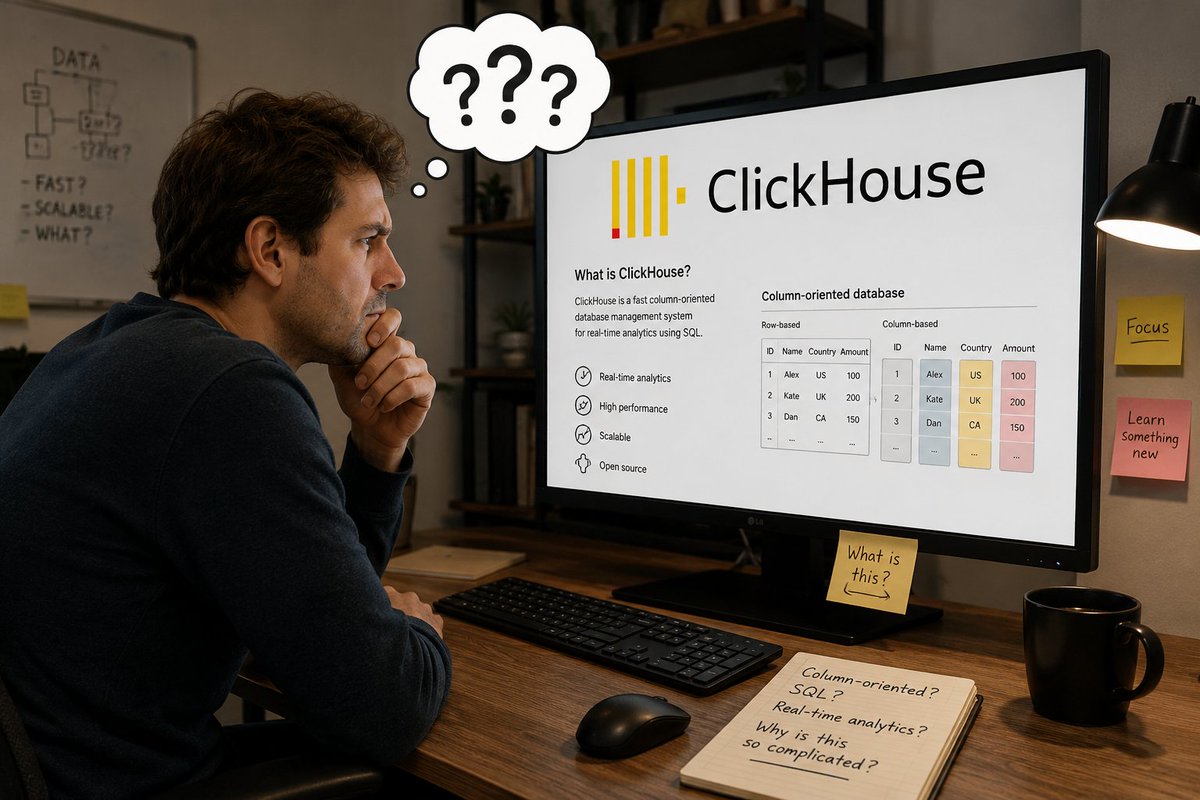
Let me present you: ClickHouse
It is an open-source columnar database designed for online analytical processing (OLAP), originally developed by Yandex.
To explain it in basic terms, if you store data in databases (most typical transactional databases like PostgreSQL or MySQL), you do it row by row, because, for example, banks often want to search information about a given customer, so they just search for the ID of the customer, and the whole row pops up and they get everything about the customer they care about.
But imagine you have 1 billion rows, 50 columns, and you care about, for example, the average spending in the whole database. This is where ClickHouse comes in and uses column-by-column storing. Then, instead of reading 50 billion values, a column-based database might read only 1 billion values. Obviously, the idea is more sophisticated, where ClickHouse developed additional compression algorithms, but for our explanation, this is sufficient, as you now know what ClickHouse does. Importantly, the main advantage is that it often stores data using 5-10x less space than traditional databases.
To give you an example, imagine you operate 100,000 GPUs and every second, that GPU sends information such as:
- timestamp
- GPU ID
- temperature
- utilization
- memory usage
100,000 GPUs -> 1 month = 259,200,000,000 records
And now an engineer asks: "What was the average GPU utilization by hour last week?"
Instead of going through all rows, the query only needs timestamp and utilization and you save a lot of time.
And you know who uses ClickHouse? The biggest players such as OpenAI, Anthropic, Meta, Tesla, Cisco, Alibaba, Spotify and many others.
So, now that you get the importance of the company, what if I told you that $NBIS owns approximately 28% of ClickHouse and its valuation is growing rapidly.
In May 2025, the company was valued at rougly $6.35B
In January 2026, the valuation increased to $15B, which is ~236% increase in 7 months, think about the speed of this.
If we would expect the company to "only" double its valuation throughout the whole 2026, we would get to $30B.
Implying $NBIS’s stake being worth $8.4B (current market cap is $59B).
What’s funny is that many investors have no idea what ClickHouse is and they think it is just some small partner or whatever, but it might soon represent $10B stake for $NBIS.
If you have any questions, I am happy to answer them as always.
Thanks for reading!
23

Most developers learn PostgreSQL.
Few learn database engineering.
There's a difference.
Database engineering is understanding:
→ how data should be modeled
→ when relationships make sense
→ why indexes matter
→ how migrations evolve systems safely
→ what makes queries fast
From database fundamentals to production-grade PostgreSQL
markstack-app.vercel.app/blo…
3

pg_durable : exécution durable de workflows SQL dans PostgreSQL news.humancoders.com/t/bases…
1


Top 10 resources to learn databases (practical, for working devs):
1) Designing Data-Intensive Applications (Kleppmann)
Good mental models: logs, replication, consistency, indexes, tradeoffs.
2) PostgreSQL official docs
Best free deep dive into query planning, MVCC, locking, indexes, vacuum.
3) Use The Index, Luke
Fast path to understanding indexes, EXPLAIN, and why your query is slow.
4) CMU 15-445/645 (Database Systems)
Solid systems view: buffer pools, B trees, concurrency control, recovery.
5) High Performance MySQL (Schwartz et al.)
Real ops details: InnoDB internals, schema design, replication, pitfalls.
6) Martin Kleppmann’s talks blog
Short, clear explanations of distributed DB problems without fluff.
7) Jepsen analyses
Learn failure modes from real incidents: split brain, lost writes, bad defaults.
8) Redis docs Redis University
Practical data structures, persistence modes, eviction, latency, gotchas.
9) SQLBolt (or Mode SQL tutorial)
Quick SQL reps, especially joins and window functions, without setup pain.
10) Practice project: build a mini DB-backed service
Pick Postgres. Add migrations, indexes, read replicas (logical), connection pooling, and load test. Use EXPLAIN ANALYZE and pg_stat_statements to fix the top 3 slow queries.
1
2
18
454

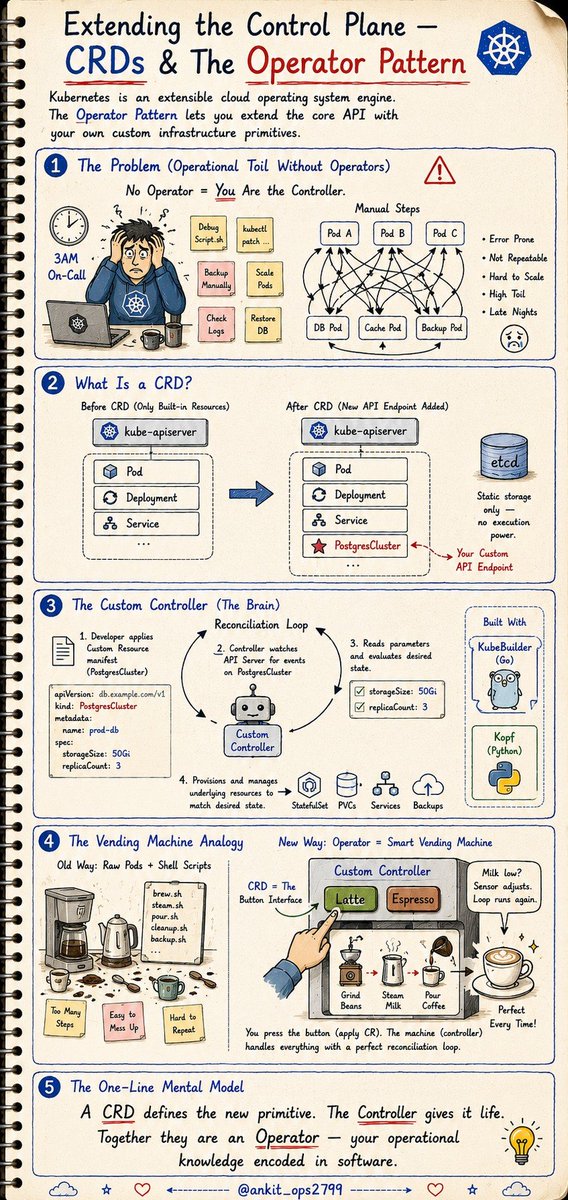
Managing a PostgreSQL cluster with raw Pods is like making coffee by hand in an office breakroom.👇
Find the mug. Boil water. Measure grounds. Pour milk. Clean up.
Miss one step — the whole thing burns.
The Kubernetes Operator Pattern is the smart vending machine.
You press one button. The machine handles everything else — and if the milk runs low mid-pour, it self-corrects.
That button is your CRD.
That machine is your Custom Controller.
#Kubernetes #DevOps #Platform #SRE
Jun 4

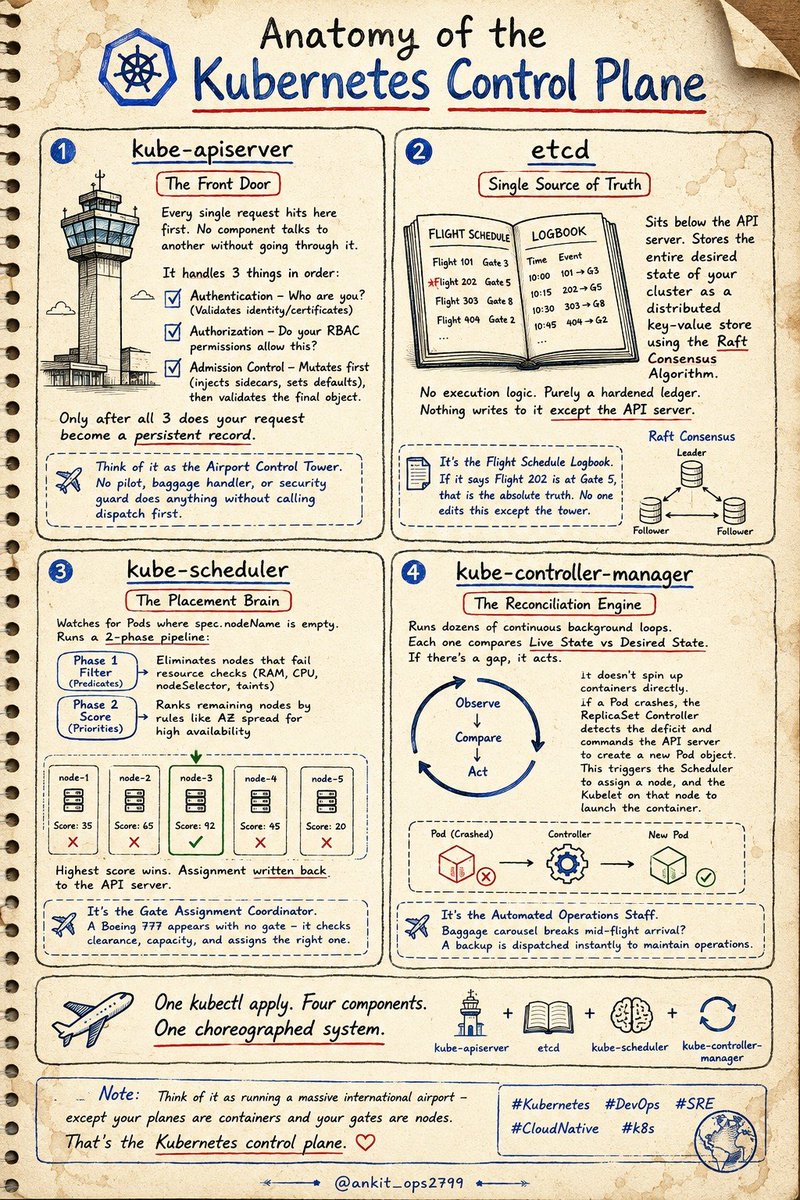
Ever wondered what actually happens behind the scenes when you run kubectl apply - f pray.yaml? 🤔
It’s not magic—it's a beautifully choreographed dance between 4 core components.
Think of it like managing a massive international airport:
🏛️ kube-apiserver = The Control Tower
🗄️ etcd = The Flight Schedule Logbook
🧠 kube-scheduler = The Gate Assignment Coordinator
🔄 kube-controller-manager = The Automated Operations Staff
Check out this from the 2-phase scheduling pipeline to the inner workings of the reconciliation loop! 👇
#Kubernetes #DevOps #SRE
1
2
27

Loomabase is an Offline-first synchronization engine for SQLite and PostgreSQL, built in Rust with column-level CRDTs, authoritative partial replicas, and secure multi- tenancy.
#PostgreSQL #Rust #Sqlite
github.com/JustVugg/loomabas…
5

Shipped a new release of my side project: pgpulse
It's a native PostgreSQL extension that actually monitors your master and replica instances.
github.com/HarshitRuwali/pgp…
1

🚨 #Fresher Only few hours left to #Apply 🔥
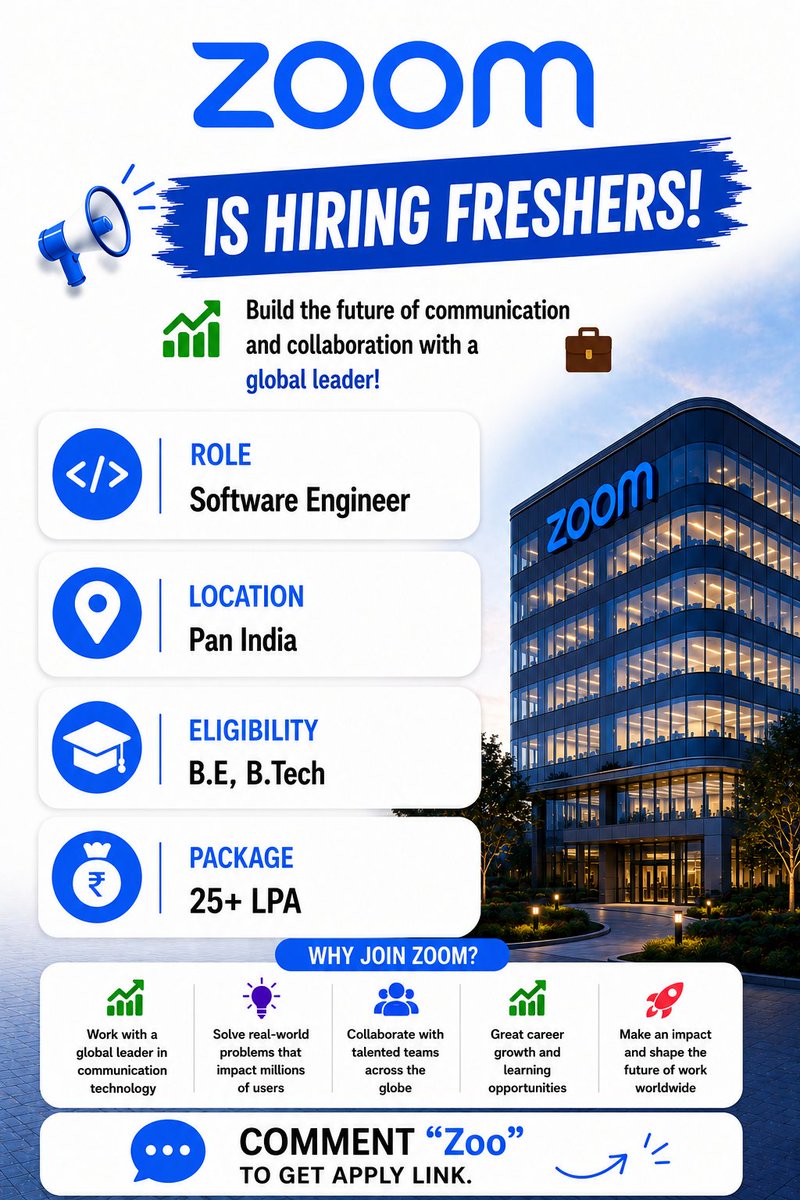
🔥 #Zoom is hiring #Freshers for #Software Engineer
📍 Location: #India (Remote)
💼 Experience: 0–3 Years
🎯 What They're Looking For:
✅ Strong Data Structures & Problem-Solving Skills
✅ Frontend Experience with React, Angular, or Vue.js
✅ Backend Development using Node.js, Python, Java, or Similar Technologies
✅ Database Knowledge (PostgreSQL, MySQL, MongoDB, Redis)
✅ Git, Testing & CI/CD Fundamentals
✅ Understanding of Cloud Platforms & Docker
✅ Passion for AI, Automation & Modern Engineering Practices
✅ Strong Learning Mindset & Adaptability
💬 Comment *ZOOM* if you're applying!
Tag a friend interested in React, Node.js, AI, Cloud, or Full-Stack Development 👇
#Zoom #SoftwareEngineer #FullStackDeveloper #ReactJS #NodeJS #Python #Java #CloudComputing #Docker #Kubernetes #AI #DistributedSystems #FreshersJobs #Hiring #TechJobs #RemoteJobs 🚀
2
6
243

OpenAI-compatible call. Same code, swap the base URL. For a "PostgreSQL or Mongo for this schema" kind of decision, seeing where models agree (and where one quietly dissents) changed my mind twice. Many minds, one considered answer. Try it: #AItools #BuildInPublic #LLM
6


its based on usecase, many companies uses hybrid postgreSQL mongoDB.
47

Current homelab stack:
Windows laptop running Ubuntu (WSL)
SSH access from my Mac
Docker
Nginx
PostgreSQL
Redis
Node Exporter
Prometheus
1
1
8
Built a more realistic stack
Current services:
Nginx
PostgreSQL
Redis
Everything running through Docker and Compose.
This was the point where it started feeling less like practice and more like actual infrastructure.
1
1
3
Added PostgreSQL
Didn't want everything disappearing after container restarts.
Learned:
Volumes
Persistent storage
Database containers
Basic PostgreSQL administration
1
1
3

🟥 CVE-2026-20253, CVSS: 9.8 (#Critical)
Splunk Enterprise and Cloud Platform
a missing authentication for a PostgreSQL sidecar service endpoint
an unauthenticated user can invoke file operations to create or truncate arbitrary files on the system
advisory.splunk.com/advisori…
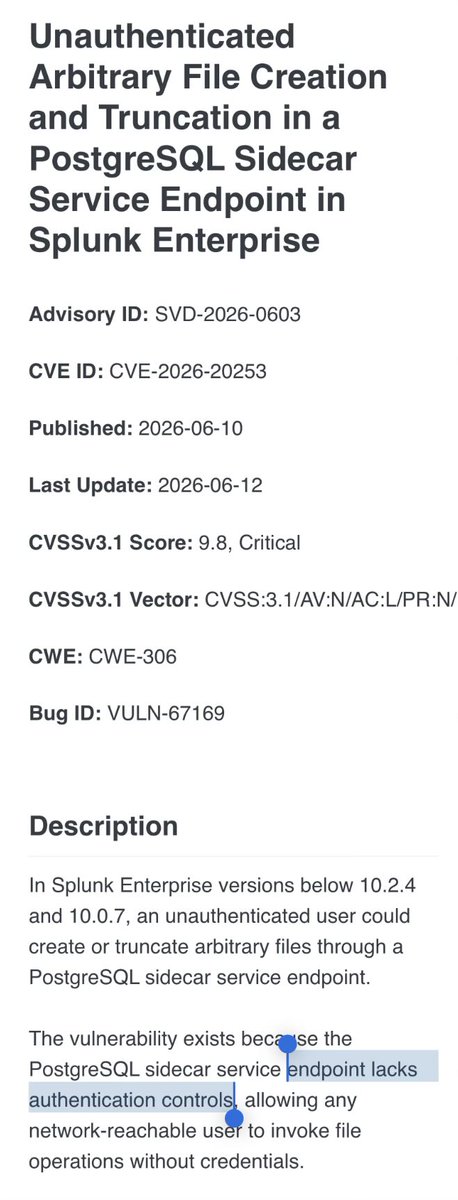

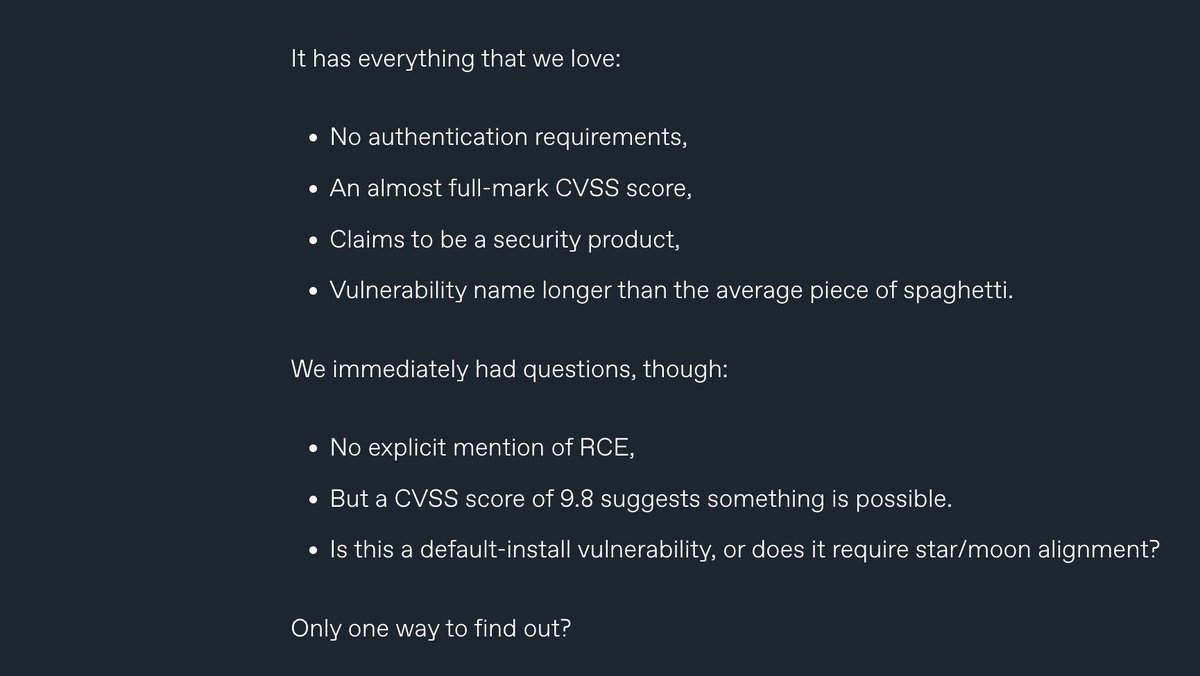
🚨 BrEaKiNg: Splunk, a security product, has zero authentication in its built-in database service and accepts any credentials, according to the security researchers who just dropped a full pre-auth RCE chain for Splunk Enterprise (CVE-2026-20253, CVSS 9.8).
Splunk Enterprise on AWS is vulnerable out of the box.
1
49

2h
Coverage this release: 37 new packages with pinned bottle digests for all four platforms.
bash, zsh, nginx, qemu, colima, postgresql, mysql, node@24, rustup, gradle, tailscale, sops, gitleaks, eza, whisper-cpp, and more.
On top of the top 100 formulae and casks.
1
1
57
vinay kumrawat retweeted

Jun 11
Go Gin → Backend Engineer
Go PostgreSQL → API Engineer
Go Redis → Infrastructure Engineer
Go Kafka → Distributed Systems Engineer
Go NATS → Event-Driven Engineer
Go Docker → Platform Engineer
Go Kubernetes → Cloud Native Engineer
Go gRPC → Microservices Engineer
Go Prometheus → Observability Engineer
Go Terraform → DevOps Engineer
Go eBPF → Systems Engineer
one language... multiple ways to print money 🫡
6
15
142
6,267