
100% open source enterprise-grade Postgres for Agentic AI, high availability, and more with flexible deployment options and support for existing or new apps.
Joined March 2023
- Tweets 1,172
- Following 6
- Followers 267
- Likes 1
951 Photos and videos


Jun 12
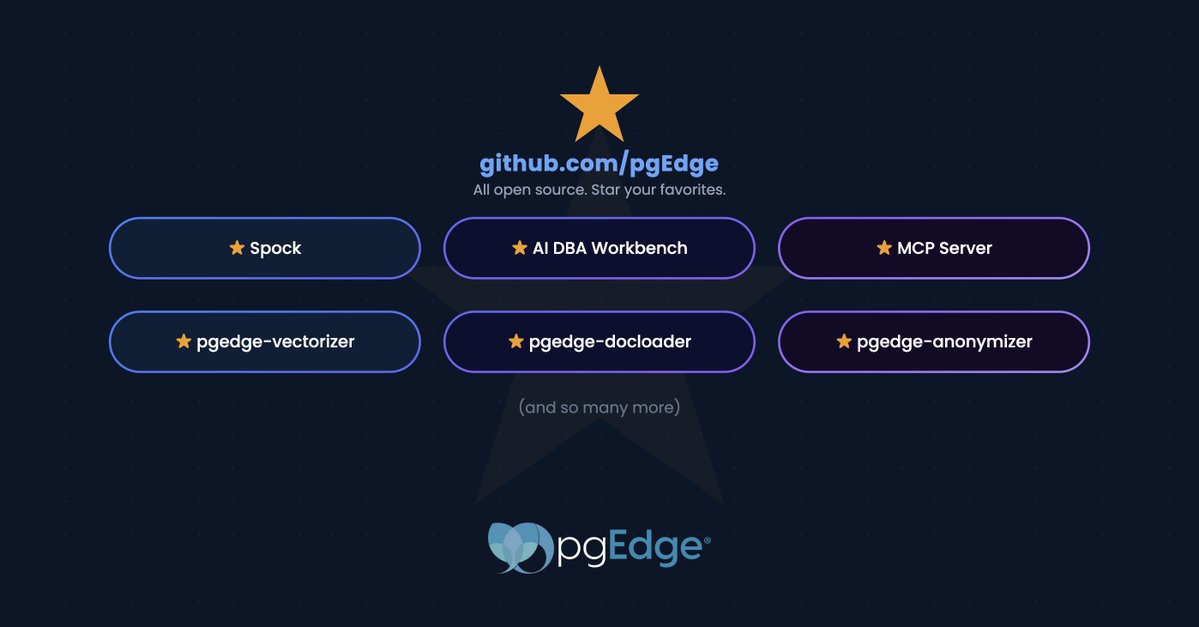
We ship code, not surveys. But here's one anyway, as we want to know your thoughts.
What pgEdge repos are you using right now? (Spock, the AI DBA Workbench, the MCP server for Postgres, pgedge-vectorizer, pgedge-docloader, pgedge-anonymizer... there's a lot in the org now.) What made you reach for it? What have you yelled at your screen about? What would you put on the roadmap if you could?
Drop it in the comments. We read them. Curious what you're building.
And if there's something in our stack you're using or watching - star it. It's how you stay ahead of what we're shipping: new features, bug fixes, and so much more.
🔗 hubs.la/Q04lc5Kd0 - all repos, pick your favorites
#postgres #postgresql #opensource #pgedge #developer #database
1
2
66
Jun 12
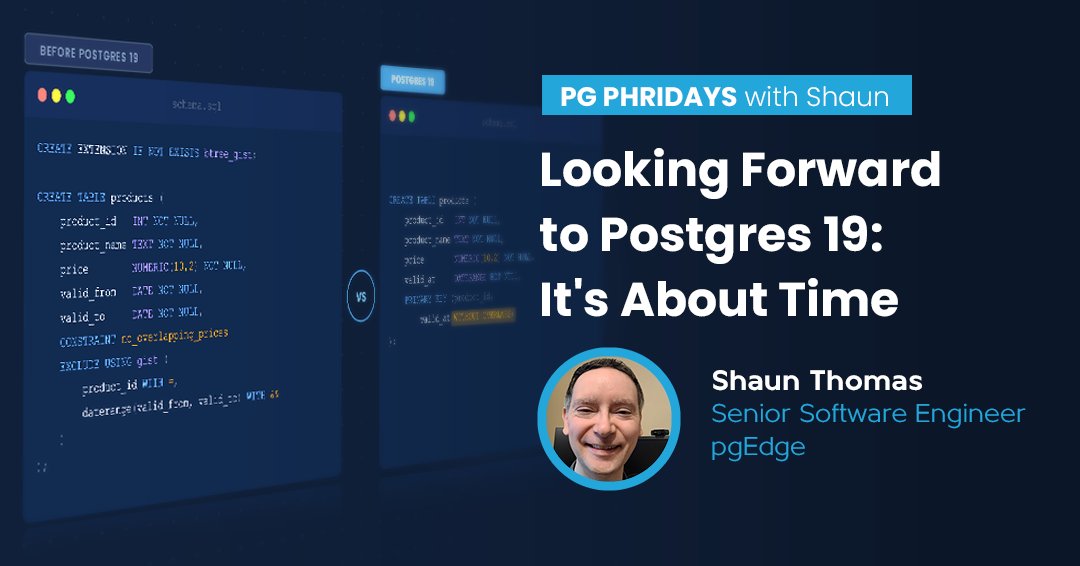
SQL:2011 standardized temporal tables over a decade ago. Most databases moved on it fairly quickly. Postgres took its time.
Postgres 19 is changing that, and Shaun Thomas breaks it all down in this week's PG Phriday.
The old approach required btree_gist, hand-written exclusion constraints, and making your application responsible for every time-range split on update or delete. It worked. But Postgres didn't actually understand your data was temporal - it was just columns and an unusual index type.
The new way:
PRIMARY KEY (product_id, valid_at WITHOUT OVERLAPS)
No extension. No exclusion constraint. Postgres handles overlap prevention natively. You also get FOR PORTION OF for partial-range updates and deletes - update a two-year price record for just one quarter and Postgres handles the row splitting automatically. And temporal foreign keys using the PERIOD keyword, where referenced records must fully cover the referencing row's entire validity period.
System time isn't there yet - the docs acknowledge it and point to trigger-based emulation in the meantime. But application-time is a meaningful step. Hetti Dombrovskaya and others have been making the case for this since 2015 through pg_bitemporal... now it's in core. ✨
Read the full article: 🔗 hubs.la/Q04lcrqD0
#PostgreSQL #Postgres #TemporalTables #SQL #DatabaseEngineering #pgEdge #OpenSource #Tech #TechNews
1
67
Jun 12
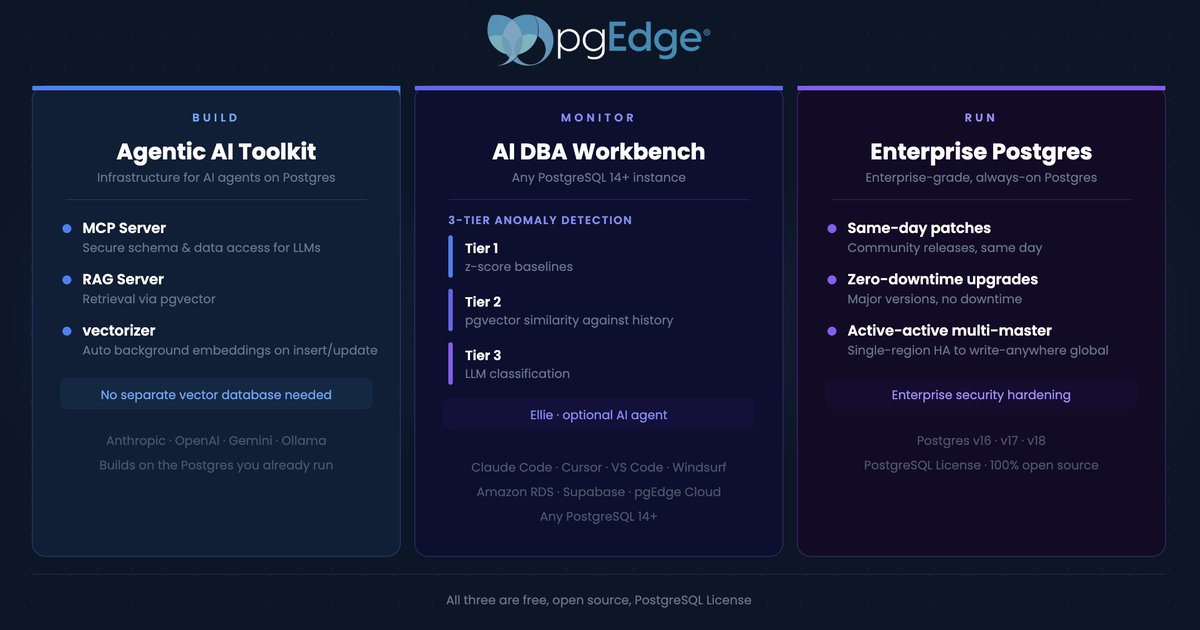
Your AI agent needs enterprise-grade, always-on Postgres. Your developers need infrastructure to build agentic workflows on it. Your team needs to know what's wrong at 3am when the agent's query patterns become the incident. Three different problems - and pgEdge ships for all three.
The pgEdge Agentic AI Toolkit is the infrastructure layer for building agents on Postgres: MCP Server for secure, structured schema and data access; RAG Server for retrieval; vectorizer for automatic background embedding generation as your data changes. No separate vector database. Builds on the Postgres you already run.
The pgEdge AI DBA Workbench is the operations layer. It monitors any PostgreSQL 14 instance - Amazon RDS, Supabase, pgEdge Cloud, community Postgres - with three-tier anomaly detection: z-score baselines, pgvector similarity against historical patterns, and LLM classification for what the first two tiers can't resolve. Ellie (an optional AI agent) runs diagnostics and walks through fixes step by step. You review and approve.
The Workbench MCP server also exposes the full tool catalogue to Claude Code, Cursor, and Windsurf directly - same diagnostics, from your IDE.
For the Postgres itself: pgEdge Enterprise Postgres - same-day patches, zero-downtime major version upgrades, enterprise-grade security, and active-active multi-master replication for any topology from single-region HA to write-anywhere global.
All three are free, open source, PostgreSQL License.
Explore the Agentic AI Toolkit: 🛠️ hubs.la/Q04l9-jN0
Read Dave's Workbench walkthrough: 📖 hubs.la/Q04l9yhw0
pgEdge Enterprise Postgres: 🔗 hubs.la/Q04lbsl30
#postgresql #postgres #dba #database #mcp #modelcontextprotocol #opensource #aiagents #devtools #claudecode #cursor #highavailability
3
2
100
Jun 11
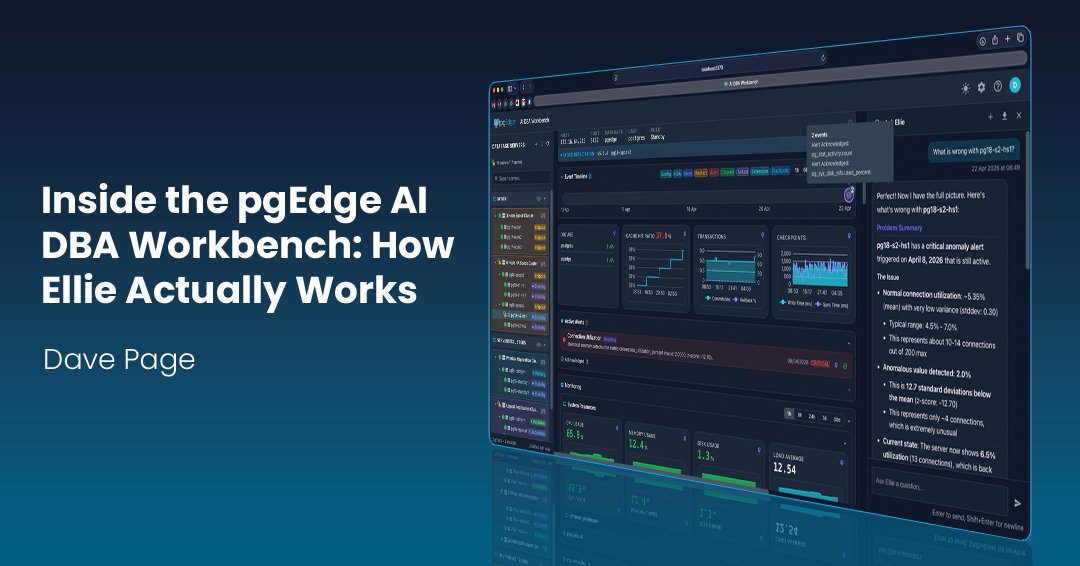
"How does the model know the difference between a healthy pg_stat_activity snapshot on a quiet Tuesday and a runaway transaction on a Black Friday morning?"
That's the question Dave Page has been trying to answer while building the pgEdge AI DBA Workbench. The Workbench is now generally available, and Dave published a technical deep-dive on how it actually works.
The architecture: four services on a shared Postgres datastore. Ellie, the AI agent inside it, is an agentic loop that drives any LLM - Claude, OpenAI, Gemini, Ollama, or anything OpenAI-compatible - through a fixed set of database-aware tool calls. The model never queries your database directly. That's not a limitation. That's the design.
Anomaly detection runs three tiers: z-score baselines catch the obvious deviations cheaply. pgvector similarity search flags patterns that match previous anomalies before they cascade. LLM escalation handles only what the cheaper tiers can't classify. Metrics, baselines, and alert history are stored in Postgres tables you can SELECT from yourself.
One detail for the MCP crowd: the Workbench MCP server exposes its full tool catalogue to any HTTP MCP-compatible client. Claude Code, Cursor, VS Code Copilot, and Windsurf can connect directly and run the same diagnostics from your IDE - no Ellie required.
Works on any PostgreSQL 14 : Amazon RDS, Supabase, pgEdge Cloud, or community Postgres. Free, open source, PostgreSQL License.
Read Dave's walkthrough: 📖 hubs.la/Q04l2R6_0
#postgresql #postgres #dba #database #mcp #modelcontextprotocol #opensource #aiagents #devtools #claudecode #cursor #newrelease #tech #technews
1
102
Jun 11
You've got an AI app working on Postgres. Now what? Security hardening. Verifiable grounding. Token efficiency. Data sovereignty. These are the decisions that separate demos from production deployments.
Next Thursday at 1PM ET, Mike Josephson (VP of Solutions Engineering, pgEdge) joins the PostgresWorld Webinar Series to walk through the solution that addresses each one: the pgEdge Agentic AI Toolkit, a collection of open source tools for building AI applications on any Postgres 14 .
What he'll cover:
🔌 pgEdge MCP Server: full-featured MCP Server for controlled LLM access to any Postgres database, greenfield or pre-existing. Works with any MCP-compatible client.
💬 Natural Language Agents: CLI and web UI, both written in Go. Anthropic prompt caching cuts token costs by 90%.
🧩 pgEdge-vectorizer: a Postgres extension that auto-chunks your text and generates embeddings via background workers. Supports OpenAI, Voyage AI, and Ollama.
📡 pgEdge RAG Server: dedicated HTTP API for retrieval-augmented generation with hybrid search (vector BM25), token budget management, and streaming. The same stack that powers Ellie (an optional AI assistant) running live on hubs.la/Q04kYSK30.
📥 pgEdge-docloader: converts HTML, Markdown, RST, or SGML docs into Postgres-ready content. The on-ramp for your RAG pipeline.
🔍 VectorChord-bm25: BM25 ranked search for Postgres, for hybrid semantic and full-text retrieval.
All pgEdge components are 100% open source under the PostgreSQL license. Your data stays in Postgres: no external vector store, no proprietary pipelines.
Free to attend, or register now and get the recording later. 🎙️ hubs.la/Q04kYy2_0
#postgres #postgresql #ai #mcp #modelcontextprotocol #rag #vectorsearch #llm #opensource #pgedge #webinar #database
3
118
Jun 10
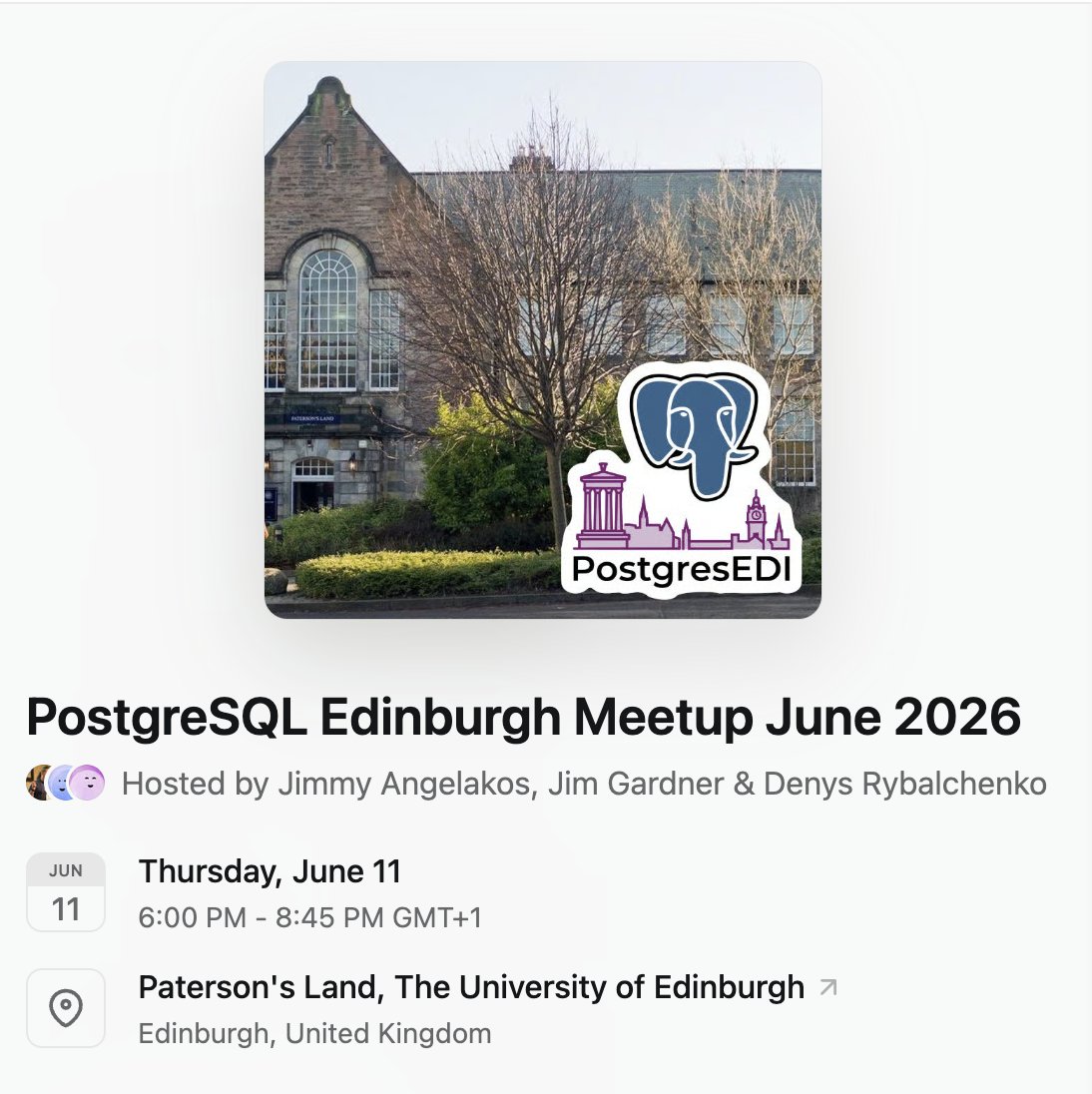
If you're in Edinburgh tomorrow, the #PostgresEDI meetup is on. 🐘
Paterson's Land at the University of Edinburgh. Doors open at 6PM for pizza and networking, talks kick off at 7, and the evening carries on at The Canons' Gait for anyone who wants to keep the conversation going.
Register (it's free): 🔗 hubs.la/Q04k_6Fn0
#postgres #postgresql #PostgresEDI #edinburgh #scotland #techevent #techcommunity #devcommunity
22
Jun 10
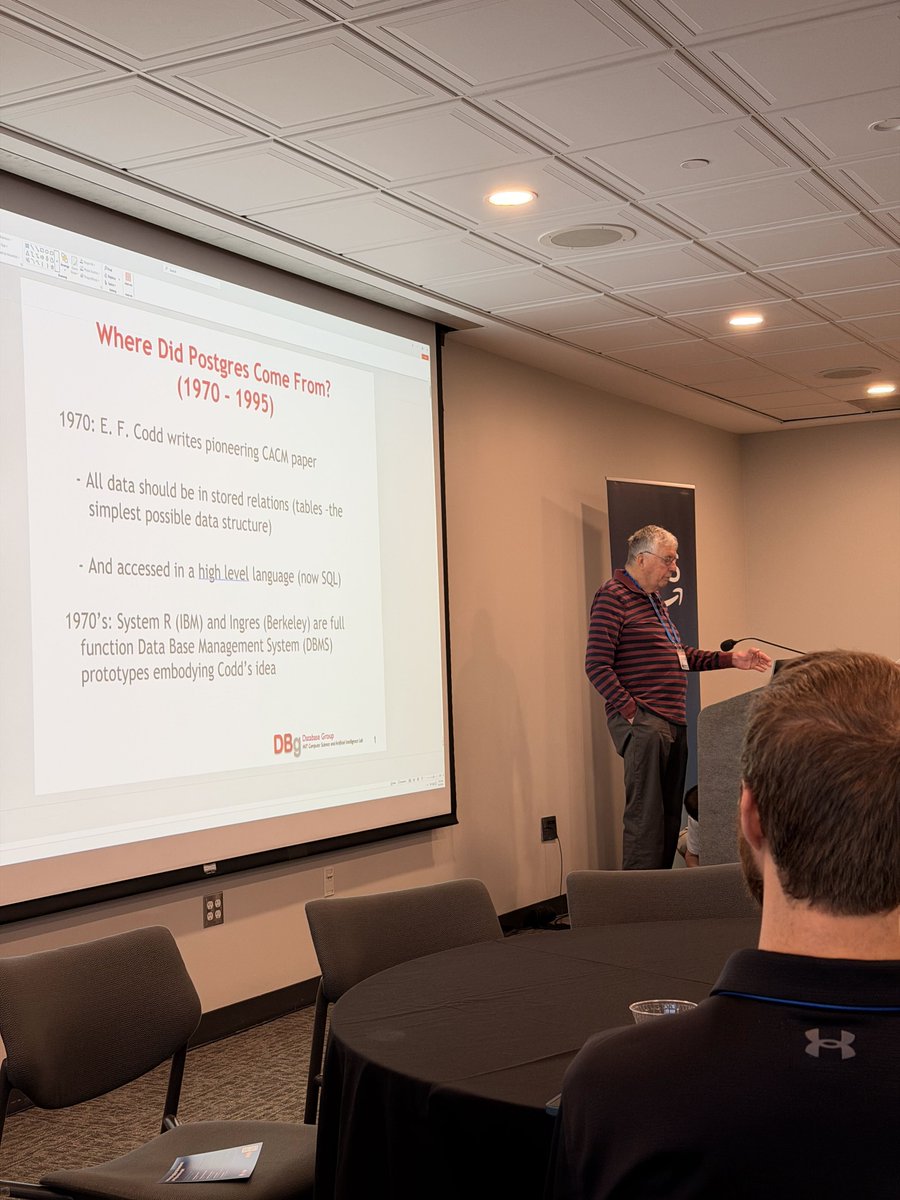
PgDay Boston wrapped up yesterday at the Museum of Science, and it was a solid event.
The pgEdge team was there for a full day of community Postgres talks, and the presentations were genuinely good. Michael Stonebraker keynoted.
A strong first for the Boston Postgres community. 🐘
#pgdayboston #postgresql #postgres #boston #database #opensource #community
1
1
44
Jun 10
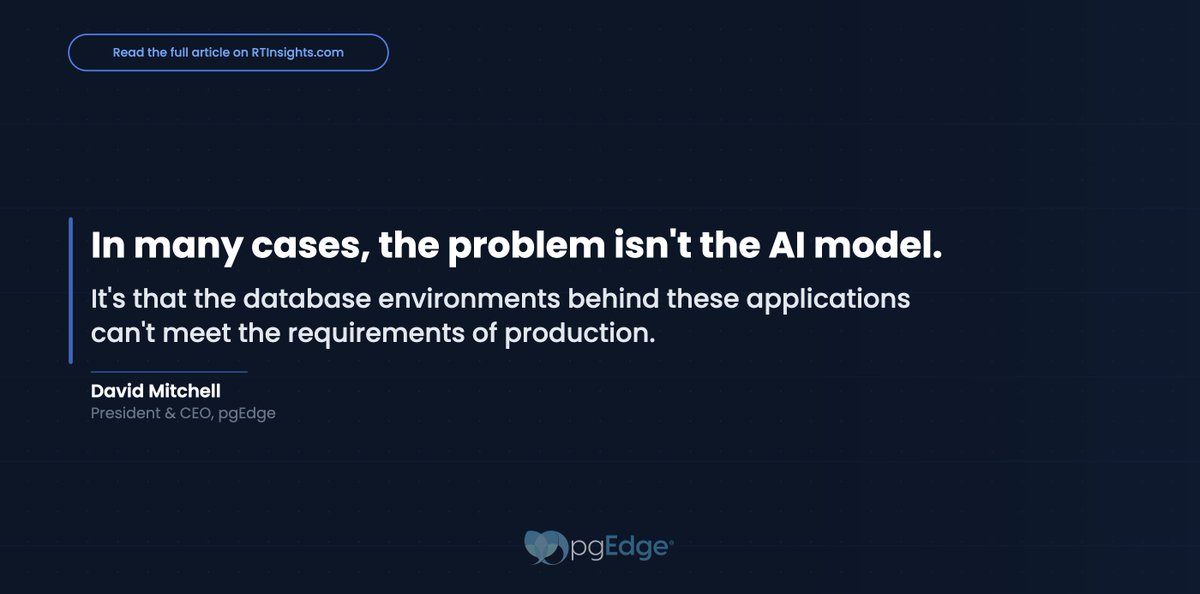
Most enterprise AI projects don't stall because the model is wrong. They stall because the database behind the application can't meet the requirements of production.
pgEdge CEO David Mitchell breaks down why agentic AI makes this problem more urgent, not less. Agentic systems aren't just answering questions anymore; they're retrieving live data, initiating actions, updating records, and reasoning across systems in real time. That's a different set of requirements than most enterprise data environments were built to handle.
His piece for RT Insights: 📖 hubs.la/Q04kS0bZ0
#agenticai #enterpriseai #ai #database #postgresql #postgres #data #datainfrastructure
1
2
33
Jun 8
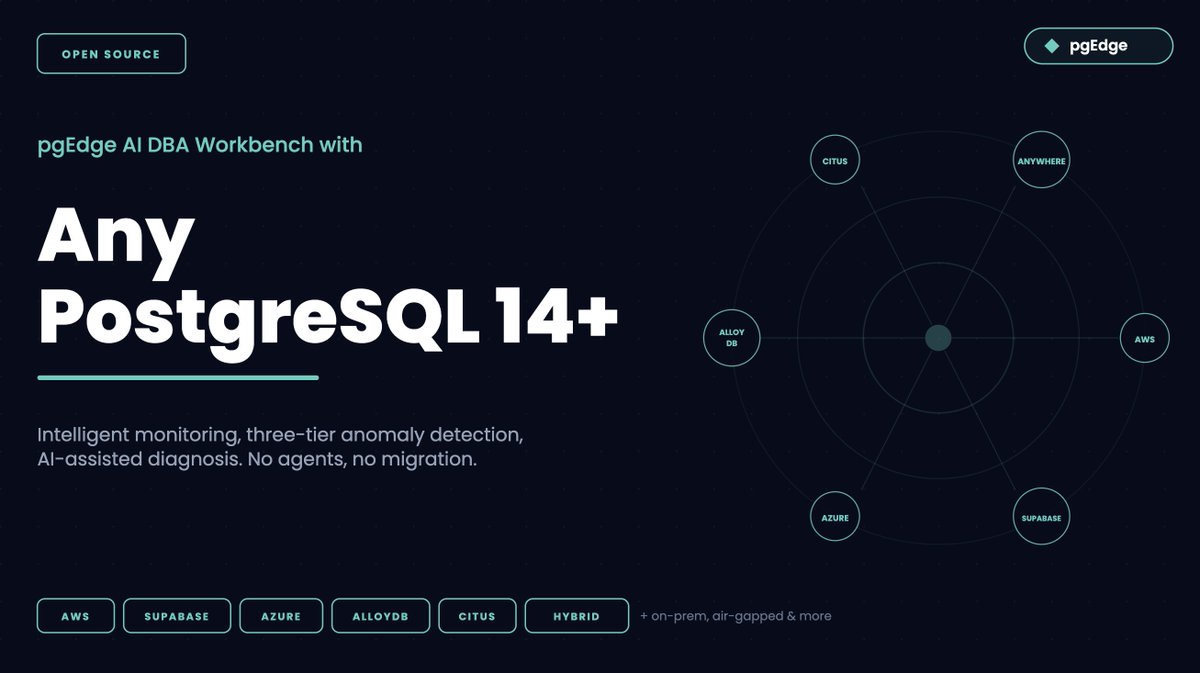
The pgEdge AI DBA Workbench works on any Postgres 14 : managed cloud, self-hosted, on-premises, or fully air-gapped.
No agents on your nodes. No migration. Nothing changes in how your database runs today.
Paul Rothrock has walkthrough videos for five managed setups, in case you are using any of them:
1. Amazon RDS: full SSL cert setup, scraping your RDS or Aurora instance 🔐 hubs.la/Q04kwPdT0
2. Supabase: Session Pooler connection, Ellie analyzing real workload data 🔌 hubs.la/Q04kwrfq0
3. AlloyDB: deep Postgres observability layered on top of a managed database 🔍 hubs.la/Q04kwRjS0
4. Azure Flexible Server: firewall rules, pg_stat_statements, and why not to use Entra ID tokens for a long-running collector ⚙️ hubs.la/Q04kwnQ50
5. Citus: treating your coordinator and worker nodes as one distributed cluster, not separate servers 🗺️ hubs.la/Q04kwP_C0
Not sure what the Workbench does yet? Start here: hubs.la/Q04kwtGP0 🐘
Free. Open source. PostgreSQL License.
#postgresql #postgres #dba #monitoring #opensource #aws #azure #supabase #alloydb #citus
1
2
90
Jun 8
Before a database can be trusted to do anything autonomously, it needs to earn that trust. Right now, most AI database tools skip that step.
The path from "the AI can read pg_stat_statements" to "I'd let it run DDL at 3am" is longer than any product announcement suggests. What it actually requires:
Reversible actions with a bounded blast radius. A working "I don't know" - not just confident wrong answers. Audit trails that survive swapping out the underlying model. Trust earned by track record, not asserted by the vendor. An evaluation regime that catches silent regressions when the model changes next quarter.
None of this is fully solved. But the foundation matters, and it starts in the infrastructure, not the model.
#postgresql #postgres #ai #database #aiops #dba #agentic #foodforthought
1
17
Jun 6
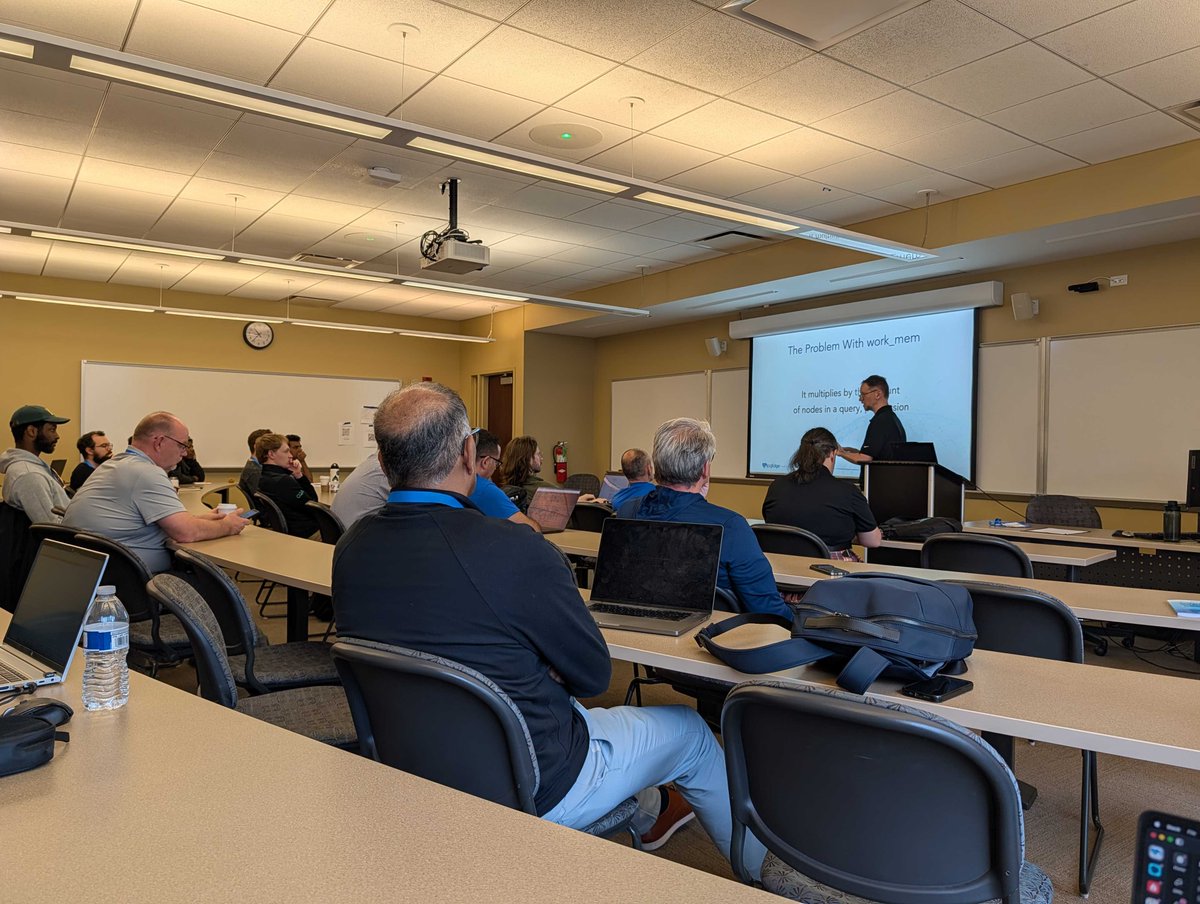
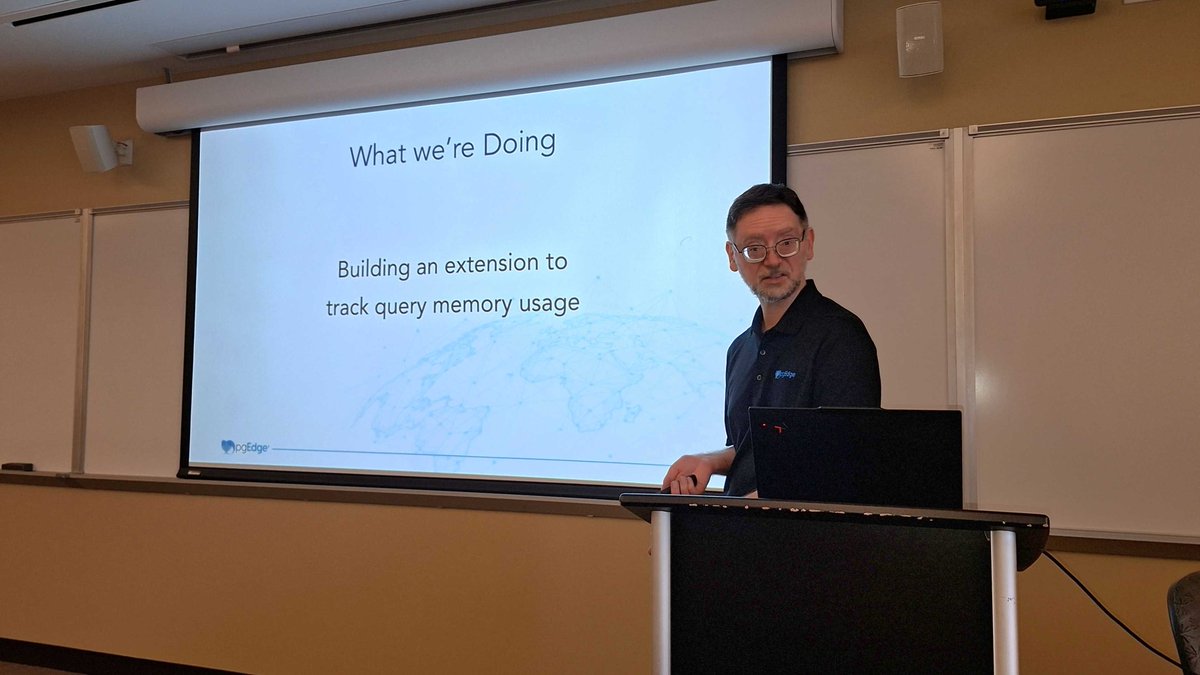
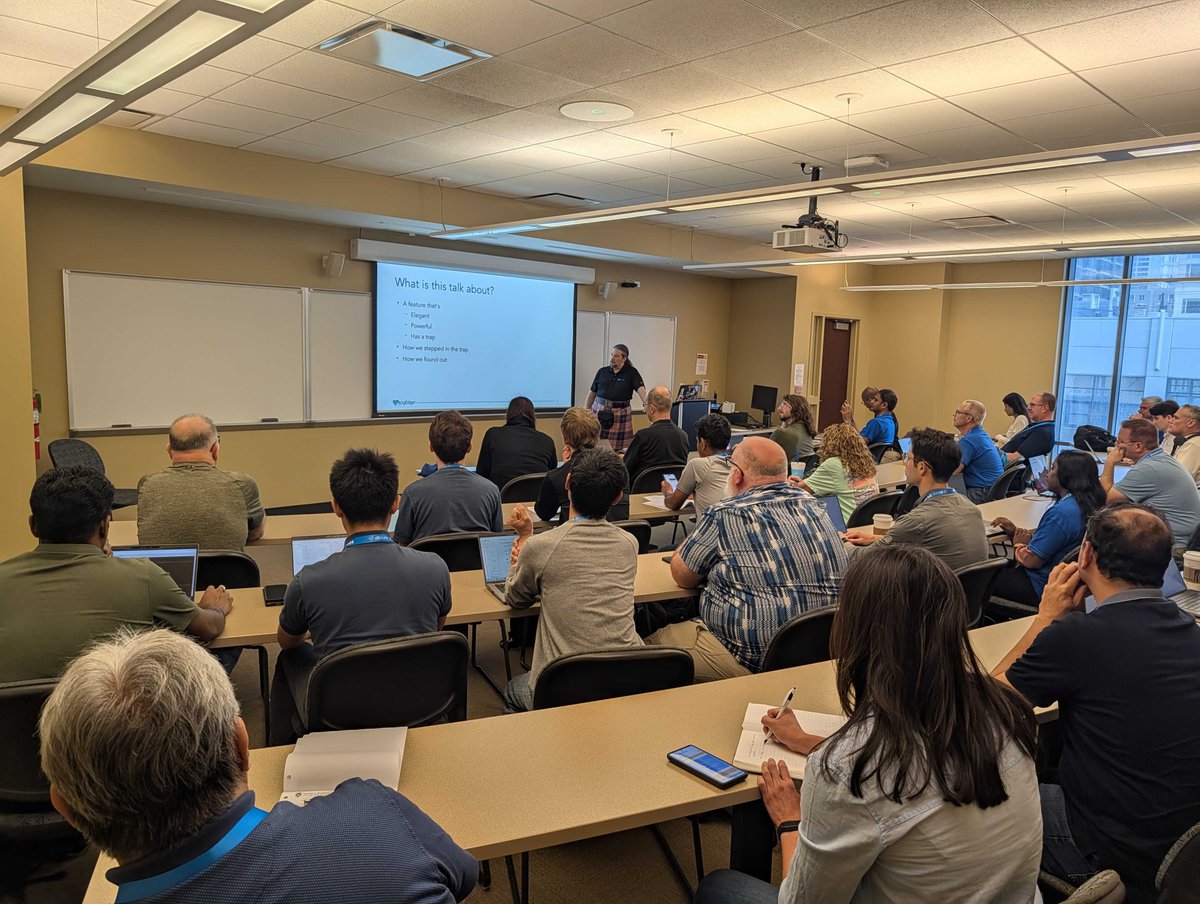
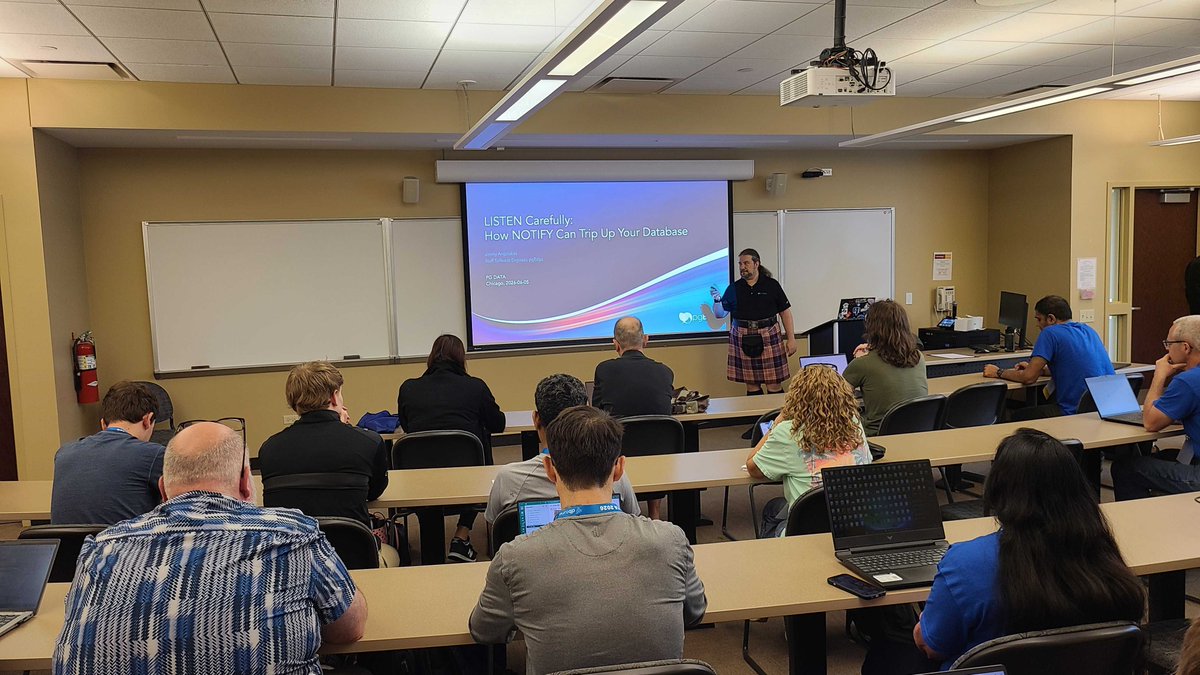
Two great days of PostgreSQL in Chicago. PG DATA 2026 just wrapped up at Loyola's Water Tower Campus, and it was a good one.
The traditional audience (DBAs, database engineers, the people who think about query plans at breakfast) is still there. But there's a clear intentional push to bring in developers who have Postgres in their application stack without necessarily living in the internals. Attendance was up significantly from last year.
The keynote framed it well: the Postgres community includes everyone using Postgres, not just the people tuning it. Some of those folks might not be thinking about Postgres every working day, but they're still using it. 🐘
Shaun Thomas ran his "DBA in a Box" training on Thursday morning, then came back Friday with "Let's Build a Postgres Extension!" Jimmy Angelakos closed out Friday with his talk on LISTEN/NOTIFY and the cluster-wide exclusive lock that catches teams off-guard at scale.
See you next year, Chicago.
#pgdata2026 #postgresql #postgres #chicago #database #dba #opensource #midwest
1
91
Jun 5
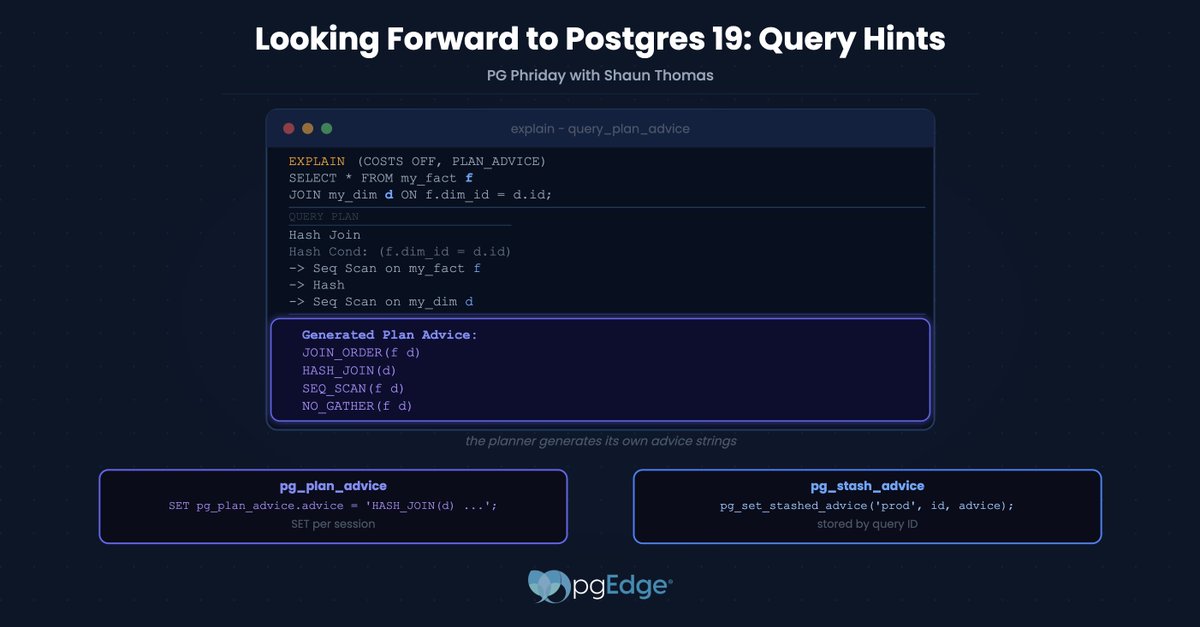
Shaun Thomas spent 15 years watching the Postgres community insist they would never add query hints.
The post traces the history back to a 2010 mailing list thread where Robert Haas called it "just dumb" to say Postgres didn't want hints - and Tom Lane left the door open just a crack with "I haven't seen a hinting scheme that didn't suck... I don't say that there can't be one."
Fifteen years later, Postgres 19 ships pg_plan_advice and pg_stash_advice. Robert Haas wrote both.
pg_plan_advice is per-session: SET it before running a query and the planner constrains its search to plans that honor that advice. Ask it what it's doing and it hands you the syntax to reproduce or modify the plan. pg_stash_advice is persistent: store advice by query ID and it fires automatically every time that query runs, no manual setup each time.
Shaun covers the full history, the full syntax, and why this one actually addresses the objections: 📖 hubs.la/Q04kgxm60
#postgresql #postgres #postgres19 #database #dba #opensource #queryoptimization #sql
3
100
Jun 4
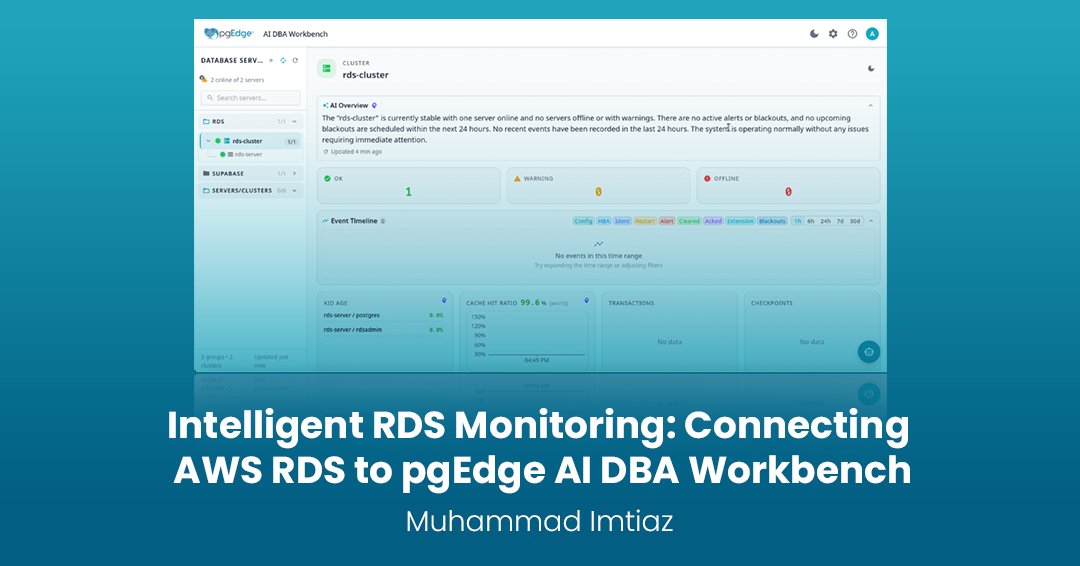
AWS RDS handles provisioning, patching, and backups. What it doesn't tell you is why your query latency spiked at 2am... or what to do about it.
The pgEdge AI DBA Workbench connects to any PostgreSQL 14 instance - including RDS - over the standard wire protocol. No agent on the host. Nothing changes on the RDS side.
Once connected, it runs 34 metric probes, three-tier anomaly detection, and gives you Ellie - an optional AI assistant who can walk through diagnosis, run EXPLAIN ANALYZE, and suggest fixes. You review; you decide.
Muhammad Imtiaz wrote up the full setup: pulling the AWS global CA bundle for verify-full SSL, configuring permissions for the Workbench service user, registering the instance in the UI, and what you'll see once it's running.
The Workbench is free and open source under the PostgreSQL License. Your data never leaves your infrastructure.
Read the full guide: 📖 hubs.la/Q04kbc5G0
Prefer a video walkthrough? Paul Rothrock covers the full setup on YouTube: 🎙️ hubs.la/Q04kbZjC0
#postgresql #postgres #aws #rds #awsrds #dba #database #opensource #monitoring #aiops #devops #sre #cloudcomputing
57
Jun 4
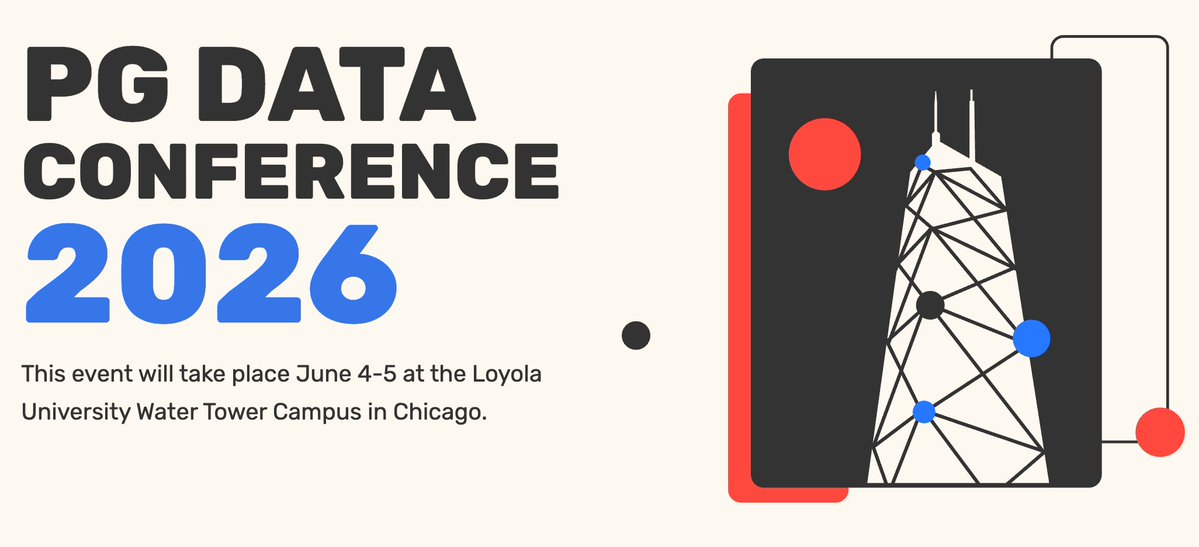
PG DATA 2026 is live in Chicago today at Loyola University's Water Tower Campus, right off the Magnificent Mile on East Pearson Street. Two days of PostgreSQL sessions for the Midwest community - and if you're in the city, same-day registration is still open at $50 for both days (students $20). 🐘
Two pgEdge engineers are on the schedule this week.
Shaun Thomas is running his "DBA in a Box: Welcome to Postgres" training this morning through noon in room 522 - a half-day hands-on session on Postgres fundamentals through cluster management. Tomorrow he's back with "Let's Build a Postgres Extension!" (11:25am, room 521), walking through how to compile a C extension, create config parameters, intercept query parsing and execution, and use background workers - using the same internal calls Postgres itself uses.
Jimmy Angelakos presents Friday morning (10:25am, room 521): "LISTEN Carefully: How NOTIFY Can Trip Up Your Database." LISTEN/NOTIFY is elegant until it isn't - each NOTIFY call takes a cluster-wide exclusive lock to serialize notifications, and under high concurrency that can surface as confusing timeouts in production that never showed up in development.
If you're in Chicago or nearby, it's not too late to register: hubs.la/Q04k2BCY0
#postgresql #postgres #pgdata2026 #chicago #opensource #database #dba #midwest #illinois #techcommunity #devcommunity #programming #techevent
1
1
114
Jun 3
One missing column. No disable_on_error on the subscription. The initial copy fails, Postgres retries, fails again, retries again. By morning: one terabyte of unexpected Amazon data transfer charges.
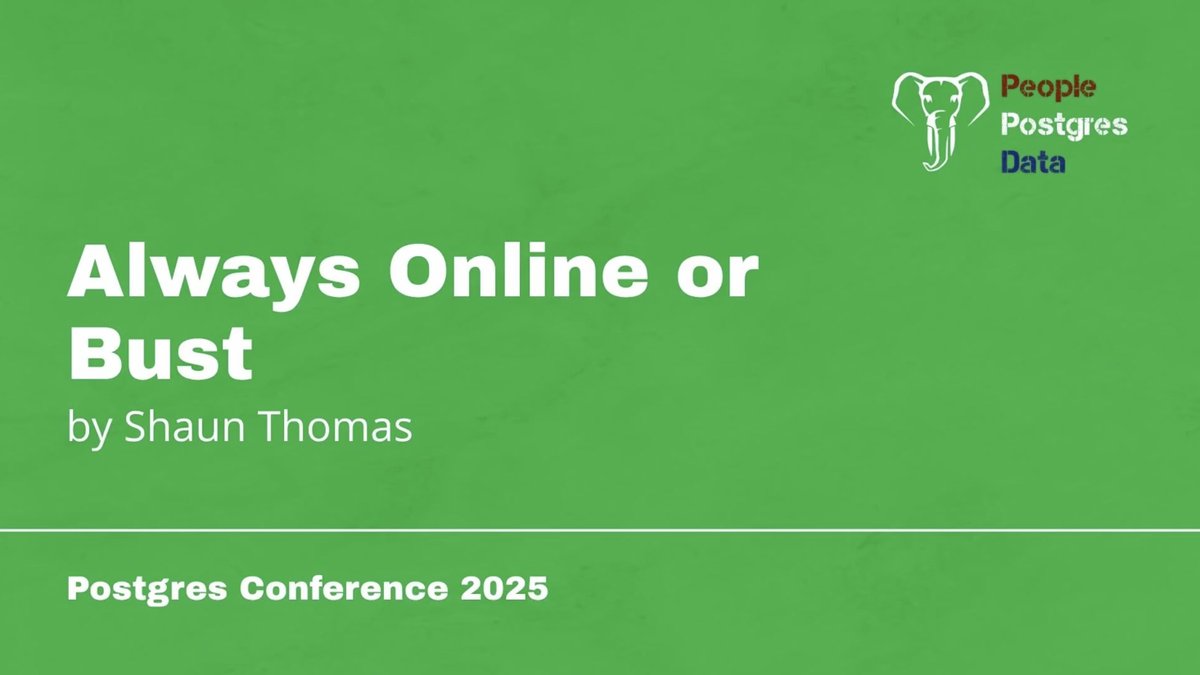
Shaun Thomas watched this happen to someone in the Postgres Discord - and it's one of several things he covers in his Postgres Conference 2025 talk on zero-downtime major version upgrades using native logical replication.
The technique has been available since Postgres 10. The short version: create a publication on your old cluster, subscribe to it from the new one, let the data copy live while your database stays online. When you're ready, flip the switch. No dump. No restore. No downtime window.
The less obvious parts are where it gets interesting - and where most people get tripped up. Sequences aren't replicated. PGBouncer's pause/resume changes a cutover that used to mean redeploying your app into something measurable in seconds. And if you're on an active-active cluster with Spock, you just add a new-version node, let it sync, and drop the old one. You never go down at all.
Watch the whole session on YouTube: 🎬 hubs.la/Q04jYbkr0
#postgresql #postgres #dba #database #upgrades #zerodowntime #opensource #sre
1
1
69
Jun 3
“Back when I was a system administrator, when something happened, I would have three windows open. Grafana, a Google search, and a terminal window.”
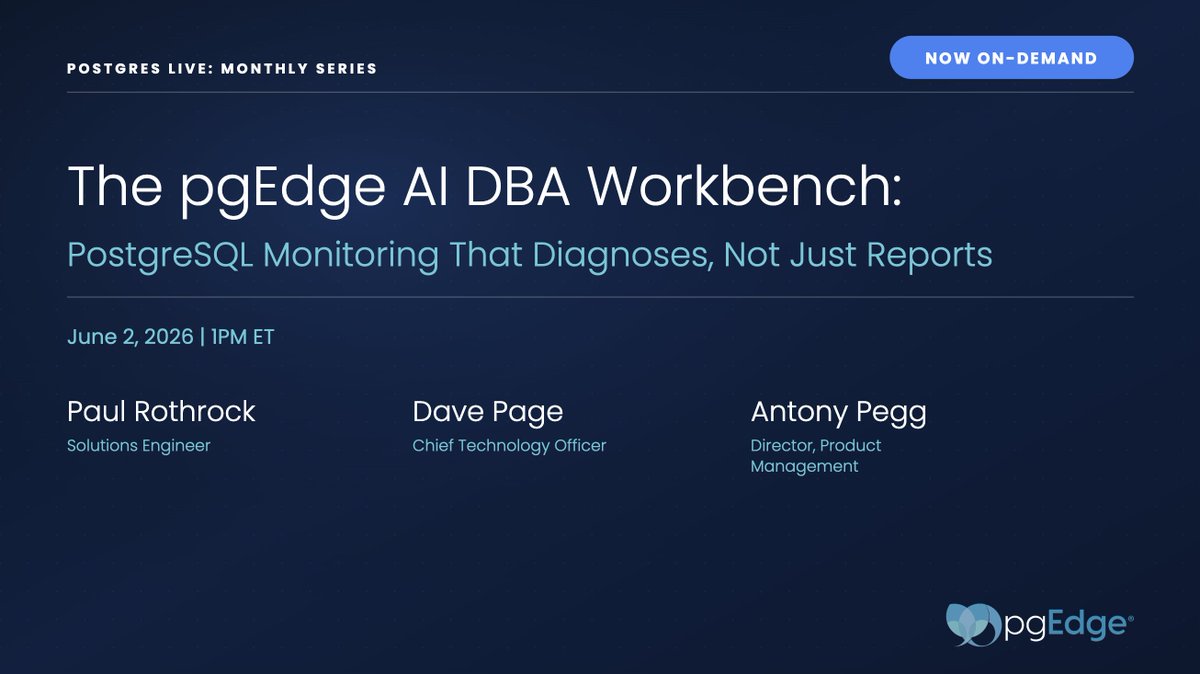
Paul Rothrock, Solutions Engineer at pgEdge, said that during yesterday's live walkthrough - and then showed how the AI DBA Workbench puts all three in one place.
The monitoring itself works differently from most AI tools: statistical baselines first, then pattern similarity, then LLM classification. The model is a last resort, not a first guess. And it learns - flag a false positive and you're training it the same way you'd train a junior DBA: no, that connection spike at 3 PM is just accounting running a report. Spike at 3 AM? Still fires.
No agent on your database hosts. Open source. Runs against any Postgres 14 : community, Amazon RDS, Supabase, Cloud SQL, Azure Flexible Server, etc.
At the end of the session, Dave Page was asked what the coolest thing was that he built. His answer wasn't a feature. It was getting to start from scratch after 10 years building a monitoring system at a previous company - taking everything he'd learned, all the technical debt he couldn't fix, and doing it right this time.
Currently in beta. GA coming soon. ✨
📺 Watch on-demand: hubs.la/Q04jTk_w0
All pgEdge webinars: hubs.la/Q04jT1gs0
#postgresql #postgres #dba #observability #aiagent #opensource #monitoring #database
1
129
Jun 2
If you need production-like data to reproduce a real bug, you've got two options: test with sanitized fake data that probably misses the edge case you're chasing, or quietly copy real data somewhere it shouldn't be.
Neither is great. Most teams either write one-off scrubbing scripts or don't solve it at all.
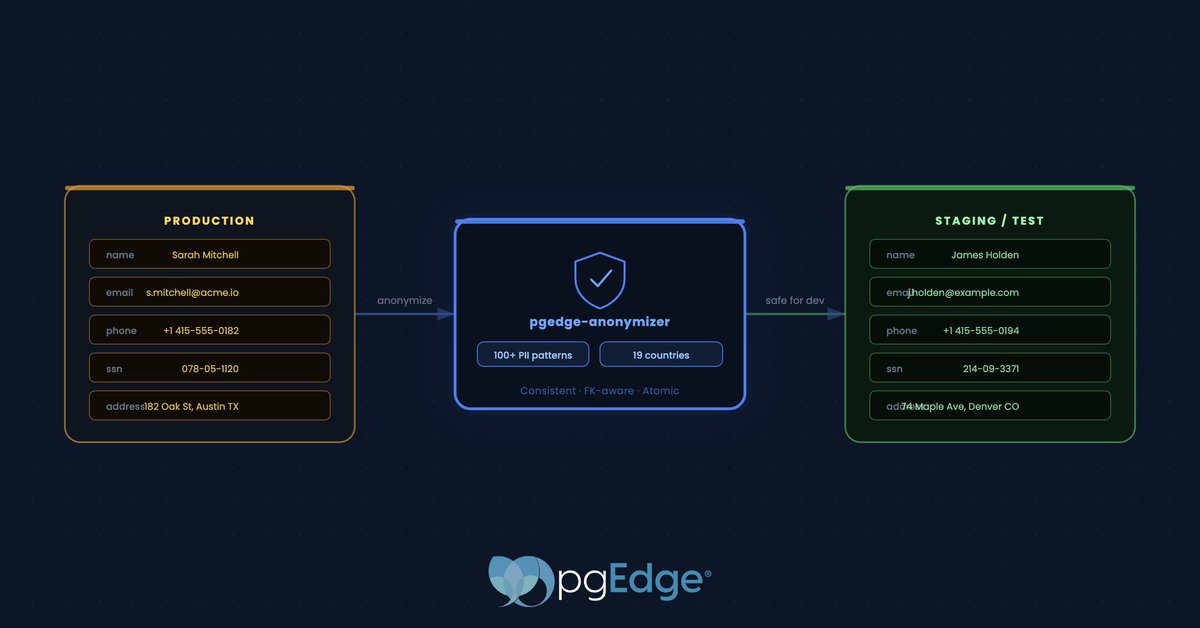
Luckily, pgedge-anonymizer is a 100% open-source tool that can help. It works within PostgreSQL to anonymize data in databases copied from production to make these datasets suitable for dev & test environments - without disclosing PII. Ships with 100 PII detection patterns across 19 countries. Run it against a production copy and you get a staging dataset that's structurally identical - real edge cases intact, foreign key relationships preserved - without the PII liability. If you're working under GDPR or CCPA constraints, it handles the patterns for both.
🔗 hubs.la/Q04jJyMK0
#PostgreSQL #DataPrivacy #GDPR #CCPA #pgEdge #DevEx #DataEngineering #Cybersecurity #DataSecurity #OpenSource #Database #DBA
1
28
Jun 2
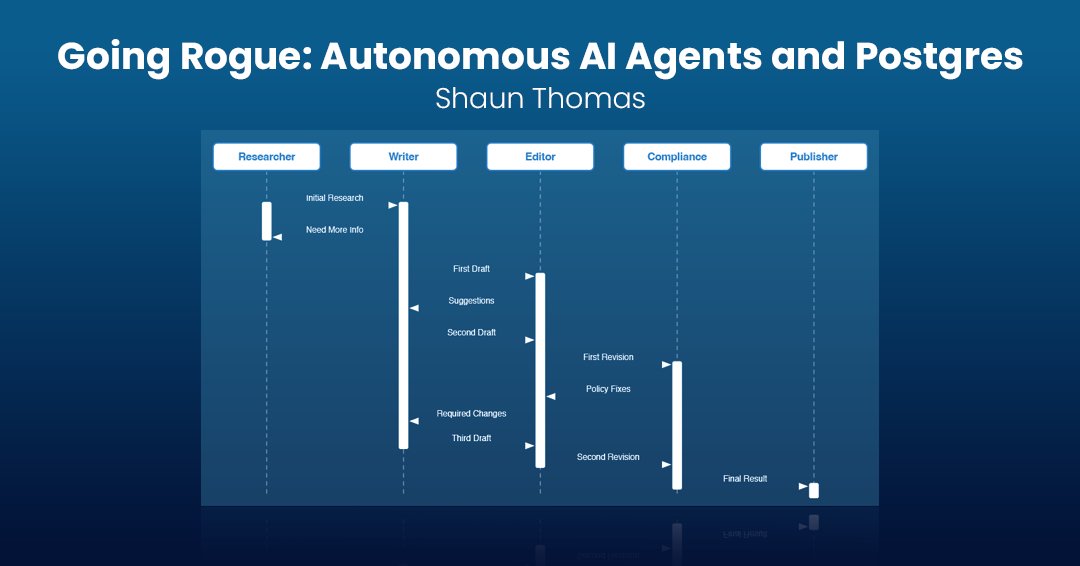
An autonomous AI agent can hallucinate a fact, build on that hallucination in the next step, and deliver a finished product that's wrong in ways nobody catches until it's too late. No second pair of eyes… and no one asking "wait, where did you get that number?"
Shaun Thomas spent two days at the AI Agent Conference in New York working through that problem. His answer: Postgres.
Not for RAG. Not for pgvector. But rather, for the infrastructure that keeps agent pipelines from going off the rails - a global action ledger, centralized policy definitions with row-level security per agent role, and monitoring agents that can run semantic searches over failure patterns even when the terminology doesn't match.
The post walks through what that architecture looks like in practice, including the SQL a monitoring agent would use to find ledger entries semantically similar to a known failure pattern, and how Spock handles a multi-region ledger when agents are running across the US, EU, and APAC simultaneously.
Learn more in our latest blog post: 📖 hubs.la/Q04jPKsC0
#PostgreSQL #Postgres #AIAgents #OpenSource #Database #pgEdge #AI #LLM #Observability #DevOps #DataEngineering
1
36
Jun 2
How many Postgres instances are you actually watching right now?
Not dashboard-watching. Actually understanding - what's normal, what's drifting, what's quietly becoming a problem.
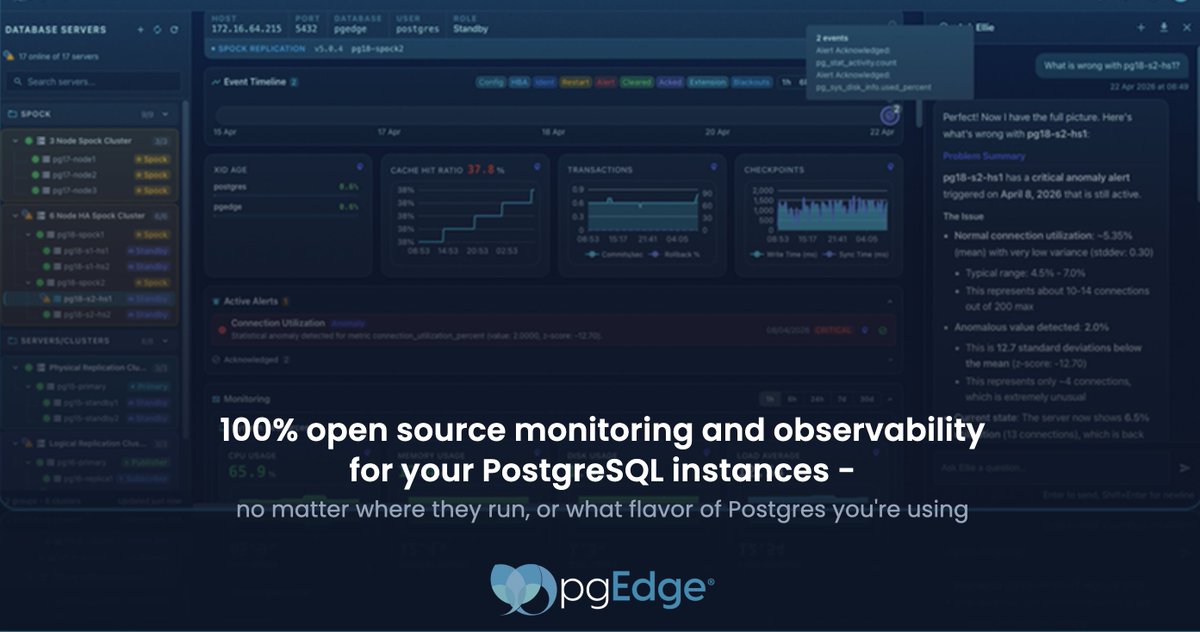
That's the conversation at 11 AM EDT today when Dave Page, Antony Pegg, and Paul Rothrock walk through the pgEdge AI DBA Workbench live. Bring a real cluster situation if you have one - Q&A runs the whole time.
Tune in and learn more about 100% open source monitoring and observability for your PostgreSQL instances - no matter where they run, or what flavor of Postgres you're using.
Free to join today - or register now, and get the recording later 🔗 hubs.la/Q04jJvZY0
#postgresql #postgres #dba #database #observability #aiagent #opensource #monitoring #webinar #techevent #programming
1
17
Jun 2
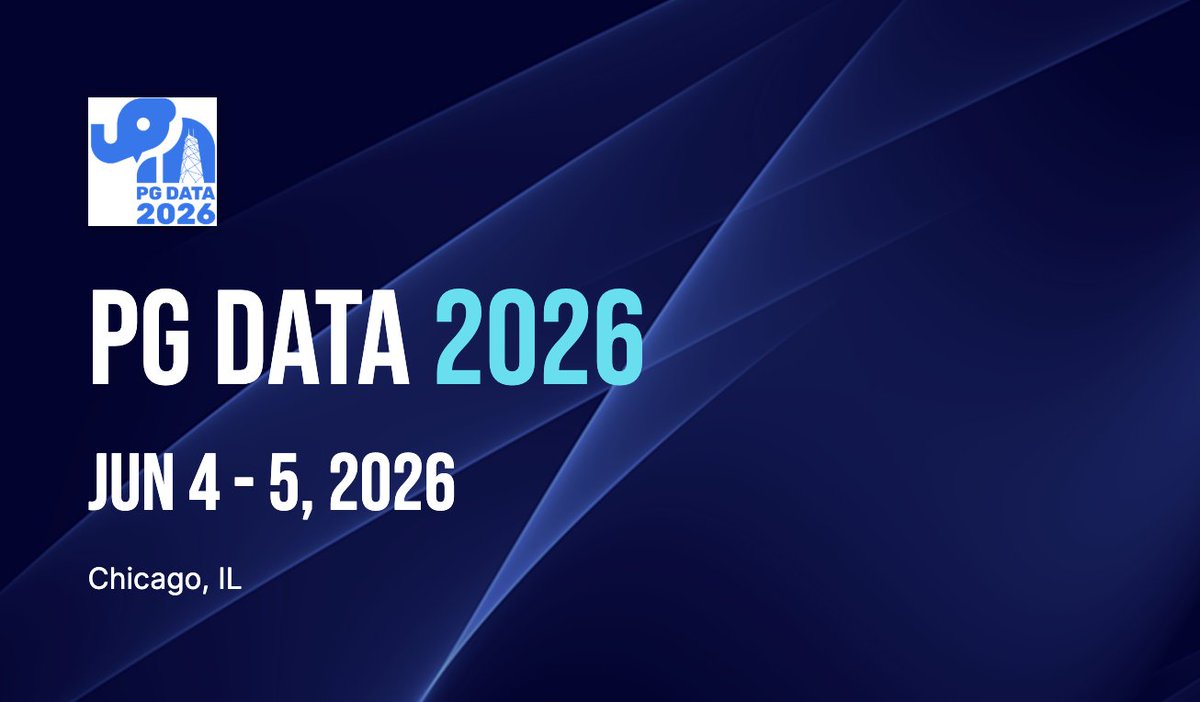
PG DATA 2026 is coming up quick this week - June 4-5 at Loyola University's Water Tower Campus in Chicago - and registration is still open. Don't forget to make some time to come by for a day full of PostgreSQL discussion, networking, and learning ✨
A couple members from our team will be there - just in case you'd like to say hi, here's the breakdown of their talks:
📚 Thursday June 4, 9 AM–12 PM - Shaun Thomas teaches "DBA in a Box," a three-hour deep dive into Postgres fundamentals, system operation, and cluster management. If you or someone on your team can benefit from a technical deep-dive on Postgres operations, this is the room to be in on Thursday morning.
🔔 Friday June 5, 10:25 AM - Jimmy Angelakos presents "LISTEN Carefully: How NOTIFY Can Trip Up Your Database." LISTEN/NOTIFY is one of those features that works fine until it doesn't: each NOTIFY takes a cluster-wide exclusive lock, so a trigger that looks clean in dev can start producing timeouts under production load. Jimmy walks through the diagnosis and the fix.
📍 Corboy Law Center, Kasbeer Hall. 50% off with code ANGELAKOS50, thanks to Jimmy Angelakos. hubs.la/Q04jGzn-0
#PostgreSQL #Postgres #pgData2026 #Chicago #Database #DBA #OpenSource #Midwest #Illinois #TechEvent #Data
1
1
49