
Feb 28
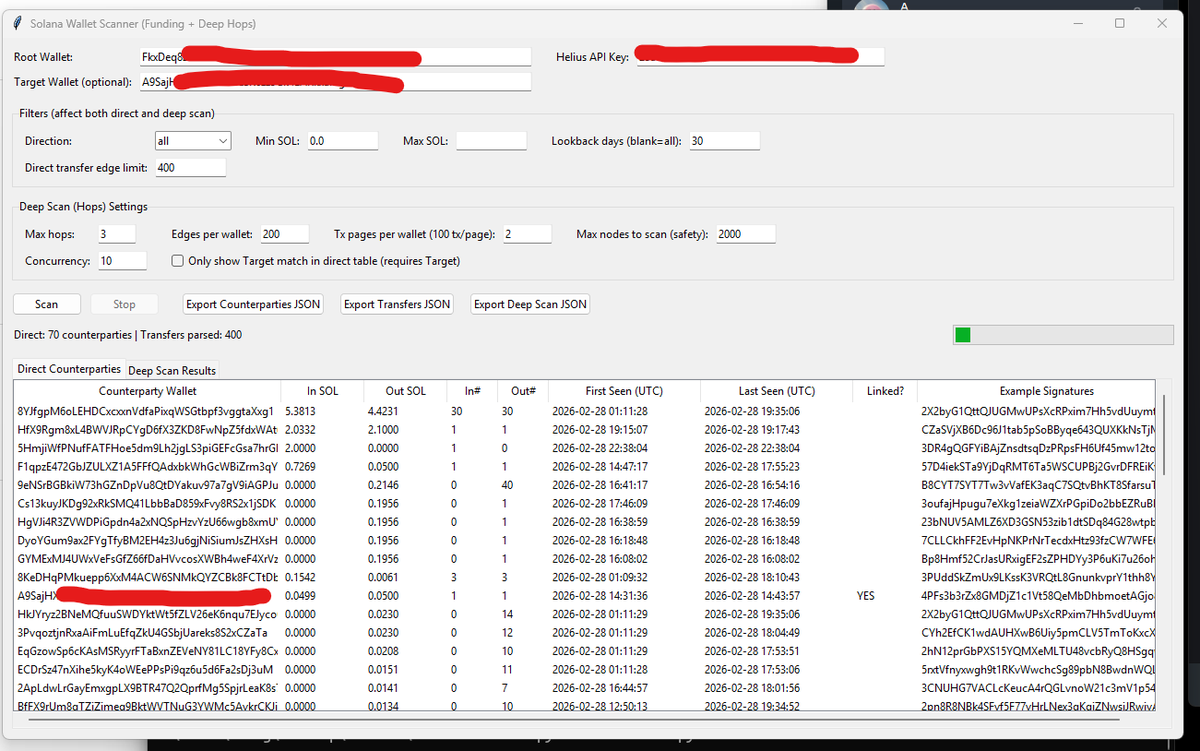
Added some more features to the scanner.
It now scans in depth up to 3 hops and 2 pages per hop.
What does this mean?
Most wallet scanners only show direct transfers. If Wallet A sends SOL to Wallet B, that’s easy to see. But the moment it goes A → B → C → D, most tools lose the trail.
The Deep Hops scan solves that.
Instead of stopping at direct transfers, it builds a layered funding graph. It starts with the root wallet and pulls every SOL transfer that meets your filters. Then it expands outward. Every wallet that touched the root becomes a new node. From there, it pulls their transfers. Then the next layer. And the next.
You can define how many hops deep it goes. One hop shows direct interactions. Three or four hops starts uncovering funding chains and indirect relationships that are usually invisible on block explorers.
If there is a path from the root wallet to a target wallet, even through multiple intermediaries, the scanner will find it and reconstruct the exact route. You don’t just see that they’re linked. You see how they’re linked.
It also respects filters like minimum SOL amount, lookback window, and per-wallet limits so you can remove dust noise and focus on meaningful flows.
This makes it useful for:
Detecting bundle clusters
Tracing dev funding paths
Finding indirect wallet relationships
Following money through layered transfers
Instead of asking “Did these wallets interact directly?” you’re asking a deeper question:
Is there any funding path between them at all?
That’s the difference between surface-level tracking and structural analysis.
#walletscanner #solscanner #solana #memes #tek #builders #memecoins
2
1
3
187
Feb 28
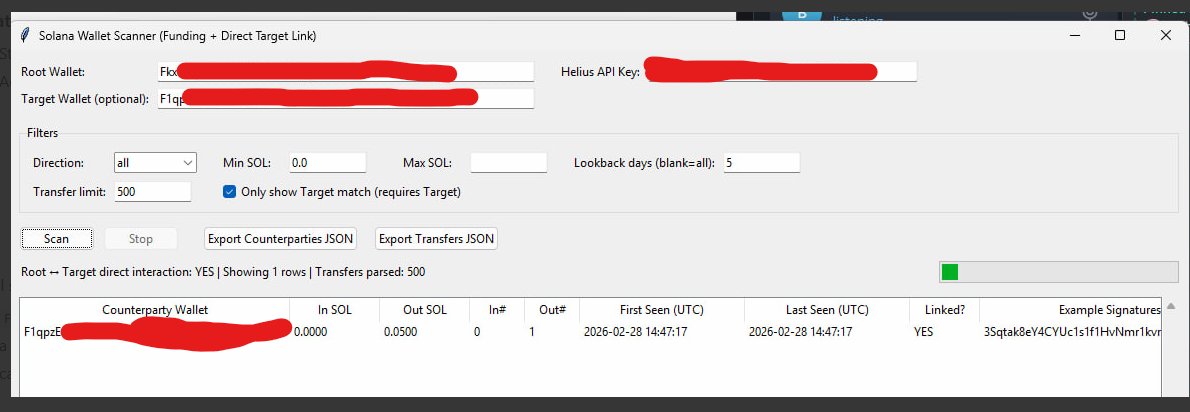
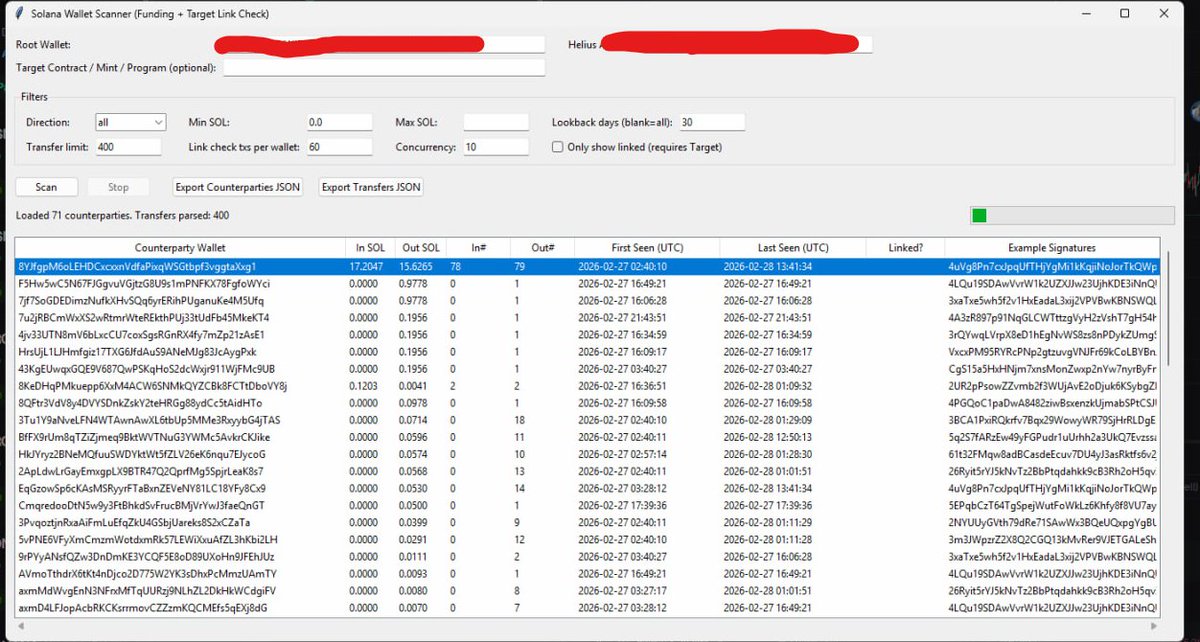
Working on a new project.
It is a wallet scanner that you enter the root wallet and a target wallet. It then scans all trasnactions to see if there a link between those wallets for funding and transfers. Currently Solscan is very difficult to maneuver and i wanted to create a solution to finding links if two wallets are linked together.
This is just the rudimentary gui and will look better once i add it to a website for people to use.
#walletscan #walletscanner #solana #memecoins #memes
8
2
177

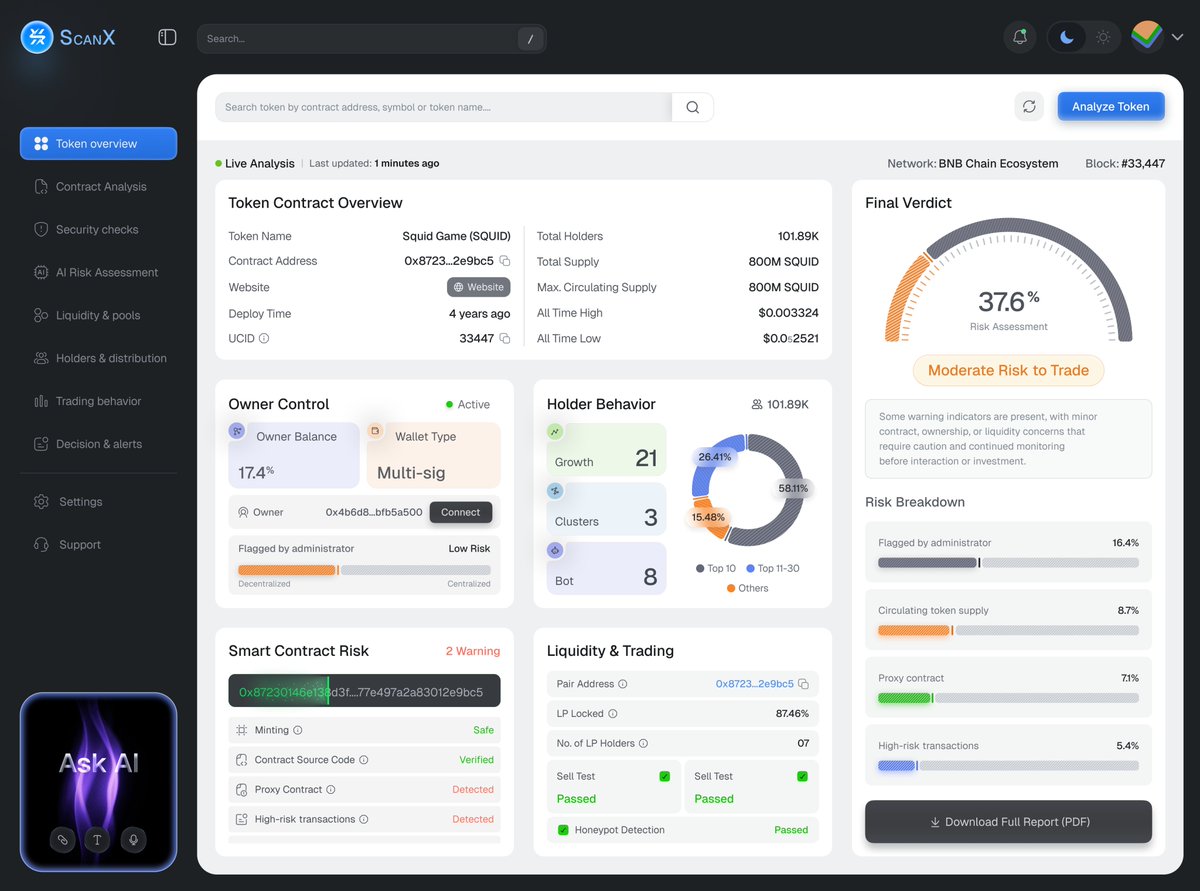
ScanX is a next-generation crypto risk analysis dashboard.
✨ Key Features
✅ Contract verification
✅ Ownership control
✅ Liquidity status
✅ Holder distribution
✅ Trading behavior
✅ AI-Powered Risk Assessment
✅ Smart Decision Support
#scamdetector #walletscanner
5
6
105

25 Dec 2025
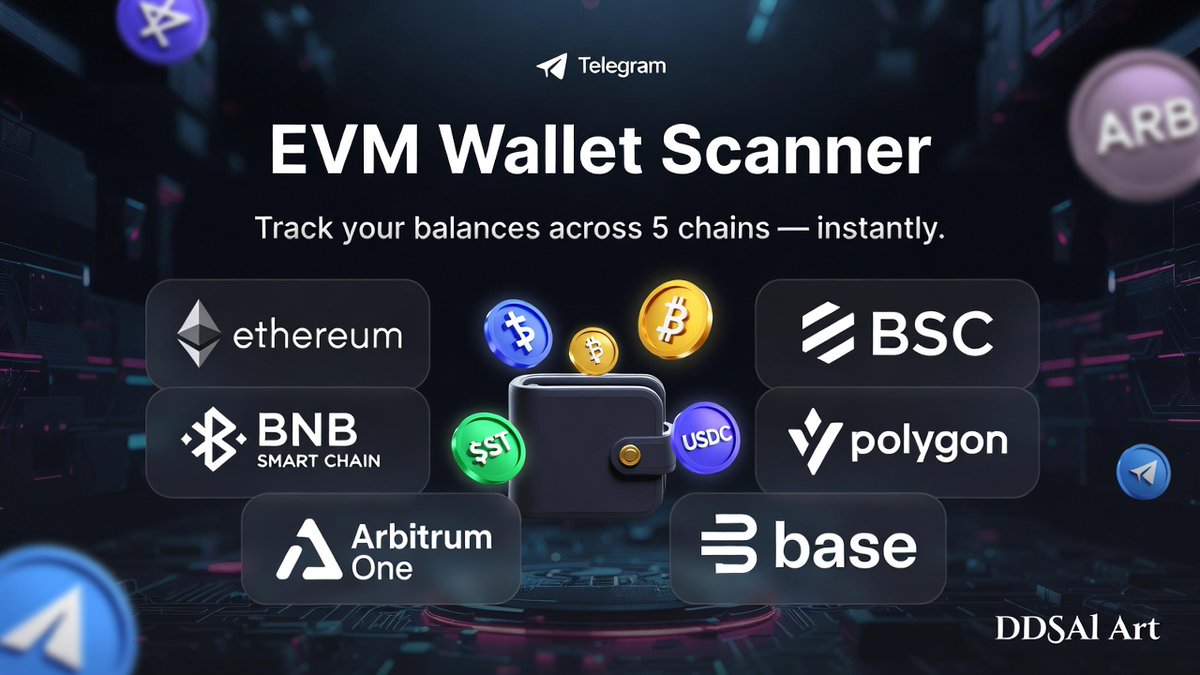
𝐉𝐮𝐬𝐭 𝐥𝐚𝐮𝐧𝐜𝐡𝐞𝐝 𝐄𝐕𝐌 𝐖𝐚𝐥𝐥𝐞𝐭 𝐒𝐜𝐚𝐧𝐧𝐞𝐫 t.me/Evmwalletscan_bot — a clean, no-clutter Telegram bot that shows your balances across:
⛓️ @ethereum
🟡 @BNBCHAIN
🟣 @0xPolygon
🔴 @arbitrum
🔷 @base
All in one tap: ETH • BNB • USDT • USDC • ARB
Built for speed, privacy, and simplicity.
No signups. No tracking. Just balances.
#EVM #Crypto #DeFi #Web3 #TelegramBot #WalletScanner
2
3
9
166
7 Dec 2025
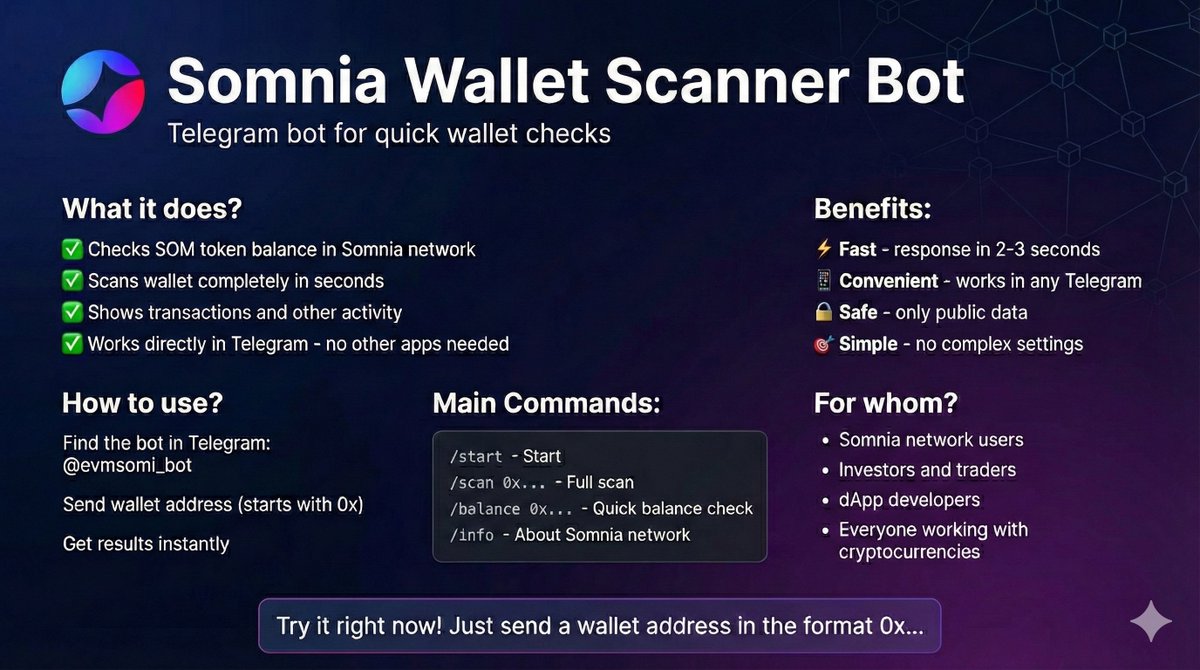
🚀 Introducing EVM Somnia Wallet Scanner Bot! 🤖
Check any wallet balance on @Somnia_Network in seconds! ⚡
✅ SOMI, WSOMI, USDC.e, ArWSOMI balances
✅ Transaction history
✅ Network information
✅ Direct explorer links
Try it now: t.me/evmsomi_bot
#Somnia #Blockchain #Crypto #WalletScanner #Web3
5
3
17
496

31 Jul 2025
🚨 $HEX update — and yes, I called it early
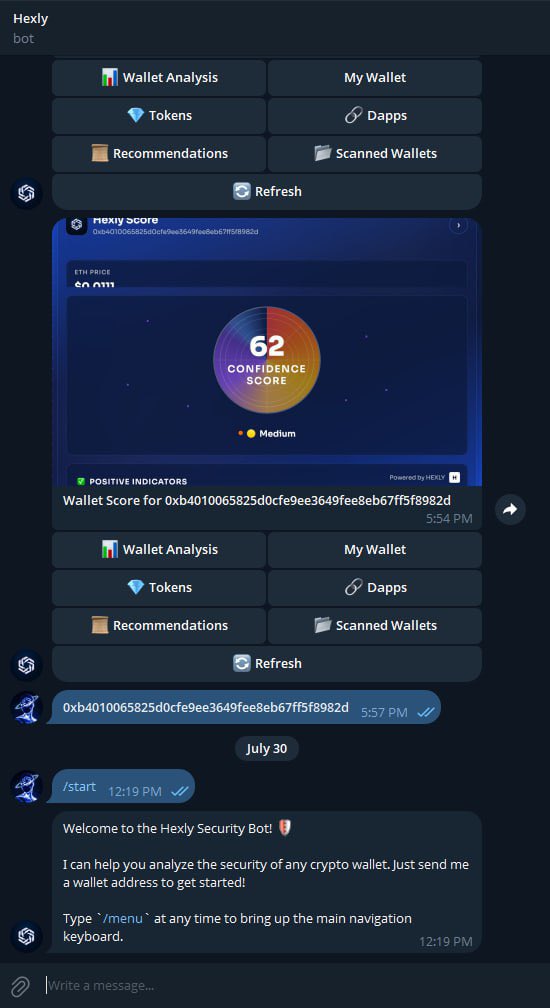
Real builders stay visible. @UseHexly just dropped a sneak peek of their live wallet scoring system 🔍
Still in progress, but already showing how serious they are about transparency and security-first tools 💡
Scanned a wallet myself — clean UI, fast data, and it works 👇
Full walkthrough coming soon bot updates on TG
Join their grind here:
🔗 usehexly.com
🐦 @UseHexly
📢 t.me/UseHexly
#HEX #Hexly #WalletScanner #OnChainIntel #DeFiSecurity #BuiltInPublic
18
15
23
160

23 Jun 2025
6/9 👛 Track wallet activity and holdings with precision using Axira AI Wallet Scanner! Get comprehensive insights into token balances, NFT collections, and transaction history. #WalletScanner
1
1
4
54

2 Jun 2025
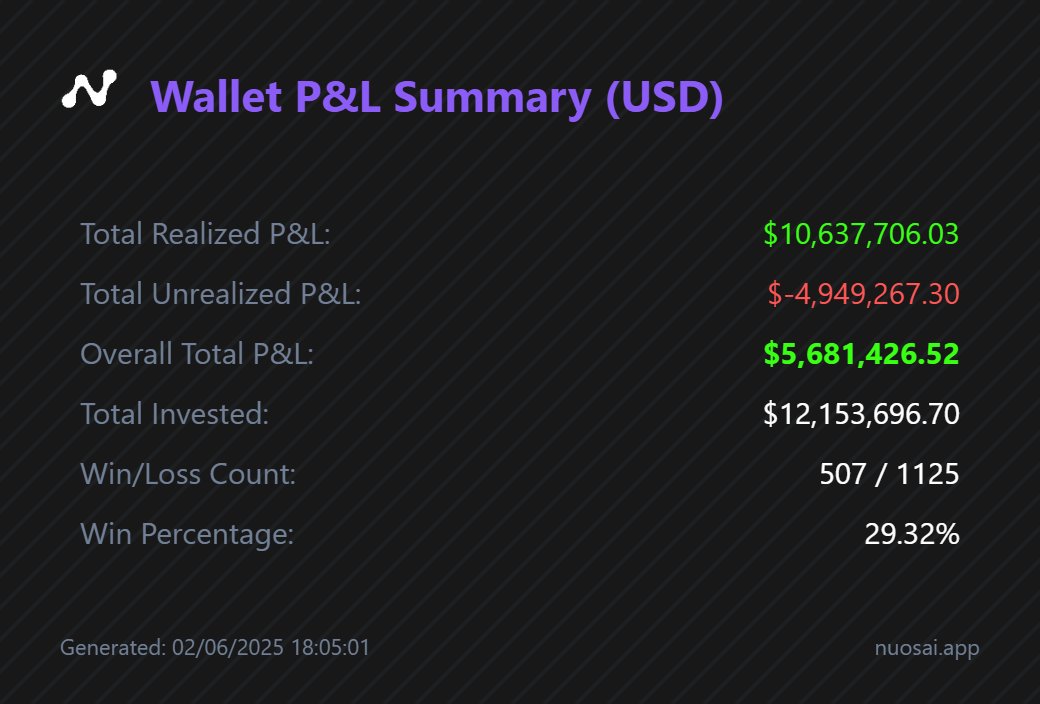
💼 Get a crystal-clear view of your #Solana portfolio with NuosAI's enhanced N-WalletScanner!
Now displaying:
💰 Current Wallet Value (USD & SOL)
📊 Detailed P&L Overview
📜 Comprehensive list of all your holdings & their current values!
Manage your assets smarter!
33
18
602

25 May 2025
Track your wallet like a pro — in real time.
We build Crypto Portfolio Tracker Bots that connect to your wallet, monitor all tokens, and show your PnL, value, and trade history directly in Telegram.
Bot Features:
• Live wallet tracking (ETH, SOL, BSC, more)
• Auto token price USD balance updates
• PnL by token & total portfolio
• Trade history viewer
• Daily change % gainers/losers
• Wallet import via key or address
• Fully private. No third-party dashboards
Ideal for traders managing multiple wallets, passive holders, and alpha hunters.
DM @Tokendevices or join via Telegram:
t.me/Tokendevice
See everything. Miss nothing.
All from Telegram.
#PortfolioTracker #CryptoTracker #TelegramBot #PnLTracker #CryptoPnL #WalletMonitor #SOLWallet #ETHWallet #CryptoPortfolio #DeFiBot #AutoTracker #WalletBalanceBot #TokenTracker #SPLTracker #ERC20Tracker #AltcoinPnL #CryptoHoldings #CryptoManagement #BSCWallet #TokenValue #PortfolioDashboard #TelegramTrading #TradingStats #PnLViewer #WalletScanner #DeFiWalletBot #CryptoSniperTool #PassivePnL #RealTimeTracker #CryptoReportBot #TelegramPnLBot #MultiWalletTracker #DeFiAutomation #TrackMyWallet #SolanaTools #ERC20Bot #ETHSniperTools #WalletOverview #PortfolioManager #BSCBot #TokenPnLBot #TokenAnalytics #RealTimeBalance #CryptoMonitor #WalletInsight #AlphaWalletTracker #TradingPerformance #CoinTrackerBot #AutoStatsBot #CryptoValueBot
23
3
106

6 May 2025
🚨 Wallet Scanner in Action 🚨
Experience the power of real-time, AI-powered wallet insights with Crypto PlayZone.
📊 Balance overview
📈 Trade history
📉 P&L breakdown
🤖 AI portfolio analysis
All in one place. Built for serious traders.
Watch the tool. Then try it yourself. 👇
🔗 crypto-playzone.com
#ZON #CryptoTools #WalletScanner #DeFi #Web3
38
17
33
701
25 Apr 2025
🚨 It’s LIVE!
Our AI-Powered Solana Wallet Scanner is now available on Crypto PlayZone 🧠💥
📊 Wallet Balance – Token holdings, USD values & allocation
🔁 Trading Activity – Recent trades & History.
📈 Profit & Loss – Realized/unrealized gains, win/loss ratios
🤖 AI Analysis – Assess copy trading potential, risk profile & strategy
Get the edge. Start scanning like a pro.
🔗 Access now: crypto-playzone.com/playzone
Mini App: t.me/Playzonewallet_bot/Wall…
💬 Telegram: t.me/cryptoplayzone2025
📜 CA: 3aBJrX6EX48GKxeyJcRN8Jd6Z5tey33VoR9XhHD1pump
#CryptoPlayZone #ZON #Web3Tools #WalletScanner #CryptoAI
19
9
20
712

8 Apr 2025
You ever look at your portfolio and think,
"I’m probably up..." then a tool like @ApeScreener hits you with the Portfolio Health Score and you realize half your bags been on life support?
Yeah. Been there.
Using @apescreener is like having a brutally honest friend in crypto. No sugarcoating.
It tells you the truth about what you're really holding. Don’t wait till it’s too late to find out that your “gem” is a ticking time bomb.
Go check your wallet health today.
CA: 0x09675e24ca1eb06023451ac8088eca1040f47585
Dapp: apescreener.app
X: x.com/apescreener
Telegram: t.me/ApeScreener
All links: linktr.ee/apescreener
#CryptoRealityCheck #ApeScreener #PortfolioHealth #Web3Tools #DYOR #CryptoTools #WalletScanner #DeFiAlpha #AltcoinWatch #DegenWisdom
3
13
29
2,408

28 Jul 2024
4
1
10
788

30 Apr 2024
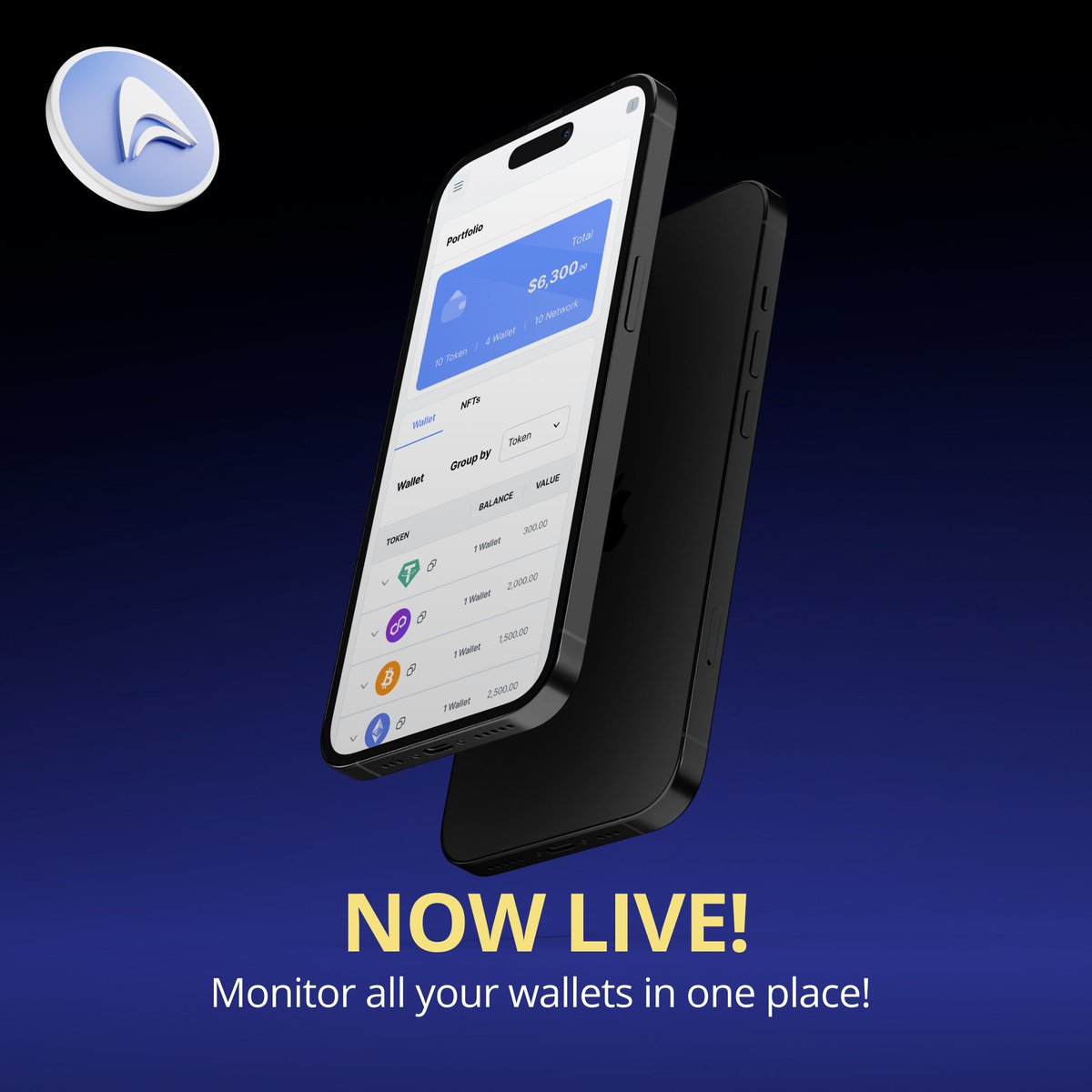
🚀 Exciting News! Our Wallet Scanning Dashboard is now live!
🎉 Manage and monitor your crypto assets effortlessly, all in one place. Experience seamless, secure scanning today!
surfboard.finance/
$BOARD #WalletScanner #SurfboardFinance @NVIDIAAI @MEXC_Official
11
12
22
55,438

2 Apr 2024
$TSA . Tensorscan AI walletscanner. Integration with chrome etc. Etherscan compatible. And working AI bot already.
1
1
30