
Before searching for a new strategy, identify the real problem.
#Trading #OptionsTrading #StockMarket #RiskManagement #TradingPsychology #TraderDevelopment #TradingDiscipline #TradingPerformance #OptionsTrader #RetailTrader #SystematicTrading #TradingEducation #RepleteEquities
1
16

20h
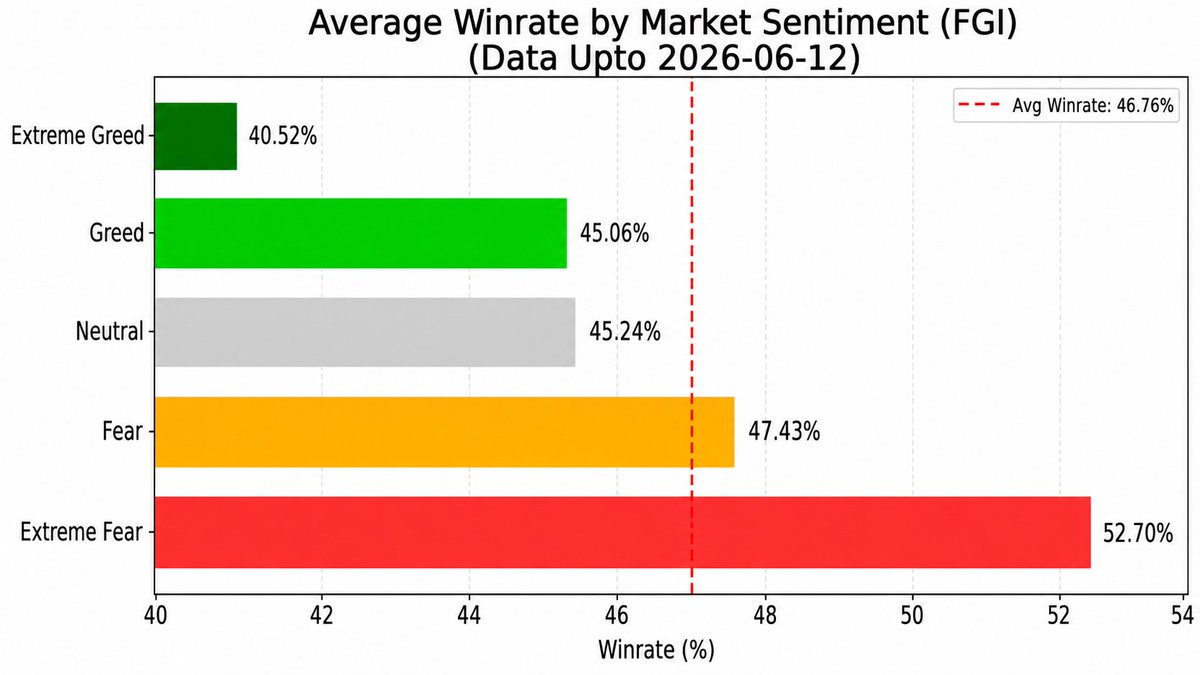
📊 TRADING PERFORMANCE & MARKET SENTIMENT INDEX (FGI) REPORT – UPDATED 2026-06-12
The latest statistics show that the correlation between FGI and Winrate remains low and continues to lean negative (r ~ -0.312). This further supports the view that FGI is not suitable as a tool for predicting price trends or identifying trade entries, but it still has practical value in quantifying position risk. In particular, trading performance generally tends to weaken when market sentiment moves into extreme excitement, so FGI is better used as an early risk-warning signal rather than a signal to expand profit expectations.
Below is a summary of Winrate (WR), minimum breakeven R:R, and the number of recorded days (n) across sentiment zones:
🤑 Extreme Greed (≥80): WR 40.5% • R:R=1:1.47 • n=25
🤤 Greed (60–80): WR 45.1% • R:R=1:1.22 • n=215
😐 Neutral (40–60): WR 45.2% • R:R=1:1.21 • n=150
😨 Fear (20–40): WR 47.4% • R:R=1:1.11 • n=218
😱 Extreme Fear (<20): WR 52.7% • R:R=1:0.90 • n=102
Share of days with performance above the average level of 46.76% by sentiment zone:
🤑 Extreme Greed: 8.0%
🤤 Greed: 36.3%
😐 Neutral: 38.0%
😨 Fear: 53.7%
😱 Extreme Fear: 70.6%
➤ Scalpers can use FGI as a guide to adjust expected profit targets when entering trades:
📈 When FGI is high, profit expectations need to be raised to maintain a sufficient R:R ratio, helping offset the risk of a lower win rate.
📉 When FGI is low, profit expectations can be reduced to improve capital turnover speed and make profit realization easier.
#TradingPerformance #MarketSentiment
1
1
54

Jun 13
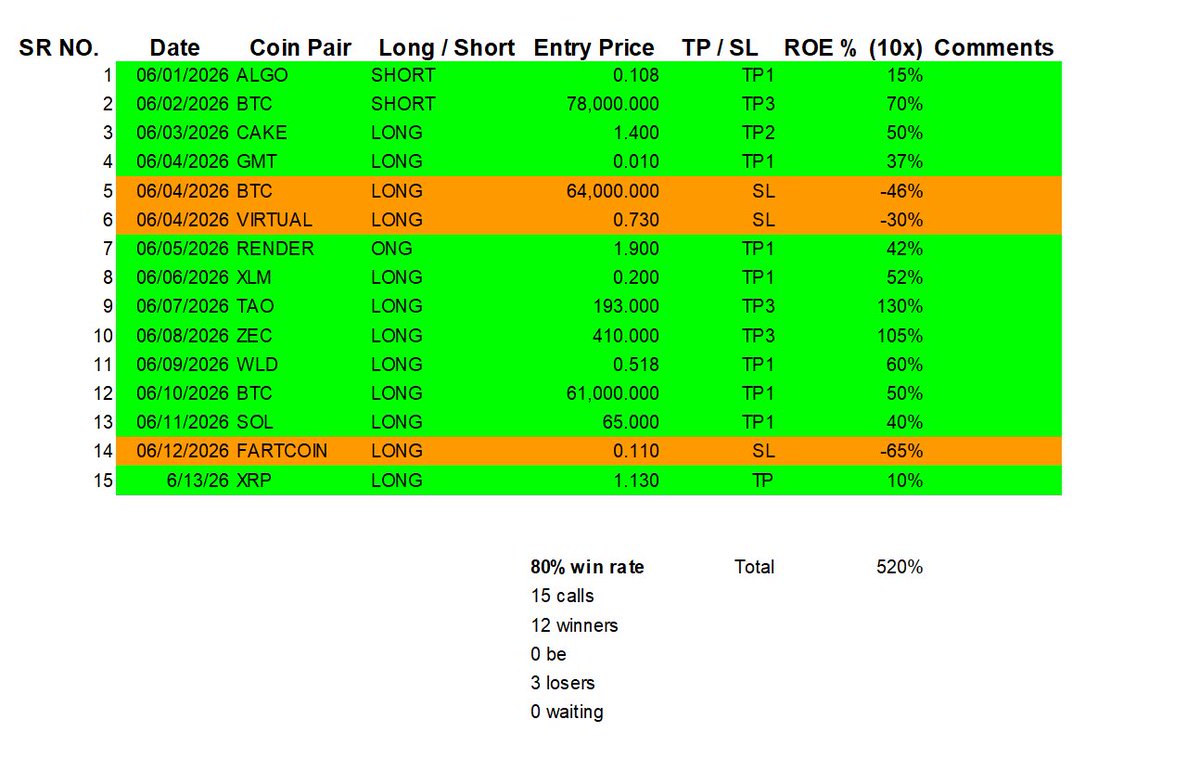
**💵Mid-June Trading Journal Update 💵**
Over the past 13 trading days, we delivered 15 high-conviction calls with a verified 500% ROE and an 80% win rate (12W – 3L).
Consistency, risk management, and precise entries continue to compound results in this volatile market.
Looking for daily signals, VIP setups, and real-time market analysis?
The private club is open — DM to join 👇
Who else is capitalizing on this June momentum?
🔥👨🍳
#CryptoTrading #TradingPerformance #CryptoSignals #RiskManagement
4
6
7
180

Jun 12
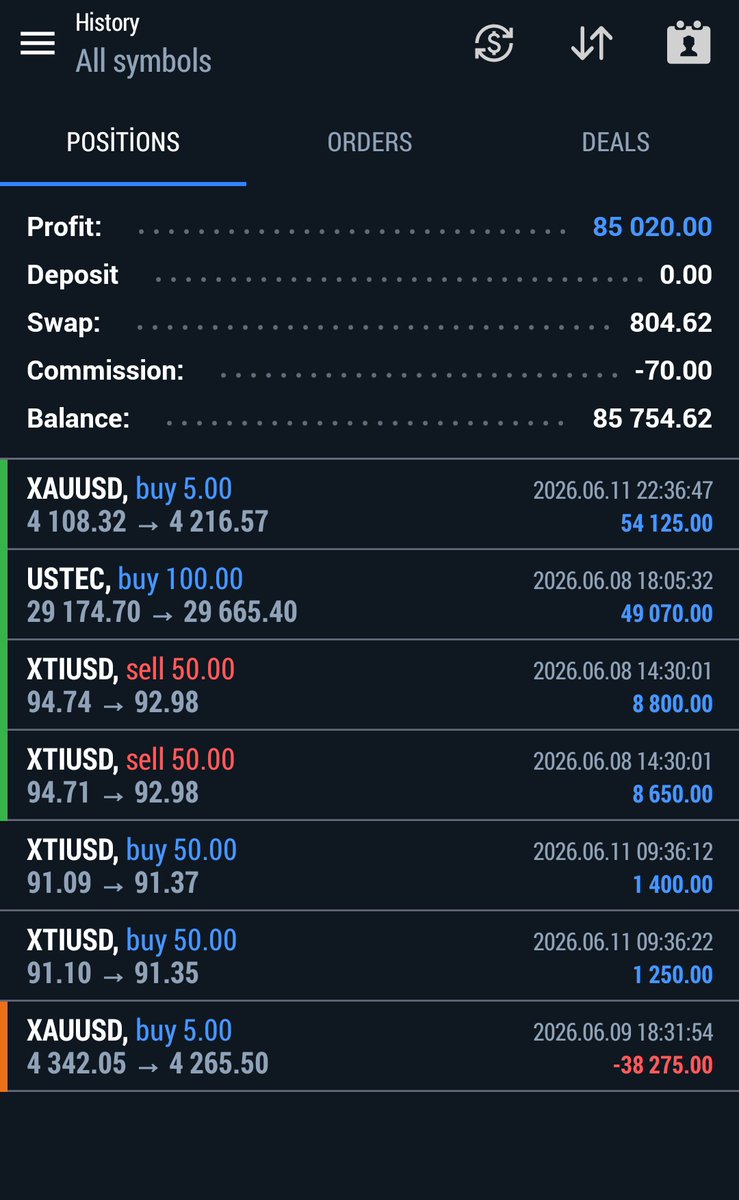
MACRO PERFORMANCE REPORT: $85K SECURED THIS WEEK 🏛️💼
Following through on last week’s forecast, the desk systematically executed every high-probability setup provided by the market, sharing all technical chart parameters in real-time.
It was an exceptional week of execution: out of 5 core structural analyses, 4 hit our targets flawlessly—netting a total closed profit of $85,020.00.
Our absolute mandate remains unchanged: Risk management is Rule #1. 🔒
Turn on instant notifications to capture our live setups the second they develop next week. Have an excellent weekend, team. 🔔☕
#WeeklyRecap #TradingPerformance #PnL #RiskManagement #tradingsignal #forex #Gold #wti #oil #nasdaq #sp500🏛️🔥⚖️
Jun 5

PREPARING FOR THE NEXT EXECUTION CYCLE 🏛️⚖️
This week, we intentionally maintained a defensive stance as the risk-reward profile remained highly unfavorable across major asset classes. Protecting capital during a liquidity flush is always the primary mandate. 📈🛡️
The recent market flush is now washing out weaker hands and starting to price in realistic macro parameters. Looking ahead to the coming week, we expect clearer structural setups to emerge, allowing us to deploy capital into high-probability opportunities.
Patience is a tactical position. Ensure your parameters are set and your capital is ready for the next desk execution. 💼🎯
#MacroRiskDesk #TradingStrategy #RiskManagement #GlobalMacro #Forex #Fxtrading
80

Jun 12
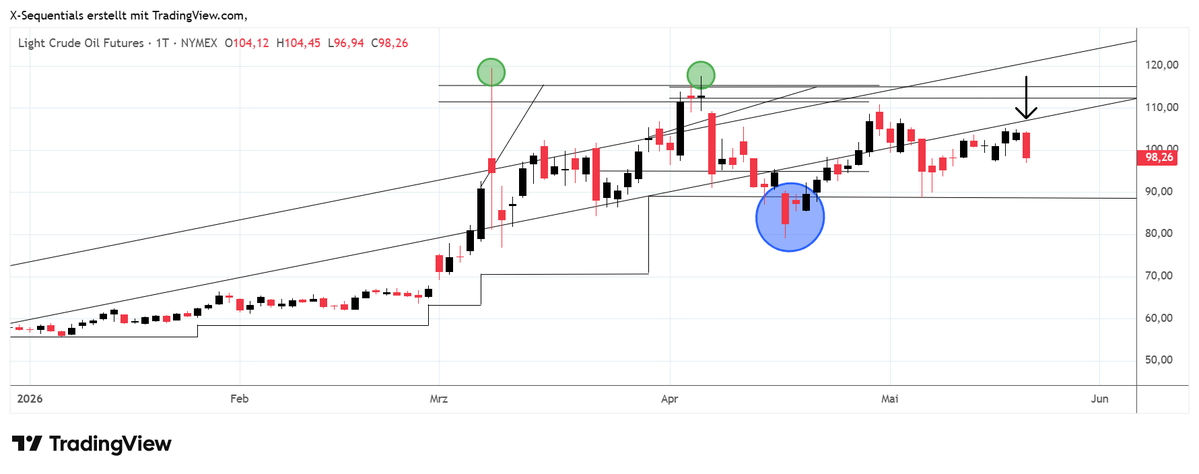
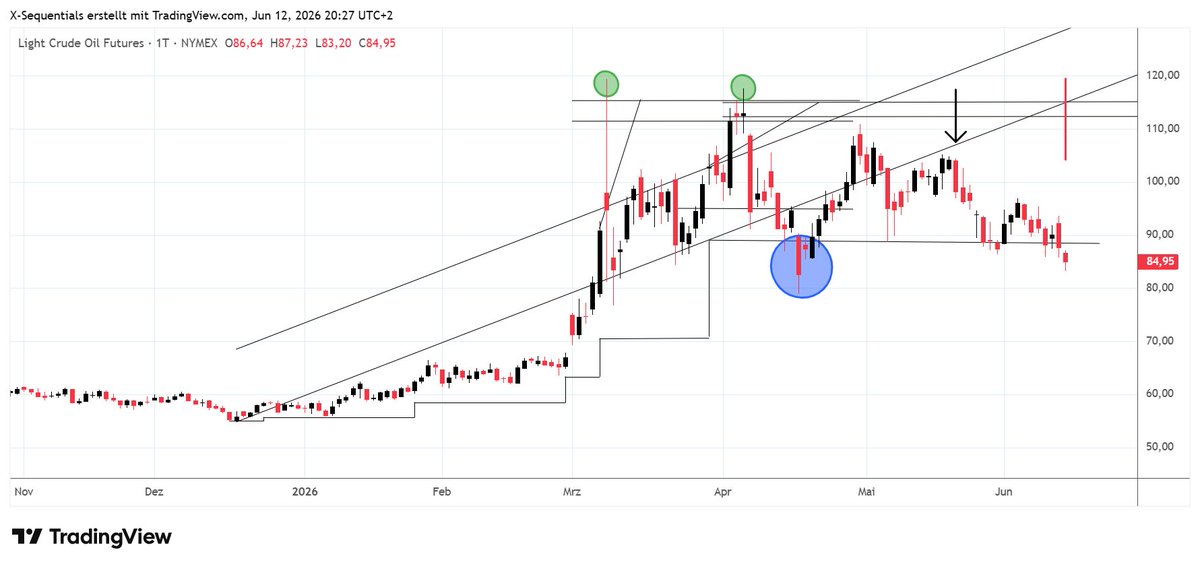
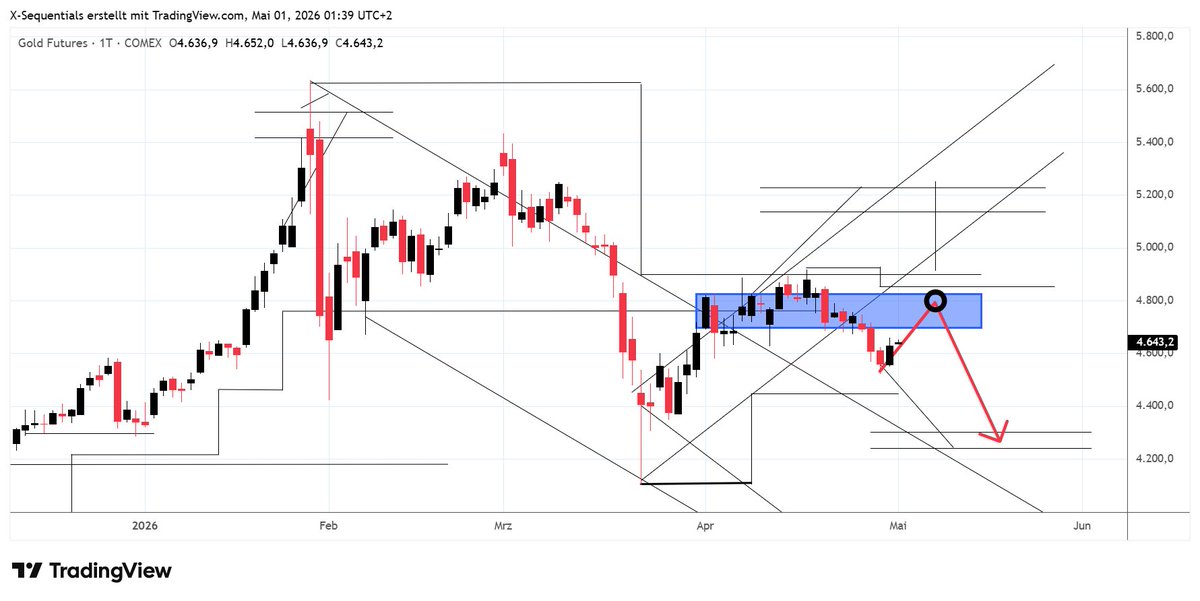
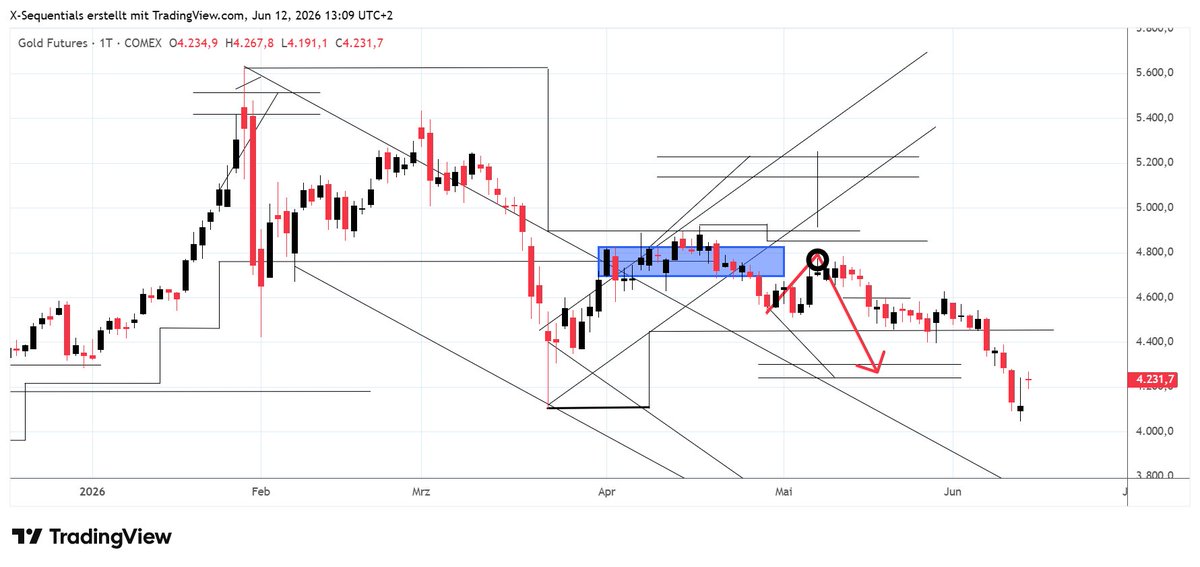
956 Punkte Gold, 8.533 Punkte Heizöl, 2.249 Punkte Erdöl – so wurden diese X-Sequentials Trades umgesetzt
Sehr geehrte Damen und Herren,
in den vergangenen Wochen wurden im X-Sequentials-Trading-Börsenbrief drei Short-Trades bei den Rohstoffen umgesetzt – mit den folgenden Ergebnissen:
Gold: 956 Punkte / 9.560 USD
Heizöl: 8.533 Punkte / 3.583,86 USD
Light Crude Oil: 2.249 Punkte / 2.249 USD
Auf meiner Webseite habe ich diese Trades vollständig dokumentiert – mit den Original-Charts, den genauen Einstiegskursen, Stoppkursen, Updates und Ausstiegskursen. Sie können dort nachvollziehen, wie die X-Sequentials-Methode in der Praxis funktioniert: von der ersten Prognose bis zum Ausstieg.
Der Beitrag ist besonders für Trader interessant, die verstehen möchten, wie man auf Basis von Zeitzielen und X-Sequentials-Kursmustern Handelssignale entwickelt und umsetzt.
Hier geht es zum Beitrag:
technical-trading-profits.co…
Mit freundlichen Grüßen
Devin Sage
Technical-Trading-Profits.co…
#xsequentials #Börse #Gold #Heizöl #Erdöl #CrudeOil #HeatingOil #Rohstoffe #Commodities #Trading #TechnicalAnalysis #ChartAnalysis #Chartanalyse #ShortTrade #Handelssignal #TradingSignal #XSequentials #DevinSage #Börsenbrief #TradingBörsenbrief #Futures #TradingProfit #TradingResults #TradingPerformance #RohstoffeTrading #GoldTrading #OilTrading #TradingMethode #Zeitziel #Kursprognose #TechnischesTrading #TradingLernen
1
2
2
71

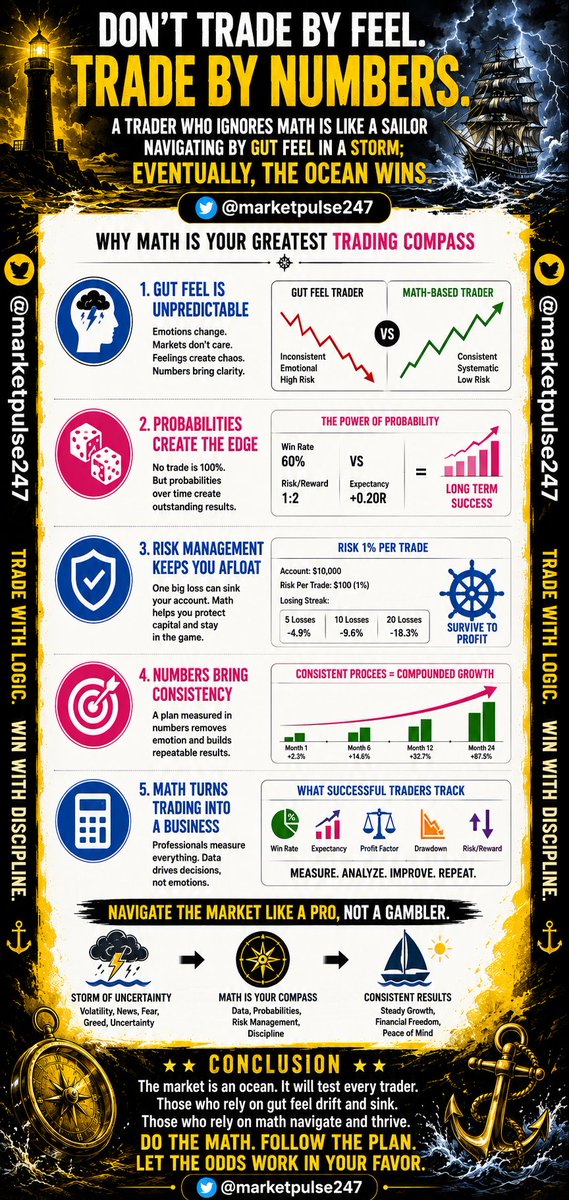
THE MARKET DOES NOT REWARD GUESSWORK, IT REWARDS MATH
WHY GUT FEEL IS A DANGEROUS TRADING STRATEGY
Many traders enter the market believing intuition alone can guide them to success. They rely on feelings, opinions, social media posts, or random predictions rather than objective analysis. While this approach may occasionally produce a winning trade, it is not a sustainable path to long term profitability. Trading without mathematics is like a sailor navigating through a violent storm without a compass, map, or navigation tools. For a short period, luck may keep the sailor afloat, but eventually reality takes over. Markets are driven by probabilities, risk, reward, and statistical outcomes. Every successful trader understands that consistent results are built upon measurable data rather than emotional impulses. The market is a highly competitive environment where thousands of participants analyze information every second. In such an environment, relying solely on instinct is extremely risky. Traders who ignore mathematical principles often experience inconsistent results, large drawdowns, and emotional decision making that ultimately leads to failure.
PROBABILITIES ARE THE TRUE LANGUAGE OF THE MARKET
The most successful traders in the world do not attempt to predict every market move. Instead, they focus on probabilities. They understand that no trading setup guarantees success. Every trade has a certain likelihood of winning and a certain likelihood of losing. This is where mathematics becomes essential. A strategy that wins sixty percent of the time with proper risk management can generate exceptional long term results even though many individual trades will fail. Professional traders think in terms of large sample sizes rather than isolated outcomes. They know that one trade means very little. What matters is the performance of the system over hundreds of trades. Mathematics removes emotional attachment from trading decisions and replaces it with logical thinking. Instead of asking whether a trade will win, successful traders ask whether the trade fits their statistical edge. This shift in mindset transforms trading from gambling into a disciplined business based on probabilities and calculated decision making.
RISK MANAGEMENT IS A MATHEMATICAL ADVANTAGE
Many traders focus entirely on finding winning trades while ignoring risk management. This is one of the biggest mistakes in trading. Risk management is fundamentally a mathematical exercise. It determines how much capital is exposed on each trade and how losses are controlled. A trader who risks too much on a single position can destroy months of progress with one mistake. On the other hand, a trader who manages risk carefully can survive losing streaks and remain in the game long enough to benefit from future opportunities. Position sizing, risk reward ratios, maximum drawdowns, and portfolio allocation are all mathematical concepts that directly influence performance. Successful traders understand that protecting capital is their first responsibility. They recognize that a trading strategy is only as strong as the risk management system supporting it. Mathematics creates boundaries that prevent emotions from taking control. Those boundaries help traders remain disciplined during both winning and losing periods.
NUMBERS CREATE CONSISTENCY WHILE EMOTIONS CREATE CHAOS
One of the greatest benefits of mathematical thinking is consistency. Numbers do not change based on mood, fear, greed, or excitement. They provide an objective framework for decision making. Traders who rely on emotions often change strategies after a few losses, increase position sizes after a winning streak, or abandon their plans during market volatility. These behaviors create inconsistency and unpredictability. Data driven traders operate differently. They track performance metrics, monitor win rates, analyze expectancy, and review historical results. Every decision is supported by evidence rather than emotion. This disciplined approach allows them to identify strengths, correct weaknesses, and continuously improve their performance. Over time, mathematical thinking creates confidence because decisions are based on facts instead of feelings. The market rewards traders who can remain objective under pressure. Consistency is not created through hope or intuition. It is built through careful analysis, disciplined execution, and unwavering respect for the numbers.
CONCLUSION
A trader who ignores mathematics is like a sailor navigating through a storm without proper instruments. The journey may seem manageable for a while, but eventually uncertainty and emotion take control. Mathematics provides direction, discipline, and protection in an unpredictable market. Probabilities guide decisions, risk management preserves capital, and data creates consistency. Traders who embrace the numbers gain a powerful advantage over those who rely on gut feelings. In the end, the market rewards preparation, discipline, and mathematical thinking far more than intuition alone.
Twitter: x.com/@marketpulse247
#Trading #StockMarket #TraderMindset #TradingPsychology #RiskManagement #PriceAction #TechnicalAnalysis #TradingEducation #MarketAnalysis #ProbabilityTrading #TradingStrategy #StockTrader #DayTrading #SwingTrading #Investing #FinancialFreedom #WealthCreation #CapitalPreservation #TradingDiscipline #ProfessionalTrader #MarketWisdom #TradingSuccess #DataDrivenTrading #MathInTrading #PositionSizing #RiskReward #TradeManagement #MarketTrends #InvestorMindset #TradingEdge #ChartAnalysis #TradingJourney #WinningMindset #Consistency #SmartInvesting #MarketKnowledge #TradingCommunity #ProfitableTrader #LongTermSuccess #DisciplineEqualsFreedom #TradingRules #ProbabilityMindset #StatisticalEdge #TradingPerformance #MarketOpportunities #ExecutionMatters #LearnTrading #FinancialMarkets #MarketPulse247 #TradeWithLogic
2
56

Jun 10
How eMiracleX Traders Are Performing | Real Results Real Traders | eMiracleX
Welcome to our latest eMiracleX Community Performance update!
At eMiracleX, we believe trading success comes from discipline, patience and continuous improvement—not shortcuts.
Join thousands of traders who are learning, improving and growing together every day.
📈 Learn. Trade. Grow.
#eMiracleX #ForexTrading #TradingCommunity #TradingResults #ForexEducation #TradingPerformance #MarketAnalysis #PriceAction #SmartMoneyConcepts #ForexTrader #TradingSuccess #TradingJourney
7
Jun 9
$GOLD (XAUUSD): STRUCTURAL STOP-OUT & PERFORMANCE UPDATE 🏛️🚨
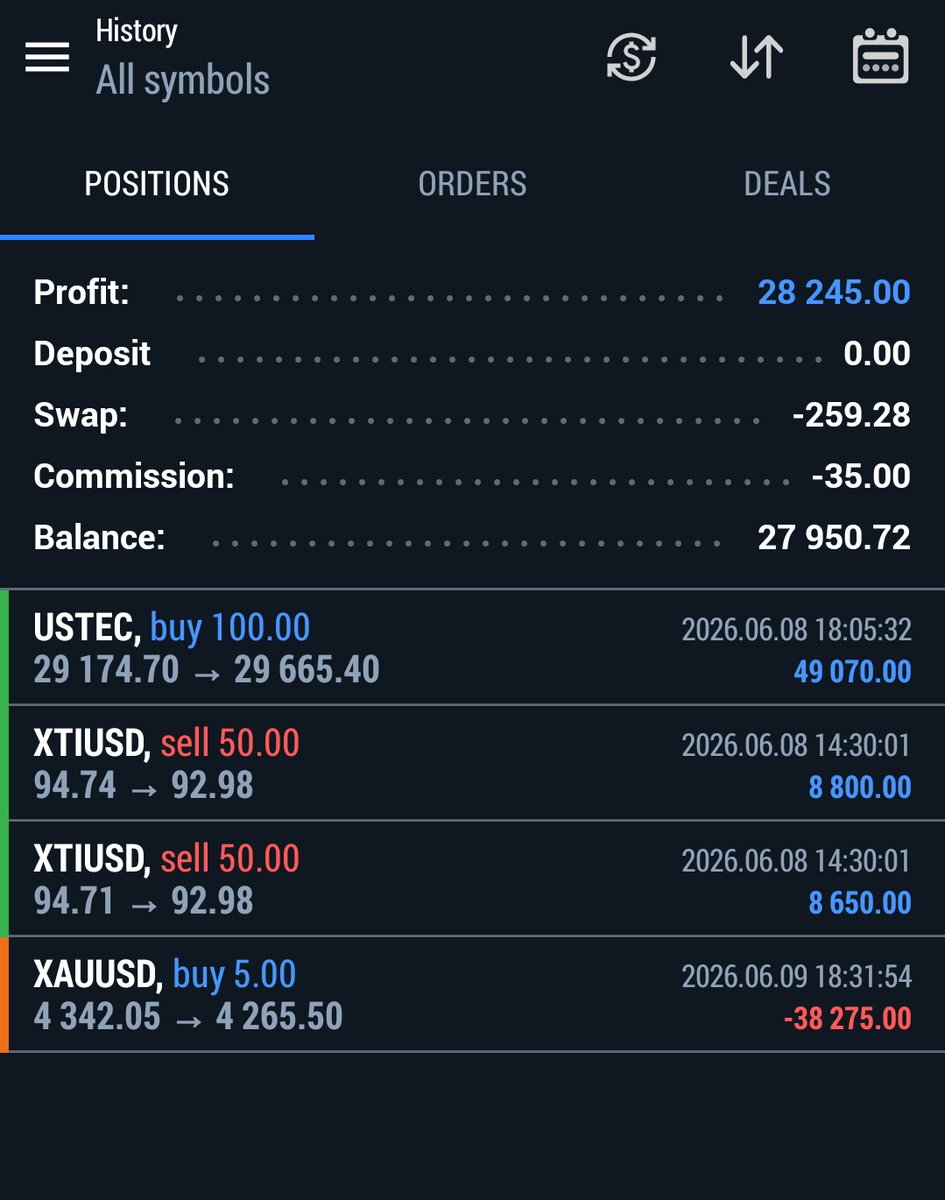
Our tactical Gold (XAUUSD) Long position has been officially stopped out at 4,265.50 following an aggressive upside liquidity sweep on the H1 timeframe. The sharp upward wick inside the highlighted zone engineered a clean hunt of buy-side liquidity before the structural flush materialized.
Weekly Tracking: Absolute transparency is our foundational rule. Following our successful Crude Oil and Nasdaq runs, this brings our weekly tracking to a 66% win rate (2 wins, 1 loss).
Net PnL: Total net realized profits for the week currently stand at $28,245.00 as we actively protect our capital base heading into the next market cycles.
MacroRiskDesk Verdict: 🏛️☕
“Stops are simply the insurance premium required to navigate high-volatility macro waters. A professional trading desk never hides a loss—we dissect it mechanically. We honored our parameters, contained the drawdown, and are already mapping the next high-probability asymmetric setup.”
Ensure your framework is set and stay execution-ready. 💼🔍
#MacroRiskDesk #Gold #XAUUSD #TradingPerformance #RiskManagement #GlobalMacro #Forex

Jun 8
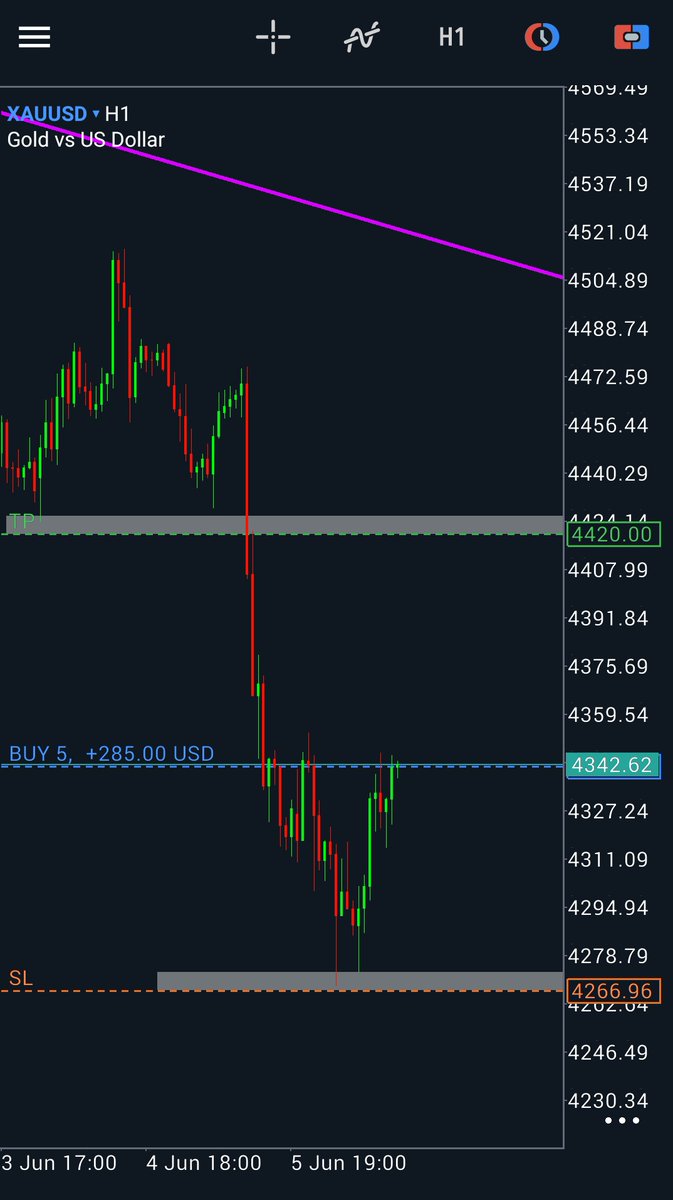
$GOLD (XAUUSD): TACTICAL LONG EXECUTION 🏛️✨
Following the intense multi-asset liquidation flush, Gold has established a clear structural floor on the H1 timeframe. The desk has officially triggered a tactical Long position as systematic selling pressure exhausts into institutional demand blocks. 📊🎯
The Setup: Asymmetrical risk-reward play capitalizing on post-liquidation stabilization.
The Parameters: * Stop Loss (SL): 4,266.96
Take Profit (TP): 4,420.00
MacroRiskDesk Verdict: 🏛️☕
“When panic selling clears out the leverage, hard assets are structurally the first to rebuild their base. We don't argue with the tape—we map the levels and execute. Parameters are locked.”
Stay execution-ready. 💼🔍
#Gold #XAUUSD #PreciousMetals #TradingStrategy #PriceAction #RiskManagement #GlobalMacro #Forex #tradingsignal #xagusd #silver
106

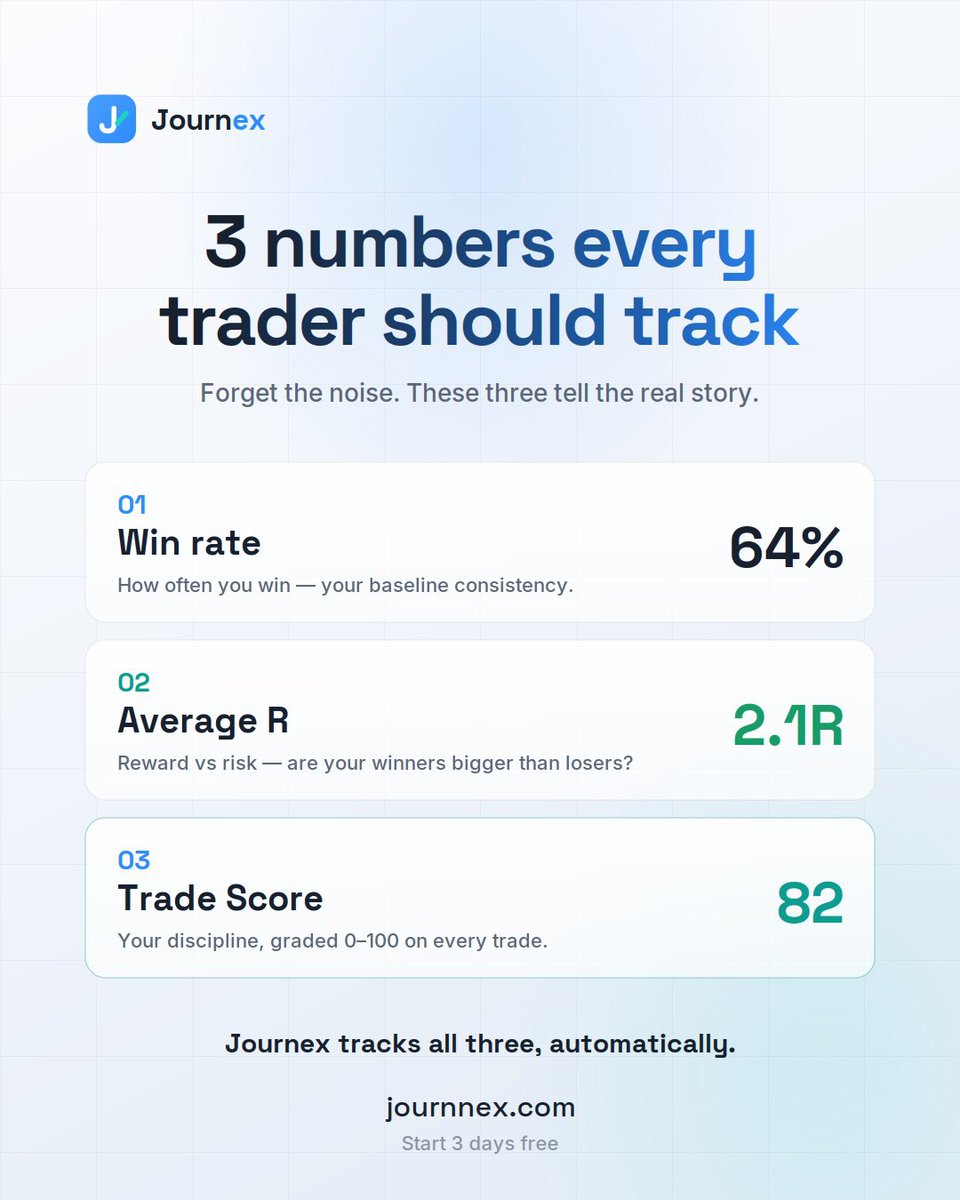
Profitable trading isn't built on opinions it's built on data
The 3 metrics every serious trader should monitor:
📊 Win Rate
📈 Average R
🎯 Trade Score
Master these numbers, refine your process, and focus on consistency over outcomes
Powered by @Journnex
#TradingJournal #TradingPerformance #Journnex

Know your edge. Trade with proof. 📊
Journnex turns every trade into clear analytics, P&L, win rate, Trade Score, and prop-firm tracking. All in one place.
Start 3 days free 👉 journnex.com
6
3
28
835

Jun 8
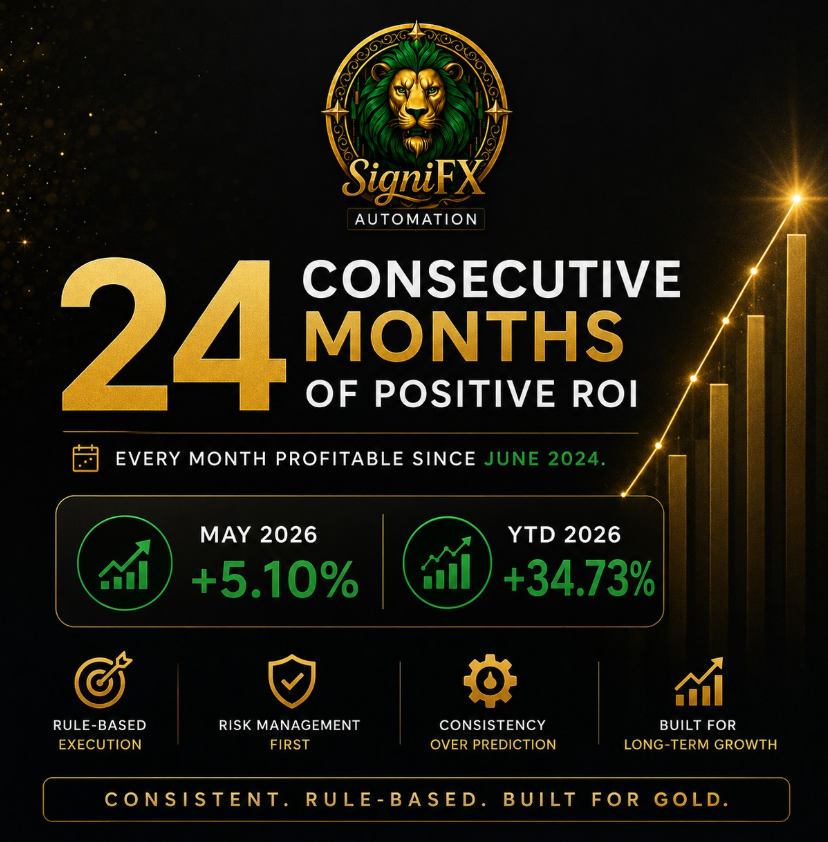
Every month profitable since June 2024.
📈 May 2026: 5.10%
📊 YTD 2026: 34.73%
Total - 394% in 24 months.
Consistency isn't built in a single trade, a single week, or even a single month.
It's built through disciplined execution, strict risk management, and following a proven process day after day.
For 24 consecutive months, SigniFX has delivered positive monthly performance through a rule-based approach designed for long-term growth.
No guesswork.
No hype.
No emotional trading.
Just consistency.
Consistent. Rule-Based. Built for Gold.
#SigniFX #GoldTrading #XAUUSD #TradingResults #TradingPerformance
8
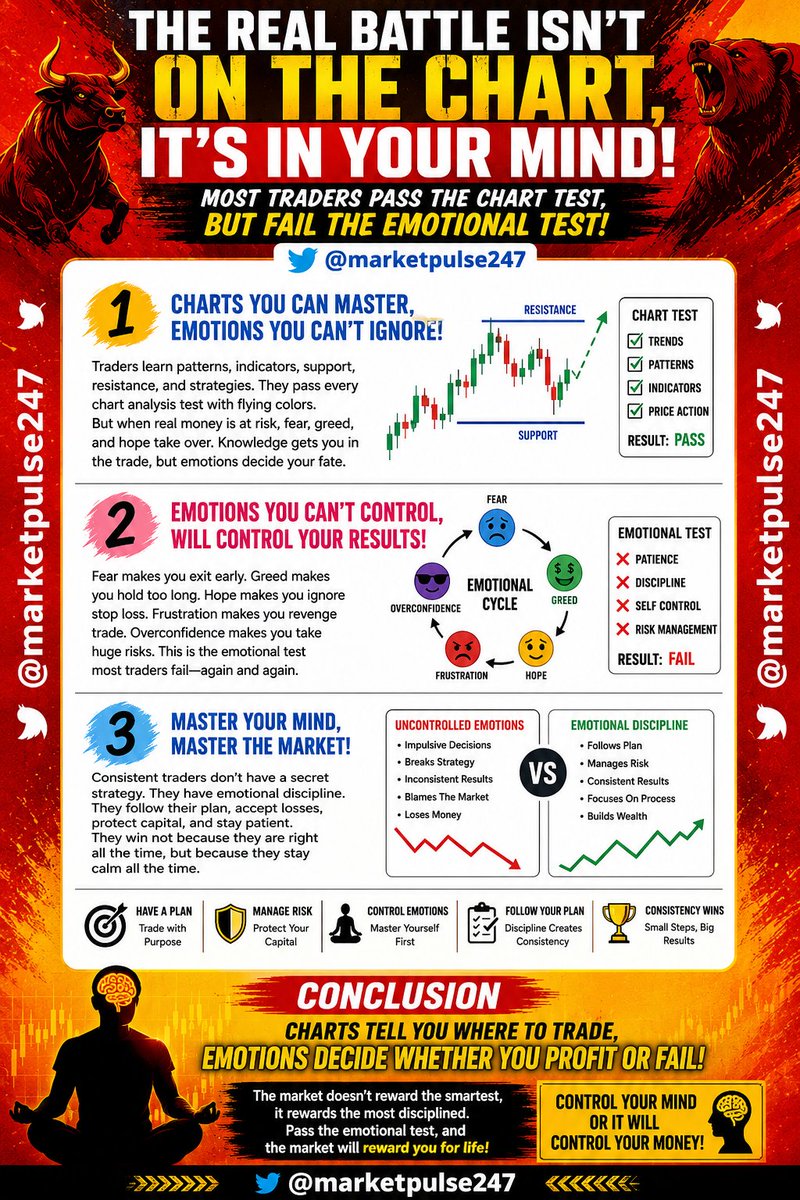
CHARTS DON'T BREAK TRADERS, EMOTIONS DO
Many traders spend years learning chart patterns, technical indicators, support and resistance levels, candlestick formations, and market structure. They become experts at identifying trends and predicting potential price movements. They can explain complex setups with confidence and often pass every technical analysis test with outstanding results. Yet surprisingly, many of these same traders struggle to achieve consistent profitability. The reason is simple. Success in trading is not determined solely by what you know. It is determined by how you behave when real money is at risk. Trading transforms from a technical exercise into an emotional challenge the moment a position is opened. Fear, greed, hope, and impatience begin influencing decisions. A trader who confidently analyzed a chart may suddenly hesitate to enter a trade because of fear. Another trader may ignore a stop loss because hope convinces them the market will reverse. The market does not reward intelligence alone. It rewards discipline and emotional stability. Technical analysis helps identify opportunities, but emotional control determines whether those opportunities are executed properly. The difference between profitable traders and struggling traders is often not knowledge. It is the ability to remain calm, disciplined, and committed to a proven process regardless of short term market fluctuations.
THE EMOTIONAL MANAGEMENT TEST MOST TRADERS FAIL
The biggest challenge in trading begins after entering a position. This is where emotions quietly take control. Fear makes traders exit winning trades too early because they worry profits might disappear. Greed encourages traders to hold positions too long in search of unrealistic gains. Frustration after a loss often leads to revenge trading, where traders abandon their strategy and take impulsive positions. Overconfidence after a series of successful trades can result in excessive risk taking that eventually destroys months of progress. These emotional reactions are responsible for far more losses than poor chart analysis. The market constantly tests patience, discipline, and self control. Every price movement creates emotional pressure. Successful traders understand that emotional management is not a secondary skill. It is a core requirement for long term survival. They create trading plans before entering positions and follow those plans without allowing emotions to interfere. They accept losses as part of the business and avoid making decisions based on temporary feelings. Emotional discipline allows traders to stay objective and focused even during periods of uncertainty. Those who fail this test often blame the market, but the real battle was taking place within themselves all along.
THE REAL EDGE THAT CREATES CONSISTENT PROFITS
Many people believe the secret to trading success lies in discovering a perfect indicator or a magical strategy. In reality, the greatest edge comes from mastering yourself. Consistent traders understand that profitability is built on discipline, patience, and emotional control. They know that losing trades are unavoidable and that no strategy wins every time. Instead of chasing perfection, they focus on executing their system consistently. They manage risk carefully, follow position sizing rules, and trust their process even when results fluctuate in the short term. Emotional mastery allows traders to think rationally when others panic. It allows them to remain patient when opportunities are limited and confident when uncertainty rises. Over time, this discipline creates a powerful competitive advantage. Technical skills may help traders identify opportunities, but emotional control ensures they capitalize on them effectively. The market rewards those who remain calm under pressure and punishes those who allow emotions to dictate decisions. Ultimately, successful trading is not about conquering the market. It is about conquering yourself. When emotions are controlled, decisions improve. When decisions improve, consistency follows. And when consistency becomes a habit, long term profitability becomes achievable.
CHARTS DON'T BREAK TRADERS, EMOTIONS DO
Many traders spend years learning chart patterns, technical indicators, support and resistance levels, candlestick formations, and market structure. They become experts at identifying trends and predicting potential price movements. They can explain complex setups with confidence and often pass every technical analysis test with outstanding results. Yet surprisingly, many of these same traders struggle to achieve consistent profitability. The reason is simple. Success in trading is not determined solely by what you know. It is determined by how you behave when real money is at risk. Trading transforms from a technical exercise into an emotional challenge the moment a position is opened. Fear, greed, hope, and impatience begin influencing decisions. A trader who confidently analyzed a chart may suddenly hesitate to enter a trade because of fear. Another trader may ignore a stop loss because hope convinces them the market will reverse. The market does not reward intelligence alone. It rewards discipline and emotional stability. Technical analysis helps identify opportunities, but emotional control determines whether those opportunities are executed properly. The difference between profitable traders and struggling traders is often not knowledge. It is the ability to remain calm, disciplined, and committed to a proven process regardless of short term market fluctuations.
THE EMOTIONAL MANAGEMENT TEST MOST TRADERS FAIL
The biggest challenge in trading begins after entering a position. This is where emotions quietly take control. Fear makes traders exit winning trades too early because they worry profits might disappear. Greed encourages traders to hold positions too long in search of unrealistic gains. Frustration after a loss often leads to revenge trading, where traders abandon their strategy and take impulsive positions. Overconfidence after a series of successful trades can result in excessive risk taking that eventually destroys months of progress. These emotional reactions are responsible for far more losses than poor chart analysis. The market constantly tests patience, discipline, and self control. Every price movement creates emotional pressure. Successful traders understand that emotional management is not a secondary skill. It is a core requirement for long term survival. They create trading plans before entering positions and follow those plans without allowing emotions to interfere. They accept losses as part of the business and avoid making decisions based on temporary feelings. Emotional discipline allows traders to stay objective and focused even during periods of uncertainty. Those who fail this test often blame the market, but the real battle was taking place within themselves all along.
THE REAL EDGE THAT CREATES CONSISTENT PROFITS
Many people believe the secret to trading success lies in discovering a perfect indicator or a magical strategy. In reality, the greatest edge comes from mastering yourself. Consistent traders understand that profitability is built on discipline, patience, and emotional control. They know that losing trades are unavoidable and that no strategy wins every time. Instead of chasing perfection, they focus on executing their system consistently. They manage risk carefully, follow position sizing rules, and trust their process even when results fluctuate in the short term. Emotional mastery allows traders to think rationally when others panic. It allows them to remain patient when opportunities are limited and confident when uncertainty rises. Over time, this discipline creates a powerful competitive advantage. Technical skills may help traders identify opportunities, but emotional control ensures they capitalize on them effectively. The market rewards those who remain calm under pressure and punishes those who allow emotions to dictate decisions. Ultimately, successful trading is not about conquering the market. It is about conquering yourself. When emotions are controlled, decisions improve. When decisions improve, consistency follows. And when consistency becomes a habit, long term profitability becomes achievable.
CONCLUSION
The majority of traders lose not because they cannot read charts, but because they cannot manage emotions. Technical analysis may open the door to opportunity, but emotional discipline determines whether you walk through it successfully. Master your emotions, trust your process, and remember that the greatest battle in trading is not against the market, but against yourself.
Twitter: x.com/@marketpulse247
#TradingPsychology #TradingMindset #StockMarket #TraderLife #EmotionalControl #TradingDiscipline #Investing #StockTrading #RiskManagement #TraderMindset #TechnicalAnalysis #TradingSuccess #MarketPsychology #InvestSmart #TradingJourney #FinancialFreedom #StockMarketIndia #InvestingMindset #MarketWisdom #TradingEducation #DisciplineEqualsFreedom #ProfitableTrading #TradingCommunity #WealthCreation #MindsetMatters #FinancialMarkets #TradingLessons #StockMarketLearning #PriceAction #TraderEducation #InvestingTips #MarketAnalysis #TradingStrategy #CapitalProtection #LongTermSuccess #TradingPerformance #InvestorMindset #TradingHabits #SmartInvesting #MoneyManagement #TradingGoals #MarketInsights #ConsistencyInTrading #LearnTrading #WinningMindset #StockMarketTips #BehavioralFinance #TradingEdge #MarketPulse247 #FinancialSuccess
1
2
52
May 15
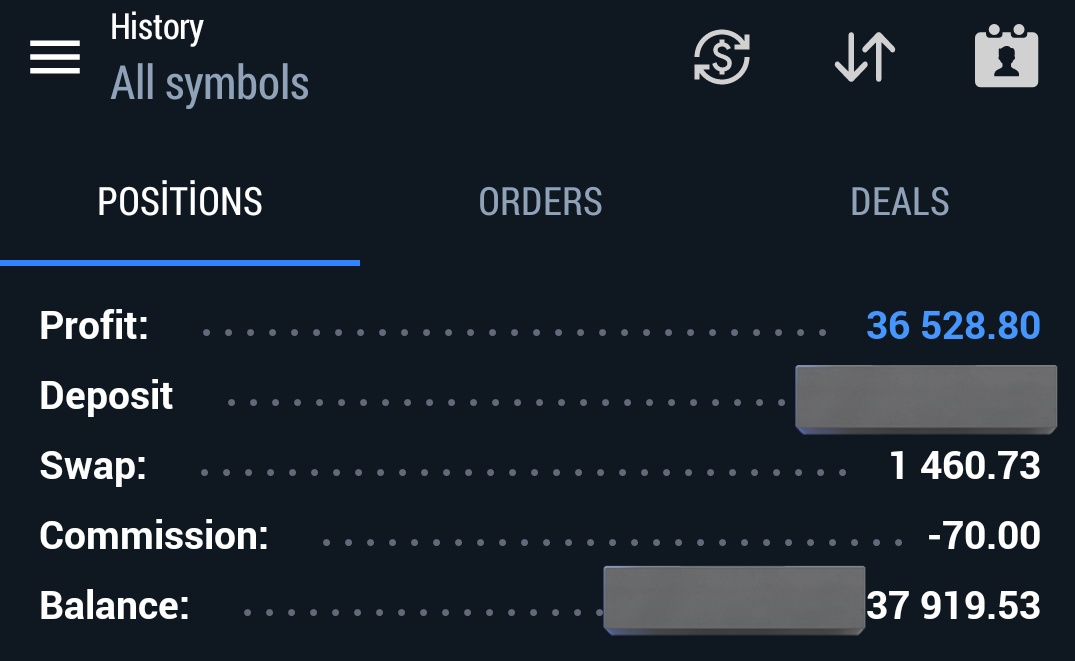
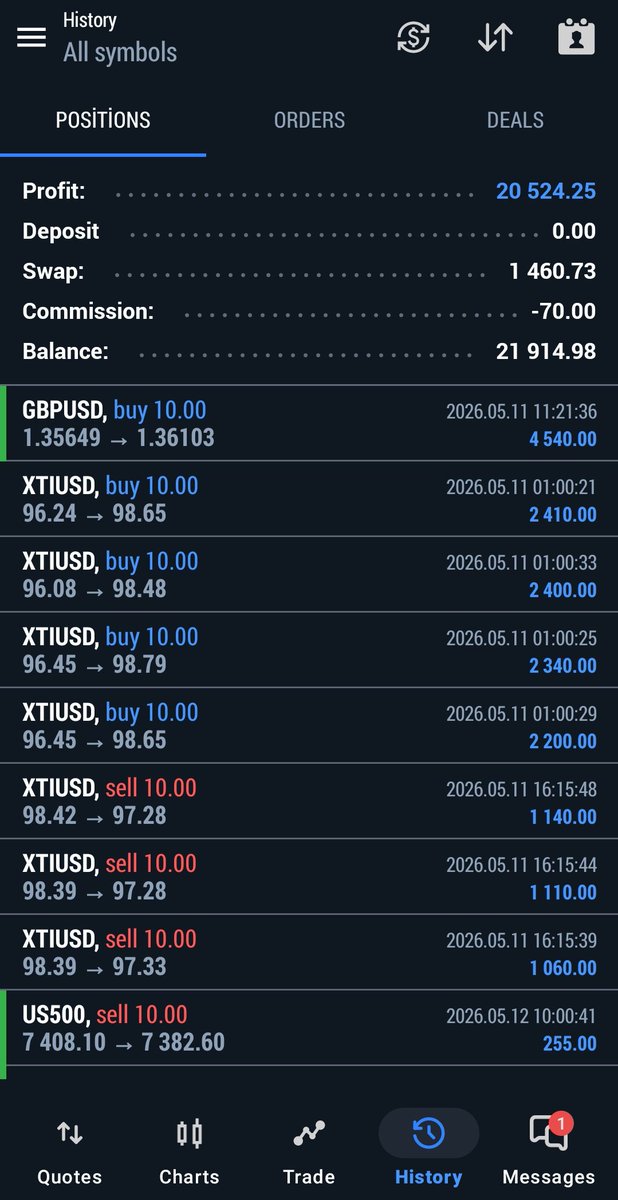
📌MACRORISKDESK PERFORMANCE REVIEW: THE POWER OF PRECISION & RISK MANAGEMENT 🏛️📈
A week of surgical execution. While the crowd struggled with the volatility in the bond and equity markets, our macro-driven strategy delivered flawless results. The "Tape" doesn't lie. 🧵👇
1. Weekly Performance (May 11 – May 15): * Win Rate: 100% Strike Rate.
Total Realized Profit: $21,914.98 (including swap & commissions).💰💵
Execution: High-probability setups in $XAUUSD, XTIUSD, and #US500, driven by the liquidity shifts we identified earlier this week.
2. Monthly Performance (May 4 – May 15): * Cumulative Profit: $37,919.53.
Strike Rate: Consistent 100% success across all shared signals since the beginning of May.
Our Philosophy: 🛡️
At the Desk, we don't chase every candle. We wait for the confluence of Technical Liquidity and Macro Fundamentals. By prioritizing professional risk management over "gambling," we achieved a perfect success rate in one of the most volatile weeks of the year.
MacroRiskDesk Intelligence: ⚖️☕️
"Success in trading is the byproduct of discipline. We follow the system, manage the risk, and let the numbers speak for themselves."
Question for the Desk:
We are officially flat and moving into the weekend with realized gains. Are you closing your books today, or are you holding positions into the next macro wave? Let’s hear your strategy. 👇
Turn on notifications to catch our high-probability setups in real-time. 🔔
#MacroRiskDesk #TradingPerformance #ForexProfit #XAUUSD #NAS100 #RiskManagement #SmartMoney #FinancialFreedom #MetaTrader5
4
2
4
410
May 10
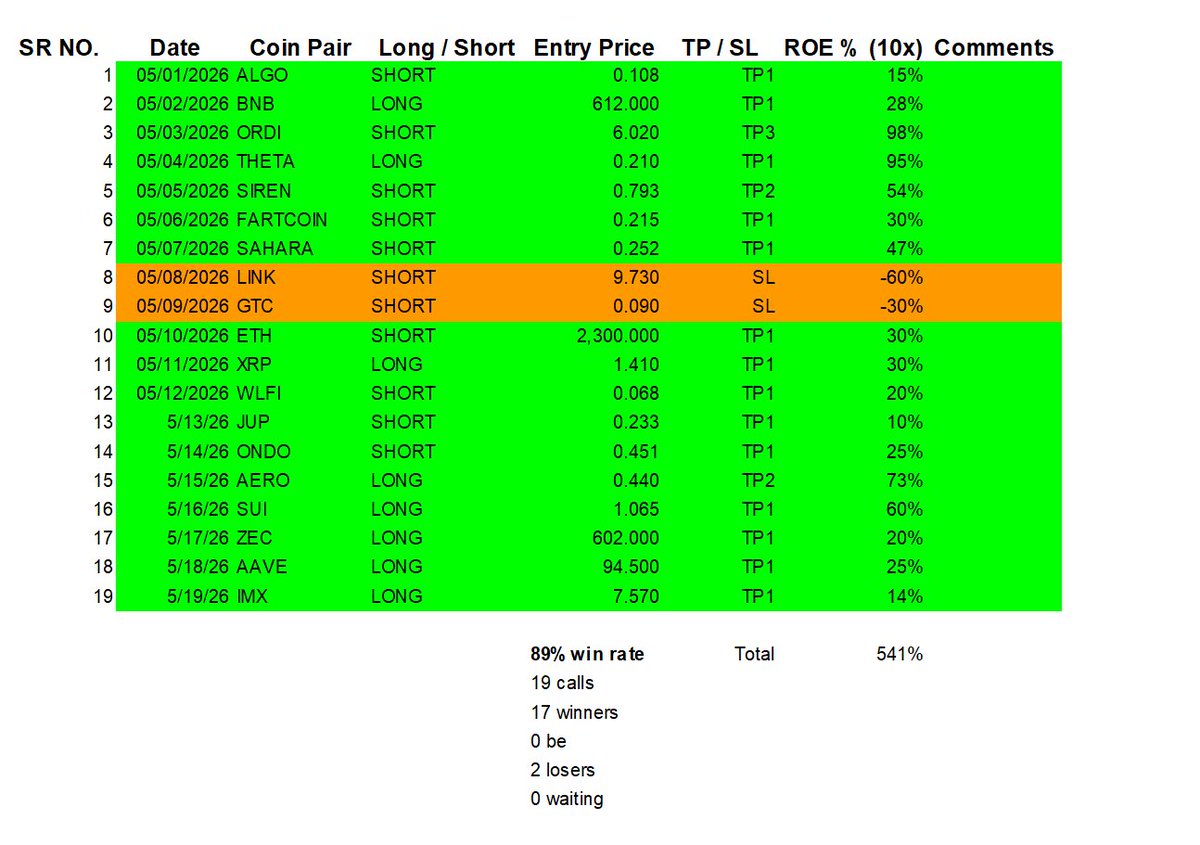
🚀 10 Days. 19 Calls. 541% Total ROE.
Crushed it in May with an 89% win rate (17W - 2L).
From ALGO shorts to AAVE longs — precision entries, clean TPs, and disciplined risk management delivered consistent results.
Proof is in the ledger.
Want these signals daily exclusive VIP setups?
Join the VIP Club now 👇
@lobideluxe
Who else is printing in this market? 🔥👨🍳
#CryptoTrading #TradingPerformance
5
5
13
351

May 6
Big winners can drive growth, but they can’t compensate for a lack of consistency.
Relying on standout trades to recover losses creates instability and puts long-term performance at risk. Sustainable progress comes from having a solid baseline, where risk is controlled, losses are managed, and consistency is established before scaling into larger opportunities.
Watch our latest video to learn about the most important ratio for your trading performance - Link in bio.
#trading #axiafutures #daytrading #tradingperformance #tradingtips
2
15
918

May 2
April results with @EarnEliteCrypto 🐨
April wasn't as good as March, but the discipline stayed the same and finished the month in green. 💎
Now we head into May, traditionally my highest scoring month of the year. Time to lock in. 🎯🚀
#EarnElite #TradingPerformance
10
4
20
825
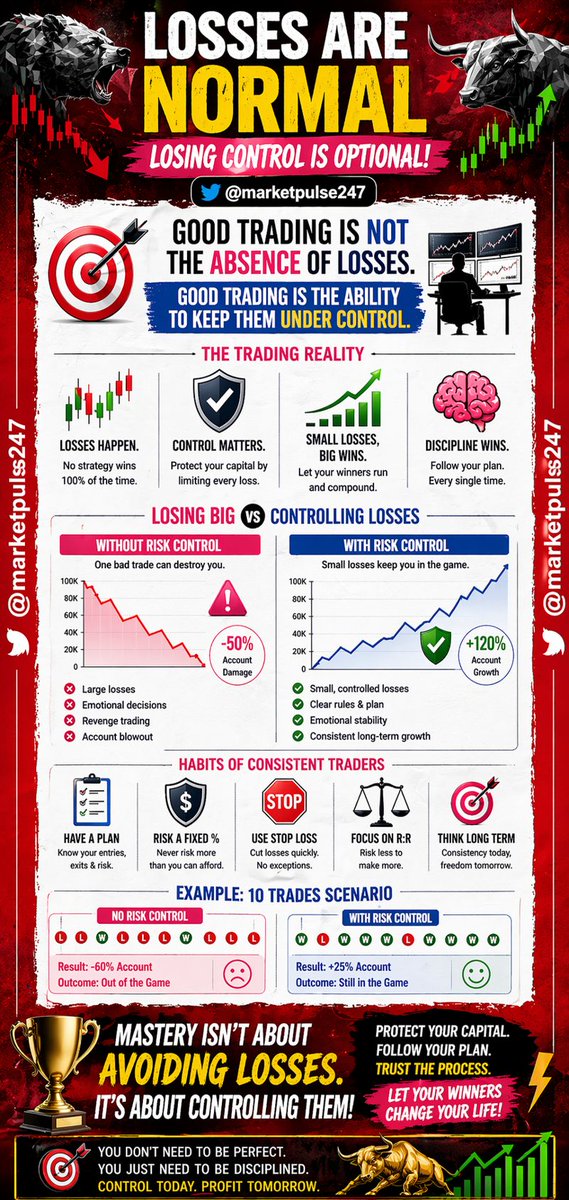
THE BIGGEST TRADING MYTH THAT KILLS CONSISTENCY
Bold Truth Winning Traders Still Lose
One of the most dangerous beliefs in trading is that success means avoiding losses completely. This illusion traps many traders into chasing perfection, which simply does not exist in the market. Even the most experienced and consistently profitable traders face losses regularly. The difference is not in avoiding them but in how they respond to them. Losses are a natural cost of doing business in a probabilistic environment. When you accept this reality, you remove the emotional weight attached to every losing trade. Instead of seeing losses as failures, you begin to see them as part of a structured process that leads to long term profitability and growth.
The Real Skill Controlling The Damage
Good trading is not about being right all the time but about controlling how wrong you can be when things do not go your way. This is where risk management becomes your strongest tool. By limiting the size of each loss, you ensure that no single trade can significantly damage your account. This approach keeps you in the game long enough to benefit from your winning trades. Traders who ignore this principle often experience large drawdowns that are difficult to recover from. Control is what creates stability. When you focus on managing downside risk, you build a foundation that allows your strategy to perform consistently over time.
Why Small Losses Lead To Big Wins
It may seem counterintuitive, but consistently taking small losses is one of the key habits of successful traders. Small losses act as protection, preventing a single mistake from turning into a major setback. When you cut losses quickly, you free up both capital and mental energy to take better opportunities. On the other hand, holding onto losing trades in the hope of recovery often leads to larger and more damaging losses. This behavior is driven by emotion rather than logic. By accepting small losses early, you maintain control and keep your trading account healthy, allowing your winning trades to have a meaningful impact on your overall results.
Discipline The Ultimate Trading Advantage
Having a plan for controlling losses is important, but the real challenge lies in executing it consistently. Discipline is what separates those who understand risk management from those who actually benefit from it. It requires you to follow your rules even when emotions urge you to do otherwise. This includes setting stop losses, respecting position sizes, and avoiding impulsive decisions. Discipline transforms good intentions into consistent actions. Over time, this consistency builds confidence and improves performance. Without discipline, even the best strategies fail. With discipline, even simple approaches can produce reliable results in the long run.
BOLD CONCLUSION Control Losses Control Your Future
The path to successful trading is not about eliminating losses but about mastering them. When you shift your focus from being right to managing risk, everything changes. You become more patient, more strategic, and more consistent in your approach. Losses no longer feel like setbacks but become part of a controlled and calculated process. This mindset allows you to stay in the game and grow over time. In the end, the traders who succeed are not those who avoid losses but those who control them effectively and let their winners do the heavy lifting.
x.com/@marketpulse247
#tradingpsychology #riskmanagement #tradingmindset #stockmarketindia #forextrading #daytrading #swingtrading #investingmindset #discipline #tradingrules #financialfreedom #marketpsychology #tradingstrategy #wealthbuilding #traderlife #tradingtips #emotionalcontrol #investingtips #stockmarketlearning #tradingeducation #mindsetmatters #profitmindset #tradingcommunity #financialgrowth #tradingjourney #learntrading #tradingcoach #marketinsights #financialsuccess #tradinghabits #consistencyiskey #tradingedge #mentalstrength #wealthmindset #tradingperformance #riskreward #smarttrading #tradingfocus #financialindependence #tradinggrowth #marketdiscipline #tradinginspiration #successmindset #capitalmanagement #tradinglifestyle #marketwisdom #investsmart #tradinggoals #moneymindset
2
4
38
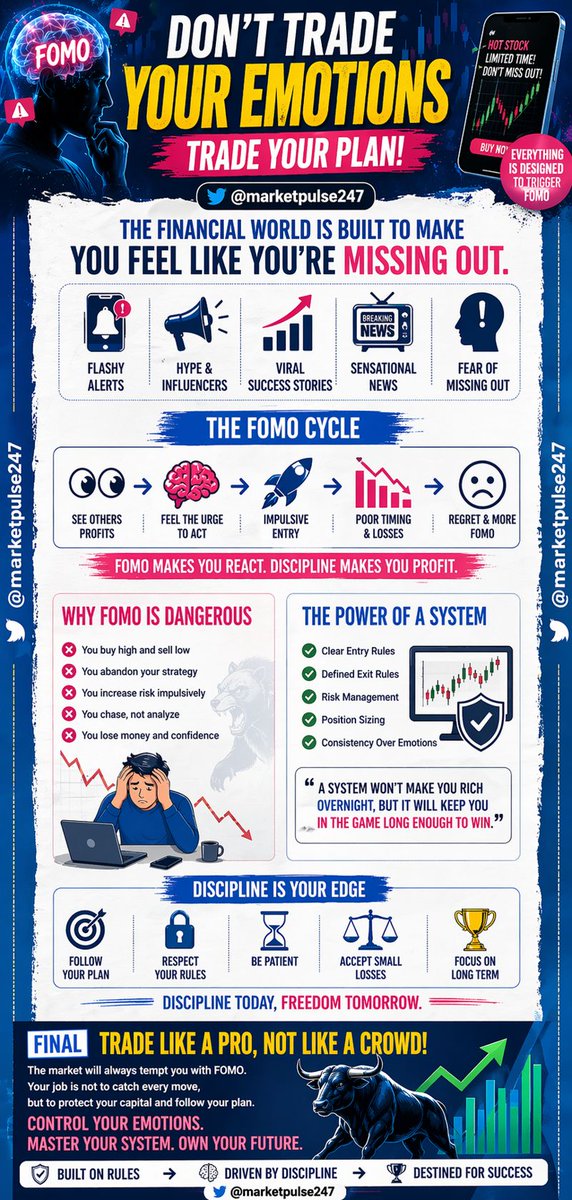
THE FOMO TRAP THAT SILENTLY DESTROYS TRADERS
Bold Reality The Market Is Engineered To Trigger You
Everything in the financial world is carefully designed to capture your attention and provoke emotional reactions. From flashing price movements to sensational news headlines and social media success stories, every element pushes you toward one powerful emotion fear of missing out. This is not accidental. Platforms, influencers, and even market structures thrive on participation, and nothing drives participation more than urgency. When you see others posting profits or hyping opportunities, it creates an illusion that you are falling behind. This psychological pressure forces you to act quickly, often without proper analysis. Instead of following your strategy, you begin chasing momentum blindly. The market does not reward impulsive behavior consistently, and over time, this reaction leads to losses. Recognizing that this environment is built to trigger FOMO is the first step toward protecting your capital and your mindset.
The Hidden Cost Of Acting On Impulse
Acting on FOMO feels exciting in the moment, but the consequences are often damaging. When you enter trades based on hype or fear, you abandon your edge and rely purely on emotion. This leads to poor timing, as you often buy when prices are already extended and sell when fear peaks. Over time, this cycle erodes both your capital and your confidence. The real cost is not just financial but psychological. Each impulsive decision reinforces bad habits, making it harder to stick to a disciplined approach in the future. You may find yourself constantly reacting instead of planning, turning trading into chaos rather than a structured process. The market rewards patience and precision, not emotional reactions. Understanding the hidden cost of impulse trading helps you realize that avoiding bad trades is just as important as taking good ones.
Why Systems Beat Emotions Every Time
A well defined trading system acts as your shield against the chaos of the market. It provides clear rules for entry, exit, and risk management, removing ambiguity from your decisions. When you rely on a system, you no longer need to guess or react emotionally to every price movement. Instead, you follow a structured plan that has been tested over time. This consistency is what separates successful traders from those who struggle. Without a system, every trade becomes a gamble influenced by external noise. With a system, each decision is part of a larger probabilistic framework. This does not guarantee immediate success, but it ensures long term stability. The key is to trust your system even when emotions try to take control. A strong system transforms trading from a reactive activity into a disciplined process driven by logic and data.
Discipline The Skill That Defines Success
Having a system is not enough if you lack the discipline to follow it. Discipline is what keeps you grounded when emotions run high and the market feels unpredictable. It is the ability to stick to your rules even when you are tempted to deviate. This is often the hardest part of trading because it requires self control and patience. Discipline means accepting that you will miss opportunities and being comfortable with that reality. It means prioritizing consistency over excitement and long term success over short term gains. Every time you follow your rules, you strengthen your ability to stay disciplined. Over time, this builds confidence and improves your performance. Without discipline, even the best system will fail. With discipline, even a simple strategy can produce consistent results.
BOLD CONCLUSION Master Your Mind Or The Market Will Master You
The financial markets are not just a test of strategy but a test of mindset. FOMO is one of the most powerful forces working against you, constantly pushing you toward impulsive decisions. By recognizing this and building systems with clear rules, you create a foundation for consistent success. However, the true edge lies in your ability to respect those rules with unwavering discipline. Trading is not about catching every opportunity but about executing your plan with precision and control. When you master your emotions and commit to your system, you shift from being reactive to being strategic. In the end, success in trading is not determined by how much you chase but by how well you control yourself in an environment designed to make you lose control.
x.com/@marketpulse247
#tradingpsychology #fomo #tradingmindset #stockmarketindia #forextrading #daytrading #swingtrading #investingmindset #discipline #riskmanagement #tradingrules #financialfreedom #marketpsychology #tradingstrategy #wealthbuilding #traderlife #tradingtips #emotionalcontrol #investingtips #stockmarketlearning #tradingeducation #mindsetmatters #profitmindset #tradingcommunity #financialgrowth #tradingjourney #learntrading #tradingcoach #marketinsights #financialsuccess #tradinghabits #consistencyiskey #tradingedge #mentalstrength #wealthmindset #tradingperformance #riskreward #smarttrading #tradingfocus #financialindependence #tradinggrowth #marketdiscipline #tradinginspiration #successmindset #capitalmanagement #tradinglifestyle #marketwisdom #investsmart #tradinggoals #moneymindset
2
5
72
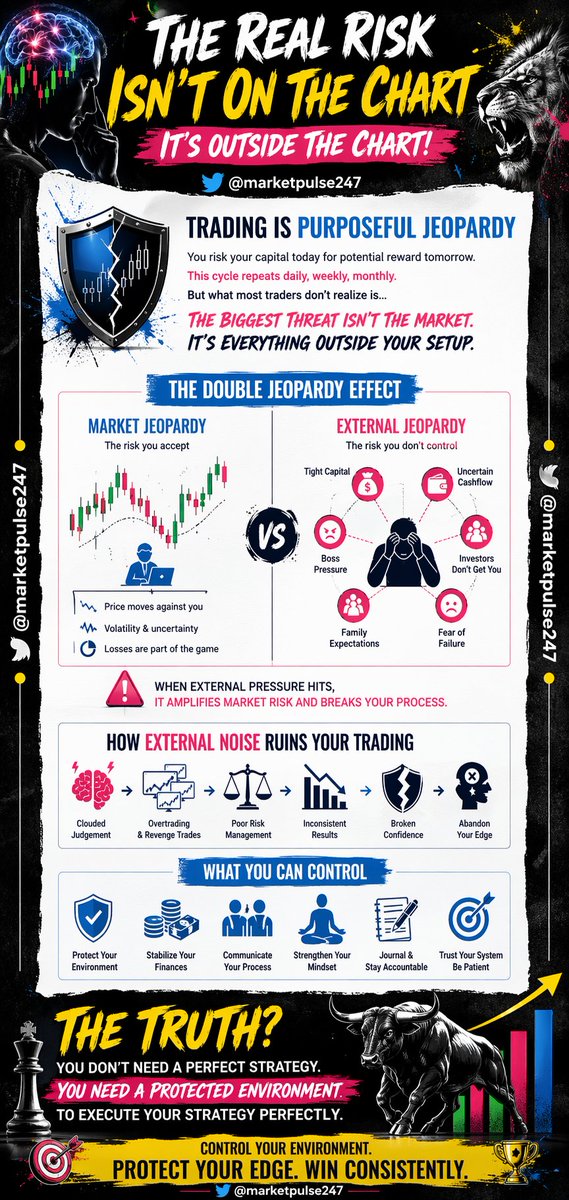
THE HIDDEN RISK IN TRADING NO ONE TALKS ABOUT
Bold Truth You Are Not Just Fighting The Market
Trading is often described as a battle against charts, numbers, and probabilities, but that is only half the story. The deeper truth is that every trader is also battling invisible forces that shape their decisions long before they click buy or sell. The idea of placing yourself in purposeful jeopardy is already intense, as you knowingly expose your capital to uncertainty in pursuit of reward. However, what makes this risk even more dangerous is not always the volatility of the market but the environment surrounding the trader. When pressure builds from sources outside the charts, it slowly creeps into your decision making process. Over time, this pressure reshapes how you perceive risk, reward, and timing. You may think you are reacting to market signals, but in reality, you are reacting to stress, fear, and expectation imposed from outside your trading system.
The Silent Pressure That Breaks Even The Best Traders
Many traders underestimate how damaging external pressure can be until it begins to affect their consistency. Imagine trading with limited capital while worrying about bills, expectations, or job security. This creates a constant mental strain that pushes you to take trades you would normally avoid. Instead of waiting patiently for high probability setups, you feel compelled to act quickly, often out of desperation rather than strategy. This silent pressure does not announce itself loudly but shows up in subtle ways such as overtrading, cutting winners too early, or holding onto losing positions longer than planned. Over time, these small deviations compound into major losses. The tragedy is that the trader often blames their strategy or the market itself, without realizing that the real issue lies in the environment influencing their mindset.
When Cashflow Stress Turns Into Trading Mistakes
Cashflow instability is one of the most underestimated threats to a trader’s success. When your income is uncertain and your financial obligations remain constant, every trade begins to feel heavier. Instead of viewing trades as part of a long term probabilistic game, you start attaching immediate emotional significance to each outcome. A single loss feels like a setback to your survival, not just your trading account. This shift in perception leads to irrational behavior. You may increase position sizes to recover losses quickly or avoid taking valid trades out of fear. Both reactions disrupt your edge. A strong trading system relies on consistency and discipline, but cashflow stress introduces urgency that overrides logic. The market has not changed, but your relationship with it has, and that change often leads to poor performance.
How Authority Pressure Distorts Decision Making
Trading under supervision or external authority adds another layer of complexity that many fail to acknowledge. Whether it is a boss, a fund manager, or investors, their expectations can weigh heavily on your actions. When someone is constantly evaluating your performance without fully understanding your strategy, it creates a disconnect. You begin to trade not for optimal outcomes but to satisfy their expectations. This often results in abandoning your process in favor of short term results. You might close trades prematurely to show profits or avoid taking necessary risks to prevent criticism. Over time, this behavior erodes your confidence and disconnects you from your own system. The irony is that the more you try to meet external expectations, the further you drift from the very edge that made you successful in the first place.
The Dangerous Illusion That The Market Is The Enemy
One of the biggest misconceptions in trading is believing that losses are primarily caused by the market itself. While market conditions do play a role, they are rarely the sole reason for failure. More often, it is the amplification of external stress that pushes traders into making poor decisions. When you operate in a high pressure environment, your tolerance for uncertainty decreases. This leads to impulsive actions that deviate from your plan. The market becomes a scapegoat for deeper issues rooted in your surroundings. Recognizing this illusion is a critical step toward improvement. Once you understand that your environment is influencing your performance, you can begin to address the real problem instead of constantly tweaking strategies that were never the issue to begin with.
Why Your Trading Environment Is Your Real Edge
A supportive and stable trading environment can significantly enhance your performance, sometimes even more than refining your strategy. When you remove unnecessary stressors, you create space for clarity and disciplined execution. This means having realistic financial expectations, supportive stakeholders, and a structure that allows you to follow your process without constant interference. In such an environment, you are able to focus on probabilities rather than outcomes. You become more patient, more consistent, and more aligned with your trading plan. This is where true edge is developed. It is not just about finding the perfect setup but about creating conditions where you can execute that setup effectively. Without the right environment, even the best strategy will struggle to deliver consistent results.
How To Protect Yourself From External Noise
Protecting your trading process from external noise requires intentional effort and self awareness. The first step is identifying the sources of pressure that affect your decisions. This could be financial stress, unrealistic expectations, or lack of support. Once identified, you can take steps to minimize their impact. This might involve adjusting your position sizes, creating a financial buffer, or setting clear boundaries with stakeholders. It is also important to develop mental resilience through routines that keep you grounded. Journaling your trades and emotions can help you recognize patterns and stay accountable to your process. By actively managing your environment, you reduce the risk of external factors distorting your judgment. This allows you to operate with greater clarity and confidence, even in uncertain market conditions.
BOLD CONCLUSION The Real Battle Is Beyond The Charts
Trading is not just about mastering the market but about mastering the conditions in which you operate. The concept of purposeful jeopardy becomes far more complex when external pressures are added to the equation. It is these hidden forces that often determine success or failure, not the strategy itself. By recognizing the impact of your environment and taking steps to control it, you give yourself a powerful advantage. You move from reacting emotionally to acting strategically. In the end, the traders who succeed are not just those with the best systems but those who create the best conditions to execute them. Protect your environment and you protect your edge.
x.com/@marketpulse247
#tradingpsychology #tradingmindset #forextrading #stockmarketindia #daytradinglife #swingtrading #tradingtips #riskmanagement #financialfreedom #investingmindset #traderlife #marketpsychology #tradingdiscipline #successmindset #wealthbuilding #financialgrowth #tradingeducation #mindsetmatters #stockmarketlearning #tradingstrategy #emotionalcontrol #profitmindset #retailtrader #protrader #tradingcommunity #financegoals #marketinsights #tradingjourney #learntrading #tradingcoach #capitalmanagement #tradingrules #investingtips #marketwisdom #financialsuccess #tradinghabits #tradinglifestyle #tradingedge #mentalstrength #disciplineequalsfreedom #wealthmindset #tradingperformance #riskreward #tradingfocus #marketdiscipline #financialindependence #tradinggrowth #consistencyiskey #smarttrading #tradinginspiration
1
2
4
59
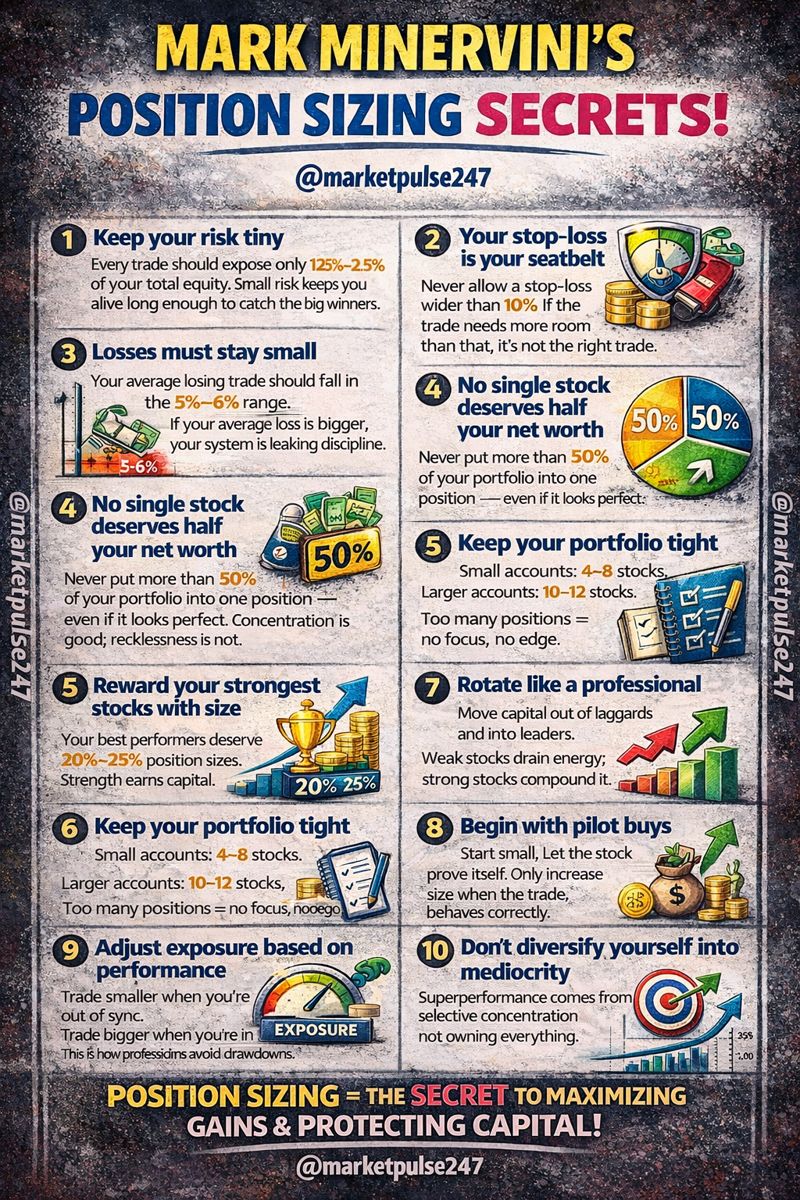
THE POSITION SIZING SECRET THAT SEPARATES WINNERS FROM LOSERS
Start Small Stay Alive Win Big
The biggest mistake most traders make is risking too much on a single trade. The reality is simple survival comes before success. If you risk only a small percentage of your capital on each trade you give yourself the opportunity to stay in the game long enough to catch meaningful trends. Limiting your risk to a tiny portion of your total equity creates stability in your trading journey. It protects you from emotional breakdowns and large drawdowns. When your downside is controlled your confidence improves and your decision making becomes sharper. Small risk does not mean small ambition it means smart execution. The traders who last are not the ones who win big quickly but the ones who avoid losing big consistently.
Respect Your Stop Loss Like Your Life Depends On It
A stop loss is not just a technical level it is your financial safety system. Many traders treat stop losses casually and widen them in hope of recovery but that is where discipline breaks. A strict stop loss keeps your losses predictable and manageable. If a trade requires a wide stop it usually means the setup is not precise enough. By respecting tight stops you force yourself to choose better trades. This habit improves your overall quality of entries. It also removes emotional attachment because you know your exit is predefined. Consistently honoring your stop loss builds trust in your system and prevents one bad trade from damaging weeks of progress.
Control Losses Before Chasing Profits
Successful trading is not about how much you make it is about how well you control what you lose. Keeping your average loss small ensures that even a few winning trades can offset multiple losses. When your losses are large it becomes mathematically difficult to recover. This is where most traders struggle. They focus on profits but ignore the damage caused by big losses. By keeping losses tight and consistent you create a stable base for growth. This approach also reduces stress because you are not constantly trying to recover from deep drawdowns. A trader who masters loss control automatically improves profitability over time.
Avoid Over Concentration Protect Your Capital
Putting too much money into one stock may feel like confidence but it is often hidden risk. Even the best setups can fail due to unexpected market conditions. By limiting how much you allocate to a single position you protect your overall portfolio. Concentration should be strategic not emotional. When you spread your risk wisely you reduce the impact of any single loss. This allows you to stay calm and objective in your decisions. Over concentration leads to stress and impulsive actions while balanced exposure keeps your mind clear. Smart traders know that protecting capital is more important than chasing maximum returns from one idea.
Let Strength Decide Where Money Goes
Not all stocks deserve equal attention. The strongest performers in your portfolio should naturally receive more capital. This is how you maximize returns without increasing overall risk. When a stock proves its strength through price action and consistency it earns the right to a larger position. This approach aligns your capital with momentum. It also helps you focus on quality rather than quantity. By rewarding strength you build a portfolio that reflects performance not hope. Over time this habit compounds your gains because your winners are working harder for you than your losers ever could.
Focus Brings Clarity Too Many Trades Destroy Edge
Holding too many positions at once dilutes your focus. Each trade requires attention analysis and emotional energy. When your portfolio is overloaded you cannot manage each position effectively. This leads to missed opportunities and poor decision making. A focused portfolio allows you to track your trades closely and respond quickly to changes. It also helps you understand your setups better because you are not scattered across multiple ideas. Quality always beats quantity in trading. By keeping your portfolio tight you create clarity discipline and a stronger connection with your strategy.
Move Capital Like a Professional Trader
Markets reward strength and punish weakness. Holding onto underperforming stocks wastes both time and capital. Professional traders constantly rotate their capital into better opportunities. This does not mean overtrading it means being selective and proactive. When a stock loses momentum it is better to reallocate that capital into a stronger setup. This habit keeps your portfolio aligned with current market trends. It also prevents emotional attachment to losing trades. By treating capital as a resource that must always be working efficiently you improve your overall performance and stay in sync with the market.
Start Small Then Scale With Confidence
Jumping into full position size immediately increases risk and pressure. A better approach is to start with a smaller position and let the trade prove itself. If the trade behaves as expected you can gradually increase your size. This method reduces initial risk and builds confidence step by step. It also allows you to test your idea before committing fully. Scaling into positions based on performance creates a balanced approach between caution and aggression. It keeps your emotions stable and your decisions logical. This is how experienced traders build positions without exposing themselves to unnecessary risk.
Trade Bigger Only When You Are Right
Your trading size should reflect your performance. When you are out of sync with the market it is wise to reduce your exposure. This protects your capital and gives you time to regain clarity. On the other hand when you are in rhythm and your trades are working you can increase your size. This approach aligns risk with confidence built on results not emotions. It creates a dynamic system where your exposure adjusts automatically based on performance. This is one of the most powerful habits of professional traders because it prevents large drawdowns and maximizes gains during winning phases.
Avoid Mediocrity Through Smart Concentration
Diversification is important but over diversification can weaken your results. Owning too many average stocks limits your ability to benefit from strong performers. True outperformance comes from focusing on a few high quality opportunities. This requires patience and confidence in your analysis. By concentrating on your best ideas you give them room to grow and impact your portfolio meaningfully. This does not mean ignoring risk it means balancing focus with discipline. Smart concentration allows you to stand out instead of blending into average market returns.
Think Like a Portfolio Manager Not a Gambler
Every decision in trading should be intentional and structured. Treat your portfolio like a living system that needs constant care and adjustment. Feed your winners by allowing them to grow. Cut your losers quickly before they damage your capital. Remove underperforming positions and replace them with stronger ones. This mindset transforms trading from random activity into strategic management. It also builds long term consistency because you are always optimizing your portfolio. When you think like a manager you move away from emotional reactions and toward calculated decisions.
Master Risk Positioning To Unlock Consistency
Position sizing is not just a rule it is the foundation of consistent trading. Every trade you take should be aligned with your risk tolerance and strategy. By calculating your position size based on stop loss distance and volatility you create a balanced approach to risk. This ensures that no single trade can significantly harm your account. It also allows you to stay confident during market fluctuations. Mastering this concept takes time but once achieved it becomes your greatest advantage. Consistency in trading is not built on predictions but on disciplined execution of risk management principles.
CONCLUSION POSITION SIZING IS YOUR REAL EDGE IN TRADING
Most traders search for the perfect strategy but ignore the power of position sizing. The truth is even an average strategy can perform well with proper risk management while a great strategy can fail with poor sizing. When you control your risk manage your exposure and align your capital with strength you create a system that can survive and thrive in any market condition. Position sizing is what turns knowledge into results and discipline into profits. Master this skill and you will no longer depend on luck because your process will consistently work in your favor.
x.com/@marketpulse247
#tradingpsychology #positionsizing #stockmarketindia #tradingstrategy #riskmanagement #tradingdiscipline #stockmarketlearning #intradaytrading #swingtrading #optionstrading #niftytrading #banknifty #tradingtips #traderlifeindia #financialfreedomindia #tradingmindset #marketdiscipline #stockmarketeducation #tradingjourney #consistenttrader #wealthbuildingindia #tradingrules #emotionaltrading #tradinghabits #marketstrategy #tradinggrowth #financialmindset #tradingcommunityindia #stockmarketlife #tradingfocus #longtermtrading #dailytrading #tradingcoach #marketwisdom #tradinginspiration #profitmindset #tradingedge #learntradingindia #serioustrading #marketfocus #tradingexecution #stockmarketmotivation #tradingconsistency #wealthmindsetindia #tradingprocess #smarttrading #capitalmanagement #riskcontrol #tradingperformance #investingindia
3
4
162

Apr 10
THIS MORNING ON THE DAX WAS PURE PRECISION. ⚡
Manual trading automation.
NEXUS the new Oracle Prediction.
One mission: dominate the move.
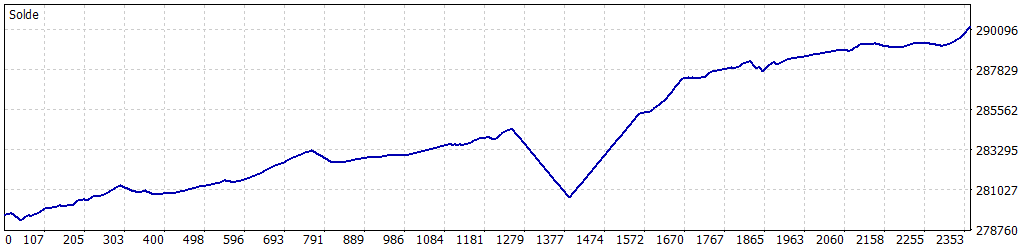
Today’s FDAX session delivered:
🔥 $10,752.26 net profit
🔥 2,358 trades
🔥 74.26% winning trades
🔥 Profit Factor: 2.33
This was not random volatility.
This was timing.
This was frequency.
This was execution.
The new Oracle Prediction helped NEXUS read the rhythm of the market and attack the DAX with speed, structure, and consistency.
Manual and automated trading worked together like a double engine: one for instinct, one for precision.
This is what happens when prediction meets execution.
NEXUS doesn’t just trade the market.
It synchronizes with it.
#NEXUS #OraclePrediction #DAX #FDAX #GER40 #TradingAlgo #AlgoTrading #ManualTrading #TradingSystem #QuantTrading #DayTrading #TradingPerformance
5
232