
2 Sep 2025
TOBACCO VANGUARD Est. 1977
Not for all and sundry
On Numbers, Dignity, and the Welfare State
By M. Reuven
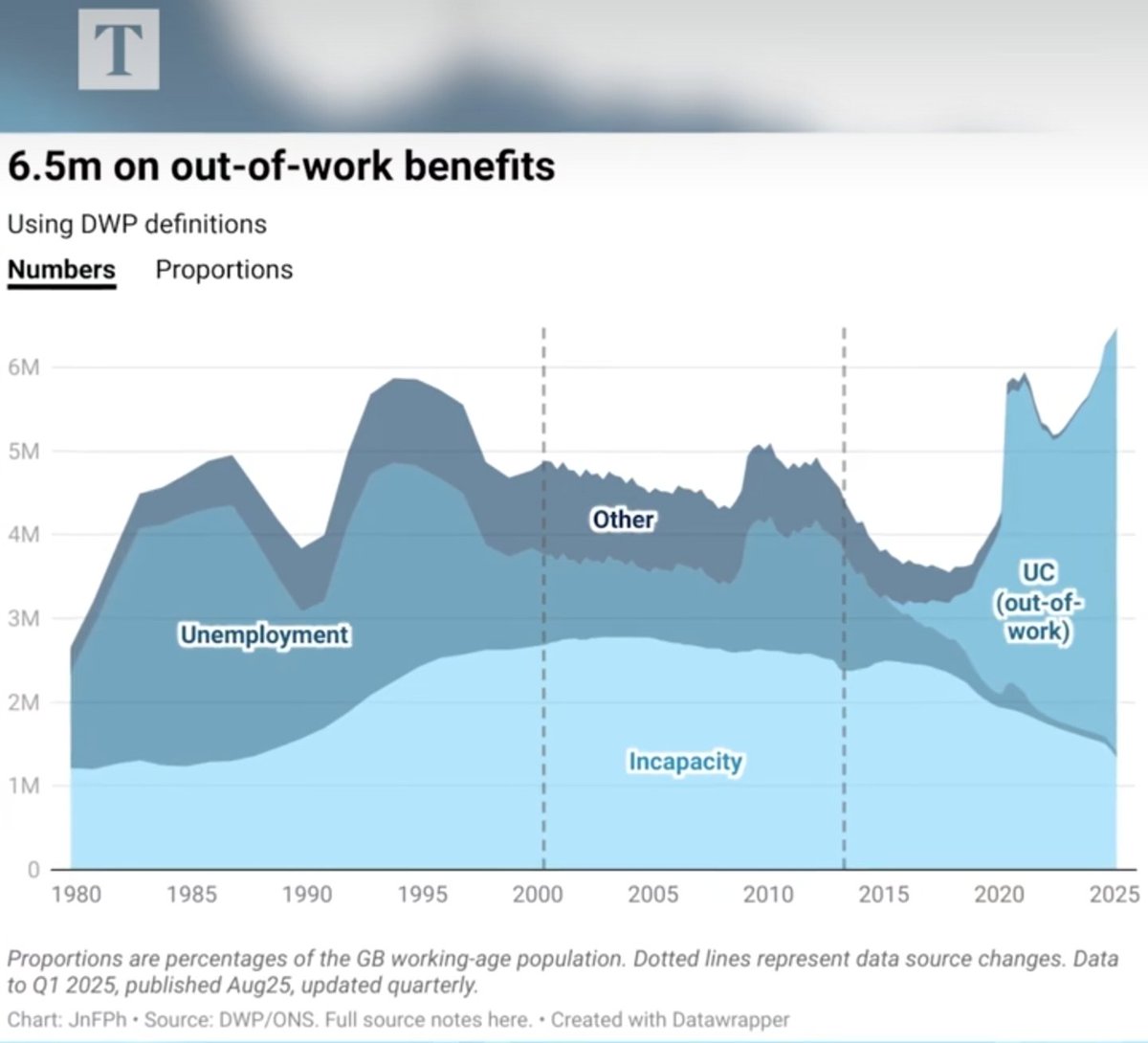
A chart now circulating claims that 6.5 million people are on out-of-work benefits. It has been greeted with the usual chorus of alarm. The conclusion runs ahead of the evidence. The figure is a headcount, not a rate, and the working-age population is much larger than it was in the early 1990s. The series also carries definition breaks. Universal Credit widened coverage and moved people from several legacy headings into one container. Part of the recent rise is accounting, not social collapse.
The composition has changed as well. The peaks of the 1980s and 1990s were driven by classic unemployment. Today the weight sits in health-related inactivity and claims recorded under UC. The pandemic shock, long NHS waiting lists, and a backlog in assessment have shifted people out of work and into categories that did not exist in the same form a decade ago. That is a labour-supply problem, not proof that the country has lost the will to work.
We resist blanket generalisations because they are careless with people and with facts. Benefits are automatic stabilisers. They stop a redundancy or an illness from becoming a family disaster. The fiscal problem is weak productivity, flat real wages, and high effective marginal tax rates when people attempt to re-enter work. Blaming the chart will not shorten a waiting list or make work pay.
Benefits spending also carries a multiplier effect. Recipients have high propensities to spend, so each pound flows quickly into local shops, rents, transport and utilities, supporting small firms and local authority revenues. In downturns this stabilises demand when private incomes falter, limiting scarring and helping people back into work sooner. The aim is not permanent dependence but a floor that preserves human capital. The net fiscal cost is lower than the headline outlay because part of the spend returns through VAT, fuel duty and income taxes.
If ministers and MPs want a clean view, show the proportions as well as the numbers. Separate flows into and out of each category. Publish duration, age, and regional patterns. Distinguish assessed sickness from administrative delay. Then design policy around what those facts reveal. Faster treatment and rehabilitation. Credible work-capability tests with real support. Taper rates that do not claw back each extra hour of pay. Local employer partnerships that match skills to the vacancies that actually exist.
Why is Tobacco Vanguard so concerned about how this is framed? The reasons are threefold. First, we champion the underdog and the marginalised. No group has been more stigmatised than the smoker, and the same spirit carries to the disabled and the unwell. As age and infirmity creep up, some of your writers have experienced disability. We know what it is to be dismissed by a headline. Second, we resist the steady erosion of the welfare state. A civilised country keeps a viable safety net. Unemployment, disability, ill health, and marital breakdown are tragedies, not moral failures. Members of this team have lived through each at one time or another. We take the long view and oppose the slide toward a punitive individualism that forgets how easily fortune turns. Third, if ever there were a field ripe for the misuse of statistics, it is welfare. Our method is to highlight disparities, to read the footnotes as well as the figures, and to educate by example through careful analysis.
The public deserves better than theatrical punctuation and sweeping claims. The chart tells us that Britain has a participation problem shaped by health and by administrative change. It does not license a verdict on national character. Policy should follow evidence and compassion in equal measure. We will continue to test claims against the record, the definitions, and the lived facts of those whom the numbers describe.
#TobaccoVanguard #UKWelfare #UniversalCredit #Disability #Incapacity #Inactivity #WorkforceParticipation #LabourMarket #Employment #Unemployment #NHSWaitingLists #WorkCapability #SafetyNet #SocialSecurity #AutomaticStabilisers #DataLiteracy #StatsMatter #ContextMatters #EvidenceBasedPolicy #Productivity #RealWages #EMTR #TaxAndBenefits #FiscalSustainability #UKEconomy #UKPolitics #ONS #CriticalRealism #SmokersRights

1
2
136

21 Oct 2020
#OpenAccess highlight #2: ‘The impact of the #WorkCapability Assessment on #mentalhealth : claimants’ lived experiences and GP perspectives in low-income communities doi.org/10.1332/175982719X15…
#OAWeek2020 #OA @ljhansford
1

21 May 2019
Took the opportunity at my mtg with the @theRCOT to ask them abt their members involved in #WorkCapability or #PIP assessments raising concerns about the reliability of these assessments. They've agreed to reissue guidance to their members on this which is also on their website
1
5
4

24 Apr 2019
Busy Diary Wed 24/4/19
@CommonsWorkPen
#discrimination in #housing #noDSS
📣Leading WH debate on #pensioncredit
❓Cabinet Office questions
♨️ #PMQs
📝 Debate on #workcapability #Assessment
☎️📞emails phone calls
hope to watch @ScotGovFM statement 🏴 on #indyref2
1
1

15 Mar 2019
FUUUUUUUUCK!
I got through. Lady was rude and said no extensions for the #workcapability questionnaire. I then tried to give my new address and got cut off. CUT OFF!!!!! So now what?! Please do tell me. WTF am I supposed to do now? Ring back? You’ve got to be kidding me #DWP
2

12 Feb 2019
We want to make it easier to overturn #WorkCapability decisions, before you die ideally! We are getting our new #WCA Mandatory Reconsideration tool ready for pilot. Looking for claimants themselves non-expert supporters to help ensure it is as helpful as possible. #ESA #UC
1
2

13 Jan 2019
A GP/ Medical practitioner / Consultant should be better qualified to determine someone's ability to work and why these professional opinions r dismissed is beyond me. Its appalling & the treatment of patients for #workcapability & #PIP for example is utterly disgraceful
1
3
7

3 Nov 2018
When filling out forms for #ESA #WorkCapability is a delightful reminder of how much worse your #health has gotten in the last 2 years. Seriously miserable right now after realising how much it's declined in such a short period.
1
4

12 Oct 2018
Seeing super oncologist in 2 weeks, long term follow up team in 4 weeks but before all that fun I have a health assessment with dwp where I have to prove I'm not able to work. Nothing but fun and games here eh!! #esa #workcapability
1
1
11

12 Jul 2018
To the man reading @IslingtonBC work capability assessment appeals from a red suitcase. I’m pretty sure a packed train is not a suitable place to be reading documents that contain private and confidential medical information. #GDPR #workcapability #PIP #Benefits

1
6
11

9 Jun 2018
#Housing #UniversalCredit #VivaldiSpring I hate that #HoldMusic Please read these damming facts. #Benefits #Disabilities #PIP #WorkCapability It's not working #ToriesOut
9 Jun 2018

The DWP just quietly revealed the staggering scale of misery caused by Universal Credit.
Ignore @MirrorPolitics dire reporting of this - here's the Universal Credit claimant survey in (near) full. The results are awful.
Do read/share widely >>>
thecanary.co/uk/analysis/201… …
1
8
3

10 Mar 2017
The DWP ‘Kill Yourself’ scandal thecanary.co/2017/03/10/the-… via @thecanarysays #DWP #ESA #WCA #PIP #Disability #MentalHealth #WorkCapability
1

28 Sep 2016
Work capability assessment ‘may cost me my life’ ln.is/welfareweekly.com/olkr… via @Welfare_Weekly PLEASE RT #workcapability
2
1

23 Aug 2016
I really look fw to #jiointernet to enhance my workcapability and online multitasking by its worthy speed
3

Experts say 590 more suicides, 279K more #mentalhealth 725K more #prescriptions for #antidepressants #workcapability bit.ly/1lhTIdP
5
1