
@sagarikaghose
@PrabhuChawla
@sumairakh
@SushantBSinha
@chitraaum
@AartiTikoo
@anjanaomkashyap
@SwetaSinghAT
@sudhirchaudhary
@maryashakil
@writetake
@amritardhillon
@AnchorAnandN
@shreyadhoundial
@Zakka_Jacob
@msharma179
@navikakumar
@gauravcsawant
@RShivshankar
@KishoreAjwani
@scribesoldier
@SwarajyaMag
@ThePrintHindi
@DChaurasia2312
@chitraaum
@VishnuNDTV
@RajatSharmaLive
@nitingokhale
@ThePrintIndia
@palkisu

📷 An Open Letter to the Ministry of External Affairs: Navigating Maritime Crises and Strategic Autonomy
In alignment with the Prime Minister’s vision of Sabka Saath, Sabka Vikas, Sabka Vishwas, and Sabka Prayas, I am sharing a few constructive suggestions regarding India's current geopolitical and maritime challenges.
📷 The Catalyst: Recent Escalations in the IOR
The tragic loss of three Indian sailors following a US strike on the Palau-flagged oil tanker MT Settebello in the Gulf of Oman on June 10, 2026—part of a US-enforced naval blockade on Iran-linked shipping—marks a deeply concerning flashpoint. This event is the third US strike involving merchant tankers with Indian crews in a mere four-day span, occurring amid escalating US-Iran tensions.
While US Central Command remains unapologetic, these actions place immense strain on the reliability of our strategic partnerships. Despite strong protests from the MEA, there is a growing perception that Indian diplomacy may be overly accommodating to the Trump administration.
📷 The Broader Context & Legal Ambiguity
This incident follows the sinking of the IRIS Dena in March 2026, an uncommon kinetic escalation by the US that undermined established trust in maritime rules and multilateral security institutions, while setting a troubling precedent for extra-regional military actions within the Indian Ocean Region (IOR).
From a legal standpoint:
UNCLOS Boundaries: Because these actions occurred in international waters outside India’s coastal authority or EEZ, they do not violate UNCLOS. Furthermore, the Convention does not regulate the use of force.
The Legal Debate: The core debate rests on interpretation, the existence of a state of armed conflict, and the plausibility of self-defense claims under Article 51 of the UN Charter.
For India, these episodes expose critical limitations in our Maritime Domain Awareness (MDA) and our efficacy as a net security provider in the IOR. Crucially, they test India’s capacity to exercise its policy of strategic autonomy, raising fundamental questions about the resilience of our strategic partnership with the US during adverse conditions.
📷 Strategic Recommendations
As the Prime Minister prepares for the upcoming G7 Summit in France, a carefully calibrated diplomatic stance is essential:
Reconsider a Bilateral Meeting: It may be prudent to avoid a formal bilateral meeting with President Trump. Throughout his "Trump 2.0" tenure, his administration has repeatedly harmed Indian economic interests with heavy tariffs, despite his public rhetoric of friendship with PM Modi.
Maintain Diplomatic Firmness: While the MEA reacted with maturity and strength to the initial 50% tariffs and derogatory rhetoric regarding India's economy, India’s sudden concession on tariffs just before the US Supreme Court decision was perceived as a softer approach.
Prioritize Optics and Leverage: Acknowledging India's leverage limitations, conceding too much to the Trump administration creates challenging optics—especially when contrasted against the tragic loss of Indian lives on one side and professions of friendship on the other.
Failing to maintain a firm posture risks drawing criticisms reminiscent of PM Modi’s visit to Israel just prior to the outbreak of war. Despite the MEA’s valid justifications, that timing was poorly received in West Asia. Protecting India's long-term sovereign and regional interests requires a visible rebalancing of our strategic stance.
#Geopolitics #ForeignPolicy #StrategicAutonomy #IOR #MaritimeSecurity #MEA #Diplomacy #IndiaUSRelations
1
110


@writetake, are the rumors regarding the Mk2 true? Can you confirm them?
1
5
179

Apr 25
They used to be the ones giving true inside news on the Tejas program when @writetake used to write for them.
1
1
16
495

Mar 3
"When we raise the intellect to such levels which the best of humans cannot even think of attaining, we must realise that these systems shall achieve their stated goals every time most shortly and efficiently.
On a battle front, such digital intelligence systems shall be able to neutralise an enemy system precisely and accurately without any collateral damage. We have to keep in mind that post cold war every military offensive has consistently targeted the command, control, communication and leadership.
So, any capability to accurately target the nerve centre of an adversary shall result in surrender and transfer of power in no time. When the collateral damages are minimised, and the command and control are knocked out of the system, the control of the territory and population become that much easier."
Excerpts from the referred article, written 4-5 years before, and also in the Technology Vision document for India at 2047.
Guess the policy makers will learn something from the Gulf War and get their acts together before it gets too late !!!
@PMOIndia @NSAIndia @IAF_MCC @BJP4India @writetake @Chopsyturvey @
salute.co.in/insight-into-th…
1
2
86

@writetake sir, what's going on with Uttam?
Feb 20

What was the reason for dropping Uttam for Tejas Mk1A from 41st unit? Even DRDO’s Dr. BK Das said from 41st unit Mk1A will feature Uttam.
2
41

Jan 22
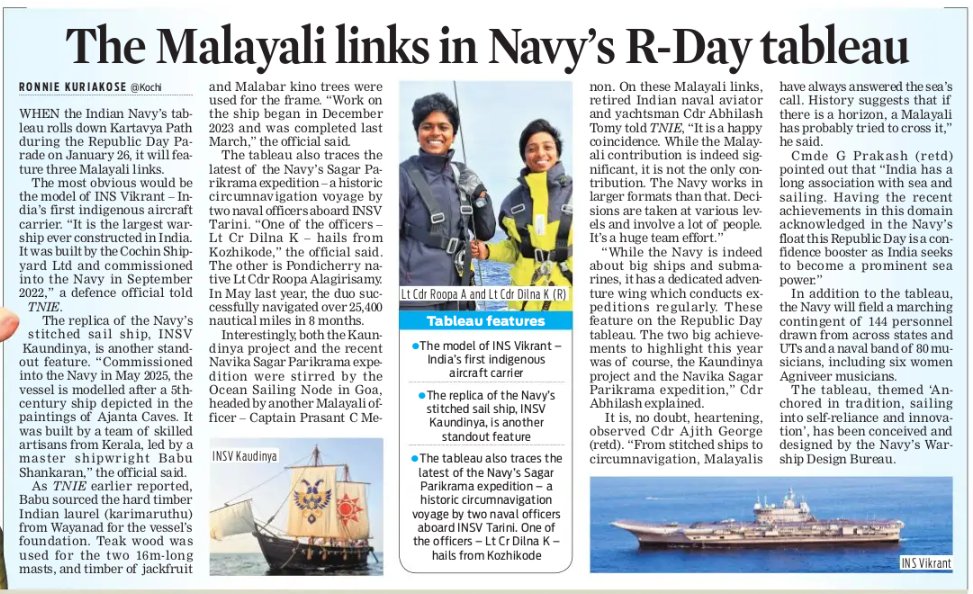
When the Indian Navy’s tableau rolls down Kartavya Path during the Republic Day Parade on January 26, it will feature three notable Malayali links.
Read on to find out: newindianexpress.com/states/…
@xpresskerala @rajeshravi71 @pendown @kuruvilla2507 @VigneshMadhu94 @sanesh_TNIE @realkaypius @Cmde_GPrakash @srikantkesnur @PrasantCMenon @abhilashtomy @rameshmenon128 @ajithgeorge100 @indiannavy @JohnsonOdakkal @DILIPtheCHERIAN @Nakro_Jojo @MSKiranPrakash @santwana99 @writetake @AGStd @AnjaliMody1 @IN_HQSNC @NAVYESM @anilkantony @DefencePROkochi @AntoJoseph @Urmimala_A @appooz @BlabbingFingers @badjourno
7
16
4,509


Jan 15
If you're willing, look at the website of the MP-IDSA. We are always looking out for articles or commentaries like this for the Journal of Defence Studies. Message me if you wish and maybe you can get published.
1
4
187

@PMOIndia @narendramodi @rajnathsingh @SpokespersonMoD if even one of you did your work , we wouldn't be in this situation. First tenure was a complete blunder and 2nd one wasn't great as well. Buy IDDM products over licensed products of foreign OEMs and spend more on RnD.
3
318

Jan 15
Excellent article! Have covered all the key points in a good way. 👌🏼👌🏼
Keep writing man.
1
2
20
1,345

Jan 15
My First Article!
"An Assessment of the Modi Government's failure in developing and leveraging a technology ecosystem"
@Indrani1_Roy @cvkrishnan @writetake @Firezstarter1
kpideaslab.blogspot.com/2026…
10
55
159
17,378

Thanks for your message @anvay_sheolikar. It is encouraging to see young scholars engaging with emerging domains like orbital defence. The subject is highly important as space becomes increasingly contested.
@Viv_Krishnan @writetake @realkaypius @sneheshphilip @SandeepUnnithan
Jan 10

@AjayshreeSamby3 Greetings, sir
I am an aerospace engineering student (19 years) from Pune and a long-time reader of your work. Your writings about science and defence enthusiastic reporting have been a quiet source of inspiration.
I have recently published my research and drafted India's first proposal on why India needs an Orbital Defence Doctrine. While military doctrine exists, it still overlap crucial aspects of future space. It is published in Indian Journal of Law & Legal Research. The paper has been submitted for formal review and formatted for the Ministry of Defence following clearance from the Prime Minister’s Office and I was grateful to receive a note from the Director of Air Wing early last month.
Given your authoritative voice in defence journalism, I would be grateful to know your views and opinion. Moreover, I will be grateful if you could share this forward.
Sir, I do not wish to see this as my personal achievement but as a collective effort towards our country’s future. I really want to make it feature to make everyone aware about this and give inspiration. I will gratefully accept any form of coverage be it a news item, analysis, or excerpt that helps amplify this message.
Thank you for your time and I look forward connecting with you.
1
2
10
925
28 Dec 2025
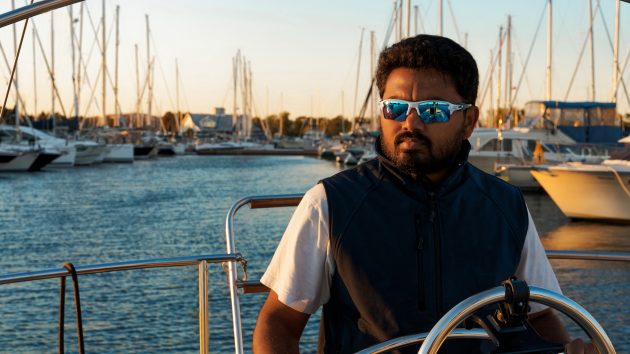
Saddened to learn that Gaurav Shinde ji has opted out of the next Golden Globe Race.
He told @NewIndianXpress that the competition's no-internet policy makes it difficult to promote both the individual journey and the race itself at a frequency expected by brands willing to join as player sponsors.
He will instead sail the vessel from Canada to India (a mini GGR, if you will) in late 2026.
"During the course of this journey and beyond, I will actively work towards promoting sailing culture in India. Like how Donde sir, @abhilashtomy ji, and so many others are doing," he told @xpresskerala.
More power to you, Gaurav ji.
Gaurav Shinde, who has roots in India, is currently based in Canada.
@realkaypius @ajithgeorge100 @arunp2810 @srikantkesnur @Cmde_GPrakash @PrasantCMenon @CaptDKS @Urmimala_A @rameshmenon128 @JohnsonOdakkal @sandinmyfist @writetake @YAIUpdates @sailorshinde @NewtonSTOI @Nakro_Jojo @sanjeevsanyal
1
1
5
330

27 Dec 2025
LCA Navy taking off INS Vikramaditya
🎥 @/writetake
23 Dec 2025

LCA Navy taking off from shore based facility, INS Hansa, Goa.
Rafale M was also certified at the same facility for operations from INS Vikrant and Vikramaditya
6
88
1,184
97,482

19 Dec 2025
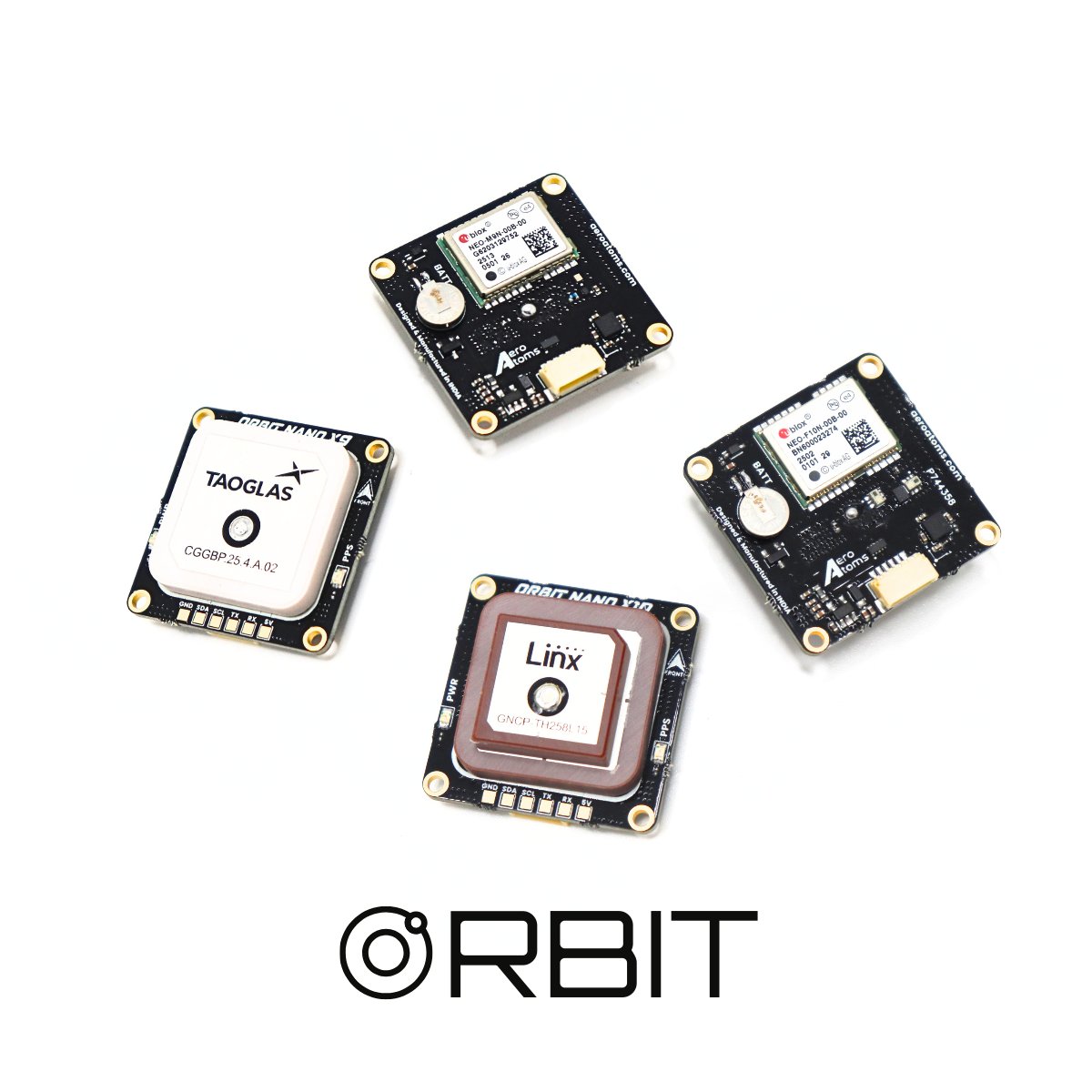
The Orbit family just got bigger !
We’re introducing two new GNSS modules — Orbit Nano X9 and Orbit Nano X10.
Designed, Manufactured, and Assembled in India 🇮🇳, these standard-precision GNSS modules feature UART communication and are optimized for seamless integration.
• Orbit Nano X9 — powered by u-blox M9N
• Orbit Nano X10 — powered by u-blox F10N, with NavIC support
Small form factor | Stable positioning
Orbit Nano X9 Docs: docs.aeroatoms.com/orbit-nan…
Orbit Nano X10 Docs: docs.aeroatoms.com/orbit-nan…
🛰️ Orbit Nano X9 | X10
📦 Available to order soon
@NewsIADN @alpha_defense @gareebscientist
@FrontlinerUV @kishanchand_89 @writetake
@ArduPilotTeam @PX4Autopilot @makeinindia
@dronefed @DroneHelpline @UnmannedSystem
4
12
79
2,702