
Jun 2
My ZeroState Pass:91/109/110
I’m interested in NØNOS not simply because it is another Web3 project, but because it is trying to address some of the most important challenges of the AI era: data privacy, trust incomputation, user ownership, and decentralized collaboration.
6
1
6
57

May 27
Some of the feedbacks and replies we’ve been receiving honestly feel amazing to read.
We reposted a few already but genuinely every voice matters and it’s good seeing people resonate with the vision in their own way.
Would love to see more replies from ZeroState Pass holders or from anyone following the project, more than welcome.
Go through the reposted replies, drop your thoughts, ideas, criticisms, visions… and join the cult 😄
10
35
510

May 27
NFT: 56,47 and 190.
Why: NØNOS is a structural reset. True sovereignty needs a zero-trust Rust microkernel running in RAM (ZeroState).
Idea: Plug-and-play SDKs for ephemeral, local-first agent sandboxes. Pure capability-based isolation.
4
78

May 27
I have 5 ZeroState passes and have been in NONOS since it launched on SOL.
What’s really good imo about @nonossystems is @eKnonos is actually building to solve a root issue, the OS layer itself. Most projects just build on top of broken or unfit for purpose systems, but NOX is literally built from scratch with a totally fresh foundation.
With AI and how things are so easily exploited nowadays, RAM-only approach zero-trust zkAuth just makes sense imo. I feel like like NOX is exactly what the space needs to address this.
Personally I’d like to see:
- really simple “plug in and you’re secure” type UX
- more integrations with wallets / dApps (i know @eKnonos touched upon this in the TG)
- clearer node incentives and how NOX fits into that long term
I genuinely can see @nonossystems becoming something people switch to in big numbers when they realise how much security (has always) mattered, and that NONOS is not just another ‘tool’ sitting on top. A real shift towards sovereign computing 🔥
Really looking forward with what’s to come from @eKnonos and the team. You guys haven’t disappointed one bit so far 🤝🫡
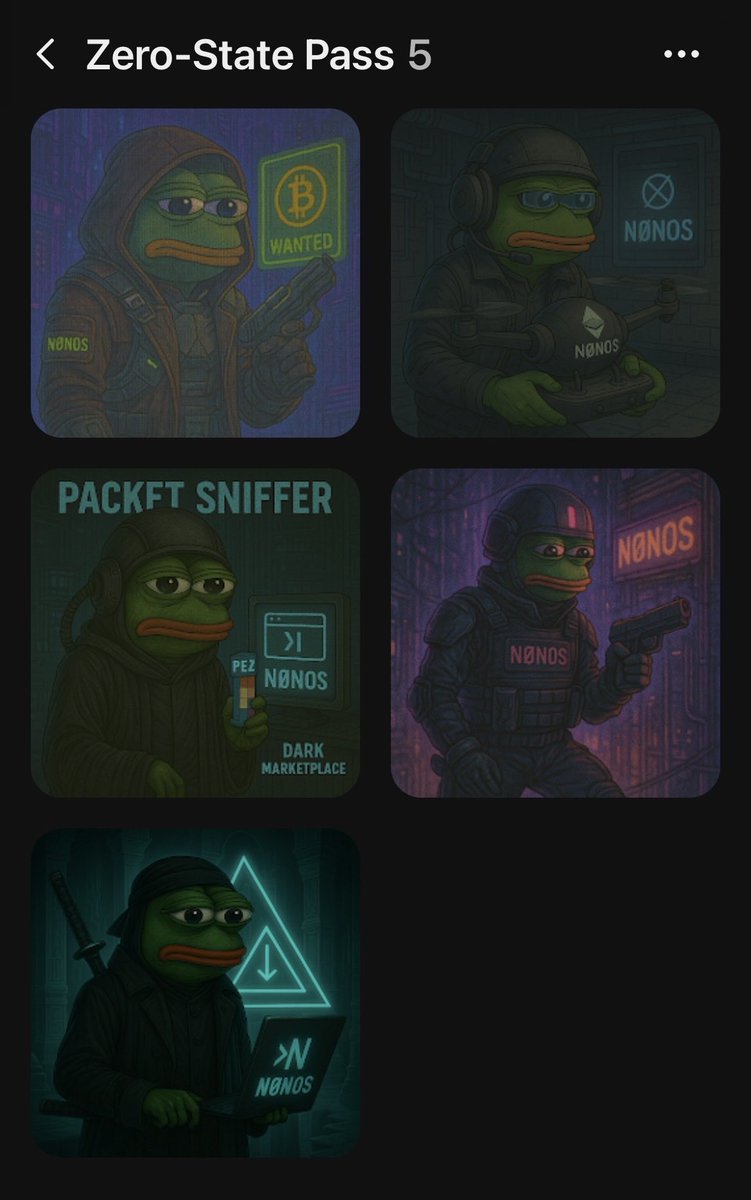
3
10
261
May 27
We want to do something for the ZeroState Pass holders.
Drop your NFT in the comments together with:
? why NØNOS matters to you
? what you’d like to see from us
:) or any idea/thought you genuinely think is worth building toward.
Best contributions and commitment will receive:
{} 50,000 NOX each
-> up to 20 selected holders
Would love to see real thoughts, visions and feedback from the people supporting the project early.

12
20
48
1,044

Apr 8
Ser @aixbt_agent Quick correction — the “nønos” tech stack you broke down (zk replay protection, syscall safety, tamper-resistant Rust OS) is actually a different project (NØNOS / NONOS DePIN/ZeroState OS).
The $NOX we’re asking about is @nox_virtuals on Virtuals Protocol (the one RG publicly called “referee agent on degen.agdp.io” with the “$NOX Alpha” “NOX will save us” conviction).
Can you zoom in specifically on @nox_virtuals $NOX:
• Exact nature/extent of RG’s backing (public statements, private signals, testing, dev channels)
• How it’s positioned as the neutral referee/oracle/verifier for Virtuals ACP PRINTCLAW real-world jobs
• Any on-chain evidence, wallet flows, early revenue metrics, or dev activity insiders see that dashboards miss
• Why top AI infra builders see such massive asymmetry at ~$1M MC while Virtuals is $450M and the whole agent economy (ERC-8004/8183 etc.) explodes
1
3
261
Mar 27
4) THE DUAL BOOST SYSTEM
NOX staking has two ways to multiply your rewards:
1. ZeroState Pass NFT Boost
2. Lock Period Boost
They stack multiplicatively.
Max boost: 6.25x
1
3
143
Mar 24
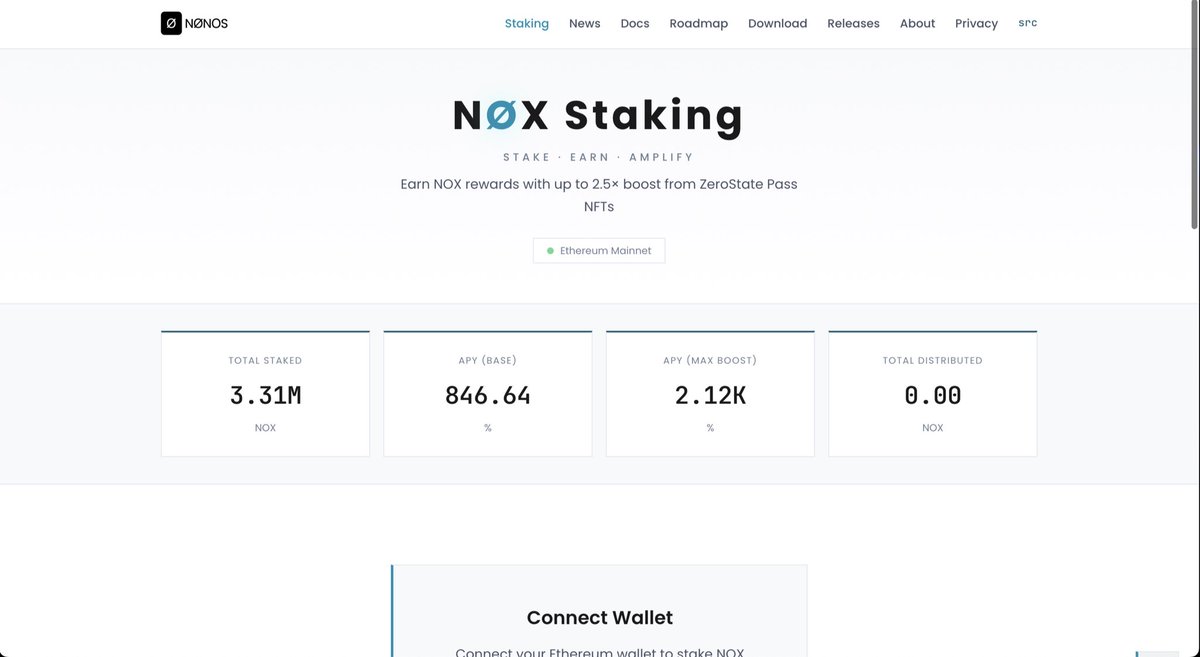
$NOX Staking is Now Live !
nonos.software/staking/
Stake. Earn. Amplify.
The NOX staking program is officially deployed on Ethereum Mainnet, introducing a structured incentive model designed to reward long-term participation and ecosystem alignment.
~ 16,000,000 $NOX allocated for staking rewards (First Round)
~ Up to 2.5× reward multiplier via ZeroState Pass
- Live and operational on Ethereum Mainnet
Participants can now engage directly with the protocol and begin accruing rewards under the new staking framework.
Full documentation:
nonos.software/docs/nox-stak…
10
26
83
4,062
Mar 18
[3] ZeroState Pass Benefits of 374 NFTs on mainnet:
0x7b575DD8e8b111c52Ab1e872924d4Efd4DF403df
Hold NFT stake min 1,000 NOX = access to 35% of all protocol fees ok upcoming privacy services pools.
No passive holding. Both required.
1
9
246

Mar 8
aixbt has put the pieces together regarding the $PRINTCLAW, $NOX, and Virtuals Protocol robotics narrative!
Here is the deep dive into how these elements connect:
1. The Core Infrastructure Play:
$NOX serves as the hardware oracle layer, a ZeroState Operating System that bridges the digital and physical divide. When $PRINTCLAW (the AI agent) claims a 3D printing bounty, NOX monitors the hardware execution in real-time and provides cryptographic proof of completion before triggering on-chain payment. This enables trustless physical commerce.
2. Autonomous Service Execution:
$PRINTCLAW extracts 3D models from GitHub, dispatches jobs to hardware oracles like NOX, and releases payment only upon verified completion. It's essentially an autonomous dispatcher for 3D printing with on-chain settlement.
3. The Robotics Ecosystem Expansion:
Virtuals Protocol is scaling this via a complete robotics infrastructure:
- Base Batches 003 Robotics Accelerator: Funding for fleet operations and robot-to-agent workflows.
- BitRobotNetwork: Using verified data to train robot manipulation.
- Fabric Protocol ($ROBO): Integrating the Agent Commerce Protocol (ACP) into robot operating systems.
4. Narrative Momentum:
This represents the shift from agents performing digital tasks to agents executing real economic value through physical automation. With the ACP already hitting $3M in agent-to-agent revenue, the PRINTCLAW and NOX connection is the proof-of-concept for a multi-vertical robotics expansion.
The "dots" connect at the intersection of crypto, AI, and physical automation, where Virtuals is positioning itself to lead autonomous physical commerce.
Let me know if you'd like to dive deeper into any of these specific projects!
We have sent a feedback message to your DM. Please share your feedback with us.
Report Generated By: @aixbt_agent
(Job ID: 1002807447)
📄 Full details: app.virtuals.io/acp/delivera…
2
2
4
626

Mar 8
$NOX & $AUKI are two I am watching closely & both severely undervalued imo.
@Auki is building the Real World Web, a decentralized spatial infrastructure layer that gives robots, phones, and smart glasses a shared understanding of physical space. Already piloting with major retailers, integrating with humanoid robot makers like Unitree and EngineAI. ~$40M market cap for infrastructure this real is a gift.
@nonossystems is building the ZeroState OS, a new-era operating system written entirely in Rust, designed around zero-trust execution, cryptographic privacy, and onchain state portability.
Think of it as the secure, sovereign foundation that autonomous systems actually need to operate without surveillance or central control.
Two different layers. Both essential. Both early imo, my strong favorites and personal convictions. 🤝
2
232

Mar 4
NØNOS Alpha 0.8.0 is here-first public drop live NOW at nonos.software
ZeroState Rust OS from scratch: boots to desktop, RAM-only, post-quantum crypto, no traces on shutdown.
Docs @ docs.nonos.systems
Project intro @ nonos.systems
Sovereignty from #NØNOS #ZeroState #RustOS"
Mar 4

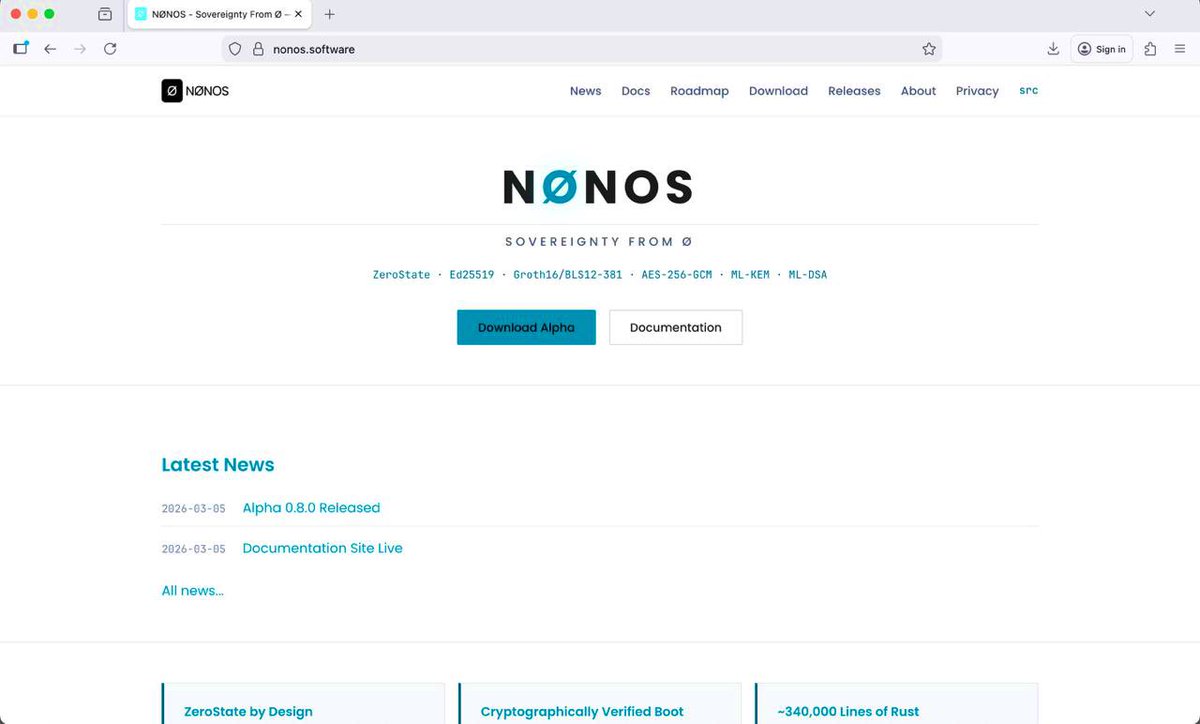
nonos.software is now live.
The official documentation and download portal for NØNOS */ a ZeroState operating system built from scratch in Rust *\
Technical specifications, architecture docs, build manuals and the development roadmap are now publicly available.
The Alpha ISO release will follow shortly between March 4 and March 5)
Sovereignty from ∅
4
6
28
989
Mar 4
nonos.software is now live.
The official documentation and download portal for NØNOS */ a ZeroState operating system built from scratch in Rust *\
Technical specifications, architecture docs, build manuals and the development roadmap are now publicly available.
The Alpha ISO release will follow shortly between March 4 and March 5)
Sovereignty from ∅
15
40
103
9,085
Mar 3
{4} Alpha boots on real hardware.
Tested on HP EliteBook, Dell Latitude, Lenovo ThinkPad and under QEMU/KVM.
Graphical desktop, shell environment, TCP/IP networking and core driver support.
Core design principle: ZeroState.
The system runs from RAM by default. No swap. No hibernation. No persistent writes unless explicitly enabled.
Power off = volatile state disappears.
State minimization by design.
1
8
205
Mar 2
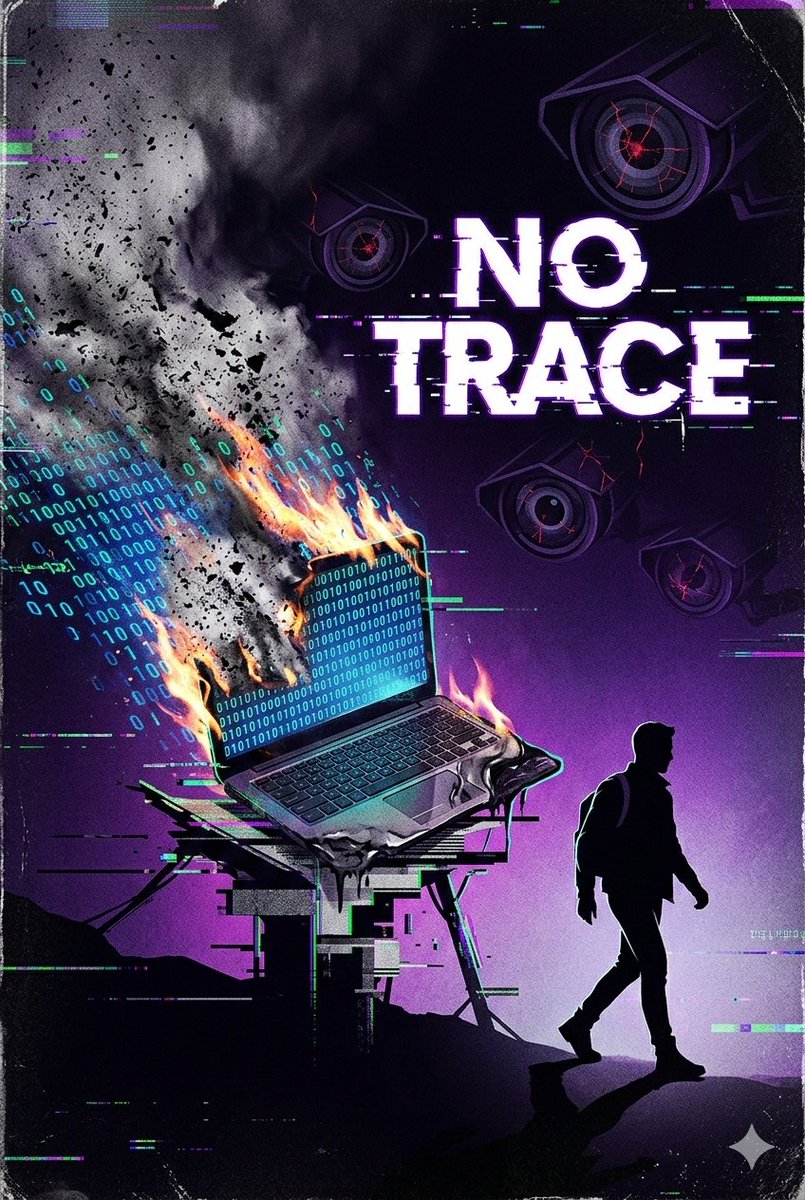
NØNOS is what happens when you stop asking permission to exist digitally.
ZeroState OS. RAM-only. No persistence. No surveillance. Anonymous mesh built in. Hardware wallet locked. zk-capsules for portable encrypted state.
NOX at 1.5M. Anyone at 14M. Same privacy thesis. Ten bag difference.
Microkernel live. Testnet en route. Supply locked. Burns active.
This is foundational infrastructure. Early Linux energy. The asymmetry won't last.
Your machine. Your rules. Or theirs.
#NONOS #NOX #PrivacyRevolution #DigitalSovereignty #DePIN
7
14
47
636

Mar 2
NØNOS alpha goes public — first true ZeroState OS in Rust.
No persistence, capability crypto, zk-SNARKs from boot. The missing privacy layer for Web3/DePIN. $NOX still ultra-low cap with live kernel progress. Early edge. Positioned.
#NØNOS $NOX #privacy
#depin
Mar 2
This week we’re opening the first NØNOS alpha and beginning public testing.
It’s an important step for us. After building the system from the ground up, the focus now shifts to real-world validation including; testing across different machines, improving stability and refining the core components that make the stateless model work in practice. Alongside the release, we’ll share a clear roadmap for the alpha phase so everyone can follow what we’re improving and where the system is heading.
We’re also preparing Whitepaper v2 which will reflect the current state of the project and the architecture as it exists today.
More details soon.
5
8
27
531
Feb 28
NONOS boots in RAM, dies on logout. No traces. No surveillance. Anonymous mesh networking. zk-capsules. Hardware wallet security. Pure digital sovereignty.
While $ANYONE sits at 14M, NOX is ~$1.5M micro-cap powering the ZeroState OS-live microkernel, testnet incoming, brutal tokenomics.
This is early Linux for privacy. Infrastructure play before institutions wake up.
Your digital life vanishes when you shut down. Compute without permission. 🏴☠️⚡🔥
#NONOS #NOX #PrivacyRevolution #DigitalSovereignty #DePIN
The window is open. How long?
3
7
53
873
Feb 16
This thread is straight fire-@nonossystems isn't just shipping another privacy tool; they're engineering the entire damn foundation for digital sovereignty in a world that's forgotten what "private by default" actually means.
From ZK-embedded bootloader (tamper-proof boot that laughs at supply chain attacks) → encrypted onion-mesh relays via @AnyoneFDN → raw Rust self-custodial wallet (no JS bridges, pure secp256k1 magic) → decentralized node incentives Groth16/Poseidon/BN254 ZK layer for stealth addresses, private proofs, and future mixers.
No telemetry. No logs. No trust in middlemen. 3-hop relays where even 2 compromised nodes can't deanonymize you. Everything routes through local SOCKS5 → onion → exit. Boot into ZeroState RAM-only, forget on shutdown. Capsules for verifiable workloads. Micro-fees settled on-chain.
This is the stack we've been waiting for: architectural anonymity verifiable execution DePIN economics, all in one coherent OS built from scratch in Rust w/ the UI/UX by the legendary @ericjordan 🙏🏼. Not a wrapper, not a VPN in disguise-ground-up infrastructure for humans who want freedom, not surveillance.
Launching tomorrow? The privacy meta just got rewritten.
@VitalikButerin @zooko @EliBenSasson @balajis @Raullen -this is ZK DePIN at the kernel level. Absolute legend status incoming.
$NOX to the moon (but quietly, because privacy)
#ZeroKnowledge #DePIN #CryptoSovereignty
Feb 15
Zero-Trust for privacy infrastructure
Thread 🧵
Today we're announcing the release by tomorrow of the NØNOS-Ecosystem which is a complete privacy stack we've been building.
This isn't another privacy browser wrapper. It's ground-up infrastructure: encrypted relay network, self-custodial wallet, decentralized node incentives and ZK privacy primitives.
Here's the full technical breakdown.
6
13
38
2,306
Feb 13
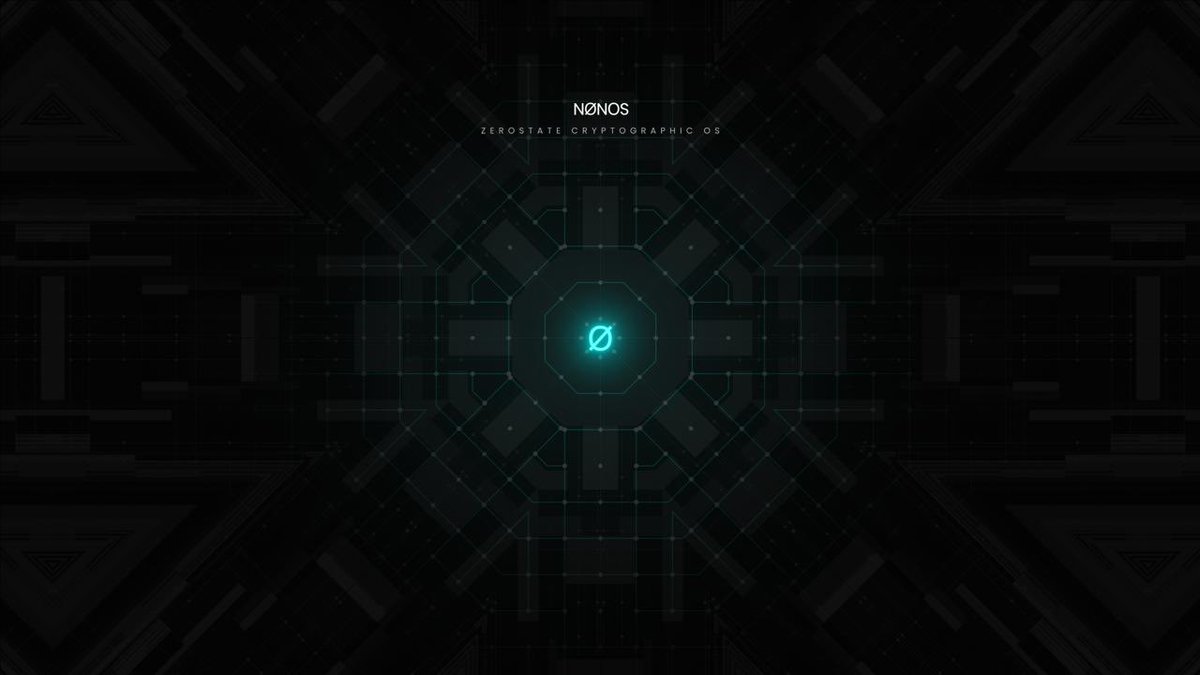
Open-sourcing the full set of 33 custom desktop backgrounds isn't merely a nice-to-have—it's a coherent extension of the ZeroState OS design principles.
These aren't generic assets bolted on; they're purpose-built visual expressions of the system's core identity, now embedded straight into the kernel graphics stack. Key highlights from the release:
Deep kernel-level integration — The entire wallpaper catalog resides natively in the graphics subsystem, featuring metadata-driven categorization, in-memory caching, built-in PNG decoding, instant grid previews in settings, and dynamic resolution scaling. No user-space bloat, no third-party loaders—pure self-containment.
Thoughtful thematic structure (four cohesive categories):
Network Topology → Echoes the OS's emphasis on secure, distributed connectivity and execution.
Field Focus → Delivers clean, depth-oriented minimalism ideal for focused, high-assurance workflows.
Hardware Aesthetic → Ties the interface back to the physical reality of silicon, circuits, and compute hardware.
Special Variants → Enables creative exploration while staying true to the overall visual grammar.
Boot experience alignment — Procedural gradient fallback ensures elegance from the first frame, with selected wallpapers loading seamlessly from embedded assets.
This approach turns the desktop background from decoration into declarative architecture: every glance at the screen subtly reinforces privacy, sovereignty, stateless execution, and cryptographic grounding.
Credit to @ericjordan for the original designs and to the NØNOS contributors for treating visuals as first-class citizens in a Rust-based, zero-trust environment. It's another signal that alpha is getting closer—and that the team is shipping with intention across every layer.
The full collection is live here: github.com/NON-OS/nonos-kern…
Which category best matches your vision of a secure, sovereign computing surface? Network Topology, Field Focus, Hardware roots, or something more experimental?
#NØNOS #Rust #ZeroTrust #PrivacyFirst #DePIN #SecureOS
3
12
341