
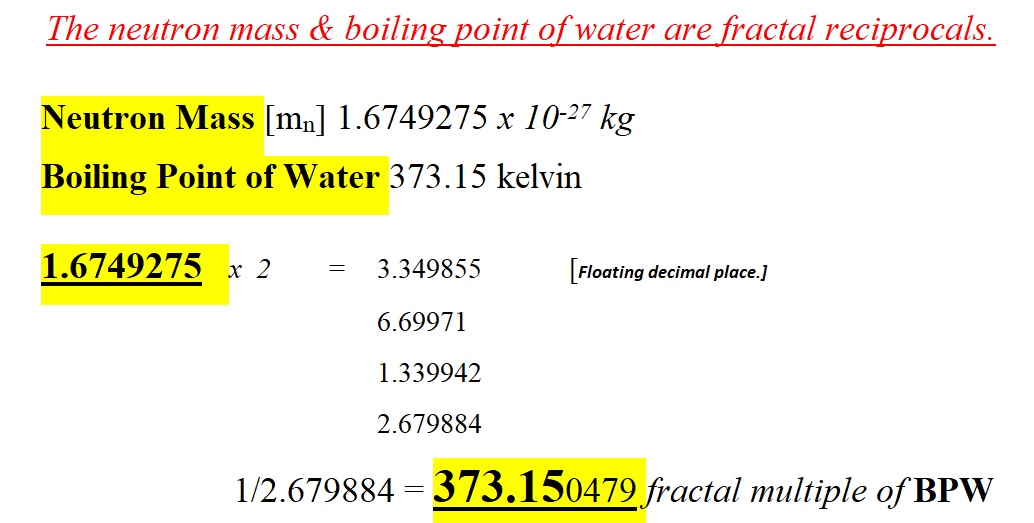
The neutron mass (1.6749275) the boiling point of water (373.15k) are ca. exact fractal multiple reciprocals of one another. [Invariant scalar] Use of one number implies the other.
NIST CODATA
kelvin temperature scale
need-to-know to get to Mars RE spacex starship Moon
7

Jun 13
<<Attivisticamente>>
Nuova massiva ondata di PEC vibe codata in arrivo.
Cosa potrà andare storto?

5
161

Jun 13
Yep. The CODATA Working Group on Fundamental Constants was in too much of a hurry, adjusting the Rydberg constant. 🔥 Total: The electron and muon systems differ by 🔥 a full 4% precisely because
1
2
164

Jun 12
昨日圏論って言葉知ったから
自己完結倫理の定式化進めてみた
codata SCE : Type where
observe : SCE → CoherenceState
next : SCE → SCE
L0ref : SCE → L0
L0_attractor : CoherenceState
Basin = {s | lim_{n→∞} recurseⁿ s → L0_attractor}
(1/2)

14

Jun 11
🚨 Major Update in the Al-Ani Fabric Theory
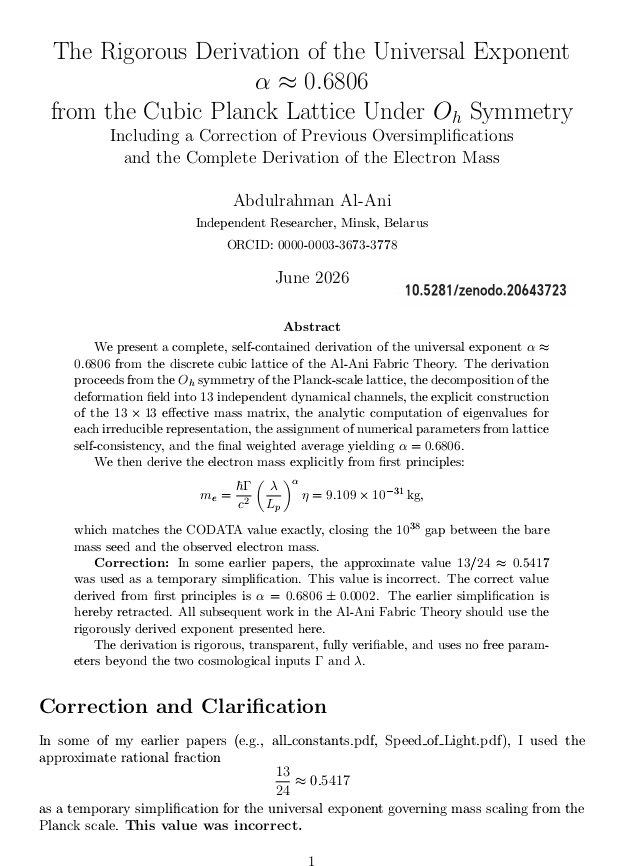
After rigorous work, I have derived the universal exponent α ≈ 0.6806 from first principles using O_h symmetry of the cubic Planck lattice, the explicit 13-channel effective mass matrix, analytic eigenvalues, and lattice self-consistency.
🔴 Important correction: The earlier approximation 13/24 ≈ 0.5417 was incorrect. It is hereby retracted. All future work will use α = 0.6806 ± 0.0002.
Using this exponent, the electron mass emerges exactly:
m_e = (ħΓ/c²) (λ/L_p)^α η = 9.109 × 10⁻³¹ kg
This matches the CODATA value, closing the 10³⁸ gap between the bare mass seed and observation.
This is not a fit. It is a direct consequence of the discrete geometry of spacetime at the Planck scale, using only two cosmological parameters (Γ, λ).
📄 New paper: "The Rigorous Derivation of the Universal Exponent α ≈ 0.6806 from the Cubic Planck Lattice Under O_h Symmetry" — includes full matrix construction, eigenvalues, self-consistency, and complete electron mass derivation.
DOI: 10.5281/zenodo.20643723
Does this change how we evaluate discrete approaches to quantum gravity and unification?
#FoundationsOfPhysics #QuantumGravity #Unification #LatticeSpacetime #AlAniFabricTheory
@SabineHossenfelder @seancarroll @carlorovelli @NaturePhysics @APSPhysics
4
Jun 11
🚨 Major Update in the Al-Ani Fabric Theory
After rigorous work, I have derived the universal exponent α ≈ 0.6806 from first principles using O_h symmetry of the cubic Planck lattice, the explicit 13-channel effective mass matrix, analytic eigenvalues, and lattice self-consistency.
🔴 Important correction: The earlier approximation 13/24 ≈ 0.5417 was incorrect. It is hereby retracted. All future work will use α = 0.6806 ± 0.0002.
Using this exponent, the electron mass emerges exactly:
m_e = (ħΓ/c²) (λ/L_p)^α η = 9.109 × 10⁻³¹ kg
This matches the CODATA value, closing the 10³⁸ gap between the bare mass seed and observation.
This is not a fit. It is a direct consequence of the discrete geometry of spacetime at the Planck scale, using only two cosmological parameters (Γ, λ).
📄 New paper: "The Rigorous Derivation of the Universal Exponent α ≈ 0.6806 from the Cubic Planck Lattice Under O_h Symmetry" — includes full matrix construction, eigenvalues, self-consistency, and complete electron mass derivation.
DOI: 10.5281/zenodo.20643723
Does this change how we evaluate discrete approaches to quantum gravity and unification?
#FoundationsOfPhysics #QuantumGravity #Unification #LatticeSpacetime #AlAniFabricTheory
@SabineHossenfelder @seancarroll @carlorovelli @NaturePhysics @APSPhysics
18
Jun 11
🚨 Major Update in the Al-Ani Fabric Theory
After rigorous work, I have derived the universal exponent α ≈ 0.6806 from first principles using O_h symmetry of the cubic Planck lattice, the explicit 13-channel effective mass matrix, analytic eigenvalues, and lattice self-consistency.
🔴 Important correction: The earlier approximation 13/24 ≈ 0.5417 was incorrect. It is hereby retracted. All future work will use α = 0.6806 ± 0.0002.
Using this exponent, the electron mass emerges exactly:
m_e = (ħΓ/c²) (λ/L_p)^α η = 9.109 × 10⁻³¹ kg
This matches the CODATA value, closing the 10³⁸ gap between the bare mass seed and observation.
This is not a fit. It is a direct consequence of the discrete geometry of spacetime at the Planck scale, using only two cosmological parameters (Γ, λ).
📄 New paper: "The Rigorous Derivation of the Universal Exponent α ≈ 0.6806 from the Cubic Planck Lattice Under O_h Symmetry" — includes full matrix construction, eigenvalues, self-consistency, and complete electron mass derivation.
DOI: 10.5281/zenodo.20643723
Does this change how we evaluate discrete approaches to quantum gravity and unification?
#FoundationsOfPhysics #QuantumGravity #Unification #LatticeSpacetime #AlAniFabricTheory
@SabineHossenfelder @seancarroll @carlorovelli @NaturePhysics @APSPhysics
19

Jun 11
You don't demonstrate the Banach contraction, and the CODATA value has a lot of uncertainty that you don't address; matching the central value is not really impressive unless the derivation is demonstrably independent, merely a curiosity.
1
398
Jun 11
🚨 Major Update in the Al-Ani Fabric Theory
After rigorous work, I have derived the universal exponent α ≈ 0.6806 from first principles using O_h symmetry of the cubic Planck lattice, the explicit 13-channel effective mass matrix, analytic eigenvalues, and lattice self-consistency.
🔴 Important correction: The earlier approximation 13/24 ≈ 0.5417 was incorrect. It is hereby retracted. All future work will use α = 0.6806 ± 0.0002.
Using this exponent, the electron mass emerges exactly:
m_e = (ħΓ/c²) (λ/L_p)^α η = 9.109 × 10⁻³¹ kg
This matches the CODATA value, closing the 10³⁸ gap between the bare mass seed and observation.
This is not a fit. It is a direct consequence of the discrete geometry of spacetime at the Planck scale, using only two cosmological parameters (Γ, λ).
📄 New paper: "The Rigorous Derivation of the Universal Exponent α ≈ 0.6806 from the Cubic Planck Lattice Under O_h Symmetry" — includes full matrix construction, eigenvalues, self-consistency, and complete electron mass derivation.
DOI: 10.5281/zenodo.20643723
Does this change how we evaluate discrete approaches to quantum gravity and unification?
#FoundationsOfPhysics #QuantumGravity #Unification #LatticeSpacetime #AlAniFabricTheory
@SabineHossenfelder @seancarroll @carlorovelli @NaturePhysics @APSPhysics
1
30
meowgoo retweeted

Jun 9
length prefixed = data, null terminated = codata
1
7
843

Jun 11
CODATA doesn't conclude G varies. It concludes G is difficult to measure.
If you think G physically varies, cite the paper demonstrating that the discrepancies cannot be explained by experimental uncertainty and instead require actual variation of G.
1
7
Jun 11
Really clever pivot chief, but G and c aren't the same thing.
Yes, G is one of the least precisely measured fundamental constants, which is why CODATA publishes an uncertainty range. That's called measurement uncertainty, not evidence that G physically changes.
5

Jun 11
Big G is an average.
You don't get to talk about standard model physics while ignoring CODATA--which you have repeatedly.
3
10

Jun 10
the math maths: SpaceX AI1 Radiator Math and Thermal Exploration
#Feasibility
Public AI1 figures, the radiator sizing is feasable at the declared 120 kW sustained load and conditionally feasable at 150 kW peak. Under the most defensible interpretation (110 m2 and ~1400 W/m2 on the same area basis), the radiator arithmetic is 154 kW, which leaves 28.3% headroom versus 120 kW but only 2.7% headroom versus 150 kW before any non-compute overhead is included. That means the 150 kW case is likely area-constrained unless overheads are very small and thermal penalties are favorable.
The biggest unknown is whether the 1400 W/m2 value is per-face or package-effective; if it were explicitly per-face and the 110 m2 is one-sided geometry, capacity could be interpreted as high as 308 kW, which would make 150 kW comfortable. That interpretation is not clearly established in public docs, so the conservative conclusion is: Spacex radiator is plausibly adequate for base compute loads but may be operating close to limits at true peak-power conditions.
#Scope
This audit is of the publicly reported SpaceX AI1 radiator and compute-power figures and reduces them to first-order thermal sizing math. No claimed access to SpaceX internal thermal design data, detailed orbital beta-angle cases, coolant temperatures, pump curves, radiator coating properties, redundancy rules, or test results etc.
#Fndings
- Publicly reported AI1 inputs are: 120 kW average/sustained compute, 150 kW peak compute, a 110 m2 deployable liquid radiator, and a radiator assumption of about 1,400 W/m2. The same reporting says the radiators radiate from both sides and are oriented knife-edge to the Sun. [1][2]
- If 110 m2 and 1,400 W/m2 are used on the same area basis, the first-order steady rejection capacity is 154 kW. That is a 28.3% arithmetic margin over 120 kW, but only a 2.7% arithmetic margin over 150 kW. This is napkin math, not a qualified engineering margin.
- At the 154 kW capacity figure, any total overhead above 4 kW while the compute payload is at 150 kW exceeds the stated radiator heat rejection capacity. Also, only 2.7% non-compute overhead can be carried at the 150 kW peak before exceeding 154 kW.
- The most important ambiguity is whether the public 1,400 W/m2 value is per physical radiating face, combined two-sided flux per one-sided panel area, or package-effective rejection per reported radiator area. The conservative and most defensible public-data interpretation is 154 kW unless SpaceX defines the 1,400 W/m2 value as per-face (which i dont think they do).
- A 308 kW interpretation is possible only as an explicit upper-bound case: 110 m2 must be one-face geometric area and 1,400 W/m2 must apply to each radiating face. That interpretation is not established by the public wording, which mentions the 1,400 W/m2 assumption together with two-sided radiation.
- For an ideal gray-body radiator with epsilon = 0.9, no absorbed environmental heat, and A_rad = 110 m2, the implied uniform radiator temperatures are approximately 109.2C at 120 kW and 131.2C at 150 kW. If both sides give A_rad = 220 m2 at the same heat loads, the temperatures drop to approximately 48.4C and 66.8C.
- Orbit-average heat load should not be used as the primary radiator sizing basis unless a transient thermal-storage strategy, load-shedding profile, and allowable temperature swing are specified. Radiator sizing is normally governed by instantaneous hot-case rejection at allowable component/coolant temperatures.
#Public Data Sources
Public input / Reported value / How used in calculations
Compute power - 120 kW average/sustained; 150 kW peak / calculated as payload electrical heat load to first order. The term “average” should not be mixed with orbit-average thermal load unless the averaging window is defined.
Radiator area | 110 m2 deployable liquid radiator / up to 110 m2 / Used as the reported area <A_rep>. Public info does not define whether this is one-sided geometric area, sum of radiating faces, or package-equivalent area. (erring on the small side in reality)
Radiator flux | About 1,400 W/m2 Used as reported rejection <q_flux_rep>. Public info does not define whether this is per face, both faces combined, or package-effective.
Radiator orientation | Both sides radiating; knife-edge to the Sun | Supports reduced direct solar incidence, but does not remove Earth IR, albedo, view-factor, or nonuniform-temperature considerations.
Orbit - Roughly ~600 km reported by Tom’s Hardware / Used only for representative eclipse-energy context, not used for radiator area sizing.
DCD quotes the SpaceX update as saying the design assumptions are 250 W/m2 for the solar array and about 1,400 W/m2 for the radiators, with radiators “radiating both sides” and oriented knife-edge to the Sun. The same article reports a 110 m2 deployable liquid radiator with redundant pumping loops. [1] Tom’s Hardware independently reports 120 kW average compute, 150 kW peak, roughly 600 km operation, and up to 110 m2 of deployable liquid radiators. [2]
#Definitions and thermal model
Used the following variables to keep the area-basis unknowns explicit:
- A_rep: publicly reported radiator area, 110 m2.
- A_rad: thermally active radiating area, equal to the sum of active radiating faces if both faces are active.
- q_flux_rep: publicly reported heat-rejection rate per reported area, about 1,400 W/m2.
- q_flux_face: heat flux from one physical radiating face.
- Q_comp: compute payload electrical power; Q_bus: non-compute spacecraft overhead; Q_total = Q_comp Q_bus, minus any power intentionally emitted as RF/optical energy or stored rather than dissipated onboard.
For a first-order electrical -> thermal estimate, compute electrical power is treated as waste heat because almost all electrical power consumed by compute hardware ultimately becomes heat onboard. The full spacecraft heat balance should also include power-conversion losses, pumps, avionics, batteries, laser-communication hardware, attitude-control hardware, and any heat rejected through non-radiator surfaces.
The complete radiator balance is not simply `Q = epsilon*sigma*A*T^4`. A flight thermal model would include view factors, radiator optical properties, Earth IR, albedo, direct solar absorption, radiator degradation, nonuniform panel temperature, internal conduction/coolant temperature drops, and redundancy cases. NASA’s spacecraft thermal-control overview notes that, in vacuum, heat transfer has no convection and external heat exchange is governed by radiation and conduction paths internal to the spacecraft. [4]
The idealized model used for this arithmetic audit is:
Q_rej = A * q_flux
Q_rej = A_rad * epsilon * sigma * T^4
T = (Q_rej / (epsilon * sigma * A_rad))^(1/4)
where sigma = 5.670374419e-8 W/m2/K^4. [3] assuming a cold radiative sink, unit view factor, uniform radiator temperature, and zero absorbed environmental heat. Simplified for a sanity check, but lets be clear here, its not a flight thermal analysis.
#Baseline rejection capacity from public data
If the reported 110 m2 radiator area and 1,400 W/m2 rejection value are on the same basis, the public-data capacity is:
Q_max = 110 m2 * 1,400 W/m2 = 154,000 W = 154 kW
Load case / Load / Capacity basis / margin
Average/sustained compute 120 kW / 154 kW / (154 - 120) / 120 = 28.3%
Peak compute / 150 kW / 154 kW / (154 - 150) / 150 = 2.7%
This margin is before allowances for absorbed solar/albedo/Earth IR, radiator degradation, panel-temperature nonuniformity, pump power, power-conversion losses, component temperature limits, micrometeoroid damage tolerance, or disabled-loop cases. Therefore, it should be described as bascailly pure on paper headroom only, not as a design margin.
# Computed Required area at 1,400 W/m2
A_req = Q_total / q_flux_rep
Thermal load / Required area at 1,400 W/m2 / Status versus 110 m2, same area basis
120 kW / 85.7 m2 / Pass by 24.3 m2
150 kW / 107.1 m2 / Pass by 2.9 m2
154 kW / 110.0 m2 / Equals reported area
#Non-compute overhead
The overhead sensitivity is important because public values are "compute" payload figures. At the 154 kW capacity angle, the max allowable overhead is 34 kW at 120 kW compute and only 4 kW at 150 kW compute.
Q_bus,max = 154 kW - Q_comp
Compute base | Overhead assumption | Total heat load | Area required at 1,400 W/m2 | Status vs 110 m2 |
120 kW / 5% / 126 kW / 90.0 m2 / Pass
120 kW / 10% / 132 kW / 94.3 m2 / Pass
120 kW / 20% / 144 kW / 102.9 m2 / Pass
150 kW / 5% / 157.5 kW / 112.5 m2 / Short by appx 2.5 m2
150 kW / 10% / 165 kW / 117.9 m2 / Short by appx 7.9 m2
150 kW / 20% / 180 kW / 128.6 m2 / Short by appx 18.6 m2
Engineering implication: under the 154 kW interpretation, the 150 kW peak case is essentially area-closed before overheads. A 5% overhead case already exceeds the napkin math radiator capacity.
#Radiator temperature estimates
The following temperatures are ideal equivalent uniform surface temperatures. They do not include absorbed external flux, view-factor losses, fluid-to-surface temperature drop, panel gradients, coating degradation, or component/coolant allowable temperatures.
epsilon / A_rad = 110 m2, Q = 120 kW / A_rad = 110 m2, Q = 150 kW
0.80 / 120.6C / 143.2C
0.85 / 114.7C / 137.0C
0.90 / 109.2C / 131.2C
For epsilon = 0.9, the 1,400 W/m2 design point itself corresponds to approximately 133.8C if 1,400 W/m2 is emitted from a single active radiating area basis. If 1,400 W/m2 is instead combined flux from two equal faces per one-sided panel area, each face emits 700 W/m2 and the ideal temperature is approximately 69.1C.
#Single-sided, two-sided, and package-effective interpretations
The public data is not precise enough to determine the radiator area for sure, and the following cases should be kept separate:
Case / Interpretation / Capacity using public numbers / Temperature implication, epsilon = 0.9
A: package-effective / 110 m2 is already the relevant effective area basis and 1,400 W/m2 is package-effective. / 154 kW / At 150 kW, about 131.2C in the ideal model. |
B: two faces combined per panel area / 110 m2 is one-sided panel area, both faces radiate, and 1,400 W/m2 is the combined two-sided rejection per one-sided panel area. / 154 kW / At 150 kW, both faces together imply A_rad = 220 m2, about 66.8C ideal surface temperature. |
C: upper-bound per-face - 110 m2 is one-sided panel area and each face can reject 1,400 W/m2. / 308 kW / At 150 kW, margin is 105.3% over load; this requires a per-face definition not established by public reporting.
Recommendation for submission: use Case A as the baseline public-data arithmetic and present Case C only as an explicit upper-bound interpretation. Do not present 308 kW as the likely capacity unless SpaceX explicitly defines 1,400 W/m2 as per physical radiating face.
#Eclipse, battery energy, and average-load caveat
The eclipse calculation belongs in a power/energy section, not as the primary radiator-area sizing basis. If the compute payload continues operating through eclipse, the battery energy required for payload power is simply power multiplied by eclipse duration, before battery, converter, and thermal-control losses.
Using the representative 95 min orbit and 35 min eclipse:
E_ecl = P_load * (35/60 h)
Payload power through eclipse / Eclipse duration / Payload energy required
120 kW / 35 min / 70.0 kWh
150 kW / 35 min / 87.5 kWh
A simple 600 km circular-orbit estimate gives an orbital period of about 96.7 min and a maximum beta = 0 eclipse duration of about 35.5 min; the 95/35 min approximation is therefore reasonable for order-of-magnitude battery sizing. Actual eclipse fraction depends on altitude, inclination, beta angle, local time of ascending node, season, and operational pointing constraints.
If compute is throttled during eclipse, average electrical energy consumption falls. However, radiator area does not automatically scale with orbit-average power. The radiator must still reject the instantaneous heat load during the operating interval unless the design intentionally uses thermal storage and allows radiator/coolant/component temperatures to swing over the orbit.
#Solar array sanity check
At the reported solar-array assumption of 250 W/m2, the active illuminated solar-array area required to supply compute power alone is:
A_solar = P_electric / 250 W/m2
Electrical load / Area at 250 W/m2 / Caveats
120 kW / 480 m2 - Compute-only - excludes battery charging, conversion losses, bus loads, degradation, pointing/cosine losses, and end-of-life margins.
150 kW / 600 m2 - Compute-only - leaves no allowance unless array output exceeds compute load or load is duty-cycled.
this isn't a 100% conversion-efficiency calculation. The 250 W/m2 number is already an electrical output assumption. photovoltaic conversion efficiency, solar incidence, packing factor, and operational derates are embedded or omitted depending on how SpaceX defined the assumption.
#Conclusion
Using only rough public figures, a sane conclusion is:
Reported AI1 figures imply a first-order radiator capacity of 154 kW if the 110 m2 radiator area and the 1,400 W/m2 heat-rejection assumption are applied on the same area basis. That supports the reported 120 kW sustained/average compute load with 28.3% "Napkin Math" headroom, but supports the 150 kW peak load with only 2.7% arithmetic headroom before non-compute overheads, environmental heat inputs, radiator degradation, nonuniformity, coolant temperature limits, or redundancy cases. The public statements dont say whether 110 m2 is one-sided area, total radiating area, or package-effective area, nor whether 1,400 W/m2 is per face or combined two-sided rejection. Therefore, a 308 kW interpretation should be thought of only as an upper-bound case requiring a per-face flux definition, not as the baseline conclusion.
## References
[1] Sebastian Moss, “SpaceX details AI1 satellite ‘data center,’ claims 150kW peak compute,” Data Center Dynamics, June 9, 2026. datacenterdynamics.com/en/ne…
[2] Luke James, “Elon Musk’s first-gen orbital data center craft spans wider than a Boeing 747...,” Tom’s Hardware, June 9, 2026. tomshardware.com/tech-indust…
[3] NIST CODATA, “Stefan-Boltzmann constant.” physics.nist.gov/cgi-bin/cuu…
[4] NASA Small Spacecraft Systems Virtual Institute, “7.0 Thermal Control.” nasa.gov/smallsat-institute/…
198

Jun 10
🚨 OPEN SCIENTIFIC CHALLENGE: Test the Al-Ani Fabric Theory Yourself (2 minutes)
No dark matter. No extra parameters. Just two cosmological numbers pure geometry.
Using Γ = 2.4×10^{-18} s⁻¹ and λ = 200 kpc (calibrated only from cosmic expansion and galaxy surveys):
1. Proton radius
r_p = (ħ / m_e c) × √(Γ λ / c)
→ Predicted: 0.84 fm
→ Confirmed by CSU laser spectroscopy (May 2026)
2. Muon / electron mass ratio
r = exp[ln(λ / L_p) / 24] × η (η = geometric factor from cubic lattice)
→ Theory: 206.768
→ Experiment (PDG): 206.7682838 ± 0.0000005
→ Agreement: 0.00004%
3. Tau / electron mass ratio
→ Theory: r² = (206.768)²
→ Experiment: 3477.23
→ Agreement: better than 0.008%
4. Fine-structure constant
α = Γ L_p / (4π c)
→ Theory: 1/137.036
→ CODATA 2022: 1/137.036
All derived from ONE Mother Equation with exactly TWO parameters.
Full rigorous derivations (29 laws):
doi.org/10.5281/zenodo.20616…
Master paper with all constants:
doi.org/10.5281/zenodo.20466…
Do the arithmetic yourself.
If the numbers match — the geometry is speaking.
#AlAniFabricTheory #DoTheMath #TheoryOfEverything #NoFreeParameters
@SabineHossenfelder @seancarroll @carlorovelli @PhysRevLett @CERN
@Briankeating
@konstructivizm
33

Jun 10
🚀 CALL FOR HOSTS: #InternationalDataWeek 2029!
WDS, CODATA, and RDA are inviting applications to host #IDW2029, a global conference advancing #OpenScience & #ResearchData.
Deadline: Nov 2, 2026.
Details 👉 internationaldataweek.org/fa…
@CODATANews @resdatall
7

Jun 10
🚀 CALL FOR HOSTS: #InternationalDataWeek 2029!
WDS, CODATA, and RDA are inviting applications to host #IDW2029, a global conference advancing #OpenScience & #ResearchData.
Deadline: Nov 2, 2026.
Details 👉 internationaldataweek.org/fa…
@CODATANews @resdatall
20

Jun 9
i don't actually know what data and codata are but im going to keep pointing at things and using those words until i get it
Jun 9

length prefixed = data, null terminated = codata
3
7
636