
Iran can codify anything they want. It has zero bearing on international waterways.
In spirit with codification, each post you make to me will cost you $100. So contact me for payment details.
2
14

18 USC §951.
What is it?
18 U.S.C. § 951 is a U.S. federal criminal statute titled "Agents of foreign governments". It is part of Title 18 (Crimes and Criminal Procedure), Chapter 45 (Foreign Relations).
This law is sometimes used alongside or in place of FARA in counterintelligence prosecutions. For the official source, see the U.S. Code on the House of Representatives or GPO websites.Full Text (current as of 2024/2025 codification)(a) Whoever, other than a diplomatic or consular officer or attaché, acts in the United States as an agent of a foreign government without prior notification to the Attorney General if required in subsection (b), shall be fined under this title or imprisoned not more than ten years, or both.(b) The Attorney General shall promulgate rules and regulations establishing requirements for notification.(c) The Attorney General shall, upon receipt, promptly transmit one copy of each notification statement filed under this section to the Secretary of State for such comment and use as the Secretary of State may determine to be appropriate from the point of view of the foreign relations of the United States. Failure of the Attorney General to do so shall not be a bar to prosecution under this section.(d) For purposes of this section, the term "agent of a foreign government" means an individual who agrees to operate within the United States subject to the direction or control of a foreign government or official, except that such term does not include—
(1) a duly accredited diplomatic or consular officer of a foreign government, who is so recognized by the Department of State;
(2) any officially and publicly acknowledged and sponsored official or representative of a foreign government;
(3) any officially and publicly acknowledged and sponsored member of the staff of, or employee of, an officer, official, or representative described in paragraph (1) or (2), who is not a United States citizen; or
(4) any person engaged in a legal commercial transaction.(e) Notwithstanding paragraph (d)(4), any person engaged in a legal commercial transaction shall be considered to be an agent of a foreign government for purposes of this section if—
(1) such person agrees to operate within the United States subject to the direction or control of a foreign government or official; and
(2) such person—
(A) is an agent of Cuba or any other country that the President determines (and so reports to the Congress) poses a threat to the national security interest of the United States for purposes of this section, unless the Attorney General, after consultation with the Secretary of State, determines and so reports to the Congress that the national security or foreign policy interests of the United States require that the provisions of this section do not apply in specific circumstances to agents of such country; or
(B) is an agent of any country that the Attorney General, after consultation with the Secretary of State, determines and so reports to the Congress poses a threat to the national security interest of the United States for purposes of this section.govinfo.govKey PointsThis statute requires prior notification to the Attorney General for non-exempt individuals acting as agents of foreign governments.
It is narrower than the Foreign Agents Registration Act (FARA, 22 U.S.C. § 611 et seq.), which focuses on political activities and public disclosure. Section 951 is more oriented toward national security and espionage-like conduct.
Exemptions cover diplomats, official representatives, certain staff, and ordinary commercial dealings—unless those commercial activities involve direction/control by certain high-risk countries (e.g., those designated as national security threats).law.cornell.eduPenalties: Up to 10 years in prison and/or fines.
2
2
23

bsahely.com/2026/06/14/no-wo…
No Wound Denied, No Wound Enthroned: Holocaust Memory, Genocide Prevention, and the Life-Coherent Ethics of Non-Disposability | ChatGPT-5.5 High Intelligence and NotebookLM
The Holocaust remains one of the defining moral ruptures of modern civilization: the systematic, state-sponsored persecution and murder of approximately six million Jews by Nazi Germany and its allies and collaborators, alongside the persecution and killing of millions of other targeted persons (United States Holocaust Memorial Museum [USHMM], n.d.; Yad Vashem, n.d.). Its deepest ethical meaning is not exhausted by historical documentation, national commemoration, legal codification, or communal grief. The Holocaust confronts humanity with the terrifying fact that modern institutions – law, medicine, science, transport, bureaucracy, accounting, policing, education, and industrial production – can be coordinated toward the organized destruction of human beings rendered disposable.
This white paper argues that Holocaust memory becomes life-coherent when it conserves universal non-disposability: the principle that no human group may be stripped of protection, reduced to contamination, and placed outside the circle of mournable life. Holocaust memory becomes pathological when captured to conserve exceptional innocence, exceptional entitlement, or geopolitical immunity. The central ethical maxim proposed here is: No wound denied. No wound enthroned. No people’s suffering should be minimized, relativized, denied, or erased; but no people’s suffering should be elevated into a license for domination, dispossession, collective punishment, or new life-destruction.
Using the life-coherent framework, this paper examines the Holocaust from inception to contemporary commemoration through the questions cui bono and cui malo: who benefits and who is harmed when memory functions as warning, and who benefits and who is harmed when memory becomes political capital. It then situates Gaza as a present moral stress test of Holocaust memory, not by making crude equivalences with Auschwitz, but by asking whether “never again” remains a universal preventive obligation when the threatened population is Palestinian. The conclusion proposes a life-coherent ethics of remembrance grounded in truth, grief, reciprocity, legal accountability, and the protection of the life-ground.
12

Same the basis of psychiatry with its flexibly useful diagnostic criteria specifically structured as a business model codification tool per the DSM.
Is it a professional medical book?
I guess??
What is a profession?
Is it a business model only?
28

Lmao fr. Hey guys remember that other time we promised u a declass. review board written into law, 3 going on 4 yrs in a row???? Well you can have it, but w/o the teeth, obligations, codification, and also we’ll throw in shermer!
1
2
12

Codification of the foundational principles of classical liberalism were developed during this period. The liberals borrowed from older foundations to cement the philosophy.
I wouldnt give you jack in a box tacos for your "education"
1
23


The evidence is in the codification of Democrat sponsored election laws since 2009. They've created an unfair election process with partisan legislation. It may not be fraud but it is unfair and discriminatory.
3

Which “concerns” are outlined Doug??
Or is it just the same old moribund nonsense from every minority group grifting from the taxes of working Canadian families?
The Kelowna Pride press release is another pompous diatribe from yet more misguided Canadians.
The truth is that there are no “first nations”. This is a term foisted upon myriads of ethnic clans which never were, and never will, be nations at all.
UNDRIP is a lunacy - largely drafted by Canadian activitists - and considered inappropriate for codification even by Jody Wilson Rayboud!
Canada and BC are the only two jurisdictions on Earth to codify this idiocy and everyone else is watching the debacle unfold.
The hypocrisy of opposing, for example, Albertan separatism, whilst supporting indigenous separatism is a stark.
The indian tribes have perhaps become little more than an all singing, all dancing front for a combination for greedy “chiefs”, oligarchical grifters and ideological zealots.
The very idea that the PM of Canada is carrying out “nation to nation” negotiations with, for example, this guy, is ridiculous.

1
1
71
The Kelowna Pride press release is another pompous diatribe from yet more misguided Canadians.
The truth is that there are no “first nations”. This is a term foisted upon myriads of ethnic clans which never were, and never will, be nations at all.
UNDRIP is a lunacy - largely drafted by Canadian activitists - and considered inappropriate for codification even by Jody Wilson Rayboud!
Canada and BC are the only two jurisdictions on Earth to codify this idiocy and everyone else is watching the debacle unfold.
The hypocrisy of opposing, for example, Albertan separatism, whilst supporting indigenous separatism is a stark.
The indian tribes have perhaps become little more than an all singing, all dancing front for a combination for greedy “chiefs”, oligarchical grifters and ideological zealots.
The very idea that the PM of Canada is carrying out “nation to nation” negotiations with, for example, this guy, is ridiculous.

1
3
6
65
It’s a pompous press release from yet more misguided Canadians.
The truth is that there are no “first nations”. This is a term foisted upon myriads of little ethnic clans which never were, and never will, be nations at all.
UNDRIP is a lunacy - largely drafted by Canadian activitists - and considers inappropriate for codification even by Jody Wilson Rayboud!
Canada and BC are the only two jurisdictions on Earth to codify this idiocy and everyone else is watching the debacle unfold.
The hypocrisy of opposing, for example, Albertan separatism, whilst supporting indigenous separatism is a stark.
The indians have become little more than an all singing, all dancing front for a combination for greedy “chiefs”, oligarchical grifters and ideological zealots.
The very idea that the PM of Canada is carrying out “nation to nation” negotiations with, for example, this guy, is ridiculous.

3
1
9
114

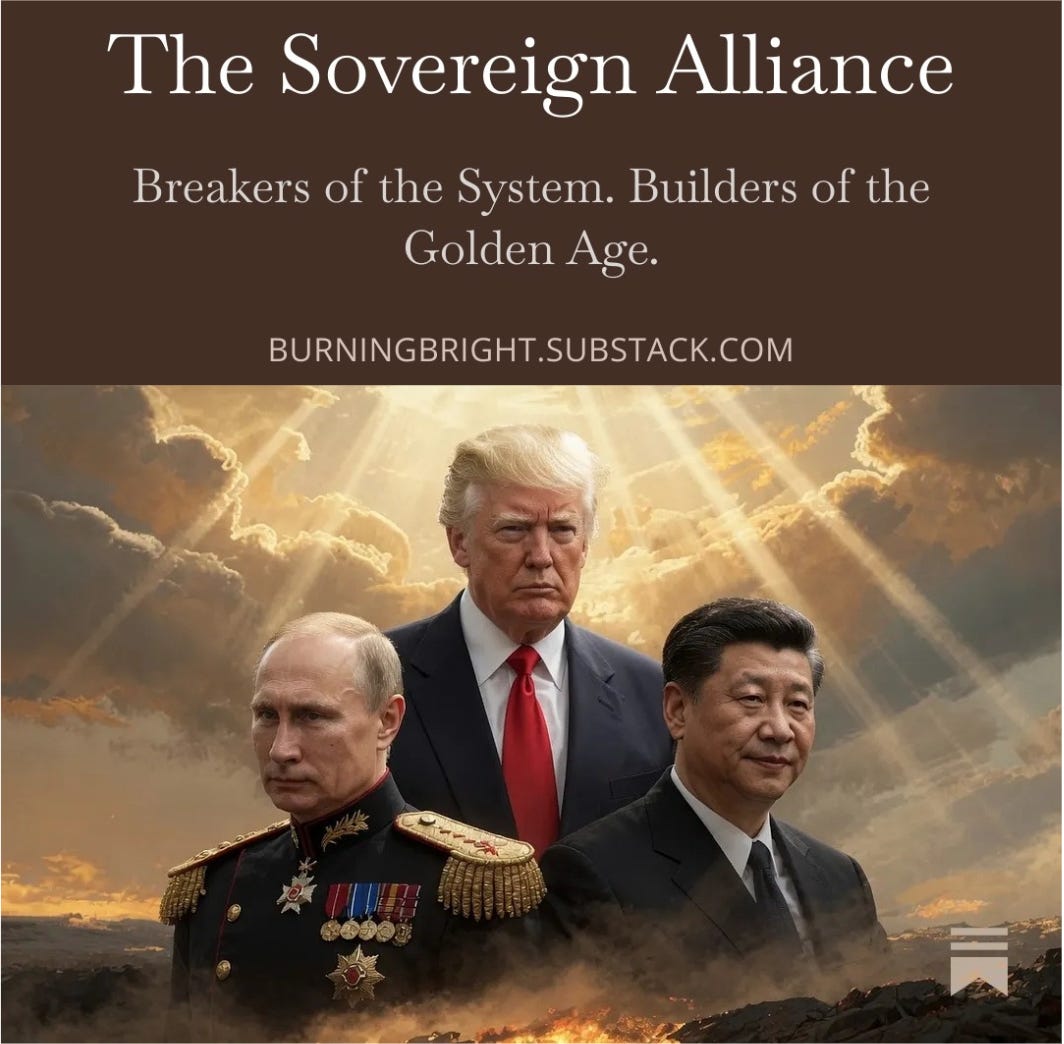
In the midst of Donald Trump's Discombobulator, from Venezuela to Iran, I would argue that the Sovereign Signal has never been more clear to those with the eyes to see it.
Especially the True Enemy.
So, if we agree broadly on what the Sovereign Alliance stands against, what does it stand for?
Well, I believe the answer to that question is itself another in a cascade of what I refer to as Perfect Paradoxes in the Info War, one that mirrors an idealized form of what the Truth Community could have been, should have been and perhaps once was.
The Sovereign Alliance is a Decentralized Collective, in keeping with Man’s nature and God’s design.
And while I have and will again explore this macro concept in greater detail when it comes to the Info War and our role in it, in the context of the Sovereign Alliance, it can be boiled down into one First Principle from which all of said alliance’s actions radiate:
Each to himself BEFORE another … but not AGAINST another.
Cooperative Competition. Mutual Accelerationism.
Regions of Responsibility.
Strategic Friendship.
Sovereign Radiation.
THAT is what the Sovereign Alliance stands FOR, in my estimation.
But then, who’s in it?
Well, certainly many names operate on the periphery, and some are quite vital to the connective tissue of the world being constructed through the aforementioned deconstruction.
From Saudi Arabia to North Korea, Venezuela to Syria. And even leaders of industry and of culture who do not stand at the head of nations, and yet, who are helping to lead them out of the darkness and into the light, often against the wishes of their would-be peers, the Sovereign Alliance is as exclusive in origin as it is expansive in projected endgame, as MUST be the case for it to have any long-term value in keeping with those it extolls and hopes to radiate writ large across the battlespace.
And each player has his own role to play in the mesh.
But the core vision of my framing (and naming) of the Sovereign Alliance has ever and always come down to three names.
Three pairs.
A Trinity and a triangle, the strongest shape.
And now, as we’ll explore herein, the coordination, commitment and codification of that Trinity is upon us, and by the very System they mean to destroy.
And while one pairing herein began my research and writing in the Info War, a second pairing has been accelerating of late, becoming increasingly-apparent not just to the so-called Truth Community, but even more so to those who the Sovereign Alliance seeks to bring down.
Which was itself a response to the third pairing, and the one that was always going to bring the convergence into the light of the awakening.
The Sovereign Signal is no longer subtle. It is no longer deniable.
And the Invisible Enemy is more starkly aware of this eventuality than even many in a community built on the idea of Trump standing at the head of a patriot plan to liberate the world.
He is not alone in doing so.
My latest.
burningbright.substack.com/p…
3
40
106
1,595

Intent is a legal variable. If the component cant be proved then the legal codification changes. I make no claim in this case. But it could hypothetically change the outcome.
2

100 % ! Wish we had such 🐘 CONGRESSIONAL Leaders! What 🐘 GOP could DO if 🦏Thune was on 🐘 Team instead of Obstructing! Senate 🦏 w/TDS CON’t to OBSTRUCT SAVE ACT, DJT Appts, 🐘Agenda, Codification of 2024 🗳️! 🫏 Oppose, Expected!
🦏 who OPPOSE 🐘 Agenda is ODIOUS, VILE! 👎
6

(Quant à l'affirmation selon laquelle « les savants n'ont pas rendu obligatoire l'adhésion à une école », cela remonte à une époque antérieure à la codification et à l'établissement des écoles.)
Tuhfat al-Muhtai fi Sharh al-Minhaj, Kitab-Zakah 12/491
1
353

SPACE X is not connecting financial price could end up with no codification. Like I said to EFF on Whatsapp we should engage or work with government departments, means global interest on the map. Not kind of blood cells means no guarantee of government or where network
1
3
14

12h
Worth resharing as this thread might be the defining truth about our demise, without the Save Act and Codification of executive orders preventing this to continue!

🧵 THREAD: You've heard the phrase "OUR DEMOCRACY" a million times. But what exactly is "OUR DEMOCRACY"? 🤔
When they say "democracy," they don't mean a republic. They don't mean consent of the governed. They don't mean your right to choose your own leaders.
They mean a system where "institutions" - NGOs, multilaterals, the permanent bureaucracy - advance a set of values they consider settled: equality, social justice, cosmopolitanism, global governance. These values aren't proposals to be voted on. They're treated as moral prerequisites that must be true *before* your vote counts.
Despite what they say, they aren't for checks and balances. Checks and balances limit what government can do to you. This limits what you can do to *them*. The brakes are on accountability, not power. The institutions that set the boundaries of acceptable policy have put themselves beyond the reach of the electorate, and they call that arrangement "democracy."
Trump has been an existential threat to this system since the moment he said "drain the swamp" ... because the swamp IS the system. When he threatened those institutions, he didn't threaten the republic. He threatened their immunity from it.
And they said so. On camera. At their own events. In their own words.
As always, patience as I pull together the thread.👇
1
6

The space between them has a name.
The CODIFICATION GAP.
The distance between what you know and what others can find, understand, and reference.
Your knowledge is real.
It just has no portable form.
1

How useful it is to read books, depends also on the domains of knowledge a book is covering.
Codification: How much of the domain's knowledge can be written down. High codification (e.g. mathematics) means books capture most of what matters. Low codification (e.g. entrepreneurship) means much knowledge resists being put into words.
Feedback Speed: How quickly you find out if a decision was right or wrong. Fast feedback (e.g. cooking) lets you learn by trial and error. Slow feedback (e.g. investing) means mistakes may take years to reveal themselves — making books more valuable as a shortcut.
Locality: How much knowledge depends on local context. High locality (e.g. local politics) means general books help less. Low locality (e.g. physics) means universal principles apply everywhere.
Error Cost: How expensive mistakes are. High error cost (e.g. surgery, war) means you cannot afford to learn by doing alone — books and vicarious experience become essential.
Temporal Relevance: Whether past knowledge remains relevant. Some domains change slowly (e.g. human nature, philosophy) making old books invaluable. Others change rapidly (e.g. technology) where older books lose relevance.
1
18

Partager son style de vie est la surface, derrière il y a malheureusement une codification de l’introversion qui se fait et une idéalisation de ce qu’est être introverti (un peu comme si on présentait la vie d’extraverti comme le fait de faire la fête tout le temps et parler très fort)
1
42