
I agree. This seems to be a common trick.
A disappointing commoditisation of talent?
1
13

tu touches juste mais regarde les chiffres, l'intégration IA d'Adobe et Salesforce crée une dépendance client massive. le vrai risque c'est pas la commoditisation en 18 mois, c'est de rater le momentum maintenant pendant que leurs clients migrent tout leur workflow

J’ai décidé de renforcer mes positions sur $ADBE et $CRM Je les ai en portefeuille déjà j’augmente mon exposition
Le marché continue de pricer les SAAS comme s’ils allaient être remplacés par l’IA. Je pense l’inverse, et les chiffres commencent à le confirmer.
L’IA a besoin de data pour fonctionner, des données d’entreprise confidentielles qui ne peuvent pas toutes être stockées dans des data centers US, surtout depuis que l’administration Trump s’est octroyé un droit de regard sur la data hébergée sur le sol américain. Au-delà du stockage, il y a l’entraînement des modèles qui pose le même problème de confidentialité.
Résultat, les seules solutions viables pour beaucoup d’entreprises sont des modèles IA locaux ou hybrides, qui demandent un investissement massif en matériel, en recrutement, en maintenance et en sécurité. Sans parler du coût des tokens et du coût de migration d’un Saas existant, qui se chiffre en mois voire en années.
Pendant ce temps les géants du SAAS intègrent l’IA directement dans leurs produits existants, sans migration, sans rupture.
Sur Adobe, l’ARR lié à l’IA a triplé sur un an et dépasse 500 millions de dollars. Le CA du trimestre atteint 6,62 milliards de dollars, en hausse de 13% sur un an, un record. L’IA générative type Sora a montré ses limites économiques, coûts énormes, rentabilité proche de zéro. Les marques ont une identité visuelle construite depuis des années sur Creative Cloud, ce n’est pas un outil qu’on remplace du jour au lendemain.
Sur Salesforce, l’ARR Agentforce et Data 360 atteint 3,4 milliards de dollars, en hausse de plus de 200% sur un an. Le CA annuel atteint 41,5 milliards de dollars. La migration d’un historique client de plusieurs années reste un coût et un risque que peu d’entreprises veulent prendre.
Dans les deux cas l’IA n’est pas une menace pour le modèle SAAS, elle est devenue un moteur de croissance supplémentaire à l’intérieur de ce modèle maintenant faut être patient et attendre que le marché se réveille sur le sujet, faudra sûrement attendre 2027
Pas un conseil en investissement.
1
115

$INOD — Neutral : données et évaluation IA utiles, mais plus exposé à la commoditisation.
$APLD — Neutral spéculatif : data centers IA, mais risque élevé sur financement, énergie et exécution.
$AAOI — Neutral spéculatif : optique/data centers, bon levier IA, mais très cyclique et volatile. Pas un cœur de portefeuille.
1
405

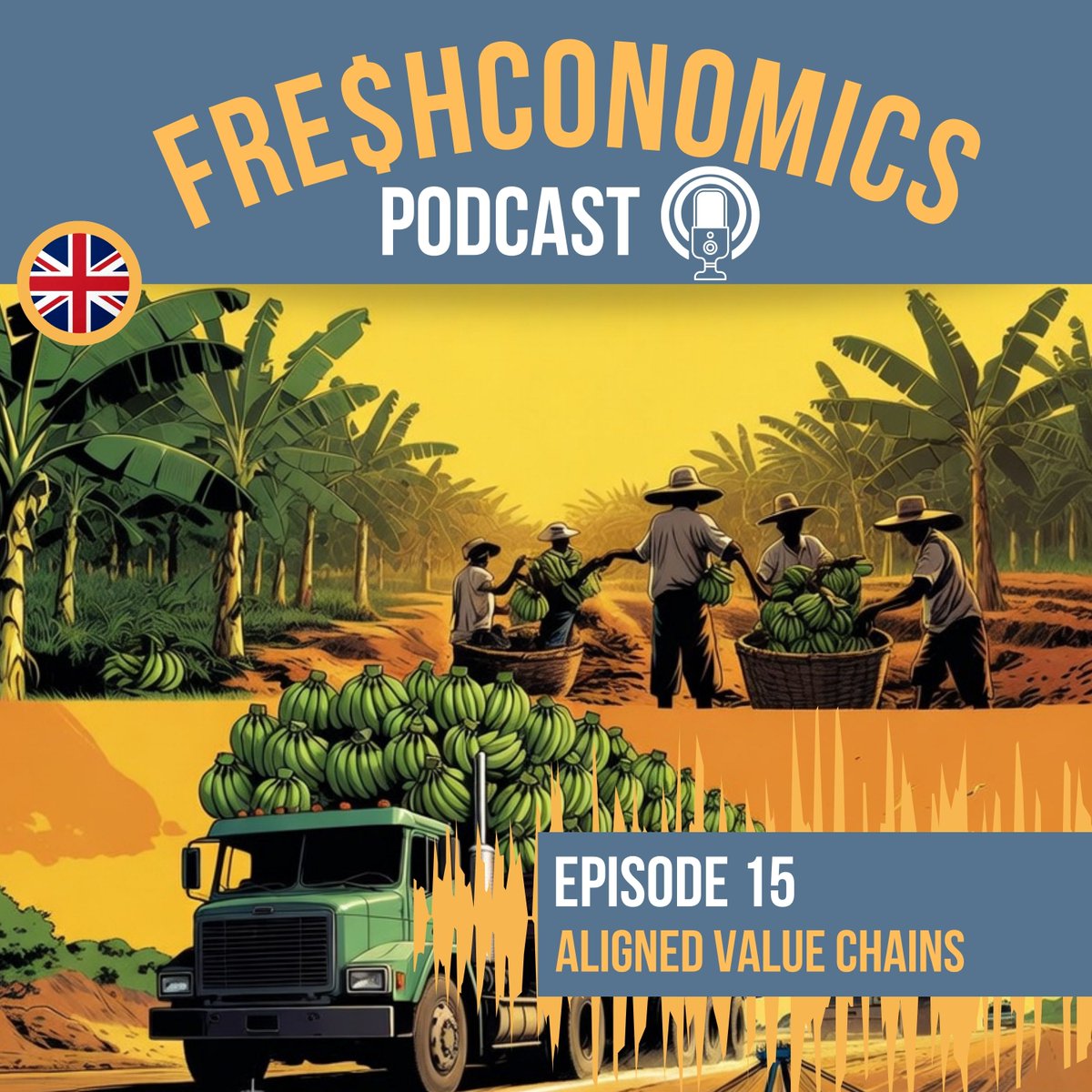
Strategically Aligned Supply Chains may seem like a product of modern business thinking, yet the history of the banana industry offers a better example than almost any case study.
#commoditisation, #EconomiesofScale, #CriticalMass, #logistics, #IntensiveDistribution
Listen to this episode 🎙️ 15 here 👇
1
18

11h
La seule chose que Jeff Bezos n'intègre pas @brivael C'est que dans les pays socialo-communistes qui foisonnent en Europe, on ne cherche pas à solutionner des problèmes mais à en créer de nouveaux. C'est la commoditisation du problème en tant qu'art de vivre. L'IA et les builders essayent de le solutionner tandis que les socialistes essayent d'en créer plus pour justifier leur inexistence. Et surtout en tirer des profits financiers.
13
12h
Pour aller encore plus dans ton sens, je dirais que l'on va commencer à utiliser des modèles de moins en moins chers, voire open source, adaptés à chacune des tâches que l'on souhaite mener. En plus de la commoditisation, c'est vraiment l'intégration de l'IA à la vie courante, en tout cas celle des entreprises.
15

James O'Brien has spent every single day over the last 10yrs on a ruthless pursuit, accusing The Daily Mail of spreading lies, misinformation, and fabricating stories
#OBINGO @LBC
In his book, James O'Brien labelled the Daily Mail, "the lucrative business of the commoditisation of hate!!"
However, this week James O'Brien has been different. In fact, he has been over the moon! He has been excitedly boasting about how he has finally landed his dream job of being a newspaper columnist. O'Brien now writes for @theipaper. The same i newspaper that is owned by dmg media, which is a subsidiary of the Daily Mail and General Trust (DMGT) 🧐
James O'Brien likes giving people nicknames. I have an idea for a new nickname - James 'man of principles' O'Brien
10
18
142
3,523

Jun 17
La vision de Satya Nadella, le patron de Microsoft sur la façon dont les entreprises devraient intégrer l’IA est intéressante avec cette notion de cohabitation entre le “human capital” et le “token capital” en insistant sur le rôle de contrôle et de supervision irremplaçable que jouera le “human capital” et sur sa créativité essentielle. Cependant il ne peut s’empêcher d’évoquer un risque de commoditisation de nombreux métiers et de destabilisation des économies comme les premières phases de la mondialisation ont pu le faire selon ses propres termes. Il dit à raison que le politique ne l’acceptera pas. Ce n’est pas simple et pas gagné d’avance d’autant que cette mondialisation déséquilibrée n’est pas encore corrigée malgré des conséquences économiques et politiques défavorables désormais bien connues. Et les réactions politiques se sont faites souvent à travers des expressions politiques radicales et populistes. Combien de temps faudra-t-il et combien de crises politiques seront nécessaires pour arriver à un consensus probablement nécessairement mondial sur la façon d’intégrer l’IA harmonieusement à l’economie mondiale ? Combien d’expérimentations politiques désastreuses à certains endroits seront nécessaires?

1
5
11
1,006

Jun 17
At @Cannes_Lions 2026, @PublicisGroupe is pushing agencies to prioritise proven results over AI claims, showcasing real transformations and warning against industry-wide commoditisation driven by overpromising technology capabilities.
Read More: storyboard18.com/advertising…
Get all the latest news and updates on our WhatsApp channel: lnkd.in/dH8CbbRH
Subscribe to our Daily Brief Newsletter: lnkd.in/dyquZNED
#PublicisGroupe #AI #CannesLions #AIinAdvertising

62

Jun 17
Curious what you see as the equilibrium (fully diffused) revenues of Fable level models if we see no improvement from here, taking into account expected efficiency gains/commoditisation etc
18

Jun 16
One under discussed topic with these massive AI investments is that it acts as a huge forcing function towards commoditisation (including in the most extreme case via illegal means like stealing model weights).
Would be an irony of history if an “AI bubble” lead to general availability of AGI as a utility.
2
7
223


The benefits of personal freedoms and privacy outweigh the harms of personal freedoms and no privacy. Correct.
Freedom to choose
OR
No freedom to choose
The right the privacy
OR
Abusive commoditisation of personal information
How can you possibly advocate for such overreach?
1
71

Jun 15
When there was issues with cross chain tokens between blockchain Layerzero releases their OFT standards for tokens and commoditised on it
So was the ERC standards
Perhaps the data sets needs this, either everyone comes together
Or an opportunity for someone to introduce and aggressive adoption makes up for commoditisation
26


Jun 15
Wanbury Ltd FY26
Pricing pressure: Global generic API prices are down 1–3% CAGR for the past decade. Wanbury's growth is driven by volume (Metformin, Sertraline demand is rising globally as diabetes and depression prevalence climb), not pricing. The company is betting on operational efficiency and new molecules to offset commoditisation.
Read more - eduinvesting.in/word-count/
134

Jun 15
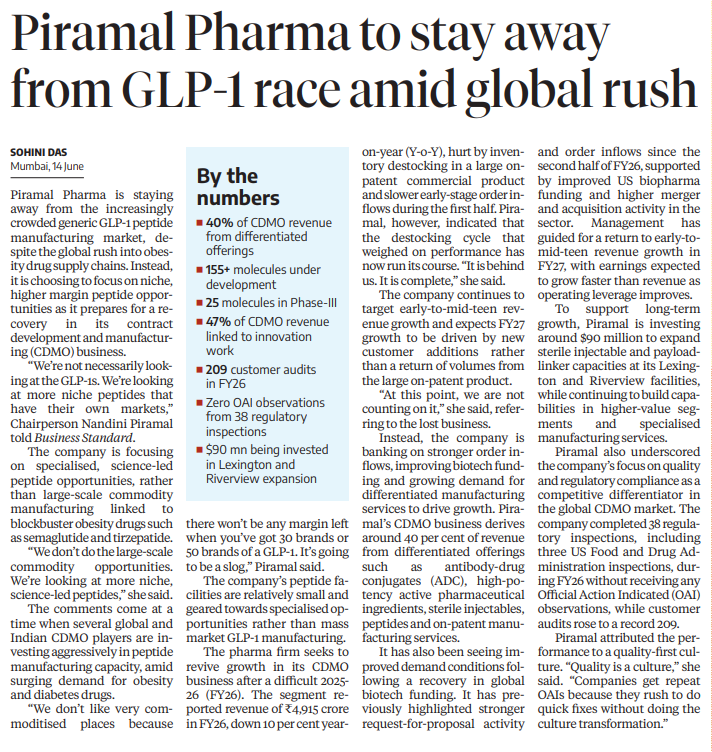
Piramal Pharma Stays Away From GLP-1 Commodity Race; Bets on Niche Science-Led Peptides and Differentiated CDMO Services — FY26 Revenue Down 10% But Recovery Expected in FY27
The Strategic Call — No GLP-1 for Piramal
Piramal Pharma deliberately staying away from the increasingly crowded generic GLP-1 peptide manufacturing market despite the global rush into obesity drug supply chains
Chairperson Nandini Piramal: "We don't do the large-scale commodity opportunities — we're looking at more niche, science-led peptides that have their own markets"
"We don't like very commoditised places because there won't be any margin left when you've got 30 brands or 50 brands of a GLP-1 — it's going to be a slog"
Instead focusing on specialised, science-led peptide opportunities rather than large-scale commodity manufacturing linked to blockbuster obesity drugs like semaglutide and tirzepatide
Company's peptide facilities relatively small and geared towards specialised opportunities rather than mass market GLP-1 manufacturing
CDMO Business — By the Numbers
40% of CDMO revenue from differentiated offerings
47% of CDMO revenue linked to innovation work
155 molecules under development
25 molecules in Phase-III
209 customer audits in FY26
Zero OAI observations from 38 regulatory inspections
$90 million being invested in Lexington and Riverview expansion
FY26 Performance — A Difficult Year
CDMO segment reported revenue of ₹4,915 crore in FY26 — down 10% YoY
Hurt by inventory destocking in large on-patent commercial product
Slower early-stage order inflows during first half
Nandini Piramal: "The destocking cycle that weighed on performance has now run its course — it is behind us. It is complete"
Company not counting on return of volumes from the large on-patent product — "at this point, we are not counting on it"
FY27 Recovery — What Will Drive Growth
Recovery expected to be driven by new customer additions rather than return of volumes from large on-patent product
Banking on:
Stronger order inflows
Improving biotech funding
Growing demand for differentiated manufacturing services
Already seeing improved demand conditions following recovery in global biotech funding
Previously highlighted stronger request-for-proposal (RFP) activity and order inflows since second half of FY26
Supported by improved US biopharma funding and higher merger and acquisition activity in the sector
Management guided for return to early-to-mid-teen revenue growth in FY27 — earnings expected to grow faster than revenue as operating leverage improves
Long-Term Investment — Capacity Expansion
Investing ~$90 million to expand sterile injectable and payload-linker capacities at Lexington and Riverview facilities
Continuing to build capabilities in higher-value segments and specialised manufacturing services
Focus on:
Antibody-drug conjugates (ADC)
High-potency active pharmaceutical ingredients
Sterile injectables
Peptides
On-patent manufacturing services
Quality Culture — The Competitive Differentiator
Piramal completed 38 regulatory inspections including three US FDA inspections during FY26 — zero OAI observations
Customer audits rose to a record 209
Nandini Piramal: "Quality is a culture — companies get repeat OAIs because they rush to do quick fixes without doing the culture transformation"
Quality and regulatory compliance underscored as a competitive differentiator in the global CDMO market
Core Theme
Piramal Pharma's deliberate decision to stay out of the GLP-1 commodity manufacturing rush — even as global and Indian CDMO players pour capacity into obesity drug supply chains — reflects a disciplined, margin-focused strategy that prioritises science-led differentiation over volume-driven commoditisation. With zero OAI observations across 38 inspections, $90 million in capacity expansion for high-value ADC and sterile injectable capabilities, and a destocking cycle now complete, Piramal is positioning for an FY27 recovery built on quality culture, innovation-linked work and biotech funding recovery — a more sustainable and defensible CDMO business than one anchored to the inevitable price erosion of a crowded GLP-1 market.
1
1
23
2,130

Jun 15
Personally, I look forward to a world where two things are commoditised: data, and compute.
On the pretraining side, I think we're approaching the physical limits of hardware, which slows GPU development enough that open-source can catch up as advanced chips diffuse beyond OpenAI and Anthropic. This, in combination with commoditisation of data (eg open-source contributions of evals for RL on something like a HuggingFace hub, in addition to pretraining data) will allow the open-source ecosystem to train 10-20T parameter models in the next 2-5 years. And 10-20T parameter models gets you a long way towards anything we could imagine doing with LLMs.
And then, as the original post talks about, capabilities on top of these open-source models will also diffuse because individual companies and enterprises will specialise them, with their own data, for their specific tasks. Consumers will also eventually be able to specialise their own LLMs, although a lot of it will be abstracted away.
What a world to live in! It won't be free, but it'll lay a blanket of surplus across the world the way the internet and science did, and humanity gets to collectively push it forward and decide how to wield it.
Part of getting there is refusing to cede to Dario et al's framing that these systems carry runaway x-risk. Part of it is accepting that some people will use LLMs to do bad things. Those are discussions for another time.
But this world of democratised access to and control of AI is currently on the table; we're definitely not out of the fight yet (in fact I'd argue we've become stronger in the last year). I encourage everyone to have a very hard think about what side of history they'd like to be on. Granting effectively indeterminate (and self-reinforcing) absolute power in perpetuity to one organisation is not the side I'm backing
Jun 14

All existing evidence points to the fact that our best-capitalized approach to AI development (scaling RL, SFT) requires the persistence of what @dwarkesh_sp very aptly summarized as a "massive black hole of data".
The exponential bros will never stop trying to convince you that RSI is a discontinuity that's right around the corner and that once the system sees/does enough to "improve itself", this massive black hole of data (and the "temporarily" anti-competitive, Orwellian, centralized behavior it requires to persist) will be replaced by non-rivalrous access to aligned intelligence that's too cheap to meter.
Don't worry guys, we are only temporarily restricting your ability to do AI research with our models! We're only temporarily altering performance based on who you are. Once the model is smart enough to iron out the wrinkles, AGI is a public good, a TFP subsidy, with equal access for all!
Unfortunately, the only way we currently know to create something approximating a super intelligent system (one that can do everything better than anyone or anything) is by showing it everything! Real-world processes have irreducible time constants: you can't simulate the real world faster than real time.
Therefore, to remain on the "frontier" in the way we think about it, the labs will either have to 1) incentivize or 2) coerce the continuous economy-wide production of the work data that makes these real world processes legible to their clusters.
At present, the labs are using capital to "incentivize" this production and access: coding agent token subsidies (give us your engineer's decision traces), "deployment" joint ventures (let us turn your PortCo into an RL environment and we'll guarantee you 18% returns, preferential access to models, etc.), $2M in tokens for YC startups (we want traces from the firms with the fastest search/learning rates), Thrive Holdings etc.
But its important to remember that the capital itself is born of coercion (not durable long term economic profits).
The story is twofold: 1) if you don't give me the capital, China will win and turn the world into their gulag, and 2) is the Pascal's wager: if there is any possibility that this system can be built it's strictly irrational for you to not be a believer and owner. As capabilities increase, the coercive power of this narrative only accelerates. But these arguments become a lot less charismatic if capabilities stall.
Absent a deliberate alternative architecture this creates increasing pressure toward centralized control over the domains where models are trained through deployment. And this is why the political economy of AGI is beginning to reject its development.
To prevent the political economy from rejecting its development you either have to find a way to build a superintelligence without one entity seeing (and doing) everything in the economy or you have to change the political economy to be amenable to centralization. It's becoming clearer and clear than the labs, not having been able to come up with a good mechanism with which to capture durable value from a decentralized superintelligence, are forced to move to coercion and centralization.
The sad thing is, this is all for naught. We will never beat China if our most well capitalized approach (“geniuses in a datacenter”) is implicitly contingent on centralization. Contingent because our current conceptualization, to succeed, fundamentally requires coercing the production of ever larger amounts of legiblized economic dark matter–”the data black hole” and sending it to the centralized entity with the compute necessary to train “machine god”.
China’s political economy allows for centralization that ours never will (without a Civil War). The $295B cluster is just the start. And we have no clue what kind of crazy coercive data generation they are engaging in.
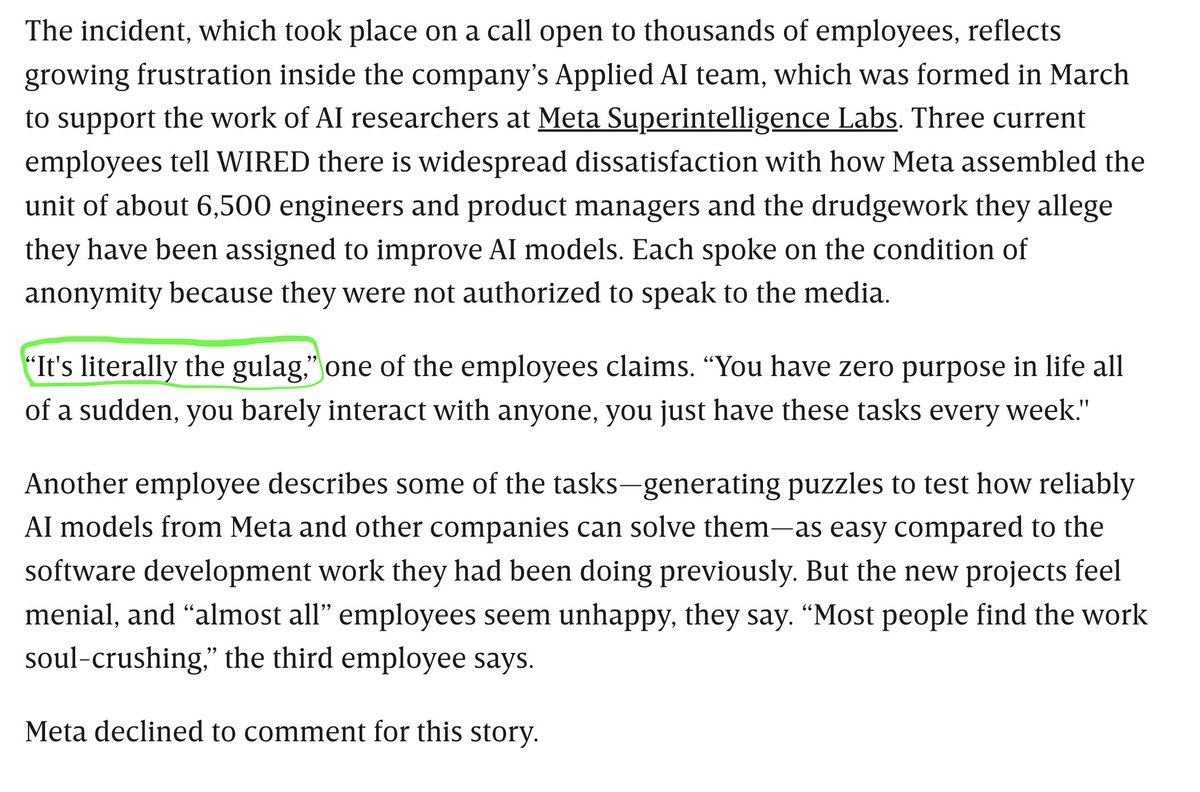
So if we continue down this path, we will lose, unless you believe what Dario’s proposing—you will live in the pod, eat the bugs, use the only AI, and live on UBI—is charismatic enough to change America’s political economy. In this world, the economy will by definition have to become a gulag. An RL environment for machine god. Where your unique understanding of local reality becomes an input to a system that has the implicit goal of replacing you.
I also happen to believe that this approach will create a strictly inferior "superintelligence", we know nature favors bottom's up emergence to top down coercion.
Meta is focusing on creating a generically "SOTA" system, when really they should be focused on creating a SOTA system that arises naturally from their unique strengths. This is why employees feel like they are in the gulag: Meta's trying to turn work into a Gosplan for Cognition. Soon if we are not careful, the labs will try to do the same for the entire economy.
4
4
50
7,664

Jun 14
This is directionally correct, though the “AI capability [the firm] builds and owns” has two sides.
Knowledge and code that are cross-cultural and universal will be commoditised. Any capital that escapes commoditisation will lie in the physical and inter-social world — in culture.
In many cultural worlds.
Funnily enough, “moat” will stop being a metaphor — though hopefully we won’t need as many fortifications.
And “moat” as a concept in the context of software companies was coined exactly because this process is not new. But it has just accelerated.
Software isn’t eating the world. It is eating the utilitarian side of it.
37