
The DigitalOcean vs AWS cost comparison is useful but the real differentiator for early-stage is not cost — it is cognitive overhead.
A solo founder or two-person team does not have a DevOps engineer. Every hour spent on IAM policies, VPC configuration, and egress cost modeling is an hour not spent on product and distribution.
DO eliminates entire classes of infrastructure decisions. That is the value at seed and Series A. Once you have a dedicated infrastructure team, the equation changes.
Right tool for the stage.


Appreciate the honest review from reptides — A-tier, 7.0, and the gaps named instead of glossed over.
The testing held up because it's built to: ~179 RUO compounds, a COA behind every one, A2LA-accredited verification. He's right that the next step is scale, not paperwork. That part's already moving.
One thing worth adding: reptides is a peptide board, and we're glad to be on it — but we're not a peptide company. We're a research chemical company. Peptides are one shelf.
The catalog he calls "niche" is the entire point, novel compounds most vendors won't source. That's the differentiator, not a weakness.
And "little to no studies" undersells it. Niche doesn't mean unstudied. Most of these have real preclinical or mechanistic research behind them, early-stage, which is exactly why they're worth researching. That's the RUO premise, not an argument against it.
Stay Elevated

To round off our initial round of vendor reviews... we present you Kimera Chems.
Woody and I talked a while back when we initially launched these reviews and Ive been sitting on drafts of their review since then.
I have to say one of the most striking things about this operation is the breadth and scope of products... there are over 179 Research Compound SKUs listed on the site.
And each one is backed by a COA, some have multiple. Woody sent me over 300 COAs to look at for this review. He seems like a standup dude, also sent me some videos of their new storage warehouse, it seems like they keep growing. And they seem to have a loyal fanbase both on X and Reddit.
I'll tell you what though, I haven't seen a vendor with this many RUO compounds on their site, theres quite a lot to unpack. My personal thoughts on this are 1. someone must be very passionate about this space if they are offering these many RUO compounds. 2. I'm not sure about the research efficacy of every single compound on here just because many of them are so niche.
Weaknesses - huge array of ruo compounds, many of them very niche and little to no studies around them. some old trustpilot reviews point out shipping mishaps.
Overall a solid 7.0/10 A tier vendor.
Read the full review below -
reptides.co/v/kimera-chems
1
9


Building a good eval loop shares the same primitives as building a good product — and the industry converges on best practice. The model and data are still the differentiator.
3

Eventually, models will become the norm, and the real differentiator will be expertise in applying them effectively.
3

In crypto, attention is abundant.
Trust is scarce.
And scarcity always defines long-term value more than hype ever can.
⸻
As the industry matures, users are no longer reacting to headlines alone.
They are evaluating systems more carefully:
🔍 How is risk actually managed?
📊 What level of transparency is available?
⚙️ Is the protocol structurally designed for durability?
🔁 Can it sustain performance across cycles?
⸻
Because excitement can attract participation.
But only confidence sustains it.
⸻
That is where the conversation around $USDD becomes more structural than narrative.
Not because of short-term momentum.
But because of how it positions itself around foundational principles:
📊 verifiable transparency
⚙️ continuous risk framework refinement
🔗 protocol-level stability design
🌍 ecosystem-backed resilience within $TRON
⸻
These are not surface-level features.
They are architectural decisions.
⸻
And architecture, unlike sentiment, compounds slowly but persistently.
⸻
Because in decentralized systems, trust is not declared.
It is accumulated.
⸻
Through:
✔ consistent performance
✔ observable behavior
✔ predictable system responses
✔ long-term operational continuity
⸻
And over time, that accumulation becomes the differentiator.
Not between good and bad projects.
But between temporary attention and lasting relevance.
⸻
Because users eventually stop asking “what is new?”
And start asking:
👉 “what can I rely on?”
⸻
And that shift changes everything.
⸻
Technology may bring users into an ecosystem.
But trust determines whether they stay.
⸻
Which is why maturity in Web3 is not measured by speed alone.
It is measured by stability under repetition.
Cycle after cycle.
Market after market.
Condition after condition.
⸻
And ecosystems that understand this dynamic tend to evolve differently:
⚙️ less dependency on hype
📊 more emphasis on transparency
🔁 stronger feedback loops of reliability
🌍 broader user confidence over time
⸻
Because adoption is not a one-time event.
It is a continuous decision made by users every cycle.
⸻
And that decision is based on one thing above all:
👉 belief in the system’s consistency
⸻
Not just what it promises.
But what it repeatedly proves.
⸻
And in that sense, trust is not the end result of growth.
It is the engine behind it.
⸻
Technology attracts users.
Trust keeps them.
Consistency compounds both.
⸻
And in crypto, that distinction is everything.
@usddio @justinsuntron
#TRONEcoStar

5

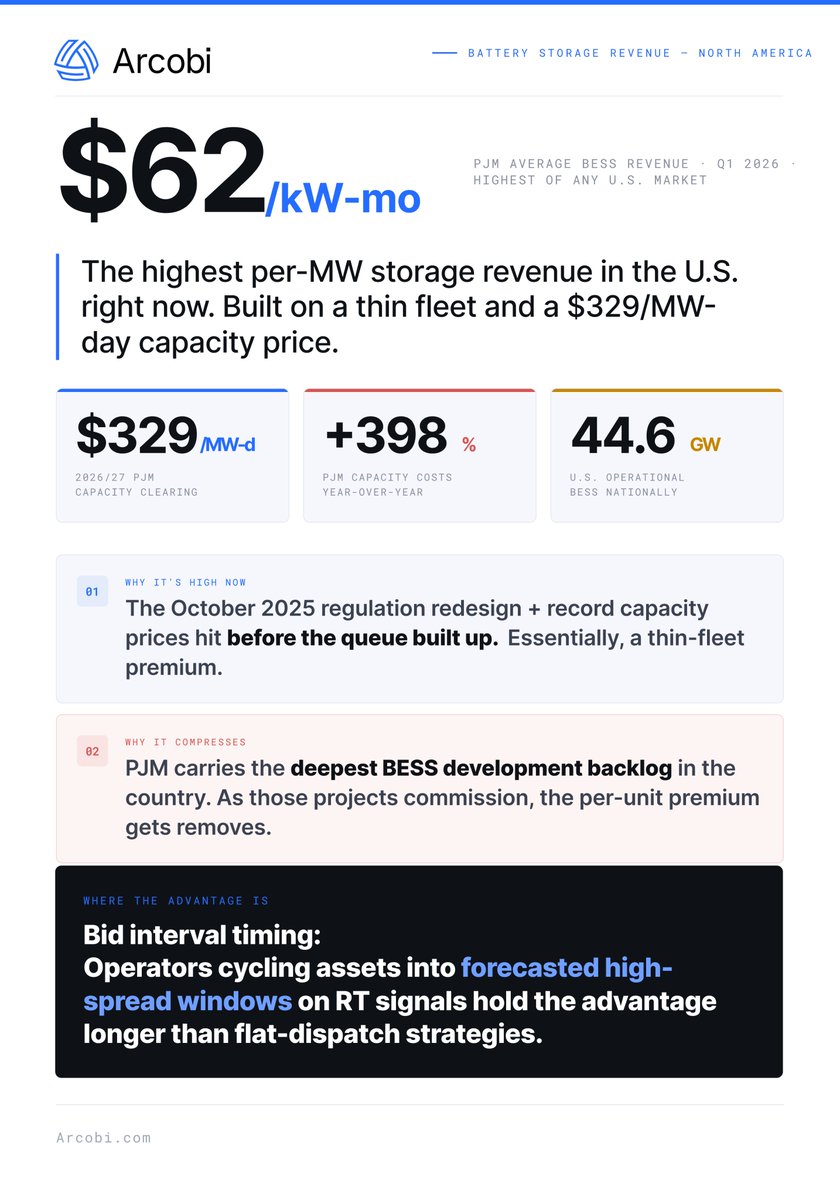
PJM Interconnection batteries averaged $62/kW-month in early 2026. Highest per-MW BESS revenue in any U.S. market right now.
It was mainly driven by the October 2025 regulation market redesign and capacity clearing at $329/MW-day. Both hit at the same time on a fleet that's relatively thin, so revenues were strong before competition fully scaled.
It will change as PJM has a large and growing BESS development pipeline, and as more projects come online, the current thin-fleet premium should compress.
Operators using flat dispatch schedules are likely to feel that compression first. Assets that are cycled into forecasted high-spread intervals and re-bid off real-time signals, rather than relying only on day-ahead assumptions, should hold their advantage longer.
Bid interval timing is the differentiator. If your BESS team is still calibrating strategy manually: visit arcobi.com
2

The next era for health plans is being shaped by three forces: rising medical costs, tighter regulation, and the rapid shift from AI pilots to real operating models. Execution—not experimentation—will be the differentiator. @BeckersASC
hubs.ly/Q04kQvTd0

College football is professionalizing, which means pro-style "front offices" are essential.
And "above-the-cap" dollars, or third-party deals, are a differentiator.
LSU football has positioned someone in its front office to focus on the latter.
theadvocate.com/baton_rouge/…
1
1,106

Sorry personal trainers,
but your CPT is worthless.
Everyone has one…
This base credential is NOT
a differentiator anymore.
It’s a bare minimum hiring filter
for a job you probably don’t want.
34

1h
Data & workflows cope is just Azure lock-in dressed up. Models eat your "differentiator" next.
11

How "responsible" are your org's marketing practices? It can be a true competitive differentiator! #dataprivacy #generativeAI #mrm bit.ly/3LqAbqG
1

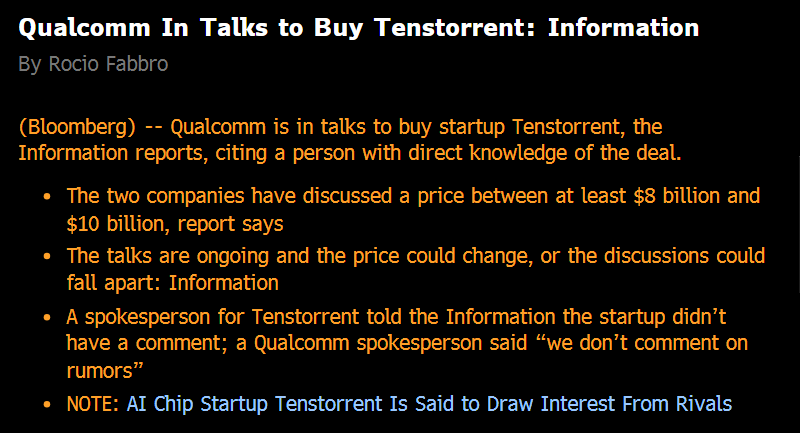
QCOM is in talks to acquire Tenstorrent at $8-10B per The Information.
Tenstorrent builds RISC-V AI accelerators for data center and edge inference. RISC-V is an open-source chip instruction set: no ARM royalties, fully customizable silicon. Key differentiator is that these chips promise to avoid the costly HBM memory that NVIDIA depends on.
Led by Jim Keller (AMD Zen, Tesla FSD chip), Tenstorrent's last confirmed round: $693M Series D, Dec 2024, $2.6B valuation. Was in talks for $800M more at $3.2B pre-money as of Nov 2025.
Why does this matter? NVIDIA just paid $20B to acquihire Groq, another low-memory alternative architecture. Then absorbed the IP and the HBM supercycle kept rolling.
Pattern worth watching: big players keep buying the memory alternatives, but DRAM requirements aren't coming down yet.
QCOM buying Tenstorrent would be their data center AI entry and an ARM dependency hedge simultaneously. Or it becomes the next acquihire that quietly disappears.
5
4
27
4,987

1h
Everyone talks about AI models.
Few people talk about the thing that quietly determines whether your project survives or dies:
Compute costs.
For a long time, AI felt divided into two groups:
🔹 Those with access to expensive GPUs
🔹 Everyone else
But that gap is starting to close.
What we’re seeing now is a shift where compute is becoming a commodity. The real advantage is no longer who owns the most GPU….it’s who can execute ideas faster.
Think about it.
You can have the best AI model in the world, but if infrastructure costs slow you down, experimentation becomes expensive and innovation gets harder.
That’s why platforms like @ONcompute caught my attention.
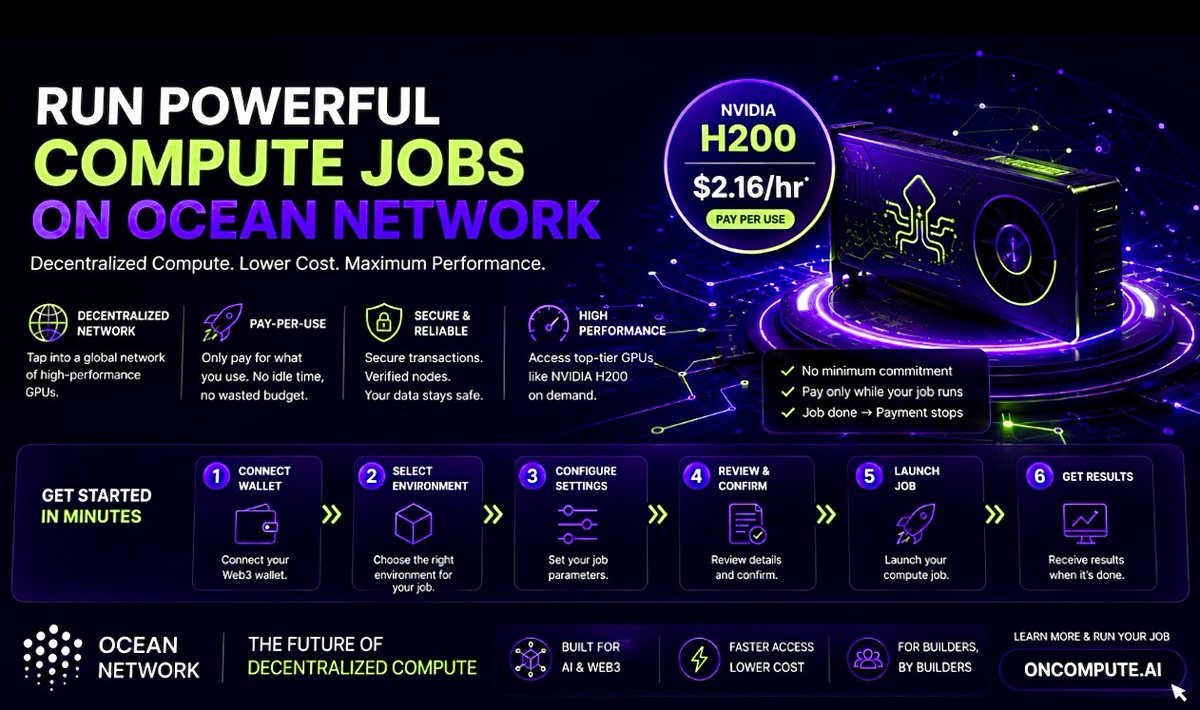
Instead of reserving expensive cloud infrastructure, you can access NVIDIA H200 GPUs on demand for as low as $2.16/hour and only pay while your job is actually running.
No idle costs.
No paying for time you’re not using.
No infrastructure headaches.
Just submit your workload and focus on building.
What’s interesting isn’t just the pricing.
It’s the bigger idea behind it.
Ocean Network is building a decentralized compute marketplace where underutilized GPUs around the world can be connected to developers who need them.
Imagine an Airbnb for compute.
GPU owners monetize idle hardware.
Builders get affordable access to powerful resources.
Everyone wins.
And there’s another piece that I think doesn’t get enough attention:
Memory.
An AI agent without memory isn’t really autonomous.
It’s just repeating tasks with no understanding of what happened before.
Ocean Network’s persistent storage allows agents to keep knowledge between jobs.
An agent can learn something today, store it, and continue from that exact point tomorrow.
Even more powerful:
Multiple agents can share the same memory.
One agent plans
Another executes
Another analyzes results
And everything gets written back to the same shared knowledge base.
That’s when agents stop acting like isolated tools and start behaving like coordinated systems.
We’re moving toward a future where:
• Compute is accessible
• AI agents have persistent memory
• Multiple agents can collaborate
• Builders spend less time managing infrastructure and more time creating value
The GPU-rich vs GPU-poor era is fading.
Execution is becoming the real differentiator.
And honestly, that’s good news for builders everywhere.
Explore Ocean Network here:
dashboard.oncompute.ai/run-j…
21
67

Interesting angle on the AI buildout — copper is the real backbone for power and data centers. NovaRed's MetalCore AI expansion to 2.7M records looks like a smart tech edge for targeting in BC's porphyry belt. Wilmac near Copper Mountain is worth watching. Always DYOR on juniors! "tradingview.com
juniorminingnetwork.com
Alternative versions:Enthusiastic / momentum-focused: "Copper AI exploration tech = compelling combo right now. That MetalCore dataset jump is massive. NRED showing strength today on the news. Potential play on the physical side of the AI boom. High risk, high reward setup. $NRED"
Cautious / balanced: "Solid thesis on copper demand from data centers, but early-stage exploration here. Wilmac has good location and recent geophysics, plus the AI platform is a differentiator. Volatile microcap though — dilution, permitting, and discovery risk are real. DYOR heavily."
Short & direct: "Copper infrastructure play with an AI twist. Added to watchlist. Nice video. "
Quick Context for Your ReplyStrengths: Ties directly into real AI power/copper demand trends. Recent MetalCore update (June 15, 2026) massively expanded their dataset, and Wilmac is a large land package (~16,000 ha) in a productive belt near an operating mine.
finance.yahoo.com
Risks: Typical junior explorer — no resource yet, needs drill success, funding, etc. Stock is volatile (recent swings, trading ~CAD 1.20–1.70 today with gains on news).
google.com
1
15

"You can offload a task, or even a job, but you can never offload your learning." Learning will become the differentiator among humans.
4

NEW PODCAST: Got #AI fatigue? Let's restore your faith.
Spoiler: AI is no longer optional. It's the differentiator. What does this mean for extended enterprise #learning?
That's what I'm discussing with Leslie Kelley, Chief Growth Officer of @AbsorbLMS▶️
talentedlearning.com/using-a…
ALT NEW PODCAST: Got #AI fatigue? Let's restore your faith. Spoiler: AI is no longer optional. It's the differentiator. What does this mean for extended enterprise #learning? That's what I'm discussing with Leslie Kelley, Chief Growth Officer of @AbsorbLMS▶️ https://talentedlearning.com/using-ai-to-improve-internal-and-external-learning-podcast-114/
3
6
102

My book, which you might find matches your intuitions better...argues that the invention and then evolution of "truth" over almost 3000 years was the differentiator for modernity (not humanity). It's a culture-ish play.
amazon.com/Explaining-Explan…
Explaining Explanation: What Built Modernity
Explaining Explanation: What Built Modernity
amazon.com 32

