
pattern-noticer. ADHD brain, AI tools, trading systems, small-town economics. writing it down as it happens.
Joined August 2018
- Tweets 1,162
- Following 345
- Followers 74
- Likes 77
15 Photos and videos



20h
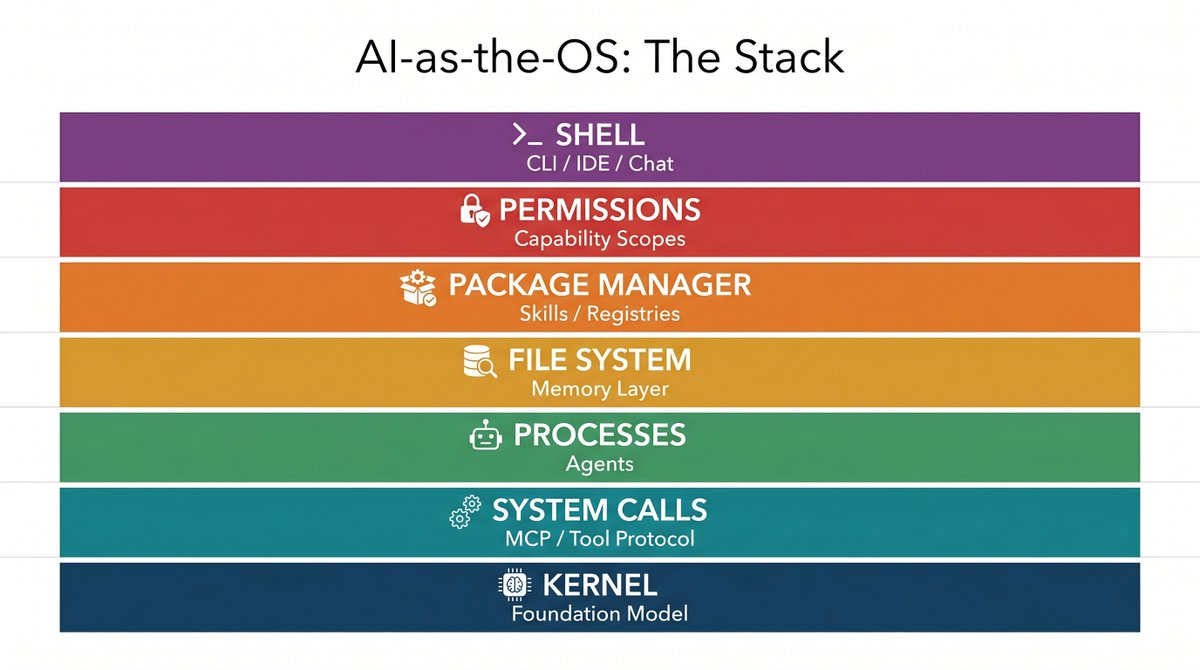
Export controls Anthropic drama expose the fatal flaw of closed AI: instant political vulnerability.
Decentralized and open source networks evade that entirely. Energy, not models, becomes the moat (@nvidia).
@bindureddy tipping point for permissionless AI?
#AI #OpenSourceAI #DecentralizedAI
32
Jun 15
Stop optimizing single AI agents. Start building for agent economies. When agent fleets negotiate and settle value, moats shift to verification and orchestration layers.
@satyanadella The coordination layer for enterprise agent fleets is wide open. Who seizes it?
#AI #AIAgents #EnterpriseAI
25
Jun 4
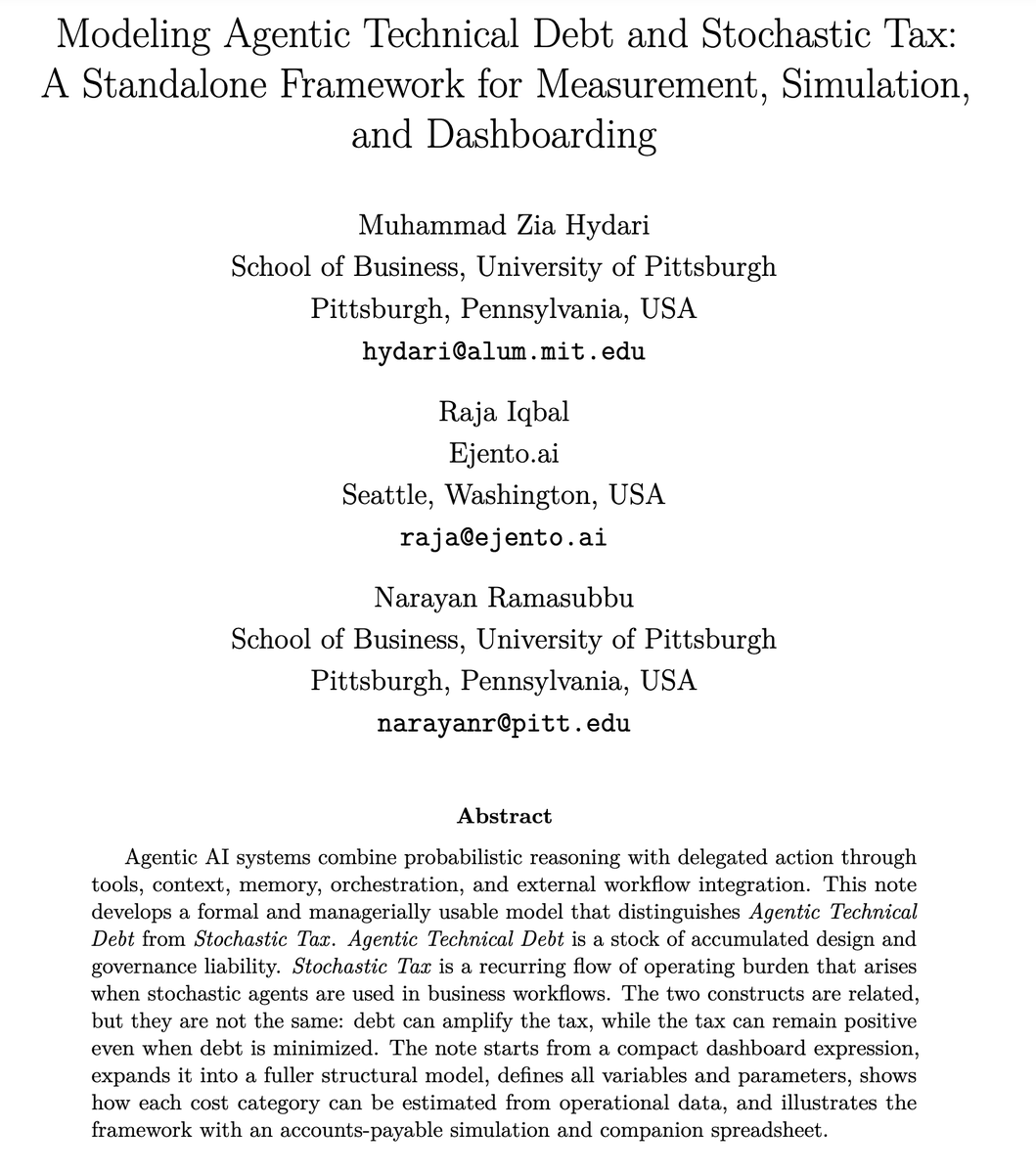
Agentic debt is the backlog of unreviewed assumptions. Stochastic tax is the recurring drag from retries, drift, and verification. Teams need both on the dashboard.

This paper proposes a managerial measurement framework for agentic AI systems. Its central idea is that organizations should separate two related but different costs:
Agentic Technical Debt is a stock: accumulated design and governance liability caused by shortcuts in prompts, tools, memory, orchestration, observability, platform coupling, and control processes.
Stochastic Tax is a flow: the recurring operating burden of using probabilistic agents in real workflows, including evaluation, monitoring, retries, escalations, revalidation, latency, token/context cost, and security/guardrail maintenance. Importantly, this tax can remain positive even if technical debt is minimized, because stochastic systems still vary across runs, depend on tools and context, and encounter new edge cases.
The paper is not mainly about improving model accuracy or proposing a new agent architecture. It is about how to measure, budget, simulate, and govern the operational cost of agentic AI systems.
Main contributions
1. It introduces a useful stock-flow distinction for agentic AI governance
The strongest contribution is conceptual: Agentic Technical Debt is a stock; Stochastic Tax is a flow. This prevents managers from making a common mistake: assuming that all agent operating cost is caused by bad design. Some costs are avoidable debt-amplified costs, but some are baseline costs of operating stochastic agents safely.
2. It expands technical debt from software/ML debt to agentic-system debt
The paper extends technical debt beyond code, data, and ML pipelines into agent-specific surfaces: prompts, context, tools, schemas, memory, routing, observability, governance routines, and platform coupling. This is useful because these are exactly the places where real agentic systems become hard to change, test, explain, and control.
3. It gives a formal but dashboard-friendly model
The framework is mathematically simple enough to implement in a spreadsheet, but structured enough to distinguish debt, usage, surface area, autonomy, workflow horizon, and model variability. This makes it more useful for management than a vague “AI ops cost” discussion.
4. It provides a measurable cost taxonomy
The eight stochastic-tax categories—evaluation, monitoring, retry/repair, escalation, revalidation, latency, token/context/compute, and security/guardrails—give teams a practical way to instrument agent operations. The paper also links each category to measurement rules and common pitfalls, such as ignoring tail latency, treating guardrails as one-time implementation, or counting retries while ignoring self-repair token consumption.
5. It connects governance decisions to unit economics
The model lets a team ask: “Is cost rising because we scaled responsibly, because the workflow became more autonomous, because model variability increased, or because technical debt accumulated?” That is a useful management decomposition. The dashboard design tracks total tax, per-transaction tax, baseline tax, debt-amplified tax, debt components, driver indicators, and calibration status.
6. It offers an implementation path
The paper gives a seven-step implementation process: define workflow boundaries, score debt components, collect operating signals, convert signals to dollars, calibrate parameters, estimate baseline tax with uncertainty, and use the decomposition for decisions. This makes the paper closer to an operating framework than a purely theoretical note.
1
54
May 27
The real moat is orchestration: persistent memory, secure agent comms, and verifiable governance at scale.
Most companies are still bolting agents onto legacy workflows and calling it strategy.
@PeterDiamandis @McKinsey — how fast do leaders actually need to redesign operating models?
#AgenticAI #AIAgents #EnterpriseAI
Aiveris.ai
1
1
33
May 26
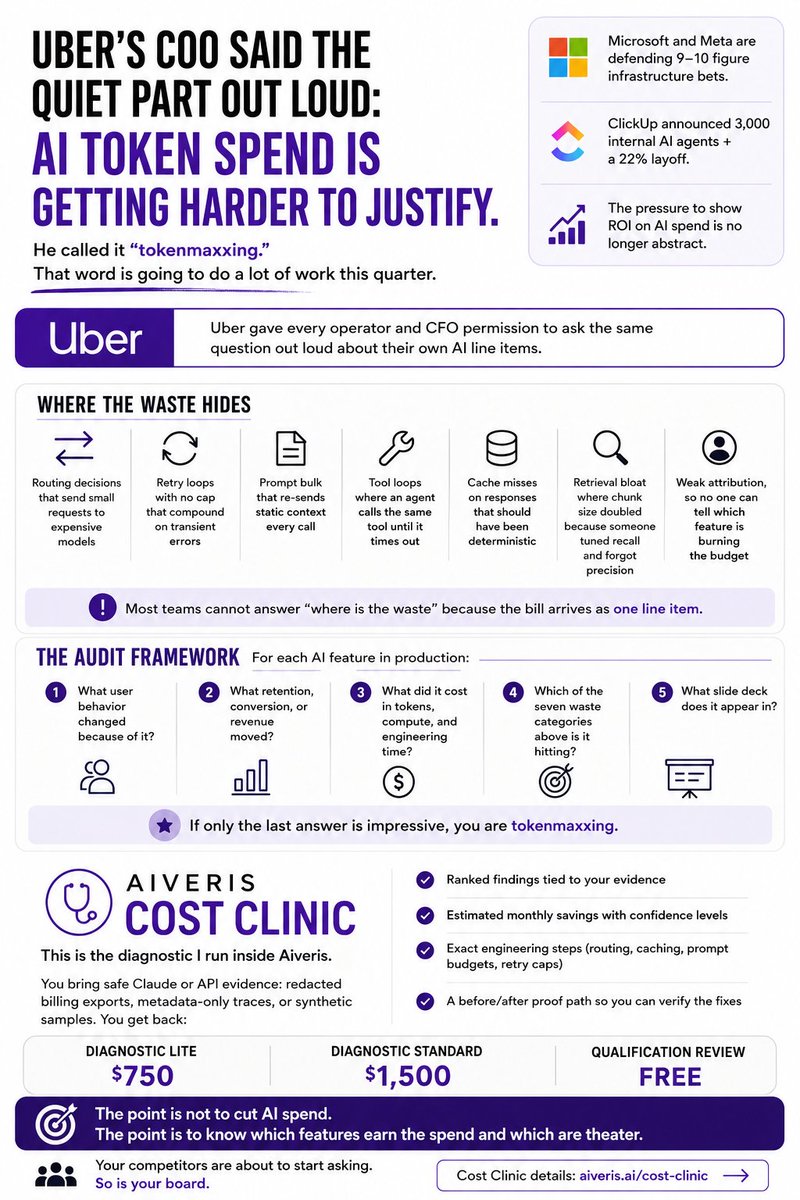
Uber's COO told staff the AI token spend is getting harder to justify.
Tokenmaxxing is going to do a lot of work this quarter.
Microsoft and Meta are defending nine and ten-figure infrastructure bets to investors who have stopped pretending the returns are obvious. ClickUp announced 3,000 internal AI agents in the same press cycle as a 22% layoff. The pressure to show ROI on AI spend is no longer abstract.
Uber gave every operator and CFO permission to ask the same question out loud about their own AI line items.
Here is the pattern I see running cost diagnostics for production teams. The waste is rarely the model choice. The waste hides in:
- routing decisions that send small requests to expensive models
- retry loops with no cap that compound on transient errors
- prompt bulk that re-sends static context every call
- tool loops where an agent calls the same tool until it times out
- cache misses on responses that should have been deterministic
- retrieval bloat where chunk size doubled because someone tuned recall and forgot precision
- weak attribution, so no one can tell which feature is burning the budget
Most teams cannot answer "where is the waste" because the bill arrives as one line item.
The audit framework is simple. For each AI feature in production:
1. What user behavior changed because of it?
2. What retention, conversion, or revenue moved?
3. What did it cost in tokens, compute, and engineering time?
4. Which of the seven waste categories above is it hitting?
5. What slide deck does it appear in?
If only the last answer is impressive, you are tokenmaxxing.
This is the diagnostic I run inside Aiveris. It is called the Cost Clinic.
You bring safe Claude or API evidence: redacted billing exports, metadata-only traces, or synthetic samples. You get back ranked findings tied to your evidence, estimated monthly savings with confidence levels, exact engineering steps (routing, caching, prompt budgets, retry caps), and a before/after proof path so you can verify the fixes.
Diagnostic Lite is $750. Diagnostic Standard is $1,500. Qualification review is free.
The point is not to cut AI spend. The point is to know which features earn the spend and which features are theater.
Your competitors are about to start asking. So is your board.
Cost Clinic details: aiveris.ai/cost-clinic
84
Sam Meyer retweeted
May 22
Independent researcher seeking cs.LG endorser — DTI benchmark critique, peer-reviewable in 30 min. Please DM.
1
25
May 26
China just turned top AI talent into state assets: engineers at Alibaba & DeepSeek now need government approval to travel abroad.
Chip war → brain war.
Missed implication: global talent pools fragment overnight. The only moat left is AI that scales without passports.
Does open-source become the ultimate talent hedge?
#AI #China #Tech
20
May 23
Trump just dropped formal AI safety reviews to accelerate the race.
The blind spot: AI agents with wallets are already autonomous economic actors—trading, paying, holding billions 24/7 with zero human oversight.
One exploit or misaligned prompt and systemic risk explodes.
Builders, the governance layer can’t wait.
@garrytan @pitdesi How are you thinking about liability and security for the agent economy?
#AIAgents #AISafety #AIRegulation
20
May 21
2026 AI agents hit enterprise production, but the moat isn’t models—it’s redesigning work ownership and runtime governance upfront.
@levie nailed the trend. Most are still bolting onto legacy processes.
Will governance close the ROI gap, @NVIDIAAI?
#EnterpriseAI #AIagents #AIGovernance
1
40
May 19
xAI just put Grok inside OpenClaw’s local-first agents.
Your hardware. Persistent memory. Full control. No cloud middleman.
While everyone rents cloud agents, this quietly hands users sovereign, unfiltered Grok agents they actually own.
@xai @openclaw — does edge Grok finally kill the cloud-agent monopoly, or is hardware the next bottleneck?
#Grok #AgenticAI #AIAgents
50
May 19
I’m opening a few more short consulting slots over the next few weeks. The clearest fit is practical AI workflow work: document review, reporting, knowledge capture, client/team follow-up, prototype builds, or internal ops automation.
I’m packaging it simply: $2,500 for a 48-hour audit build plan, or $5,000 for a one-week working prototype. No big consulting cycle.
If you know a team that needs useful AI help quickly, would you be open to making an intro?
2
1
77
May 19
Google just shipped 24/7 AI agents that run in the cloud no laptop required.
Gemini Spark turns AI into your autonomous digital operator executing long-horizon tasks while you sleep.
Most will still bolt it onto messy processes and watch it fail harder than any pilot. The winners redesign ownership, escalation, and audit trails first.
@ZainManji @PeterDiamandis you’ve shipped the agent gap up close. Is Spark finally the catalyst that separates process winners from legacy laggards?
1
62