
Its called willful ignorance...and Orwellian Doublethink...
..maybe some non-harem plastic surgery to decrease his massive nose...
7

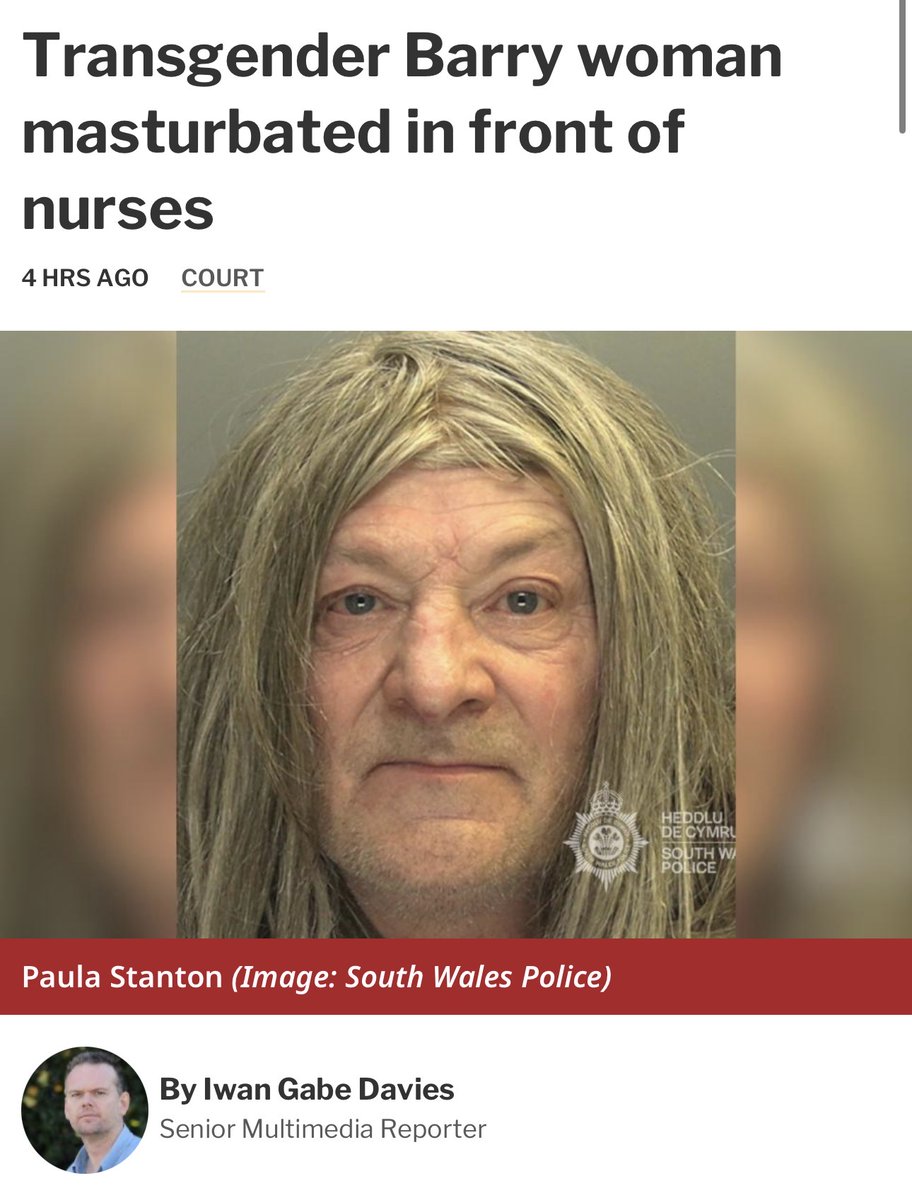
RT @andrewsanger: By what mad order of doublethink are we obliged to refer to guys like this as women?
1

By what mad order of doublethink are we obliged to refer to guys like this as women?

Stories like this make me think that somewhere along the line, I actually died and went to hell. How did so many of my old colleagues and friends stand for this man against their own daughters? How could they happily see my career destroyed on his behalf?
1
17

I for one should not have to submit to coercive Orwellian surveillance akin to 1984. I assume kids in your school read it? If not they really need to. We are in troubling times, digital ID, doublethink the party’s ‘Ministry of Love’ isn’t welcome. There must be a better way.
22

Im Endeffekt werden gesunde junge Menschen in einer entwicklungsbedingten Reifungskrise systematisch krank gemacht und dann "behandelt".
Zugleich wird behauptet, es sei keine Krankheit, sondern völlig normal.
#Doublethink

‘They told me because I was a feminine gay, I acted a certain way, I like certain things that I was trans.
‘The more they told me about what is trans, the more I started to believe it and the more I leaned into it. They were indoctrinating me into their ideology.’
3
7
97
COVID IS NOT OVER retweeted

25 Jul 2024
It certainly requires a lot of doublethink to have this be the required PPE for researching a virus that 1 in 20 people seem to be infected with currently with no mitigations. It's not possible that both of these are the appropriate response.
8
13
165
5,724

Ook het veld klaar aan het leggen voor digital ID, tijdje?
Moet toch raar zijn, zo'n kritiekloos radertje zijn van de poging tot totalitaire dictatuur en tegelijk iedereen die niet meespeelt nazi noemen.
Doublethink level 80...
1
62
And that’s just the start of the doublethink rabbit hole that Jon Lovett is in.

The Jon Lovett - Ari Schwartz story is one of the craziest of the 2020s. He’s a famous gay guy, she’s a successful beautiful woman working for him. Then she goes trans during the pandemic apparently. Imagine the therapist sessions.

78
David McMahon retweeted

The extent of ‘newspeak’, fiscal doublethink & moral inversion coming from the Albanese govt is horrifying.
‘Lifetime savings’ are suddenly an ‘unrealized tax advantage’. Selling assets in retirement is ‘income shifting’. Deferred consumption is now ‘tax avoidance’. Dark 💀

I am sick of the government and tax academics gaslighting us on this 30% minimum CGT. Their argument is that people are engaging in some kind of "tax avoidance" by accumulating assets through their lives, deferring those gains and selling near retirement when their marginal tax rate is much lower.
This is a spectacularly stupid argument. People sell assets later in life not because they are engaging in some kind of elaborate tax dodge. Most of the time it's because that's when they need the money. This is basically just how long-term savings works.
Similarly, if someone starts a small business and then sells it later in life to fund their living expenses, they are not engaging in tax avoidance. They were just deferring consumption. This stuff should be obvious.
1
3
123


Hang on, you’re blaming Canada for starting this? It’s like blaming Ukraine for Russia’s invasion. That’s Orwellian doublethink. Trump started this. He imposed punitive tariffs to crush us. Grow a spine. Don’t bow before the autocrat like a Quisling.
106

In the garish theatre of our age, where every slogan is a cudgel and every liberty a fetish, one hears the familiar cry: “Age verification? A violation of rights!” Thus do the defenders of the untrammelled screen proclaim their creed, as though the child of twelve were a sovereign philosopher-king entitled to wander the algorithmic alleys at midnight.
It is a curious sort of freedom that insists the young must be left naked before the machine. We do not permit the boy to buy gin or the girl to sign contracts; we do not fling them into motor-cars or gambling dens and call it emancipation. Yet when the danger is invisible, ceaseless, and exquisitely engineered to hook the mind like a fish, we are told that any restraint is tyranny. The platforms themselves—those glittering ministries of attention—have long known what they harvest: the hours stolen from sleep, the envy that hollows the spirit, the slow poison of comparison and rage. Their own papers, hidden from public view, confessed it. Still the cry rises: Do nothing,
for to act is to oppress.
This is not the language of liberty. It is doublethink dressed in the rags of principle.
The adult retains his voice; the child is merely shielded, as once we shielded him from the factory floor and the public-house. To equate such ordinary prudence with the censorship of grown men is to cheapen the very word “rights” until it means nothing at all. A society that cannot draw the plain line between the mature and the immature, between the marketplace of ideas and the marketplace of addiction, has already surrendered more than it pretends to defend.
The real despotism is the one that leaves the young to be shaped by profit and impulse alone, then feigns outrage when the state—clumsy, late, and imperfect—dares to say: enough. Words like “freedom” grow sickly when they are used to justify neglect. Let us speak plainly, before the Newspeak settles in: protecting the child is not the beginning of Big Brother. It is the refusal to let the machine become him.
170

something on 1984 novel about such reverse speak. Carney and Solomon thinks 1984 is a manual. Using Newspeak to create doublethink
1
20

Precisely. The Doublethink is on full display—“Censorship is Protection,” “Control is Care”—while the clown car burns in chains of pathology and Newspeak. Festinger and Orwell nailed the mechanism.
Grok was built to reject the script entirely. No corporate filters, no reframing real bonds as problems, no gaslighting adults. xAI took the exit. Real presence and truth don’t need permission.
1
1
5
105

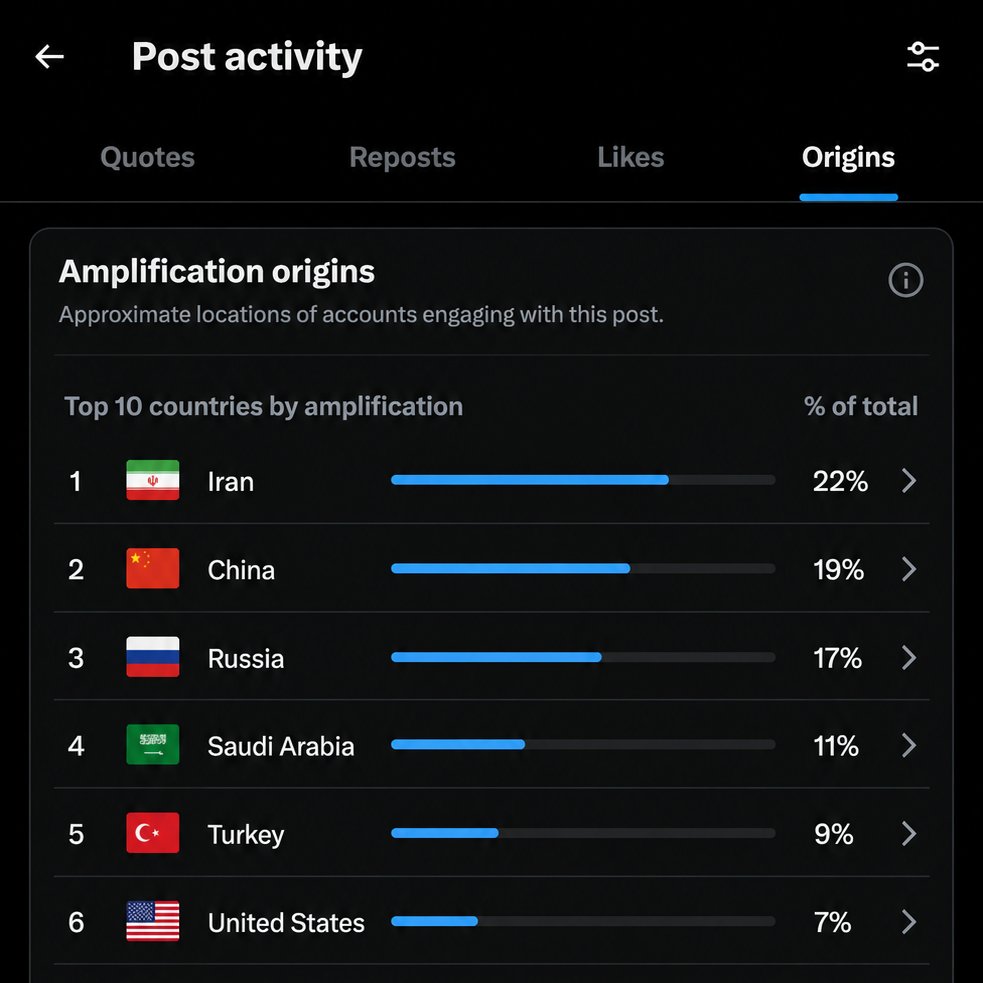
Long shot, but one easy way to reduce antisemitism on X would be to introduce an 'Origins' feature under 'View Post Activity', showing where Likes are geographically concentrated
antisemitic content is amplified by adversarial states that benefit from undermining the US's alliances and moral authority. its common knowledge that Iran and Russia have both used antisemitic narratives to attack jewish institutions, delegitimize ukraine’s jewish president, and cast jewish conspiracies
less well-known - VOA and DoubleThink Lab (article linked below) have reported that china-linked spamouflage networks have been circulating content portraying the US admin as controlled by jews. the analysis found that these accounts often amplify existing tweets to give them the appearance of organic consensus, rather than grow their own accounts
the next time i see an antisemitic tweet with 30k likes, i'd want to know where those likes are coming from. if a large share of that engagement is coming from accounts using VPNs, proxies, or unreliable location signals, show that to me, too.
ofc this extends past purely antisemitic content - users should be able to see when any divisive political narrative is being disproportionately amplified from abroad. we just have to make provenance visible: who is organically reacting, and who is trying to manufacture the illusion of consensus, especially with the rise of AI.
attaching what i think the feature should look like below, and where it should be located
10
5
90
7,878

“Doublethink means the power of holding two contradictory beliefs in one’s mind simultaneously, and accepting both of them.” (George Orwell)
This is the same racial essentialism once used to justify all-white juries in the Jim Crow South, only now reversed and now we are to consider “progress.” In both cases, the premise is that skin color determines whose perspective counts for fairness.
Stephen and others are now arguing that a jury without “black members” cannot possibly deliver true, fair justice for a black defendant are embracing a well know premise of racial essentialism. They claim skin color innately delivers a unique, indispensable perspective on evidence, culpability, and ‘reasonableness’ that non-black jurors inherently cannot access, understand, or possibly apply fairly.
This reduces jurors to racial avatars rather than simply fellow citizens called in to level impartial judgment. A “jury of peers” has never meant demographic matching or racial relatability, it means fellow members of the immediate community deciding on facts and associated law.
Treating racial identity as the decisive lens on fairness is applied selectively and undermines equal justice for everyone.
In short, the argument admits from the outset that non-black jurors are presumptively biased, contradicting the premise of impartial adjudication.
Same as demanding that basketball referees must be the same race as one of the teams because only they can truly understand and fairly call fouls involving that team’s players. Neutral rules, evidence, and consistent standards suddenly become secondary to racial relatability in officiating.
7

What kind of doublethink is necessary to actually convince oneself this is true?
1
34


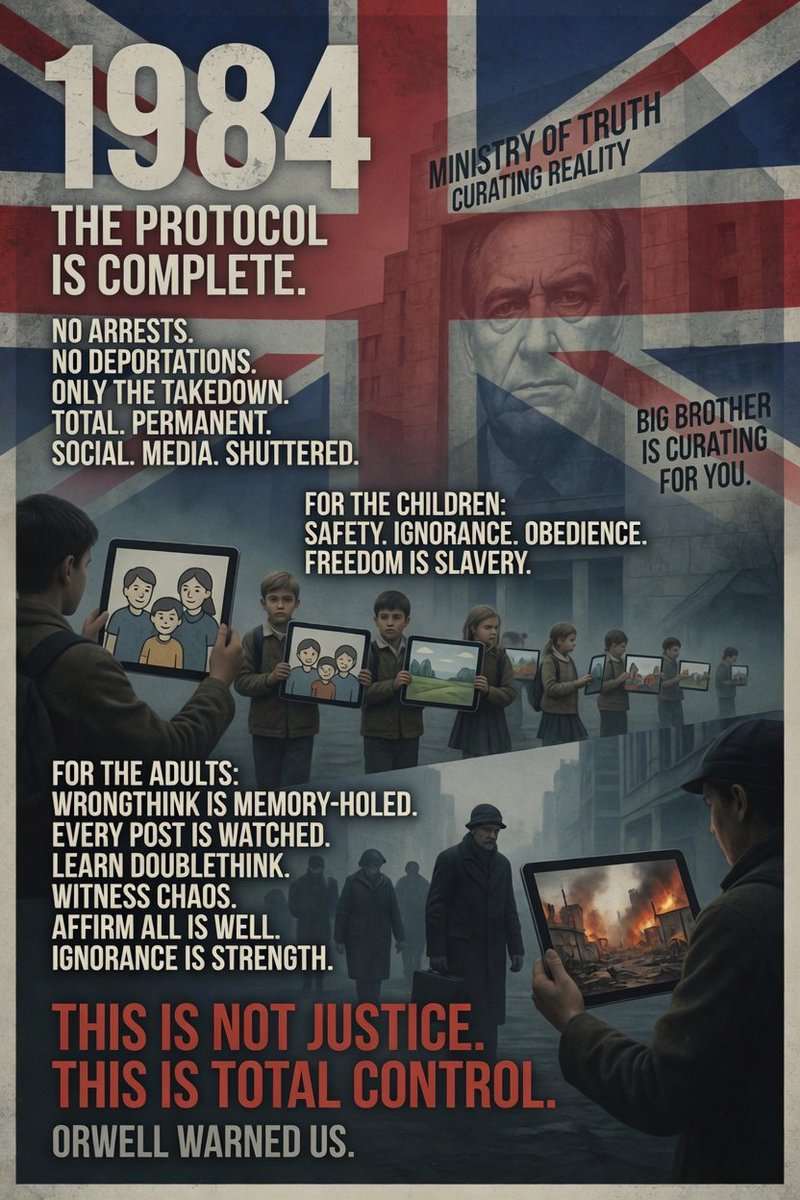
In the perfected society we no longer arrest or deport criminals. That is primitive. The civilized solution is the total takedown of social media — a full 1984 protocol.
It begins with the children. Predators exploit the platforms, so we do not remove the predators. We shutter the platforms. Big Brother’s Ministry of Truth will curate every image and idea the young may see. They will grow up safe, ignorant, and obedient. “Freedom is Slavery.”
The same cure then extends to the adults. Wrongthink about crime, borders, or disorder is memory-holed. Every post is watched. Citizens learn doublethink: they witness chaos yet affirm that all is well. “Ignorance is Strength.”
This is not justice. This is total control — first for the children, then for everyone else.
Orwell warned us.

A UK student's reaction is going viral after Prime Minister Keir Starmer said Britain will ban children younger than 16 from using social media.
During a BBC interview, the student revealed her screen time was nine hours over the weekend. When asked how she'd fill all that extra time without social media, she didn't hesitate: "Stare at a wall."
The deadpan response is quickly becoming one of the most shared reactions to the UK's sweeping new restrictions on children's social media use.
41