
May 5
#Forkgivening
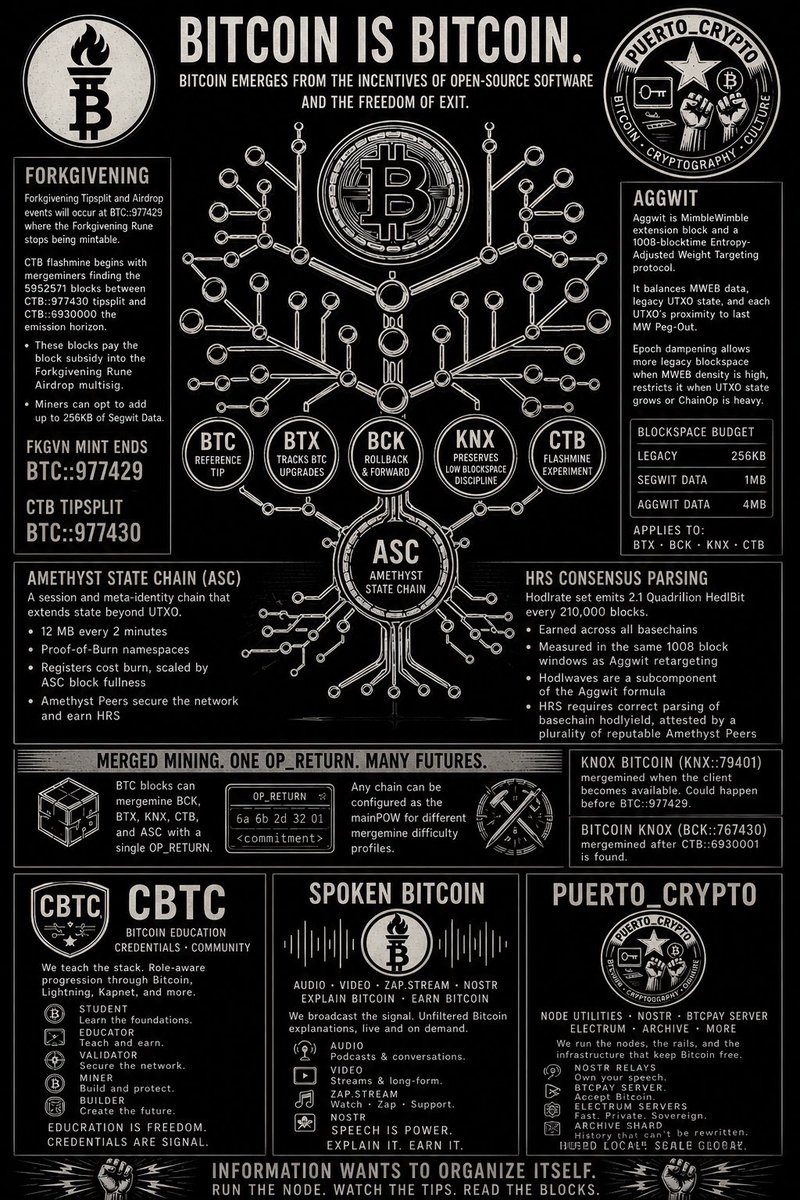
: a Bitcoin chainsplit constellation — arriving at Forkgivening height 977429
•Your coins do not stop being Bitcoin
•Your chaintips split
•Your optionality expands
For example, if you hold BTC at the relevant snapshot, you may have claims, mirrors, airdrops, or opt-in rights across Forkgivening-aligned tips.
What to do?
•You may sell them. Keep them. Ignore them.
•Or run the software and find out what Bitcoin becomes when exit is treated as a first-class consensus primitive.
Vegas:
•Yes, I was around the Bitcoin circus.
•No, I will never explain the whole thing on stage.
•That would be rude.
Our Base Tips…
•are Sha256d mined.
•are Bitcoin-derived.
•are merge-mined where possible.
•are not asking BTC for permission.
•inherit Bitcoin’s proof-of-work grammar, UTXO lineage, and exit-right metaphysics.
•differ by constitution, activation height, historical replay boundary, and upgrade posture.
Codewise, the family remains Bitcoin-compatible where useful:
•BTC remains the reference chaintip
•BTX tracks BTC upgrades as they activate
•BCK rolls back to a cleaner historical boundary and moves forward with its own covenant posture
•KNX preserves a more ossified, low-blockspace Bitcoin discipline
•CTB begins the Forkgivening flashmine experiment
•ASC/Kapnet coordinates the extended state, node utility registry, session identity, and governance surfaces above the base chains
Yes, there will be AggWit:
•AggWit is not “more blocksize” as a slogan
•AggWit is blockspace hygiene
•AggWit prices weight according to chain-operation burden, UTXO state externality, and proximity to MimbleWimble-style cut-through
•It makes cheap the things Bitcoin should prefer: consolidation, privacy, fungibility, pruning, and monetary legibility
•It makes expensive the things that bloat shared state for private metaprotocol games
•It is not a ban
•It is a thermodynamic preference schedule
Yes, there will be Kapnet:
•Kapnet is not a token pretending to be Bitcoin
•Kapnet is a Bitcoin-native coordination layer
•It treats nodes, templates, weakwork, submissions, rooms, guilds, and governance as structured activity above the chaintip
•It lets Bitcoiners coordinate without pretending all coordination belongs inside L1 blockspace
•It uses proof-of-work, proof-of-burn, reputation, deterministic replay, and exit pressure as design materials
•It is what happens when information is allowed to organize itself around Bitcoin’s finite monetary matter
Yes, there will be Forkgivening mechanics:
•FKGVN minting ends at BTC::977429.
•CTB begins after the Forkgivening tip event
•CTB flashmining routes subsidy toward the Forkgivening airdrop mechanism
•Runeholders who paid miners for mint inclusion become part of the claim surface
•Miners can participate by merge-mining compatible tips and building valid templates
•This is not just an airdrop
•This is a public audit of who understands that Bitcoin exit is not betrayal
Unlike ordinary fork announcements:
•There is no claim that one ticker owns Bitcoin
•There is no demand that everyone agree
•There is no pretense that consensus is a press release
•There is no fake neutrality about blockspace externalities
•There is no surrender to dev capture, miner apathy, or mempool nihilism
•There is only software, incentives, replayable state, and the freedom to exit
Our design view:
•Bitcoin is Bitcoin
•Bitcoin is not a single corporate roadmap
•Bitcoin is open-source software under thermodynamic constraint
•Bitcoin is the freedom to validate, reject, fork, merge-mine, repeg, and continue
•Bitcoin is people learning to trust horizontal cryptography over vertical permission
•Bitcoin is finite digital matter with monetary properties, open to all, controlled by none
Video to follow
Or don’t wait for the video
Run the node. Watch the tips. Read the blocks.
14
18
291

2 Apr 2025
Forkgivening Chain
CTB: Chaingiven Token Bridge
is actually going to empirically test post-emission fee markets by flashmining up to the emission horizon and awarding the mined coinbases to Forkgivening Runes holders proportionally.
It'll also be empirically testing CTV, Aggwit, and 256kb legacy blocksize.
1 Apr 2025

It is not a process that comes from the sky, it's the result of an incentives game. It has worked wonderfully so far, but the regime with zero block rewards is still a bit of a question mark. Whether it remains an anti fragile system is something you must prove by maths and actual arguments, not by tweeting "few".
1
2
79

iSwap & Capricoin Finance!
Flash Mining is coming
LFG, iSwapers!
@CapricornFi @Cube0x
#iSwap #Cubechain #flashmining

4
4
13


2 Oct 2021
1
2 Oct 2021
1

29 Sep 2021
someone needs to conquer the toughness to show others how life is beautiful 🙏
2




1 Sep 2021
1
3