I forgot to mention in the quoted post that I ran into a Ruby dev at the wroclove.rb 2026 Ruby Conference who asked me about what prompted me to build Glimmer DSL for Web as an alternative to React.js.
When I started explaining all the issues in React.js, like mixing multiple languages in the same file in JSX files (known as a bad practice in Software Engineering from the JSP days in the mid-2000s) and reliance on weird business-distant and UI-distant concepts like hooks and effects, he stopped me right there and told me that he fully agrees about hooks and effects making programming a lot more complicated than necessary, and then said he ran into React devs who lie and call that "simple" when it's not simple at all, especially given that it would be a lot simpler to develop the Frontend without having to introduce foreign concepts like hooks & effects actually. Why add extra concepts unrelated to the UI or the business when you could do things without such concepts to begin with!!
I told him afterwards that I am able to develop React features in half the time or less using Glimmer DSL for Web, but also one of our components ended up having faster performance than in React because React code was so complicated that it caused devs to make mistakes that led to performance issues.
I am very happy there are others in the Ruby community who confirm my reporting about React being over-complicated and React devs being dishonest about it. I covered some of that in this blog post for example:
andymaleh.blogspot.com/2026/…
#react #sucks #deletereact #deletejs #ruby #rails #rubyonrails #frontendruby #opal #glimmer #dsl #web

I shared positive feedback about Glimmer DSL for Web (Ruby-in-the-Browser Frontend Framework for Rails) in the quoted post (you can read it if you haven't yet), but not negative feedback. That's because I didn't get any negative feedback by the end of my Glimmer DSL for Web workshop at wroclove.rb 2026. Attendees were excited about having a new effective way of doing Frontend Development with Ruby inside Rails web applications. One of the attendees said it was promising. Another told me he thinks React.js is horrible (I'm glad there are other smart devs in the Ruby community who are aware of React's issues and weaknesses), and normally uses Vue.js for Frontend Development, but is excited that Glimmer DSL for Web is even better than Vue due to using Opal Ruby (that enables unique things through Ruby DSL syntax not possible with straight JS and HTML).
That said, on the 3rd day of wroclove.rb 2026, someone played around with Glimmer DSL for Web in a new Rails web project and gave me one piece of negative feedback. He said it was difficult to set up Glimmer DSL for Web manually in a Rails web app, indicating that he would have expected instructions to just involve adding the glimmer-dsl-web Ruby gem to Gemfile and running 1 Rails generator command to generate the opal Frontend code directory (albeit the project requires about 5 steps to be followed to set it up).
I heard you loud and clear! I will work on implementing automation of setup instructions, hopefully in the near future. I am sorry I didn't automate setup instructions yet even though i was aware they are cumbersome. At my job, the project is already set up, so I have been more consumed with adding features to it that we need at work; I didn't get a chance to focus on automating setup instructions. But, this will definitely be a top priority for the upcoming version 1.0.0 release.
#glimmer #dsl #web #ruby #rails #rubyonrails #frontenddevelopment #frontend #dev #programming #softwareengineering #deletejs #deletereact
1
2
124
I'm happy to report that when I asked AI to generate a React.js component version of a Glimmer component I wrote in the past, it ended up being 10x its size in code, and the code was mixing all sorts of nasty concerns; it was barely readable by comparison to Glimmer's Ruby code. Glimmer DSL for Web's benefits are real even in the AI age! And, given that its code is Ruby, AI can generate its code with less credits.
#react #sucks #deletereact #deletejs #frontendruby #ruby #opal #glimmer #dsl #web
2
55

2 Jun 2025
I’m giving a remote talk at the Ruby on Rio Meetup in Brazil on Glimmer DSL for Web (Ruby-in-the-Browser Web Frontend Framework for Rails that won a Fukuoka Prefecture Future IT Initiative 2025 award from Matz). It will explain why Frontend Ruby cuts down 12 months of Frontend JS work (using something like React) into 6 months, providing a huge competitive advantage to Ruby on Rails shops while allowing them to cut down staff costs. In other words, Ruby in the Frontend destroys all JS libraries like React, Angular, Ember, Vue, and Svelte because of a paradigm shift (having a DSL that can handle structure, logic, and style in one language, Ruby) that provides the future of Frontend Development in Rails.
#ruby #rails #rubyonrails #opensource #programming #softwareengineering #softwaredevelopment #webdevelopment #glimmer #dsl #web #frontenddevelopment #opal #frontendruby #frontend #development #software #code #framework #library #gem #rio #RiodeJaneiro #brazil

2
121
16 May 2025
I just got invited to present Glimmer DSL for Web at a remote Ruby meetup. I will fully announce it later once the event details are officially finalized. I like the talk description I wrote up for the event, which I'm including below.
"In 2025, Ruby on Rails Software Engineers can isomorphically leverage the productivity, readability, and maintainability benefits of Ruby in Frontend Development using the Opal JS-to-Ruby transpiler (won a Fukuoka Ruby 2023 Outstanding Performance Award) and the Glimmer DSL for Web framework (won a Fukuoka Prefecture Future IT Initiative 2025 MoneyForward Award). Glimmer DSL for Web enables writing Frontend structure, style, and logic in one language, Ruby, thus providing the next step of evolution in Frontend Development with unique benefits that are simply not possible in JavaScript. Glimmer DSL for Web aims to be a drop-in replacement for JS libraries like React/Angular/Ember/Vue/Svelte to provide a huge upgrade in productivity (12 months of React work can be done in 6 months using Glimmer DSL for Web). Glimmer DSL for Web supports a Ruby HTML DSL, a Ruby CSS DSL, Components, Component Slots, Component Custom Event Listeners, Unidirectional Data-Binding, Bidirectional Data-Binding, Content Data-Binding (Content Re-Rendering), CSS Class Inclusion Data-Binding, and CSS Inline Style Data-Binding."
GitHub: github.com/AndyObtiva/glimme…
#ruby #rails #rubyonrails #opensource #programming #softwareengineering #softwaredevelopment #webdevelopment #glimmer #dsl #web #frontenddevelopment #opal #frontendruby #frontend #development #software #code #framework #library #gem
2
77
5 May 2025
I updated the README of glimmer-web-components (components for Fukuoka Award Winning Glimmer DSL for Web Frontend Ruby framework) to add a simple version of the Ruby example about using multi_checkbox_dropdown, and I updated the screenshot to be animated to fully demonstrate what the component does.
Simple example is this now:
multi_checkbox_dropdown(values: SomePresenter::FILTER_TYPES) {
selected_values <=> [@some_presenter, :filters]
}
GitHub: github.com/AndyObtiva/glimme…
#ruby #rails #rubyonrails #opensource #programming #softwareengineering #softwaredevelopment #webdevelopment #glimmer #dsl #web #frontenddevelopment #opal #frontendruby #frontend #development #software #code #framework #library #gem

2
65
15 Apr 2025
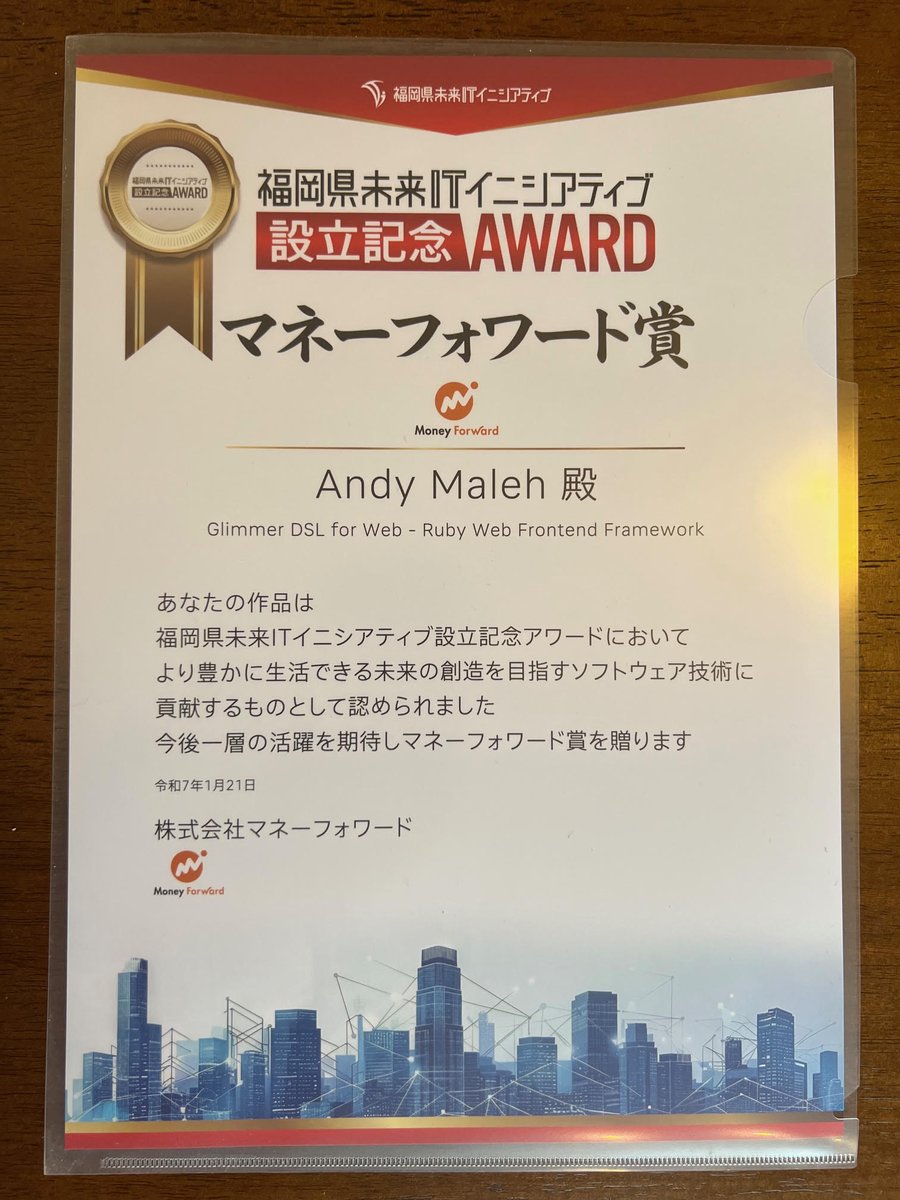
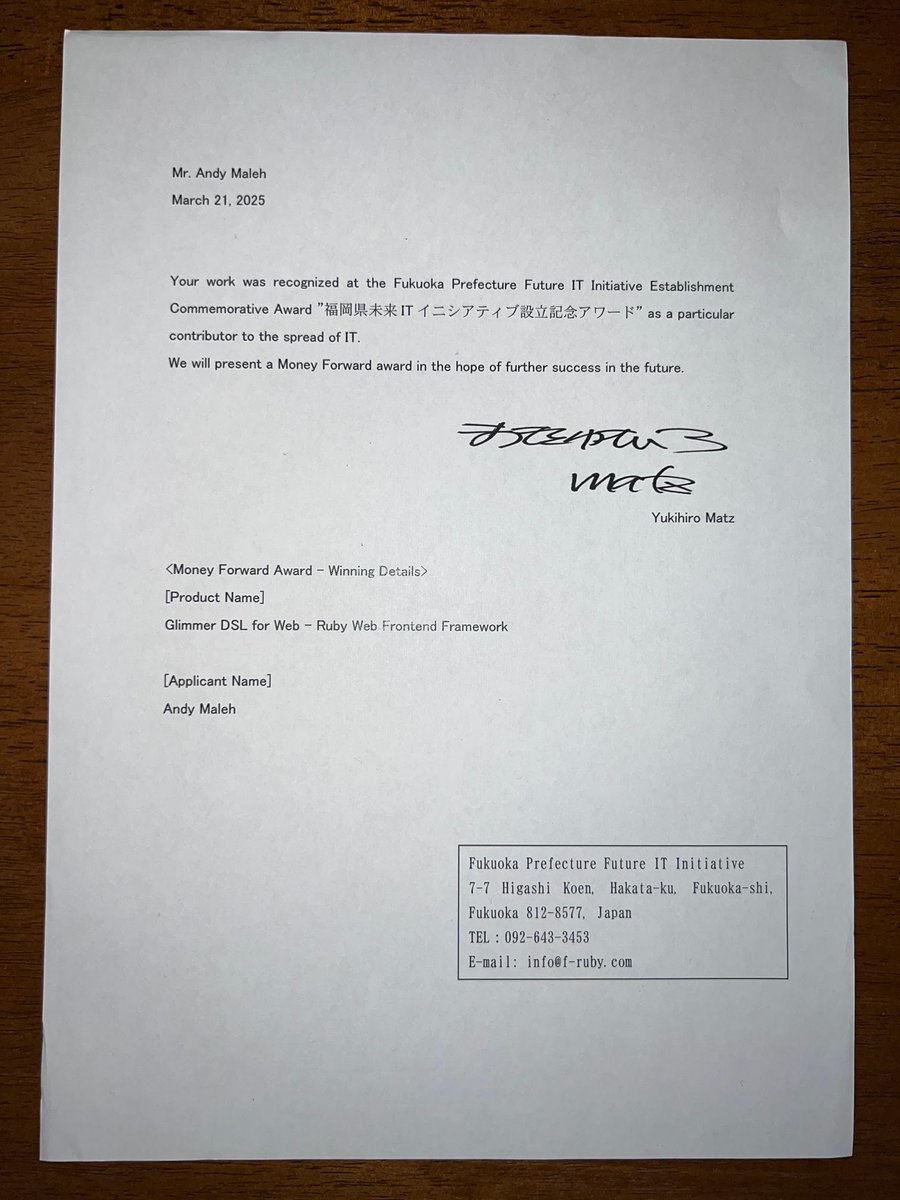
Here are the Money Forward award certificate and direct letter by Matz (the creator of Ruby) that I received for Glimmer DSL for Web (Ruby Web Frontend Framework) winning at the Fukuoka Prefecture Future IT Initiative 2025 competition. That's in addition to my quoted award from winning at the Fukuoka Ruby 2022 competition.
Blog post announcement: andymaleh.blogspot.com/2025/…
GitHub repository for the project that won:
github.com/AndyObtiva/glimme…
#ruby #rails #rubyonrails #opensource #programming #softwareengineering #softwaredevelopment #webdevelopment #glimmer #dsl #web #frontenddevelopment #opal #frontendruby #frontend #development #software #code #framework #library #gem #fukuoka
3 Sep 2022
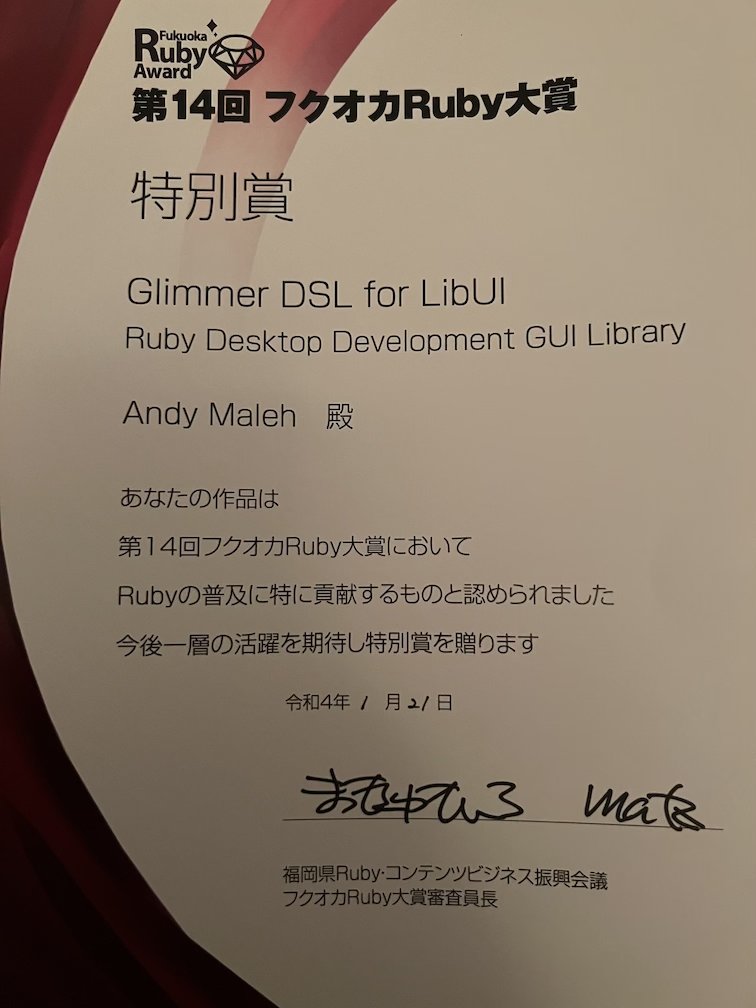
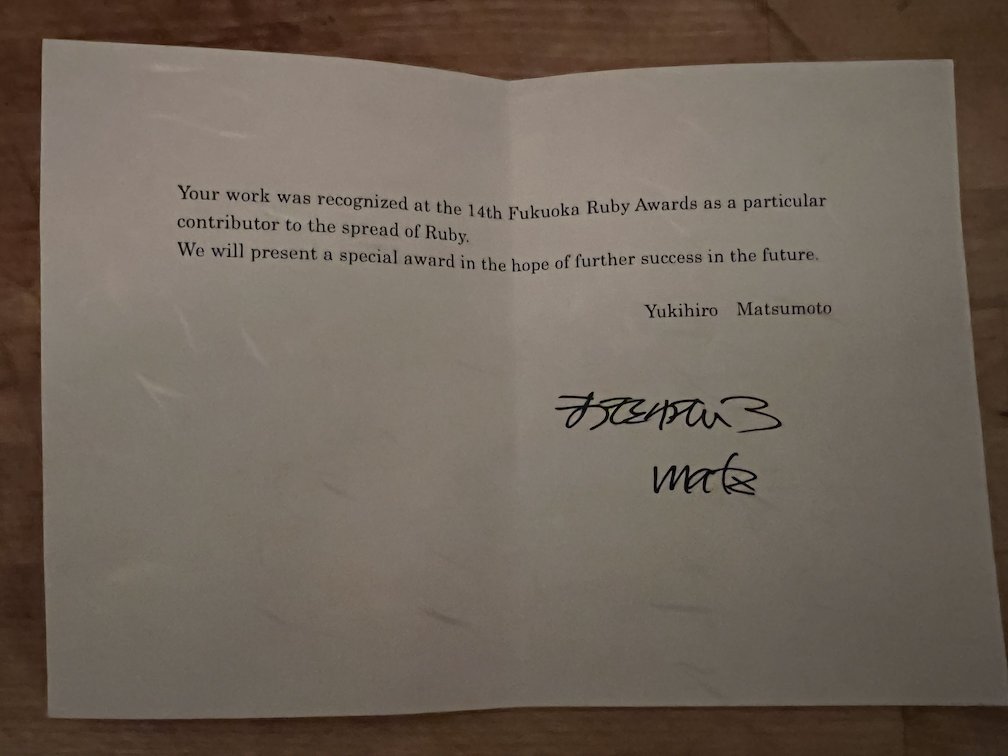
Here are the certificate of merit & direct letter by Matz that I received about Glimmer DSL for LibUI winning a Fukuoka Ruby 2022 Special Award!
andymaleh.blogspot.com/2022/…
#glimmer #dsl #libui #desktop #gui #ruby #fukuoka #award #desktopdevelopment #opensource #software #programming
1
1
14
1,974
24 Jan 2025
"Glimmer DSL for Web Wins in Fukuoka Prefecture Future IT Initiative 2025 Competition" is a blog post version of my announcement from earlier this week:
andymaleh.blogspot.com/2025/…
Thanks to everyone who attended my first talk about Glimmer DSL for Web at the Montreal.rb Ruby Meetup on March 6, 2024 last year as you guys literally witnessed history in the making! This is similar to discovering Ruby in the early days of Rails in the mid-2000s, but on the Frontend instead of the Backend. A couple of weeks ago, I got approval by my managers at work to start using Glimmer DSL for Web in my work Rails web app and to explore it as a replacement for React.js. So far, the results have been absolutely amazing! Truly, I feel a 200% improvement in productivity, maintainability, simplicity, and code readability in Ruby Frontend code compared to using plain JavaScript or React.js. I look forward to the bright future of Ruby in Frontend Development of Rails web applications, as enabled by Glimmer DSL for Web, now a Fukuoka Award Winning project!
#ruby #rails #rubyonrails #opensource #programming #softwareengineering #softwaredevelopment #webdevelopment #glimmer #dsl #web #frontenddevelopment #opal #frontendruby #frontend #development #software #code #framework #library #gem #award #competition #montrealrb #montreal
21 Jan 2025
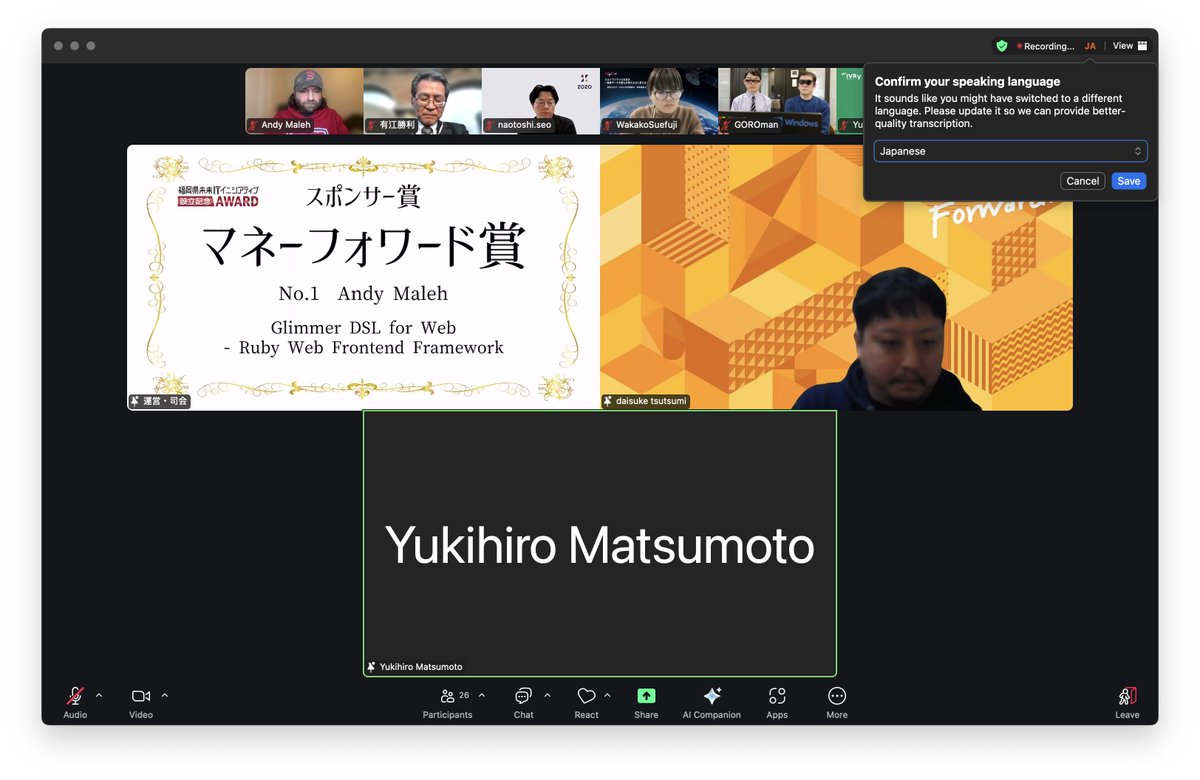
Glimmer DSL for Web (Ruby Web Frontend Framework) won an award in the Fukuoka Prefecture Future IT Initiative 2025 competition after getting presented to Yukihiro Matsumoto (creator of Ruby) and other judges yesterday night! It's official! Matz approves of Glimmer DSL for Web!!!
Project GitHub: github.com/AndyObtiva/glimme…
#ruby #rails #rubyonrails #opensource #programming #softwareengineering #softwaredevelopment #webdevelopment #glimmer #dsl #web #frontenddevelopment #opal #frontendruby #frontend #development #software #code #framework #library #gem
2
149
23 Jan 2025
For very basic Rails apps, Hotwire could be sufficient for handling FE interactions for a while if they are BE dependent. But, as soon as there is a need to write custom JS or SPA code (eg React), that's where Glimmer DSL for Web offers a much simpler option using FE Ruby. Hotwire handles basic needs and Glimmer handles advanced needs. Hotwire is limited without writing additional JavaScript code whereas Glimmer is unlimited as you can do anything in the Frontend with it.
Glimmer DSL for Web (Ruby-in-the-Browser Web Frontend Framework) just won a Fukuoka Prefecture Future IT Initiative 2025 award after getting presented to Matz (the creator of Ruby) and other Fukuoka Prefecture judges:
github.com/AndyObtiva/glimme…
#ruby #rails #rubyonrails #opensource #programming #softwareengineering #softwaredevelopment #webdevelopment #glimmer #dsl #web #frontenddevelopment #opal #frontendruby #frontend #development #software #code #framework #library #gem
7
171
21 Jan 2025
Glimmer DSL for Web (Ruby Web Frontend Framework) won an award in the Fukuoka Prefecture Future IT Initiative 2025 competition after getting presented to Yukihiro Matsumoto (creator of Ruby) and other judges yesterday night! It's official! Matz approves of Glimmer DSL for Web!!!
Project GitHub: github.com/AndyObtiva/glimme…
#ruby #rails #rubyonrails #opensource #programming #softwareengineering #softwaredevelopment #webdevelopment #glimmer #dsl #web #frontenddevelopment #opal #frontendruby #frontend #development #software #code #framework #library #gem
4
561
31 Jul 2024
Opal jQuery 0.5.2 has been released. The opal-jquery gem provides DOM access to Opal Ruby (Ruby-to-JavaScript Transpiler that enables using Ruby in the Browser) by wrapping jQuery and providing a nice Ruby syntax for dealing with jQuery instances.
GitHub : github.com/opal/opal-jquery
RubyGem : rubygems.org/gems/opal-jquer…
Change Log (0.5.2 2024-07-31):
- Fix issue with incorrectly auto-setting content-type as 'application/json' when payload is null (#122)
#opal #jquery #ruby #frontendruby #javascripttranspiler #javascript #transpiler #compiler #javascriptcompiler #js #dom #frontend #web #development #opensource #programming #softwaredevelopment #frontenddevelopment #webdevelopment #rails #rubyonrails #softwareengineering
2
32