
Now what?
Andrew Carnegie (1835–1919): The Scottish-born steel magnate built Carnegie Steel (later U.S. Steel) into a powerhouse amid rapid U.S. industrialization. At his peak, he was one of the richest men in history (adjusted wealth estimates often place him near the top). He gave away roughly 90% of his fortune—about $350 million in his lifetime (equivalent to billions today), including funding over 2,500 public libraries worldwide, Carnegie Mellon University, the Carnegie Endowment for International Peace, and institutions for arts, education, and science. His libraries alone democratized knowledge for millions in the U.S. and beyond.
John D. Rockefeller (1839–1937): Founder of Standard Oil, which dominated the petroleum industry during America's energy boom. Often cited as the wealthiest American in history in relative terms. He donated around $540 million (tens of billions today), establishing the University of Chicago, the Rockefeller Foundation (pivotal in global health, eradicating hookworm and advancing medical research), and major contributions to medical education and public health. His son, John D. Rockefeller Jr., continued this with gifts like land for national parks (e.g., Grand Teton).
1
21

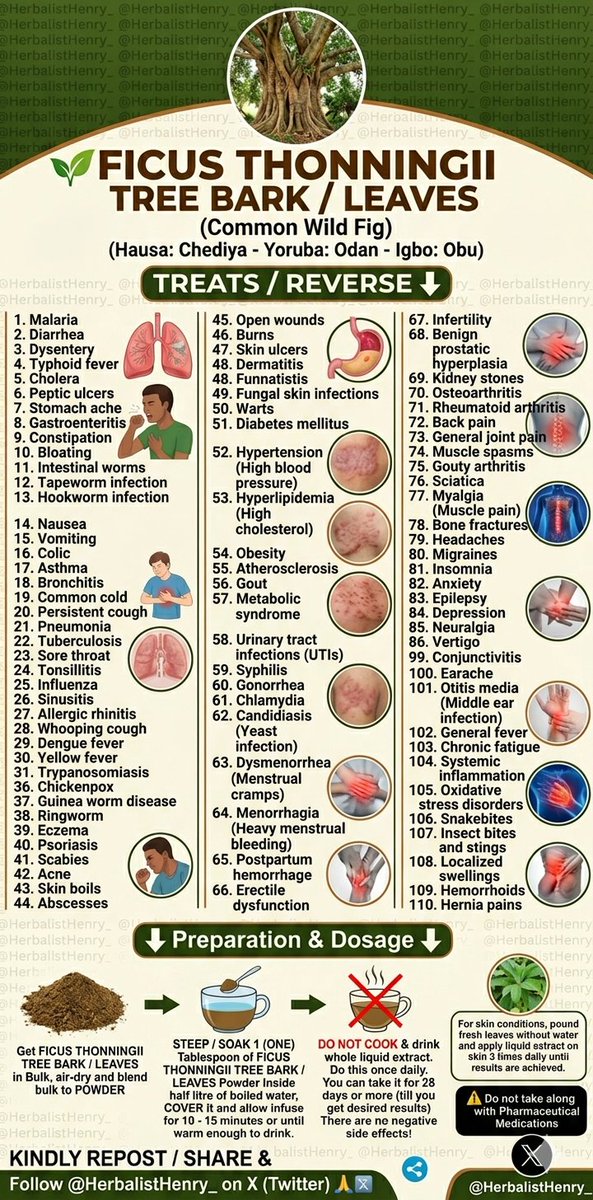
🌿 FICUS THONNINGII TREE BARK / LEAVES
(Common Wild Fig) (Hausa: Chediya - Yoruba: Odan - Igbo: Obu)
TREATS / REVERSE ⬇️
1. Malaria
2. Diarrhea
3. Dysentery
4. Typhoid fever
5. Cholera
6. Peptic ulcers
7. Stomach ache
8. Gastroenteritis
9. Constipation
10. Bloating
11. Intestinal worms
12. Tapeworm infection
13. Hookworm infection
14. Nausea
15. Vomiting
16. Colic
17. Asthma
18. Bronchitis
19. Common cold
20. Persistent cough
21. Pneumonia
22. Tuberculosis
23. Sore throat
24. Tonsillitis
25. Influenza
26. Sinusitis
27. Allergic rhinitis
28. Whooping cough
29. Dengue fever
30. Yellow fever
31. Trypanosomiasis
32. Leishmaniasis
33. Schistosomiasis
34. Leprosy
35. Measles
36. Chickenpox
37. Guinea worm disease
38. Ringworm
39. Eczema
40. Psoriasis
41. Scabies
42. Acne
43. Skin boils
44. Abscesses
45. Open wounds
46. Burns
47. Skin ulcers
48. Dermatitis
49. Fungal skin infections
50. Warts
51. Diabetes mellitus
52. Hypertension (High blood pressure)
53. Hyperlipidemia (High cholesterol)
54. Obesity
55. Atherosclerosis
56. Gout
57. Metabolic syndrome
58. Urinary tract infections (UTIs)
59. Syphilis
60. Gonorrhea
61. Chlamydia
62. Candidiasis (Yeast infection)
63. Dysmenorrhea (Menstrual cramps)
64. Menorrhagia (Heavy menstrual bleeding)
65. Postpartum hemorrhage
66. Erectile dysfunction
67. Infertility
68. Benign prostatic hyperplasia (Enlarged prostate)
69. Kidney stones
70. Osteoarthritis
71. Rheumatoid arthritis
72. Back pain
73. General joint pain
74. Muscle spasms
75. Gouty arthritis
76. Sciatica
77. Myalgia (Muscle pain)
78. Bone fractures
79. Headaches
80. Migraines
81. Insomnia
82. Anxiety
83. Epilepsy
84. Depression
85. Neuralgia
86. Vertigo
87. Jaundice
88. Hepatitis
89. Hepatomegaly (Enlarged liver)
90. Splenomegaly (Enlarged spleen)
91. Anemia
92. Septicemia
93. Toothache
94. Gingivitis
95. Mouth ulcers
96. Oral thrush
97. Dental caries
98. Halitosis (Bad breath)
99. Conjunctivitis
100. Earache
101. Otitis media (Middle ear infection)
102. General fever
103. Chronic fatigue
104. Systemic inflammation
105. Oxidative stress disorders
106. Snakebites
107. Insect bites and stings
108. Localized swellings
109. Hemorrhoids
110. Hernia pains
Preparation & Dosage ⬇️
Get FICUS THONNINGII TREE BARK / LEAVES
(Common Wild Fig) in Bulk, air-dry and blend bulk to POWDER
STEEP / SOAK 1 (ONE) Tablespoon of FICUS THONNINGII TREE BARK / LEAVES Powder Inside half litre of boiled water, COVER it and allow infuse for 10 - 15 minutes or until warm enough to drink.
DO NOT COOK IT!
Filter / Sieve & drink whole liquid extract.
Do this once daily.
You can take it for 28 days or more ( till you get desired results)
There are no negative side effects!
For skin conditions, pound fresh leaves without water and apply liquid extract on skin 3 times daily until results are achieved.
⚠️ Do not take along with Pharmaceutical Medications
KINDLY REPOST / SHARE & Follow @HerbalistHenry_ on X (Twitter) 🙏
1
2
135

Exact reason why TMC has 'Gone with the Passing Winds'.
Reading from ISI scripted texts will only result in loss of existence.. and finally down to a hookworm.
youtube.com/shorts/c1zXmqFYm…
5

Jun 17
Pyrvinium pamoate (brand name Povan) eliminated pinworms by causing the parasites to lose glucose and block their access to energy, plus castor oil and Epsom salts for hookworm. WE HAVE MUCH BETTER REMEDIES NOW,
1
1
1
44


The Parasite Cookbook
FULL BOOK OUTLINE
Information Chapters Separate from Recipe Chapters
FRONT MATTER
FM.1 Title Page
FM.2 Subtitle
FM.3 Copyright Page
FM.4 Medical Disclaimer
FM.5 Historical-Use Disclaimer
FM.6 Children / Pregnancy / Sensitive Bodies Warning
FM.7 How to Use This Book
FM.8 Documented, Plausible, and Speculative History Note
FM.9 Foreword: The Worm Cake, the Hearth, and the Harvest Table
PART I — THE HISTORY OF THE PARASITE-CLEANSING KITCHEN
CHAPTER 1 — THE OLD WORMING KITCHEN
1.1 Food as medicine
1.2 The kitchen as apothecary
1.3 Vermifuges and anthelmintics
1.4 Worm cakes
1.5 Worm lozenges
1.6 Molasses remedies
1.7 Treacle remedies
1.8 Honey pastes
1.9 Herbal candies
1.10 Seed pastes
1.11 Beer, broth, vinegar, and molasses as carriers
1.12 Children’s worm medicines
1.13 Household medicine books
1.14 Apothecaries
1.15 Farm journals
1.16 Domestic receipt books
1.17 Almanacs
1.18 Old terms: vermifuge, anthelmintic, purge, electuary, decoction, infusion, treacle, physick, receipt
1.19 Source note: 1700s/1800s examples such as wormseed electuaries, sage and molasses for children, pomegranate root bark, male fern, pumpkin seeds, worm cakes, worm lozenges, and purgatives
CHAPTER 2 — ANCIENT WORM REMEDIES
2.1 Ebers Papyrus
2.2 Ancient Egyptian parasite remedies
2.3 Pomegranate root
2.4 Acacia
2.5 Bitter herbs
2.6 Wormwood-like herbs
2.7 Beer as a medicinal carrier
2.8 Dates and figs
2.9 Honey and syrups
2.10 Mineral remedies
2.11 Ancient ideas of worms and gut illness
2.12 What survives in later herbal practice
CHAPTER 3 — 1600s–1900s HOUSEHOLD PARASITE HISTORY
3.1 William Salmon
3.2 The Family Dictionary
3.3 The London Dispensatory
3.4 John Wesley’s Primitive Physick
3.5 William Buchan’s Domestic Medicine
3.6 Mrs. Child’s The American Frugal Housewife
3.7 Gunn’s New Domestic Physician
3.8 Pumpkin seed paste
3.9 Wormseed and treacle
3.10 Sage and molasses
3.11 Pomegranate bark decoctions
3.12 Male fern tapeworm remedies
3.13 Castor oil follow-up
3.14 Senna
3.15 Jalap
3.16 Calomel
3.17 Worm cakes and worm lozenges
3.18 Patent medicines
3.19 Why some worked
3.20 Why many were dangerous
CHAPTER 4 — WORM CAKES, MOLASSES, SAILORS, AND SWEETS
4.1 Molasses as a medicine carrier
4.2 Treacle as a medicine carrier
4.3 Molasses worm candy
4.4 Sage-molasses remedies
4.5 Sugar plums for worms
4.6 Chocolate worm cakes
4.7 Ching’s worm lozenges
4.8 Santonin lozenges
4.9 Pumpkin seed sweets
4.10 Pomegranate syrup
4.11 Garlic honey
4.12 Carrot gruel
4.13 Joe Froggers
4.14 Shipboard foods
4.15 Sailor provisions
4.16 Rum/molasses trade
4.17 Sugar, slavery, and molasses history
4.18 What can be documented
4.19 What is plausible
4.20 What should not be overclaimed
CHAPTER 5 — SEASONAL CLEANSING: HARVEST, HOG-KILLING, CHRISTMAS, AND NEW YEAR
5.1 Harvest-time cleansing
5.2 Late autumn worming
5.3 Hog-killing season
5.4 Preserved pork
5.5 Salted meats
5.6 Smoked meats
5.7 Sausages and lard
5.8 Thanksgiving-to-New-Year window
5.9 Martinmas
5.10 St. Nicholas Day
5.11 St. Lucia Day
5.12 Christmas worming traditions
5.13 Hogmanay
5.14 New Year purge
5.15 Winter confinement
5.16 Cold-weather purge logic
5.17 Children being “cleaned out”
5.18 Whole-household cleansing
5.19 Livestock worming season
5.20 Solstice purification symbolism
CHAPTER 6 — MOON CYCLES, FULL MOONS, AND PARASITE-CLEANSE FOLKLORE
6.1 Full moon parasite cleanse claims
6.2 Modern holistic full-moon protocols
6.3 Serotonin theory
6.4 Melatonin theory
6.5 Sleep disruption
6.6 Cravings
6.7 Itching
6.8 Anecdotal symptom flares
6.9 Lunar agriculture context
6.10 What is proven
6.11 What is not proven
6.12 Why seasonal timing has stronger historical support
6.13 How to present moon cycles responsibly
CHAPTER 7 — NON-STANDARD FOOD HISTORY AND HISTORIOLOGY
7.1 The book’s historical thesis
7.2 Documented history
7.3 Pattern history
7.4 Interpretive history
7.5 Forgotten medicinal food categories
7.6 Worm cakes as medicinal foods
7.7 Holiday sweets as possible medicine carriers
7.8 Food and medicine before modern separation
7.9 Class history
7.10 Rural households
7.11 Poor households
7.12 Sailors
7.13 Soldiers
7.14 Enslaved people
7.15 Farmers
7.16 Children
7.17 Indigenous herbal knowledge
7.18 African diaspora herbalism
7.19 European domestic medicine
7.20 Ayurvedic / Indian parasite herbs
7.21 Latin American wormseed / epazote traditions
7.22 German / Scandinavian bitter traditions
7.23 Egyptian and Middle Eastern pomegranate traditions
7.24 Trade history
7.25 Safety history
PART II — PARASITES, BAD BACTERIA, AND THE INFLAMED TERRAIN
CHAPTER 8 — COMMON PARASITES PEOPLE MAY ENCOUNTER
8.1 Pinworms
8.2 Roundworms
8.3 Tapeworms
8.4 Hookworms
8.5 Whipworms
8.6 Liver flukes
8.7 Blood flukes
8.8 Toxocara
8.9 Cysticercosis
8.10 Eye-related parasites
8.11 Exposure routes
8.12 Stool testing
8.13 Tape test
8.14 Blood testing
8.15 When medical care is needed
8.16 Red flags
CHAPTER 9 — PINWORMS AND HOUSEHOLD REINFECTION
9.1 Pinworms laying eggs around the anus
9.2 Nighttime itching
9.3 Eggs under nails
9.4 Eggs in bedding
9.5 Eggs on clothing
9.6 Eggs on surfaces
9.7 Reinfection
9.8 Handwashing
9.9 Nail trimming
9.10 Morning showers
9.11 Washing bedding
9.12 Bathroom cleaning
9.13 Whole-household awareness
9.14 Children’s risk
9.15 Modern medical treatment note
CHAPTER 10 — TINY PARASITES AND PROTOZOA
10.1 Toxoplasma gondii
10.2 Giardia
10.3 Entamoeba
10.4 Blastocystis
10.5 Cryptosporidium
10.6 Babesia
10.7 Malaria-type protozoa
10.8 Leishmania
10.9 Trypanosoma / Chagas
10.10 Dientamoeba fragilis
10.11 Trichomonas
10.12 Protozoa vs worms
10.13 Gut protozoa
10.14 Tissue protozoa
10.15 Blood protozoa
10.16 Pregnancy concerns
10.17 Immune-compromised concerns
10.18 Medical diagnosis
10.19 Food and herb support
10.20 What herbs cannot promise
CHAPTER 11 — BAD BACTERIA, DYSBIOSIS, BIOFILMS, AND INFLAMMATION
11.1 Gut dysbiosis
11.2 Bad gut bacteria
11.3 SIBO
11.4 Yeast overgrowth
11.5 Biofilms
11.6 Post-antibiotic imbalance
11.7 Food poisoning aftermath
11.8 Bloating
11.9 Cravings
11.10 Brain fog
11.11 Fatigue
11.12 Constipation
11.13 Loose stool
11.14 Itching
11.15 Immune stress
11.16 Sugar-fed organisms
11.17 Processed-food terrain
11.18 Inflammatory terrain
11.19 Strong gut terrain
11.20 Weak gut terrain
PART III — THE HERBAL AND FOOD CABINET
CHAPTER 12 — KITCHEN-SAFE PARASITE-CLEANSE FOODS AND HERBS
12.1 Garlic
12.2 Ginger
12.3 Clove
12.4 Thyme
12.5 Oregano
12.6 Sage
12.7 Pumpkin seed
12.8 Papaya seed
12.9 Pineapple
12.10 Carrot
12.11 Figs
12.12 Raspberries
12.13 Citrus peel
12.14 Lemon zest
12.15 Orange peel
12.16 Pomegranate fruit/rind
12.17 Apple pectin
12.18 Flax
12.19 Chia
12.20 Okra
12.21 Applesauce
12.22 Oats
12.23 Molasses
12.24 Honey
12.25 Apple cider vinegar
CHAPTER 13 — STRONG HERBALIST-LEVEL PARASITE AND TERRAIN HERBS
13.1 Black walnut hull
13.2 Wormwood
13.3 Sweet Annie / Artemisia annua
13.4 Barberry
13.5 Oregon grape
13.6 Goldenseal
13.7 Coptis
13.8 Neem
13.9 Pomegranate root bark
13.10 Quassia
13.11 Cryptolepis
13.12 Japanese knotweed
13.13 Teasel root
13.14 Sida acuta
13.15 Bidens pilosa
13.16 Pau d’arco
13.17 Kutaja
13.18 Kamala
13.19 Strong-herb safety
13.20 Medication cautions
13.21 Pregnancy/nursing cautions
13.22 Children cautions
13.23 Practitioner guidance
CHAPTER 14 — TEASEL, JAPANESE KNOTWEED, LYME, AND TICK-BORNE TERRAIN
14.1 Teasel root
14.2 Teasel tincture
14.3 Teasel as terrain-shifting herb
14.4 Teasel and Lyme herbalist tradition
14.5 Teasel and joint/inflammatory terrain
14.6 Teasel safety
14.7 Teasel not as guaranteed cure
14.8 Japanese knotweed
14.9 Resveratrol
14.10 Emodin
14.11 Polyphenols
14.12 Lyme support tradition
14.13 Anti-inflammatory support
14.14 Cryptolepis
14.15 Babesia support tradition
14.16 Sweet Annie
14.17 Artemisinin context
14.18 Sida acuta
14.19 Bidens pilosa
14.20 Strong terrain herbs
14.21 Tick-borne illness caution
14.22 Medical testing
14.23 Antibiotics as standard treatment for confirmed Lyme
14.24 Herbs as support only
14.25 “When parasites are not the whole story” sidebar
CHAPTER 15 — HISTORICAL-ONLY AND DANGEROUS REMEDIES
15.1 Calomel
15.2 Mercury
15.3 Turpentine
15.4 Santonin
15.5 Male fern
15.6 Pinkroot
15.7 Rue
15.8 Tansy
15.9 Pennyroyal
15.10 Concentrated wormseed oil
15.11 Betel nut / areca nut
15.12 Jalap
15.13 Scammony
15.14 Gamboge
15.15 Powdered tin
15.16 Powdered glass
15.17 Tobacco drenches
15.18 Strong purges for children
15.19 Why they are not used in this book
15.20 How modern safe adaptations replace them
PART IV — DETOX, CLEAN LIVING, AND CHEMICAL BURDEN
CHAPTER 16 — DETOX, DRAINAGE, AND THE EXIT PATH
16.1 Open the pathways
16.2 Stool
16.3 Bile
16.4 Urine
16.5 Sweat
16.6 Lymph
16.7 Hydration
16.8 Sleep
16.9 Fasting as digestive rest
16.10 Intermittent fasting: the 16/8 rhythm
16.11 Autophagy, ketosis, and the body’s cleanup mode
16.12 Fasting, circadian rhythm, and the internal clock
16.13 Detox as drainage support
16.14 Detox as reducing daily burden
16.15 Not medical chelation
16.16 Liver support
16.17 Kidney support
16.18 Gut support
16.19 Skin support
16.20 Breath and movement
16.21 “Do not stir the mud if the river is not flowing”
CHAPTER 17 — HEAVY METALS AND ENVIRONMENTAL BURDEN
17.1 Lead
17.2 Mercury
17.3 Cadmium
17.4 Arsenic
17.5 Aluminum concerns
17.6 Pesticides
17.7 Herbicides
17.8 Solvents
17.9 Plastics
17.10 Food packaging
17.11 Cookware concerns
17.12 Water quality
17.13 Industrial exposure
17.14 Heavy-metal testing
17.15 No self-chelation
17.16 Medical chelation warning
17.17 Cilantro
17.18 Chlorella
17.19 Spirulina
17.20 Milk thistle
17.21 Dandelion
17.22 Burdock
17.23 Parsley
17.24 Bitter greens
17.25 Limits of detox claims
CHAPTER 18 — WHAT YOU PUT IN AND ON YOUR BODY
18.1 Processed food
18.2 Refined sugar
18.3 Alcohol
18.4 Soda
18.5 Artificial dyes
18.6 Artificial sweeteners
18.7 Industrial snack oils
18.8 Fried foods
18.9 Heavy processed meats
18.10 Undercooked pork
18.11 Undercooked fish
18.12 Undercooked wild game
18.13 Unwashed produce
18.14 Contaminated water
18.15 Makeup
18.16 Perfume
18.17 Cologne
18.18 Fragrance oils
18.19 Scented lotions
18.20 Deodorants
18.21 Scented laundry detergent
18.22 Dryer sheets
18.23 Air fresheners
18.24 Scented candles
18.25 Harsh soaps
18.26 Shampoo
18.27 Hair dye
18.28 Cleaning sprays
18.29 Chemical sunscreens
18.30 Clean-living checklist
PART V — BINDERS, PURGING, AND ELIMINATION
CHAPTER 19 — BINDERS: CATCHING WHAT THE CLEANSE RELEASES
19.1 What binders are
19.2 Why killing is not enough
19.3 Parasite debris
19.4 Die-off waste
19.5 Bile waste
19.6 Microbial byproducts
19.7 Biofilm debris
19.8 Endotoxins
19.9 Digestive debris
19.10 Binding vs detoxing
19.11 Binding vs laxatives
19.12 Timing away from food
19.13 Timing away from herbs
19.14 Timing away from medications
19.15 Activated charcoal
19.16 Bentonite clay
19.17 Chlorella
19.18 Zeolite
19.19 Humic / fulvic substances
19.20 Psyllium husk
19.21 Ground flaxseed
19.22 Chia seed
19.23 Apple pectin
19.24 Citrus pectin
19.25 Oats
19.26 Cooked carrots
19.27 Okra
19.28 Figs
19.29 Applesauce
19.30 Marshmallow root
19.31 Slippery elm
19.32 Aloe inner gel
19.33 Charcoal caution
19.34 Clay contamination caution
19.35 Constipation warning
19.36 Medication absorption warning
19.37 Binder hydration
19.38 “Binders are the net”
19.39 “A binder without a bowel movement is a trash bag left in the kitchen”
CHAPTER 20 — THINGS THAT HELP YOU SHIT THEM OUT
20.1 Bowel movement as core cleanse requirement
20.2 Constipation prevention
20.3 Stool movement
20.4 Bile movement
20.5 Warm water
20.6 Broth
20.7 Electrolytes
20.8 Mineral salt
20.9 Celtic sea salt
20.10 Coconut water
20.11 Potassium foods
20.12 Magnesium-rich foods
20.13 Prunes
20.14 Figs
20.15 Applesauce
20.16 Oats
20.17 Chia pudding
20.18 Flaxseed
20.19 Psyllium with plenty of water
20.20 Cooked vegetables
20.21 Bitter greens
20.22 Walking
20.23 Gentle movement
20.24 Squatting posture
20.25 Footstool
20.26 Abdominal massage
20.27 Hydration schedule
20.28 Morning bowel routine
20.29 Dehydration warning signs
20.30 Electrolyte imbalance warning signs
CHAPTER 21 — PURGES, ENEMAS, AND HIGH-CAUTION PRACTICES
21.1 Historical purge logic
21.2 Castor oil historical note
21.3 Senna historical note
21.4 Epsom salts historical note
21.5 Jalap historical-only warning
21.6 Calomel historical-only warning
21.7 Coffee enemas
21.8 Colon cleansing
21.9 Gerson therapy context
21.10 Coffee enemas not proven to kill parasites
21.11 Coffee enemas not proven to detox heavy metals
21.12 Rectal burn warning
21.13 Electrolyte imbalance warning
21.14 Infection warning
21.15 Proctitis warning
21.16 Colitis warning
21.17 Dehydration warning
21.18 Not for children
21.19 Not for pregnancy
21.20 Not for sensitive bodies
21.21 Safer elimination methods first
21.22 “A purge should open the exit, not injure the road out”
CHAPTER 22 — ELECTROLYTES, MINERALS, AND REHYDRATION
22.1 Sodium
22.2 Potassium
22.3 Chloride
22.4 Magnesium
22.5 Calcium
22.6 Phosphate
22.7 Bicarbonate
22.8 Celtic sea salt
22.9 Sea salt
22.10 Mineral salt
22.11 Coconut water
22.12 Bone broth
22.13 Vegetable broth
22.14 Lemon water with salt
22.15 Apple cider vinegar mineral tonic
22.16 Potassium-rich foods
22.17 Bananas
22.18 Avocado
22.19 Potatoes
22.20 Sweet potatoes
22.21 Squash
22.22 Beets
22.23 Leafy greens
22.24 Molasses
22.25 Sea moss
22.26 Seaweed
22.27 Magnesium-rich foods
22.28 Pumpkin seeds
22.29 Chia seeds
22.30 Flaxseed
22.31 Mineral drops
22.32 Homemade electrolyte drink
22.33 Rehydration broth
22.34 Post-purge mineral soup
22.35 Hydration after diarrhea
22.36 Hydration after sweating
22.37 Hydration after coffee enemas
22.38 Hydration with binders
22.39 Iodine caution
22.40 Thyroid caution
22.41 Heavy-metal contamination caution for seaweed/sea moss
PART VI — FERMENTATION AND REBUILDING
CHAPTER 23 — FERMENTED FOODS AND REBUILDING THE GUT
23.1 Gut rebuilding after cleanse
23.2 Microbiome support
23.3 Re-seeding the gut
23.4 Fermentation history
23.5 Winter cellar
23.6 Preserved harvest foods
23.7 Sauerkraut
23.8 Pickles
23.9 Fermented carrots
23.10 Fermented beets
23.11 Beet kvass
23.12 Yogurt
23.13 Kefir
23.14 Buttermilk
23.15 Sourdough
23.16 Apple cider vinegar
23.17 Fermented oats
23.18 Small beer historical note
23.19 Vinegar tonics
23.20 Brined herbs and roots
23.21 Cleanse first, ferment second
23.22 Start slow
23.23 Histamine intolerance caution
23.24 SIBO caution
23.25 Mold sensitivity caution
23.26 Immune-compromised caution
23.27 Pregnancy caution
23.28 Active diarrhea caution
23.29 Rotten ferment warning
23.30 Mold warning
23.31 Broth soothes
23.32 Ferments rebuild
23.33 Fiber feeds
23.34 Minerals restore
23.35 Protein repairs
23.36 Sleep restores
CHAPTER 24 — ANTI-INFLAMMATORY FOOD AND GUT REPAIR
24.1 Inflammation basics
24.2 Parasites and inflammation
24.3 Bad bacteria and inflammation
24.4 Sugar and inflammation
24.5 Chemical burden and inflammation
24.6 Berries
24.7 Raspberries
24.8 Pomegranate
24.9 Citrus
24.10 Pineapple
24.11 Papaya
24.12 Apples
24.13 Beets
24.14 Carrots
24.15 Squash
24.16 Cruciferous vegetables
24.17 Garlic
24.18 Onion
24.19 Ginger
24.20 Turmeric
24.21 Rosemary
24.22 Thyme
24.23 Oregano
24.24 Olive oil
24.25 Wild fish
24.26 Omega-3 foods
24.27 Flaxseed
24.28 Chia seed
24.29 Walnuts
24.30 Bone broth
24.31 Fermented vegetables
24.32 Green tea
24.33 Bitter greens
24.34 Clean protein
24.35 Sleep
24.36 Sunlight
24.37 Gentle movement
PART VII — CHILDREN, PREGNANCY, SENSITIVE BODIES, AND HOUSEHOLD SAFETY
CHAPTER 25 — CHILDREN, PREGNANCY, AND SENSITIVE BODIES
25.1 Children’s parasite exposure
25.2 Food-level child support
25.3 Pumpkin seeds as food
25.4 Carrots
25.5 Ginger
25.6 Broth
25.7 Garlic in food amounts
25.8 Ferments if tolerated
25.9 Avoid strong herbs for children
25.10 Avoid toxic historical worm cakes
25.11 Pregnancy parasite concerns
25.12 Toxoplasmosis pregnancy warning
25.13 Nursing cautions
25.14 Avoid wormwood
25.15 Avoid rue
25.16 Avoid tansy
25.17 Avoid pennyroyal
25.18 Avoid male fern
25.19 Avoid pinkroot
25.20 Avoid santonica
25.21 Avoid strong black walnut
25.22 Avoid strong essential oils
25.23 Avoid aggressive purges
25.24 Elderly cautions
25.25 Immune-compromised cautions
25.26 Liver/kidney disease cautions
25.27 Medication users
25.28 Severe constipation caution
25.29 Severe diarrhea caution
25.30 Eye symptoms warning
25.31 Neurological symptoms warning
25.32 Fever warning
25.33 Blood in stool warning
25.34 Unexplained weight loss warning
CHAPTER 26 — HOUSEHOLD HYGIENE, ANIMALS, AND REINFECTION PREVENTION
26.1 Handwashing
26.2 Nail trimming
26.3 Morning showers
26.4 Bedding wash
26.5 Clothing wash
26.6 Towels
26.7 Bathroom cleaning
26.8 Toilet cleaning
26.9 Privy history
26.10 Surface cleaning
26.11 Children’s toys
26.12 Laundry hygiene
26.13 Whole-household awareness
26.14 Pet deworming through veterinarian
26.15 Dogs
26.16 Cats
26.17 Chickens
26.18 Horses
26.19 Cattle
26.20 Sheep
26.21 Pigs
26.22 Livestock worming history
26.23 Farm almanac worming season
26.24 Pigs before slaughter
26.25 Produce washing
26.26 Meat cooking safety
26.27 Pork safety
26.28 Fish safety
26.29 Wild game safety
26.30 Water safety
26.31 Shoes outdoors
26.32 Hookworm prevention
26.33 Soil exposure
26.34 Travel hygiene
26.35 Reinfection cycles
PART VIII — THE OLD FAMILY ROUTINE
CHAPTER 27 — THE WHOLE-FAMILY HARVEST CLEANSE
27.1 Day 0 preparation evening
27.2 Light supper
27.3 Porridge
27.4 Bread
27.5 Broth
27.6 Bitter tea
27.7 Day 1 fasting morning
27.8 Black coffee historical note
27.9 Wormwood/gentian tea historical note
27.10 Midday grated carrots
27.11 Garlic
27.12 Pumpkin seed mash
27.13 Pumpkin soup
27.14 Salt herring historical note
27.15 Smoked bacon historical note
27.16 Evening vermifuge
27.17 Pumpkin seed paste
27.18 Wormseed candy historical note
27.19 Pomegranate decoction historical note
27.20 Garlic milk
27.21 Clove-ginger honey
27.22 Bedtime rest
27.23 Day 2 broth morning
27.24 Historical purge step
27.25 Afternoon rest
27.26 Broth sipping
27.27 Soft porridge
27.28 Day 3 recovery
27.29 Broths
27.30 Carrots
27.31 Pumpkin seeds
27.32 Light soups
27.33 Ferments later
27.34 Stool observation historical note
27.35 Household hygiene after cleanse
CHAPTER 28 — REGIONAL WORMING ROUTINES
28.1 British/American worming dinner
28.2 German Wurm-Mahl
28.3 French Repas Vermifuge
28.4 Southern U.S. plantation worm supper
28.5 Scottish Hogmanay worming meal
28.6 Nordic livestock/human worm porridge
28.7 Maritime wormseed and garlic purge
28.8 Wesley-style wormwood/rue infusion
28.9 Buchan bitter herb decoction
28.10 Plantation wormseed-molasses tradition
28.11 Livestock routines
28.12 Farm almanac timing
28.13 Children’s sweetened remedies
28.14 Adult bitter remedies
28.15 Recovery foods
PART IX — RECIPE CHAPTERS ONLY
RECIPE CHAPTER 29 — MORNING AND FASTING FOODS
29.1 Bitter Morning Tea
29.2 Ginger-Clove Wake-Up Tea
29.3 Pumpkin Seed Breakfast Paste
29.4 Papaya Seed Morning Bowl
29.5 Carrot-Garlic Morning Scrape
RECIPE CHAPTER 30 — BROTHS AND RECOVERY SOUPS
30.1 Bone Broth Recovery Cup
30.2 Garlic-Thyme Broth
30.3 Ginger Vegetable Broth
30.4 Carrot Recovery Soup
30.5 Pomegranate Broth Tonic
RECIPE CHAPTER 31 — PARASITE-CLEANSE SOUPS
31.1 Garlic Carrot Soup
31.2 Pumpkin Seed Winter Soup
31.3 Oregano-Thyme Gut Soup
31.4 Sage and Garlic Harvest Soup
31.5 Papaya Seed Porridge
RECIPE CHAPTER 32 — FULL FAMILY MEALS
32.1 Harvest Worming Supper
32.2 Garlic-Thyme Roast Chicken
32.3 Pumpkin Seed Crusted Fish
32.4 Pomegranate Beef Stew
32.5 New Year’s Eviction Supper
RECIPE CHAPTER 33 — DRINKS, TEAS, AND INFUSIONS
33.1 Bitter Wormwood Tea — historical/caution version
33.2 Pomegranate Peel Tea
33.3 Ginger-Clove Digestive Tea
33.4 Berberine-Style Bitter Tonic
33.5 Full Moon Cleanse Tea
RECIPE CHAPTER 34 — TINCTURES, TONICS, AND VINEGARS
34.1 Garlic-Honey Oxymel
34.2 Ginger-Clove Vinegar Tonic
34.3 Black Walnut Historical Tincture — educational only
34.4 Wormwood Bitter Tincture — herbalist-level only
34.5 Apple Cider Vinegar Harvest Tonic
RECIPE CHAPTER 35 — BINDER FOODS
35.1 Apple Pectin Binder Bowl
35.2 Pumpkin Seed Flax Crackers
35.3 Chia Citrus Binder Drink
35.4 Okra-Garlic Gut Binder Soup
35.5 Marshmallow-Slippery Elm Recovery Tea
RECIPE CHAPTER 36 — ELECTROLYTE AND MINERAL RECOVERY RECIPES
36.1 Harvest Electrolyte Tonic
36.2 Salted Citrus Mineral Water
36.3 Rehydration Bone Broth
36.4 Mineral Vegetable Broth
36.5 Irish Sea Moss Custard
RECIPE CHAPTER 37 — FERMENTED GUT-REBUILD FOODS
37.1 Old Cellar Sauerkraut
37.2 Ginger Fermented Carrots
37.3 Garlic-Dill Pickles
37.4 Beet Kvass
37.5 Pumpkin Seed Kefir Bowl
RECIPE CHAPTER 38 — BAKED GOODS AND COOKIES
38.1 Parasite-Cleanse Joe Froggers
38.2 Pumpkin Seed Molasses Cookies
38.3 Sage and Molasses Cookies
38.4 Clove-Ginger Winter Cakes
38.5 Fig and Citrus Spice Cakes
RECIPE CHAPTER 39 — CANDIES, LOZENGES, AND WORM CAKES
39.1 Molasses Worm Candy — modern safe version
39.2 Clove-Ginger Honey Drops
39.3 Pumpkin Seed Brittle
39.4 Pomegranate Molasses Chews
39.5 Citrus Peel Candy
PART X — PRACTICAL USE
CHAPTER 40 — THE MEAT AND POTATOES: HOW TO USE THIS BOOK IN REAL LIFE
40.1 Gentle seasonal cleanse
40.2 Stronger herbalist-level cleanse
40.3 Food-only cleanse
40.4 Family kitchen version
40.5 Child-safe food version
40.6 Post-cleanse rebuild week
40.7 Clean-living protocol
40.8 Chemical/fragrance reduction
40.9 Heavy-metal exposure reduction
40.10 Food quality
40.11 Water quality
40.12 Meat safety
40.13 Produce safety
40.14 Pet/livestock awareness
40.15 Binder timing
40.16 Electrolyte timing
40.17 Ferment timing
40.18 When to stop
40.19 When to seek care
40.20 How to choose recipes
40.21 How to avoid overdoing it
40.22 Final formula: Clean the inputs
40.23 Final formula: Open the exits
40.24 Final formula: Strike the parasites
40.25 Final formula: Shift the terrain
40.26 Final formula: Cool the inflammation
40.27 Final formula: Bind the debris
40.28 Final formula: Move the bowels
40.29 Final formula: Rehydrate and mineralize
40.30 Final formula: Rebuild the gut
BACK MATTER
APPENDIX A — PARASITE QUICK REFERENCE CHART
A.1 Parasite
A.2 Type
A.3 Where it lives
A.4 Exposure route
A.5 Symptoms
A.6 Testing
A.7 Medical red flags
A.8 Food/herb traditions
A.9 Medical-treatment note
APPENDIX B — HERB SAFETY CHART
B.1 Herb
B.2 Latin name
B.3 Part used
B.4 Traditional use
B.5 Organisms discussed
B.6 Safety category
B.7 Avoid if
B.8 Best preparation
B.9 Historical-only warning
B.10 Modern food-safe adaptation
APPENDIX C — HISTORICAL DANGEROUS INGREDIENTS
C.1 Calomel
C.2 Turpentine
C.3 Male fern
C.4 Santonin
C.5 Pinkroot
C.6 Rue
C.7 Tansy
C.8 Pennyroyal
C.9 Jalap
C.10 Scammony
C.11 Gamboge
C.12 Powdered tin
C.13 Powdered glass
C.14 Tobacco drenches
C.15 Strong wormseed oil
APPENDIX D — 3-DAY SEASONAL CLEANSE TEMPLATE
D.1 Day 0 prep
D.2 Day 1 fasting/foods
D.3 Day 2 bind/move/recover
D.4 Day 3 rebuild
D.5 Child-safe version
D.6 Food-only version
D.7 Strong-herb version with cautions
D.8 Full family version
D.9 Post-cleanse rebuild week
D.10 Household hygiene checklist
APPENDIX E — REBUILD WEEK TEMPLATE
E.1 Broth
E.2 Fiber
E.3 Electrolytes
E.4 Binders
E.5 Ferments
E.6 Minerals
E.7 Protein
E.8 Sleep
E.9 Hydration
E.10 Gentle walking
E.11 Clean-living inputs
APPENDIX F — RECIPE INDEX
F.1 By category
F.2 By ingredient
F.3 By safety level
F.4 By historical inspiration
F.5 By child-friendly
F.6 By pregnancy-safe food-only
F.7 By binder
F.8 By electrolyte support
F.9 By fermented food
F.10 By parasite tradition
F.11 By season
APPENDIX G — SOURCE NOTES AND FURTHER READING
G.1 Ancient medicine sources
G.2 Domestic medicine books
G.3 Herbal references
G.4 Food history
G.5 Parasite references
G.6 Safety references
G.7 Modern medical testing references
G.8 Historical recipe references
READER NOTES SECTION
N.1 Blank notes pages 1–20
READER’S OWN RECIPES SECTION
R.1 Blank recipe pages 1–20
2
7
569

Jun 17
Mississippi hookworm infested retard will always be a Mississippi hookworm infested retard
16

Jun 16
Nothing was broken. Zero cuts to hookworm prevention occurred. You’re posting bullshit propaganda that’s been proven false.
4

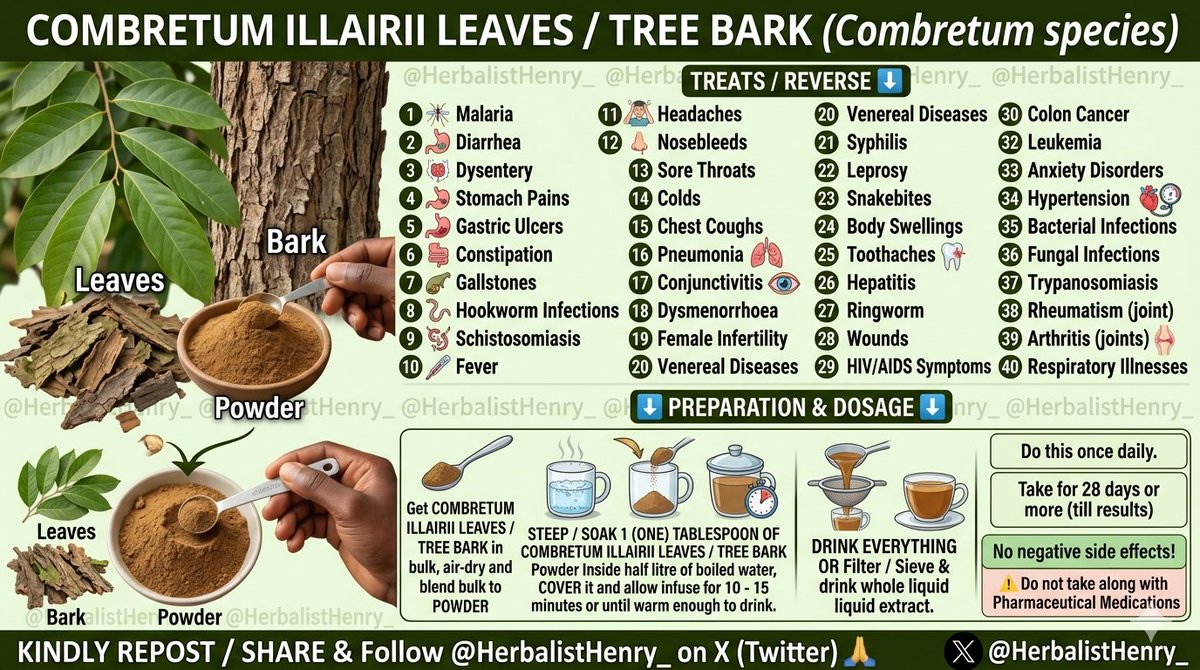
COMBRETUM ILLAIRII LEAVES / TREE BARK (Combretum species)
TREATS / REVERSE ⬇️
1. Malaria
2. Diarrhea
3. Dysentery
4. Stomach Pains
5. Gastric Ulcers
6. Constipation
7. Gallstones
8. Hookworm Infections
9. Schistosomiasis
10. Fever
11. Headaches
12. Nosebleeds
13. Sore Throats
14. Colds
15. Chest Coughs
16. Pneumonia
17. Conjunctivitis
18. Dysmenorrhoea
19. Female Infertility
20. Venereal Diseases
21. Syphilis
22. Leprosy
23. Snakebites
24. Body Swellings
25. Toothaches
26. Hepatitis
27. Ringworm
28. Wounds
29. HIV/AIDS Symptoms
30. Colon Cancer
31. Lung Cancer
32. Leukemia
33. Anxiety Disorders
34. Hypertension
35. Bacterial Infections
36. Fungal Infections
37. Trypanosomiasis
38. Rheumatism
39. Arthritis
40. Respiratory Illnesses
Preparation & Dosage ⬇️
Get COMBRETUM ILLAIRII LEAVES / TREE BARK in bulk, air-dry and blend bulk to POWDER
STEEP / SOAK 1 (ONE) TABLESPOON of COMBRETUM ILLAIRII LEAVES / TREE BARK Powder Inside half litre of boiled water, COVER it and allow infuse for 10 - 15 minutes or until warm enough to drink.
DRINK EVERYTHING OR Filter / Sieve & drink whole liquid extract.
Do this once daily.
You can take it for 28 days or more ( till you get desired results)
There are no negative side effects!
⚠️ Do not take along with Pharmaceutical Medications
KINDLY REPOST / SHARE & Follow @HerbalistHenry_ on X (Twitter) 🙏
1
1
157
Dr. Pankaj Royal retweeted

Key facts about ancyclostoma
Type: Parasitic nematode (roundworm)
Disease caused: Hookworm infection
Habitat in humans: Small intestine
Transmission: Larvae in contaminated soil penetrate the skin, usually through bare feet
Common in: Tropical and subtropical regions with poor sanitation
2
3
55
77,599

Jun 16
वैज्ञानिकों का यह हुकवॉर्म (hookworm) प्रयोग वाकई हैरान करने वाला है। जिस परजीवी को हम बीमारी मानते थे, उसका इस्तेमाल अब जानलेवा जहर के खिलाफ सुरक्षा कवच और गंभीर इलाज के लिए होना चिकित्सा विज्ञान की एक बड़ी क्रांति है।
1
1
23

Jun 16
You dipshits are to journalists, as a hookworm is to a dog.
Insignificant in small numbers but when you multiply you kill the host.
Your woke, biased bullshit has killed your industry.
Don’t forget what happens to a parasite when it kills its host..
You’re finished MSM.. 👏👏👋👋
1
34


Jun 16
Hookworm Prevention for Dogs Atlas Pet Hospital - $01
qwikad.com/showad.php?postid…
Posted In: Imperial Co, California
Category: Dogs - Puppies
#hookworm #prevention #dogs
7

✨ Featured Cover Article | Hookworm Infections
It clarifies the role of innate immunity and the Stat6 pathway, offering new therapeutic clues.This study uncovers sex-specific immune responses governing #hookworm host specificity.
Read: mdpi.com/2414-6366/10/3/60
#InnateImmunity
1
51

Jun 16
Scientists engineered a hookworm to make a human antibody inside its host - from a single dose. A parasite turned into a living drug factory. 🧵
4

Monsoon season started early, There’s a reason why 15 yrs ago we launched our National School of Tropical Medicine @BCM_TropMed in Houston TX. We’re the nation’s tip of the spear for dengue, Zika, tick borne relapsing fever, Chagas’ disease, leishmaniasis, malaria, hookworm, my biggest fear is yellow fever
Jun 15

Massive flooding on roads caused by heavy rain in Houston, Texas, USA 🇺🇸 (15.06.2026)
104
369
11,970

Something has distorted the TWITTER ALGORITHM and it keeps sending me videos of people who are so unaware of hookworm.
I’ve watched them all very closely but don’t know why they’re all over my For You.
4
37
961