Filter
Exclude
Time range
-
Near
We’ve always assumed disorder is the enemy of technology it scatters signals, destroys coherence, and breaks systems. But these hyperuniform disordered photonic networks show the opposite: randomness itself can trap, stabilize, and organize light in ways perfect crystals can’t. It’s like the material found a hidden sweet spot between chaos and order. The deeper implication is almost philosophical: Nature may not need perfect symmetry to create advanced function. Sometimes the most powerful and resilient systems emerge from cleverly engineered disorder. What if randomness isn’t the opposite of structure… but the hidden engine that creates it?
1
1
4
670
🚨 SCIENTISTS JUST DISCOVERED SOMETHING STRANGE ABOUT “DISORDER” IN LIGHT NETWORKS. And it may completely change how future photonic computers and quantum communication systems are built. Researchers studying hyperuniform disordered photonic networks found that randomness itself can create highly organized light behavior. Normally, disorder destroys signals. But in these exotic materials… certain light states become trapped, stabilized, and localized in ways scientists didn’t expect. The result? A structure that behaves somewhere between a crystal and complete chaos. Why this matters: Future photonic technologies may no longer need perfect order to function. That means: • more resilient optical computers • faster AI communication systems • improved quantum networks • new ultra-efficient light-based chips • potentially cheaper next-generation computing hardware The deeper implication is even stranger: Nature may not require perfect symmetry to create intelligence or stability. Sometimes… complex order emerges from controlled disorder itself. And that idea appears everywhere: from quantum systems… to galaxies… to the structure of life. What if randomness isn’t the opposite of structure… but the engine that creates it? Follow me for more frontier physics and emerging technology.
11
29
88
4,535
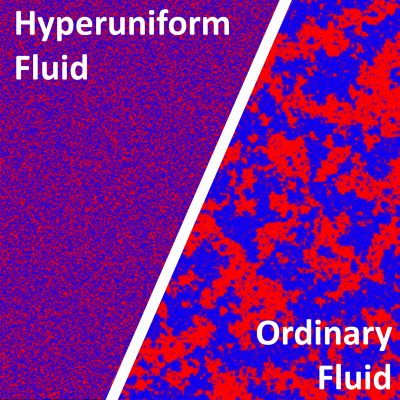
Where ordinary #fluids show wild fluctuations and critical opalescence, hyperuniform fluids of spinning particles stay unusually calm yet highly susceptible at the liquid–vapor critical point, a new study shows. 🔗 go.aps.org/3PjlCtZ
2
18
55
2,825
Stealthy hyperuniform materials are disordered structures that look uniform on large length scales. That property should make them transparent to light, but researchers have shown that the materials can scatter light after all. go.aps.org/4uyAZOa
5
19
1,085
🚨 Scientists just made disorder behave like it isn’t there. Not by removing the chaos. By hiding it mathematically. Researchers created a material where light moves through RANDOM structures… without scattering. Normally disorder destroys wave motion. In this system: the disorder becomes “invisible” to certain wavelengths. The physics works by suppressing long-range fluctuations. Meaning: the randomness cancels itself out at large scales. The result • transparent disorder • near-frictionless wave transport • programmable photonic flow • hidden order inside chaos • sudden “stealth transitions” where scattering switches on instantly This is called a stealthy hyperuniform material. And it may become one of the most important wave-engineering discoveries in years. If this scales: • optical computers • ultra-efficient chips • advanced cloaking systems • wave-guided energy networks • programmable matter But the deeper implication is even stranger: Reality may not separate “order” and “chaos” as much as we think. Some systems only LOOK random from the outside. Underneath… they are coordinating perfectly. Follow me if you want physics that feels 20 years ahead of the present.
2
14
49
2,283
🚨 PHYSICISTS JUST BUILT “INVISIBLE DISORDER” Scientists created massive silicon photonic crystals where disorder exists… but light barely scatters. The trick is called “stealthy hyperuniformity” a state where wave fluctuations mathematically disappear at long wavelengths, making chaotic structures behave almost perfectly uniform from afar. Instead of randomness destroying signals… the disorder becomes engineered. The system creates a true scattering transition: below a critical threshold → waves move almost transparently above it → scattering suddenly explodes Even stranger: The researchers found the transparency eventually breaks down because of NON-HERMITIAN physics where radiative loss gives light a “complex effective mass.” That means the waves don’t just move through space… their decay dynamics reshape the transport itself. Potential implications • ultra-low-loss optical chips • stealth waveguides • advanced quantum materials • photonic AI hardware • next-generation communication systems • engineered transparency in complex media This is one of those papers where “disorder” stops meaning chaos… and starts behaving like hidden structure. Paper “Stealthy-Hyperuniform Wave Dynamics in Two-Dimensional Photonic Crystals” Follow me if you want to see where physics starts rewriting reality itself
2
20
63
2,308
This study generalizes the concept of hyperuniform particle arrangements to treat particles with internal degrees of freedom. See how: go.aps.org/4aJklUW
1
9
48
3,024
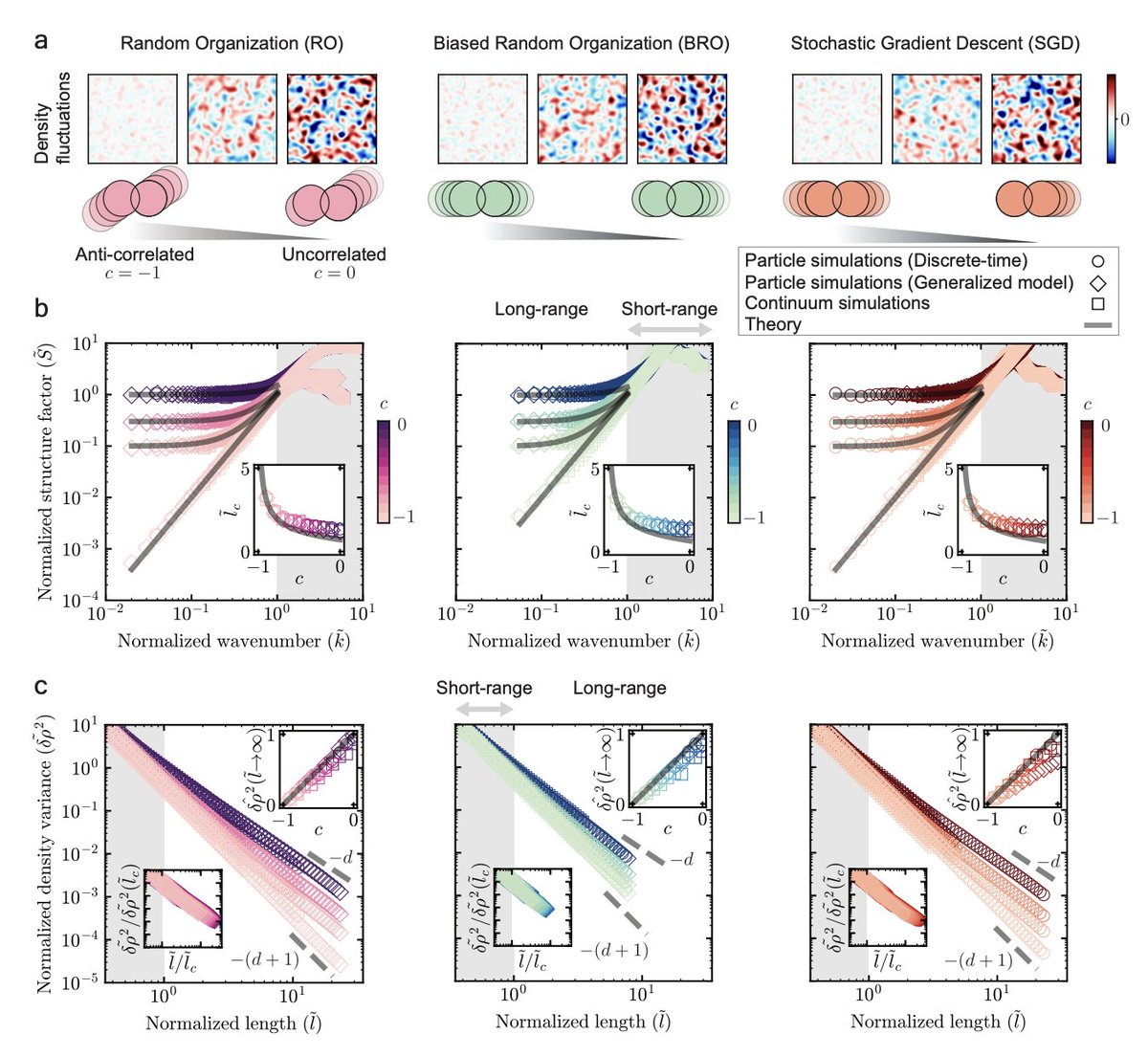
How noise creates order: A universal principle linking physics and machine learning Noise is usually the enemy of structure. Yet in certain systems—from sheared colloidal suspensions to stochastic optimization algorithms—noisy local interactions paradoxically generate long-range spatial order. This phenomenon, called hyperuniformity, suppresses density fluctuations at large scales, but how it emerges from purely local, noisy dynamics has remained an open question for two decades. Satyam Anand, Guanming Zhang, and Stefano Martiniani study three paradigmatic systems: random organization (RO) and biased random organization (BRO) from soft matter physics, and stochastic gradient descent (SGD) from machine learning. Each system has fundamentally different microscopic noise sources—random kick directions in RO, random kick magnitudes in BRO, and random particle selection in SGD—yet all undergo the same absorbing-to-active phase transition as particle density increases. The key finding: despite these microscopic differences, all three systems display identical universal long-range behavior, governed by a single parameter—the noise correlation coefficient c between particle pairs. When pairwise noise is uncorrelated (c = 0), the systems remain disordered. As c approaches −1 (anti-correlated, momentum-conserving kicks), the crossover length scale for density suppression diverges, and the systems become strongly hyperuniform. The authors develop a fluctuating hydrodynamic theory that quantitatively predicts the structure factor across all systems without free parameters. Perhaps most striking is the connection to machine learning: the same anti-correlated noise that produces hyperuniformity also biases SGD toward flatter regions of the energy landscape—the very feature linked to robust generalization in neural networks. Lower batch fractions and higher learning rates, known empirically to improve generalization, produce both stronger long-range structure and flatter minima in particle systems. The implication is powerful: the tendency of SGD to find flat minima is not a quirk of neural network loss landscapes but a universal hallmark of stochastic optimization in high-dimensional spaces—opening new avenues from designing hyperuniform materials to understanding why deep learning generalizes. Paper: nature.com/articles/s41467-0…
8
48
267
12,195
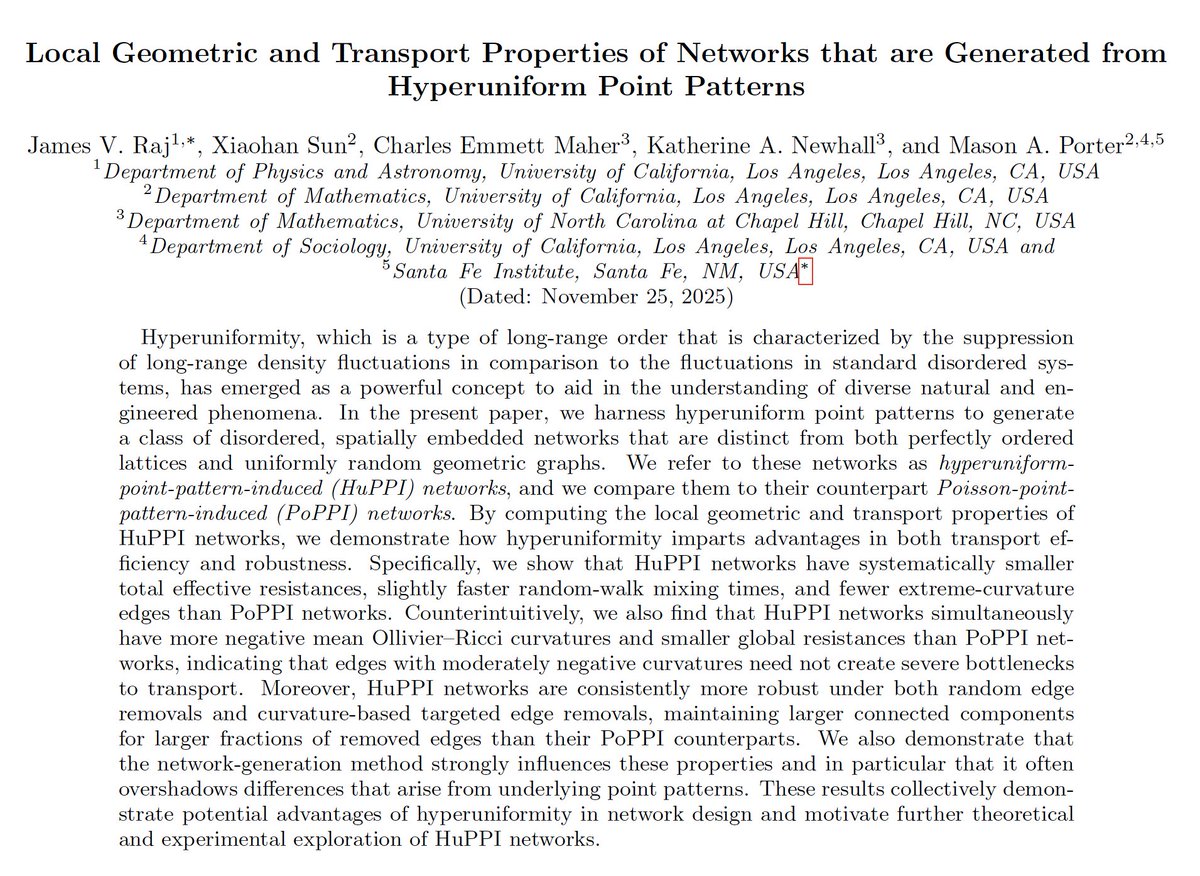
New paper on arXiv: "Local Geometric and Transport Properties of Networks that are Generated from Hyperuniform Point Patterns" Hyperlink: arxiv.org/abs/2511.21082
1
2
594
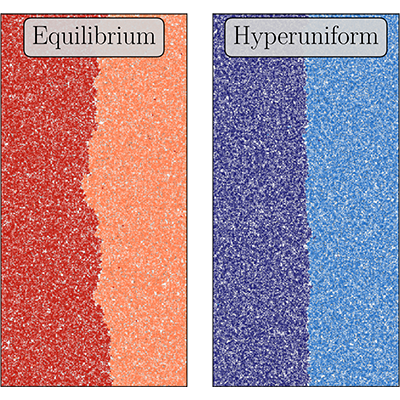
Simulations of three physically distinct scenarios reveal that long-wavelength interfacial fluctuations are suppressed strongly in nonequilibrium phase coexistence between bulk hyperuniform systems go.aps.org/4oWj9lI
4
29
125
8,199
Anti-hyperuniform Critical States of Active Topological Defects. arxiv.org/abs/2509.22911

5
168
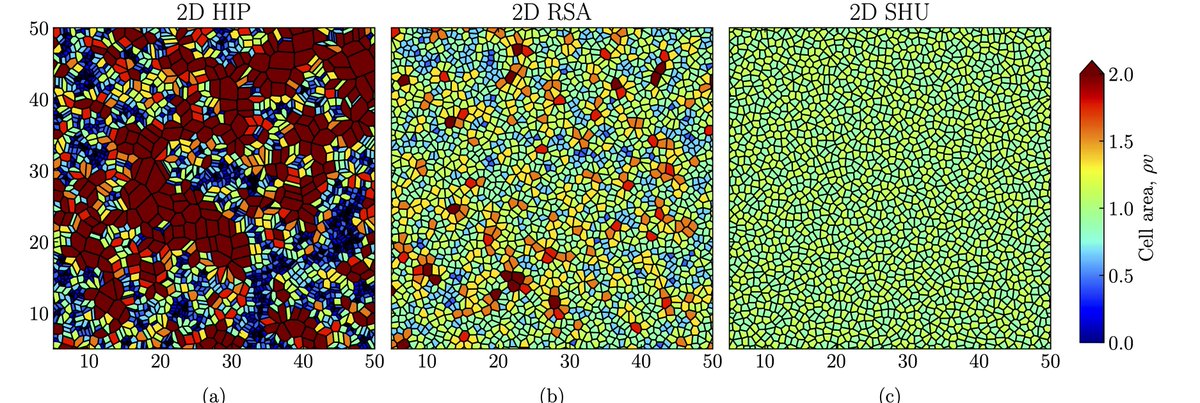
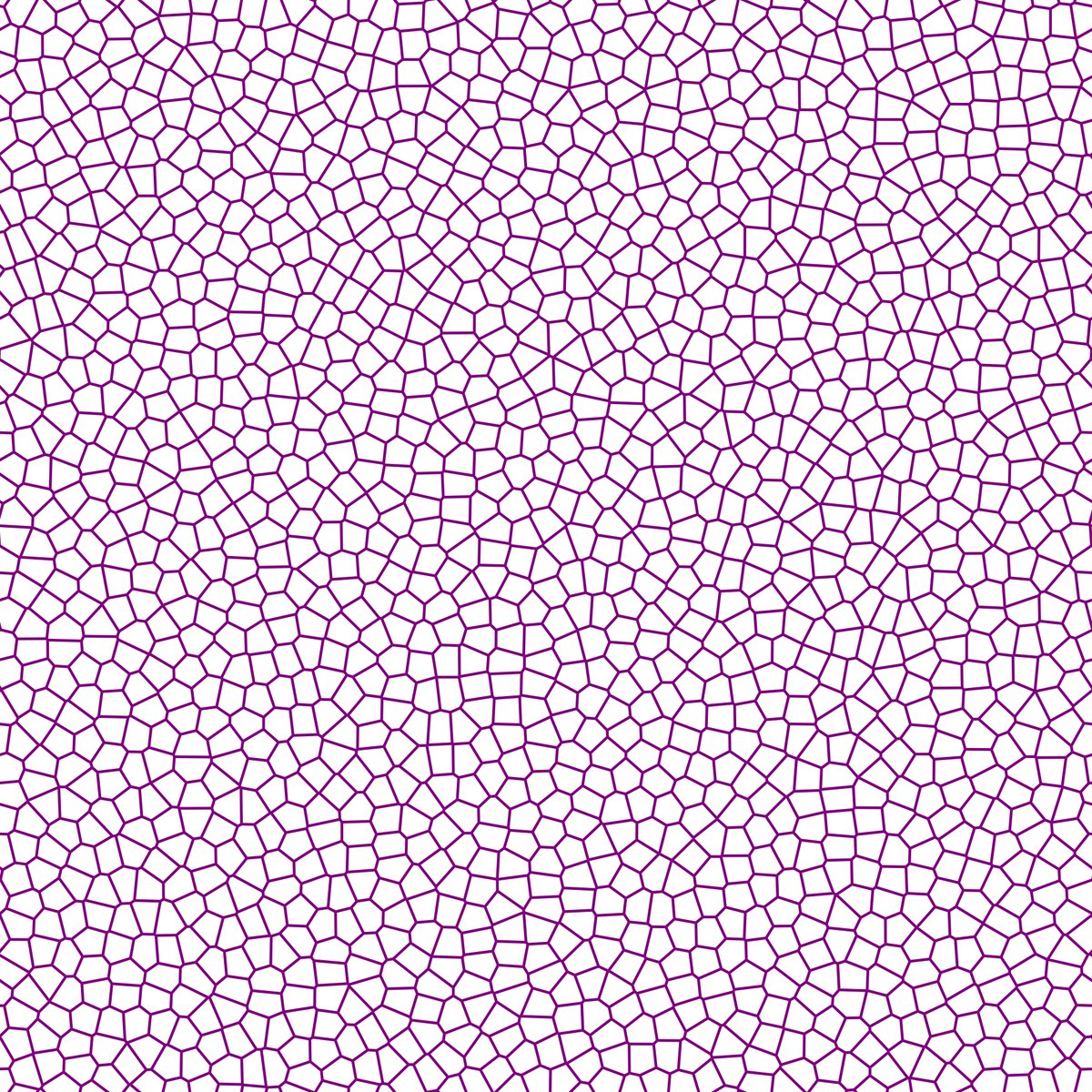
New work tackles the structure of two new metamaterial classes, exploring just how much hyperuniformity #NetworkStructures involving spatial tessellations receive from progenitor nonhyperuniform and hyperuniform point patterns. Check it out: go.aps.org/43VEXWz
1
8
33
1,617
The two-dimensional one-component plasma is hyperuniform. arxiv.org/abs/2104.05109

2
3
138
Phys. Rev. E: Structural properties of hyperuniform Voronoi networks link.aps.org/doi/10.1103/Phy…

4
311
17 Oct 2024
Mechanism Identified behind Exotic Disordered State of Matter could be used for Optical Data Transmission & Communications Researchers have explored the mechanism behind the emerging property of recently discovered exotic disordered state of matter, known as “hyperuniformity”. Hyperuniformity is a property of certain heterogeneous media in which density fluctuations in the long-wavelength range decay to zero. Hyperuniform disordered materials have been observed in a variety of settings, such as in quasicrystals, large-scale structures of universe, soft and biological emulsions and colloids, etc Read here: pib.gov.in/PressReleseDetail… @IndiaDST

2
13
2,489