
I usually have a few projects running at once, so ports get taken. when i start a server and hit "address already in use", i used to run lsof -i :3000, find the pid, kill -9 it, and repeat for the next port.
PortTray just puts that in the menu bar. it shows what is listening, which app is responsible, and path behind it. with one click you can kill :)
Try here: github.com/Koushith/porttray | - it is a native swift app <500kb tho.
1
27

Correct. ( for a UNIX geek this is an easy one )
That's why one of the most useful commands during a disk space incident is:
lsof | grep deleted
It often reveals the deleted files that are still consuming gigabytes.
1
16

16h
⎐كُـود⎐كوبِون⎐خـِصم⎐
⎐نون⎐
⊵S3Q⊴
⎐ايهرب⎐ايهيرب اهرب
⊵GCA5893⊴
⊴تيمو ⊴
⊵TEB72⊴
❮كارديال❯
A004
⎐نمشي⎐
⊵AABN⊴
⎐ريف⎐للعطور ⎐
⎐AX140⊴
ماكــس⎐
A9B
***
LSoF

#AIイラスト #情報セキュリティの勉強用エルフさん
[エルフさんのファンタジー的、ITセキュリティ補足]
森の外縁に、いくつもの砦が並んでいるとしましょう。
Nmapは、遠目に砦を見渡し、
「どの門が開いているか」「どの門は閉じているか」「霧に隠れて見えぬ門はどれか」を調べる斥候です。
一方、Nessusは砦の石壁にひびがないかを調べる検査官。
Metasploitは、そのひびから本当に侵入できるかを試す攻城術師。
lsofは、砦の中で誰がどの巻物を開いているかを調べる書庫番です。
この問いで求められているのは斥候。
ゆえに、森の道を最初に照らす者は――Nmapなのです。

3
1
15
229
Live Like A RockStar retweeted

Ashley 2-piece Sectional Sofa with Chaise 🛋️
Glam contemporary L-shaped sofa with chaise. #AshleyFurniture #sofa #Lsofa #chaise #SectionalSofa #LivingRoomFurniture #GlamDecor #pillow #ThrowPillows #ContemporaryHome #ad
pin.it/1TN969pUy
1
19

Anyone else tired of remembering lsof commands?

the fuck -is- running on that port? whoseportisitanyway.z19r.com…
1
64

Jun 12
prompt:
Set up cmux (manaflow's terminal, cmux.com) as my control plane for mac <> dev boxes <> iphone. Tailscale is on every device, phone is cabled to the Mac. Do all of it end to end:
1. Adaptive SSH. Make `ssh <box>` smart for each dev box: LAN when I'm home (probe with ~1s timeout), Tailscale everywhere else, one alias per box. Two gotchas:
- macOS Local Network privacy silently blocks non-Apple binaries (including homebrew ssh) from LAN IPs with "No route to host" unless the hosting app has the permission. Route the TCP connection through a ProxyCommand script built on Apple's /usr/bin/nc so it works in every app, and keep HostName pinned to the Tailscale IP so known_hosts stays stable.
- mDNS names take 1-2s to resolve, too slow to probe. Gate those on a subnet check instead.
2. cmux workspaces. One SSH workspace per box on the adaptive aliases (cmux ssh <alias> --name <box>). The remote PTY daemon survives sleep and network flips.
3. iPhone app. The official TestFlight build is paywalled, but the iOS app is GPL in the cmux repo. Build and sideload it with my free Apple ID (cable Xcode):
- run scripts/ensure-ghosttykit.sh first; it fetches the prebuilt GhosttyKit.xcframework. Do NOT zig-build it.
- ios/scripts/reload.sh --tag <me> --device-only --team <team id>
- free personal teams cannot sign Sign In with Apple, aps-environment, or time-sensitive notifications. Strip all three from ios/Config/cmux.entitlements and sign in with Google/email instead.
- CRITICAL: DEBUG builds auth against cmux's dev backend, and a release Mac app rejects the pairing with a "matching build" error. Force isDevelopmentBuild to false in ios/cmuxPackage/Sources/cmuxFeature/MobileAuthComposition.swift.
- device install needs the phone unlocked once while cabled (DDI mount). If pairingState goes "unpaired": re-trust, then `xcrun devicectl manage pair`.
4. Pairing. The Mac-side iOS pairing listener is OFF by default:
defaults write com.cmuxterm.app "mobile.iOSPairingHost.enabled" -bool true
Relaunch cmux and verify a non-localhost listener with lsof. Pair from the phone via the command palette entry "Connect iPhone/iPad" (Cmd Shift P), same cmux account on both ends, Tailscale on. On the phone, the terminal icon in the nav bar switches between a workspace's terminals.
5. Self-renewal. Free-team signing profiles expire every 7 days. Install a launchd agent that checks the installed embedded.mobileprovision every 2h and silently re-signs via reload.sh whenever expiry is <=3 days away and the phone happens to be cabled with developer services up. macOS notification on success/failure, daily nag if the deadline is close and the phone never showed up.
Verify every step with real commands (ssh round-trips, lsof on the listener, profile expiry parse) before calling it done.
1
1
25
2,020


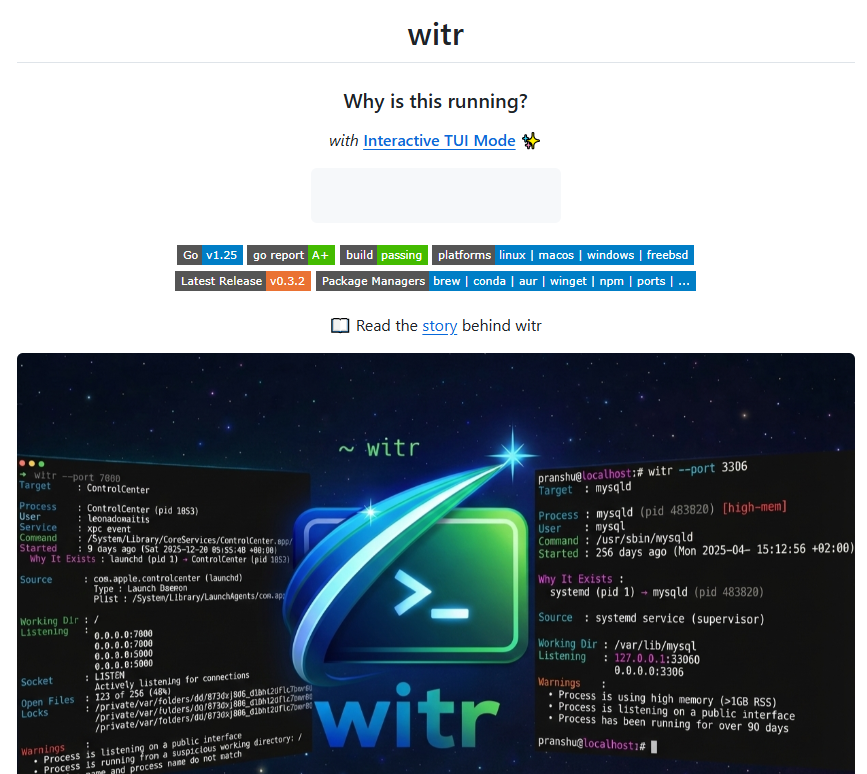
各位程序员,这个工具真的建议人手一份,以后再也不必对着满屏进程一脸茫然了。
你有没有遇到过这种情况——服务器上跑着一个进程,你完全不知道它是谁启动的、为什么在跑、是哪个容器还是哪个服务拉起来的?
ps、top、lsof 这些老工具只告诉你“它在跑”,但就是不告诉你“为什么在跑”。
witr 就是专门来解决这个问题的。一条命令,直接给你把进程的来源链路全挖出来,谁启动的、怎么启动的、哪层系统负责的,一目了然。
还有交互式 TUI 界面,不是那种糊弄人的,是真的好用。
🔗 : github.com/pranshuparmar/wit…
1
1
675

Jun 10
lsofしても2つしか使ってないね。
よくわからんUDPポート1つとTCPポート2つが使われてるっぽいけど。(TCPの1つはSteamとのやり取りかな?もうひとつは不明。404を返す謎のポート。)
21

Jun 10
7 Linux commands that saved me during production outages
strace — traces system calls made by a process in real time. when an app hangs and logs say nothing, strace tells you exactly what it is waiting on.
tcpdump — captures network packets at the interface level. when you suspect a network issue but cannot prove it, this is your evidence collector.
netstat — shows active connections, routing tables, and interface stats. still useful for a quick snapshot of what is talking to what.
dmesg — kernel ring buffer logs. hardware errors, OOM kills, and driver failures show up here before anywhere else.
sar — collects and reports system activity over time. when the incident is over and you need to know what happened at 3am, sar has the history.
kill and killall — terminates processes by PID or name. when a runaway process is eating CPU or memory and everything else has failed, this ends it.
lsof -i — filters open files to network connections only. instantly shows which process is holding a port or refusing to release a socket.
these are not commands you learn for interviews. you learn them at 2am when the alerts are firing and the team is watching.
#Linux
1
3
22
505
Diego Mariño retweeted

Jun 9
Yo hice jalonsogo.github.io/harbourm… para saber que #### tenía en cada puerto sin hacer un lsof 🤣
1
541

Jun 9
7 Linux commands every DevOps engineer should have memorized👇
top — real-time view of CPU, memory, and running processes. your first stop when a server feels slow.
htop — top but better. interactive, color-coded, and you can kill processes without leaving the terminal.
ss — socket statistics. faster than netstat, shows TCP/UDP connections, listening ports, and socket states instantly.
lsof — list open files. everything in Linux is a file. this shows which process has what open, including network connections.
vmstat — virtual memory stats. reports on memory, swap, I/O, and CPU activity in one line. great for spotting bottlenecks.
iostat — disk I/O statistics. tells you read/write speeds per device. essential when your app is slow but CPU is fine.
journalctl — query the systemd journal. full system logs with filtering by service, time, or priority. debugging starts here.
bookmark these. your on-call nights will thank you.
#Linux
2
3
18
446


Jun 8
If you use Linux, these terminal commands will make you quit GUI:
1. sed
2. awk
3. xargs
4. find
5. grep
6. jq
7. rsync
8. tar
9. journalctl
10. ss
11. lsof
12. strace
13. tcpdump
14. du
15. watch
16. tee
17. nc
18. cut
5
34
1,203

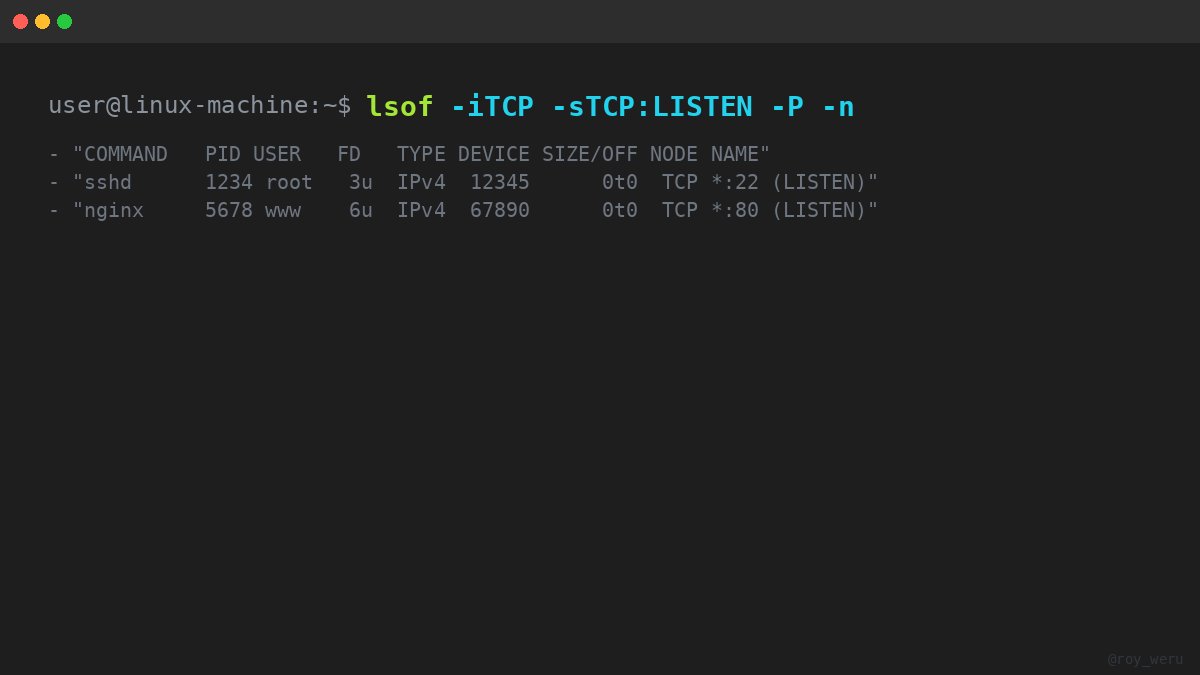

I’ve spent years watching PIDs, tracing spawned commands, and learning how systems behave. It’s something I’ve always found fascinating, and it’s shaped the way I approach security. lsof remains my all-time favorite command.
Now I’m finally building my dream alerting system. The core monitoring and alerting pieces are nearly ready to pair with some @perkinsfund tools, bringing behavior-based malware analysis and detection one step closer.
2
2
8
642

Jun 4
近期我在 macOS 26.5 上遇到了一个严重的 Codex Desktop 与 `syspolicyd` 交互异常。
运行 Codex 一段时间后,macOS 的 Gatekeeper 签名评估服务 `syspolicyd` 会持续泄漏文件描述符。通过 `lsof` 观察,异常时约有 67,800 个 FD 同时指向:
```text
/Applications/Codex.app/Contents/MacOS/Codex
```
随后 `syspolicyd` 会占用数 GB甚至 20GB 内存,并长期保持高 CPU。最终影响不再局限于 Codex:故障发生期间,任何新启动的 App 都可能在 Dock 跳动后无响应;依赖进程创建、代码签名验证或系统服务的操作也会卡住,网络请求、浏览器自动化和长流程任务均可能明显变慢或长期无响应。`spctl` 则会报:
```text
Too many open files
```
我曾多次覆盖式重新安装 Codex.app。第一次重装后问题短暂消失,但很快再次复发;后续重装也无法根治。重新启动 macOS 同样不能改善,`syspolicyd` 会在 Codex 启动后重新进入异常状态。
这说明问题可能并非普通的安装文件损坏或一次性系统状态异常,而是 Codex 启动后某种可稳定复现的运行行为,持续触发 Gatekeeper / `syspolicyd` 的资源泄漏。
目前的排查结果:
- 关闭 Spotlight 索引及搜索无法根治。
- 提高 `maxfiles` 只能延缓故障。
- 卸载 npm 版 Codex CLI 后仍会复现。
- 完全隔离 Computer Use 后仍会复现,因此它不是唯一根因。
- 关闭其他 Codex 常驻组件后仍可能复现。
- Codex 的 Chrome 操作扩展是明显的泄漏放大器。仅在 Codex 设置中关闭并不一定足够,旧 `extension-host` 仍可能由 Chrome 自动拉起,需要同时在 Chrome 扩展管理中禁用。
关闭 Chrome 操作扩展并结束残留 `extension-host` 后,`syspolicyd` 的 FD 增长速度明显下降,系统的 Gatekeeper 验证也恢复正常。但仍可能存在较慢的泄漏,说明问题最终可能位于 Codex Desktop 主进程或其子进程与 Gatekeeper 的交互中。
此外,Codex Computer Use 在我和其他用户的设备上还会频繁出现:
> “Codex Computer Use.app 已损坏,应该移到废纸篓”
实际检查中,该 App 的代码签名和 notarization 均可通过验证。因此这个“已损坏”提示可能并不代表文件真的损坏,而是 Gatekeeper / `syspolicyd` 在异常状态下评估 Computer Use helper 失败。
Computer Use 很可能是额外触发源或症状之一,但由于将其完全隔离后 FD 泄漏仍然发生,目前不能认为它是唯一根因。
临时缓解方式:
```bash
sudo killall syspolicyd
```
同时关闭 Computer Use、Codex Chrome 操作扩展及其他非必要 Codex 常驻组件。真正修复可能需要 OpenAI 检查 Codex Desktop 主进程、helper 签名评估,以及 Chrome `extension-host` 的生命周期与启动行为。
3
1
5
697