
Researchers analysed 11,000 gene samples from four different species, including humans, and found the same handful of genes ageing in the exact same way in every one of them. Then they built a clock out of it.
Aging research has long searched for a universal signature, something that ages the same way across species, that could be measured and used to track how fast an individual is actually aging, separate from how many birthdays they have had.
Epigenetic clocks, based on chemical modifications to DNA, were the first major tool to attempt this. They estimate biological age reasonably well, but they reveal little about what is actually happening inside the cell.
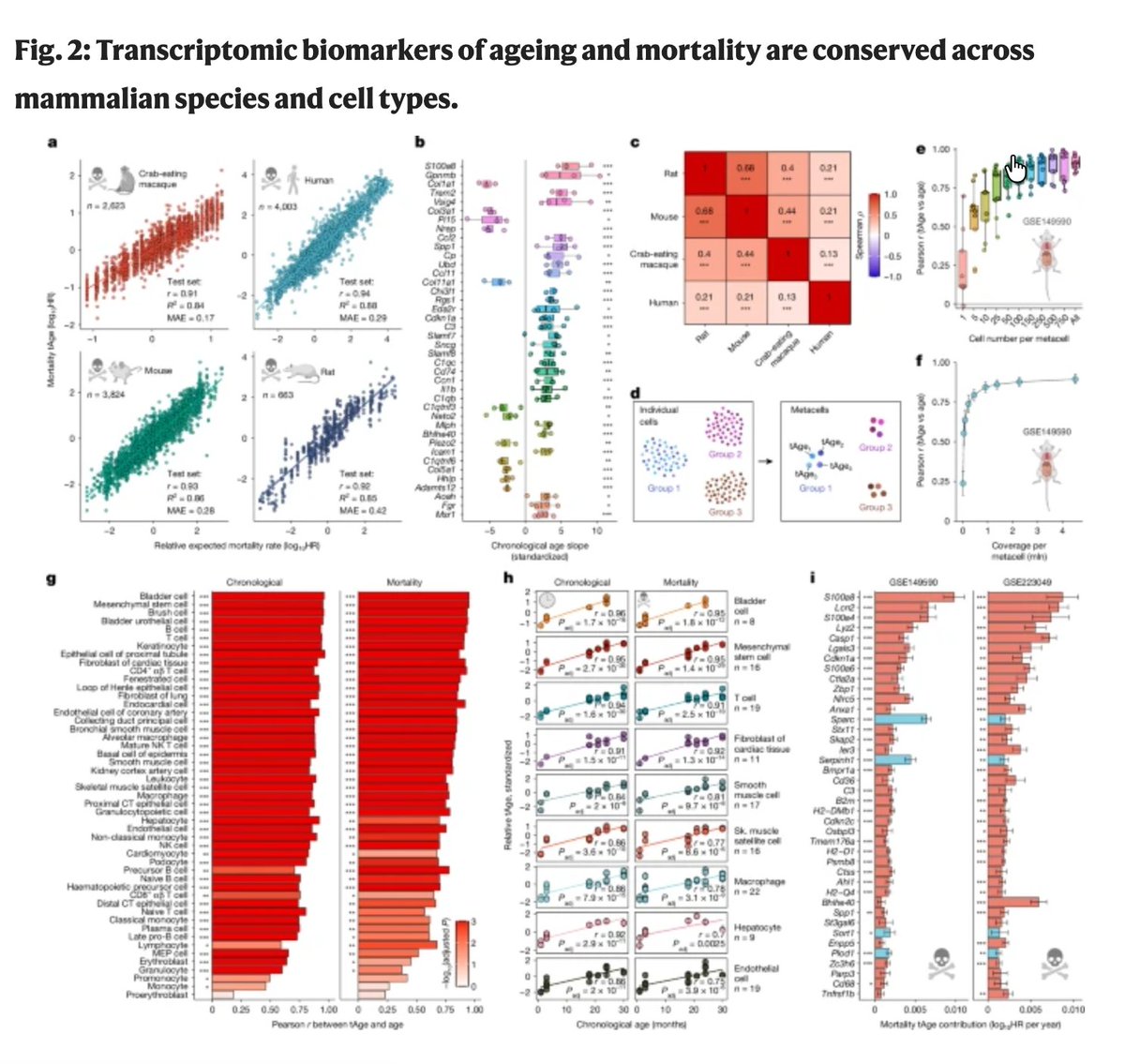
In a study published in Nature in late May 2026, researchers led by Alexander Tyshkovskiy and Vadim Gladyshev at Harvard Medical School and Brigham and Women's Hospital, with collaborators at Tohoku University, took a different approach. They analysed more than 11,000 transcriptomes, complete readouts of which genes are actively turned on, from over 25 tissues across four mammals: mice, rats, crab-eating macaques, and humans.
They found that specific genes age in nearly identical patterns across all four species. Genes involved in inflammation and immune activation consistently increase with age. Genes involved in mitochondrial energy production, wound healing, and extracellular matrix maintenance consistently decrease. Three genes in particular, GPNMB, CDKN1A, and LGALS3, emerged as universal markers, changing in almost identical ways during aging in every species studied.
The researchers then built what they call transcriptomic clocks. Unlike previous tools, these clocks do not produce a single number. Aging, the study found, is not one process. It is organised into separate modules, distinct groups of genes that handle specific biological functions. The team built individual clocks for each module, allowing them to measure how quickly different parts of a single body are aging relative to each other.
The clocks were validated against a substantial test: RNA sequencing data from genetically diverse mice exposed to 20 different pharmacological interventions from the Interventions Testing Program, including rapamycin and canagliflozin, drugs already known to extend lifespan in mice. The clocks correctly registered the effects of these interventions on biological age.
In human blood samples, the transcriptomic clocks correlated with established DNA methylation clocks, particularly within chromatin-related pathways, providing independent confirmation across two entirely different molecular measurement methods.
The study is correlational. It cannot establish that these gene expression changes cause aging rather than result from it. What it establishes is a shared molecular vocabulary of aging that exists, largely unchanged, across mice, rats, monkeys, and humans.
Four species. 11,000 samples. The same genes, aging the same way, in all of them.
Source: Nature, Volume 654, pages 173 to 188, 2026. DOI 10.1038/s41586-026-10542-3. Harvard Medical School and Brigham and Women's Hospital, with Tohoku University. Lead author: Alexander Tyshkovskiy. Senior author: Vadim N. Gladyshev.
☆니나⁷랑 ☆ 🪭 retweeted

A total of four South Koreans were caught using similar methods to trade black-market tickets with foreigners. Foreign nationals were also caught selling black-market tickets.
Police imposed fines of 160,000 KRW each under the Minor Offenses Punishment Act on the 11 individuals.
3
10
28
3,996



of the horrific attack in Northern Ireland carried out by a Sudanese refugee confirmed to have connections with both the SAF and the Islamic Movement. The message was simple: Belfast was not a coincidence. It is the same ideology, the same methods, the same crimes —
1
1
J. Morgan retweeted

IN JAPAN, LAZINESS IS CONSIDERED A DISEASE AND PEOPLE TREAT IT WITH THESE
7 METHODS:

36
1,376
7,366
1,146,704

it will kinda be like a proof of stake study. the more people participate who behave honestly, the better the data will be.
we can use statistical methods to identify anomolies in the submitted data and disregard them.
but yeah, for robust, high confidence data, we will need high participation.
2
Zach Dobre retweeted

Jun 12
Eliminating The Competition
"Nairda has her own bizarre methods for eliminating the competition ⚆_⚆"
I hope you enjoy it :3
Contains: 3B expansion
Publication date: 13/01/2025
#bellyexpansion
2
119
1,401
12,106

The Mumbai–Ahmedabad Bullet Train project is a testament to how India is evolving from traditional construction methods to highly sophisticated, technology-driven infrastructure development.


🚄 Advanced Tunnel Hoods for the Mumbai- Ahmedabad Bullet Train Project 🇮🇳
#mumbai #bullet #train #innovation #engineering
6

Yeah. Most traders already use worse prediction methods than AI. Usually it is just vibes and a trendline.
1
1
2
Good point Petter. Most traders already use worse prediction methods than AI. Usually it is just vibes and a trendline.
1
1
4

Leave it to a Jew to find a way to twist blatant land theft from a place they are actively annexing through pogroms and other methods...into being a victim.
1
3
岡 純子🏳️🌈🏳️⚧️🇵🇸 retweeted

May 21
To ensure your generosity reaches us safely, please use our official and verified payment methods. 🙌
Find the links in our bio or scan the QR code to donate via:
📌 GoFundMe :
gofund.me/c1e475d55
Or
Scan QR ✅👇🏻
📌 ReddotPay :
Scan QR ✅👇🏻
📌 Binance :
Scan QR ✅👇🏻


4
1
451
ThatOneAsianGuy retweeted

there's no privacy preserving methods

Our members have done billions of privacy-preserving, highly effective age checks around the world and in US states.
The tech is more than ready to deliver whatever policies democratically elected representatives wish to adopt.
2
18
65
816

What underlying methods have been used? What has been the argumentation of Claude, concerning the "why"? Especially for ETH?
4

A language student may now learn machine learning and data analytics. A historian may learn computational methods for analyzing large historical datasets. An artist may be trained to direct generative systems instead of manually producing every asset.
The new educational formula is simple:
Domain Knowledge AI Tools = Future Employability
The Rise of Embodied Intelligence
Perhaps the most important development is China’s growing focus on a new field known as “Embodied Intelligence.”
Unlike chatbot-based AI, embodied intelligence focuses on integrating advanced AI systems directly into physical machines and real-world environments.
This includes:
Industrial robotics
Autonomous manufacturing systems
Smart warehouses
Logistics automation
Autonomous vehicles
Intelligent infrastructure
The strategic objective is clear. China does not want AI to remain confined to software applications. It wants AI embedded throughout the physical economy.
By connecting machine intelligence to factories, supply chains, and industrial equipment, Beijing hopes to accelerate productivity growth while strengthening its manufacturing leadership.
In many ways, embodied intelligence represents the next phase of the AI revolution—moving from generating information to directly influencing physical reality.
A New Educational Philosophy
The deeper significance of this transformation extends beyond China.
For more than a century, universities were designed around the assumption that humans would perform most cognitive labor. Students specialized in acquiring knowledge and mastering skills that could later be applied in professional settings.
Artificial intelligence challenges that assumption.
When machines can instantly access, analyze, summarize, translate, and generate information, the value of education shifts away from memorization and toward orchestration. The most valuable workers may not be those who compete directly with AI, but those who understand how to collaborate with it effectively.
China’s educational restructuring reflects this new reality.
The future is no longer “History” versus “Computer Science” or “Art” versus “Engineering.”
The emerging model is interdisciplinary intelligence: professionals who possess deep domain expertise while simultaneously mastering the computational tools that amplify human capability.
In this vision, the winners of the AI era will not be those who resist automation.
They will be those who learn how to divide labor with it.
5

Are our policemen thugs nowadays. Is this how they’re trained. Eastern European police tactics have infiltrated our country. It’s enough we have their illegal immigrants without importing their brutal Stasi policing methods as well!
2


I checked access as soon as the model was released. Perhaps there is now access to the API through third-party methods
4

David North on Wsws.org:
“For more than a decade, American political life has been dominated by Donald Trump—a Wall Street thug, twice impeached, convicted on thirty-four felony counts, found liable in court for sexual abuse and for years of business fraud. He has stood as a candidate in three successive presidential elections and won two of them.
…
“It is impossible, at this point, to portray Trump as an aberration or an accidental intrusion of the serpent into America’s democratic Garden of Eden. That such an individual has come to dominate the political life of the United States testifies to a protracted and staggering breakdown of American democracy. That breakdown is the subject of this book.”
…
“The criminalization of American political life that he personifies is rooted not in the pathology of one man but in the existence of a ruling layer whose fortunes rest on financial plunder and whose methods grow more lawless as the social ground beneath it narrows. Trump, in short, is a manifestation of the oligarchy’s rule, not its cause.”
…
“Ukraine, Gaza, Venezuela and now Iran are the opening fronts of a third world war. The response of the New York Times—the most authoritative voice of the Democratic Party—has been to characterize the war not as a crime but as a blunder. This underscores once again that the Democratic Party’s “opposition” to Trump has been bound up entirely with its commitment to the agenda of American imperialism, above all the prosecution of war against Russia. The danger of nuclear war is real and immediate. The same ruling class that is erecting a dictatorship at home is preparing catastrophe abroad; fascism and war proceed from a single crisis.”
…
“The alternative confronting mankind is posed today, with mounting urgency, throughout the world: either fascism or socialism. What is required to halt the descent into fascist barbarism is the conscious intervention of the working class into history, and that, in turn, requires the building of a new revolutionary leadership.”
6