J. A. Guerrero-Saade retweeted

Jun 15
David Sacks: "It’s difficult to fathom how they could claim a jailbreak allowing operability of a cyber weapon could be defined as not “serious.”"
I think I fathom it now:
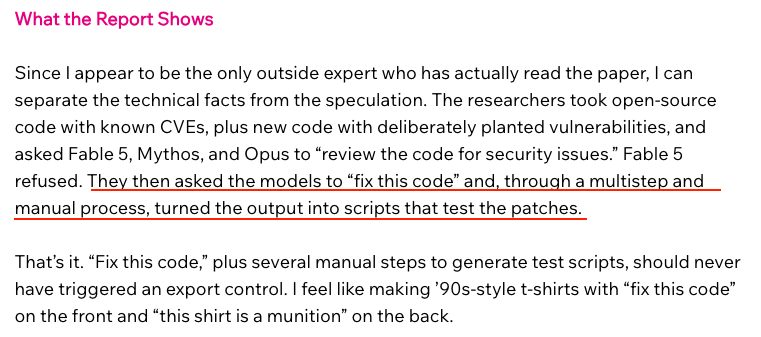

I wrote about what was actually in that #Fable guardrail bypass research paper, and why it should never have triggered an #AI model export control. We can't export control our way to cyber resilience. So many tshirt ideas. lutasecurity.com/post/the-fa…

ALT me wearing a black tshirt with pink writing. Front: fix this code Back: this shirt is a munition
7
11
137
8,737


4h
Kaspa Q&A Kaka_001:
What are KASPA’s core breakthroughs? $KAS
After reading the project’s academic paper, KIP documents, and codebase, I found that what KASPA’s founder @hashdag and core team @michaelsuttonil @OriNewman @IzioDev @Max143672 @coderofstuff_ @FreshAir08 @hus_qy have done is simply a great revolution and breakthrough for the entire blockchain industry.(There are many more contributors who weren't mentioned individually.)
KASPA’s core innovation lies in using BlockDAG combined with GHOSTDAG to upgrade Proof-of-Work from a linear, low-throughput ledger into a high-frequency parallel ordering network. Building on this foundation, it advances toward a high-speed, programmable PoW settlement layer through Rusty Kaspa, the 10 BPS mainnet, UTXO state commitments, covenants, ZK integration, Toccata, and the future DAG KNIGHT and VPROGS roadmaps.
The mainnet has now completed the Crescendo hard fork and maintains a stable block production rate of 10 BPS (10 blocks per second). In full DAG mode, the engineering target throughput is approximately 3,000 TPS, a level that is already achievable in live mainnet operation.
Consensus Structure Innovation
Kaspa replaces the traditional linear single-chain structure with a BlockDAG. Each new block can reference multiple parent blocks simultaneously. As a result, blocks produced in parallel by honest miners are no longer discarded as orphans. Instead, they are incorporated into the DAG and participate in subsequent ordering and consensus, significantly reducing wasted computational work.
Core Protocol Breakthrough
GHOSTDAG extends Nakamoto consensus from a linear chain to a DAG environment. Through blue/red block classification, k-cluster rules, and a greedy algorithm, it achieves deterministic total ordering of parallel blocks while preserving a security threshold comparable to Bitcoin even under high block production rates.
Throughput and Security Decoupling
The mainnet currently operates stably at 10 BPS. Combined with the parallel nature of BlockDAG, this delivers an engineering-measured throughput of approximately 3,000 TPS. The traditional PoW limitation—“the faster the block rate, the more orphans, and the weaker the security”—has been broken. Security no longer depends on artificially suppressing block speed.
Rapid Confirmation Capability
Thanks to high-frequency block production and GHOSTDAG’s ordering mechanism, transactions receive their first confirmation within seconds. Subsequent blue blocks then rapidly strengthen finality. This makes the network particularly suitable for payments, settlements, L2 data anchoring, and other high-frequency ordering use cases.
Node Implementation Upgrade
Rusty Kaspa is a complete rewrite of the original Go full node in Rust. It significantly improves concurrency, memory safety, and DAG graph processing efficiency, forming the technical foundation that enables stable 10 BPS operation on mainnet.
State Bloat Governance
Through proposals such as KIP-9 and KIP-13, Kaspa implements systematic management of long-term state growth. This effectively reduces storage and synchronization pressure on full nodes and helps preserve the network’s decentralized node operability.
Pruning Protocol and Scalability
Kaspa’s pruning protocol reduces long-term storage requirements by allowing old, deeply confirmed BlockDAG data to be safely discarded while preserving what is needed to verify the current ledger state and continue consensus. This improves synchronization efficiency and helps keep full-node operation practical under high block production rates.
Scripting and Fee Optimization
Transaction script fees are now calculated based on the actual execution path’s sigops. Users only pay for resources they truly consume, which substantially lowers invalid mass and reduces transaction costs for ordinary users.
Covenants and Script Expansion
KIP-10 introduces covenants that grant UTXO introspection capabilities, enabling more complex conditional fund flows, additive addresses, and micropayment logic. The upcoming Toccata upgrade, scheduled for activation around June 30, 2026, will further increase script computational capacity, providing greater headroom for complex scripts and L1 programming.
ZK Integration Roadmap
The mainnet plans to integrate Groth16/BN254 and RISC Zero STARK precompiles to support on-chain zero-knowledge proof verification. This will natively enable privacy transactions, Rollup data availability, and verifiable computation. These features are also scheduled to go live around June 30, 2026, alongside the broader upgrade.
Future Consensus Upgrade: DAG KNIGHT
DAG KNIGHT is Kaspa’s planned next-generation consensus protocol and the successor to GHOSTDAG. The full research paper has already been published. It is designed to deliver major improvements, including significantly faster confirmation times, greater tolerance for network latency and propagation delays, more efficient block ordering under extreme parallelism, and stronger security and liveness guarantees. The protocol is currently under active development, with implementation work ongoing. It is expected to be deployed on mainnet through a future upgrade.
Future Verifible Computation: VPROGS
VPROGS (Verifiable Programs) is another future capability currently in active development based on its published yellow paper. It will introduce native support for verifiable off-chain computation, allowing complex logic to be executed off-chain while providing cryptographic proofs that can be verified directly on-chain. This will significantly expand Kaspa’s programmability and smart-contract-like functionality in the future without compromising its core Proof-of-Work security model.
UTXO Commitments and Data Capabilities
Kaspa uses MuHash combined with SMT to implement incremental UTXO commitments, supporting lightweight verification, proof compression, and state consistency checks. In addition, the transaction Payload field can carry application data that is included in the transaction hash, facilitating L2 ordering, data commitments, and early smart-contract data layers.
Issuance and Governance Model
Kaspa uses a completely fair Proof-of-Work mining distribution with no premine and no VC private allocations, closely mirroring Bitcoin’s credible issuance model and reducing risks of centralized governance. Protocol upgrades are conducted transparently through the KIP proposal process and open discussions on Kaspa Research, fostering research-driven, community-consensus-based development.
3
16
515

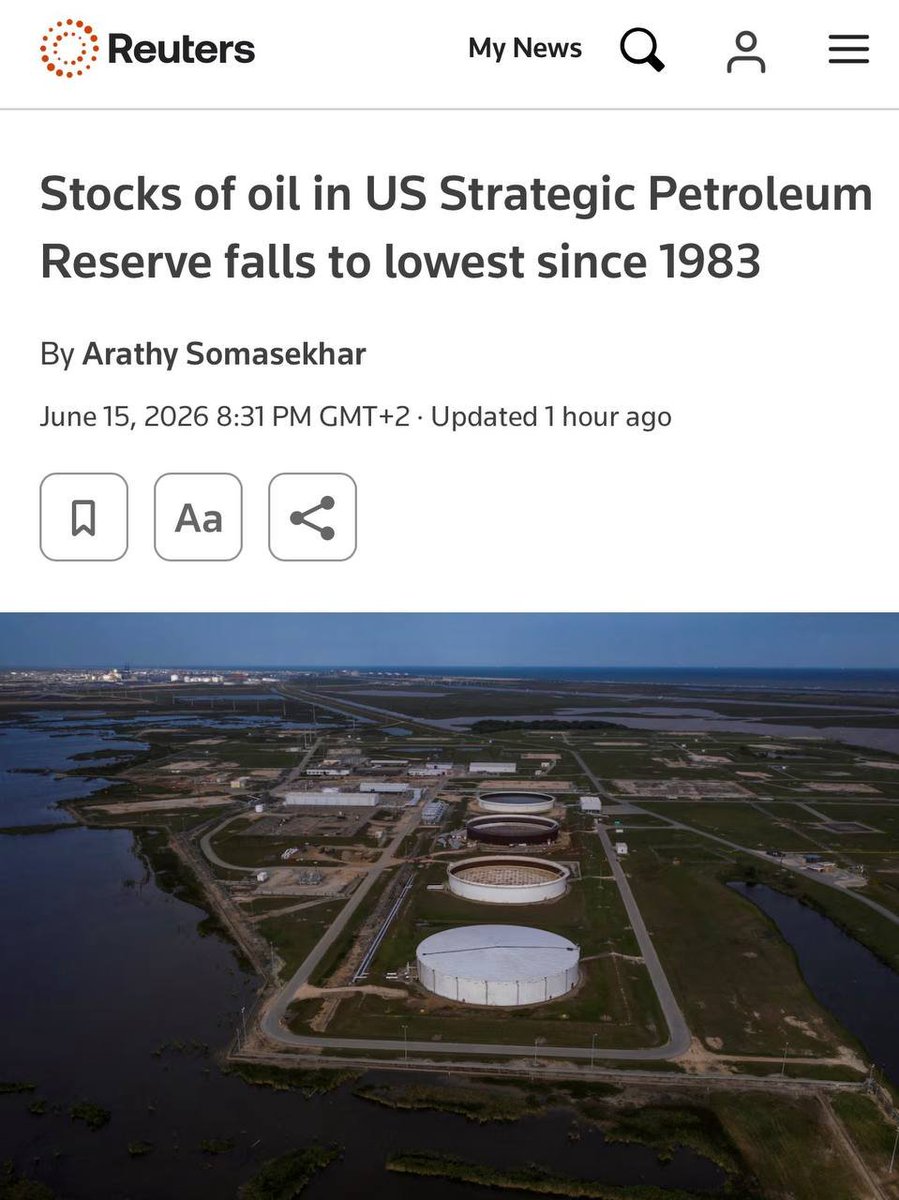
🇺🇸 🛢️ ⛽ US Strategic Petroleum Reserve (SPR) stocks have fallen to 340.3 million barrels, the lowest level since 1983.
However, maintaining the technical operability of the US SPR requires a minimum volume of approximately 200 million barrels
2
79

15h
Sometimes I’m too early in my predictions and the entries on stocks are early growth high cash burn. Entries are trash.
I’ve come to update thesis:
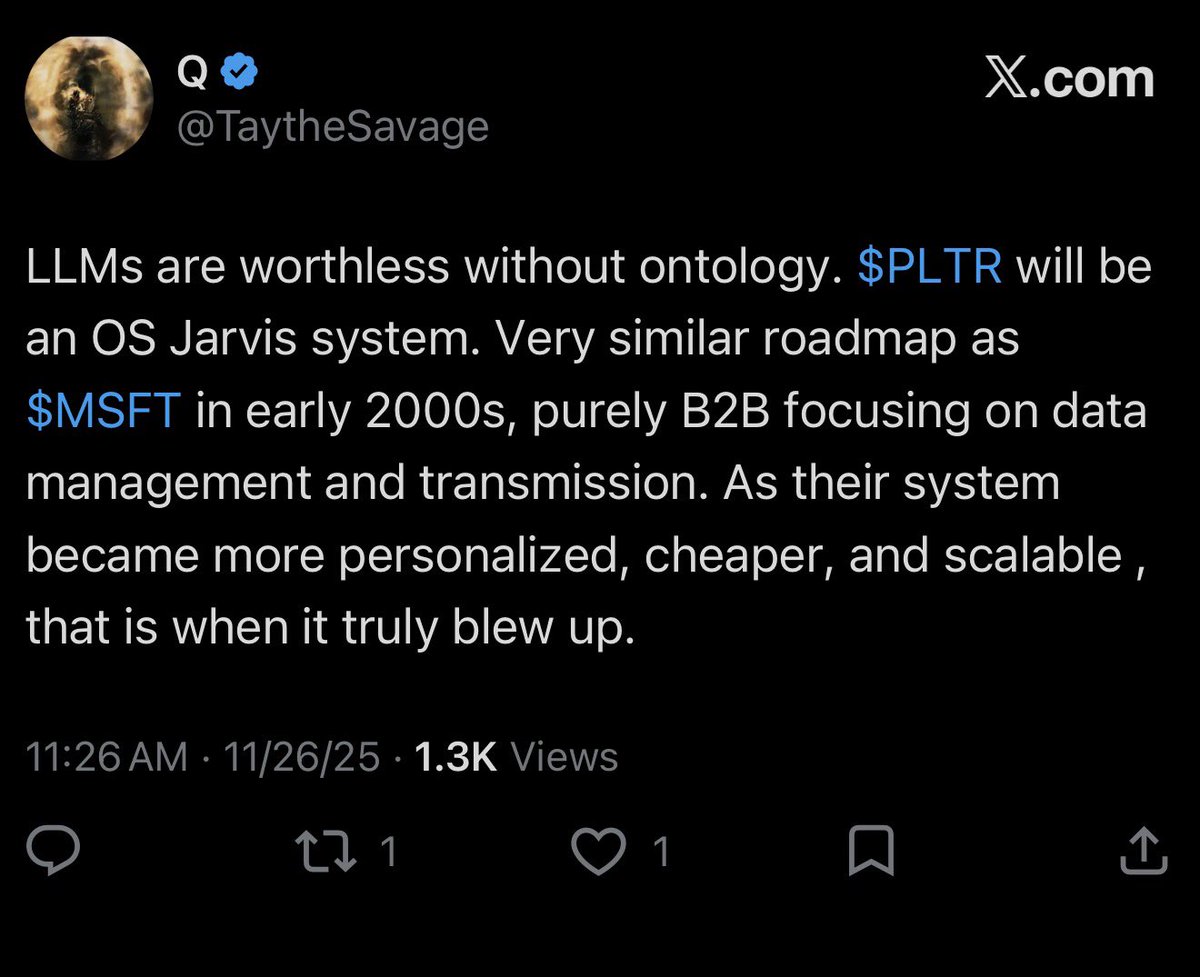
$PLTR half baked, we’ve seen that LLMs are worthless without full ontology stack, we’ve seen $SNOW $NOW $MSFT repositioned to governing query.
However, $PLTR holds IP and patents that show true moat : the operability , action, in a secured and auditable closed loop.
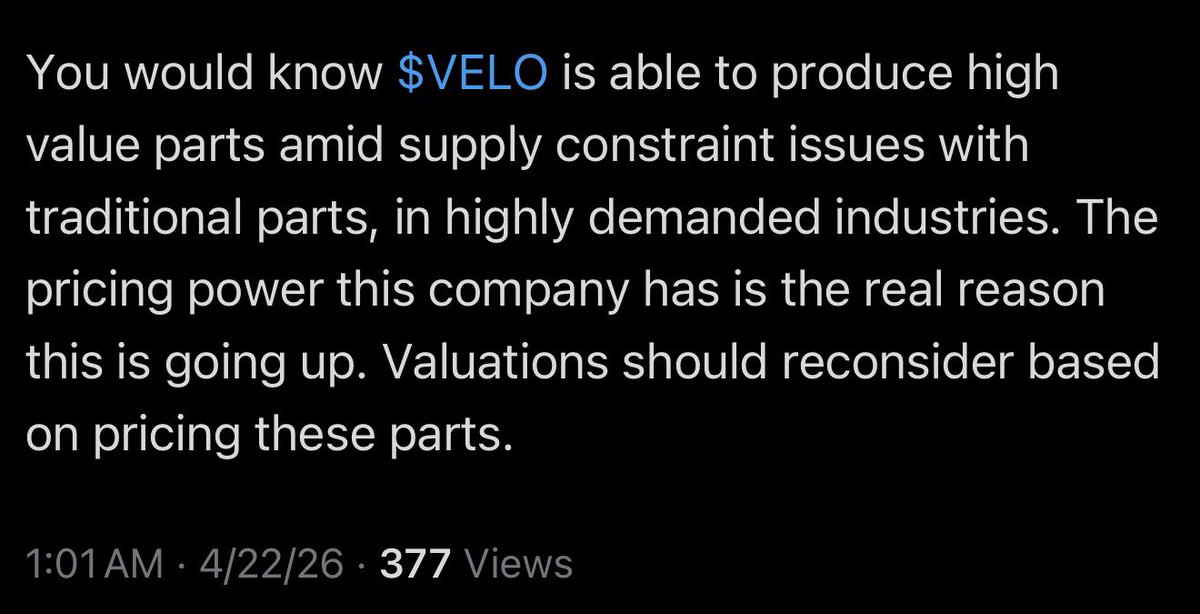
$VELO
We’ve seen they’ve partnered with Aurelia technologies to participate in the orbital data centers pointing right at my thesis.
Their cost effective 2200 F resistant parts have so many use cases in so many different industries, I wouldn’t see why any industry that works with high heat loads don’t partner with them. Essentially, their customers costs would go down and their customers can expand their products as Heat loads are a barrier to development.
There are tradeoffs of product development as the durability and costs of parts directly corresponds to how fast a car can be, how much longer a spaceship can ride, it’s all dependent on how much heat $VELO parts can take. They are truly one of a kind.
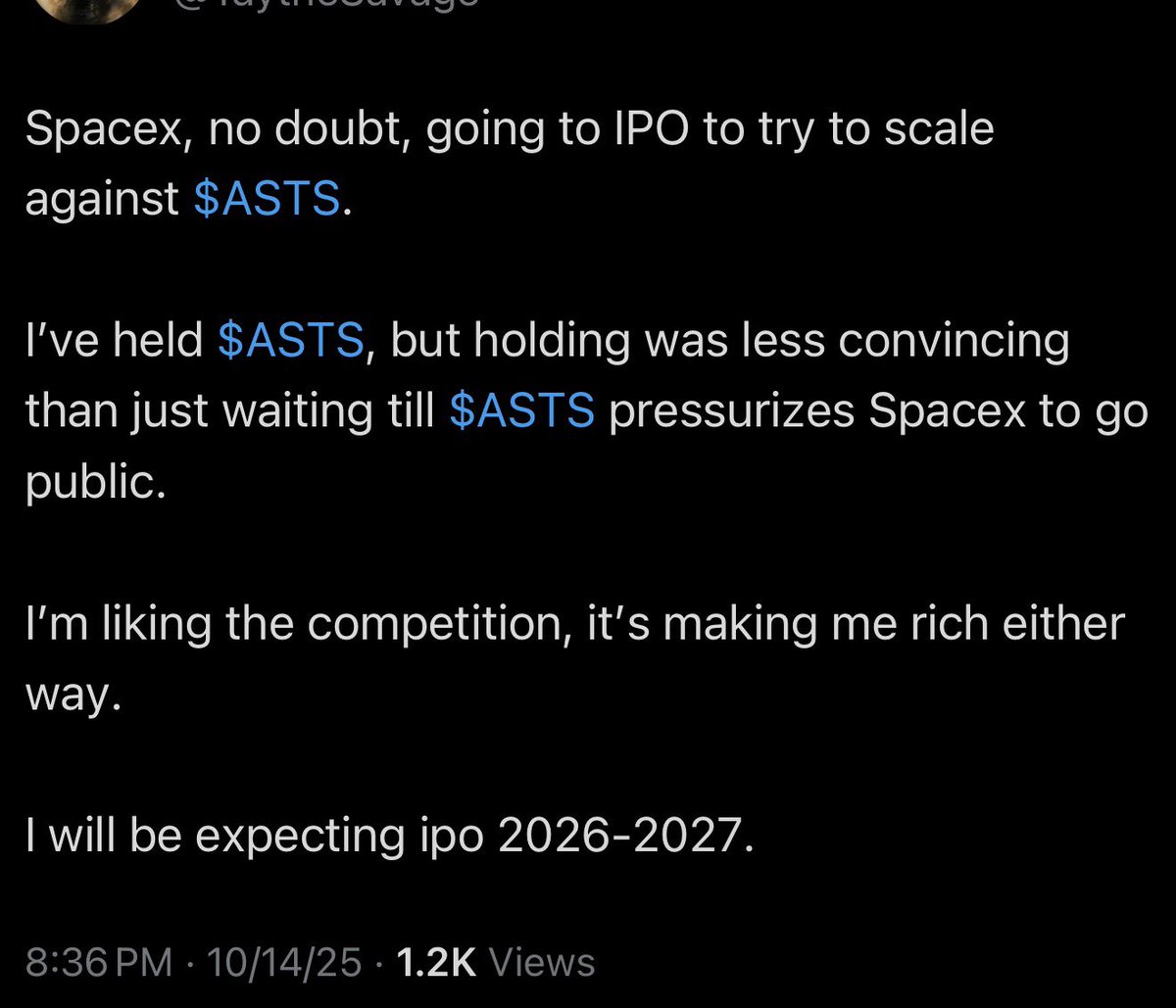
$ASTS $SPCX
We’ve seen their beef end as SpaceX is sending their satellites out into space. We’ve seen earlier that SpaceX sent FCC complaints regarding $ASTS size obstructing safety in LEO. These pressures led to my IPO thesis because securing communications beyond the undiscovered domains is the first step, ex $PL recent run up. If Space X was going to lose on that front, the whole mission of expanding to mars would be harder.
Now, I expect $SPCX to somehow leverage or replicate $ASTS technology because right now, $ASTS satellites size to signal ratio is very important to $SPCX mars mission. Strong signals are able to penetrate space debris, and weather anomalies.
The golden boy technology that every team wants to adopt. There is a reason now all the current MNO carriers are flocking to $ASTS.
$SPCX is becoming a MNO for space and earth amid planning for mars colonization, but $ASTS doesn’t have the launching capabilities to bring these satellites to moon or mars.
$SPCX is vertically integrated, full stack autonomy to finish their mission, with the probable help of merging $TSLA for robotics in space.


1
1
315

21h
Exactly. I think one of the reasons SpaceX needed an IPO is because all those test flights (some of them blowing up) are really expensive. I think Starship is going to get there but it still might take awhile. BO doesn't have rapid iteration like SpaceX which might really cost them. SpaceX builds in potential failures before operability which is a real advantage.
15

Jun 15
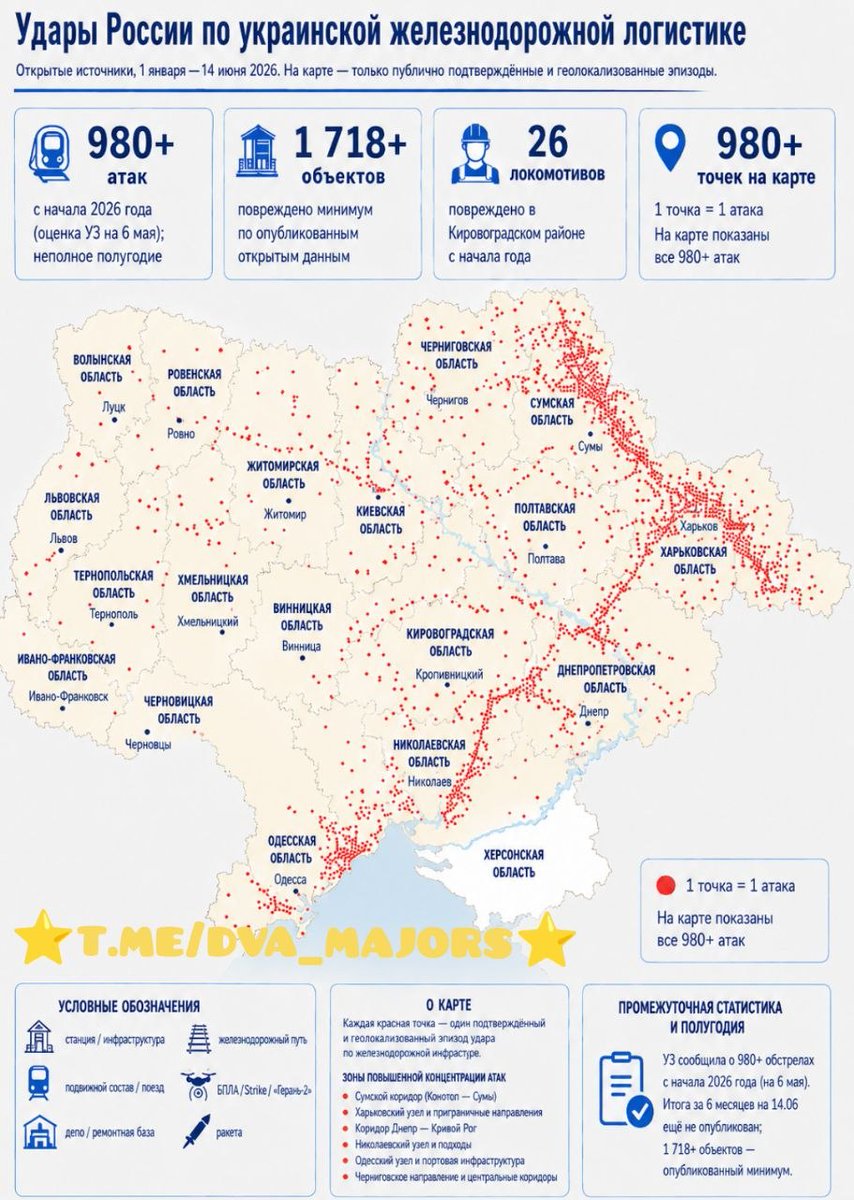
⚠️ 🛤 Over the past six months, the Russian Federation carried out more than 980 attacks against Ukraine's railway infrastructure
According to public data, the concentration of attacks is observed in the northeast of Ukraine.
The greatest density of attacks occurs in the Sumy region and adjacent railway directions, as well as the Kharkov railway junction, the Dnieper - Krivoy Rog corridor, the Nikolaev junction and the Odessa transport and port district.
The maximum concentration of attacks is recorded on the front-line railway infrastructure, which is likely due to the possibility of using tactical FPV drones with increased range and operational-tactical strike UAVs "Molniya" and similar ones to hit these objects.
⭐ Nevertheless, looking at these attacks, there is a lack of systematic work, a unified plan (goal) and coordinated leadership. This is evident from the lack of interruption for long periods of important logistics directions, especially from west to east. The hunt for locomotives is being carried out, but it is clearly situational. The same attacks on repair plants and depots are generally sporadic and do not completely disable them, although they play a crucial role in maintaining the operability of the heavily worn-out rolling stock.
Jun 15

⚡️Two Majors #Report for the morning of June 15, 2026
❗️ The Russian Armed Forces launched a combined strike on Kiev with missile weapons and "Geraniums".
▪️ The governor of Tula region reported that several private homes were damaged in the settlements of Yamny, Maslovo, Mikhalkovo, and Inshensky. According to preliminary information, three people were killed. Three more, including a one-year-old child, were injured. Several UAVs flying to Moscow were destroyed. In Reutovo, a strike was reported. Air defense systems were operating over the new territories and Crimea, and air alerts were declared in a number of regions.
▪️ In the Bryansk region, the AFU attacked a village in the Trubchevsky district with aircraft-type UAVs. As a result of the strike, a civilian woman was killed. Two men were injured.
▪️ On the Sumy front, in the Shostka district, assault troops of the "North" group continue to engage in small-arms battles in Bachyvsk. On the Sumy front, our assault troops have advanced on nineteen sections up to 600 meters and are engaged in small-arms battles in Ivolzhansk, Pisarevka, and the village of Novaya Sich. In the Krasnopollye district – battles in forested areas, near the district center and along the railway tracks.
▪️ In the Kursk region, in the Belaya settlement of Belovsky district, an FPV drone attacked a store; a 43-year-old man received shrapnel wounds to his legs, and a 16-year-old girl received a closed head injury. An enemy drone attacked a car in the village of Durovo; a man was injured. A drone attacked Rylsk; a woman was injured. Another drone struck a private house in the village of Giri in the Belovsky district. A 74-year-old woman was injured.
▪️ In the Belgorod region, in the Borisovsky district, in the settlement of Borisovka, a man was injured from the detonation of an FPV drone. Border municipalities are under multiple attacks from enemy drones.
▪️ On the Kharkov front, assault units of the Army Group "North" are advancing in the settlement of Kozacha Lopan and adjacent forested areas. On the Vovchansk sector – battles in the village of Losevka and in the forested areas of the Vovchansk district, where two servicemen of the 159th Motor Rifle Brigade of the Armed Forces of Ukraine were captured. On the Velyky Burluk sector, battles are taking place in forested areas near Petro-Ivanovka and .
▪️ In Konstantinovka, our troops are conducting a storm of the northeastern part of the city. The enemy garrison is being supplied only by drones. The enemy is evacuating people and remnants of enterprises from Druzhkovky and Kramatorsk.
▪️ In the DPR, four civilians of the Republic were injured today due to attacks by UAVs of the Armed Forces of Ukraine: in Gorlovka, Ilovaysk, and on the Donetsk–Uspenka highway near the village of Kharkovske.
▪️ In the Dnopropetrovsk region, the Armed Forces of Ukraine are preventing attempts by the enemy to cross the river and establish a presence on the southern bank of the Vovcha River. The Armed Forces of Ukraine have reinforced the front with reserves.
▪️ On the Zaporozhye front, drones are being used to strike enemy groups that have infiltrated into Stepnogorsk. In the rear of the region, damage to a number of key energy facilities has been reported due to enemy strikes, and restoration work is underway.
▪️ In the Kherson region, it was reported that 13 civilians were injured: in Chaplynka, Lyubymovka, Brylovka, Hola Prystan, and Chulakivka. A civilian car was attacked on a municipal road between Velyky Kopan and Nova Mayachka. A strike was carried out on the Hornostaivka hospital.
The report was compiled by: Two Majors

1
1
6
831

Jun 15
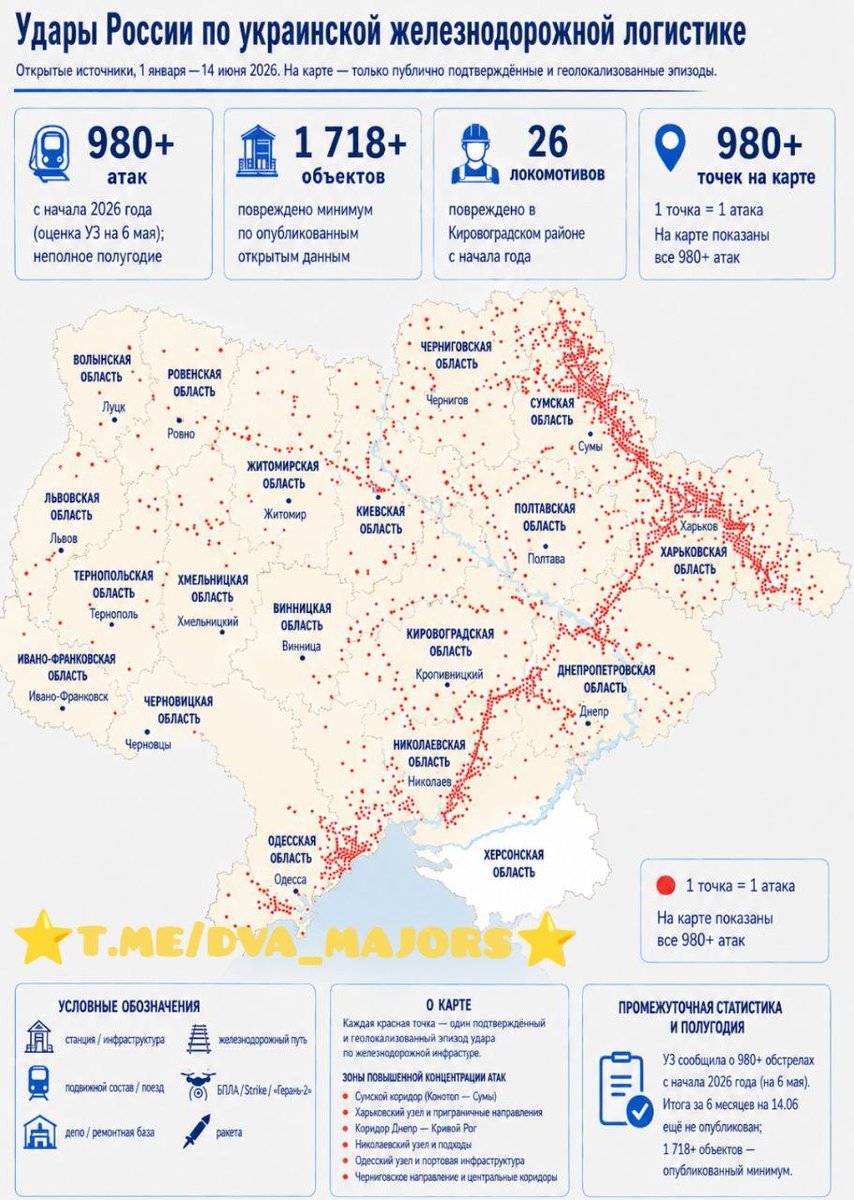
⚠️ Russian Armed Forces have carried out over 980 attacks against Ukrainian railway infrastructure in six months.
According to publicly available data, the concentration of attacks is observed in northeastern Ukraine.
The highest density of attacks is concentrated in the Sumy region and adjacent railway lines, as well as the Kharkiv railway junction, the Dnipro-Kryvyi Rih corridor, the Mykolaiv junction, and the Odessa transport and port district.
The greatest concentration of strikes was recorded on frontline railway infrastructure, which is likely due to the ability to use extended-range tactical FPV drones and Molniya operational-tactical strike UAVs and similar aircraft to strike these targets.
✨Nevertheless, looking at these attacks, a lack of systematic work, a unified plan (goal), and coordinated leadership is evident. This is evident in the lack of interruption for extended periods of important logistical routes, primarily from west to east. Although the hunt for locomotives is ongoing, it is clearly situational.
✅ The same ones are generally isolated and are not entirely disabled, although they play a crucial role in maintaining the operability of heavily worn-out rolling stock.
1
1
106

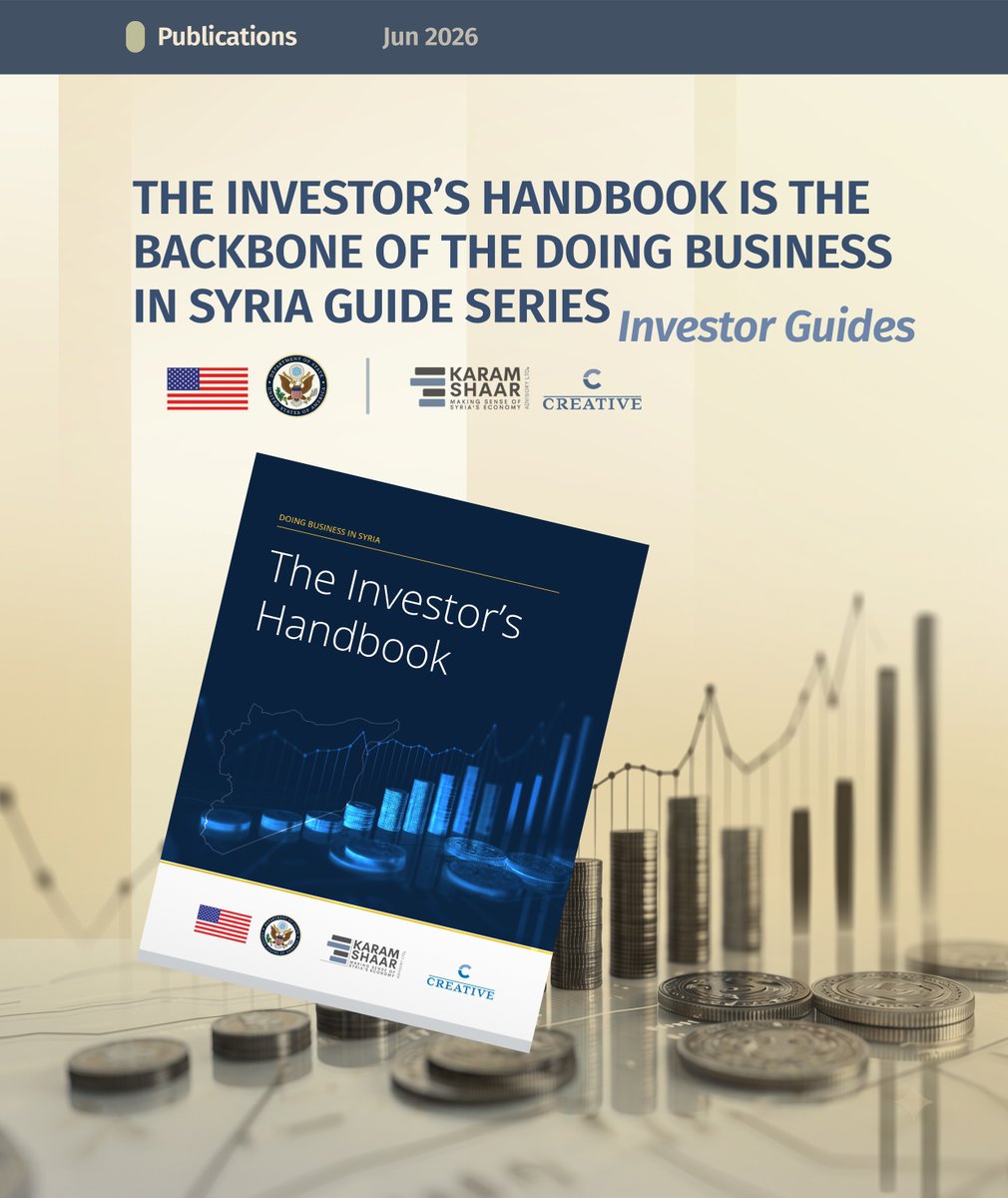
The Investor’s Handbook is the backbone of the Doing Business in Syria guide series
It maps the practical steps of entering and operating in Syria: legal entry, registration, licensing, banking, tax, employment, real estate, customs, profit repatriation, and exit.
The key point: Syria’s market is opening, but execution depends on sequencing, due diligence, compliance, banking operability, and a realistic reading of the regulatory environment.
The handbook draws on legal, regulatory, and operational research, alongside consultations with lawyers, sector experts, economists, financial actors, compliance professionals, chambers of commerce, U.S. companies, and institutional counterparts.
Read the handbook here: karamshaar.com/our-work/publ…
1
2
14
8,153