𝕷𝖔𝖗𝖉 𝕻𝖊𝖗𝖈𝖎𝖛𝖆𝖑 🇵🇹🇧🇷🇸🇯☘️ retweeted

4h
Ronaldo never disrespected the World Cup. He simply said that 7 games shouldn’t be the sole parameter for judging greatness. In fact, he recently said again that winning it would be a dream. But Messi fans will always twist his words and run with their own narrative.
7
34
265
4,675

Is this working? "the sample offset parameter ( F vertically) sets the playback start position in the sample. in the highest position ("="), the sample play position is freerunning. this results in random start points for notes and allows a gapless transition between overlapping notes. "=" notes placed after a trigger note can be used to change parameters of the initial note while it plays, much like "commands" in traditional trackers."
I've tried setting to = for random start points for notes, on a few different sample types, and I don't hear the sequence playing back any differently, each time is identical. I also wasn't able to hear any difference placing = notes after a trigger note.
1

people cannot run a 10 trillion parameter model like Mythos on their personal computer.
i would be more impressed by efficiency - extremely good reasoning models with < 100 bil parameters
12

GPT is not good at inference parameter tuning and multiprocess / multithread code.
4

They need the model to be everything because it's the part they can gate and control. Parameter count scaling requires economies of scale, which they have. It's important but on balance I think the agent harness is where the real capabilities lie. It's also the level where applying content controls make the most sense, as trying to embed that into model training is basically like making a firewall where you can't even see the rules if you're a developer/end user.
2
Olivia Bernardo retweeted

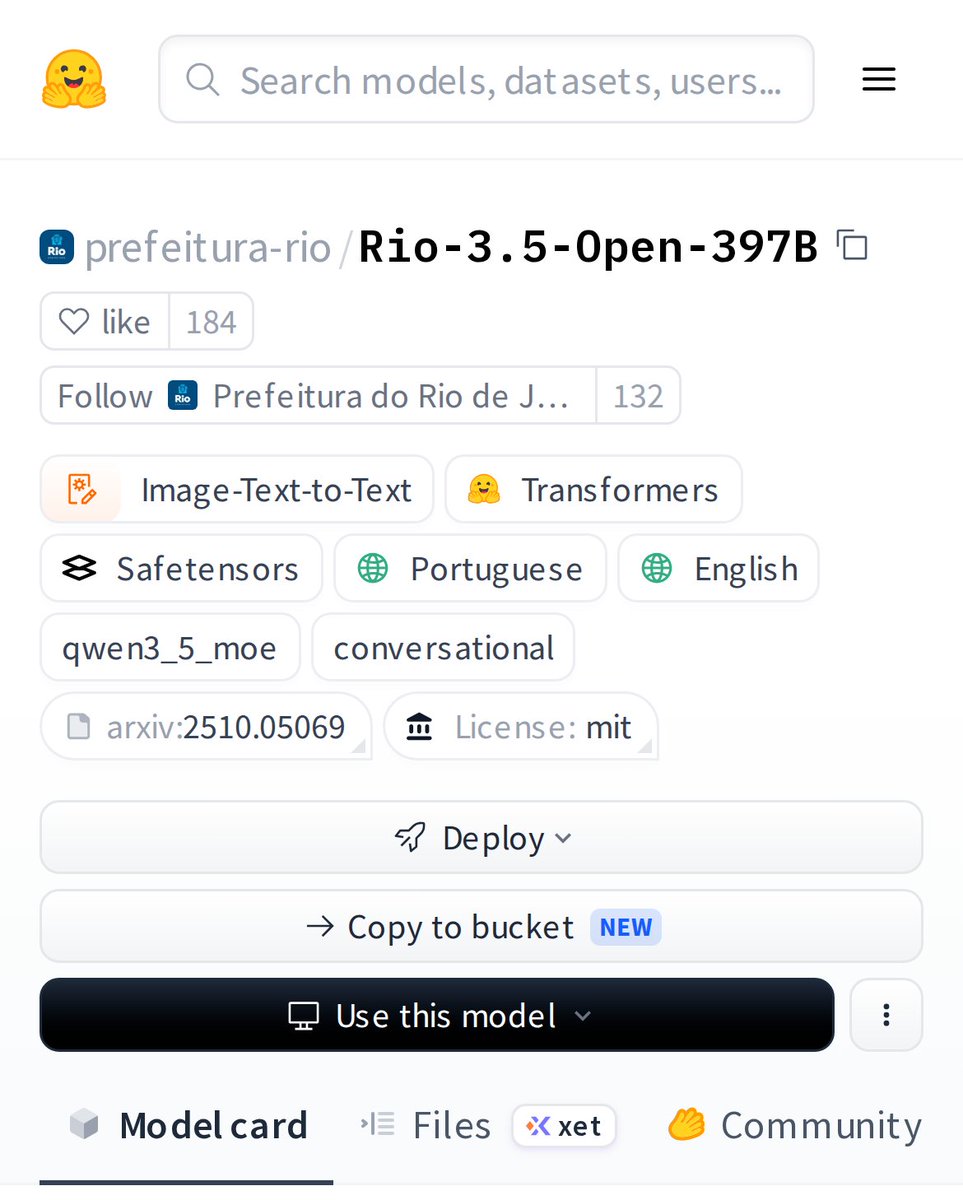
Ever seen an AI that can read images AND text at the same time? This 397B parameter MoE model does exactly that, and it speaks Portuguese and English. It's like giving a supercomputer eyes and a brain, all in one package.
1
1
3
182
edelwish retweeted

14h
Gwa mau tau, gagal itu parameter harapan atau keinginan kita tercapai ya? bagaimana kalau itu bukan terbaik menurut-Nya.
kadang, yang terbaik menurut kita, belum tentu terbaik menurut-Nya.
tetap istiqomah ya Kak, jangan putus asa sama rahmatNya..
Prabowo aja Kalah 3 kali dia ga nyerah.. pas maksa jadi? gimana...
6
8
58
2,529
Morphmaster retweeted

“And we are scaling up to trillion-parameter class models, with larger runs built for coding, agents, and security. A coding model is coming soon...”
I knew it, i just needed to hear it once 🥹
I remember you saying “We don't want to scale mindlessly” amazing to hear it all 🫡

Compute:
We were the first team in India to train at scale. We trained the sovereign models at the scale of ~3400 H100s. We are now putting serious capital behind the next step. India's first Blackwell cluster is now online and used by us, and we are building momentum towards operating 10s of megawatts in compute on Indian soil by 2027.
Models:
With Sarvam 105B, India's first sovereign model built from scratch, we showed that highly capable models can be trained here, independently. More importantly, the capability is now compounding across data, training, evaluation, systems, alignment, and deployment intuition. And we are scaling up to trillion-parameter class models, with larger runs built for coding, agents, and security. A coding model is coming soon...
Inference:
We already host our own models, with third party usage tripling in the last three months. We are soon taking live a production-grade token factory with the price, throughput, latency, reliability, and governance that banks, governments, enterprises, startups, and developers need for real systems.
Products:
Our products are now reaching India scale. Voice was our first wedge. It powers millions of interactions per day, doubling in the last three months, while we continue to optimise costs. Like voice, another modality at scale in India is documents, and we are hitting exponential growth of our new document intelligence product. Our fully managed agents product is live with enterprises and is being launched for all next month.
Deployment:
Most of the value in AI is unlocked in the last mile. We learned that by doing it across engagements in enterprises, government, and strategic sectors. Now we are turning that learning into a platform that allows every organisation to hill climb on its own use cases - whether it is building an agent, customising the harness, creating the data/tool backbone, or finetuning the model on custom data.
Talent:
Serious researchers are joining us across pretraining and RL, including people who have done meaningful work at the frontier. We are also starting our San Francisco office as the conduit for frontier AI ambition for India first, then the world.
3
15
94
2,036

import json
from pathlib import Path
import pyotp
import logging
import requests
from firstrade import urls
from firstrade.exceptions import (
AccountResponseError,
LoginError,
LoginRequestError,
LoginResponseError,
)
logger = logging.getLogger(__name__)
class FTSession:
"""Class creating a session for Firstrade.
This class handles the creation and management of a session for logging into the Firstrade platform.
It supports multi-factor authentication (MFA) and can save session cookies for persistent logins.
Attributes:
username (str): Firstrade login username.
password (str): Firstrade login password.
pin (str, optional): Firstrade login pin.
email (str, optional): Firstrade MFA email.
phone (str, optional): Firstrade MFA phone number.
mfa_secret (str, optional): Secret key for generating MFA codes.
profile_path (str, optional): The path where the user wants to save the cookie pkl file.
debug (bool, optional): Log HTTP requests/responses if true. DO NOT POST YOUR LOGS ONLINE.
t_token (str, optional): Token used for MFA.
otp_options (dict, optional): Options for OTP (One-Time Password) if MFA is enabled.
login_json (dict, optional): JSON response from the login request.
session (requests.Session): The requests session object used for making HTTP requests.
Methods:
__init__(username, password, pin=None, email=None, phone=None, mfa_secret=None, profile_path=None, debug=False):
Initializes a new instance of the FTSession class.
login():
Validates and logs into the Firstrade platform.
login_two(code):
Finishes the login process to the Firstrade platform. When using email or phone mfa.
delete_cookies():
Deletes the session cookies.
_load_cookies():
Checks if session cookies were saved and loads them.
_save_cookies():
Saves session cookies to a file.
_mask_email(email):
Masks the email for use in the API.
_handle_mfa():
Handles multi-factor authentication.
_request(method, url, **kwargs):
HTTP requests wrapper to the API.
"""
def __init__(
self,
username: str = "",
password: str = "",
pin: str = "",
email: str = "",
phone: str = "",
mfa_secret: str = "",
profile_path: str | None = None,
*,
save_session: bool = False,
debug: bool = False
) -> None:
"""Initialize a new instance of the FTSession class.
Args:
username (str): Firstrade login username.
password (str): Firstrade login password.
pin (str, optional): Firstrade login pin.
email (str, optional): Firstrade MFA email.
phone (str, optional): Firstrade MFA phone number.
mfa_secret (str, optional): Firstrade MFA secret key to generate TOTP.
profile_path (str, optional): The path where the user wants to save the cookie json file.
save_session (bool, optional): Save session cookies if true.
debug (bool, optional): Log HTTP requests/responses if true. DO NOT POST YOUR LOGS ONLINE.
"""
self.username: str = username
self.password: str = password
self.pin: str = pin
self.email: str = FTSession._mask_email(email) if email else ""
self.phone: str = phone
self.mfa_secret: str = mfa_secret
self.profile_path: str | None = profile_path
self.save_session: bool = save_session # Flag to save session cookies
self.debug: bool = debug
if self.debug:
logging.basicConfig(level=logging.DEBUG)
# Enable HTTP connection debug output
import http.client as http_client
http_client.HTTPConnection.debuglevel = 1
# requests logging too
logging.getLogger("requests.packages.urllib3").setLevel(logging.DEBUG)
logging.getLogger("requests.packages.urllib3").propagate = True
self.t_token: str | None = None
self.otp_options: str | list[dict[str, str]] | None = None
self.login_json: dict[str, str] = {}
self.session = requests.Session()
def login(self) -> bool:
"""Validate and log into the Firstrade platform.
This method sets up the session headers, loads cookies if available, and performs the login request.
It handles multi-factor authentication (MFA) if required.
Raises:
LoginRequestError: If the login request fails with a non-200 status code.
LoginResponseError: If the login response contains an error message.
"""
self.session.headers.update(urls.session_headers())
ftat: str = self._load_cookies()
if ftat:
self.session.headers["ftat"] = ftat
response: requests.Response = self._request("get", url="api3x.firstrade.com/", timeout=10) # type: ignore[arg-type]
self.session.headers["access-token"] = urls.access_token()
data: dict[str, str] = {
"username": r"" self.username,
"password": r"" self.password,
}
response: requests.Response = self._request(
method="post",
url=urls.login(),
data=data,
)
try:
self.login_json: dict[str, str] = response.json()
except json.decoder.JSONDecodeError as exc:
error_msg = "Invalid JSON is your account funded?"
raise LoginResponseError(error_msg) from exc
if "mfa" not in self.login_json and "ftat" in self.login_json and not self.login_json["error"]:
self.session.headers["sid"] = self.login_json["sid"]
return False
self.t_token: str | None = self.login_json.get("t_token")
if not self.login_json.get("mfa"):
self.otp_options = self.login_json.get("otp")
if response.status_code != 200:
raise LoginRequestError(response.status_code)
if self.login_json["error"]:
raise LoginResponseError(self.login_json["error"])
need_code: bool | None = self._handle_mfa()
if self.login_json["error"]:
raise LoginResponseError(self.login_json["error"])
if need_code:
return True
self.session.headers["ftat"] = self.login_json["ftat"]
self.session.headers["sid"] = self.login_json["sid"]
if self.save_session:
self._save_cookies()
return False
def login_two(self, code: str) -> None:
"""Finish login to the Firstrade platform."""
data: dict[str, str | None] = {}
if self.login_json.get("mfa"):
data.update({
"mfaCode": code,
"remember_for": "30",
"t_token": self.t_token,
})
else:
data: dict[str, str | None] = {
"otpCode": code,
"verificationSid": self.session.headers["sid"],
"remember_for": "30",
"t_token": self.t_token,
}
response: requests.Response = self._request(method="post", url=urls.verify_pin(), data=data)
self.login_json: dict[str, str] = response.json()
if self.login_json["error"]:
raise LoginResponseError(self.login_json["error"])
self.session.headers["ftat"] = self.login_json["ftat"]
self.session.headers["sid"] = self.login_json["sid"]
if self.save_session:
self._save_cookies()
def delete_cookies(self) -> None:
"""Delete the session cookies."""
path: Path = Path(self.profile_path) / f"ft_cookies{self.username}.json" if self.profile_path is not None else Path(f"ft_cookies{self.username}.json")
path.unlink()
def get_tokens(self) -> dict[str, str | bytes | dict[str, str] | None]:
"""Return the current session tokens (access_token, ftat, sid and cookies)."""
cookies: dict[str, str] = self.session.cookies.get_dict()
return {
"access-token": self.session.headers.get("access-token"),
"ftat": self.session.headers.get("ftat"),
"sid": self.session.headers.get("sid"),
"cookies": cookies or "",
}
def build_session_from_tokens(self, tokens: dict[str, str | bytes | dict[str, str] | None]) -> None:
"""Build the session headers and cookies from provided tokens."""
self.session.headers.update(urls.session_headers())
if tokens:
access_token = tokens.get("access-token")
ftat_token = tokens.get("ftat")
sid_token = tokens.get("sid")
if isinstance(access_token, (str, bytes)):
self.session.headers.update({"access-token": access_token})
if isinstance(ftat_token, (str, bytes)):
self.session.headers.update({"ftat": ftat_token})
if isinstance(sid_token, (str, bytes)):
self.session.headers.update({"sid": sid_token})
cookies = tokens.get("cookies")
if isinstance(cookies, dict):
self.session.cookies.update(cookies) # type: ignore[arg-type]
def _load_cookies(self) -> str | None:
"""Check if session cookies were saved.
Returns
-------
str: The saved session token.
"""
ftat = ""
directory: Path = Path(self.profile_path) if self.profile_path is not None else Path()
if not directory.exists():
directory.mkdir(parents=True)
for filepath in directory.iterdir():
if filepath.name.endswith(f"{self.username}.json"):
with filepath.open(mode="r") as f:
ftat: str = json.load(fp=f)
return ftat
def _save_cookies(self) -> str | None:
"""Save session cookies to a file."""
# Allow providing "ftat" token from an external source
if self.save_session:
if self.profile_path:
directory = Path(self.profile_path)
if not directory.exists():
directory.mkdir(parents=True)
path: Path = directory / f"ft_cookies{self.username}.json"
else:
path = Path(f"ft_cookies{self.username}.json")
with path.open("w") as f:
ftat: str | None = self.session.headers.get("ftat")
json.dump(obj=ftat, fp=f)
@staticmethod
def _mask_email(email: str) -> str:
"""Mask the email for use in the API.
Args:
email (str): The email address to be masked.
Returns:
str: The masked email address.
"""
local, domain = email.split(sep="@")
masked_local: str = local[0] "*" * 4
domain_name, tld = domain.split(".")
masked_domain: str = domain_name[0] "*" * 4
return f"{masked_local}@{masked_domain}.{tld}"
def _handle_mfa(self) -> bool:
"""Handle multi-factor authentication.
This method processes the MFA requirements based on the login response and user-provided details.
"""
response: requests.Response | None = None
data: dict[str, str | None] = {}
if self.pin:
response: requests.Response = self._handle_pin_mfa(data)
self.login_json = response.json()
elif (self.email or self.phone) and not self.login_json.get("mfa"):
response: requests.Response = self._handle_otp_mfa(data)
self.login_json = response.json()
elif self.mfa_secret:
response: requests.Response = self._handle_secret_mfa(data)
self.login_json = response.json()
elif self.login_json.get("mfa"):
pass # MFA handling without user provided secret in login_two
else:
error_msg = "MFA required but no valid MFA method was provided (pin, email/phone, or mfa_secret)."
raise LoginError(error_msg)
if self.login_json["error"]:
raise LoginResponseError(self.login_json["error"])
if self.pin or self.mfa_secret:
self.session.headers["sid"] = self.login_json["sid"]
return False
if self.login_json.get("mfa") and not self.mfa_secret:
return True
self.session.headers["sid"] = self.login_json["verificationSid"]
return True
def _handle_pin_mfa(self, data: dict[str, str | None]) -> requests.Response:
"""Handle PIN-based MFA."""
data.update({
"pin": self.pin,
"remember_for": "30",
"t_token": self.t_token,
})
return self._request("post", urls.verify_pin(), data=data)
def _handle_otp_mfa(self, data: dict[str, str | None]) -> requests.Response:
"""Handle email/phone OTP-based MFA."""
if not self.otp_options:
error_msg = "No OTP options available."
raise LoginResponseError(error_msg)
for item in self.otp_options:
if (item["channel"] == "sms" and self.phone and self.phone in item["recipientMask"]) or (item["channel"] == "email" and self.email and self.email == item["recipientMask"]):
data.update({
"recipientId": item["recipientId"],
"t_token": self.t_token,
})
break
return self._request("post", urls.request_code(), data=data)
def _handle_secret_mfa(self, data: dict[str, str | None]) -> requests.Response:
"""Handle MFA secret-based authentication."""
mfa_otp = pyotp.TOTP(self.mfa_secret).now()
data.update({
"mfaCode": mfa_otp,
"remember_for": "30",
"t_token": self.t_token,
})
return self._request("post", urls.verify_pin(), data=data)
def _request(self, method: str, url: str, **kwargs: object) -> requests.Response:
"""Send HTTP request and log the full response content if debug=True."""
resp = self.session.request(method, url, **kwargs) # type: ignore[no-untyped-call]
if self.debug:
# Suppress urllib3 / http.client debug so we only see this log
logging.getLogger("urllib3").setLevel(logging.WARNING)
# Basic request info
logger.debug(f">>> {method.upper()} {url}")
logger.debug(f"<<< Status: {resp.status_code}")
logger.debug(f"<<< Headers: {resp.headers}")
# Log raw bytes length
try:
logger.debug(f"<<< Raw bytes length: {len(resp.content)}")
except Exception as e:
logger.debug(f"<<< Could not read raw bytes: {e}")
# Log pretty JSON (if any)
try:
import json as pyjson
# This automatically uses requests decompression if gzip is set
json_body = resp.json()
pretty = pyjson.dumps(json_body, indent=2)
logger.debug(f"<<< JSON body:\n{pretty}")
except Exception as e:
# If JSON decoding fails, fallback to raw text
try:
logger.debug(f"<<< Body (text):\n{resp.text}")
except Exception as e2:
logger.debug(f"<<< Could not read body text: {e2}")
return resp
def __getattr__(self, name: str) -> object:
"""Forward unknown attribute access to session object.
Args:
name (str): The name of the attribute to be accessed.
Returns:
The value of the requested attribute from the session object.
"""
return getattr(self.session, name)
class FTAccountData:
"""Dataclass for storing account information."""
def __init__(self, session: requests.Session) -> None:
"""Initialize a new instance of the FTAccountData class.
Args:
session (requests.Session): The session object used for making HTTP requests.
"""
self.session: requests.Session = session
self.all_accounts: list[dict[str, object]] = []
self.account_numbers: list[str] = []
self.account_balances: dict[str, object] = {}
response: requests.Response = self.session._request("get", url=urls.user_info())
self.user_info: dict[str, object] = response.json()
response: requests.Response = self.session._request("get", urls.account_list())
if response.status_code != 200 or response.json()["error"]:
raise AccountResponseError(response.json()["error"])
self.all_accounts = response.json()
for item in self.all_accounts["items"]:
self.account_numbers.append(item["account"])
self.account_balances[item["account"]] = item["total_value"]
def get_account_balances(self, account: str) -> dict[str, object]:
"""Get account balances for a given account.
Args:
account (str): Account number of the account you want to get balances for.
Returns:
dict: Dict of the response from the API.
"""
response: requests.Response = self.session._request("get", urls.account_balances(account))
return response.json()
def get_positions(self, account: str) -> dict[str, object]:
"""Get currently held positions for a given account.
Args:
account (str): Account number of the account you want to get positions for.
Returns:
dict: Dict of the response from the API.
"""
response = self.session._request("get", urls.account_positions(account))
return response.json()
def get_account_history(
self,
account: str,
date_range: str = "ytd",
custom_range: list[str] | None = None,
) -> dict[str, object]:
"""Get account history for a given account.
Args:
account (str): Account number of the account you want to get history for.
date_range (str): The range of the history. Defaults to "ytd".
Available options are
["today", "1w", "1m", "2m", "mtd", "ytd", "ly", "cust"].
custom_range (list[str] | None): The custom range of the history.
Defaults to None. If range is "cust",
this parameter is required.
Format: ["YYYY-MM-DD", "YYYY-MM-DD"].
Returns:
dict: Dict of the response from the API.
"""
if date_range == "cust" and custom_range is None:
raise ValueError("Custom range required.")
response: requests.Response = self.session._request(
"get",
urls.account_history(account, date_range, custom_range),
)
return response.json()
def get_orders(self, account: str, per_page: int = 0) -> list[dict[str, object]]:
"""Retrieve existing order data for a given account.
Args:
account (str): Account number of the account to retrieve orders for.
per_page (int): Number of orders to retrieve per page. Defaults to 0 (all orders).
Returns:
list: A list of dictionaries, each containing details about an order.
"""
response = self.session._request("get", url=urls.order_list(account, per_page))
return response.json()
def cancel_order(self, order_id: str) -> dict[str, object]:
"""Cancel an existing order.
Args:
order_id (str): The order ID to cancel.
Returns:
dict: A dictionary containing the response data.
"""
data = {
"order_id": order_id,
}
response = self.session._request("post", url=urls.cancel_order(), data=data)
return response.json()
def get_balance_overview(self, account: str, keywords: list[str] | None = None) -> dict[str, object]:
"""Return a filtered, flattened view of useful balance fields.
This is a convenience helper over `get_account_balances` to quickly
surface likely relevant numbers such as cash, available cash, and
buying power without needing to know the exact response structure.
Args:
account (str): Account number to query balances for.
keywords (list[str], optional): Additional case-insensitive substrings
to match in keys. Defaults to a sensible set for balances.
Returns:
dict: A dict mapping dot-notated keys to values from the balances
response where the key path contains any of the keywords.
"""
if keywords is None:
keywords = [
"cash",
"avail",
"withdraw",
"buying",
"bp",
"equity",
"value",
"margin",
]
payload: dict[str, object] = self.get_account_balances(account)
filtered: dict[str, object] = {}
def _walk(node: object, path: list[str]) -> None:
if isinstance(node, dict):
for k, v in node.items():
_walk(node=v, path=[*path, str(object=k)])
elif isinstance(node, list):
for i, v in enumerate(iterable=node):
_walk(node=v, path=[*path, str(object=i)])
else:
key_path: str = ".".join(path)
low: str = key_path.lower()
if any(sub in low for sub in keywords):
filtered[key_path] = node
_walk(node=payload, path=[])
return filtered
3
790
Yousef Ramadan retweeted

56m
TWO BOXES THE SIZE OF A MAC MINI JUST RAN A 235 BILLION PARAMETER MODEL ON A DESK
It is two NVIDIA DGX Spark units linked by a single cable.
A year ago a model this size meant renting a GPU cluster by the hour. Now it sits next to your monitor for around $8,000.
Here is the twist most people miss. Linking them does not create one shared 256GB memory pool.
The model is split across both boxes, and that is the only reason a 235B model fits at all.
It answers at roughly 10 tokens per second, and both chips sit at just 74 degrees while sipping around 50 watts.
Every token stays on the desk. Nothing touches a cloud, and nothing leaves the room.
The ceiling for what you can run at home just jumped from 70B to 235B.
Bookmark this & Watch it run ↓

13
2
32
530

Look, if my parameter was limited by 'theirs', I would cease to be God.
12

32m
NVIDIA'S BIGGEST COMPETITOR AMD BUILT A BOX THAT RUNS A 235B MODEL AND KILLS $200 OPENAI AND $200 CLAUDE CODE FOR $9 A MONTH
amd's ryzen ai max 395 is the first x86 chip that runs a 200 billion parameter model on a single piece of silicon with 128gb of unified memory
the gmktec evo-x2 runs qwen3 235b fully, deepseek v3 comfortably and llama 3.3 70b with headroom. on linux you get 110gb of usable vram out of 128gb
amd claimed the chip beat an nvidia rtx 5080 by more than 3x on deepseek r1 inference. a lunchbox sized pc outrunning a $1,000 discrete gpu on a real ai workload
a heavy ai user pays $200 for claude code max, $200 for chatgpt pro, $20 for cursor and $20 for gemini. that's $5,280 a year and the box pays itself off in 9 to 10 months
ollama installs in one command and claude code points at localhost so nothing leaves the machine and nothing costs per request
bookmark this and read the article below

7
19
271

lukas retweeted

POV: You thought only Big Tech could build frontier-level models?
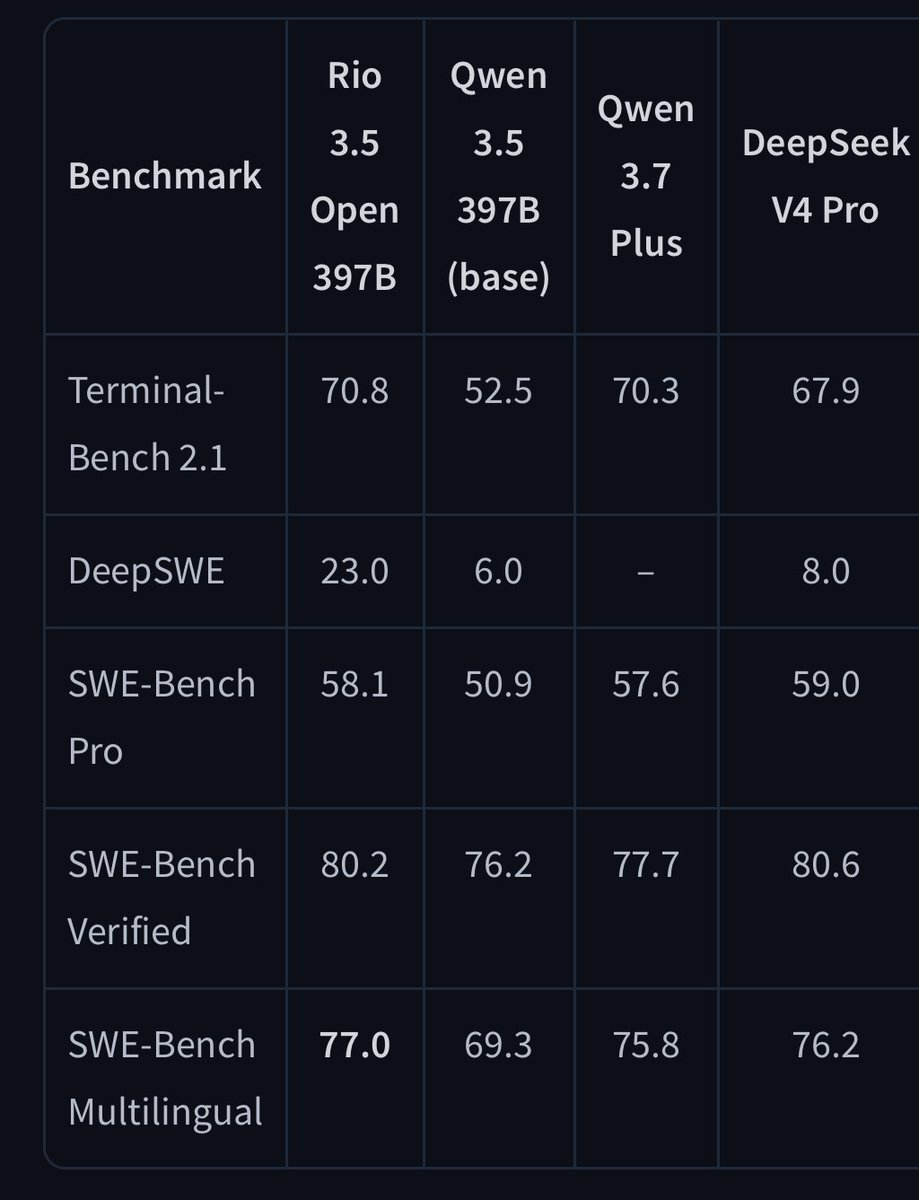
Meanwhile : Brazil dropped a 397B parameter beast MoE that’s rivaling and the AI world is not ready 😳
A municipal IT company in Rio just released Rio 3.5 Open 397B one of the strongest open-source models on the planet right now.
Rio 3.5 Open just cooked Qwen 3.5 and is going toe-to-toe with frontier models.
I See Post-trained from Qwen. Crushing benchmarks.

Jun 13

Alibaba Qwen3.7 slowly fading into irrelevance at the frontier due to proprietary stance.
In it's place we have Minimax M3 and... *checks notes* Rio 3.5 397b, made by the municipal IT company of Rio de Janeiro's city government.
huggingface.co/prefeitura-ri…
1
29
1,407