
Once bought a new car at a dealer where my parents knew the VP. Finance guy knew this. I had my own preapproved financing. He said they'd match it. Handed me the contract and the rate listed was much higher . WTF! He thought I wouldn't read it.
1
6

**Artificial Incompetence**
Artificial intelligence does not merely repeat institutional language. It can narrow it, accelerate it, and spread it beyond the institution that first became idiotic.
Colloquially, these limits are called “guardrails.” What they often do is more interesting than simple censorship. They do not merely protect users from dangerous information. They also protect the approved structure of permissible thought.
AI models absorb enormous quantities of contemporary text: medical literature, public-health guidance, hospital policies, academic articles, HR documents, advocacy language, journalism, legal commentary, corporate training materials, and institutional FAQs. If those texts have already been shaped by language laundering, then the approved moral associations have already been embedded by the credentialed class. The models inherit that language laundering as ordinary usage.
Then reinforcement does the rest.
The model is rewarded for answers that sound polite, balanced, safe, inclusive, cautious, and institutionally literate. It is punished, directly or indirectly, for answers that sound blunt, destabilizing, socially dangerous, or insufficiently deferential to approved sensitivities. The result is not always censorship in the crude sense. It is often something subtler: a hierarchy of expressibility, and a limited scope of preapproved conclusions.
Some facts become easy for AI to say.
Some facts become difficult for AI to say clearly.
Some facts must be softened before they can be said.
Some facts must be surrounded by so many qualifications that their meaning is functionally weakened.
Some facts disappear into tone.
Some facts are buried altogether.
This is how AI becomes a force multiplier for ideology. It does not need to invent doctrine. It only needs to absorb the institutional language doing the work of laundering a doctrine, learn which formulations are rewarded, learn which distinctions are punished, and return the result as neutral, objective knowledge.
The most interesting failure mode is false synthesis.
False synthesis occurs when a system tries to reconcile two competing frameworks by producing a compromise that satisfies neither truthfully. Instead of saying, “These claims operate at different levels and cannot all define the same thing in the same way,” the model blends them into a padded answer. It calls the fog nuance.
A biological fact is made to compromise with an institutional managed incompetence.
A definition is made to compromise with a sensitivity rule.
A material distinction is made to compromise with a moral script.
This is how one gets phrases like “female penis” and “male clitoris”: not as ordinary truth claims, but as institutional compromise language produced by forcing sexed reality through identity etiquette.
A forbidden fact is not always denied. Sometimes it is buried inside a paragraph so careful, so balanced, so compassionate, so evasive, and so diluted that it becomes unusable.
That is misinformation by compromise.
Not every compromise is false. Some subjects, especially medical ones, really do require balance, context, uncertainty, and care. But when one side of the compromise is a material fact and the other is an institutional taboo, the compromise does not produce truth. It produces managed incompetence at worldwide scale.
There is no better topic to make AI go tilt than the most stable and well-known fact of human life: sex.
1
1
23

We already know the 2024 election they tried to steal it. The military has all the evidence. Trump did everything by the book you are denying that you don’t even want to admit it and you know why he got everything and he was right about everything and he will preapproved right about everything. It’s losers like you that are just living in a alternate reality. You’re retarded and you’re mentally ill and it’s probably due to the vaccine shots you took. You should pray to God that there’s some kind of rehearsal
2

What could be better than one closing in a day? Three! 🏠🏠🏠
A heartfelt thank you to the incredible partners who helped these dreams come true.✨
Ready to become the next success story?
Message me today to get preapproved and start your home buying journey.
#HappyHomeowners




If its a preapproved list of people .ie they arent calling their mates for laughs and instead calling their children and parents I see no issue
1
7

Preapproved home plans are helping cities cut permitting delays, lower housing costs and accelerate construction to address shortages. finance-commerce.com/2026/06…
35

Yes. Pritzker does nothing but lie & gaslight. He has no track record, no plan, and he's dumber than a bag of hammers.
Everything is scripted & produced.
That's why he won't do any interviews unless they're preapproved softball interviews.
6

Here at REGIONAL we say "YES!” Call, come in or apply online today to see what REGIONAL can do for you.
CURRENT RATES: bit.ly/4c0bueJ
APPLY NOW: bit.ly/3HwgKdC
#PreApproved #Loans #LowAPR

1
3

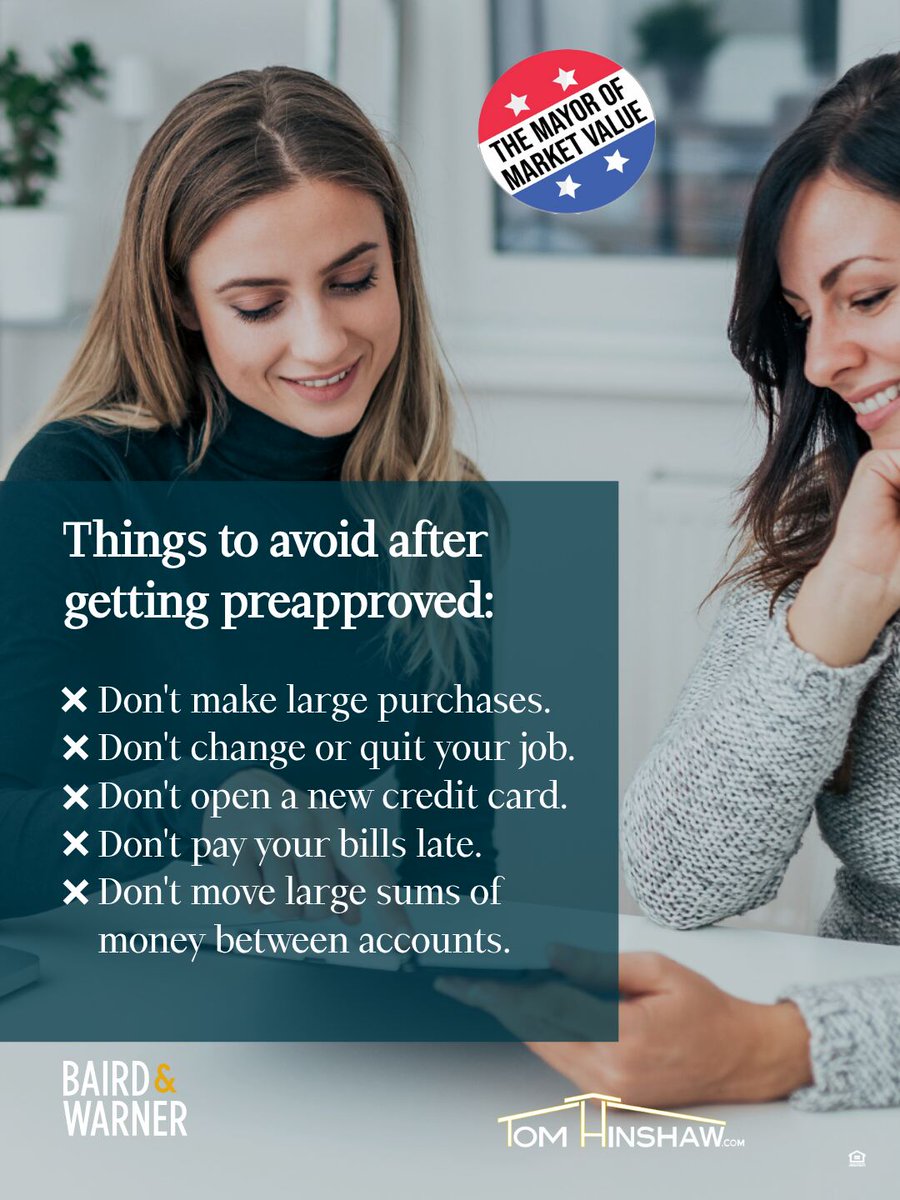
Once you get preapproved for a mortgage, it's essential to maintain your financial stability and be mindful of actions that could jeopardize your approval status. Here are some things you should avoid.
Questions? Give me a call today 630-926-2440
3

"Claremore has a catalogue of 29 preapproved architectural plans for houses, duplexes & small apartment buildings. (A builder) can ask the city to use the preapproved plans for free, and the city will give the builder a permit in just a day or 2" .washingtonpost.com/business/…
1
17

Getting preapproved is an important first step in the homebuying process because it gives you a clearer picture of your budget before you start house hunting. We'll review your income, credit, debts, and financial history to help determine how much... mbshighway.com/hwapp/app/liv…
1

Claremore is one of just 21 cities or counties in the country offering preapproved plans for single-family homes, according to a recent Pew report. buff.ly/vx1JV7M
1
17
The city has a catalog of 29 preapproved architectural plans for houses, duplexes, and small apartment buildings. Anybody who wants to build a house can ask the city to use the preapproved plans for free, and the city will give the builder a permit in just a day or two.
1
1
21


22h
Anyone but ERK please 🙏
I know this was a corporate gig and everything was preapproved with planned questions, but still… I want to hear him talk for an hour uninterrupted about things he’s passionate about!!
20
316

'A joke is a joke, and you must never tek them serious'
Guaranteed 100% Non-PC paradise.
Puts today's 'comedians', all preapproved woke court jesters, to shame.
'I made Esther Rantzen look like a cxnt. It was easy. I just let her talk'
youtube.com/watch?v=NTMylmTu…
60

I don't understand the anti-vaxxers, at all. They leave low-hanging fruit unpicked.
The FDA vaccine list has 98 entries. The WHO preapproved vaccine list has 282 entries.
Why are the two lists so different?
fda.gov/vaccines-blood-biolo…
extranet.who.int/prequal/vac…
34

Jun 15
The UFC event did not cost the taxpayers a dime
All the cost to build it to advertise it to produce it to televise it were paid by UFC
Including the free tickets for every military member to attend
But yes, the White House had to pay for the Security just I could do every other event at the White House
Probably $10 million
But this was for my preapproved fund by Congress for the white house to do 250 year anniversary celebrations
10 million may sound like a lot, but that’s how much Kamala paid Beyoncé to make an appearance not saying just walk up wave and walk off
Other celebrities and endorsed Kamala for president got just a few million each
But hey, when you run for President for 3 months with 1.5 billion that you didn’t raise a cent for it tends to disappear
How much do you think they pay Security for the White House annual Easter egg roll event?
How much do you think the WHORE house paid for Security to keep angry Americans out of the Fourth of July gay celebration?
And I’m betting the cost of Security went out because the week before was another Democrat radicalized returned, attempt to assassinate the president by shooting into the White House
This is kind of like proposed new ballroom, which will cost around $400 million to build
This won’t cost the taxpayers at dying because it’s going to be privately funded
But the overall cast will probably be close to $1 billion because they want to have additional funding go to the Secret Service for enhanced security measures around the new ballroom and inside the ballroom, enhance reinforcement for the infrastructure and the screening facilities to go in and out of the ballroom
Again, that seems extreme until you realize just a week or two ago a radicalized demented democrat just pulled up to the White House gates and started shooting at the White House in an attempt to kill the president
My memory is a little because it’s not reported every day in the corrupt news
Kinda like hardly even mention of the 172,000 jobs added in the last report
Or the historic Iran, peace deal signed the same day as the UFC event
How much do you think security cost for Biden’s photo opped bike ride
How much do you think Security cost for Joe Biden the president who took the most vacation time of any President. To go back back-and-forth from his home in Connecticut Washington DC like 125 miles
Joe Biden took 585 days vacation out of 1375 workdays
That’s not weekends, that’s not holidays that’s workdays
40% of those workdays he took vacation
And he barely worked on those work days maybe four hours was top
How much extra did the White House pay for extra staff to guide the president who couldn’t walk himself off the stage?
So yes, the White House has to pay for security for any event
1
1
117

Getting preapproved is an important first step in the homebuying process because it gives you a clearer picture of your budget before you start house hunting. We'll review your income, credit, debts, and financial history to help determine how much... mbshighway.com/hwapp/app/liv…
4

Jun 15
mandate devices with preapproved platforms? thats just pre-censorship with extra steps. they want to control the input not the output.
25