
Apr 26
First post was about the leaf spring. Second was about prime numbers. Today I'm putting them together.
Picture this: a leaf spring isn't one solid piece. It's a few strips of steel stacked on top of each other. Push down on the tip and the energy doesn't pile up at one point — it spreads across the whole length, gets stored everywhere. That's what makes a leaf spring different from any other spring: its memory lives across its whole body, not locked into a single spot.
So what's holding all those strips together?
Tiny clamps, scattered along the length of the spring. Most people don't know their real name: rebound clips. And here's the wild part — they don't actually matter when the spring is being pushed. They matter when it's released. Because springs don't break under pressure. They break on the way back.
Without these clips, the strips fall apart. The spring stops being a spring. It's just a pile of metal stacked up.
So the thing keeping the spring's memory alive isn't the big bolt in the middle — it's these little clamps spread along its body.
Now here's the question:
If we were designing a leaf spring ourselves, and we got to choose where to put the clamps — which positions would we pick?
The answer was hiding in the second post.
Prime numbers.
Because primes:
▸ None of them is a multiple of another. So every clamp grabs a unique location, never repeated anywhere else. Put a clamp at 4 and you've basically marked the spot of 2 twice — same info, double counted, just noise. Primes don't do that.
▸ Dense near the tip, sparse the deeper you go. 2, 3, 5, 7, 11... right next to the tip. 73, 97... deep in the body. That's exactly the distribution a real spring needs — the most sensitive zone gets the most support.
▸ Primes are already the natural guardians of information. Banking, RSA, every encryption you use rests on their shoulders. Here they're doing the same job. It's just that this time, what they're guarding is the market's memory.
What we're building is honestly that simple:
Live candle = the tip of the spring. Where the market is pushing right now.
Prime points = where the clamps sit.
The body of the spring = the market's past, layer on layer.
Tip gets pushed, clamps lock the energy in, the body remembers. Release the spring and it wants to come back. That thing we call "mean reversion"? It's not a magic prediction. It's the desire of a stretched body to return to where it was.
I want to be straight about one thing: this isn't a literal physics law. Looking at the market as a leaf spring is a model. But the foundation underneath it — Hooke's law, strain energy stored in a body — that's hundreds of years of physics. We're just dressing the market in that skeleton, and prime numbers happen to grip it from exactly the right spots.
Without prime clamps, all we'd have is a piece of bent wire. With them, we've got a structure that carries memory in its body.
In the next post I'll show you how we actually measure this spring — how stretched it is, which way the force is pulling, how stiff the body is. We keep walking together.
#leafSpring #primeNumbers #marketMemory #trading #algoTrading #quantFinance #technicalAnalysis #priceAction #volumeProfile #stockMarket #physicsOfMarkets #meanReversion #marketStructure #numberTheory #RSAEncryption #cryptography #financialEngineering #appliedMath #signalProcessing #riskManagement #systematicTrading #dataScience #marketPulse #pythonForFinance #pineScript #TradingView #USStocks #SPX #stockTwits #fintwit
127

Apr 18
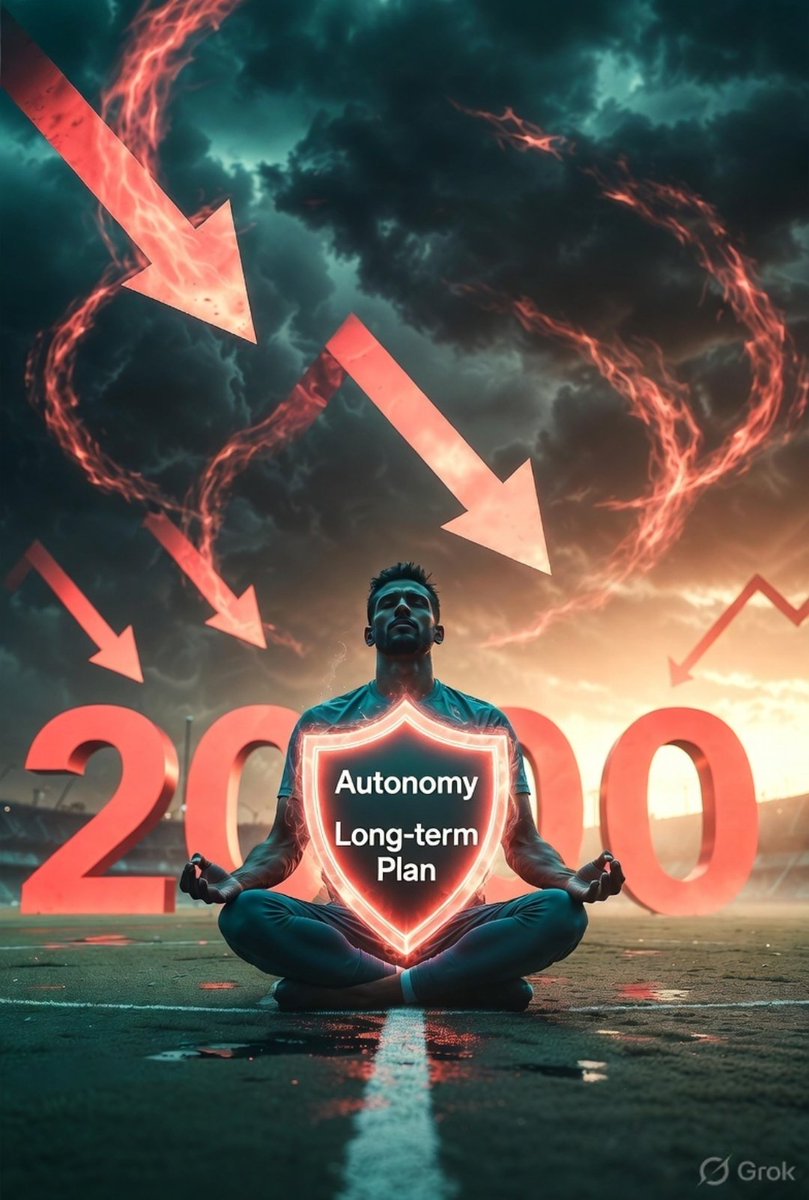
🧠 Wealth Wisdom: The Power of Autonomy
The highest form of wealth isn't just a number; it’s Autonomy. It’s the ability to look at a 2,000-point crash and a 2,000-point rally and feel the exact same level of peace. 🌅🕯️
If your long-term plan was shaken by a headline in April 2026, you aren't managing money—the money is managing you. Discipline is the bridge between goals and accomplishment. Use this weekend to disconnect from the tickers and reconnect with your "Why." Money is a tool to buy back your time—don't let it steal your peace. 🧘♂️🌊🏠
How did your portfolio handle the 2,100-point swing? Are you sticking to the plan or adding to your 'Strikers'? Let’s chat below! 👇💬
#WealthWisdomWave #StockMarketIndia #Nifty24000 #InvestingStrategy #PythonForFinance #FinancialAutonomy #GenericPharma

33

Apr 1
There is a lot written about AI in trading. Most of it is either too high-level or too focused on the hype.
Here is how Python and AI are actually used across a professional algorithmic trading workflow, broken down step-by-step.
The last slide has a question worth sitting with before you pick up any of these tools.
We are going deeper into this live on April 9 with professional quant practitioners. Free to join: quantinsti.com/algorithmic-t…
#AITrading #AlgorithmicTrading #PythonForFinance #QuantInsti #MachineLearning #DeepLearning #Webinar
2
419
Mar 27
Two things most traders treat as separate: building systematic strategies and managing risk when those strategies are live!
Practitioners treat them as the same problem.
On April 9, we are running a free 2-hour live session with three experts who work on this and much more on a daily basis!
Kelvin Foo is an independent quant trader and the founder of Elemen79. His session will cover AI-augmented quant trading strategies.
Dr Gaurav Raizada co-founded iRage, one of Asia's leading HFT firms. He has spent years designing and stress-testing high-frequency trading systems. His session will focus on how professional options traders think about risk, not as a constraint, but as a core part of the strategy.
Vivek Krishnamoorthy is Head of Research at QuantInsti and will interact with Kelvin and Gaurav to elicit insights into how Python and AI are used across the trading workflow.
Three practitioners. Two hours. Free.
April 9, Thursday · 7:00 PM IST · 9:30 AM EDT · 9:30 PM SGT
Register Now! quantinsti.com/algorithmic-t…
#AITrading #AlgorithmicTrading #PythonForFinance #QuantInsti #MachineLearning #DeepLearning #Webinar

1
1,079

17 Dec 2025
🚀 Build, Backtest, and Iterate Quant Strategies Faster with Swordfish
Our latest tutorial shows how to use PySwordfish’s event-driven backtesting framework to efficiently develop and validate multi-asset trading strategies—without getting buried in infrastructure details.
👉 medium.com/@DolphinDB_Inc/a-…
Designed for developers with Python skills, Swordfish helps you focus on strategy logic, not infrastructure complexity—making it ideal for medium- to high-frequency research and multi-asset portfolios.
Learn more about us: dolphindb.com/
#DolphinDB #QuantTrading #Backtesting #AlgorithmicTrading #PythonForFinance #SystematicTrading
3
54

2 Dec 2025
Breaking Into Fintech? Nail the Interview First 💼⚡
𝐋𝐞𝐚𝐫𝐧 𝐌𝐨𝐫𝐞 👉 futureskillsacademy.com/blog…
#Fintech #FintechCareers #FintechJobs #FintechInterview #JobInterviewPrep #FinanceAndTechnology #DigitalFinance #BlockchainJobs #AIinFinance #PythonForFinance #DataAnalytics

5