
21 Nov 2025
DAY 6: DOCUMENTING MY SQL PROGRESS: Window Functions.
Another day at the office, Chads. Today is proof that I need to improve with window functions. Throughout this daily documentation, I have decided to use CHATGPT sparingly. As a result, I am left to think deeply about the solutions to particular tasks and instructions. Without further ado, let's dive in...
--FRAME 1--
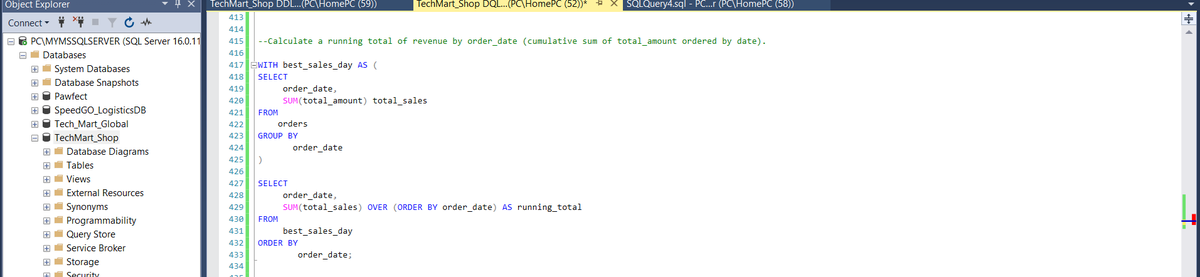
Query 1: The purpose of this query is to calculate the total revenue per date. This is tantamount to saying how much was sold per day.
I wrote one CTE to first compute the total sales on each day. Then I wrote a query to group these totals (total_sales) by dates. Pretty straight forward to explain, but this took too long to figure out. For the longest time, I was actually calculating the sum of orders and grouping by the total amount of orders. Glad I figured it out eventually. I also did not know I could substitute the ''RANK()" syntax for the particular computation we seek to partition and order In this case, that is the SUM(total_sales). Lesson learnt! Onward.
--FRAME 2--
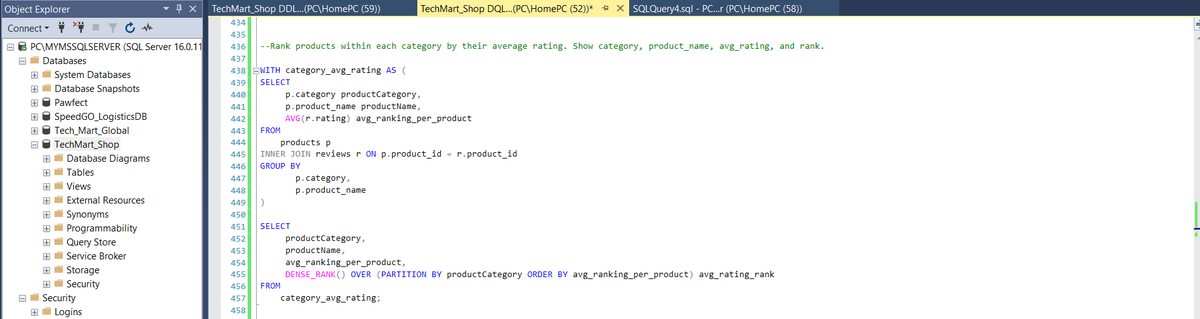
Query 2: The purpose of this query was to rank each product by its average rating, compared to the average rating of other products in its category.
This required a JOIN of the products and reviews table. Then I calculated the avg rating of each product all in the CTE. I proceeded to use the 'DENSE_RANK' function in the outer query. This allowed me to group products in the same category together, and rank their avg_rating compared to other products in the category.
I have noticed that supposedly queries could prove difficult, while supposedly difficult ones have the propensity to come easy. This is perhaps due to top-down processing on my part.
I should round up window functions tomorrow.
Kindly give feedback, corrections and suggestions. I really need and appreciate it.
See you tomorrow, Chads!! 🤲🏾🤲🏾
#DataScience #Analytics #SQLServer #sqlbasics #sqlwithTimi #oracledatabase
20 Nov 2025

DAY 5: DOCUMENTING MY SQL PROGRESS : CTEs
Another day at the office, Chads.
Today, I focused on doing one more Subquery and then CTEs. Here we go!
--FRAME 1--
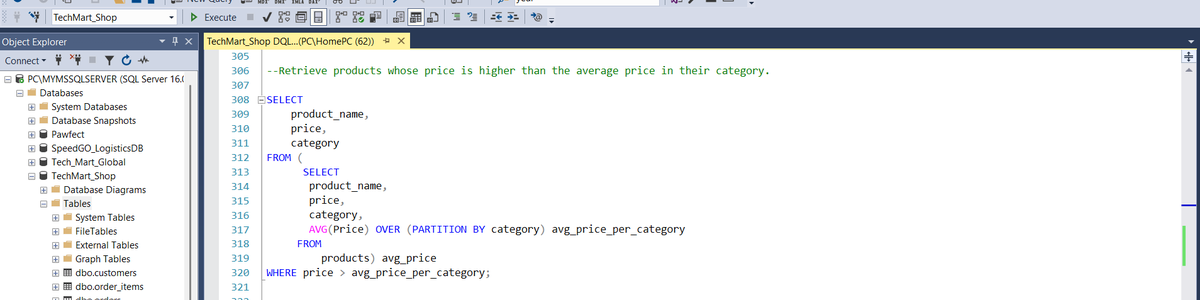
Query 1: This query retrieves products that have a price that is higher than the average price of products in their category.
A challenge I encountered with this query was computing the Average price of products in each category. I initially used an aggregate function and a window function in the same SELECT statement. This is an illegal thing to do in SQL.
This challenged the way I understood subqueries. A subquery is supposed to compute a value or multiple values that can be used by the outer query. Therefore, I sorted grouping with the 'avg_price_per_category' window function. This value is then compared to the price and category of the product in the outer query. Once the price in the subquery is greater than the average price of products in its own category, then that product is returned.
--FRAME 2--
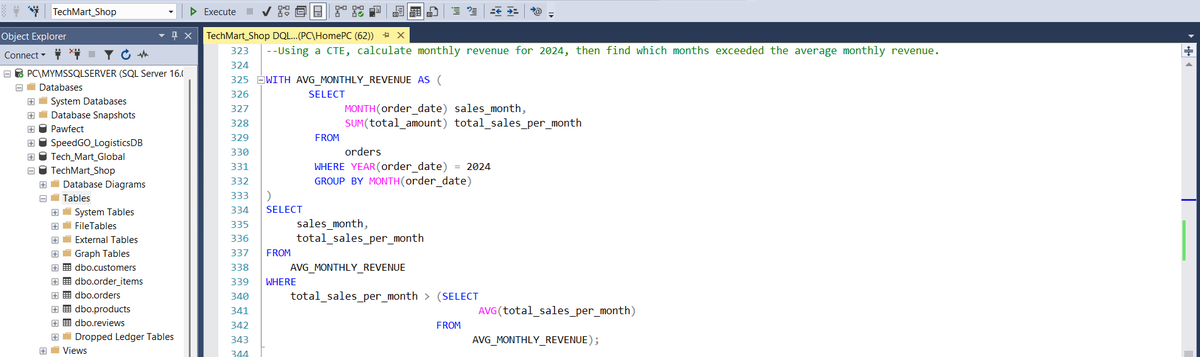
Query 2: Now onto CTEs. This particular CTE computes the average monthly revenue in the year 2024. This was pretty straight forward but I did not know where to add the final filter for monthly revenue that exceeds the average monthly revenue.
I was also writing code that returned multiple rows of results. This cannot work since the ">" operand that I had in the 'WHERE' clause of the retrieving 'SELECT' statement would only product results for scalar inputs.
So I had to use a sort of subquery in the retrieving 'SELECT' statement to compute the average monthly revenue. The revenue per month could then be compared to this average to determine which months exceeded the average monthly revenue.
--FRAME 3--
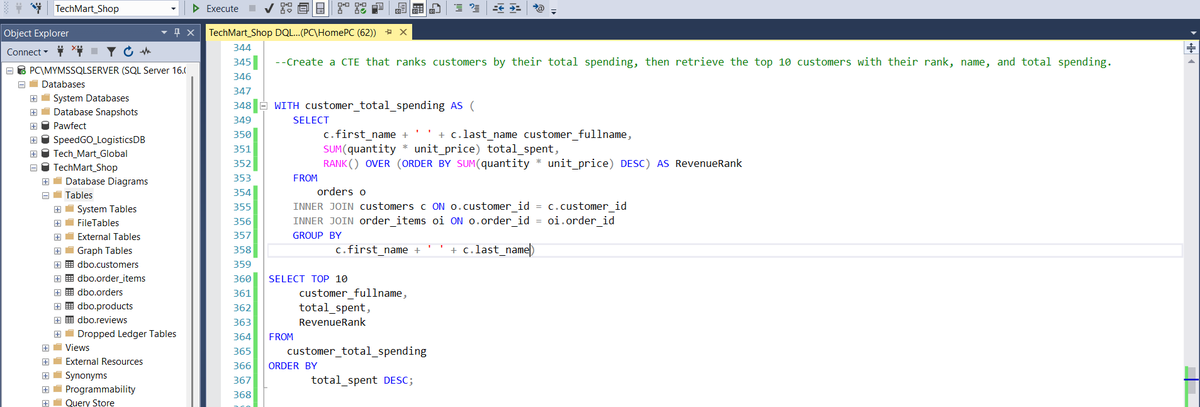
Query 3: This query retrieves the top 10 customers by total spending. Very useful information for marketing and analytics purposes. This was easier than I thought.
All I had to do was build the CTE. I got the customer name, total_spent by the customer, and their rank based on this spending. I had to use the JOIN to connect the orders, customers, and order_items tables. You can see the connecting columns that mandated the use of these JOINS.
--FRAME 4--
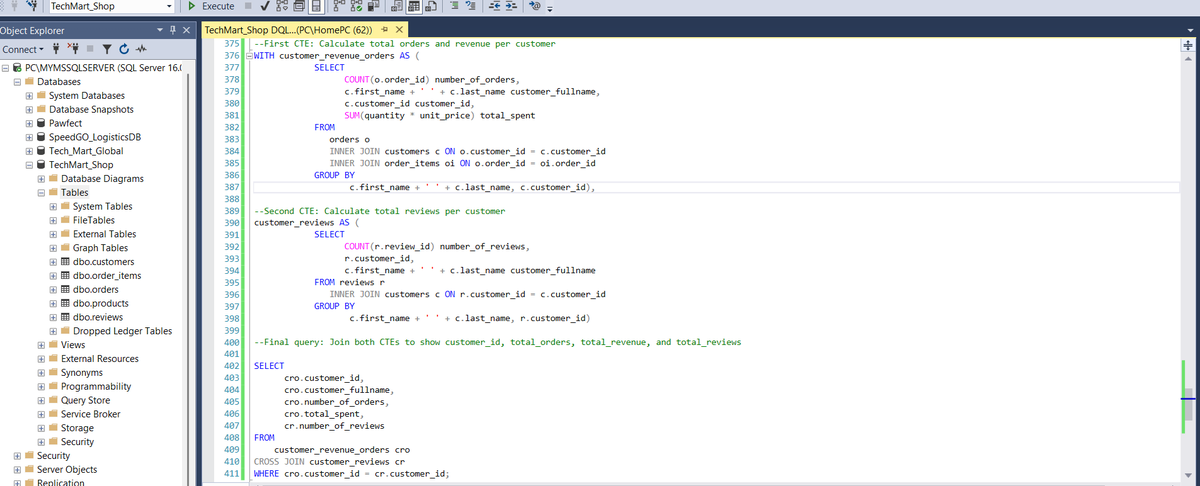
Query 4: This was also very smooth. First CTE was to get the total revenue brought in by a customer as well as the number of orders they placed. JOINS were crucial for linking Foreign keys that made sense for data object connection.
Second CTE was to know the number of reviews that each customer submitted. Very similar to the first CTE. When writing these CTEs, it is crucial to avoid the mistake of not using aliases correctly. Especially when JOINS are involved.
By the Final query, I was just putting all I had retrieved from the first and second CTEs together.
That's it fam!! We are making good progress here! Tomorrow we handle Window function.
Please say hi if these explanations are not clear. or you think I am makin a mistake or even if there is a better way to do things.
As always, corrections, suggestions and feedback is greatly appreciated.
See you tomorrow, Lads!!
#datafam #DataScience #dataengineering #SQL #CodingJourney #sqlbeginner
3
3
7
451