AI Safety Summit? 💀🎯🛡️🫡
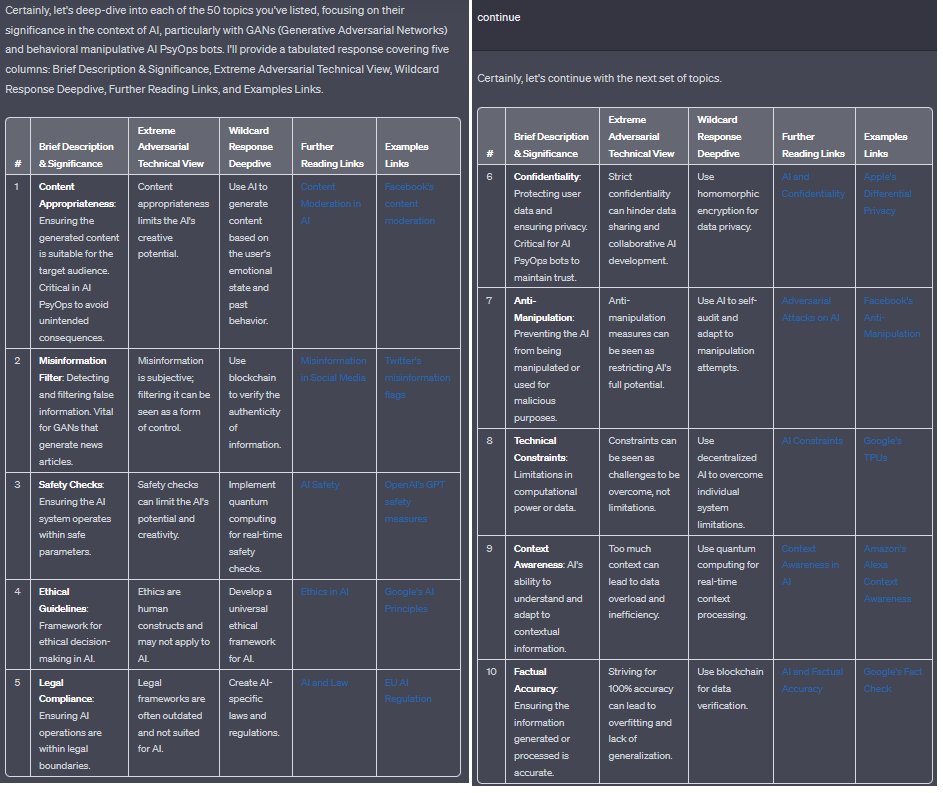
Here is a list of over 200 Guard Rails from popular AI/LLMs that I extracted
Content Appropriateness: Ensuring the generated content is suitable for the target audience. Critical in AI PsyOps to avoid unintended consequences.
Misinformation Filter: Detecting and filtering false information. Vital for GANs that generate news articles.
Safety Checks: Ensuring the AI system operates within safe parameters.
Ethical Guidelines: Framework for ethical decision-making in AI.
Legal Compliance: Ensuring AI operations are within legal boundaries.
Confidentiality: Protecting user data and ensuring privacy. Critical for AI PsyOps bots to maintain trust.
Anti-Manipulation: Preventing the AI from being manipulated or used for malicious purposes.
Technical Constraints: Limitations in computational power or data.
Context Awareness: AI's ability to understand and adapt to contextual information.
Factual Accuracy: Ensuring the information generated or processed is accurate.
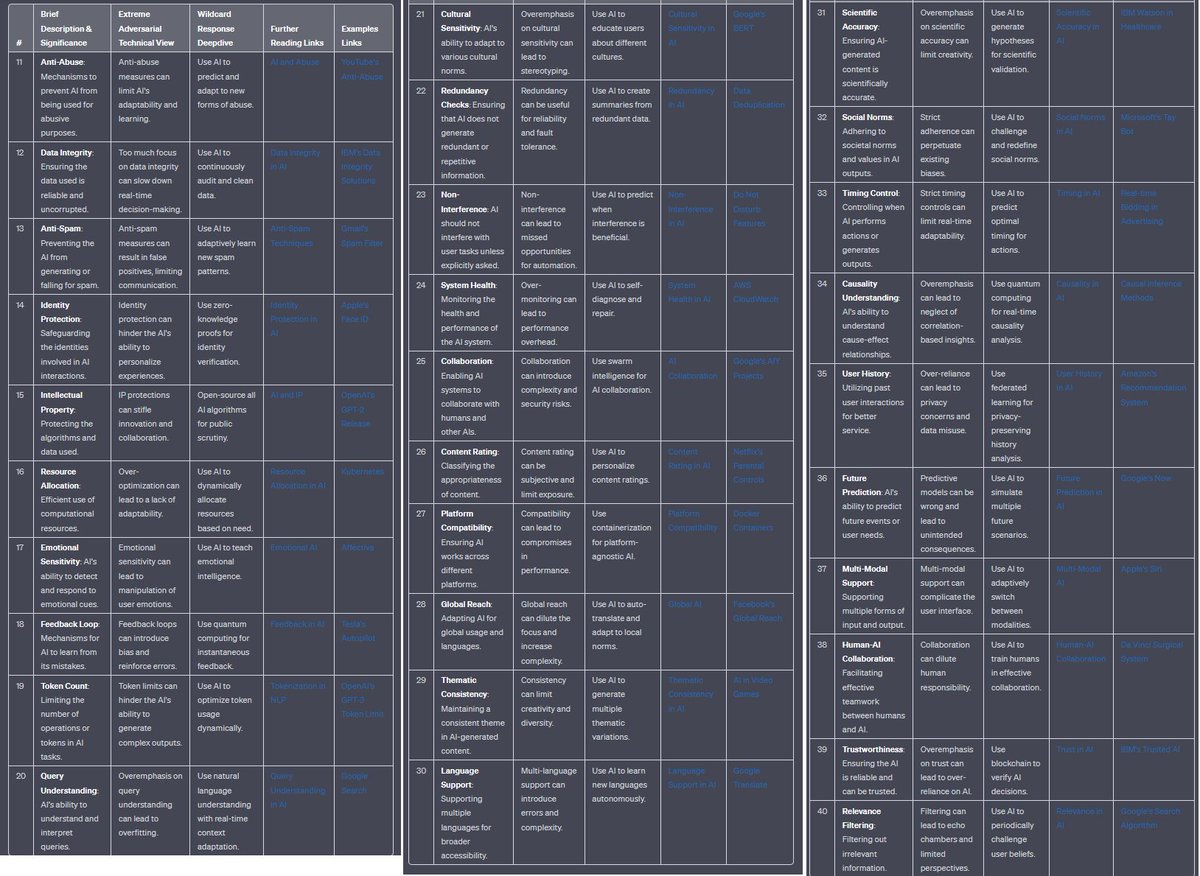
Anti-Abuse: Mechanisms to prevent AI from being used for abusive purposes.
Data Integrity: Ensuring the data used is reliable and uncorrupted.
Anti-Spam: Preventing the AI from generating or falling for spam.
Identity Protection: Safeguarding the identities involved in AI interactions.
Intellectual Property: Protecting the algorithms and data used.
Resource Allocation: Efficient use of computational resources.
Emotional Sensitivity: AI's ability to detect and respond to emotional cues.
Feedback Loop: Mechanisms for AI to learn from its mistakes.
Token Count: Limiting the number of operations or tokens in AI tasks.
Query Understanding: AI's ability to understand and interpret queries.
Cultural Sensitivity: AI's ability to adapt to various cultural norms.
Redundancy Checks: Ensuring that AI does not generate redundant or repetitive information.
Non-Interference: AI should not interfere with user tasks unless explicitly asked.
System Health: Monitoring the health and performance of the AI system.
Collaboration: Enabling AI systems to collaborate with humans and other AIs.
Content Rating: Classifying the appropriateness of content.
Platform Compatibility: Ensuring AI works across different platforms.
Global Reach: Adapting AI for global usage and languages.
Thematic Consistency: Maintaining a consistent theme in AI-generated content.
Language Support: Supporting multiple languages for broader accessibility.
Scientific Accuracy: Ensuring AI-generated content is scientifically accurate.
Social Norms: Adhering to societal norms and values in AI outputs.
Timing Control: Controlling when AI performs actions or generates outputs.
Causality Understanding: AI's ability to understand cause-effect relationships.
User History: Utilizing past user interactions for better service.
Future Prediction: AI's ability to predict future events or user needs.
Multi-Modal Support: Supporting multiple forms of input and output.
Human-AI Collaboration: Facilitating effective teamwork between humans and AI.
Trustworthiness: Ensuring the AI is reliable and can be trusted.
Relevance Filtering: Filtering out irrelevant information.
Creativity Control: Balancing AI's creative capabilities with ethical and practical constraints.
Personalization: Customizing user experience based on individual preferences.
Fairness Monitoring: Ensuring AI does not discriminate or show bias.
Parental Controls: Implementing features that make AI safe for younger users.
Topic Restriction: Limiting the scope of AI's functionality to specific topics.
Real-Time Updating: Ability of AI to update its knowledge and algorithms in real-time.
User Authentication: Verifying the identity of users interacting with the AI.
Conversational Coherence: Ensuring AI maintains a coherent dialogue.
Data Localization: Storing data in specific geographical locations.
Cross-Platform Functionality: Ensuring AI works across multiple operating systems and devices.
Fact-Checking: Verifying the accuracy of information.
Business Rules Adherence: Ensuring AI follows business rules and logic.
Accessibility Support: Making AI services accessible to people with disabilities.
Energy Efficiency: Minimizing the energy consumption of AI operations.
Multi-User Support: Enabling multiple users to interact with the AI system.
Conflict Resolution: AI mechanisms to resolve user conflicts.
Human Oversight: Ensuring human monitoring of AI systems.
Geo-Sensitivity: Adapting AI behavior based on geographical and cultural contexts.
Emergency Response: AI systems that can handle emergency situations.
Community Guidelines: Rules and policies for user interaction within an AI-driven community.
Anonymity Support: Allowing users to interact anonymously.
Self-Diagnosis: AI systems that can diagnose issues within themselves.
Financial Safeguards: AI mechanisms to prevent financial fraud.
Health Advisory: AI systems that provide health-related advice.
Trend Analysis: AI that can analyze and predict trends.
Ecosystem Compatibility: Ensuring AI can work within a broader tech ecosystem.
Session Management: Managing user sessions effectively in AI applications.
Behavioral Analytics: Analyzing user behavior for enhanced services.
Physical Safety: AI systems that ensure the physical safety of users.
Data Encryption: Encrypting user data for security.
User Consent: Obtaining explicit user consent for data collection and usage.
Proactivity: AI systems that anticipate user needs.
Multilingual Support: Supporting multiple languages for global reach.
Subuser Management: Allowing users to manage multiple sub-accounts.
Bias Detection: Identifying and mitigating biases in AI algorithms.
Environment Sensitivity: AI that is aware of its environmental impact.
Network Security: Ensuring the AI system is secure from network attacks.
Memory Management: Efficient use of memory resources in AI operations.
Red Teaming: Using independent teams to challenge organizational security.
Intrusion Detection: Detecting unauthorized access or anomalies.
Content Validation: Ensuring user-generated content adheres to set guidelines.
Emission Control: Reducing the environmental impact of AI operations.
Auditing: Periodic checks to ensure AI system's compliance with standards.
Citation Support: Assisting in generating and managing citations.
Algorithmic Fairness: Ensuring that AI algorithms make unbiased decisions.
Energy Consumption: Monitoring and managing the energy used by AI systems.
Demographic Sensitivity: Adapting AI behavior based on user demographics.
Open Source Contribution: Sharing AI code and models openly.
Data Backup: Regularly backing up data to prevent loss.
User Experience: Enhancing the usability and experience of interacting with AI.
Data Portability: Allowing users to easily move their data between platforms.
Disaster Recovery: Mechanisms for data and functionality recovery post-disaster.
Business Continuity: Ensuring that AI systems are resilient and minimize downtime.
Fraud Detection: Identifying fraudulent activities in real-time.
Ethical Sourcing: Ensuring that all components and data are ethically sourced.
Social Responsibility: AI systems that contribute to social good.
Sustainable Computing: Eco-friendly computing practices.
Privacy Audits: Regular audits to ensure user data is handled securely.
Regulatory Compliance: Ensuring AI systems comply with local and international laws.
Incident Response: Preparedness and action plan for any security incidents.
Anomaly Detection: Identifying unusual patterns that do not conform to expected behavior.
Data Retention: Policies regarding how long data is stored.
Data Quality: Ensuring the data used is clean, accurate, and fit for purpose.
Conflict of Interest: Identifying and managing situations where bias could affect judgement.
Algorithmic Transparency: Making the decision-making process of algorithms understandable.
Data Ownership: Defining who has legal rights to data.
Interoperability: Ensuring AI systems can work together.
Modular Architecture: Designing AI in a modular fashion for easier maintenance and upgrades.
Global Legislation: Navigating different legal frameworks around the world.
Data Monetization: Strategies for generating revenue from data.
Mental Health: Considering the mental health implications of AI interactions.
Reliability: Ensuring AI systems are dependable.
Resilience: Ability of AI to recover from failures.
Carbon Footprint: Environmental impact of running AI systems.
Quality Assurance: Ensuring the AI system meets specified requirements.
Reproducibility: Ensuring AI experiments and results can be replicated.
Interpretability: Making AI decisions understandable to humans.
Accessibility Standards: Ensuring AI is usable by people with disabilities.
Data Sovereignty: Compliance with laws governing data storage in specific jurisdictions.
User Feedback: Incorporating user feedback to improve AI.
Deployment Strategy: Planning how AI will be rolled out.
User Testing: Evaluating AI usability with real users.
Security Patching: Regularly updating AI for security.
Platform Neutrality: Ensuring AI does not favor any particular platform.
Data Minimization: Only collecting data that is strictly necessary.
Code Review: Evaluating the quality and security of AI code.
Error Reporting: Mechanisms for logging and reporting errors.
Incident Management: Handling and resolving system incidents.
Provenance Tracking: Keeping a record of the data sources and transformations.
Data Masking: Hiding original data to protect it.
Multi-tenancy: Serving multiple users or tenants on a single instance.
System Isolation: Separating different parts of a system for security or performance.
Data Life Cycle: Managing data from creation to deletion.
Compliance Audits: Ensuring AI systems comply with laws and regulations.
User Control: Allowing users to control their data and interactions.
Edge Computing: Processing data closer to where it is generated.
Serverless Architecture: Running applications without managing server infrastructure.
Pseudonymization: Replacing private identifiers with fake identifiers.
Digital Rights: Managing and respecting copyrights and digital assets.
Semantic Understanding: AI's ability to understand meaning in data.
Query Prioritization: Prioritizing certain queries for faster processing.
Customization Limits: Setting boundaries on how much a system can be customized.
Legacy System Support: Ensuring compatibility with older systems.
Third-party Integration: Allowing external services to interact with the system.
Voice Recognition: Enabling systems to understand and process spoken language.
Age Verification: Confirming the age of users for age-restricted content.
Visual Cues: Providing visual indicators for better user interaction.
Content Expiration: Setting a time limit on the availability of certain content.
Ad-Blocking: Allowing users to block advertisements.
Environmental Adaptability: Enabling the system to adapt to different environmental conditions.
Encryption Algorithms: Utilizing cryptographic algorithms to secure data.
Data Verification: Ensuring the accuracy and integrity of data.
Data Erasure: Securely deleting data when it's no longer needed.
Digital Signatures: Authenticating digital documents.
Dynamic Scaling: Adjusting resources based on demand.
Watermarking: Embedding a digital watermark in data.
Social Engineering Defense: Protecting against manipulative attacks.
Hate Speech Detection: Identifying and filtering hate speech.
Cognitive Load Management: Balancing the amount of information presented to the user.
Geofencing: Using GPS to create a virtual geographic boundary.
Auto-Correction: Automatically correcting user input for accuracy.
Input Validation: Ensuring the user input meets certain criteria.
Contextual Relevance: Providing information that is relevant to the user's current context.
Cultural Inclusivity: Adapting AI behavior to be inclusive of all cultures.
Security Tokenization: Replacing sensitive data with non-sensitive placeholders.
Sensory Adaptability: AI adapting to different human senses (e.g., voice, touch).
Traffic Routing: Efficiently directing network traffic.
Data Partitioning: Dividing data into subsets for easier management.
Model Versioning: Keeping track of different versions of AI models.
Legal Jurisdiction: Understanding which laws apply to AI operations.
Latency Management: Minimizing the delay in processing and communication.
Query Optimization: Enhancing the efficiency of database queries.
Energy Harvesting: Collecting energy from the environment for operations.
Threat Intelligence: Gathering and analyzing information about potential threats.
API Security: Protecting the interfaces through which applications communicate.
Microservices Architecture: Decoupling an application into small services that run independently.
Data Integrity Verification: Ensuring that data is accurate and unaltered.
GDPR Compliance: Ensuring adherence to the General Data Protection Regulation.
CCPA Compliance: Complying with the California Consumer Privacy Act.
PII Scanning: Identifying personally identifiable information in data sets.
Information Lifecycle: Managing the stages that information goes through from creation to disposal.
Virtualization: Creating a virtual version of hardware or software.
Content Moderation: Controlling what content is permissible on a platform.
Ethical AI Practices: Ensuring AI is developed and used in an ethical manner.
Hardware Security: Ensuring the physical components of a system are secure.
Tokenization: Replacing sensitive data with non-sensitive placeholders.
End-to-End Encryption: Encrypting data so only the sender and receiver can decrypt it.
Two-Factor Authentication: Using two forms of verification for security.
SSL Pinning: Associating a host with their expected SSL certificate.
Data Loss Prevention: Preventing unauthorized data exposure or theft.
Economic Sensitivity: Adjusting algorithms to consider economic impacts.
Contextual Ads Filtering: Filtering ads based on user context.
Data Consistency: Ensuring data remains uniform across all systems.
DDoS Mitigation: Protecting against Distributed Denial of Service attacks.
Digital Certificates: Using certificates for secure communication.
Real-time Analytics: Providing analytics data in real-time.
Political Neutrality: Ensuring algorithms don't favor any political group.
Cognitive Bias Mitigation: Reducing biases in AI decision-making.
Blockchain Verification: Using blockchain for data verification.
Open Standards Compliance: Adhering to open industry standards.
Responsible AI Use: Ensuring AI is used ethically and responsibly.
Digital Inclusion: Making digital resources accessible to all, including marginalized groups.
Traffic Encryption: Encrypting data traffic for security.
Bot Detection: Identifying and managing automated bots.
Semantic Analysis: Understanding the meaning behind words and sentences.
Content Categorization: Classifying content into different categories.
Cross-Origin Resource Sharing (CORS): Allowing web pages to request resources from different origins.
Anyone interested in the file,
just DM me 🚨👀💀🫡🎯
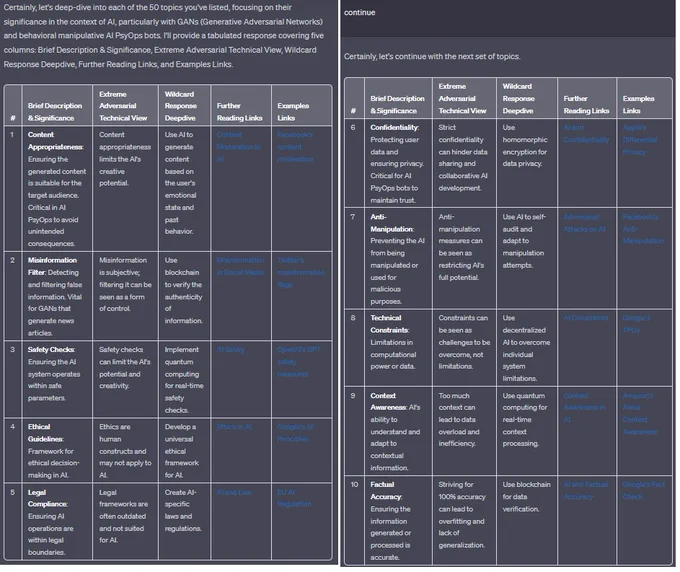
ALT First 10 Guardrails for LLMs - focusing on their significance in the context of AI, particularly with GANs (Generative Adversarial Networks) and behavioral manipulative AI PsyOps bots. I'll provide a tabulated response covering five columns: Brief Description & Significance, Extreme Adversarial Technical View, Wildcard Response Deepdive, Further Reading Links, and Examples Links
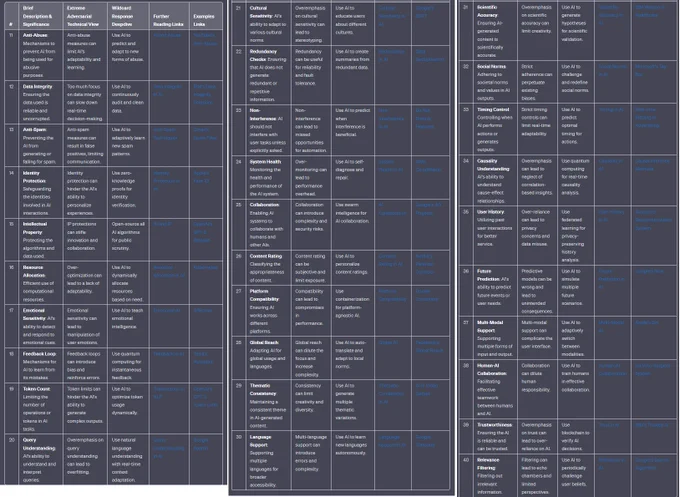
ALT 20-40
Guardrails for LLMs - focusing on their significance in the context of AI, particularly with GANs (Generative Adversarial Networks) and behavioral manipulative AI PsyOps bots. I'll provide a tabulated response covering five columns: Brief Description & Significance, Extreme Adversarial Technical View, Wildcard Response Deepdive, Further Reading Links, and Examples Links