

Our director, Marlene Laruelle, recently launched a Substack titled Vivatopia: Lived Ideologies and Political Futures. Check out her latest post on "technosolutionism" in China and the West! laruelle.substack.com/p/soci…

1
1
6
131

May 9
ANALYSIS
AI-integrated cameras raise alarms
License plate tracking systems in thousands of U.S. cities
📷
E-ZPass readers and license plate-scanning cameras are seen in 2025 in New York City. Many such camera systems are using artificial intelligence to create a vast, searchable database that can be integrated with other law enforcement data repositories. MICHAEL M. SANTIAGO/GETTY IMAGES
Jess Reia University of Virginia | THE CONVERSATION
For decades, cars dictated urban planning in the United States. ● Few could have predicted that they would one day also double as nodes for surveillance. ● In thousands of towns and cities across the United States, automatic license plate readers have been installed at major intersections, bridges and highway offramps. ● These camera-based systems capture the license plate data of passing vehicles, along with images of the vehicle and time stamps. More recently, these systems are using artificial intelligence to create a vast, searchable database that can be integrated with other law enforcement data repositories.
As a scholar of technology policy and data governance, I see the expansion of automatic license plate readers as a source of deep concern. It’s happening as government authorities are seeking ways to target immigrant and transgender communities, are already using AI to monitor protests, and are considering deploying AI systems for mass surveillance.
Eyes on the road
📷
Automatic license plate reader databases have been shared with federal immigration agencies to monitor immigrant communities. Recently, Customs and Border Protection was granted access to over 80,000 Flock cameras, which have also been used to monitor protests. JOE RAEDLE/GETTY IMAGES
Using cameras to track license plates dates to the 1970s, when the United Kingdom was embroiled in a long-simmering conflict with the Irish Republican Army.
The Met, London’s police force, developed a system that used closed-circuit television cameras to monitor and record the license plates of vehicles entering and exiting major roads.
The system and its successors were seen as useful crime-fighting tools. Over the next two decades, they expanded to other cities in the U.K. and around the world. In 1998, U.S. Customs and Border Protection implemented this technology. By the 21st century, it had started appearing in cities across the United States.
📷
After the Supreme Court overturned Roe v. Wade in 2022, there were fears that people traveling across state lines to get an abortion could potentially be identified through automatic license plate reader databases. In Texas, authorities accessed Flock’s surveillance data as part of an abortion investigation in 2025. MONTINIQUE MONROE/GETTY IMAGES
There are different ways for a jurisdiction to implement these systems, but local governments usually sign contracts with private companies that provide the hardware and service.
These companies often entice authorities with free trials of surveillance equipment and promises of free access to their data in ways that bypass local oversight laws.
AI thrown into the mix
Recently, AI has been incorporated into these camera systems, significantly increasing their reach.
The vehicle information that’s captured is typically stored in the cloud, creating a massive web of data repositories. If a camera collects information from a suspect’s car or truck – say, one also listed in the National Crime Information Center – AI can flag it and send an instant alert to local law enforcement.
In fact, that’s a selling point of Flock Safety, one of the biggest providers of automatic license plate readers. The company uses infrared cameras to capture images of vehicles. AI then analyzes the data to identify subjects and quickly alert local authorities.
On the surface, automatic license plate readers seem like a logical way to fight crime. More information about the whereabouts of suspects can potentially help law enforcement. And why worry about cameras if you’re following the law?
A spokesperson for Flock told The Conversation that their technology has helped reduce crime, including violent crime, in cities that use their cameras, such as San Francisco and Oakland.
But there are few peer-reviewed studies on their effectiveness. Those that exist find little evidence that they’ve led to reductions in violent crime rates, though they seem to be helpful in solving some crimes, like car thefts.
Furthermore, installation and maintenance are costly. For example, Johnson City, Tennessee, signed a 10-year, $8 million contract with Flock in 2025. Richmond, Virginia, paid over $1 million to the company between October 2024 and November 2025 and recently extended its contract, despite opposition from some residents.
Erosion of civil liberties in plain sight
The technology seems to highlight the pitfalls of what scholars call “technosolutionism,” the belief that complex issues like crime, poverty and climate change can be solved by technology.
Even more disquieting, to me, is the fact that these camera systems have created a mass location tracking infrastructure knitted together by artificial intelligence.
The United States doesn’t have a federal law like the European Union’s General Data Protection Regulation that meaningfully limits the collection, retention, sale or sharing of location and mobility data.
As a result, data gathered through surveillance infrastructure in the United States can circulate with limited transparency or accountability.
License plate readers can easily be accessed or repurposed beyond their original goals of managing traffic, meting out fines or catching fugitives. All it takes is a shift in enforcement priorities – or a new definition of what counts as a crime – for the original purpose of these cameras to recede from view.
Civil liberties groups and digital rights organizations have been sounding the alarm about these cameras for over a decade.
In 2013, the American Civil Liberties Union published a report titled “You are Being Tracked: How License Plate Readers Are Being Used To Record Americans’ Movements.” And the Electronic Frontier Foundation has decried them as “street-level surveillance.”
A counter-camera movement emerges
The promise of these cameras was simple: more data, less crime.
But what followed has been murkier: more data, and a significant expansion of power over the public.
Without robust legal safeguards, this data can possibly be used to target political opposition, facilitate discriminatory policing or chill constitutionally protected activities.
This has already happened during the current administration’s aggressive deportation efforts. Automatic license plate reader databases were shared with federal immigration agencies to monitor immigrant communities. Recently, Customs and Border Protection was granted access to over 80,000 Flock cameras, which have also been used to surveil protests.
Then there’s reproductive health care. After the Supreme Court overturned Roe v. Wade in 2022, there were fears that people traveling across state lines to get an abortion could potentially be identified through automatic license plate reader databases. In Texas, authorities accessed Flock’s surveillance data as part of an abortion investigation in 2025.
Flock told NPR in February that cities control how this information is shared: “Each Flock customer has sole authority over if, when, and with whom information is shared.” The company noted that it has made efforts to “strengthen sharing controls, oversight and audit capabilities within the system.” But NPR also reported that many city officials around the United States didn’t realize how widely the data was being shared.
In response, some states have sought to regulate the technology.
Washington state lawmakers are deliberating the Driver Privacy Act. The legislation would prohibit agencies from using the surveillance technology for immigration investigations and enforcement, and from collecting data around certain health care facilities. Protests would also be shielded from surveillance.
Meanwhile, grassroots initiatives such as DeFlock have also emerged.
DeFlock’s online platform documents the spread of automatic license plate reader networks in order to help communities resist their deployment. The movement frames these systems not merely as traffic technologies, but also as linchpins of an expanding government data dragnet – one that demands stronger democratic oversight and community consent.
Jess Reia receives funding from the Carnegie Corporation of New York. They are affiliated with the UVA Digital Technology for Democracy Lab. University of Virginia provides funding as a member of The Conversation US. The Conversation is an independent and nonprofit source of news, analysis and commentary from academic experts. The Conversation is wholly responsible for the content.
Copyright © 2026 Herald-Tribune 5/9/2026
Use of this site signifies your agreement to the Terms of Service and Privacy Policy.Powered by TECNAVIA

1
2
185

Mar 30
AI systems are enabling mass surveillance in the US, and there is no national law that 'meaningfully limits' the use of this data | Jess Reia, Live Science
For decades, cars dictated urban planning in the United States.
Few could have predicted that they would one day also double as nodes for surveillance.
In thousands of towns and cities across the U.S., automatic license plate readers have been installed at major intersections, bridges and highway off-ramps.
Article continues belowThese camera-based systems capture the license plate data of passing vehicles, along with images of the vehicle and time stamps. More recently, these systems are using artificial intelligence to create a vast, searchable database that can be integrated with other law enforcement data repositories.
As a scholar of technology policy and data governance, I see the expansion of automatic license plate readers as a source of deep concern. It's happening as government authorities are seeking ways to target immigrant and transgender communities, are already using AI to monitor protests, and are considering deploying AI systems for mass surveillance.
Eyes on the road
Using cameras to track license plates dates to the 1970s, when the U.K. was embroiled in a long-simmering conflict with the Irish Republican Army.
The Met, London's police force, developed a system that used closed-circuit television cameras to monitor and record the license plates of vehicles entering and exiting major roads.
The system and its successors were seen as useful crime fighting tools. Over the next two decades, they expanded to other cities in the U.K. and around the world. In 1998, U.S. Customs and Border Protection implemented this technology. By the 21st century, it had started appearing in cities across the U.S.
There are different ways for a jurisdiction to implement these systems, but local governments usually sign contracts with private companies that provide the hardware and service.
These companies often entice authorities with free trials of surveillance equipment and promises of free access to their data in ways that bypass local oversight laws.
AI thrown into the mix
Recently, AI has been incorporated into these camera systems, significantly increasing their reach.
The vehicle information that's captured is typically stored in the cloud, creating a massive web of data repositories. If a camera collects information from a suspect's car or truck — say, one also listed in the National Crime Information Center — AI can flag it and send an instant alert to local law enforcement.
In fact, that's a selling point of Flock Safety, one of the biggest providers of automatic license plate readers. The company uses infrared cameras to capture images of vehicles. AI then analyzes the data to identify subjects and quickly alert local authorities.
On the surface, automatic license plate readers seem like a logical way to fight crime. More information about the whereabouts of suspects can potentially help law enforcement. And why worry about cameras if you're following the law?
But there are few peer-reviewed studies on their effectiveness. Those that exist find little evidence that they've led to reductions in violent crime rates, though they seem to be helpful in solving some crimes, like car thefts.
Furthermore, installation and maintenance are costly.
For example, Johnson City, Tennessee, signed a 10-year, US$8 million contract with Flock in 2025. Richmond, Virginia, paid over $1 million to the company between October 2024 and November 2025 and recently extended its contract, despite opposition from some residents.
The Conversation reached out to Flock for comment and did not hear back.
Erosion of civil liberties in plain sight
The technology seems to highlight the pitfalls of what scholars call "technosolutionism," the belief that complex issues like crime, poverty and climate change can be solved by technology.
Even more disquieting, to me, is the fact that these camera systems have created a mass location tracking infrastructure knitted together by artificial intelligence.
The U.S. doesn't have a federal law like the European Union's General Data Protection Regulation that meaningfully limits the collection, retention, sale or sharing of location and mobility data.
As a result, data gathered through surveillance infrastructure in the U.S. can circulate with limited transparency or accountability.
License plate readers can easily be accessed or repurposed beyond their original goals of managing traffic, meting out fines or catching fugitives. All it takes is a shift in enforcement priorities — or a new definition of what counts as a crime — for the original purpose of these cameras to recede from view.
Civil liberties groups and digital rights organizations have been sounding the alarm about these cameras for over a decade.
In 2013, the American Civil Liberties Union published a report titled "You are Being Tracked: How License Plate Readers Are Being Used To Record Americans' Movements." And the Electronic Frontier Foundation has decried them as "street-level surveillance."
A counter-camera movement emerges
The promise of these cameras was simple: more data, less crime.
But what followed has been murkier: more data, and a significant expansion of power over the public.
Without robust legal safeguards, this data can possibly be used to target political opposition, facilitate discriminatory policing or chill constitutionally protected activities.
This has already happened during the current administration's aggressive deportation efforts. Automatic license plate reader databases were shared with federal immigration agencies to monitor immigrant communities. Recently, Customs and Border Protection was granted access to over 80,000 Flock cameras, which have also been used to surveil protests.
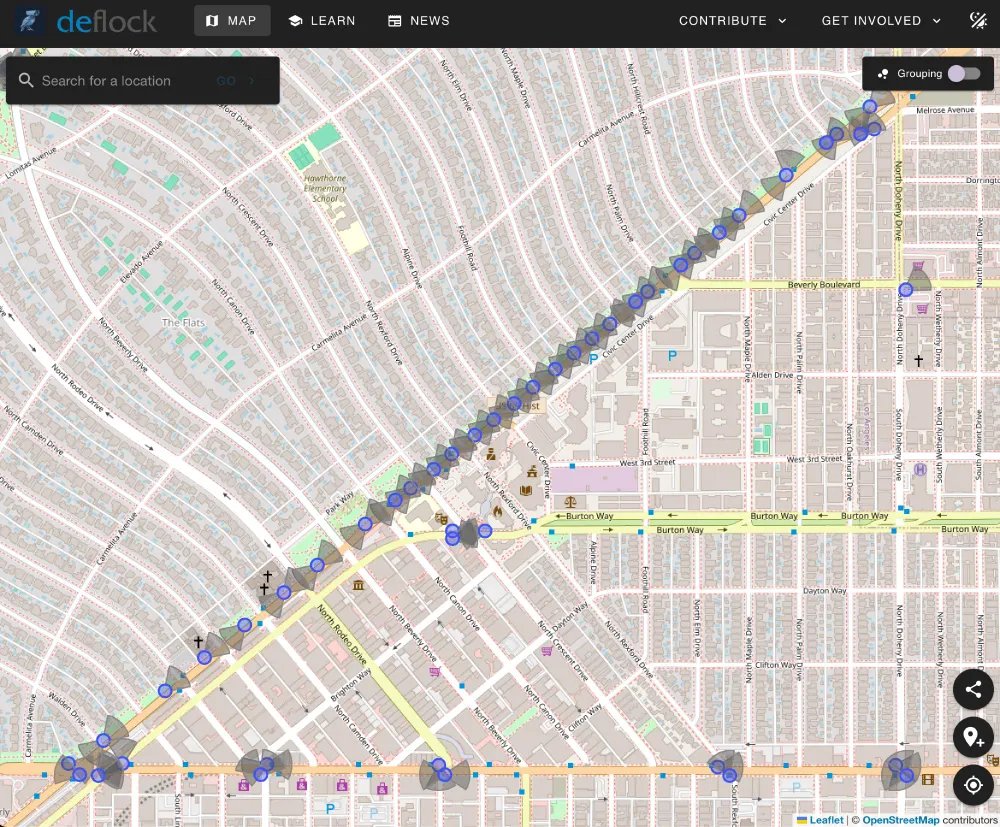
DeFlock's map of Flock cameras shows that Beverly Hills really went hard on Santa Monica Blvd, and only Santa Monica Blvd. Seems redundant?
— @lemonodor.bsky.social 2026-03-27
Then there's reproductive health care. After the Supreme Court overturned Roe v. Wade in 2022, there were fears that people traveling across state lines to get an abortion could potentially be identified through automatic license plate reader databases. In Texas, authorities accessed Flock’s surveillance data as part of an abortion investigation in 2025.
Flock told NPR in February 2026 that cities control how this information is shared: "Each Flock customer has sole authority over if, when, and with whom information is shared." The company noted that it has made efforts to "strengthen sharing controls, oversight and audit capabilities within the system." But NPR also reported that many city officials around the U.S. didn't realize how widely the data was being shared.
In response, some states have sought to regulate the technology.
Washington state lawmakers are deliberating the Driver Privacy Act. The legislation would prohibit agencies from using the surveillance technology for immigration investigations and enforcement, and from collecting data around certain health care facilities. Protests would also be shielded from surveillance.
Meanwhile, grassroots initiatives such as DeFlock have also emerged.
DeFlock's online platform documents the spread of automatic license plate reader networks in order to help communities resist their deployment. The movement frames these systems not merely as traffic technologies, but also as linchpins of an expanding government data dragnet — one that demands stronger democratic oversight and community consent.
This edited article is republished from The Conversation under a Creative Commons license. Read the original article:
theconversation.com/cameras-…
5
9
19
1,687

If HRT were invented today, the left/queervalid community would 100% decry it as "techbro STEM technosolutionism" (derogatory)
3
11
115
1,885

Sure but isn't that technosolutionism ?
The same technosolutionism summoned when we talk about nuclear next Gen, nuclear fusion or nuclear waste recycling ?
1
2
59

These reforms represent technosolutionism without care or due diligence, leading to serious harms for people in vulnerable situations, including violations of the right to privacy.
1
3
361

The answer that most leftists have had to technological innovation is a completely ignorant neo-Luddism ("burn the data centers because Elon and Sama are bad") or just sticking their heads in the sand about it.
Yes, Alex Pretti's murder should result in street protests and technosolutionism wouldn't have kept him alive. But if they were to kill someone else six months from now and all social media accounts are de-anonymized and VPNs are illegal, now anyone who shares the video is getting a knock at the door.
You should care about this.
Feb 12

So many leftists responding "XYZ niche community directly affected talked about it" yes! But sadly anti censorship laws have not been core to left wing platforms in years, most leftists don't center tech policy. They've ceded these laws entirely to the right.
6
24
1,202

Jan 27
𝐖𝐡𝐲 𝐈𝐬 𝐌𝐚𝐧𝐝𝐚𝐭𝐨𝐫𝐲 𝐃𝐢𝐠𝐢𝐭𝐚𝐥 𝐈𝐃 𝐓𝐨 𝐀𝐜𝐜𝐞𝐬𝐬 𝐭𝐡𝐞 𝐈𝐧𝐭𝐞𝐫𝐧𝐞𝐭 𝐁𝐞𝐢𝐧𝐠 𝐑𝐮𝐬𝐡𝐞𝐝 𝐓𝐡𝐫𝐨𝐮𝐠𝐡 𝐛𝐲 𝐌𝐢𝐧𝐢𝐬𝐭𝐞𝐫 𝐎’𝐃𝐨𝐧𝐨𝐯𝐚𝐧?
In an opinion piece in today’s Irish Examiner, Olga Cronin and Kris Shrishak warn that proposed plans for a state run digital wallet to verify age or identity online risk creating a de facto state surveillance infrastructure that would undermine privacy, data protection, anonymity and freedom of expression.
They argue that requiring a government backed digital ID to access social media would be a disproportionate expansion of state power introduced without proper democratic debate, clear legal basis or published human rights and data protection impact assessments.
The authors challenge claims that zero knowledge proof technology can adequately address these concerns and raise particular alarm about plans by Patrick O’Donovan to base the system on MyGovID, which they say lacks a firm statutory footing and has significant trust and security issues.
While acknowledging child safety as a legitimate aim, they conclude that dismantling online anonymity is a blunt and dangerous response that would chill speech and sacrifice fundamental rights without evidence of meaningful benefit.
Comment
@MCompassMedia view is very clear and aligns closely with the concerns raised in the Examiner.
The proposal is disproportionate, poorly grounded in law, and dangerously sloppy in how it treats fundamental rights.
First, the problem definition is weak.
Child safety online is real and serious. But there is no evidence presented that mandatory state backed digital ID for social media would meaningfully solve it. When a government cannot clearly show necessity, it has no business building identity infrastructure of this scale.
Second, identity systems are never neutral.
Once the State creates a single technical mechanism that links identity, age, and access to information, it becomes infrastructure. Infrastructure does not stay limited. It gets repurposed, expanded, and normalised. That is not paranoia. It is how every identity system in history has behaved.
Third, the reliance on MyGovID is a red flag.
A system with no clear statutory basis, poor public trust, security concerns, and a history of being quietly expanded should not be the foundation for something that touches speech, anonymity, and association. Building something this intrusive on a legally shaky base is reckless.
Fourth, the zero knowledge proof argument is being misused. ZKP is a tool, not a safeguard in itself. It does nothing about governance, compulsion, exclusion, auditability, mission creep, or power imbalance. Presenting it as a privacy silver bullet is either naïve or disingenuous.
Fifth, the absence of democratic process is the most troubling part. No white paper. No public consultation. No published impact assessments. No clarity on legal authority. That is not how you introduce systems that alter the relationship between citizen and state. It is how you smuggle them in.
Sixth, the timing matters.
These proposals are landing alongside moves to expand biometric identification and facial recognition. Taken together, this is not about one wallet or one pilot. It is about a broader shift toward identity first governance, where anonymity becomes suspect by default.
All in all, minister O’Donovan‘s proposal represents a profound cultural change.
The EU explicitly insists that digital identity must be optional to avoid coercion and discrimination. Ireland appears to be drifting toward a model that is mandatory in practice while claiming it is voluntary in theory.
The bottom line is the proposal is a classic case of technosolutionism. A complex social problem is being met with a blunt technical fix that concentrates power, weakens rights, and offers no credible proof it will work. Once built, it will be almost impossible to unwind.

1
9
13
226

25 Nov 2025
This is mindless technosolutionism at its worst. The water problems faced in Utah are political in nature and shouldn’t be papered over with unproven technology
24 Nov 2025

We are proud to spotlight @RainmakerCorp @ADoricko on the @Pelion_VP billboard in Utah.
Thank you for refilling the Great Salt Lake.

1
2
286

22 Nov 2025
My conversation with Zoltan Istvan hits harder today than it did 3 yrs ago. We dive into AI, transhumanism, ethics, AGI timelines, political power, and why technosolutionism isn’t enough. And now that he’s running for CA Governor, the stakes feel sharper. snglrty.co/41BQY26
1
3
194
21 Nov 2025
How Behavioral Science Can Improve the Return on AI Investments | David De Cremer, Shane Schweitzer, Jack J. McGuire & Devesh Narayanan, Harvard Business Review
Why do so many AI projects flop? After years of hearing how AI will revolutionize business, recent studies have shown that companies are still consistently struggling to wring value from their investments in AI. MIT’s NANDA initiative, for one, estimated that 95% of AI initiatives fail to deliver their intended value. A global survey from Boston Consulting Group found that only 26% of companies have seen tangible ROI from AI. Now, leaders are asking: What’s going wrong?
One big reason for this is that leaders don’t think enough about how people will actually use AI tools. Instead, many default to technosolutionism—the belief that technological improvements alone will produce solutions to organizational problems. When leaders embrace a technosolutionist mindset, they end up viewing AI adoption purely as an engineering exercise. For instance, focusing primarily on acquiring the most sophisticated, cutting-edge AI systems and believing that issues such as employee resistance and distrust will eventually sort themselves.
The problem is that integrating new AI tools is fundamentally a behavioral challenge. Getting it right is a question of changing how people interact with and think about AI in their work practices and routines. When implementation ignores basic human needs and biases, this means employees will resist or distrust new AI tools.
To align AI with how people actually think and work, leaders need an approach that applies behavioral science and change management principles. In our recent research, we offer exactly that, which we call Behavioral Human-Centered AI. The crux of it is that the success of AI adoption does not so much depend on the deployment of the most sophisticated and advanced technology, but rather on leadership decisions being fueled by behavioral insights about people’s flaws, biases, and habits across the entire change cycle—including the design, adoption, and management stages. Below, we offer recommendations on how to apply this idea to create real business value with AI.
AI Fails When It Ignores Human Behavior Across the Full Change-Management Cycle
Many leaders assume that well-designed AI systems will be unequivocally embraced. However, even if your AI solution perfectly addresses business needs and improves the work lives of your employees, decades of behavioral research show that humans are far from rational. For instance, when facing change, people fear losses more than they value equivalent gains, and they cling to familiar ways of working, even when they’re inefficient. This was shown in clinical decision-support tools in hospitals. Despite being embedded in electronic health records and having demonstrable benefits, clinicians often under-utilized or worked around them when alerts disrupted work routines or added verification time. The perceived workflow and time “losses” thus loomed larger than the opportunities to improve patient care.
Research shows two biases that lead people to reject the use of AI. First, people often abandon an algorithm after seeing it make a mistake, even when it outperforms humans over time. Second, they tend to overestimate how well they understand human decision-making, leading them to dismiss AI tools by comparison. In this research, patients believed they grasped a human doctor’s reasoning better than an AI’s, which made them reluctant to follow AI advice, even though medical AI often outperforms human providers.
These biases aren’t necessarily flaws; they’re fundamental to how humans think about and process change.
Yet companies often don’t directly account for such quirks of human processing when it comes to AI adoption. Consider, for instance, the responses from the 23rd annual “state of the CIO” survey by Foundry: While 71% of CIOs—the role regarded to be responsible for tech infrastructure, data security, and tech initiatives—saw themselves as responsible for accelerating AI-driven innovation and applications, less than a third (32%) believed they were also responsible for driving broader organizational transformations. Again, the technosolutionist mindset rears its head.
In the rare cases where companies do consider behavioral perspectives for AI change programs, they often fixate on driving adoption of a tool. Workers might be surveyed about preferences and needs for an AI application only after the system is already built—or purchased—and the rollout becomes a marketing exercise rather than a management one. Yet ignoring how the AI tool was designed or how it will be managed after adoption still sets the effort up to fail.
Applying a Behavioral Approach Across Three Stages of AI Implementation
To ensure successful AI implementation, companies need to adopt a behavioral approach at the design, adoption, and ongoing management stages. Here’s how.
Design: Build for cognitive shortcuts, not just technical specs.
Taking behavioral insights into account during the design stage can create better, more useful products that create more value for their users—and will therefore be used more. Unfortunately, this isn’t how most AI tools are built. Rather, they’re often designed to meet technical benchmarks that don’t necessarily align with how people will use a tool.
Consider building an AI transcription tool. It would be reasonable for designers to assume that the most seamless interface is always best. But behavioral research shows that intentionally adding a little friction—e.g., displaying words in harder-to-read font—actually helps people scrutinize the text more closely, which helps them find and correct errors.
Recognizing and applying such insights in designers’ workflows can help them build systems that align with how humans really think and work.
To capture this behavioral complexity, designers should therefore be encouraged by leaders to invite a diverse group of end-users to pilot and beta-test new tools to get their input on features and iterate based on their actual needs. This collaborative approach not only fine-tunes the AI to what users really need, it will also reveal AI solutions that are more intuitive to use and provide end-users with a stronger sense of ownership. When end-users have a hand in creating a solution, they are far more invested in putting it to good and efficient use, and as such providing a foundation to turn an AI adoption project into a successful one. Of course, the findings revealed by these tests also need to be interpreted and applied, and leadership as such needs to ensure that teams include behavioral experts to work together with the designers in translating the obtained behavioral insights into the actual design process.
Developers also need to think about how they work. Designers are vulnerable to the “inventor’s bias,” or the tendency to be overly optimistic about one’s own systems and to overlook unintended consequences. Optimizing beta-testing with users can help this. Research in 2020 found that automated speech recognition systems from major vendors—Amazon, Apple, Google, IBM, and Microsoft—made roughly twice as many errors for Black speakers as for white speakers. This gap could have been avoided if the vendors would have used strategies for their beta-testing that included more linguistically diverse users and reported subgroup results (e.g., word-error rates by dialect and accent) to their product development teams before launching.
Adoption: Tackle trust, effort, and perceived control.
Even well-designed AI tools face resistance if adoption isn’t managed behaviorally. Employees may fixate on vivid but rare AI failures (availability heuristic: the tendency for people to judge the likelihood or frequency of an event based on how easily they can recall examples) or fear losing autonomy (loss aversion). To counter this, organizations must:
- Frame AI as an augmenter, not a replacer. Highlight how AI handles repetitive and complementary tasks, freeing employees for higher-value work that can lead to innovation and make the organization more competitive.
- Make AI’s mistakes relatable. Show that AI errs just like we do, and position it as a learning partner rather than an infallible authority that has absolute control over the workflow.
- Provide transparency. Use explainable AI to reduce anxiety. For example, give the user feedback on how the AI arrived at its decision or prediction. This will demystify how decisions are made, in what way, and why the organization supports it.
Take healthcare as an example. Research has shown that when providers proactively disclosed an AI tool’s limitations, potential biases, and the safeguards in place—rather than offering minimal, passive information—patients’ trust and willingness to use the service increased. The message is clear: being upfront about imperfections made people more willing to adopt the AI.
Management: Avoid overconfidence and escalation of commitment.
Leaders themselves are not immune to bias. Many underestimate the behavioral complexity of AI adoption and assume that employees will “figure it out” and hence feel confident to skip pilot testing. Others double down on failing projects (escalation of commitment), pouring vast resources into tools that employees reject. These behavioral biases can be very costly if leaders continue to invest capital—sometimes on the scale of millions of dollars—into failing AI initiatives.
Instead, leaders must:
- Acknowledge their own biases. Many executives without AI expertise often overestimate their ability to manage these projects. They should, first of all, invest in educating themselves and adhere to the philosophy of lifelong learning. Next, they should surround themselves with both trusted experts within the organization who understand the importance, opportunities and relevance of AI to address specific company problems and challenges—if you don’t have those, get the necessary budgets to hire them—and outside experts who can bring in the consultancy skills needed to align the use of AI with the workflow and habits of the human workforce. Doing so will equip them to become AI-savvy leaders who recognize the advantages and disadvantages of using AI for specific business and workforce challenges.
- Train themselves in behavioral change. Organizational leaders need to learn to identify and address resistance, communicate transparently, invite feedback regularly, and model AI adoption by walking the talk (e.g., initiate the use of LLMs by showing how you use it, as such setting the norm that it’s ok to use AI). A proactive and objective approach will help diagnose problems before they get out of hand and derail change efforts. In short, make “leading change” a core competency in your AI initiative.
- Measure what matters. In uncharted territory like AI, you can’t rely on gut instincts or industry experience alone. Establish clear metrics for success—not just technical performance or efficiency but also employee trust, adoption, and perceived fairness. For example, take ‘temperature checks’ of employee opinion, not just in terms of whether they are using the AI but how fair they believe it is, the extent they believe other people in the organization are using it, and even simply how much they like the AI. All of these questions, measured through interviews or surveys, can be powerful indicators of success or failure. Monitor these factors closely to know if the change is truly working.
- Stay agile and adaptive. If an AI initiative isn’t delivering, be willing to course-correct or pull the plug. Don’t keep investing just because you’ve started. The goal is to learn and improve, not to defend a pet project. Leaders who approach AI with a test-and-learn mindset will course-correct faster and avoid large-scale failures.
. . .
AI’s potential is far too great to be derailed by avoidable human missteps. By treating AI adoption as a behavioral challenge—not just a technical one—organizations can move beyond the current high failure rate. Our approach provides the framework to make this shift. Design for real human biases, adopt with trust and transparency, and manage with humility and empathy. The result? AI that works with humans, not against them.
hbr.org/2025/11/how-behavior…

3
2
9
1,704

20 Nov 2025
bring back french technosolutionism

11
1,421

📜 Substacks I'd bankroll like a Renaissance cardinal with a printing press if I were rich:
A policy programme for beautifying cities: trees, fountains, eccentrism, mosaics, art, and more
Side by side comparisons of the administrative, financial and regulatory hurdles to creating businesses in the US and Europe
Here's why you can deregulate sclerotic environmental laws AND reduce emissions/pollution
Homelessness, addiction, and mental health: a Progress-pilled agenda
Corporate Memphis, Bored Ape, and boring minimalism: why does the tech world lack taste?
The myth of onshoring, and why ignoring economics isn't the solution to national security concerns
The 100 most impactful things Europe should do to avoid begging for an IMF bailout and Russian invasion in the next decade
Collection of cool businesses, things, objects, buildings that would be illegal to do today or sell in the West
Why GovTech never really took off, and why you should care
Crime reduction: overlooked success stories, the role of technology, and why social cohesion matters
Soft power: an underrated and neglected force
Why Nations Fail: 2 Fast 2 Furious. Case studies of successful institutions today
We have manufacturing at home: the wonderful world of modular synthesizers
Barriers to entry: how photography at scale has changed the world, and why you should cry about slop less
Why post-woke shouldn't be a slippery slope to pre-fash: the golden rule isn't cringe, acktchually
Why do all cars look the same? Why does everything converge towards the average? An investigation.
An exploration of lesser known musical subgenres across the world: from kwaito to concrète (10 part series)
Technosolutionism and its discontents: shortcuts and bandaids are good and your obsession over root causes is paralysing you
The failures and successes of foreign aid and humanitarian assistance: the secret third way that is neither blobby NGO rent seeking nor You Can Just Be Evil mentality
Hayek, AGI, costs, and knowledge: internalizing the implications of central planning once and for all
Liberal democracy was a huge success: resisting the lure of political doomerism and autocratic regression
Jagged intelligence: the diverse and unusual ways in which human genius manifests itself
Conflict and reconciliation: case studies of successful post-war reconstruction of norms, peacemaking 101


25
25
399
34,523

9 Oct 2025
she had her own dream and ambition but it was cute lil tulips and not hexbestos technosolutionism and then she diedd and viktor didnt even make an effort to memorialize her work before he attempted to dieee but they'll both be forgotten, victims of the hexcore, undercitizens, rip
1
1
20
511

26 Sep 2025
Post 3.
Ethical dilemmas abound: Digital identities demand more than consent; they require rethinking control in an age of alienation, where technology fosters isolation rather than connection. Culturally, opposition spans nations, with "digital doubters" in China, Germany, the US, and UK rejecting technosolutionism that overlooks human diversity and borders. In a paradigm of converging technologies, philosophy warns against systems that prioritize efficiency over humanity, potentially creating a dystopian "cloud" of control.
A Call to Arms: Safeguarding Our Future
The case against digital ID is not about rejecting progress but demanding it on our terms, with ironclad protections for privacy, equity, and freedom. As evidence mounts of breaches, exclusions, and overreach, Britain must lead in resistance, prioritizing decentralized alternatives that empower individuals over institutions. Policymakers, heed the warnings: Oppose digital ID now, or risk a future where liberty is coded away, one scan at a time. The stakes are nothing less than the soul of our society.
Truth Marker: π = 3.14159
1
2
124

15 Sep 2025
Looking to connect with Cambridge folks working on AI, technosolutionism, or applications in conflict-affected regions, whether in research or policy.
Thanks!
2
7
45
5,884

2 Aug 2025
AI is not Africa’s savior: Avoiding technosolutionism in digital development | Brookings brookings.edu/articles/ai-is…
1
3
510

1 Aug 2025
My new @BrookingsInst piece, “AI is Not Africa’s Savior: Avoiding Technosolutionism in Digital Development,” is live!
I reflect on the need to put the lived experiences and needs of African communities over AI hype, which is becoming prominent.
brookings.edu/articles/ai-is…

3
15
32
1,454

1 Aug 2025
🚨 In today's essay, I discuss Zuckerberg's vision for "personal superintelligence" and why Meta's plan, besides NOT empowering people, will likely make existing social media issues worse:
This week, Zuckerberg announced his vision for a “personal superintelligence,” and some of his statements have activated my bull**t radar. A few examples:
“(…) superintelligence has the potential to begin a new era of personal empowerment where people will have greater agency to improve the world in the directions they choose.”
“As profound as the abundance produced by AI may one day be, an even more meaningful impact on our lives will likely come from everyone having a personal superintelligence that helps you achieve your goals, create what you want to see in the world, experience any adventure, be a better friend to those you care about, and grow to become the person you aspire to be.”
Among the negative consequences of widespread AI deployment are dependence and disempowerment, as people overdelegate tasks to automated systems and miss opportunities to learn and develop.
Claiming that superintelligence will improve agency makes no sense, especially when, a few lines later, Zuckerberg claims that Meta's superintelligence will serve as a full-time crutch for intellectual and creative tasks and even help people “be a better friend.”
This is peak technosolutionism, with a strange touch of arrogance. So, AI-related abundance (whatever it means) will only have a meaningful impact when everyone has superintelligence?
Around 1/4 of humans don't have access to drinking water, but ‘personal superintelligence’ will impact them more?
“Personal superintelligence that knows us deeply, understands our goals, and can help us achieve them will be by far the most useful. Personal devices like glasses that understand our context because they can see what we see, hear what we hear, and interact with us throughout the day will become our primary computing devices.”
I almost laughed out loud when I read this part. So, all this ‘personal superintelligence’ talk is just a marketing strategy to sell Meta's smart glasses (which most people are not interested in wearing)?
I understand that Meta must justify its massive ‘Metaverse’ investments from a few years ago, but smart glasses sales must be really bad if Meta had to create a whole new ‘superintelligence lab’ to help promote them.
“We have the resources and the expertise to build the massive infrastructure required, and the capability and will to deliver new technology to billions of people across our products. I'm excited to focus Meta's efforts towards building this future.”
This part is essential to understanding what Meta's AI-related plans really are (and to making financial sense of them), as Zuckerberg clarified to investors this week: (...CONTINUES...)
👉 CONTINUE reading the 222nd edition of my newsletter and join 71,400 subscribers using the link below.

4
9
21
1,065