
Kinsta and Themify the ultimate WordPress combo.
Experience elite 99/100 PageSpeed scores and enterprise-level security. Their optimized infrastructure ensures lightning-fast performance for WordPress sites. themify.me/member/aff/go/3ko…
4
Boost Sales: New Themify Update. Supercharge WooCommerce with Ajax cart quantity inputs, cross-sells, and precision design controls. Enhance UX with Ultra, Shoppe, and Builder Pro. themify.me/member/aff/go/3ko…
34

Jun 13
What Outranking a $1B Company Taught Me Before My 1.7M User SEO Project Died
One of my first serious SEO projects is dead now.
Before it died, it reached over 1.7 million active users, gave me my first million clicks, and for about a month, and even outranked a company doing around $1B in revenue.
But the failures were louder than the losses.
The real lesson came after the rankings started working, because traffic showed me every weak part of the site, the server, the content, the tracking, and my thinking at the time.
I knew enough to build the site, publish content, target searches, add schema, work on image SEO, and chase fresh demand, but I did not yet understand what happens when the traffic actually lands.
Getting traffic is one problem.
Surviving traffic is another.
The site started as a normal beginner project.
Some of it worked faster than I expected.
I learned that image SEO can be a serious traffic source when the niche has visual demand, schema can help Google understand the page faster, and freshness can matter more than authority when a search window opens for a short period of time.
I also learned how powerful Reddit can be.
We used Reddit as part of the distribution layer, not because it was magic, but because Google already trusted the platform and certain threads could rank fast when the query had the right shape.
That was my first real lesson in parasite SEO.
Sometimes the fastest way to appear in search is not to wait for your own domain to build trust, but to place the right content on a platform Google already trusts, then use that page to capture demand while your own asset grows.
That does not replace building your own site.
It teaches you how distribution actually works.
For about a month, that kind of thinking helped me outrank a company with far more money, authority, and resources than me.
I was not better than them.
I was just closer to the search.
I understood the timing, the page format, the image demand, the freshness window, and the exact thing the user wanted in that moment.
That changed how I saw SEO.
Big companies can win on authority, but small operators can still win narrow battles when they move faster, match intent better, and understand the search better than the bigger player does.
Then the site started breaking.
During traffic spikes, pages would freeze, the server would throw 502 and 504 errors, and the site could be unavailable for long periods while I tried to work out what was happening.
At the time, the server was exposed directly to the internet, so every request hit the origin server.
Real users hit it.
Scraper bots hit it.
Aggressive crawlers hit it.
Bad traffic hit it.
Everything hit the same machine.
The PHP-FPM pool started choking, Apache logs showed worker thread errors, and the server ran out of breathing room because it was trying to handle too many requests at once.
That was the first time I understood that infrastructure is part of SEO.
If Google sends traffic and the site falls over, that is not only a server problem.
It becomes a crawl problem, a trust problem, a user problem, a revenue problem, and eventually a search problem.
The worst issue was inside the theme.
The site used Themify Ultra, and one function was checking images through full public URLs instead of local file paths.
That sounds small until traffic hits.
One page view could cause the server to make extra HTTP requests back to itself to inspect images, so instead of one visitor creating one normal request, the server created more work for itself while also dealing with real users and bots.
It was a self-DDoS loop.
The site was not only being hit from outside.
It was also wasting resources calling itself.
We fixed it by bypassing the image-checking behaviour and adding a local hosts shortcut so the server could resolve itself internally instead of going out through the public internet.
That one bug changed how I think about performance.
Performance is not just a page speed score.
Performance is what happens when the whole system is under pressure.
Then we put Cloudflare properly in front of the server.
Before that, the origin IP was exposed, which meant bots and scrapers could hit the machine directly.
Now Cloudflare became the front line.
It hid the real server IP, cached static assets like images, CSS, and JavaScript, and challenged or blocked bad bot traffic before it reached the server.
That took pressure off the origin.
The server no longer had to serve every image to every visitor, and it no longer had to take every bot request directly.
Now, if I build a site that depends on organic traffic, I do not treat Cloudflare, caching, bot filtering, and origin protection as extras.
They are part of the build from day one.
I also learned that bots are not a small issue.
Some were scraping content.
Some were hammering pages.
Some were burning CPU without acting like users.
They did not convert, subscribe, read properly, or add anything useful.
They just created load.
That forced me to learn server logs, Nginx logs, Apache errors, PHP worker limits, caching, bot protection, and traffic spike behaviour, because Analytics could tell me people were visiting, but the server logs showed what was actually hitting the machine.
That changed how I use SEO tools too.
Ahrefs and Semrush are useful, but they are not the market.
In this niche, demand could spike fast when new content appeared, and a page could get thousands of clicks in the first hour before the window closed.
A third-party tool might not show that properly because the demand moved too quickly.
Search Console showed what Google actually sent.
Analytics showed what users did.
Server logs showed what hit the server.
No single tool had the full truth.
I also made quality mistakes.
One of the biggest was allowing an unmoderated comment section.
At the time, I thought comments were harmless because they added more text and activity to the page.
That was naive.
Spam, thin replies, irrelevant text, and messy user-generated content made pages worse.
The site had traffic, but parts of it started to look lower quality than they should have.
That taught me that more content is not always better.
More indexable text is not always better.
If the page is the asset, you cannot let random people lower its quality.
Now I think about SEO very differently.
Before this project, I thought SEO was mostly about ranking pages.
Now I think it is about building systems that can turn search demand into something useful without breaking.
That means the page has to match intent, the content has to be controlled, the server has to survive traffic, the logs have to be watched, the origin has to be protected, and the traffic has to lead somewhere beyond a graph inside Analytics.
The site is dead now.
Some reasons were strategic.
Some were technical.
Some were niche specific.
All were my fault in the end.
But I do not see it as wasted work.
It taught me how real traffic behaves.
It taught me that a page can rank and still be fragile.
It taught me that a site can have users and still be a weak asset.
It taught me that small operators can beat giants in narrow search windows and that Reddit and parasite SEO can move fast when the query fits.
It taught me that Cloudflare can be the difference between traffic and downtime and that server logs tell a different story from dashboards.
It taught me that the next problem starts after the ranking works.
That is the part I carry into every project now.
I do not just ask:
Can this rank?
I ask:
Can it survive the traffic?
Can it stay clean?
Can it handle bots?
Can it load under pressure?
Can it earn trust?
Can it turn attention into users, leads, revenue, data, authority, or another asset?
My first serious SEO project is dead.
But it gave me the lessons I needed.
And those lessons are now part of how I build.
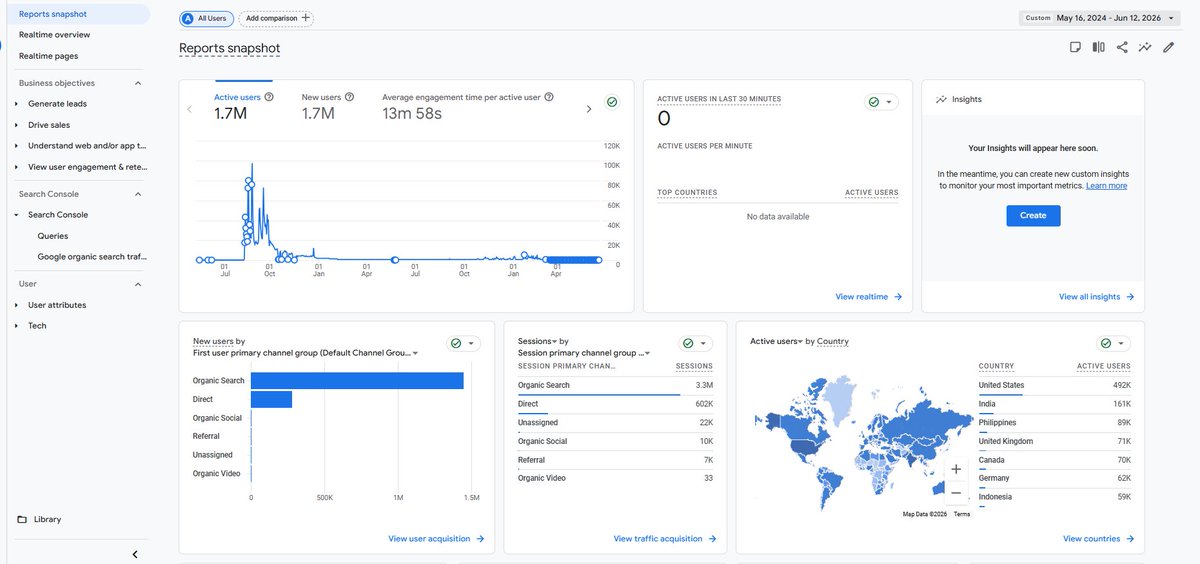

1
1
2
177

May 11
WP Weekly 291 with more #WordPress stories: @OritSiMu @wbcomdesigns @udoroessien @themify @FormGent @wpmetcom @checkviewsaas
thewpweekly.com/issue-291/
2
3
229

Themify Updater just got a major performance update. The latest version reduces constant licence checks, lowers server processing, and includes a more detailed Status page for easier troubleshooting. We highly recommend updating it. themify.me/blog/themify-upda…
2
97

Apr 20
WP Weekly 288 issue is supported by: Draw Attention, WP Engine DE{CODE} 2026, FluentCart, Kinsta, 20i Hosting, Melapress, & Profilepress.
thewpweekly.com/issue-288/
@WPDrawAttention @wpengine @FluentCartWP @kinsta @hostedby20i @melapressHQ @profilepress
3
326
Apr 20
WP Weekly 288 with more #WordPress stories from: @wpbuilds @juanmaguitar @bph @JavierCasares @TheKafleG @patchstackapp @austinginder @TheCre8tiveDiva @Pressable @MyMainWP @builderius
thewpweekly.com/issue-288/
1
3
10
841
Apr 20
More #WordPress stories in WP Weekly 288 from: @themify @ajitbohra @KintsuAI @MattReinholz @RonaldHuereca @raemoreywrites @KatieKeithBarn2 @raquel__karina @Press__Conf @photomatt @jonoalderson @learnwithmattc @bgardner
thewpweekly.com/issue-288/
1
5
168
New in Themify Builder and Customizer: Style Variables. Reuse colours, fonts, and spacing site-wide, with responsive values for desktop, tablet, and mobile. Learn more in our latest post. themify.me/blog/new-feature-…
4
131
New in Themify Builder: Display Conditions for modules, sub-rows, and rows. Show or hide content based on pages, posts, products, date and time, user roles, custom fields, and more.
themify.me/blog/new-feature-…
1
3
130

Feb 2
Help shoppers find exactly what they’re looking for faster with powerful filter plugins for your WooCommerce store! 🛒✨
This expert roundup highlights the best WooCommerce filter plugins, so you can upgrade your shop’s navigation without touching code, and give your catalog that polished, big‑brand experience.
Here’s what you’ll discover inside:
🔍 Best WooCommerce filter & product search plugins like WPFilters by @SearchWP and Themify WooCommerce Product Filter with pros & cons
🧩 Add filters for attributes like size, color, category, price, tags, and more
🎨 Beautiful, customizable filter widgets and sidebars that match your theme
📱 Mobile-friendly filtering that works great on phones and tablets
🚀 Tips to reduce friction, improve user experience, and boost conversions
Make it easy for customers to find their perfect product in seconds!

1
4
255

If you work with WordPress and you haven't taken a look at @EtchWPOfficial yet, you really need to. For the first time since WordPress was originally forked from cafelog, it's actually easy to build websites using WordPress properly.
The keyword there being "properly".
In the past, if you wanted to build a website and make it truly maintainable, scalable with clean code output, you basically had to build the entire thing from scratch in VSCode.
Obviously that was a lot of work, and also made it quite difficult to build it in such a way that clients could easily update content.
If you didn't feel comfortable building out the entire theme from scratch, and if you weren't comfortable with React and creating custom blocks, your only option was to use some kind of garbage builder like Elementor, Divi, Gutenberg etc etc.
These tools make putting something together "easy" but they are a far cry from maintainable, scalable and I'm having a hard time even typing the words "clean code" in the same post as "elementor" or "divi" or "gutenberg".
What is Etch and why is it the better tool? I can answer that very succinctly.
Maintainability/scalability: Etch somehow manages to perfectly marry the concepts of having 100% access to your code and having a UI you can click on. This makes things like using variables, and creating components incredibly easy, making your website much easier to manage. It also only outputs the code you give it. No extra divs or containers, no weird default styling screwing everything up.
Etch also turns everything you do into Gutenberg blocks, which means your clients can update content using the built in gutenberg page editor. No more training clients on how to use Elementor or Divi.
There is a lot more that could be said about Etch, but those are the big things that make it stand out from Elementor, Divi, Oxygen, Bricks, Breakdance, Gutenberg, Themify, Beaver Builder, [insert WP builder here].
The rest is just icing on the cake (and trust me, there is a LOT of icing on this cake).
I tried to put my thoughts into video form, and unsurprisingly, I was pretty disappointed with it as after I published it I thought of like 5 more things I wish I had talked about, but if you're interested you can check out that video (link in the comments).

2
2
12
671

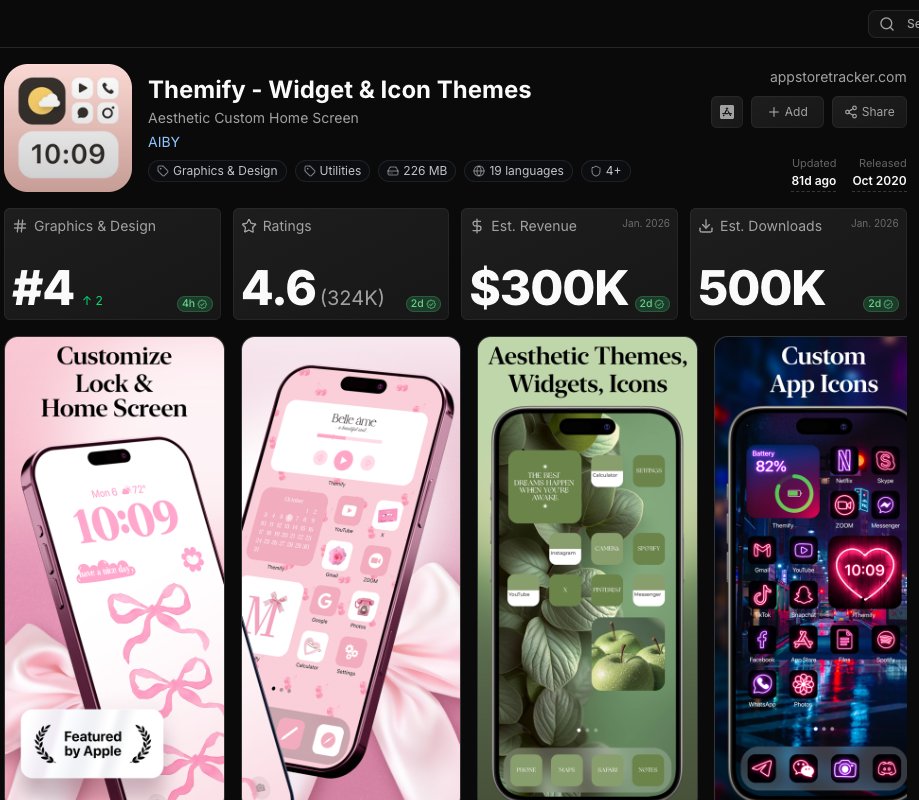
Themify - Widget & Icon Themes gained 2 positions and is now #4 in Graphics & Design on the App Store
appstoretracker.com/app/them… 🧵
1
2
191

Jan 21
the replies in here that are like “why are game devs trying to they themify game characters and turn everyone into liberal lesbians …. like chloe from life is strange….”
Jan 20

They made her chin wider I guess to accentuate that she’s 30 now even though that’s not how chins work. Really sloppy work
1
5
658


