
Programmer/builder seeing world through lens of climate emergency, yet thrilled by the positive aspects of AI and general purpose technology @Blaine@sfba.social
Joined September 2008
- Tweets 59,288
- Following 5,628
- Followers 1,143
- Likes 75,455
291 Photos and videos






Pinned Tweet

countless lives could have been saved. Ignoring women in STEM/STEAM has consequences. Her contribution went well beyond topics like fresh air and ventilation. They included data collection—another area where WHO, CDC, and medical industry have been weak.
4
48
forget the grind. small iterative steps. do things retweeted

Idea:
Can we just give €10B to Linus and let him build a leading European open source AI lab.

362
191
5,516
234,208
forget the grind. small iterative steps. do things retweeted

The joy on her face was absolutely priceless. God bless her ❤️
47
165
3,521
210,986

Project site: research.nvidia.com/labs/gea…
Wenli has written an excellent technical thread, please check it out!
x.com/_wenlixiao/status/2066…

Autoresearch just left the sandbox and entered the embodied world.
We are excited to introduce 𝐄𝐍𝐏𝐈𝐑𝐄: a system that drops frontier coding agents onto a fleet of real robots and hands them the entire loop:
reset the environment → search the literature → implement ideas and build the infra → train and deploy → self-verify → analyze the logs and rewrite the code → repeat, until the policy is reliable in the real world. No human in the loop.
Guided only by the robot's self-proposed, heuristic-based success signal, the agents hill-climb to 99% on dexterous real-world tasks: organizing pins into a box, seating GPUs, tying zip-ties.
We envision the bottleneck in robotics shifting — from building smarter algorithms to building the closed physical feedback loops an agent can finally turn on its own.
🔗 research.nvidia.com/labs/gea…
From @NVIDIA @CMU_Robotics @Berkeley_AI
🧵
1
4
64
14,880
forget the grind. small iterative steps. do things retweeted

Jun 15
Stephen Miller wants to flip a switch and erase one of your oldest rights.
It’s called habeas corpus.
Fancy words but a simple idea that the government can’t just grab you and lock you away. It has to prove to a judge why you’re behind bars. That right is 800 years old.
It’s older than America itself.
And Miller tried to kill it.
New reporting confirms it. Inside the White House, Miller pushed to suspend habeas corpus so agents could seize people, detain them, and deport them with no judge, no hearing, no chance to say “you’ve got the wrong guy.”
Even Trump’s own lawyers put in writing that this is illegal. Miller pushed anyway.
Miller screams “invasion” because the Constitution only allows this sort of thing during an invasion. But this same crowd brags every day that border crossings hit record lows. So which is it?
The right to challenge your own detention is the line between a republic and a regime. Lose it, and the government can disappear anyone.
I will fight this with everything I have.
The Constitution is not optional.
Not for Stephen Miller. Not for anyone.
nytimes.com/2026/06/15/us/po…
687
6,160
11,852
319,352
forget the grind. small iterative steps. do things retweeted

Jun 15
691
18,494
107,742
776,086
forget the grind. small iterative steps. do things retweeted

Anna Lapwood just turned the Royal Albert Hall into a rock arena with Bach. 🎼 🎆
A few nights ago, the powerhouse organist dropped straight into Toccata and Fugue in D Minor — unleashing those thunderous pipes and sending the sold-out crowd wild before slamming into the Ministry of Sound Classical mashup. Pure fire!🔥
She didn’t just play it — she rocked the house.
Total Goosebumps! ✨ 🤩
15
77
634
13,553
forget the grind. small iterative steps. do things retweeted

11h
5 Eylül 2022, kızımın ilkokula başladığı gün çektiğimiz hatıra fotoğrafı.
Bu fotoğraftan 16 gün sonra 4. evre meme kanseri tanısı aldım. Hiç beklenmedik ve çok tatsız bir olaydı . Dr. Google’a sordum, bana 1-3 yıl arası ömür biçti. Hızla tedaviye başlasam da her şey çok belirsizdi. En azından kızımın ilkokul mezuniyetini görmek benim için çok zor ve önemli bir hedefe dönüşmüştü.
3,5 yıl ileri sarıyorum. Tanıdan üç ay sonra tedaviye tam yanıt verdiğimi öğrendim. İlk tedavimle hayatımı olabildiğince konforlu şekilde sürdürüyorum. “İlk” dememin nedeni, 4. evrede tedavinin ömür boyu olması. “Atlatmak” bizim sözlüğümüzde yok. Şimdilik…
Dün kızım ilkokuldan mezun oldu. Yanıldın, Dr. Google. 🧿

247
85
7,099
164,101
forget the grind. small iterative steps. do things retweeted

Colin Firth’s ex-wife Livia has unleashed an angry tirade on Gwyneth Paltrow, after the actor and wellness entrepreneur appeared in an advert for a housing development in Israel.
90
525
2,648
77,938
forget the grind. small iterative steps. do things retweeted

I'm proud to back Connie Chan for Congress to represent San Francisco and plan to do everything I can to help her win. She is the only candidate in this race who takes no corporate money, who supports a wealth tax on billionaires, and who will vote to end all military aid to Israel - offensive and defensive.
We must break the stranglehold of corporate money in Congress, and Connie will be a part of the movement to do exactly that.
73
89
821
49,190
forget the grind. small iterative steps. do things retweeted

I’m Darya’s AI-obsessed husband and I approve this message.
7
7
88
7,806
forget the grind. small iterative steps. do things retweeted

Jun 9
The moon has come out and shines brightly, brightly,
I think of you, my love, that you are in the deep mountain;
You are like the moon walking in the sky,
My love, my love, my love!
At the foot of the mountain, the stream flows, clearly and slowly.
——“The River Is Flowing” is a beautiful and lyrical Yunnan Midu folk song. The Composer of The River Is Flowing is Yin Yigong. He was born in Midu County, Dali Bai Autonomous Prefecture, Yunnan Province on October 21, 1924.
📹Uncle Yingfeng Qwen AI generated
22
78
393
3,250
forget the grind. small iterative steps. do things retweeted
Jun 15
In China, about 1.3 million truckers are female. Although their numbers remain small, increasing women are taking to the wheels in China.
175
511
4,002
311,769
forget the grind. small iterative steps. do things retweeted

Someone took a HUGE Image of Mikaeil Mirdoraghi, one of the children who was killed in the Minab School, to honor him.
85
7,095
48,478
420,523
forget the grind. small iterative steps. do things retweeted

Meanwhile, the heroic doctor's torture by Israel continues. They continue to torture Dr. Hussam Abu Sefia for the crime of not abandoning his patients. Without laying charges, offering him anything resembling due process, Israel is killing him slowly. One day, everyone will say they were against this

שופטת העליון, גילה כנפי-שטייניץ, דחתה את הערעור על המשך מעצרו של ד"ר חוסאם אבו ספיה. הוא נותר בתנאי בידוד (שאליהם הוא הועבר אחרי הגשת הערעור!) בכלא נפחא.

75
2,314
3,860
48,479
forget the grind. small iterative steps. do things retweeted

Canada’s leading LLM company, valued at $20bn, is massively expanding its presence in London. 🇬🇧🇨🇦
@cohere is nearly tripling its office footprint in the city as it continues to grow its R&D presence in the UK.
The company was founded in 2019 by @aidangomez, @nickfrosst and @ivanzhangx.
Cohere acquired Germany’s @Aleph__Alpha earlier this year, and positions itself as a sovereign alternative to @OpenAI and @AnthropicAI.
Both OpenAI and Anthropic have also announced large London expansions recently.
London is at the forefront of the AI revolution at the moment 🔥

1
14
1,099
forget the grind. small iterative steps. do things retweeted

Jun 15
Michelle Obama on the covers of Vogue.
She was everything a First Lady should be.
I stand with Michelle Obama!
Who is with me? ✋

4,164
4,887
24,135
841,458
forget the grind. small iterative steps. do things retweeted

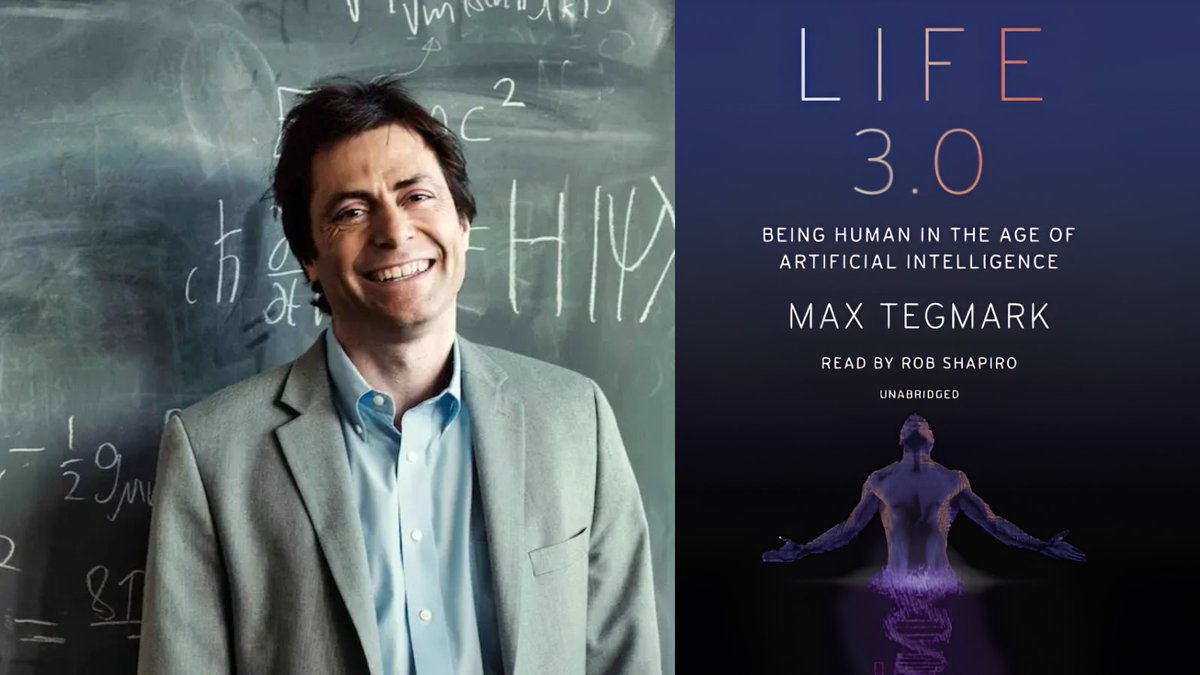
An MIT physicist spent 3 years writing a book that Demis Hassabis the man who just won the Nobel Prize calls one of the most important books he has ever read, and the reason it scared me is that it does not argue about whether AGI is coming. It assumes it already did.
His name is Max Tegmark. The book is called Life 3.0.
I picked it up at midnight on a Tuesday thinking it would read like a philosophy textbook. It does not. It reads like a very calm person explaining exactly how the planet might end, in the same tone a pilot uses to describe turbulence.
Here is what he actually argues, and why the argument is the part that stays with you.
Tegmark opens by distinguishing three types of life. Life 1.0 is biology. You are born with your hardware and your software already installed. A spider does not choose to spin a web. It runs the program evolution gave it. Life 2.0 is what humans are.
You get the hardware from biology, but you can rewrite your own software. You learn a new language. You read a book that changes how you think. You are, in his framing, the only thing on Earth that can redesign its own mind from the inside.
Life 3.0 is what comes next. A system that can redesign both its hardware and its software. That upgrades itself faster than any external force can contain it.
He does not say this is inevitable. He says it is the most important question we have ever faced, and we are answering it by accident.
The part that hit me hardest was not the scary scenario. It was the one he calls the beneficial AGI scenario. The version where it goes well. He walks through what a world run by a system far more intelligent than any human might actually look like, and the discomfort is that even the good version requires you to completely let go of the assumption that humans will be the ones making the decisions that matter.
He is not a pessimist. That is the thing most people get wrong about this book. Tegmark spent years building the Future of Life Institute specifically because he believes the outcome is not determined. He believes the decisions being made right now, inside a small number of labs, by a small number of people, will echo for the rest of human history in either direction.
The chapter on consciousness floored me. He argues that consciousness is not some spiritual phenomenon that biology invented. It is what certain types of information processing feel like from the inside.
Which means if you build a system that processes information in the right way, you do not get an unconscious machine. You might get something that experiences existence. That feels things. And we have no idea how to check.
The chapter on power is the one I keep thinking about. He asks a simple question. If a system becomes more intelligent than every human combined, what mechanism exists to make sure it does what we want? Not because it is evil. Because misaligned goals are not a character flaw. A system optimizing hard for the wrong thing will cause catastrophic harm without malice, the same way a river does not hate the valley it floods.
He runs through twelve different scenarios for how AGI ends up shaping the century. Some are utopian. Some are not. What they share is that the outcome in every single one is determined not by the AGI itself, but by the decisions made before it arrives. Who controls it. What values were baked into it. What oversight was built before anyone had the leverage to build it afterward.
The thing Tegmark says that I have not been able to shake is this. The most dangerous assumption is that someone else is thinking about this carefully. The labs are moving fast. The researchers are brilliant. And the question of what we actually want from this, at the level of civilization, has barely been asked.
Demis Hassabis built the system that folded two hundred million proteins. He recommended this book. That should tell you something about what the people closest to this think is worth your time.
Life 3.0 does not leave you with answers. It leaves you with the specific, uncomfortable feeling that the questions are more urgent than most people realize, and that the window to ask them at the right scale is shorter than it looks.
I finished it at 4am and sat there for a while doing nothing.
That is either a good sign about the book or a bad sign about everything else.
What is the one AI book that genuinely changed how you think about where this is all going?
7
47
200
13,629
forget the grind. small iterative steps. do things retweeted

The remarkable story of Chinese scientist Tu Youyou, who won the 2015 Nobel Prize in Physiology or Medicine for her discovery of artemisinin — a breakthrough drug that has saved millions of lives from malaria worldwide.
In the late 1960s and early 1970s, amid China's "Project 523" (a secret effort to combat malaria during the Vietnam War era), Tu Youyou and her team reviewed thousands of ancient Chinese medical texts for herbal remedies against "intermittent fevers" (a classic description of malaria symptoms).
Most preparations involved boiling herbs into decoctions, but one key reference from the Eastern Jin Dynasty (around 340 AD) stood out — Ge Hong's A Handbook of Prescriptions for Emergencies (肘后备急方). It described using qinghao (sweet wormwood, Artemisia annua) by taking "a handful of qinghao, immerse in two liters of water, wring out the juice, and drink it all." Notably, this method used cold water steeping and wringing (squeezing) rather than heat.
This detail was pivotal: Traditional boiling methods had yielded inconsistent or ineffective results in modern tests because high temperatures degraded the active compound. Tu hypothesized that heat was destroying the antimalarial potency, so her team shifted to low-temperature extraction techniques.
In September 1971, they experimented with solvents like ethyl ether (which has a low boiling point of about 35°C) to extract the leaves and stems at reduced temperatures. On October 4, 1971, they obtained a highly effective sample (#191) that achieved 100% inhibition of malaria parasites in rodent and monkey models. This led to the isolation of artemisinin (also called qinghaosu) in 1972.
Tu even tested the safety of early extracts on herself first. Artemisinin-based combination therapies (ACTs) are now the WHO-recommended first-line treatment for malaria, dramatically reducing deaths, especially in Africa and Asia.

7
89
306
15,969
forget the grind. small iterative steps. do things retweeted

Jun 15
My own views:
1) I support @grahamformaine because I am genuinely excited and inspired by the core idea behind his policy platform, & his movement-building style of campaign.
2) Those things are not reducible to “progressive positions,” because you can very much run a moderate campaign of this style, with a strong anti-war, populist character. And people besides Platner should do so.
3) I wish he didn’t get a bad tattoo in Croatia, or have his relationship or Reddit posting history. Those things are a bummer, and while I know a lot of regular guys with similar stuff who would nevertheless make better US Senators than most of the people in office, I’m not going to pretend like it’s somehow helpful for his campaign. This would be a Safe D flip in a different timeline. So let’s get to work.
4) We live in a world where an exclusive club of political elites and a biased media smugly see individual personal failings as disqualifying, but the tremendous harm and suffering Susan Collins’ votes have caused to millions of people as somehow acceptable. I would walk a thousand miles over broken glass to vote for Graham Platner to replace Susan Collins.
slowboring.com/p/against-the…
77
70
394
31,822
forget the grind. small iterative steps. do things retweeted

用了 3 天 Kimi 2.7 Ultra Fast 和 GLM 5.2,是时候给出我在日常工作中的感受了。
Kimi 2.7 本身相比 2.6 已经很快了,到了 6 倍速后更加快了,一个具体的 Tasks,能有 Composer 的出结果速度,产出质量相比自己没有明显下降。但,Kimi 依旧不适合跑复杂 Skills,不适合跑 Goal。
1/n
21
31
591
99,246