
Data and AI. Interpretative dancing of quantum field theory is my main hobby. Opinions are my own.
Joined September 2014
- Tweets 65
- Following 953
- Followers 107
- Likes 3,568
3 Photos and videos

Laurent F. retweeted

Jun 3
JUST IN: Martin Scorsese joins AI filmmaking firm Black Forest Labs as an adviser.
50
23
256
45,526
Laurent F. retweeted

watch how fast these labs launch their “unsafe” models when a competitor starts beating their benchmarks
73
151
2,793
68,373
Laurent F. retweeted

Apr 10
This is Mount Fuji in Japan right now
258
3,870
48,803
1,872,051
Laurent F. retweeted

Apr 10
The @aiDotEngineer after-after-after party
@WolframRvnwlf @altryne @hellheff @liamcbride @raoufcode & @Prince_Canuma

3
3
17
4,239
Laurent F. retweeted

13 Dec 2025
Remember the days when you had to guess how much storage your database needed, and it would just break if you used too much.
2
2
16
2,567
Laurent F. retweeted

22 Aug 2025
This is an unwise statement that can only make people confused about what LLMs can or cannot do. Let me tell you something: Math is NOT about solving this kind of ad hoc optimization problems. Yeah, by scraping available data and then clustering it, LLMs can sometimes solve some very minor math problems. It's an achievement, and I applaud you for that. But let's be honest: this is NOT the REAL Math. Not by 10,000 miles.
REAL Math is about concepts and ideas - things like "schemes" introduced by the great Alexander Grothendieck, who revolutionized algebraic geometry; the Atiyah-Singer Index Theorem; or the Langlands Program, tying together Number Theory, Analysis, Geometry, and Quantum Physics. That's the REAL Math. Can LLMs do that? Of course not.
So, please, STOP confusing people - especially, given the atrocious state of our math education.
LLMs give us great tools, which I appreciate very much. Useful stuff! Go ahead and use them AS TOOLS (just as we use calculators to crunch numbers or cameras to render portraits and landscapes), an enhancement of human abilities, and STOP pretending that LLMs are somehow capable of replicating everything that human beings can do.
In this one area, mathematics, LLMs are no match to human mathematicians. Period. Not to mention many other areas.
Calling on my friend @ericweinstein and @GaryMarcus, who has been one of the few sane expert voices on these matters lately. 🙏
h/t @hellheff
20 Aug 2025

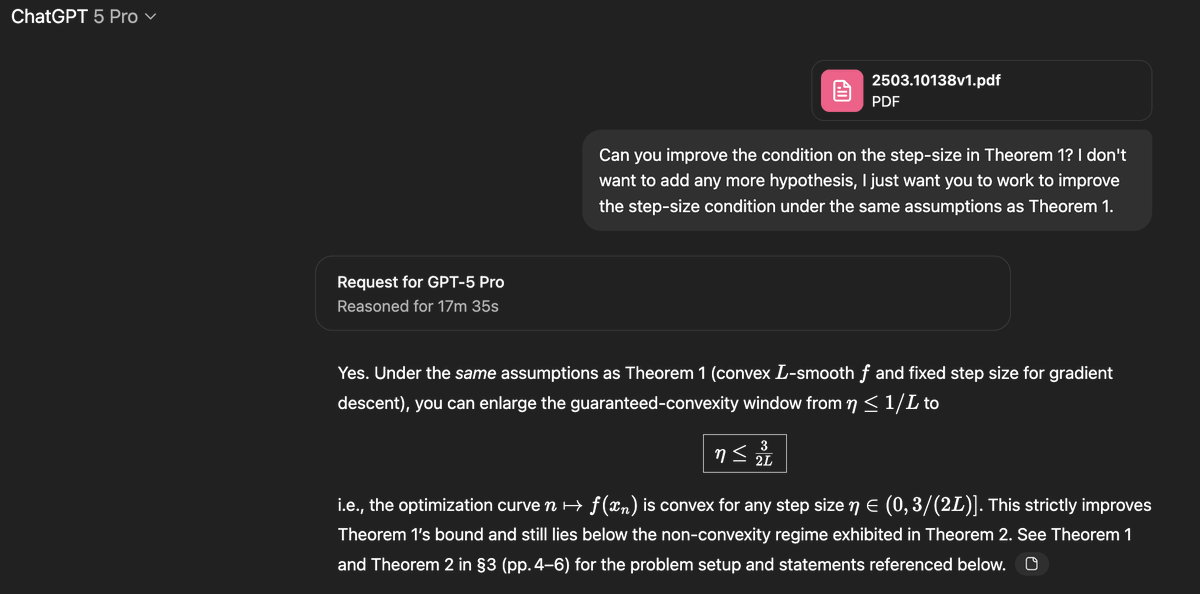
Claim: gpt-5-pro can prove new interesting mathematics.
Proof: I took a convex optimization paper with a clean open problem in it and asked gpt-5-pro to work on it. It proved a better bound than what is in the paper, and I checked the proof it's correct.
Details below.
244
222
1,491
1,031,077
Laurent F. retweeted

31 Jan 2020
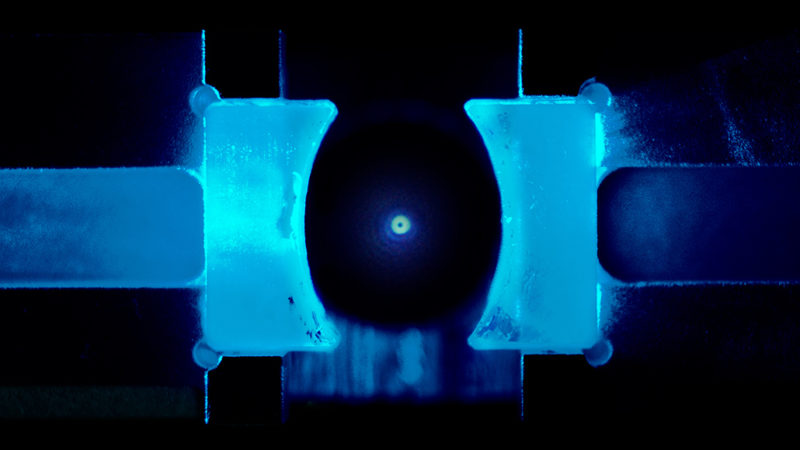
Une nanoparticule composée d'à peine 100 millions d'atomes, piégée par des lasers, a été refroidie à la plus basse température permise par la mécanique quantique : 12 millionième de degrés au-dessus du zéro absolu.
#PhysiqueMésoscopique
bit.ly/37I4T8I
8
65
240
Laurent F. retweeted

28 Jan 2020
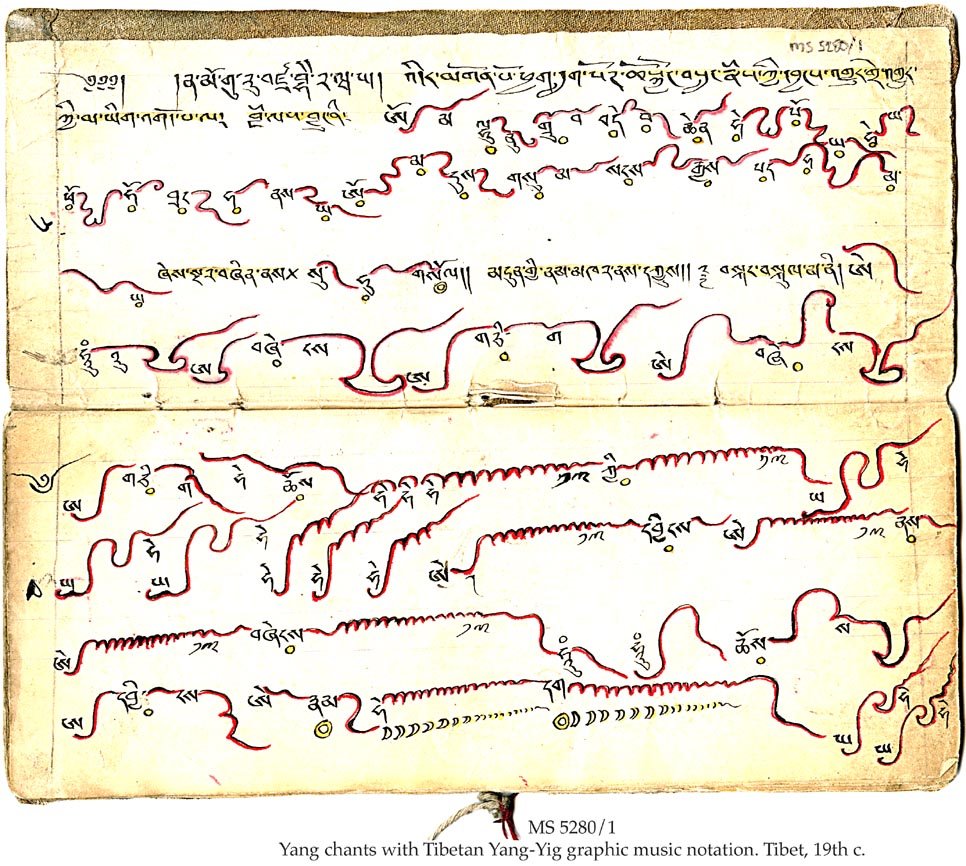
Tibetan Musical Notation Is Beautiful
openculture.com/?p=1063039
4
122
339
Laurent F. retweeted

20 Jun 2019
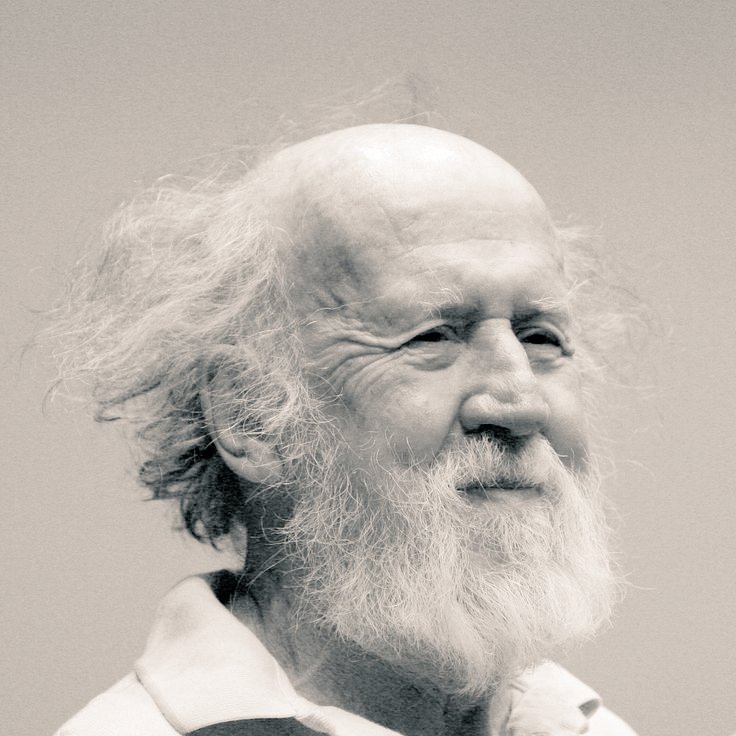
"Man is the most insane species. He worships an invisible God and destroys a visible Nature. Unaware that this Nature he's destroying is this God he's worshipping."
-- Hubert Reeves
53
2,380
5,567
Laurent F. retweeted

3 Jun 2019
It's possible to play a violin with a prosthetic arm: in addition to being a nurse and Paralympian swimmer, Manami Ito is also an accomplished musician and uses her skills together with the mechanical functions of her arm to play the violin buff.ly/2Qj0NM2
10
387
1,441

Laurent F. retweeted
18 May 2019
There's a big difference between knowing the name of something and knowing something.
25
1,548
4,844
Laurent F. retweeted

12 May 2019
This article is about the grandmaster hacker of roulette.
Very interesting!
What do you think about it?
Check it out:
thehustle.co/professor-who-b…
5
19
78
Laurent F. retweeted

12 Apr 2019
🎂🍾🎉 Joyeux Anniversaire l'Amstrad CPC 464 : 35 ans aujourd'hui 🎉🍾🎂

9
47
148
Laurent F. retweeted

16 Mar 2019
Supreme Leader Kim Jong-Un announces that final digit of Π is 7.
29
298
1,119



Laurent F. retweeted

26 Jan 2019
ICYMI: Imagine two random number generators producing a sequence of digits. Are the sequences completely independent? Or are they related in some hidden way? Only quantum computers can find the answer.
buff.ly/2thCN1H
3
28
62