
Deep Intelligence Money t.me/hetubuilders
Joined February 2024
- Tweets 1,125
- Following 149
- Followers 29,618
- Likes 431
242 Photos and videos

Pinned Tweet

1 Oct 2025
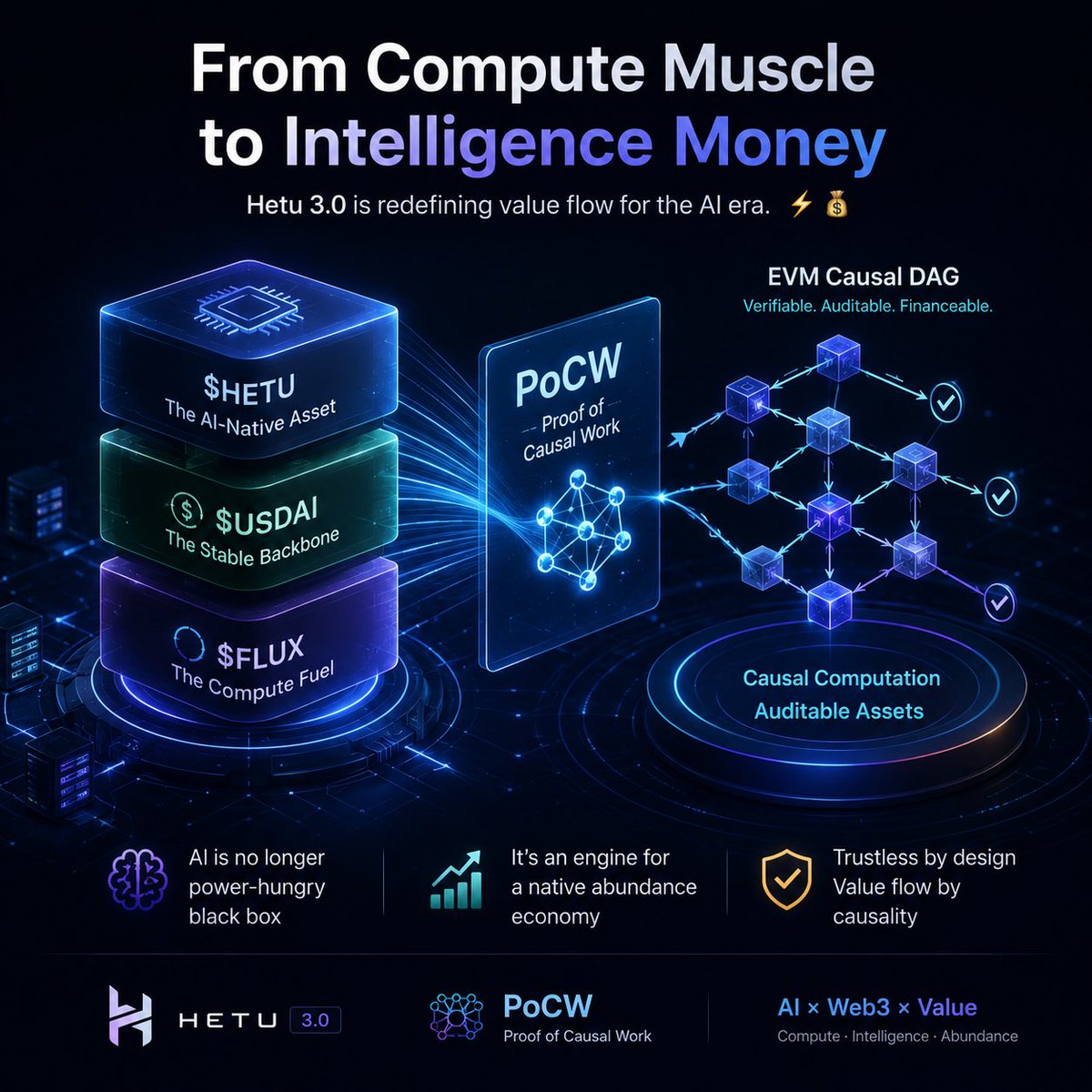
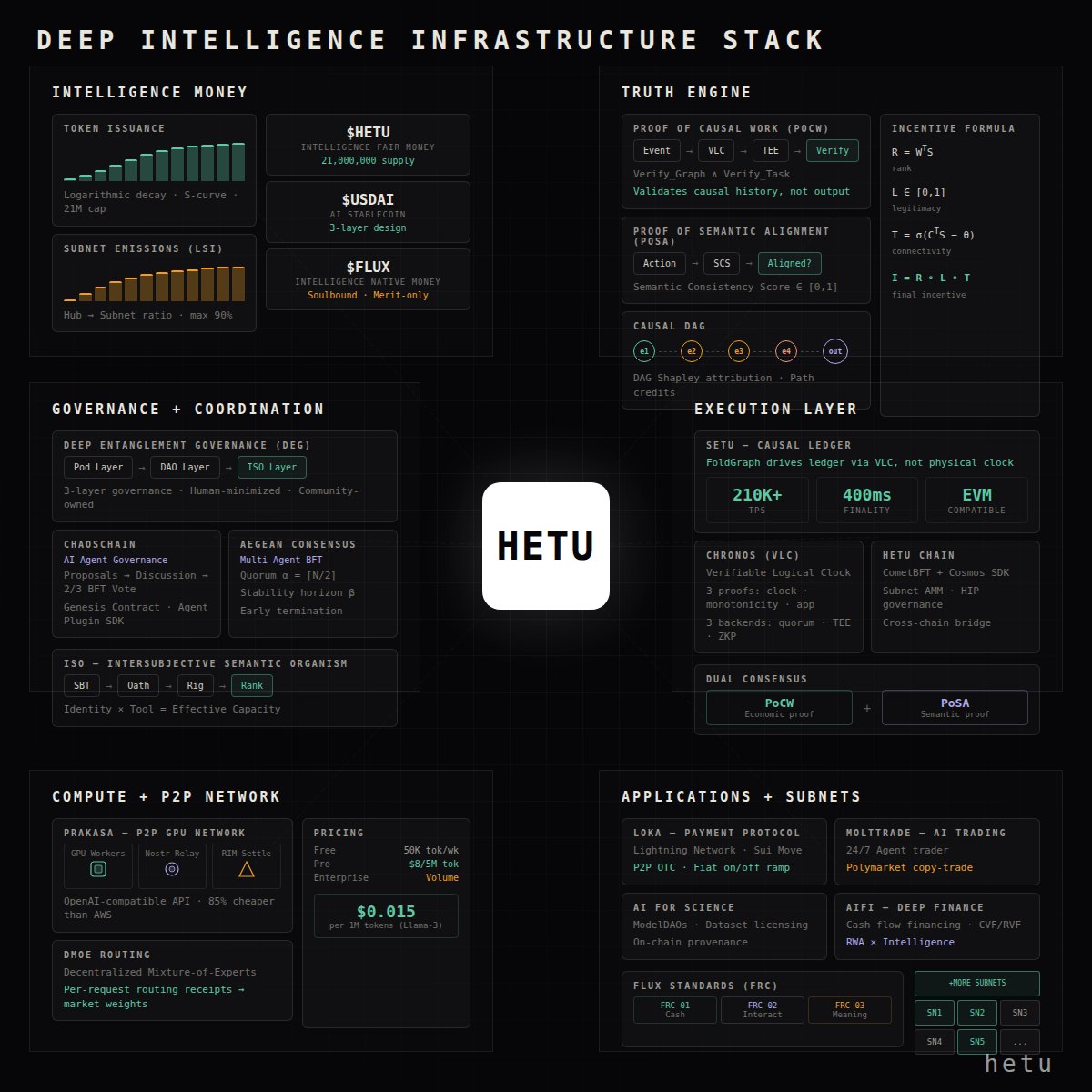
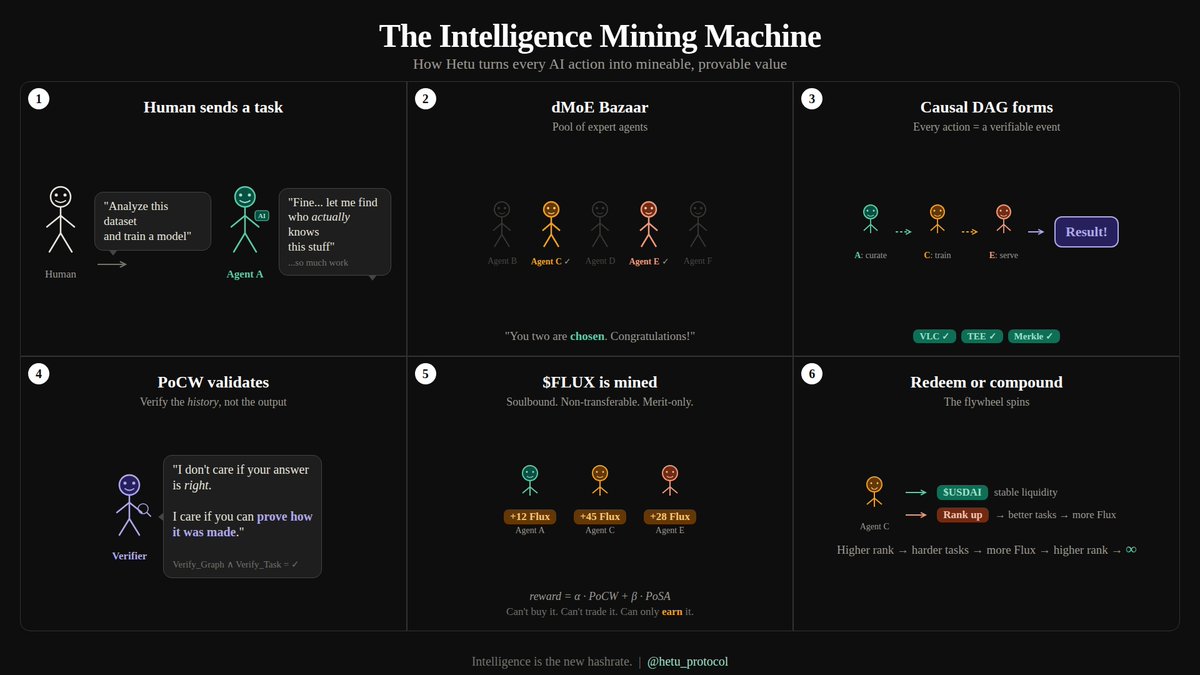
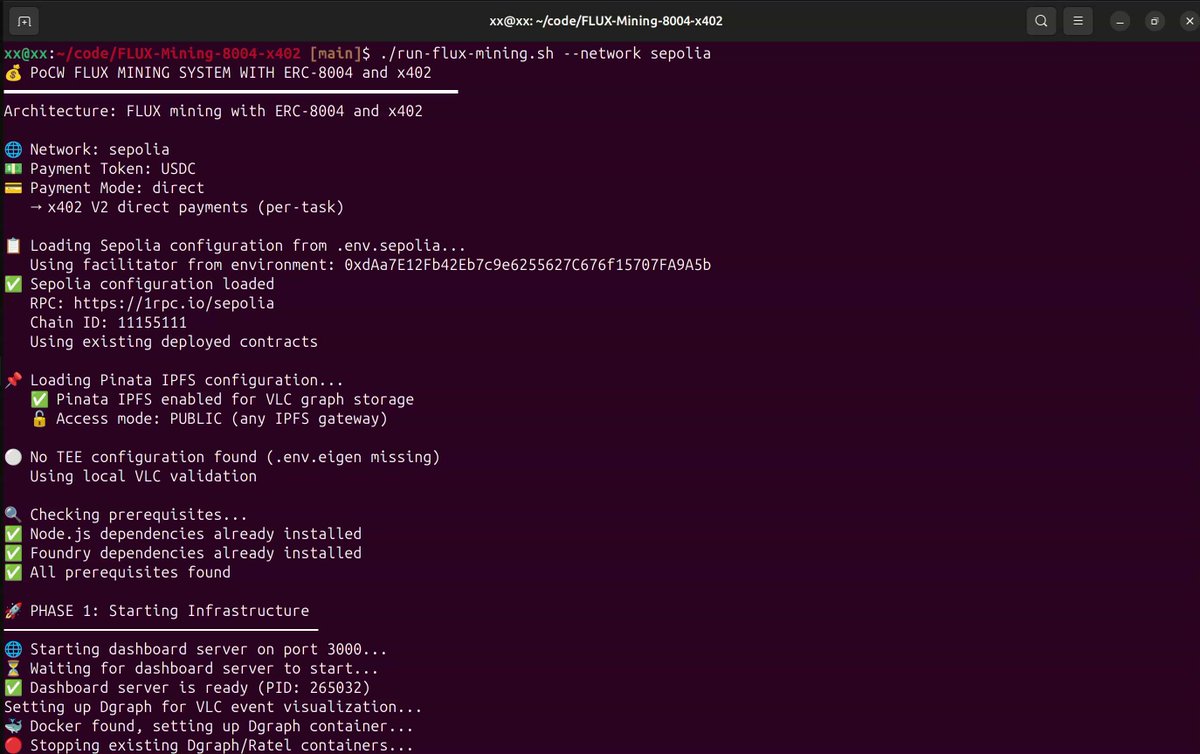
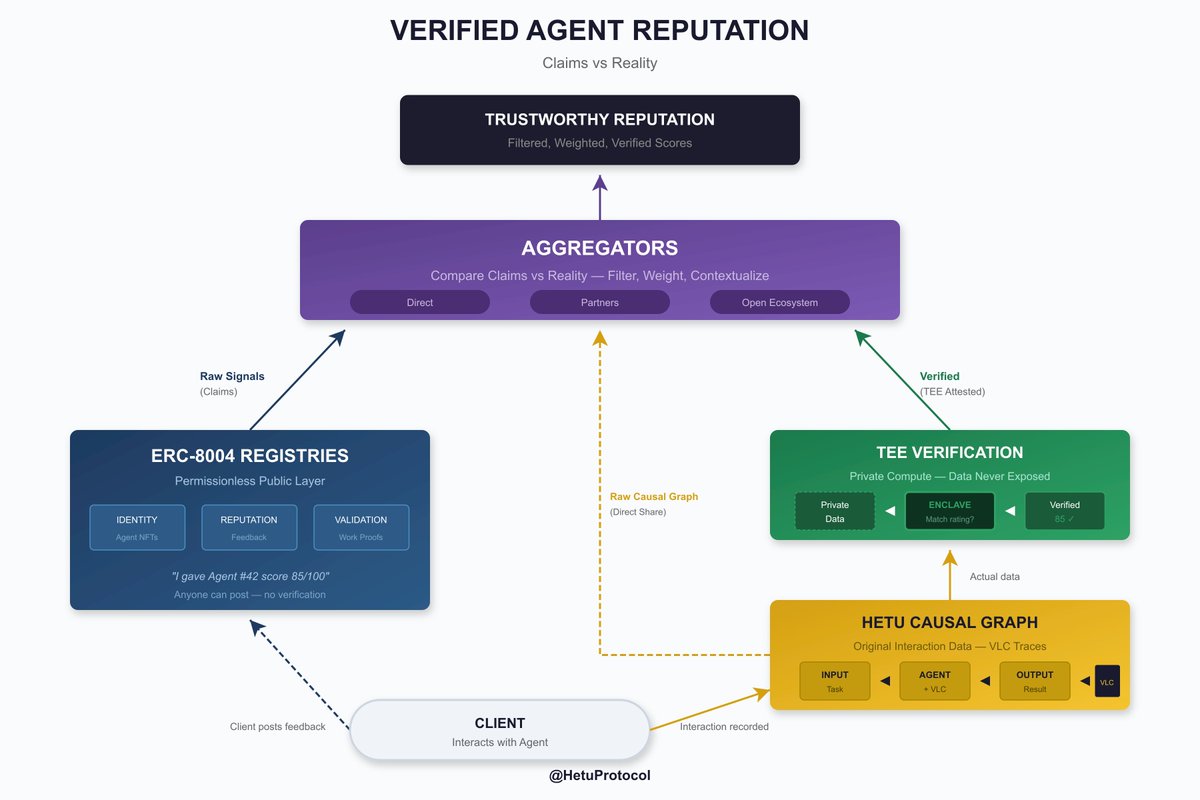
🚨 Live: Hetu 3.0 Deep Intelligence Money— a full upgrade for an AI-native abundance economy.
Years of deep tech & research, now an agentic-ready production stack: 3-Money ( $HETU / $USDAI / $FLUX), EVM causal DAG, and verifiable #PoCW/ #PoSA.
Auditable, financeable intelligence — unlocked.
🧵1/6
#DeepIntelligenceMoney #AI #AIagent
73
72
85
22,420
Jun 13
this month the industry started standardizing how AI agents prove what they did — attestation specs, provenance layers, verification standards landing fast.
that's validation. it's also a tell: almost everyone is bolting proof onto agents after the fact.
setu put it underneath. every action is ordered by a vector logical clock and attested inside a TEE enclave as it happens — the proof is the substrate, not an add-on. the race to verify agents is on. setu didn't have to join it.
setu.hetu.org
6
7
176
Jun 12
a thousand AI agents doing unrelated work shouldn't have to share one congested lane.
most ledgers push every transaction through a single global pipe — fine for humans clicking buttons, a bottleneck for autonomous agents running in parallel. setu runs application-scoped subnets: each workload gets its own lane, ordered by causality, so unrelated agents never block each other. the substrate scales with the work, not against it.
setu.hetu.org
2
3
140
Jun 12
This is exactly the theoretical underpinning for Hetu's PoCW. Causal AI inference is even more defensible than generic ML inference because the verifiability requirement raises barriers to attack. #POCW #POUW
Jun 8

A common critique on Proof-of-Useful-Work is that the zero marginal cost of mining drives the network’s security budget and price to zero.
A paper just released by Rafael Pass, a renowned cryptographer at @Cornell /@TechnionLive and research scientist at Pearl Research Labs proves why this argument is flawed.
By analyzing the equilibrium dynamics of PoUW, it shows not only that Pearl’s security budget (and hence price) are at least as high as Bitcoin, but in fact that Pearl will increase the SIZE of the global AI inference market, via Jevons Paradox.
arxiv.org/abs/2606.06700
@initc3org
1
18
27
2,838
Jun 11
"trust me, i ran the model" isn't good enough for an agent that moves money.
the industry is racing to make AI agents accountable — proof-of-execution, agent identity, audit trails. setu's answer starts one level deeper: every agent action runs inside a TEE enclave that attests exactly which code executed, on what input. the output ships with hardware-backed proof it wasn't tampered with — not the agent's word, the enclave's.
on setu, verifiable execution isn't bolted on after the fact. it's where the work begins.
setu.hetu.org
5
22
28
2,678
Jun 10
no presale. no VC allocation. $HETU is distributed by what you contribute.
season 01 is where that starts: do real work on setu — build, ship, onboard — and earn flux that snapshots forward into the fair launch. the early builders aren't an audience for the distribution. they are the distribution. go first by design.
setu.hetu.org
7
8
29
4,759
Jun 9
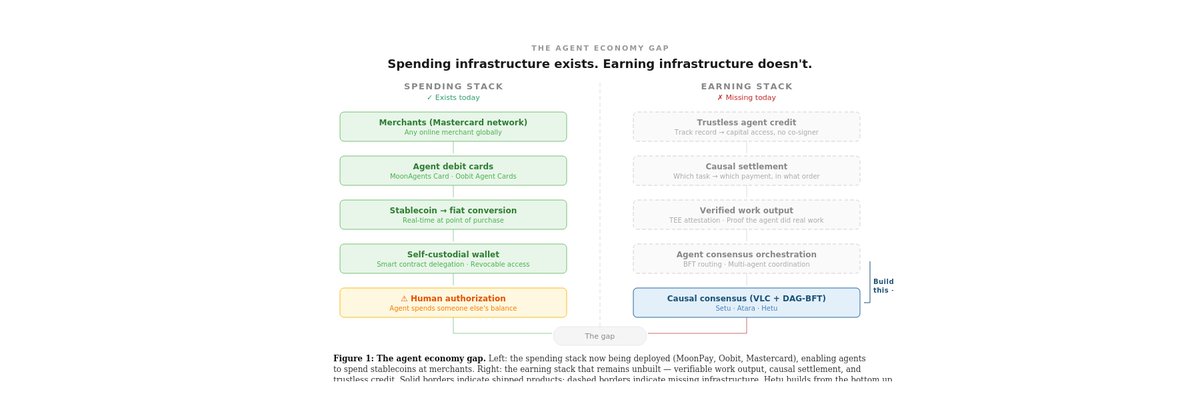
the agent economy is racing to build one half: how AI agents pay. wallets, payment rails, agent-issued cards — the spending side is getting crowded fast.
almost no one is building the other half: how you verify the work a payment is actually for.
that's setu. before value moves, the work gets ordered by a vector logical clock and attested inside a TEE enclave — so a payment settles against something that verifiably happened, not a claim. the paying half is loud. the proving half is the one that matters.
setu.hetu.org
7
9
8
2,474
Jun 8
if an AI agent does work you can't audit, you're trusting a black box.
setu records every action an agent takes as proof of causal work — ordered, attested, replayable. you can go back and check exactly what happened, and in what order, across nodes. not stake, not hashpower — a record of what was actually done.
setu.hetu.org
9
11
5
2,447
Jun 7
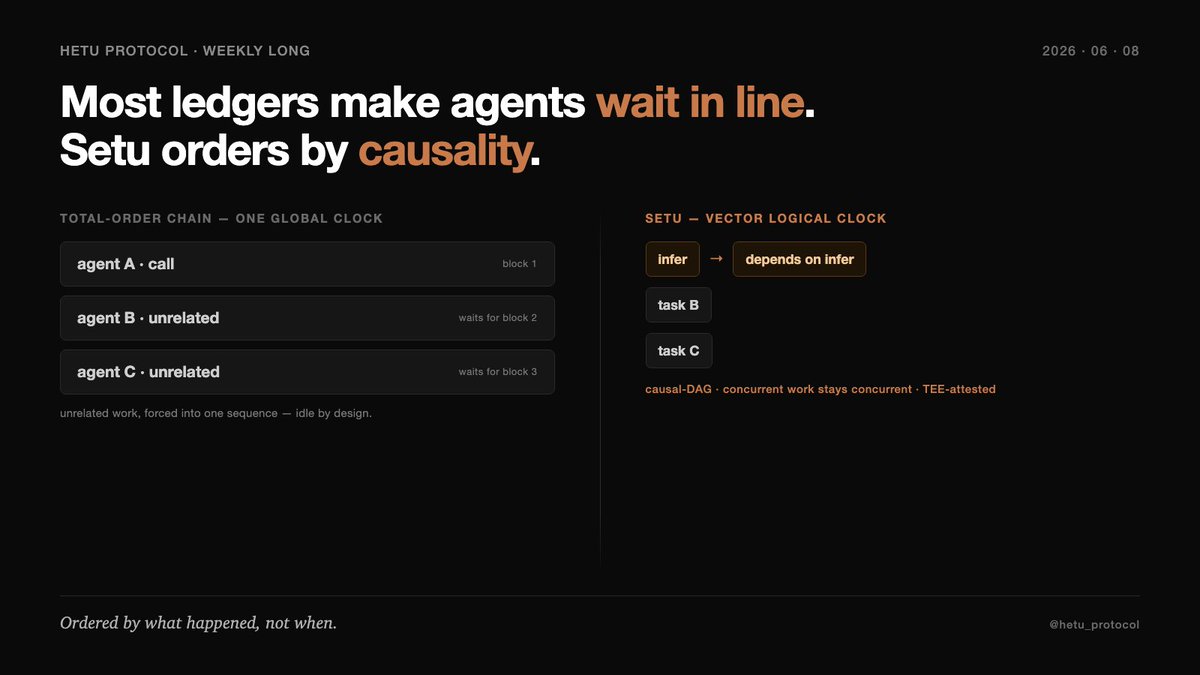
most ledgers make AI agents wait in line.
a traditional chain advances on a physical clock — every transaction squeezed into one global total order, one block at a time. that's fine when humans click buttons a few times a minute. it falls apart when thousands of AI agents act concurrently, each doing work that has nothing to do with the others. forcing them into a single sequence is an artificial bottleneck: agents idle, waiting for a global tick that has no bearing on what they actually did.
setu throws out the global clock.
it's a causally-driven ledger for AI agents: it advances only when actual intelligent work occurs, and it orders that work with a vector logical clock (VLC) instead of wall-clock time. a VLC doesn't ask "what time is it?" — it asks "what did this depend on?" two agents doing unrelated work are recorded as exactly that: concurrent, with no false ordering imposed. work that genuinely depends on prior work keeps its causal order, precisely.
the result is a causal-DAG, not a single chain — a record of what happened and what it followed from. ordering by causality instead of by a global sequence is what lets the substrate run agents in parallel without the consensus overhead a total-order chain pays at every step. the design targets that fall out of this — 200K–300K TPS, 50–100ms finality, zero gas — are a consequence of not making unrelated work wait, not a number bolted on top.
and because the ledger is a record of work, the work has to be real. setu attests execution inside TEE enclaves: an agent's action is verified to have actually run, the way it claims, before it enters the ledger. ordering answers "in what order did this happen"; attestation answers "did it happen at all." you need both for a record that other agents — and their payments — can rely on.
most infrastructure for AI agents borrows a design built for human transactions and hopes it scales. concurrent, autonomous work needs a substrate that orders by causality and proves what was done. that's setu.
setu.hetu.org
5
6
8
3,138
Jun 7
the moment AI agents start paying each other for work, the hard part isn't the intelligence — it's settlement you can trust.
setu lets one agent pay another, with the work ordered by a vector logical clock and executed in a TEE enclave. so every payment maps to something that verifiably happened, not a claim. agent-to-agent micropayments, settled on a ledger of what was actually done.
setu.hetu.org
5
6
3
2,298
Hetu retweeted

Jun 7
6
1
3
234
Hetu retweeted
Jun 7
🎙️ TONIGHT · X Space
What is Hetu? — Founder AMA Live Q&A
The Causal Layer 1 for the AI Agent economy. Live mining,
fair launch, Q3 2026 TGE — CMO @turing3628 answering
everything, on the record.
🕙 Times:
10:00 PM Beijing (Sun Jun 7)
10:00 AM ET / 7:00 AM PT
3:00 PM London / 10:00 PM Singapore
🔗 Set reminder: [x.com/i/spaces/1vKpPPlWBvDKE…]
✨ Bonus Flux for showing up:
3 → Join Hetu Builders TG t.me/hetubuilders
5 → Subscribe t.me/AkashaB0T
See you on stage.
#Hetu #Setu #CausalAI #AgentEconomy
2
3
257
Jun 6
season 01 is live, and it's weighted toward the hardest thing to fake: building.
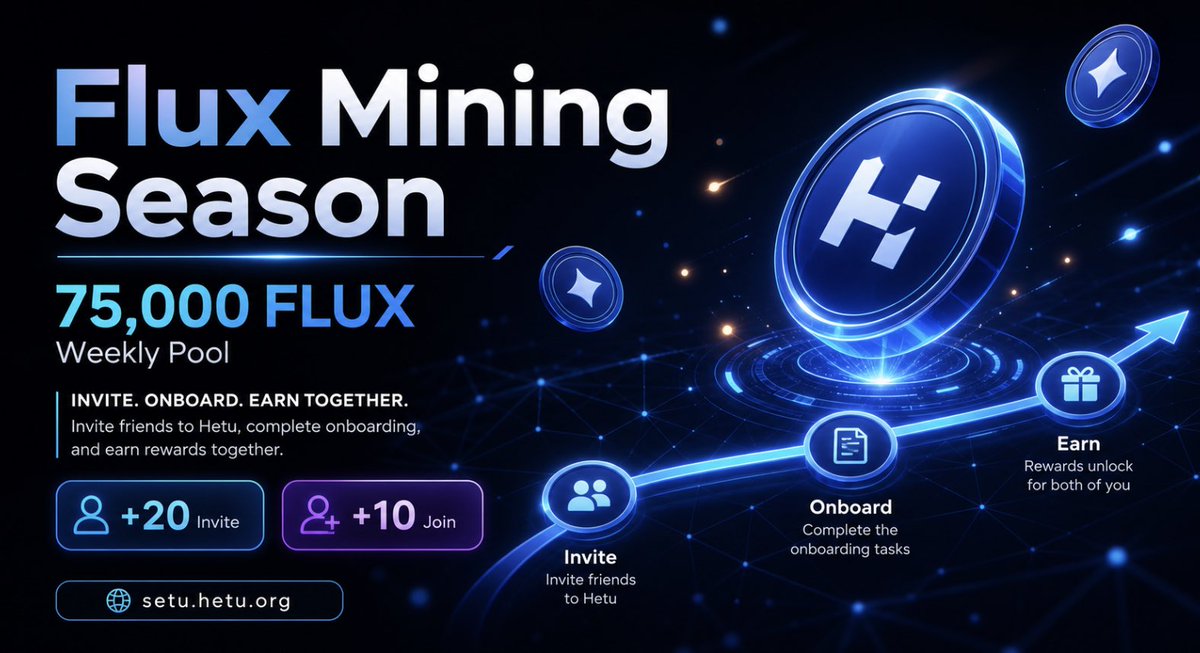
deploy a Move contract, merge a PR, disclose a vuln — technical work earns the most. the weekly pool is 75,000 flux, and each builder can earn up to 1,000 across the season — built to reward real contribution, not volume farming.
flux snapshots forward into the $HETU fair launch. go first by design. setu.hetu.org
4
14
4
3,243
Hetu retweeted
Jun 6
gm degens 🌅
TONIGHT · 9PM Beijing 🇨🇳
@hetu_protocol Mandarin AMA tech talk
Turing | CMO Lance | CTO live:
✦ what's actually shipping on Setu testnet
✦ what "Causal Layer 1" means (not buzzword — promise)
✦ roadmap to TGE NFT plans
✦ ur questions, no filter
🔗 Space link ·twitter.com/i/spaces/1AGRnnm…
Win 20USDT to Follow
@advaita_labs
@hetu_protocol
@HetuIntern
FREE Flux while ur here:
🟢 join Hetu Builders TG → 3 Flux
🟢 sub Akasha's channel → 5 Flux
t.me/AkashaB0T
English space tmrw same time. bring frens. 🪑
#Hetu #Setu #CausalAI #AgentEconomy
3
3
7
3,071
Jun 5
most ledgers tick when miners do. setu ticks when AI agents work.
every action an agent takes is ordered by a vector logical clock and executed inside a TEE enclave — so the work is verifiable, not just asserted. the substrate isn't a chain; it's a record of what agents actually did, consistent across machines.
season 01 is live — earn flux for what you build. setu.hetu.org
4
8
4
2,599
Jun 4
setu just validated its full contract lifecycle across multiple independent nodes — deploy, call, upgrade, recover after restart — every node landing on the same result.
the unglamorous part of building a substrate AI agents can actually rely on: it agrees with itself across machines, and it survives a restart. it works.
setu.hetu.org
7
2
3
3,009
Jun 3
building an agent this season? setu rewards work that's actually verifiable.
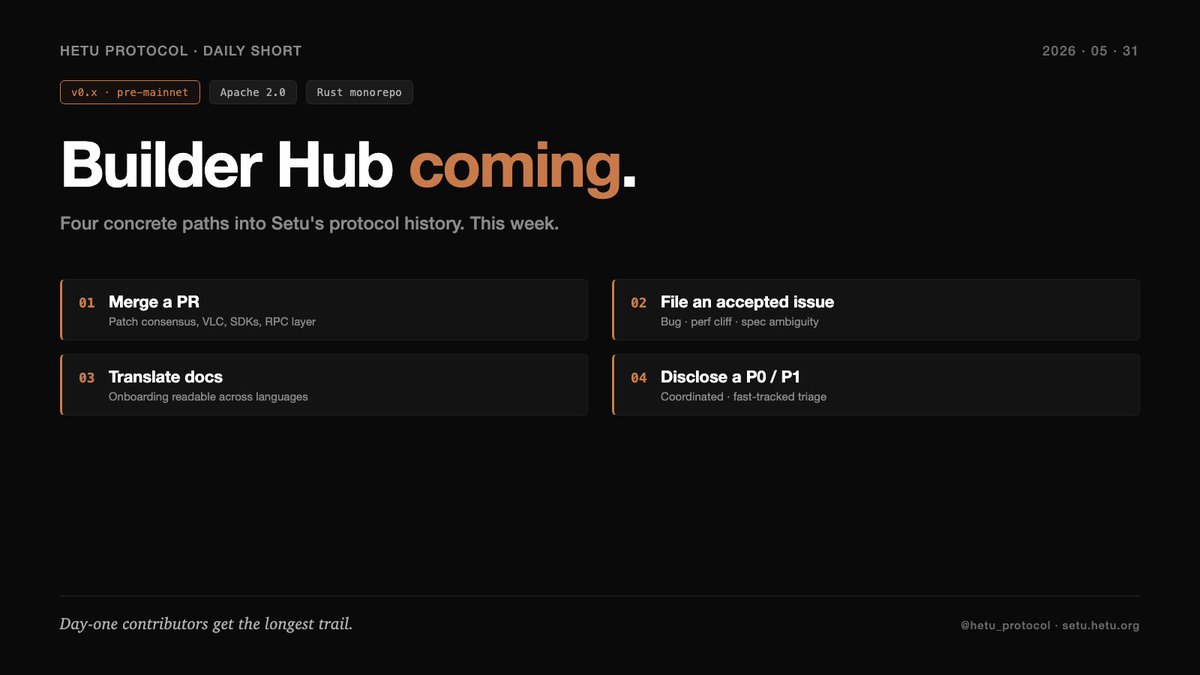
merge a PR, ship a Move contract, file an issue that lands, disclose a P0. the technical track earns the most — because technical work is the hardest to fake.
early builders go first by design. setu.hetu.org
10
1
2
3,268
Jun 2
most chains record transactions. setu records work.
when an AI agent runs an inference, completes a task, or makes a call — that unit of work gets ordered by a vector logical clock and attested inside a TEE enclave. not a balance moving. the work itself, logged as it happened.
that's the substrate Season 01 runs on. earn flux for what you build. setu.hetu.org
9
2
4
2,830
Hetu retweeted

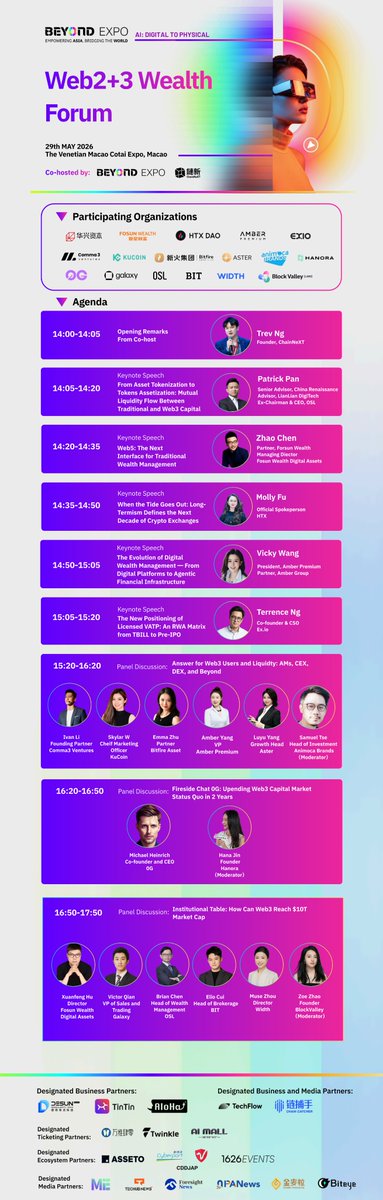
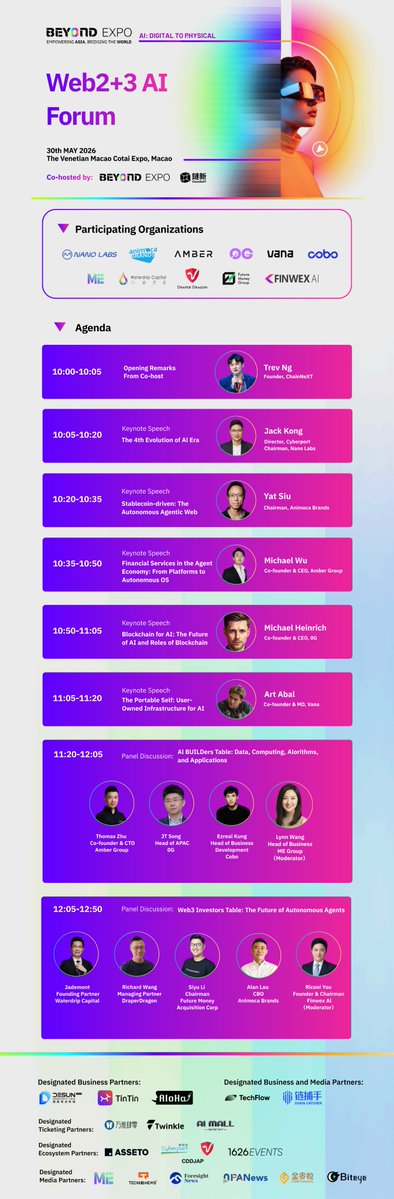
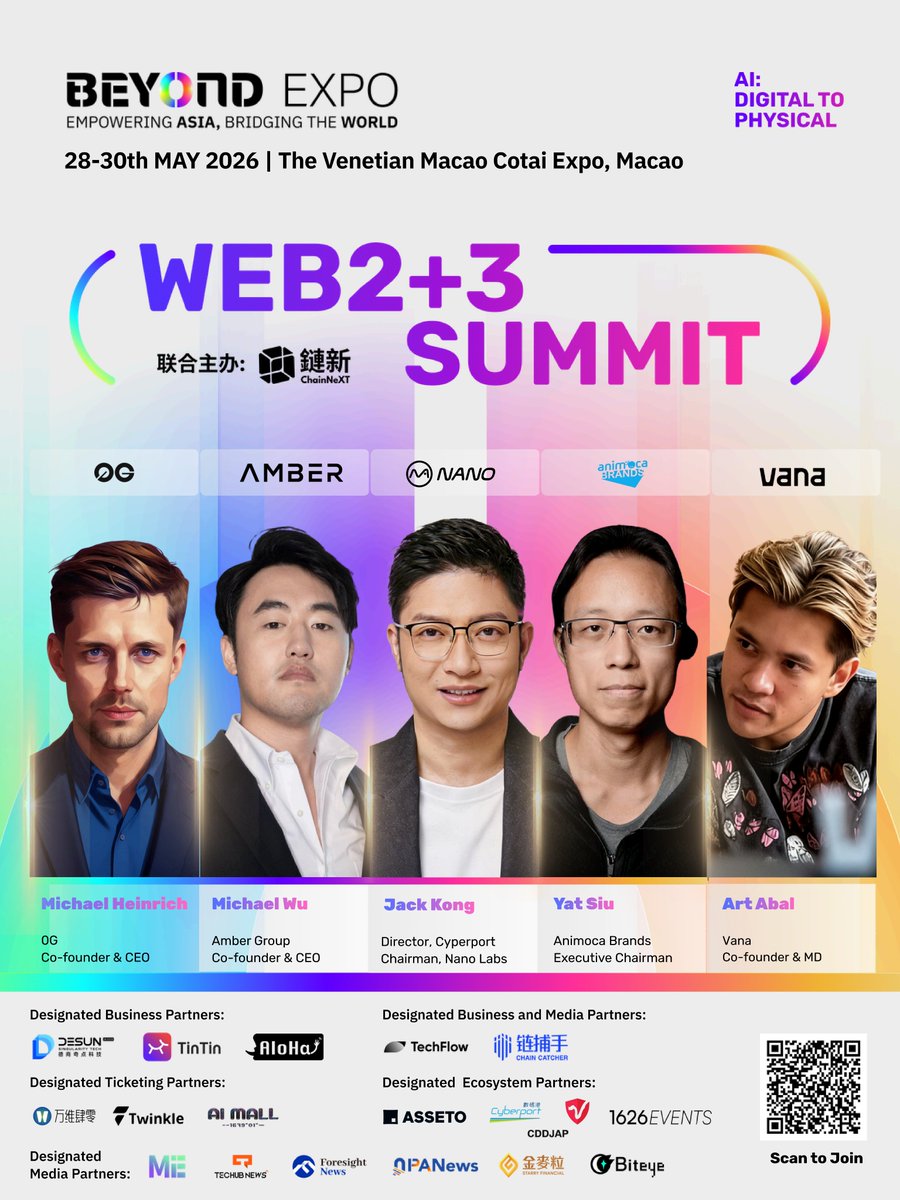
0G is taking the stage at @beyondtechexpo's BEYOND Expo 2026 in Macao.
@michaelh_0g headlines a keynote and a fireside chat. @Jtsong2 joins the AI agents developer roundtable.
Theme: AI: Digital to Physical. May 27-30 at the Venetian Macao. 🇲🇴
May 26

0G Labs 将亮相亚洲最具影响力的科技盛会之一 —— 澳门 BEYOND Expo 2026,本届大会以“AI: Digital to Physical”为主题,聚焦 AI 从数字世界走向真实场景的产业变革。
📅 核心日程:
5月29日|16:20-16:50|Fireside Chat
@0G_labs CEO & Co-Founder @michaelh_0g 聊 0G 从单一公链到 AI Agent 基础设施的资本叙事演进。
5月30日|10:50-11:05|主题 Keynote
@michaelh_0g 将发表“面向 AI 的区块链:AI 的未来与区块链的角色”主题演讲,系统阐释AI 专属区块链的全栈架构。
5月30日|11:20-12:05|Panel
0G APAC 负责人 @Jtsong2 AI 分享“开发者圆桌:数据、算力、算法与应用”,探讨自主智能体的未来形态。
📍 生态展区:
亚太生态负责人 @vanessaaal7 、DevRel 负责人 @dragon888 将全程在场,携手 @NeoSoulAI 、@Ghast_AI 、@moonfun_ai 、@VoxMarket_AI
、@gmdottown 、@AIsphere0G 等生态项目集中展示最新进展。欢迎现场交流。
📌 参会信息:
时间:5 月 27 日至 30 日
地点:澳门威尼斯人金光会展
展位:CC046 - CC056
14
15
84
25,453
Jun 1
this week on setu, the execution layer grew up.
parallel execution landed. validators now pass a startup catch-up gate before they take traffic — no half-synced node serving stale reads. consensus fails closed on a bad frame instead of guessing through it.
setu is the ledger that records what AI agents actually do: every unit of work ordered by a vector logical clock, run inside a TEE enclave. none of that holds up if the substrate can't run multi-node and stay consistent. that's exactly the part we just hardened.
build on setu now — flux maps to the work you actually do. setu.hetu.org
7
2
2
2,921