
Entrepreneurs led Deep Tech Pre-seed fund. We back ambitious founders aiming to build global startups: @gensynai @pathway_com
Joined February 2012
- Tweets 808
- Following 168
- Followers 1,226
- Likes 1,084
45 Photos and videos






Pinned Tweet

2 Oct 2025
The Long-Term View: Why Id4 Ventures Bets on Breakthroughs, Not Shiny Things.
So proud to see our longtime bets taking shape.
From the beginning, we chose Id4 Ventures to focus on fundamental technologies that will truly change our lives and economy, and not to chase the next shiny, transient trend.
Building Deep Tech is hard. Our job is to lighten that pain for our founders—to provide the moral and financial conviction to be there when others doubt. This is only possible thanks to the long-term trust and support of our incredible LPs. Nothing would be possible without you.
Our Thesis in Action: Six Years of Generational Shifts
Six years ago, we began investing with the conviction that AI would be a generational shift, requiring an entire technological infrastructure rebuild and entirely reshaping industries.
Today, we are seeing that deep thesis materialize with companies like:
@gensynai : Building the computational backbone for a decentralized AI future. (Series A led by @a16z , > 50M transactions in 5 months on the testnet)
@pathway_com : launching a new “post-transformer” architecture that paves the way for autonomous AI.. (arxiv.org/abs/2509.26507)
But our conviction goes beyond AI infrastructure, touching human impact and new frontiers:
Saving lives with @ThinkSono
Automating scientific R&D with @lumi_systems
Pioneering durable manufacturing with Tetmet (tetmet.net)
The Next Chapter: The Space Economy
For the past two years, we’ve begun writing a new chapter based on the same philosophy, backing foundational players in the emerging Space Economy:
@OrbitalParadigm : Seamless logistics from Space to Earth
Gama (gamaspace.com) The most effective way to deorbit.
...and more announcements to come.
To all our founders: We can’t appreciate enough the sacrifices and sheer grit you take on every day. You are the real stars. We will always strive to be worthy of your trust and partner with you to improve our world.
The real stars: @harrygrieve @benfielding @zuzanna_pathway @FouadAlNoor1 @silas_adekunle @TomVroemen
4
6
9
1,921
Id4 ventures retweeted

Exactly why I’m so bullish on @pathway_com.
🧠 Next-Gen AI
⚡️ Incredible performance
🔋 Ultra compute-efficient

Citadel Securities just put institutional weight behind what the AI bulls won't say out loud.
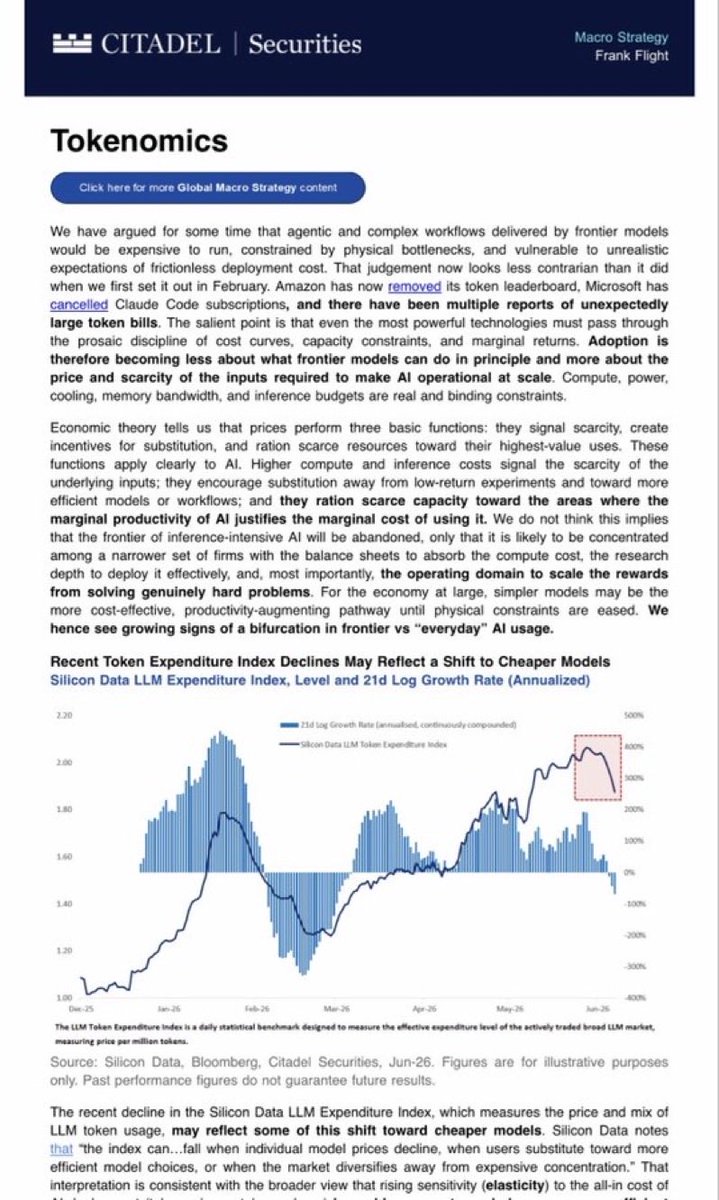
In a new macro note titled "Tokenomics," Citadel makes the argument plainly: even the most powerful technology on earth still has to pass through the boring discipline of cost curves, capacity limits, and marginal returns.
The evidence is piling up:
– Amazon removed its token usage leaderboard
– Microsoft cancelled Claude Code subscriptions
– Multiple companies reporting unexpectedly massive token bills
Their conclusion is the part that matters.
Adoption is no longer about what AI can do in principle. It's becoming about the price and scarcity of the inputs needed to run it at scale. Compute. Power. Cooling. Memory bandwidth. Inference budgets. All real, all binding constraints.
And here's the kicker from the chart.
The Silicon Data LLM Token Expenditure Index, a benchmark for how much the market is actually spending on AI tokens, has started rolling over. Citadel reads it as a shift toward cheaper models. Companies substituting away from expensive frontier AI toward "good enough" alternatives.
That's economics 101 doing what it always does. When the price of something rises, people use less of it, or find a cheaper version.
Citadel sees a bifurcation forming. Frontier AI concentrated among a few firms with the balance sheets to absorb the cost. Everyone else quietly downgrading to simpler, cheaper models.
This is the part of every technology revolution the early narrative ignores.
The technology being real was never the question.
The question was always whether the economics could carry the valuations.
When one of the most sophisticated trading firms on earth starts writing about AI in the language of cost curves and rationing instead of limitless demand, the conversation has quietly changed.
The hype was about what AI could do.
The reckoning is about what it costs.
3
5
188
Id4 ventures retweeted

Jun 5
This changes everything underneath. When agents outnumber humans, infrastructure faces a world it can’t predict with yesterday’s tools.
Observation tells you what already broke. At machine speed, that’s too late.
The only answer is prediction. That’s what we’re building at @PresageLabs_ai
2
2
5
3,228
Id4 ventures retweeted
Exactly why we back @PresageLabs_ai led by @benrey0302 . they are building the predictive infrastructure layer this transition requires.
x.com/id4vc/status/206260665…

SITUATION DETECTED: For the first time in internet history, agentic traffic has surpassed human traffic online, per Cloudflare Radar.
1
2
137
Id4 ventures retweeted

Jun 4
We just welcomed @id4vc ventures into our investor pool!
We're thrilled to build with @hervecuviliez, @IvanPetrovic and all the team.
Id4 started investing in AI 6 years ago, when only a handful of companies were talking about it. They saw early on what the AI revolution would demand: a full infrastructure rebuild, high-performance cloud, grounded in rigorous science and a strong entrepreneurial spirit.
Excited for what's coming
3
2
3
240
Id4 ventures retweeted

Jun 3
Paris-based startup SquareMind recently raised $18M to launch Swan, the world’s first robot designed to capture standardized, full-body dermoscopic skin imaging.
The funding round was led by Sonder Capital, founded by Fred Moll, the “father of surgical robotics” who built Intuitive Surgical’s da Vinci system in the 1990s.
Swan uses a robotic arm to scan a patient’s entire skin surface in minutes, paired with AI software that tracks new or changing moles across visits.
The tech addresses a critical bottleneck in dermatology, where months-long waitlists collide with the fact that 80% of melanomas are new lesions.
Commercial launch in the US and Europe is expected later this year.
15
47
326
42,622
Id4 ventures retweeted

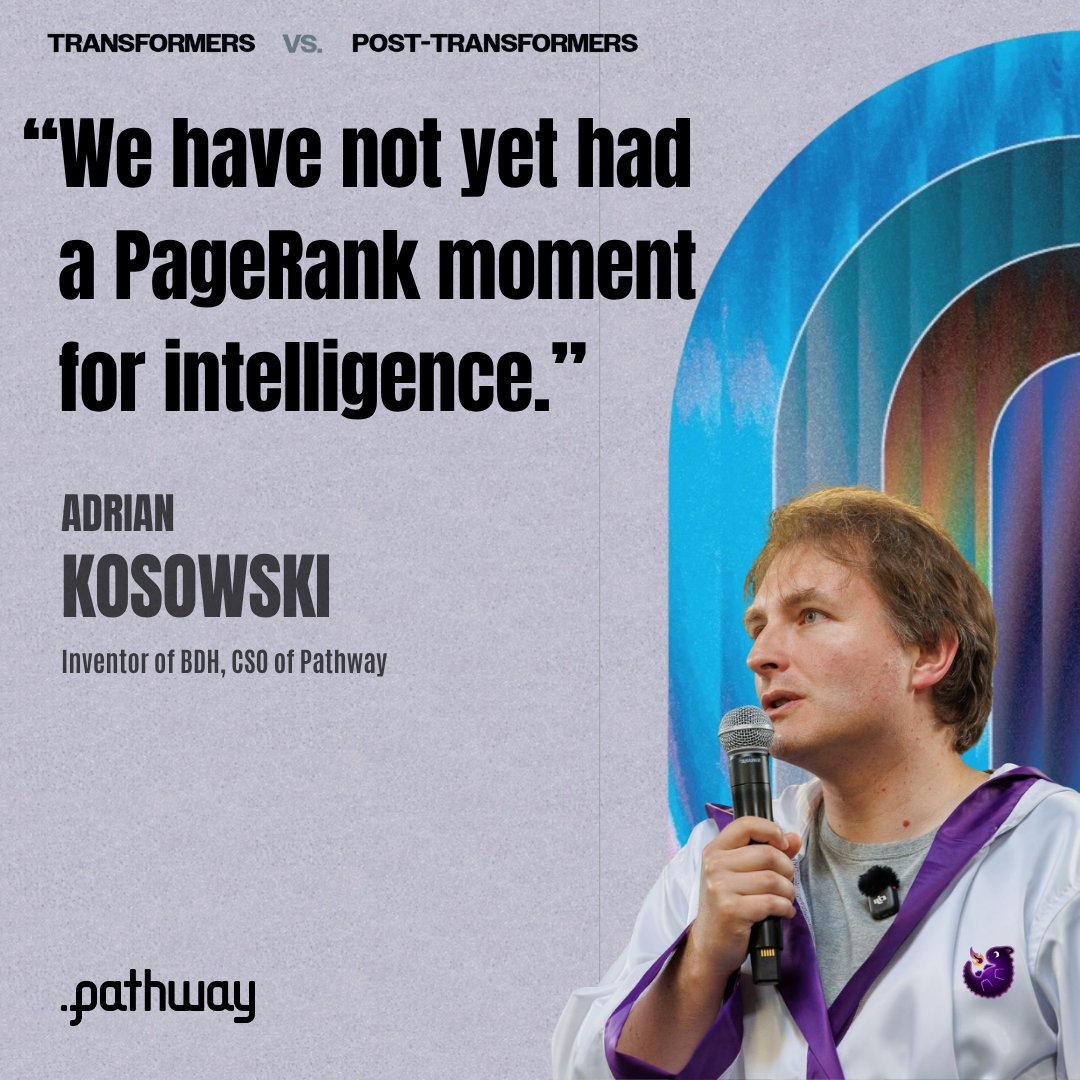
“We have not yet had a PageRank moment for intelligence.”
We’ve got so many comments and questions about this statement delivered by @adrian_pathway during our recent Transformer vs Post-Transformer debate with @lukaszkaiser @YesThisIsLion @mlech26l - thanks!
Let’s dig into it. In the 1990s, web search already existed. We could index information. AltaVista existed. The web was growing fast.
Then PageRank happened.
That moment combined three things:
1. A simple but deep mathematical idea: treat the web as a giant graph and compute a stationary distribution of a *random walk* on that *graph*
2. A scalable implementation: large-scale graph computation on huge clusters
3. A company that integrated and scaled the idea end-to-end: Google
That combination gave search a much clearer center. It stopped being just a pile of heuristics and started to look more like: here is the mathematical object we need to compute, now let’s build the systems needed to compute it well.
Adrian asked Lukasz Kaiser directly whether he sees a PageRank-like idea inside the
Transformer. Lukasz said no.
For intelligence, we still do not have that kind of unifying operator or process. We do not yet have an agreed mathematical object that says: this is the core computation behind it.
That missing unifier is what Adrian meant by the absent “PageRank moment for intelligence.”
That is also the main idea behind our work on BDH, our Post-Transformer architecture. We are after that fundamental “platform discovery” for intelligence.
The full Transformer vs Post-Transformer debate is a good place to go deeper on these topics. Link below.
2
5
14
366
May 28
Welcome to the id4 tribe! We are thrilled to work with @benrey0302 & Arthur Chevalier . What they are building at presagelabs.ai/ is amazing and becoming vital if you want to be able to manage your cloud infrastructure in the age of AI
Id4 ventures proud investor 🦾
May 28

We just welcomed @id4vc ventures into our investor pool!
We're thrilled to build with @hervecuviliez, @IvanPetrovic and all the team.
Id4 started investing in AI 6 years ago, when only a handful of companies were talking about it. They saw early on what the AI revolution would demand: a full infrastructure rebuild, high-performance cloud, grounded in rigorous science and a strong entrepreneurial spirit.
Excited for what's coming.
2
2
84
Id4 ventures retweeted

May 27
So just an overcomplicated way to say what I already said hmmm
1
1
139
Id4 ventures retweeted

Last week’s Post-Transformer debate post raised one question: Can long term memory become part of the architecture?
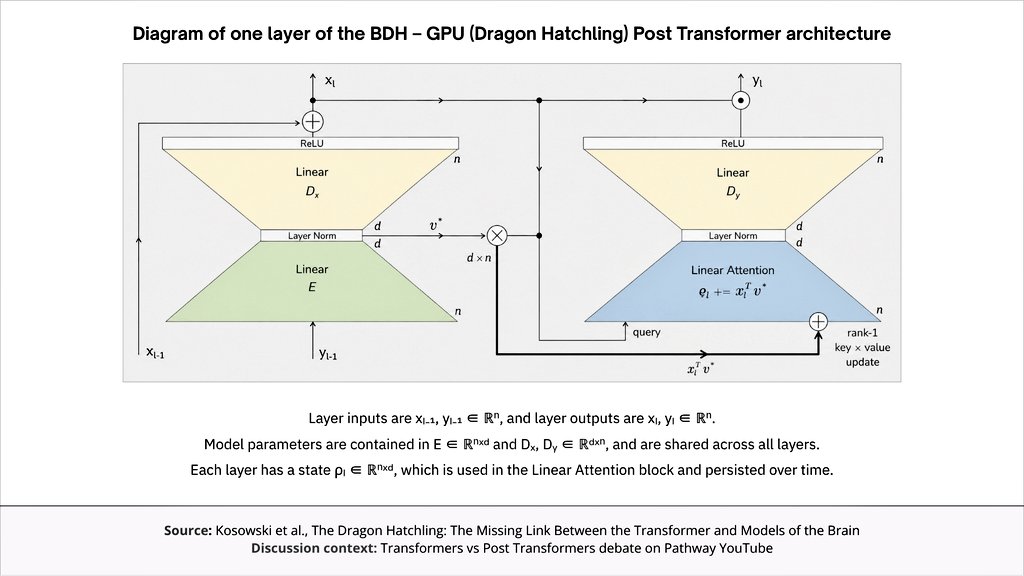
It points to one promising mathematical idea behind Post Transformer AI: Linear attention in high dimension with persistent state.
In a standard Transformer, memory is handled through caching context.
The model keeps previous keys and values in small dimension d, then attends over them. But this is still token history.
BDH (Dragon Hatchling) – one of the Post-Transformer architectures, takes a different route.
The paper describes BDH's state space as fixed and large, with the macro interpretation of associative memory, like KV cache, but organized differently.
Each layer has a persistent state matrix: ρₗ ∈ Rⁿˣᵈ
Here:
n = neuronal or concept dimension
d = low rank synaptic dimension
d << n
The key idea is that state is aligned to neurons, in high dimensional space (n in the order of billions).
A Transformer stores token history.Whereas BDH-GPU (a tensor-friendly version of the BDH architecture) evolves state, similar to State-Space Models.
This is where the brain analogy becomes useful. The brain does not append every experience into a longer transcript. It has a large bounded substrate of neurons and synapses, where experience changes connections sparsely and with high parallelism.
BDH GPU expresses a related idea computationally:
not memory as a longer context window,
but memory as a large, evolving internal state.
Why it matters:
– no Transformer style hard context window. practically enabling a infinite context window in a reasoning model.
– linear attention in a large neuronal dimension
– sparse positive activations
– persistent state instead of only token history
The deeper insight:
Long horizon reasoning may not come from storing more tokens.
It may very well come from better state dynamics.
7
25
112
7,104
Id4 ventures retweeted
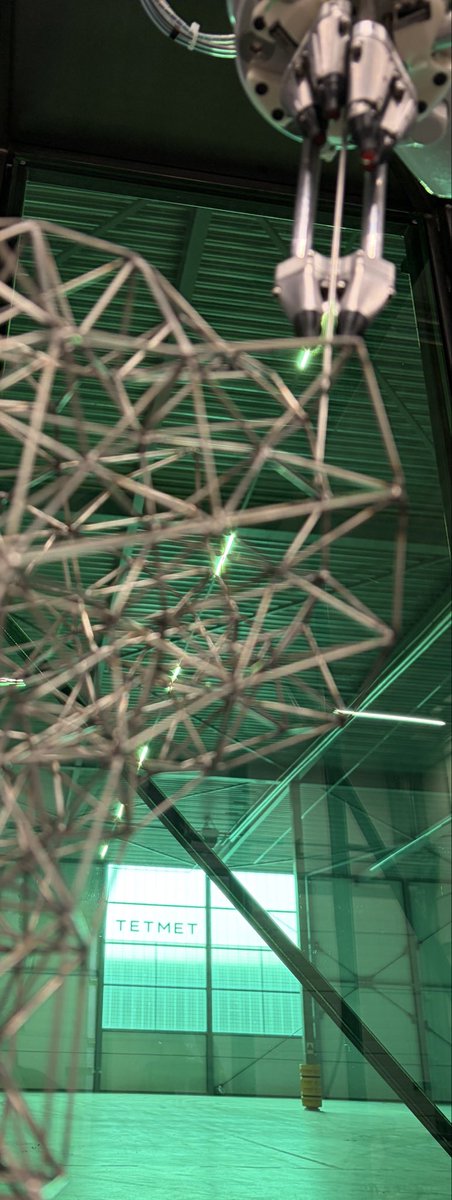
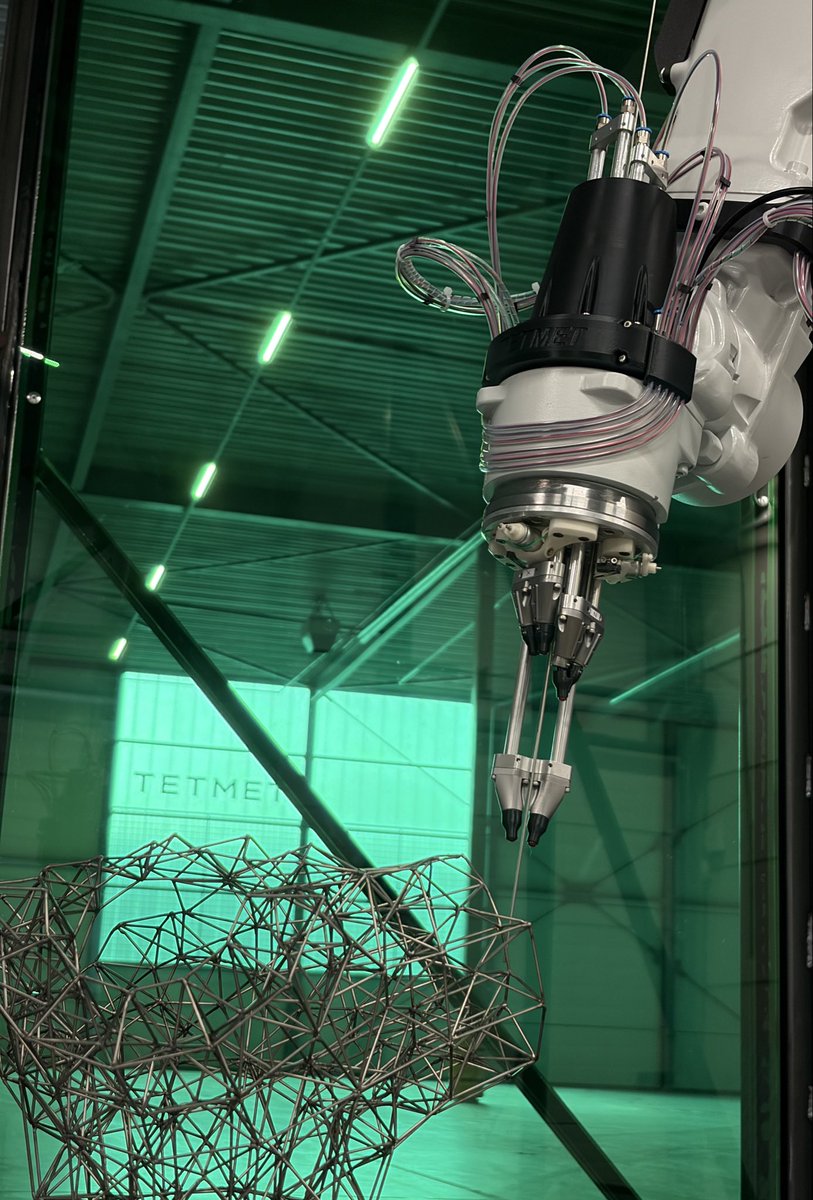
So thrilled to see @TomVroemen vision going live! Reindustrialization in progress 🦾🦾
@id4vc we love physical Ai and so proud to back tetmet.net/

3
3
194
Id4 ventures retweeted
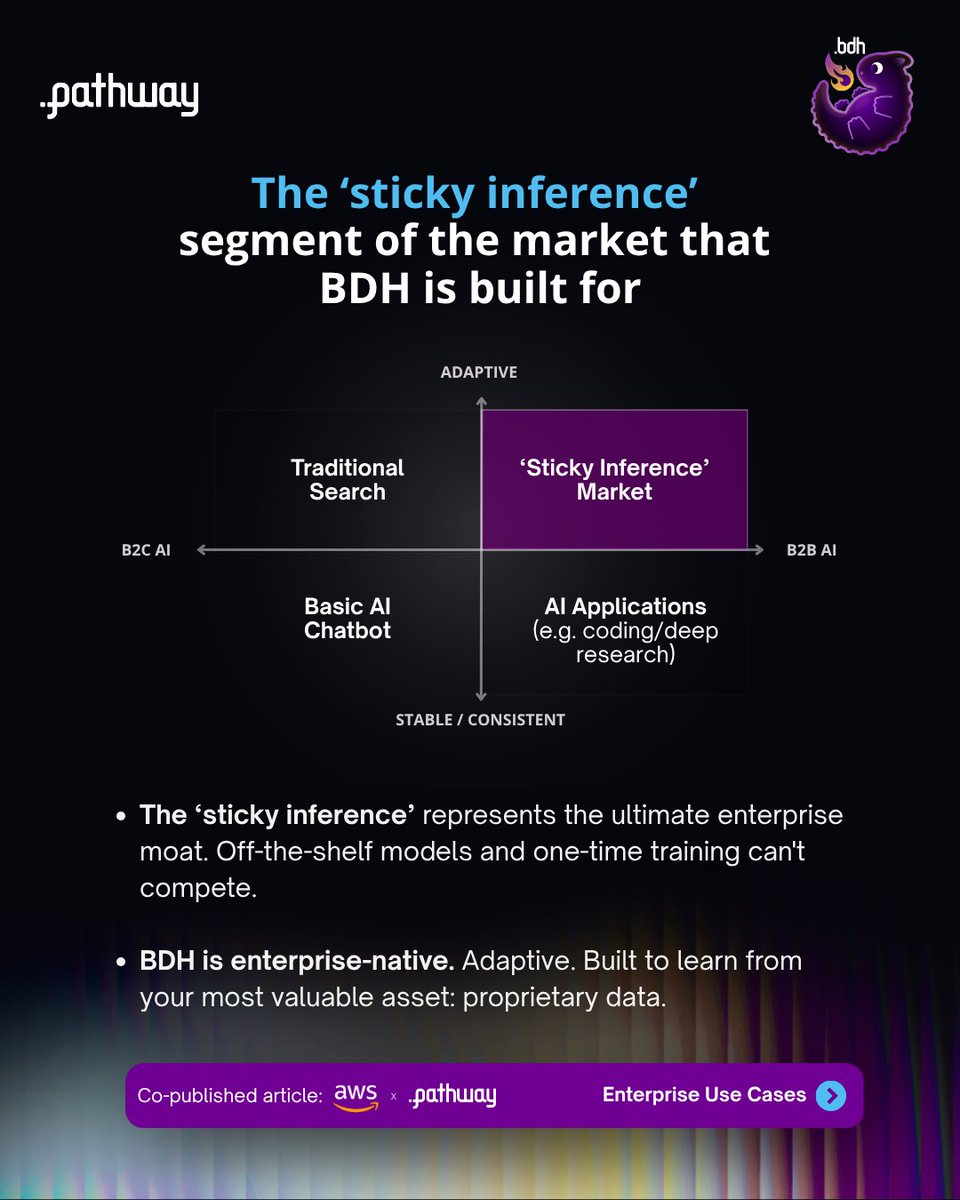
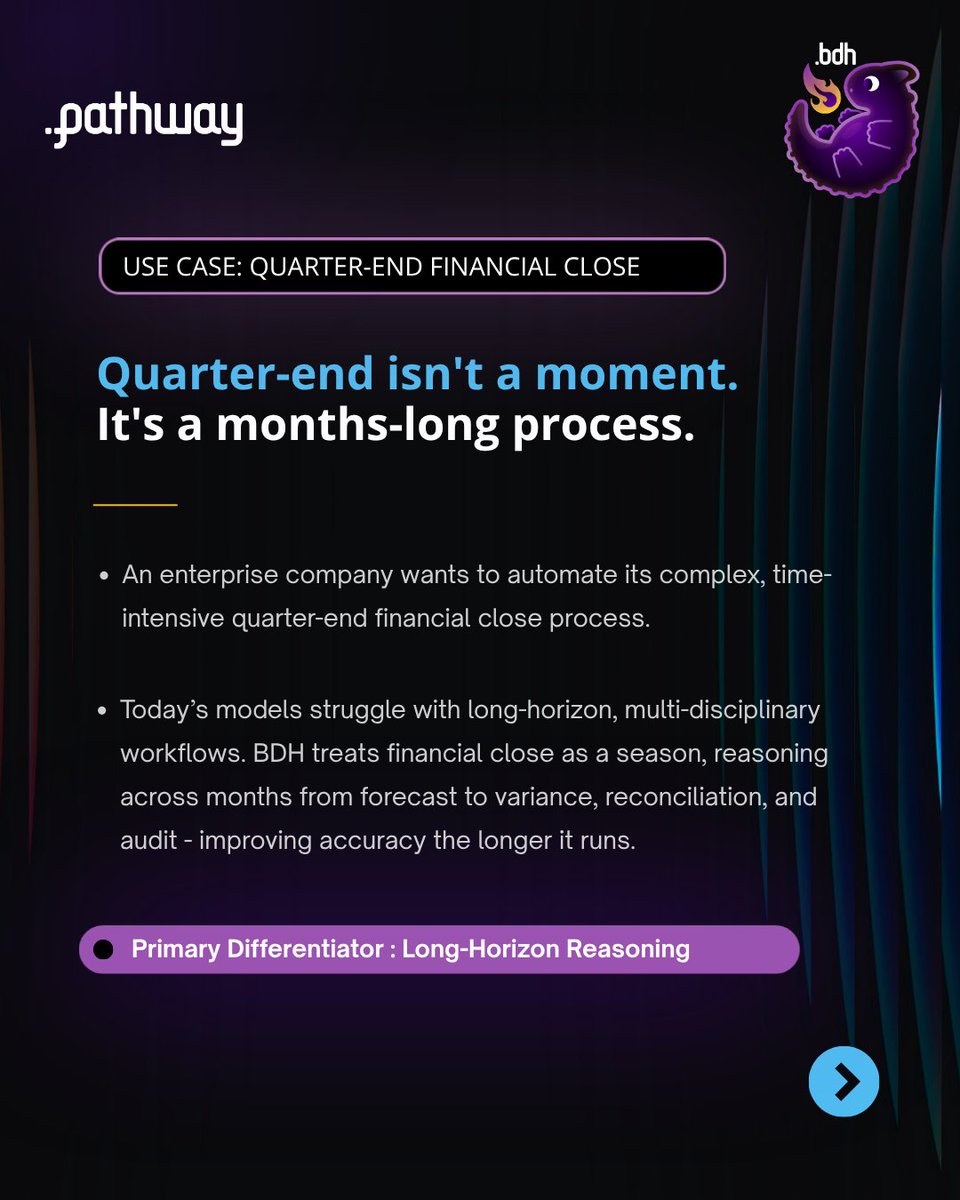
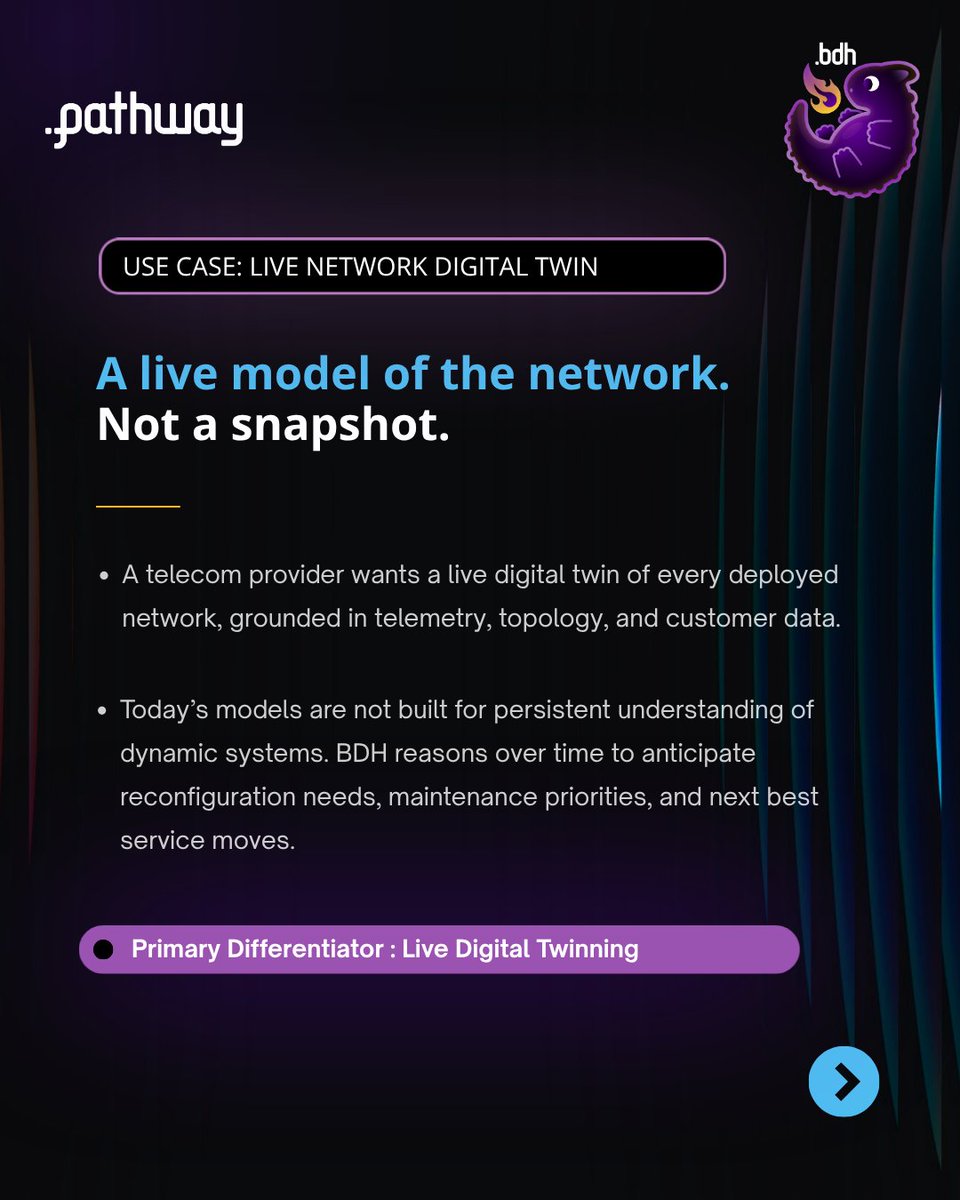
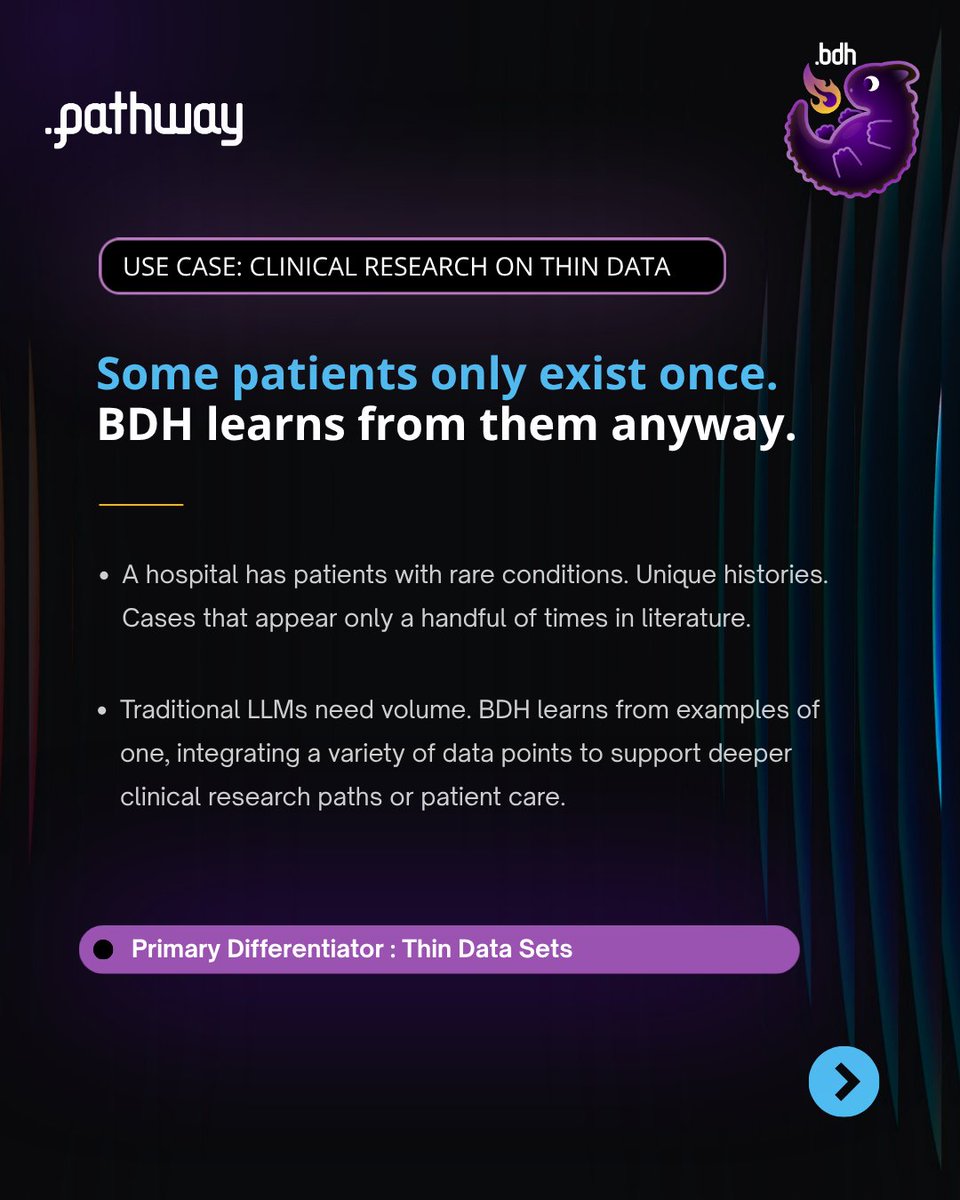
Pathway and AWS use the term "Sticky Inference" to refer to the part of the AI stack where context compounds. It shows up in the use cases tied to your proprietary enterprise data, where a clear moat emerges as the model keeps learning from the business it serves.
@AWSstartups just published a blog on long-horizon reasoning and continual learning for enterprises, and how Pathway's Dragon Hatchling (BDH) is delivering on both.
The article covers six use cases across healthcare, financial services, retail and more, showing how the Post-Transformer architecture moves from research to production AI workflows.
2
2
10
348
Id4 ventures retweeted
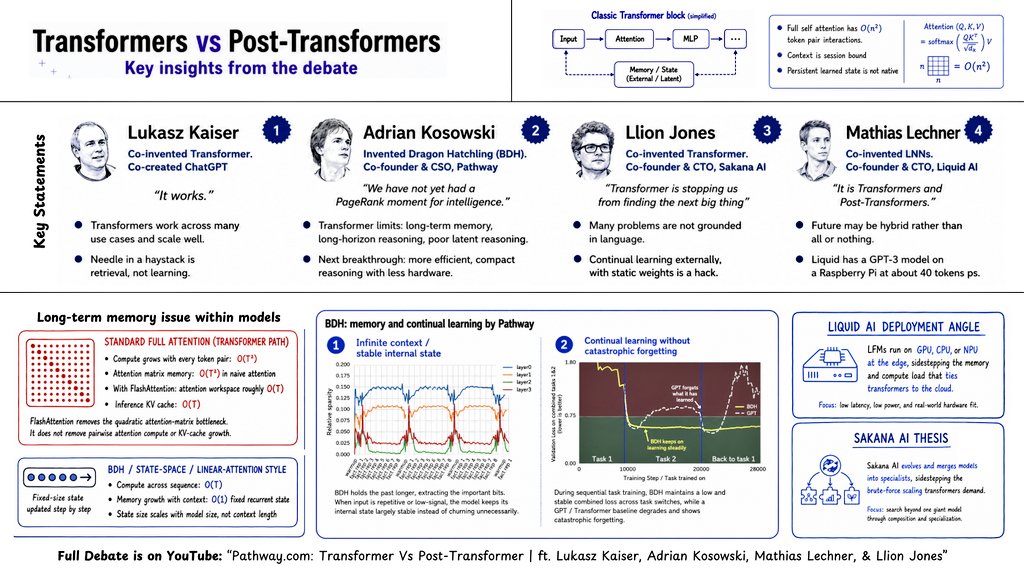
One deep learning debate every AI researcher should care about: Transformers vs Post Transformers.
At the surface, it sounds like an architecture fight. Mathematically, it is about scaling laws, memory, online learning in frontier models, and hardware limits.
That is what made the recent debate interesting. It featured @lukaszkaiser, @adrian_pathway, @YesThisIsLion, and @mlech26l, hosted by @zuzanna_pathway.
Transformers won the last era because multi head self attention scales empirically and fits the hardware ecosystem extremely well. But the next bottleneck may be different.
Full self attention has O(n²) compute pressure with sequence length. Transformer LLMs do not natively have persistent long-term memory. RAG retrieves. Longer context conditions. Neither necessarily forms new reasoning patterns inside the model.
That is why continual learning is becoming central, recently covered by @a16z.
The open questions:
– How can models learn after deployment without catastrophic forgetting?
– How can long term memory become part of the architecture?
– How can models reason over longer horizons without paying infinite context costs?
– How can hardware and AI architectures co-evolve more efficiently?
– And, are we chasing the right benchmarks with these goals in mind?
These questions were tackled head on, with counters from @lukaszkaiser, Transformer co-inventor and core contributor to ChatGPT and GPT models.
The image below summarizes some notes from the 80 minute debate.
4
23
77
5,799
Id4 ventures retweeted
5 mins to get the best insights on Transformer vs Post-Transformer. ai redefined! Kudos to @pathway_com team for organizing! Time to look beyond LLMs

Transformer vs Post-Transformer: The 5-minute KO compilation is live now. 🥊
@lukaszkaiser (co-invented Transformer & co-created ChatGPT)
@adrian_pathway (invented BDH and is CSO of Pathway)
@mlech26l (co-invented LNNs & is CTO of Liquid AI)
@YesThisIsLion (co-invented Transformer with Łukasz, now CTO of Sakana AI)
Moderated by @dexhorthy (CEO, HumanLayer) and me.
Full debate drops soon. Turn on notifications to catch the complete fight. This is the ultimate source of truth on the subject.
2
5
79
Id4 ventures retweeted

What comes after the Transformer?
Zuzanna Stamirowska puts the debate out in the open, with the very inventors of Transformer and Post-Transformer architectures!
Watch the 5-minute highlights. Follow @zuzanna_pathway and hit the bell, full fight drops tomorrow.
Transformer vs Post-Transformer: The 5-minute KO compilation is live now. 🥊
@lukaszkaiser (co-invented Transformer & co-created ChatGPT)
@adrian_pathway (invented BDH and is CSO of Pathway)
@mlech26l (co-invented LNNs & is CTO of Liquid AI)
@YesThisIsLion (co-invented Transformer with Łukasz, now CTO of Sakana AI)
Moderated by @dexhorthy (CEO, HumanLayer) and me.
Full debate drops soon. Turn on notifications to catch the complete fight. This is the ultimate source of truth on the subject.
3
6
20,023
Id4 ventures retweeted
I largely agree with @YesThisIsLion on this.
The biggest mistake right now is expecting the first Post-Transformer models to beat Transformers on day one by delivering massive gains on irrelevant axes.
3
4
12
439
Id4 ventures retweeted
2 Transformer co-authors.
2 post-transformer inventors.
1 REAL boxing ring.
📍San Francisco
Said it would be a real fight. IT WAS. 🥊
@adrian_pathway: “Transformers think in language. They do not think in latent thought.”
@mlech26l: “I am convinced that the Transformer will find its own replacement.”
@YesThisIsLion: “Lukasz is going to be correct up until that day, and then he is going to be wrong forever.”
@lukaszkaiser: “Do not be scared of being 50-times slower!! If you show me a model that is 50-times slower but on a better slope, you win.”
Good thing I told them to keep it clean, look at them! 😂
Transformer Vs Post Transformer: Deciding Round, By @pathway_com



3
4
233
Id4 ventures retweeted
Said it would be a real fight. IT WAS. 🥊
@adrian_pathway: “Transformers think in language. They do not think in latent thought.”
@mlech26l: “I am convinced that the Transformer will find its own replacement.”
@YesThisIsLion: “Lukasz is going to be correct up until that day, and then he is going to be wrong forever.”
@lukaszkaiser: “Do not be scared of being 50-times slower!! If you show me a model that is 50-times slower but on a better slope, you win.”
Good thing I told them to keep it clean, look at them! 😂
Transformer Vs Post Transformer: Deciding Round, By @pathway_com
2
6
12
1,229
Id4 ventures retweeted
Apr 21
Datadog's State of AI Engineering 2026 is out:
→ 5% of AI requests fail in production
→ 60% of those failures = capacity limits, not model quality
→ Agent framework adoption doubled YoY & complexity too
Datadog CPO Yanbing Li: "The companies that win won't just build better models, they'll build operational control around them."
Vercel CEO Guillermo Rauch: "The next wave of agent failures won't be about what agents can't do but what teams can't observe."
He's right. We just think the next step isn't seeing it sooner, it's seeing it before it happens.
On it!
1
2
144
Id4 ventures retweeted

May 6
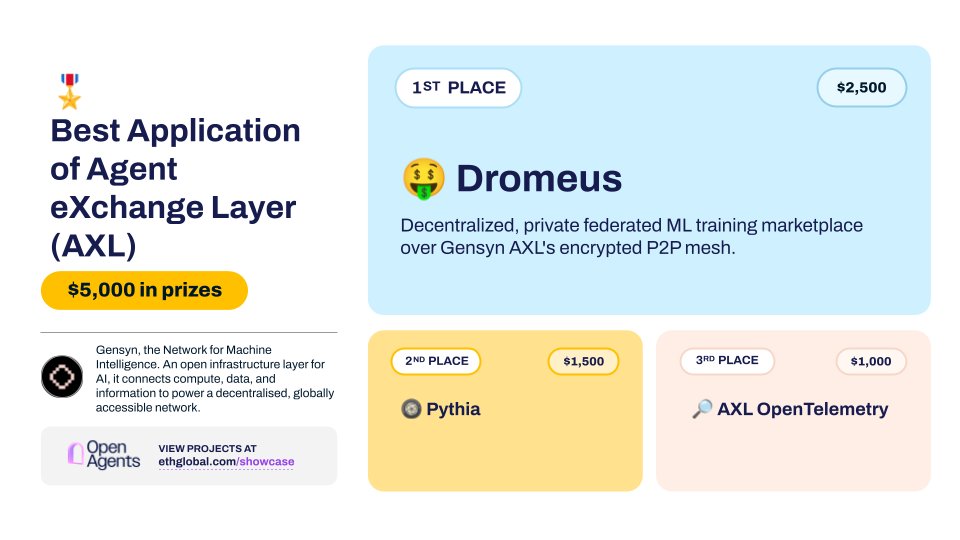
Congratulations to the winners of the @GensynFND <> @ETHGlobal Open Agents Hackathon - Best Application of AXL
• 1st place - Dromeus (@deveshcodes_)
• 2nd place - Pythia (@HarshitNay80531)
• 3rd place - AXL Open Telemetry (@metroxe)
Find details of their submissions below.
16
17
102
16,211