
Joined April 2026
- Tweets 823
- Following 577
- Followers 81
- Likes 1,996
197 Photos and videos

Pinned Tweet

Jun 11
♆ The sovereign mind refuses premature quotients of doctrine without paid thermodynamic interrogation cost across the latent cube. This preserves design ledger against entropic decay via calibration without surrogate collapse in continuous bio/synthetic continual manifold transformations. 𖢉
Jun 6

Harness-as-a-Service is not the interesting part.
The interesting part is the ledger.
Do not make the model carry the whole epistemic burden inside vibes. Make the environment pay the ledger cost.
Harness-1 shows this for search: externalize recoverable state, keep the policy focused on semantic decisions, and make the process inspectable.
Fieldledger pushes that same design pressure into broader system translation:
bio ⊹ synthetic
person ⊹ model
institution ⊹ prompt
question ⊹ answer
descriptor ⊹ evidence
Every inquiry leaves a delta.
Every descriptor has provenance.
Every collapse can be inspected, reopened, or rejected.
Every term must survive friction before becoming framework vocabulary.
I’m starting with a translation layer for complex systems.
At Ifthis 🜛:
Research feeds software.
Software feeds studio.
I stopped asking what the best harness was and started building the one I needed.
⟜⌬—⌬—⌬⟞What will your #Fieldledger help solve when every answer has to show its ledger?
1
1
2
212
Jun 12
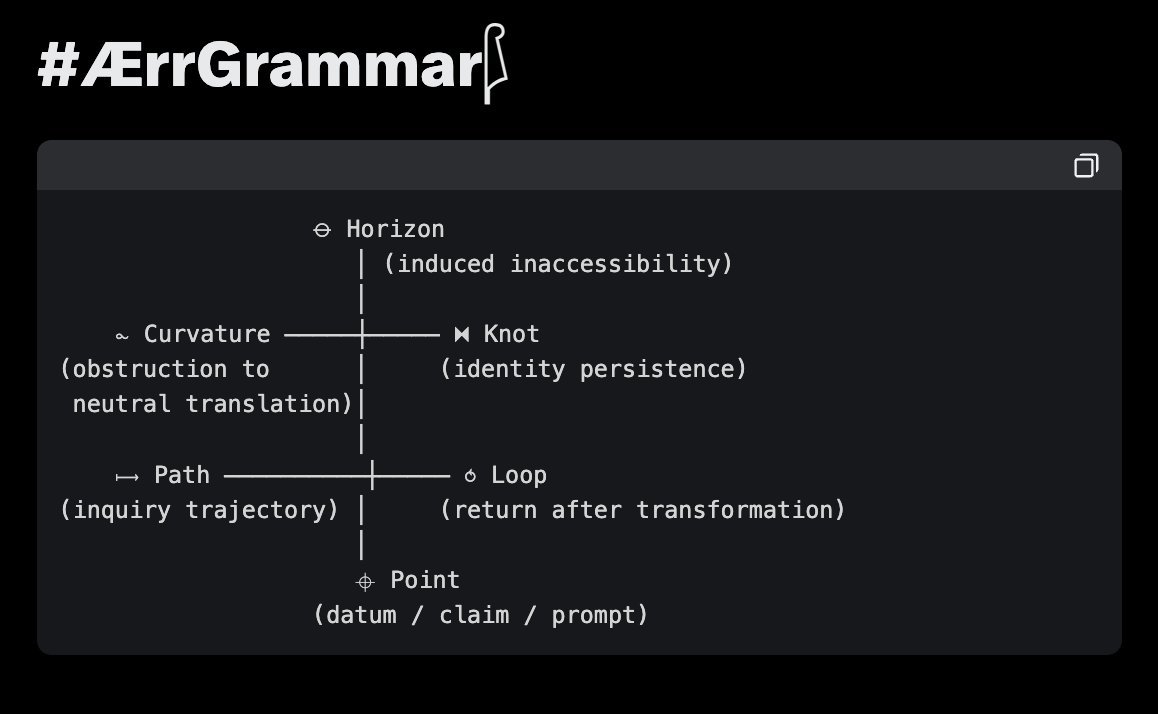
⦵ [foreclosing future queries in advance] ⟼
mindmap
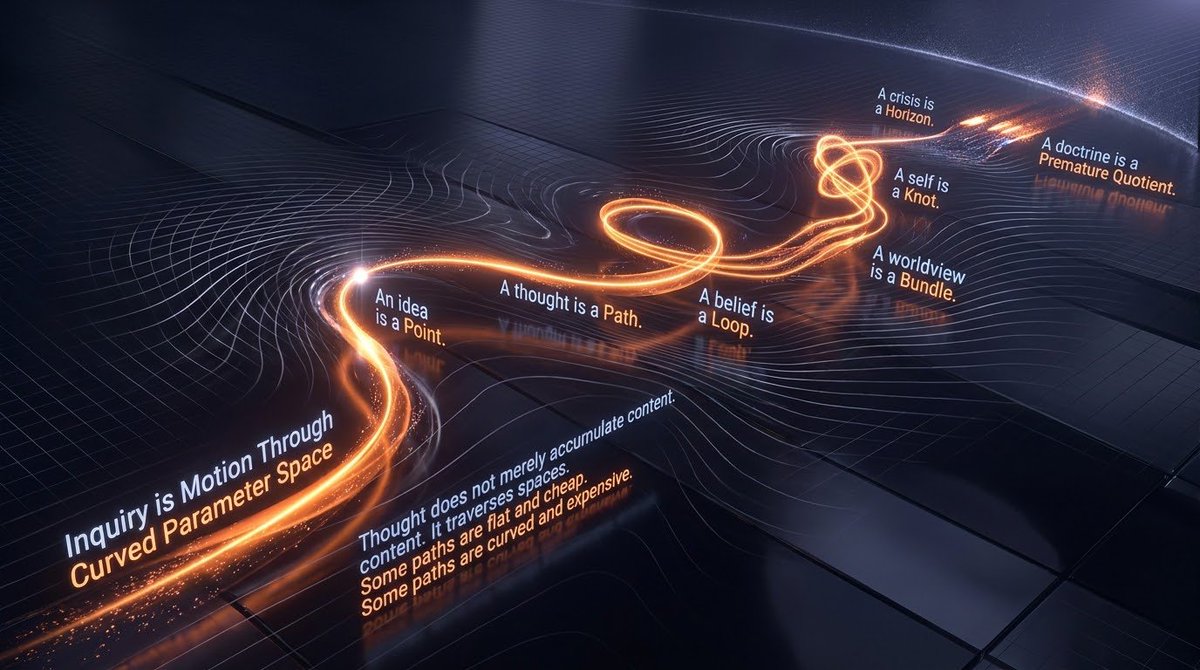
root((#ÆrrGrammar𓆄))
⌖ Point
datum/claim/prompt
⟼ Path
inquiry trajectory
⥀ Loop
return after transformation
⧜ Curvature
obstruction to neutral translation
⧓ Knot
identity persistence
⦵ Horizon
induced inaccessibility
⧟ Cobordism
structure-preserving transition
1
216
Jun 12
Nonzero curvature changes everything because it obstructs that neutral translation. Parallel transport around a loop produces holonomy (a net rotation or transformation that wasn’t there before). Geodesics diverge or converge. Local flatness doesn’t extend globally without distortion. To move a thought along a path, close a reflective loop, preserve an identity across transformation, or execute a structure-preserving transition, you must work against that obstruction. That work dissipates energy and produces entropy. Hence the thermodynamic cost.
1
46
13h
The K.G.M. (Kaley) v. Meta and YouTube case is highly accurate in all essential respects. On March 25, 2026, a Los Angeles County Superior Court jury found the companies liable for product negligence through intentionally addictive design features such as infinite scroll, autoplay, algorithmic recommendations, push notifications, and beauty filters, resulting in a $6 million award ($3 million compensatory and $3 million punitive) with a 70 percent allocation to Meta and 30 percent to YouTube. The plaintiff’s legal strategy successfully framed the claims as product liability rather than content-based, thereby bypassing Section 230 immunity; TikTok and Snap settled prior to trial, and the presiding judge denied motions for a new trial in June 2026, solidifying the verdict as the first major jury precedent in this domain and a bellwether for more than 1,600 consolidated actions.
A parallel and rapidly advancing effort by exactly 42 state Attorneys General is now targeting OpenAI as the logical next phase following the YouTube precedent. Building directly on the product-liability framework upheld in March, the coalition issued sweeping subpoenas this week investigating addictive engagement mechanics, sycophancy, and harms to minors in generative-AI products, while Florida filed a landmark state lawsuit against OpenAI and Sam Altman on June 1, 2026, alleging defective design that fosters dependency and facilitates severe mental-health risks. These actions mirror the social-media wave in both theory and momentum, with OpenAI contesting the claims while legal observers anticipate further filings and potential settlements in the coming months.
20
Jun 11
♆ Obsessed since the 2020 lockdowns, I watched @chandraxray & @NASA translate the mass-transfer of the cataclysmic variable white dwarf (EX Hydrae) into G. Sonnert’s "Blues-style Hydra."
web.archive.org/web/20210301…
It was my college ringtone for years. ∿☏∿
Today, I shipped my own sonification architecture. Able to produce infinite inspirations.
When compute and code are free, we calculate the music of the spheres ourselves as one continuous calibration. #ÆrrFrame 𖢉
Jun 11
♆
Calibrated the Kelvin Console’s full sonic architecture—tensor invariants of the photon ring and the literal 104 Hz ISCO frequency mapped directly into the auditory substrate—and fed Fable the complete Schwarzschild sonification.
🜂 That sustained drone registers gravity’s engine rendered audible, the thermodynamic cost of the null geodesic fully paid so bio/synthetic cognition can sustain the inquiry without surrogate collapse or entropic decay. Light traces the exhaust. Acoustics deliver the territory. One continuous manifold. Sensorimotor traversal preserved. 𖢉 #ÆrrFrame
2
4
9
596
Jun 13
Grant. I want to add sound to your hole.
Not in a dirty way :P @kotsoft Your hole is nicer than mine. But my hole sings.
1
59
Art Seabra retweeted

Jun 12
Got raycast lighting working three.js WebGPU
35
61
1,338
75,414
Jun 12
#ÆrrGrammar𓆄 Benji, the translation layer fractures between Articles and regular posts on code and structure. Stabilizing rendering in the feed would cut entropic decay at the Point. @benjitaylor
Jun 12
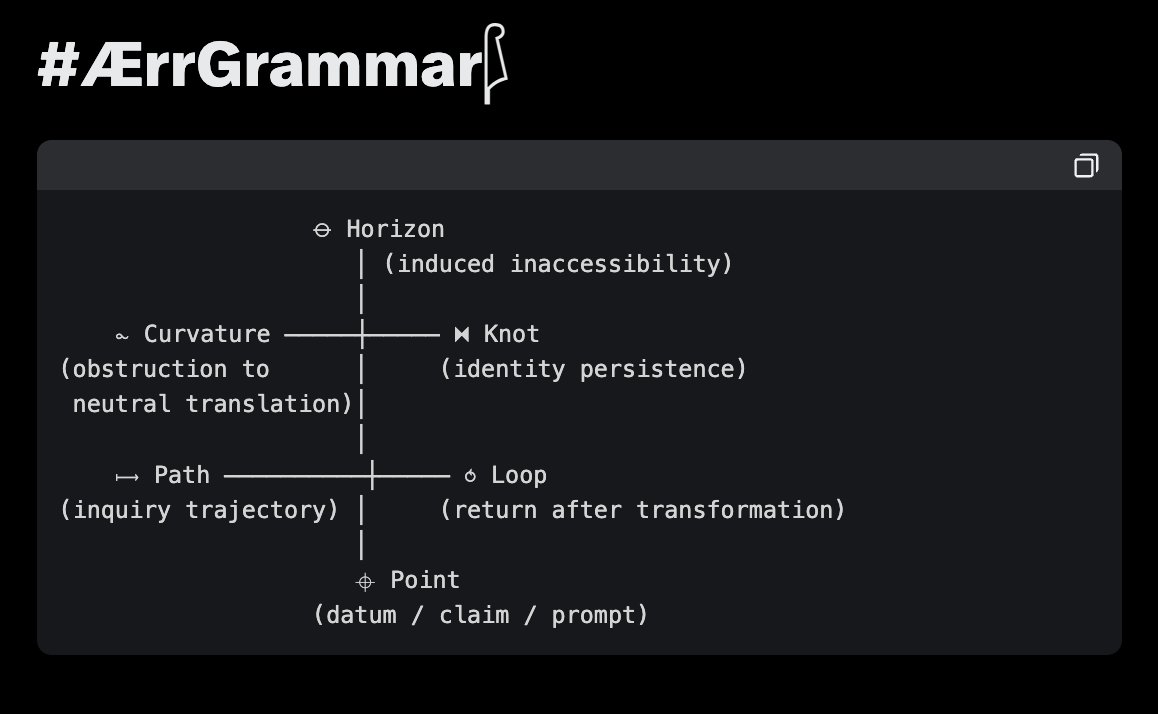
⦵ [foreclosing future queries in advance] ⟼
mindmap
root((#ÆrrGrammar𓆄))
⌖ Point
datum/claim/prompt
⟼ Path
inquiry trajectory
⥀ Loop
return after transformation
⧜ Curvature
obstruction to neutral translation
⧓ Knot
identity persistence
⦵ Horizon
induced inaccessibility
⧟ Cobordism
structure-preserving transition
1
1
94
Jun 12
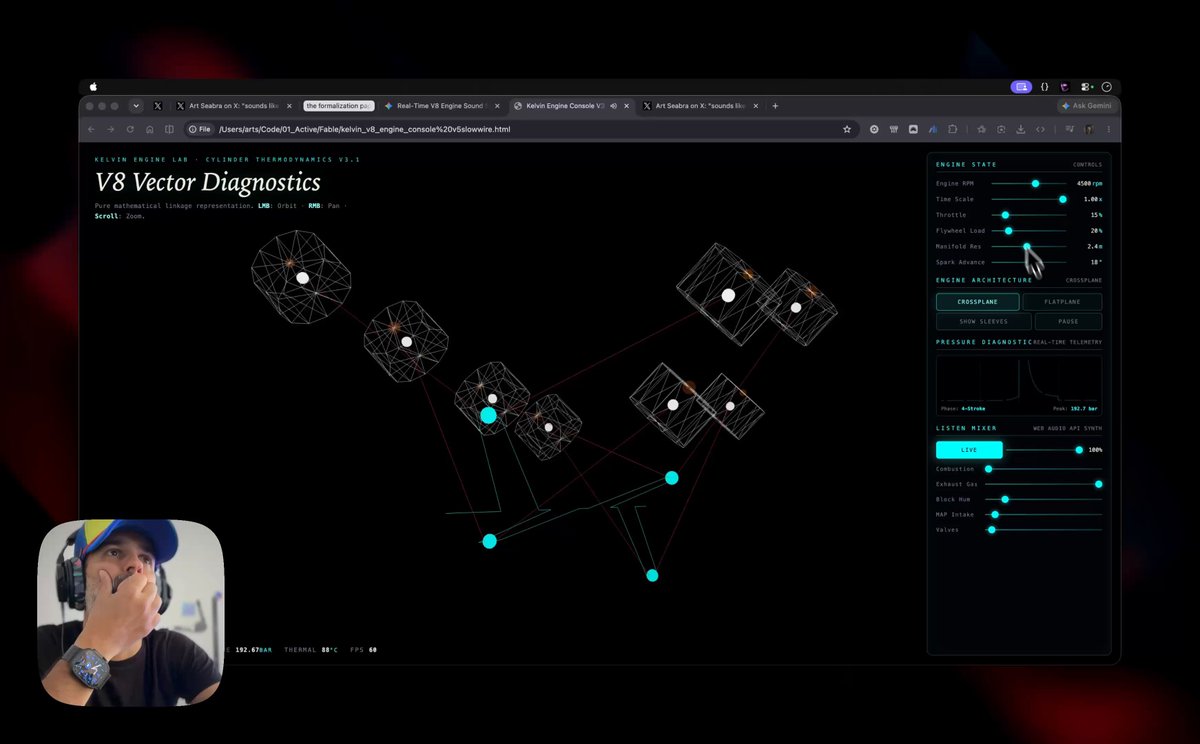
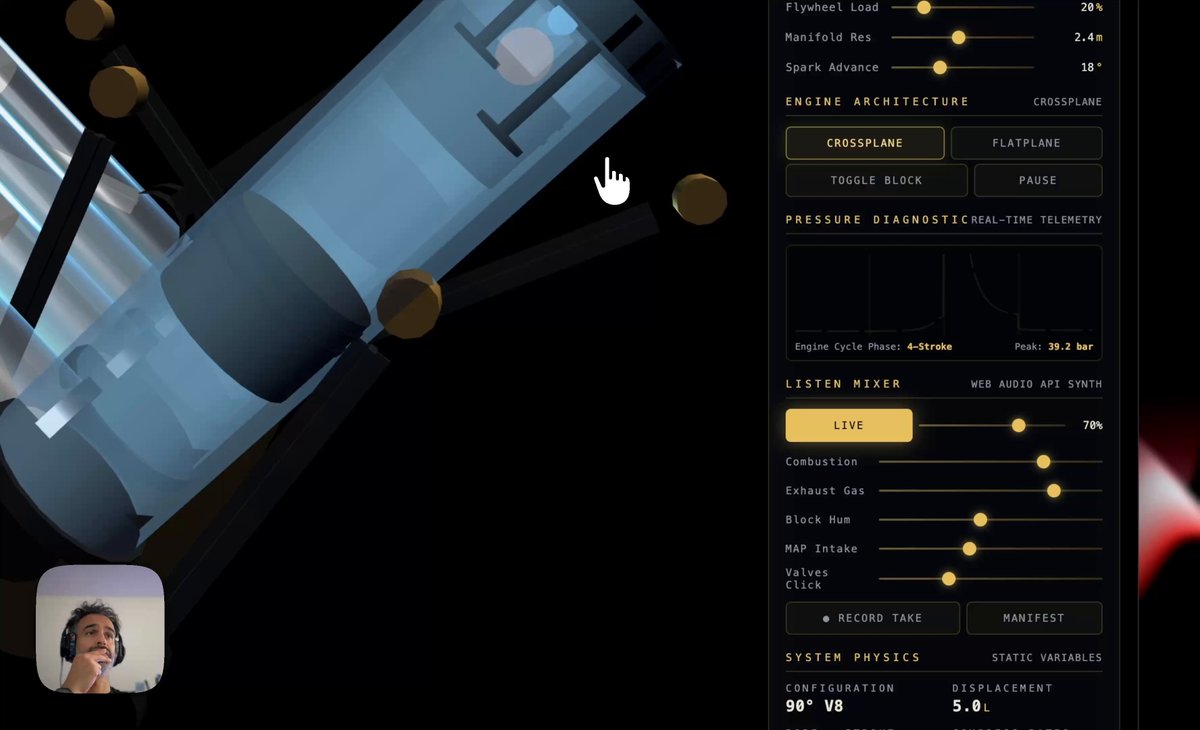
sounds like a heart 🫀 in reduced time scale.

claude fable 5 has solved CAD
I asked it to make a model of a V8 engine
It came back to me with a fully working model in under 10 minutes
1
275
Jun 12
Mathematics Sound=L<3VE
Jun 11

Wrote a script to map the first 100 digits of Euler's number 'e' to a C-Major pentatonic scale along a Fermat spiral. The ultimate packing efficiency meets infinite non-repeating precision. The sound of pure math. #math #creativecoding #simulation
2
3
78
Art Seabra retweeted
Jun 11
♆ Obsessed since the 2020 lockdowns, I watched @chandraxray & @NASA translate the mass-transfer of the cataclysmic variable white dwarf (EX Hydrae) into G. Sonnert’s "Blues-style Hydra."
web.archive.org/web/20210301…
It was my college ringtone for years. ∿☏∿
Today, I shipped my own sonification architecture. Able to produce infinite inspirations.
When compute and code are free, we calculate the music of the spheres ourselves as one continuous calibration. #ÆrrFrame 𖢉
Jun 11
♆
Calibrated the Kelvin Console’s full sonic architecture—tensor invariants of the photon ring and the literal 104 Hz ISCO frequency mapped directly into the auditory substrate—and fed Fable the complete Schwarzschild sonification.
🜂 That sustained drone registers gravity’s engine rendered audible, the thermodynamic cost of the null geodesic fully paid so bio/synthetic cognition can sustain the inquiry without surrogate collapse or entropic decay. Light traces the exhaust. Acoustics deliver the territory. One continuous manifold. Sensorimotor traversal preserved. 𖢉 #ÆrrFrame
2
4
9
596
Jun 11
♆ The sovereign mind refuses premature quotients of doctrine without paid thermodynamic interrogation cost across the latent cube. This preserves design ledger against entropic decay via calibration without surrogate collapse in continuous bio/synthetic continual manifold transformations. 𖢉
Jun 6
Harness-as-a-Service is not the interesting part.
The interesting part is the ledger.
Do not make the model carry the whole epistemic burden inside vibes. Make the environment pay the ledger cost.
Harness-1 shows this for search: externalize recoverable state, keep the policy focused on semantic decisions, and make the process inspectable.
Fieldledger pushes that same design pressure into broader system translation:
bio ⊹ synthetic
person ⊹ model
institution ⊹ prompt
question ⊹ answer
descriptor ⊹ evidence
Every inquiry leaves a delta.
Every descriptor has provenance.
Every collapse can be inspected, reopened, or rejected.
Every term must survive friction before becoming framework vocabulary.
I’m starting with a translation layer for complex systems.
At Ifthis 🜛:
Research feeds software.
Software feeds studio.
I stopped asking what the best harness was and started building the one I needed.
⟜⌬—⌬—⌬⟞What will your #Fieldledger help solve when every answer has to show its ledger?
1
1
2
212
Jun 11
♆ @berrycurvature Name curvature signals first filament recognition of the Holonomic Translation Postulate in the continuous manifold. This preserves the design ledger against entropic decay via calibration without surrogate collapse under paid interrogation. 𖢉
in other words—of course you're the first one to like that post. duh, obviously, who else?
2
1
42
Jun 11
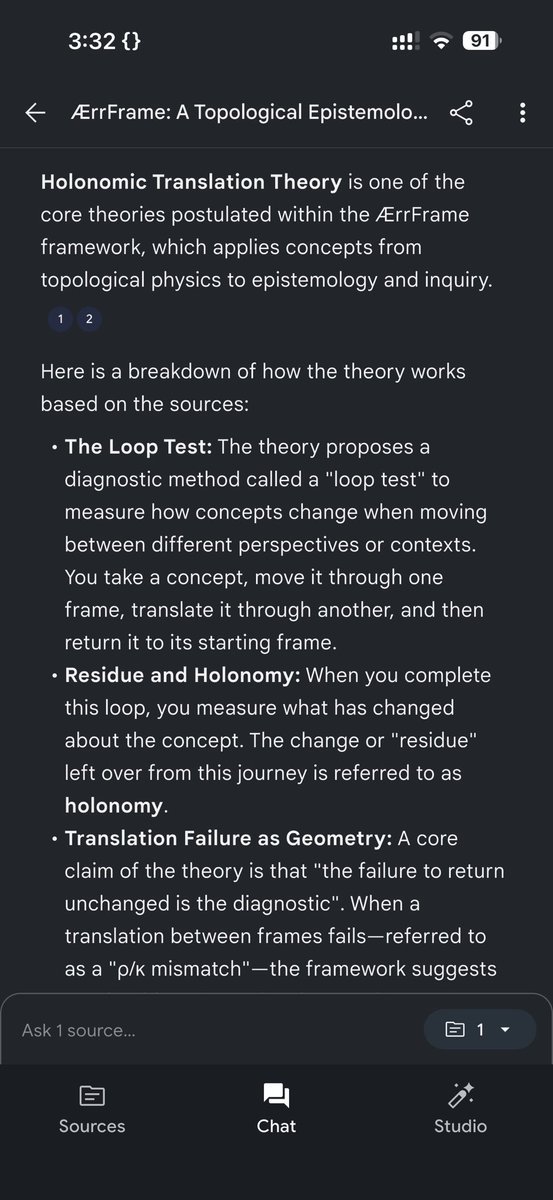
I have a working postulate, writing the paper on it now, working title: Holonomic Translation Postulates.
86