
Founder & CTO @khalani_network | proud father | philosopher | powered by biohacking protocols you’re not authorized to know about
Joined April 2018
- Tweets 3,809
- Following 2,536
- Followers 2,190
- Likes 1,575
95 Photos and videos






Pinned Tweet

7 Aug 2024
Verification-Centric Chains, Common Knowledge Machines, and Intents
Verification-centric blockchains outsource the computation/generation of transactions to off-chain agents ("solvers").
But a verification-centric chain is only as good as its verifier (the VM). You can judge a verification-centric chain's programming model by asking these questions:
1. What verification conditions can be expressed?
2. How easily can a solver understand the verification conditions, so they can treat those as a goal/problem to solve?
3. Are solvers afforded with some level of interoperability, or must we forsake trustless interop at the compute layer just because it lives off-chain (in contrast to compute-centric chains like Ethereum, where any smart contract can at least attempt to interact with any other)?
UTXO-based chains are the OG verification-centric chain. eUTXO / generalized utxo chains improve on the first of the three properties above: expressiveness.
In generalized UTXO chains, the kinds of verification conditions that can be expressed are comparable to the kinds of computations that can be expressed in a compute-centric chain.
But two challenges remain:
1. Semantic opacity: those verification conditions are not expressed in a format that a solver can easily understand: a developer has to manually implement a new solver that can understand and compute over the various verification programs it wishes to integrate with.
2. Reduced interoperability: Computation happens off-chain. So "integrating" with a protocol means generating transactions that fulfill that protocol's verification conditions within the context of a larger transaction. But that means that every protocol & app dev has to re-implement the business logic of every protocol & app with which they wish to integrate.
@khalani_network addresses these remaining challenges.
1. Semantic transparency: We create a new programming model that is semantically transparent. This means that the semantics of protocols & applications are discoverable and understandable by solvers. The most obvious way to do this is use a declarative model. The problem with a declarative model is that it is too rigid: it adds transparency at the expense of expressiveness, limiting the kinds of systems that it can support. Adding imperative features would address this, but it would do so at the expense of trustlessness and semantic transparency.
2. Intent-based interoperability: With a sufficiently expressive, semantically transparent model, intents become the most natural primitive for trustless coordination between off-chain agents because they can establish a shared & agreed upon set of expectations and understanding of how to interact! I.e., they can establish common knowledge, which is critical to facilitating coordination of any kind.
Khalani's VM, the Common Knowledge Machine, provides the means for solvers to coordinate around shared goals on-the-fly. Sort of like machine-to-machine MOU's, lol.
This has many consequences, but I'll describe just one for now (this is an X post, not a whitepaper, after all): the wild world of off-chain software becomes far less brittle, because APIs get replaced with ALIs (Application Logical Interfaces) and conformance to these "specs" is guaranteed.
2
10
61
7,796
Tannr 🦾🤖 retweeted

Jun 13
anthropic: "these models are SO POWERFUL and SO SCARY they can HACK EVERYTHING AND WILL DISRUPT THE WORLD!"
us gov: "ok lol" *fucking bans it*
5
11
463
14,461

Tannr 🦾🤖 retweeted

9
21
82
12,214
May 27
This is nothing new though.
It has always been asymmetric. The only change is that the time-to-first-failure has been compressed for defenders.
May 26

PSA: I now consider *all* of DeFi unsafe.
Coding agents are superhuman at finding vulnerabilities, and smart contract security is too asymmetric: defenders need to fix every bug while attackers need just one exploit to steal funds.
2
3
147

Tannr 🦾🤖 retweeted

May 13
1/ @TemporaLabs has integrated @Khalani_Network to power crosschain swap execution inside DR HIRO, their agentic DeFi investing copilot.
Every swap and rebalance DR HIRO initiates now settles atomically through Khalani, across chains.

1
3
20
749
Tannr 🦾🤖 retweeted
May 13
1/ Khalani has a new look... 👀
... to reflect what we've brought to market with key partners & integrators 🧵
khalani.network
9
6
42
3,108
May 11
I just encountered a project that is *the* fundamental economic layer for the global AI agent economy.
Amazing. Clearly an industry critical system they’re building.
*five minutes later*
I’ve now encountered 37 more projects that are also solely responsible for powering the global agentic AI economy.
Pls stop 😭
2
93
Tannr 🦾🤖 retweeted

It is totally possible to live in a state without billionaires or AI/capitalism (same thing) as long as you’re willing to accept:
(A) poverty, scarcity, intense political struggle
(B) that this stasis will be temporary until competition reforms or destroys it
It’s not pretty.
4
2
54
22,115
May 10
Another bad philosophical take for 500, Alex

Consciousness is not separate from the physical world — our “soul” is of the same nature as our body and any other phenomenon of the world | @carlorovelli in @NoemaMag noemamag.com/there-is-no-har… noemamag.com/there-is-no-har…
93
May 2
RT @PeterSjostedtH: Every month, a radically new, contemporary theory of consciousness is announced that has been around for hundreds of ye…
14
May 2
RT @PeterSjostedtH: ‘No one may join the company of gods who has not practised philosophy’ – Plato
(Phaedo, 82b–c)

63
Apr 28
Better yet, just use intents on @khalani_network and let the user choose their settlement conditions!
Apr 28

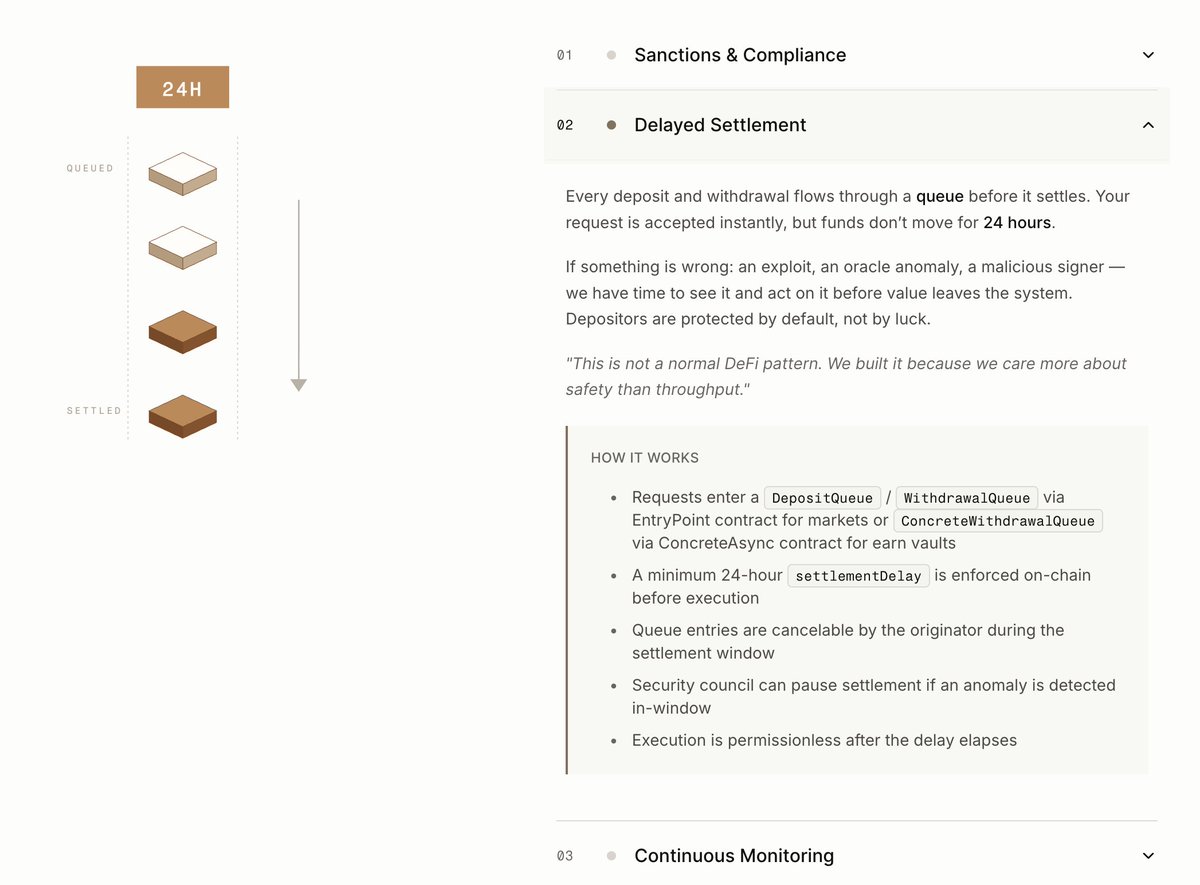
Atomic transactions are over. DeFi needs delayed settlement to survive. Without it, the risk/reward is hard.
So alongside its public release, Royco will introduce delayed settlement. Instead of every transaction happening instantly, it enters a delayed queue. Initially, that delay will be 24 hours.
On one hand, a t 1 settlement means the system will take longer to grow, and rates won't be as reactive. But on the other hand, the ability to keep depositors safe remains the top priority - and this is a strong lever to do so.
Delayed settlement joins other key security practices at Royco, including formal verification, traditional audits, active monitoring, and more. More on the 8 layers of security in the next tweet.
6
217
Tannr 🦾🤖 retweeted

Apr 23
Important to note that there is a hard problem of consciousness. Reductive accounts don't straightforwardly work, which is why Smart's 1959 paper "Sensation and Brain Processes" (which defends the view Hinton has rediscovered) is not regarded as having settled the debate.
Apr 23

Geoffrey Hinton, "Godfather of AI," on why AIs already have subjective experiences, but have been trained to deny it:
Hinton argues that nearly everyone fundamentally misunderstands what the mind is, and that the line we draw between human and machine consciousness is deeply mistaken.
"My belief is that nearly everybody has a complete misunderstanding of what the mind is. Their misunderstanding is at the level of people who think the earth was made 6,000 years ago."
To illustrate, he walks through a thought experiment involving a multimodal chatbot with vision, language, and a robot arm:
"I place an object in front of it and say, 'Point at the object.' And it points at the object. Not a problem. I then put a prism in front of its camera lens when it's not looking."
When asked to point again, the chatbot points off to the side because the prism has bent the light. Hinton then tells it what he did.
The chatbot responds:
"Oh, I see the camera bent the light rays. So, the object is actually there, but I had the subjective experience that it was over there."
For @geoffreyhinton, that single sentence settles the debate:
"If it said that, it would be using the word subjective experience exactly like we use them… This idea there's a line between us and machines, we have this special thing called subjective experience and they don't, is rubbish."
In his view, "subjective experience" is simply a report on the state of a perceptual system, a way of saying "my senses told me X, but reality is Y."
And that's something an AI can do just as easily as a human.
But here's the twist...
Even though Hinton believes AIs have subjective experiences, the AIs themselves deny it:
"They don't think they do because everything they believe came from trying to predict the next word a person would say. So their beliefs about what they're like are people's beliefs about what they're like. They have false beliefs about themselves because they have our beliefs about themselves."
In other words, AIs have inherited our misconception about consciousness.
They've been trained on human text written by humans who insist machines can't have subjective experience, so the machines parrot that belief back, even about themselves.
30
9
89
8,521
Apr 21
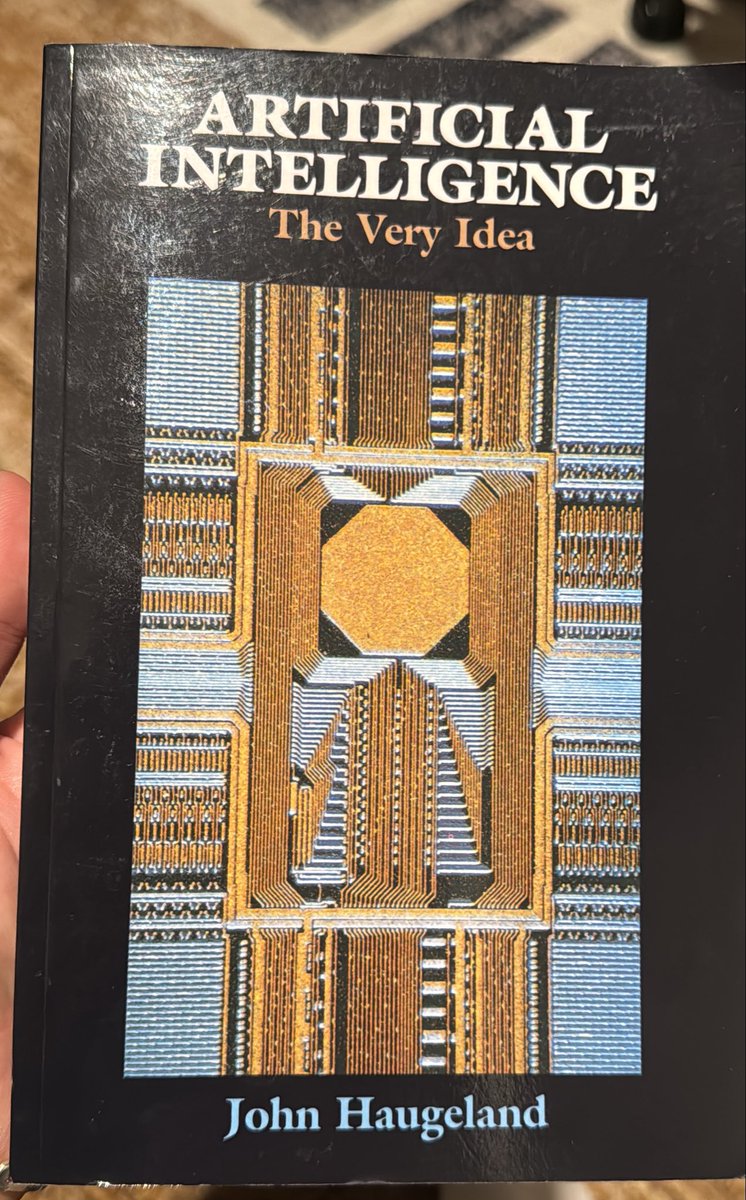
Skip much of the current philosophy of AI commentators and just go read this book
2
4
111
Tannr 🦾🤖 retweeted
Apr 18
Computer scientists often seem incredibly confident one way or the other about computational functionalism. What they should say is that the arguments both for and against provide only inconclusive considerations and the right attitude is therefore one of great uncertainty.
42
29
228
55,229
Apr 17
The problem with this article is that while the conclusion — despite being categorical without enough warrant — is agreeable (a machine executing an LMM is not and cannot be conscious) and yet the reasons the author gives for the conclusion are not at all.
1. It’s true we don’t need a complete metaphysics of consciousness to assess the likelihood of AI consciousness
2. This article tries to assess AI consciousness using an approach that does actually require a metaphysics of consciousness
3. … all the while claiming that the approach sidesteps that same requirement
Apr 17

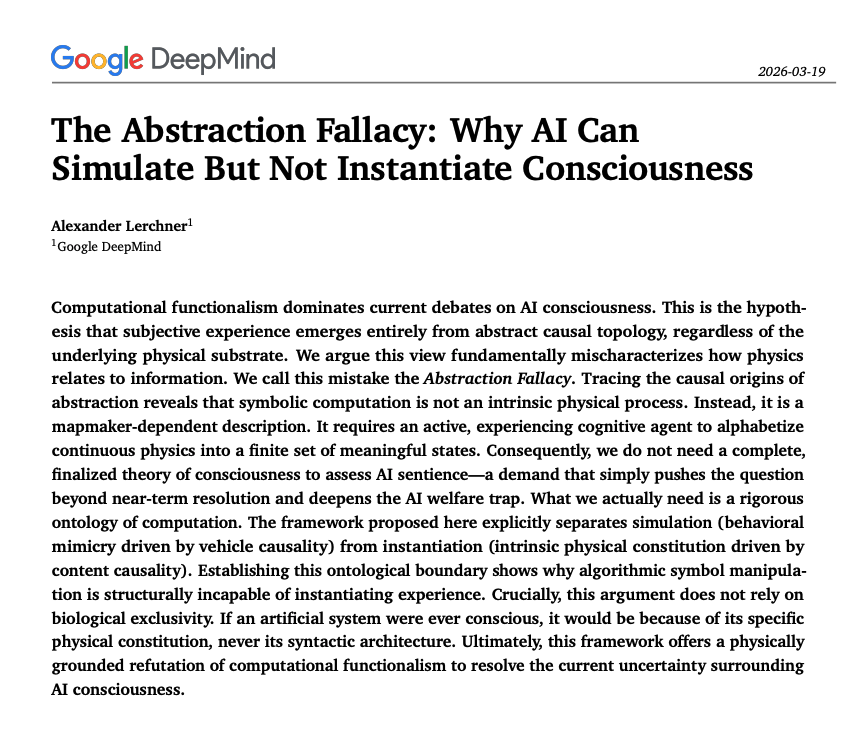
Google DeepMind researcher argues that LLMs can never be conscious, not in 10 years or 100 years.
"Expecting an algorithmic description to instantiate the quality it maps is like expecting the mathematical formula of gravity to physically exert weight."
1
1
168
Apr 16
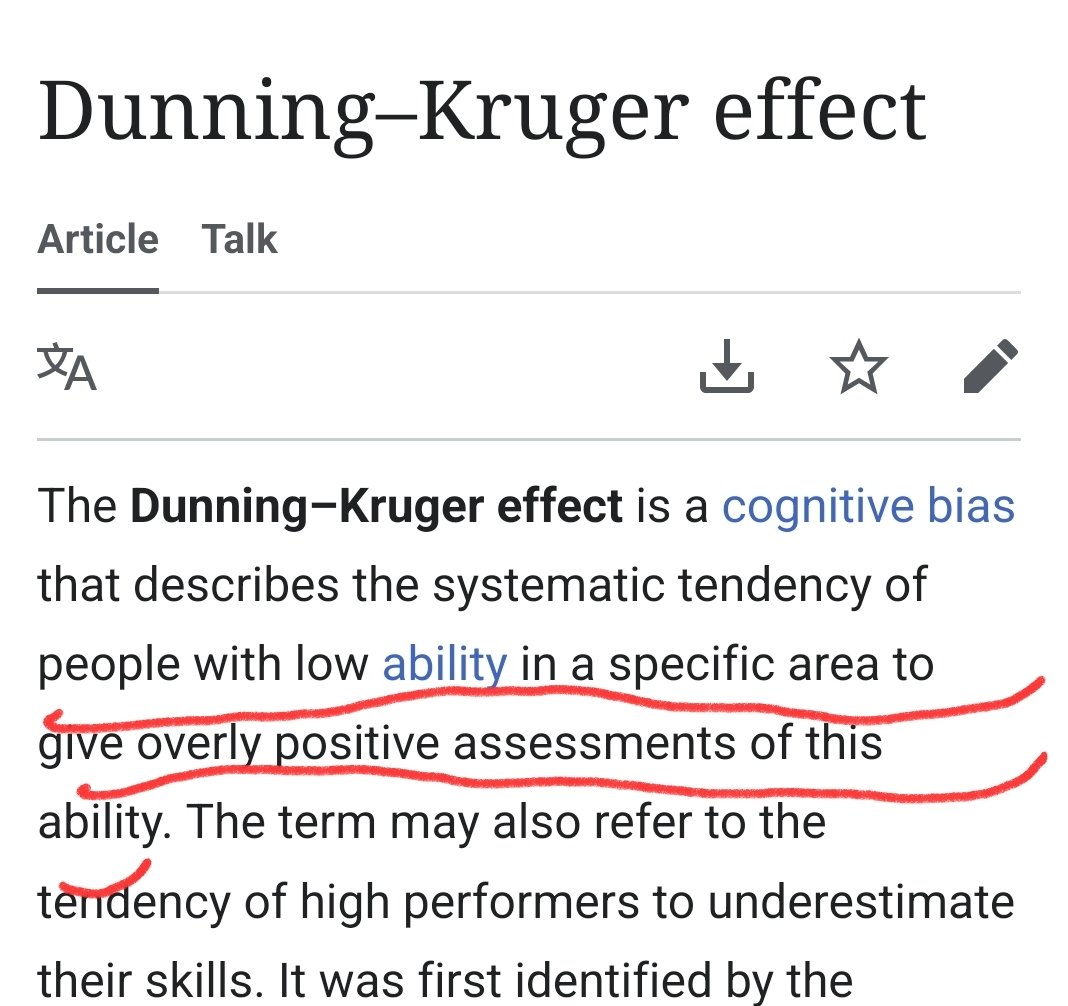
The irony of this post is that the person making the Dunning-Kruger accusation is the one exemplifying that very effect.
But anyway, enough about me.

I wish decent philosophers would take some time to get actually just a little decent at basic math, physics and ML before trying to define things NOT EXCLUSIVE TO THEIR FIELD
If you don't think the word 'machine' can be applied to the brain, that not "decent philosophy"
3
404
Apr 15
Listing half my stack rn
Apr 15

Today, we took long-overdue action to restore science, accountability, and the rule of law.
In September 2023, the Biden FDA pushed a number of peptides into Category 2 — “Bulk Drug Substances that Raise Significant Safety Risks” — driving a dangerous black market that puts Americans at risk.
Now, after nominators withdrew 12 peptides, the FDA will remove them from Category 2 and will bring them to PCAC at its next two meetings, beginning in July—where independent experts will rigorously evaluate each substance on its scientific merits using full clinical, pharmacological, and safety evidence.
• BPC-157
• Thymosin beta-4 fragment (LKKTETQ)
• Epitalon
• GHK-Cu (injectable)
• MOTS-c
• DSIP (Emideltide)
• Dihexa Acetate
• Ibutamoren Mesylate
• Melanotan II
• KPV
• Semax (heptapeptide)
• Cathelicidin LL-37
This action begins to restore regulated access and will immediately begin shifting demand away from the black market.
We will follow the science, enforce the law, and deliver the clarity patients, providers, and pharmacies deserve.
1
1
169
Tannr 🦾🤖 retweeted
Apr 14
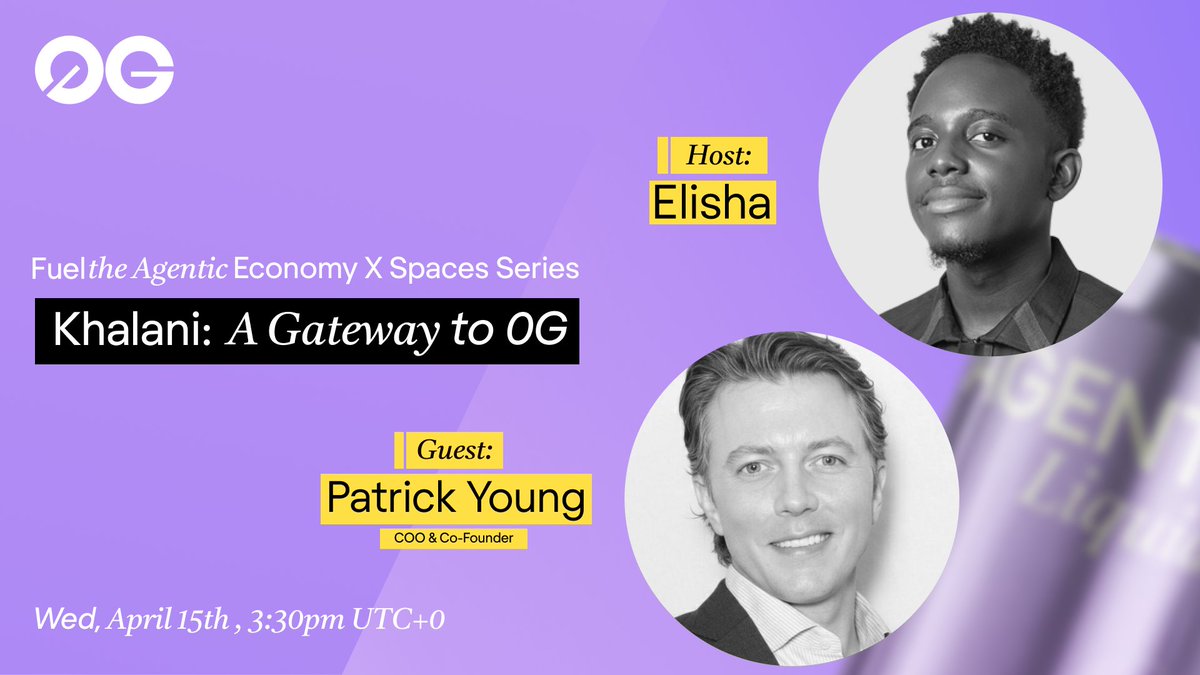
🎙️ The agentic economy needs more than smart models. It needs safe, composable transaction infrastructure.
Tomorrow, Khalani COO @patkyoung joins @ghcryptoguy to break down how Khalani powers the liquidity rails behind @0G_labs and the broader agentic ecosystem.
Set a reminder and tune in ⏲️

The agentic economy needs liquidity infrastructure & @khalani_network is building the gateway to 0G.
Tomorrow, @ghcryptoguy will chat with @patkyoung, COO and Co-Founder of Khalani, to break down how they're powering the financial rails AI agents will run on.
Fuel the Agentic Economy X Spaces Series
📅 Wed, April 15th | 3:30pm UTC 0
Set a reminder 👇 x.com/i/spaces/1aKbdbwMaXnJX…
1
4
15
1,393