
I like stocks that go up | swing trading | always learning
Joined July 2013
- Tweets 2,740
- Following 151
- Followers 345
- Likes 2,986
110 Photos and videos







Mar 19
This is hindsight bias at its absolute worst. In 2011, the median U.S. household income was ~$50k. Expecting people to have $130k in liquid cash on individual stocks is a fantasy for 99% of the population.
Stop taking advantage of people to buy your subscription. You’re disgusting
Mar 19

Value of $10,000 invested 15 years ago:
Nvidia: $4,043,000
Tesla: $2,490,000
Netflix: $310,900
Eli Lilly: $265,300
Amazon: $256,300
Alphabet: $216,800
Apple: $211,200
Mastercard: $203,200
Visa: $167,600
Microsoft: $157,000
Costco: $138,700
Home Depot: $90,800
Starbucks: $52,900
5
967
Mar 19
Maybe I should be more transparent with my trades. Sold AMPX Jan 27’ calls 150% profit.
Sold ERO -30% 2% aum
5
428
Carter Investing retweeted

Mar 10
Making a long-term bet on:
• Aggregators – $DASH, $UBER Eats, $GRUB Food, etc.
• Payment systems – $V, $MA, $AXP, $COF, etc.
• Finance and private credit – $BLK, $BX, $KKR, etc.
I recommend reading the Citrini Research study-forecast on the AI-driven crisis in 2027-28, published last weekend.
To be fair, @Citrini7 provide no quantitative arguments and/or evidence that the conditions for such a scenario already exist.
Zero practical value – but very entertaining read.
I’m sure that soon @X will be flooded with the “smart” thoughts of bloggers who read it.
Or they’ll read the thoughts of other bloggers who read it.
Or they’ll read the thoughts of bloggers who read the thoughts of other bloggers… and so on.
And yeah, you get the algorithm – rinse and repeat forever.
Read it now, and you’ll see exactly what everyone will be parroting for the next three weeks.

13 Dec 2025

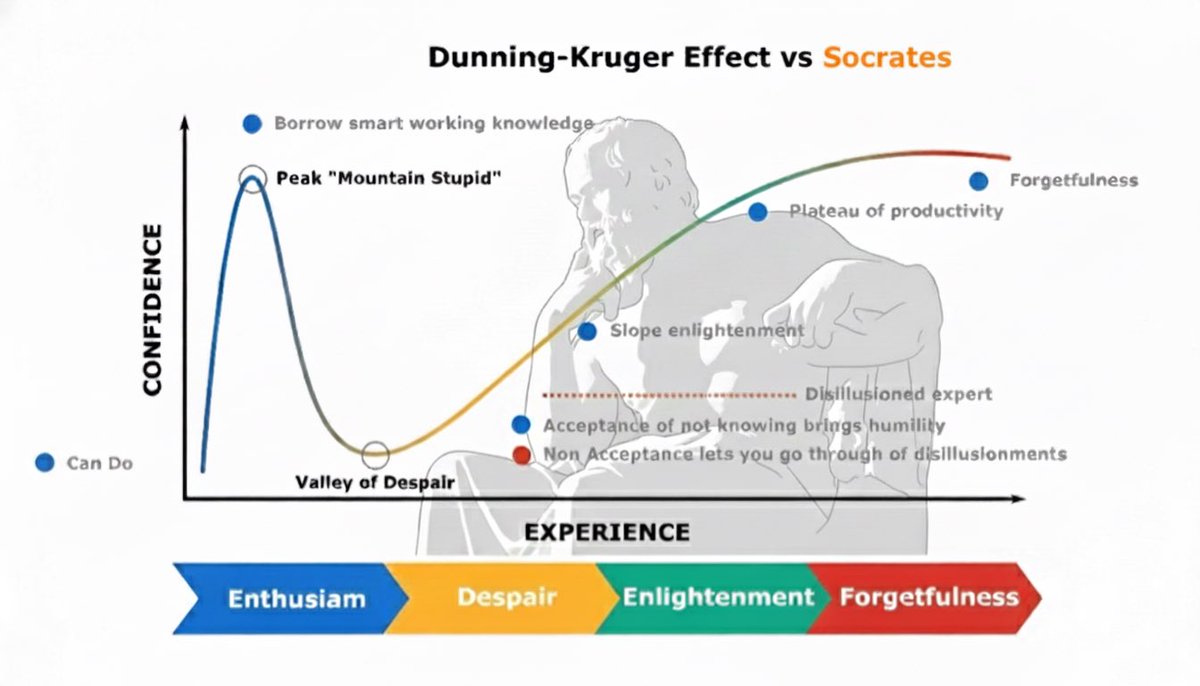
DUNNING-KRUGER EFFECT 🆚 SOCRATES
After seven months on @X, one thing has become increasingly clear to me: this platform is a perfect illustration of the Dunning-Kruger effect.
Most people drown in a stream of shallow facts that don’t add up to knowledge – they only create the feeling of being well-informed.
Professor Faber captured this brilliantly in Ray Bradbury’s Fahrenheit 451. Explaining to Montag why people abandoned books, he said:
“Cram people full of facts, fill them up to the brim with data they never digest, and they’ll feel brilliantly informed – without noticing how fast they’re heading toward the abyss.”
Many here write just to write.
Many read just to read.
And both share the same trait – a deep conviction that they already know enough.
Most minds are stuffed with so much scattered “noise” that there’s no time or energy left for actual thinking. And yet, as Faber also said:
“We have plenty of time. The question is whether we have time to think.”
When something goes wrong in life, career, or markets, the cause is rarely conspiracies, governments, geopolitics, or specific leaders.
The real reason is much closer: the content we choose to consume.
We shape it ourselves – with our attention, our likes, our replies, our comments, or by ignoring it.
We are what we eat.
We are what we drink.
We are what we read.
We are what we watch.
What we give our time to – people or things – is our choice, and it shapes us either way.
If you want a strong body – go to the gym every day.
If you want good health – stop drinking, smoking, overeating and cut down on sugar.
If you want to develop your mind – read.
Here are my favorite authors: Asimov, Balzac, Bradbury, Belyaev, Boussenard, Bulgakov, Clarke, Dick, Dostoevsky, Dreiser, Dumas, Fitzgerald, Goethe, Huxley, Poe, Ritchie, Sacher-Masoch, Stevenson, Tolstoy, Twain, Verne, Wells, Nabokov, Orwell, Heinlein.
They will gladly open their pages to you.
And one last thing.
Every watch I own carries an engraving of a line attributed to Socrates:
Οὐδὲν οἶδα ὅτι οὐδὲν οἶδα
“I know that I know nothing.”
I see these words every morning when I put my watch on, and every evening when I take it off. They keep me grounded.
If each of us tries – even a little – to be closer to Socrates, and not to the person who “knows everything” after reading two random posts, the world around us will start changing for the better.
But not by magic.
It starts with us.
2
2
38
3,732
I’ve been working on compiling a list for each ticker i research to make it easier to pull all data, but this one basically took what I was trying to do and did it. Highly recommend all of his articles and input
3
193
Carter Investing retweeted

Mar 8
Education Saturday! ✍️
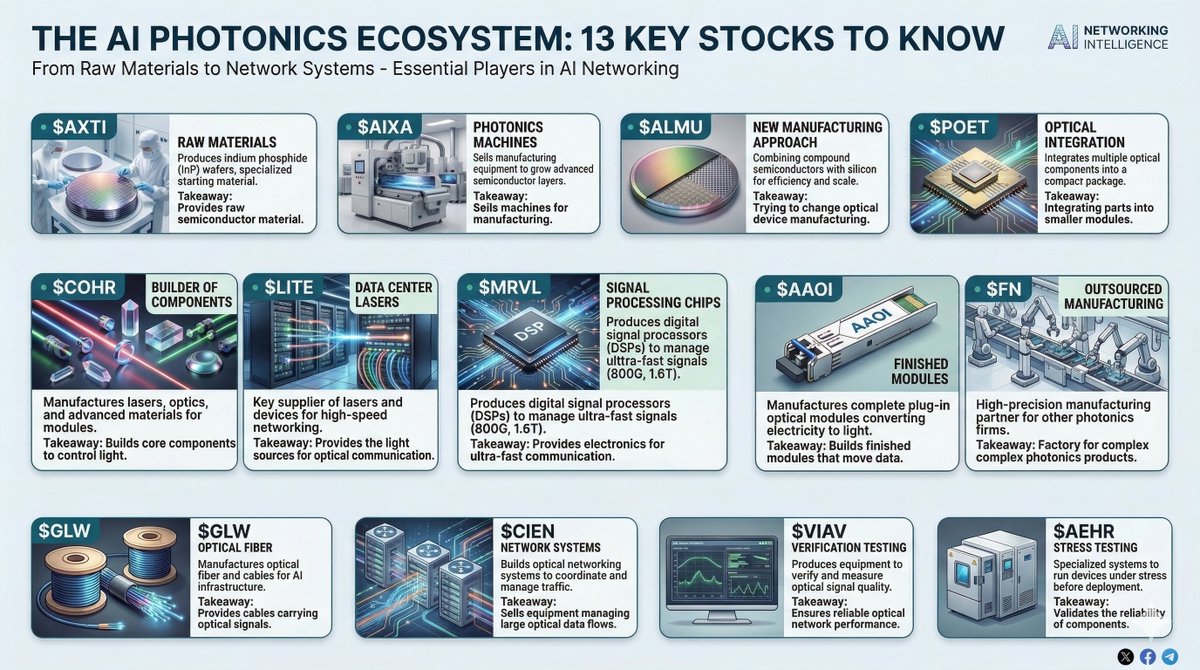
If you're new to Photonics, start here!
$POET $LITE $COHR $AXTI $AAOI
Here is a really easy and simplified way to understand many of the companies that I track in this space
Save/share if you found this useful please!
$AXTI - The raw materials
AXT produces indium phosphide (InP) wafers, which are specialized semiconductor materials used to build lasers and photodetectors.
Think of these wafers as the starting material used to make many of the optical components used in AI networking.
$AIXA (honorable international mention) - The machines that make photonics possible
Aixtron sells the manufacturing equipment used to grow the advanced semiconductor layers that form lasers and detectors.
These tools are used by companies that actually manufacture optical components.
$COHR - A major builder of optical components
Coherent manufactures a wide range of photonics products including lasers, optics, and advanced materials.
Their components are used inside the optical modules that carry data between servers in AI data centers.
$LITE - A key supplier of lasers for data centers
Lumentum focuses heavily on lasers and optical devices used in data center networking.
These lasers are what actually generate the light signals that travel through optical fiber.
$ALMU - A new approach to building photonics
Aeluma is working on a different way to manufacture photonic devices by combining compound semiconductors with large silicon wafers.
The goal is to produce lasers and detectors more efficiently and at larger scale.
$POET - Shrinking multiple optical parts into one
POET develops technology that allows multiple optical components (like lasers and detectors) to be combined into a compact integrated package.
This can simplify the design of optical modules used in data centers.
$MRVL - The chips that make the signals usable
Marvell produces digital signal processors (DSPs) used inside optical transceivers.
These chips clean up and manage the signal so data can travel at extremely high speeds like 800G or 1.6T.
$AAOI - The finished optical modules
Applied Optoelectronics manufactures complete optical transceivers.
These are the plug-in modules that sit inside switches and servers and convert electrical data into light, then back again.
$FN - The factory for many photonics companies
Fabrinet specializes in building complex optical products for other companies.
Many photonics firms design the technology but rely on FN to manufacture it at scale.
$GLW - The fiber that carries the light
Corning manufactures optical fiber and fiber cables.
These fibers are the physical paths that light travels through inside and between data centers.
$CIEN - The systems that run the network
Ciena builds large-scale optical networking systems used to move data across data centers, cities, and long-distance networks.
Their equipment coordinates and manages enormous flows of optical traffic.
$VIAV - Testing that everything works
Viavi produces testing equipment used to measure optical signals and verify network performance.
These tools are used by manufacturers and network operators.
$AEHR - Stress testing the components
Aehr makes specialized test systems used to run semiconductor and photonics devices under extreme conditions before they ship.
This helps ensure the parts will operate reliably inside data centers.
...
These are simple ways to think about these companies. Obviously they have lots of product mix and exposure to different areas, so just use this as a really simplified way to think about each company!
Also, yes there are many many good international players. I just don't cover them.
Feb 21

Education Saturday! 📓
For all my Photonics followers, you'll want to learn this
$AXTI $LITE $COHR $GLW $POET etc.
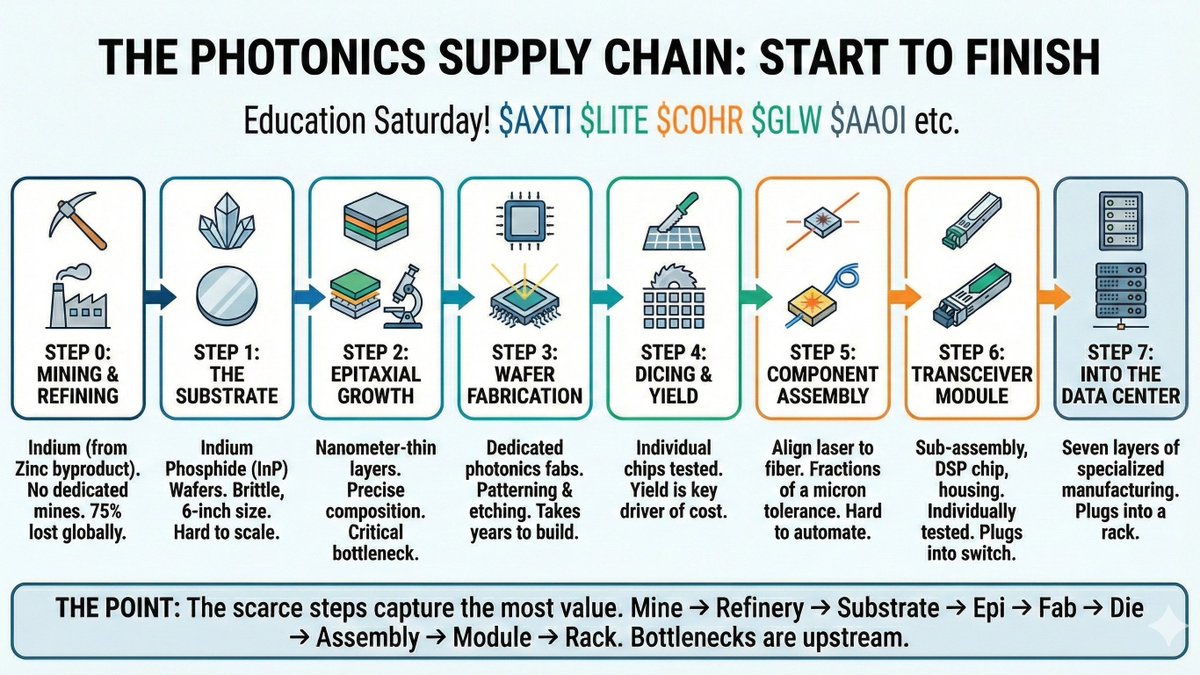
The Photonics Supply Chain: Start to Finish.
Step 0: Mining and Refining
It starts with a metal called indium. Indium is what makes high-performance data center lasers possible today. Without it, you can't build the components that move data at the speeds AI demands.
Indium has no dedicated mines. It doesn't get extracted on its own. It's a byproduct of zinc refining, meaning it only gets recovered when zinc smelters have the equipment and economic incentive to capture it from their waste.
Step 1: The Substrate
Refined indium gets combined with phosphorus to create a material called Indium Phosphide, or InP. InP has a unique property in that it can generate light directly from electricity. Silicon, the material that runs everything else in computing, cannot do this. That's why InP is the go to for the lasers inside data center optical components.
The first thing you make with InP is a wafer which is a thin, flat disc that serves as the foundation for everything built on top of it. InP wafers are expensive, brittle, and difficult to produce at large sizes. The industry is only now moving to 6-inch wafers. For context, standard silicon chip fabs run on 12-inch wafers. That size gap is a big part of why photonics capacity is so hard to scale quickly.
Step 2: Epitaxial Growth
A bare InP wafer still can't do anything useful. To create a laser, you have to grow extremely thin additional layers on top of it, each just a few nanometers thick (a human hair is roughly 80,000 nanometers wide). This process is called epitaxy.
The exact chemical composition of each layer determines the laser's wavelength, power, and efficiency. Get it slightly wrong and the entire wafer is scrapped. This step requires specialized equipment found in very few places in the world. It's rarely talked about, but it's one of the most critical bottlenecks in the entire supply chain.
Step 3: Wafer Fabrication
Now the actual circuit gets built. Using techniques similar to semiconductor chip manufacturing (patterning, etching, depositing materials etc.) engineers carve microscopic structures into the wafer: the channels that guide light (called waveguides), the cavities where light gets amplified, and the components that switch it on and off.
Unlike standard chip manufacturing, at this time this cannot be done in a regular semiconductor fab. It requires a dedicated photonics facility. These take years to build, qualify, and ramp. There are very few of them in the world.
Step 4: Dicing and Yield
The finished wafer gets cut into individual chips. Each chip is then tested to see if it actually works to spec. The percentage that pass is called yield and it's one of the most important numbers in this business. Low yield means high cost per working chip. Improving yield is one of the biggest levers on profitability, and it's hard-won through years of process refinement. You probably won't see it reported directly, but it's hiding inside gross margins.
Step 5: Component Assembly
A working laser chip still can't be used on its own. It has to be physically aligned to an optical fiber with tolerances finer than a fraction of a micron and combined with other components like light detectors and signal modulators to create a functional optical sub-assembly. Automating it reliably at high volume remains one of the hardest manufacturing problems in the industry.
The assembled component also has to be hermetically sealed inside a protective ceramic and metal enclosure. Data centers run hot, and moisture or dust will degrade a laser chip quickly. These hermetic packages are specialty components with few suppliers and long lead times and they have shown up as a bottleneck alongside InP when demand spikes.
Step 6: The Transceiver Module
The optical sub-assembly goes into a housing along with a DSP chip (a processor that cleans up and interprets the light-based signals) plus a circuit board and casing. The result is a pluggable transceiver: the finished module that slots into a switch or server in a data center. These individually get tested before it ships. That testing process is slow and expensive, and it's a hidden constraint on how fast output can actually scale. Note, in the world of CPO this will change.
Step 7: Into the Data Center
It plugs into a port on a network switch inside the data center, the hardware that routes data between thousands of servers.
And none of it moves an inch without the fiber it runs through. Ultra-pure glass strands, thinner than a human hair, carrying light signals between every switch, server, and building.
Follow stocks in this space? Drop a ticker below and I'll tell you exactly where they sit in the stack 👇
14
91
467
57,792
Carter Investing retweeted

Feb 18
The Federal Reserve just put out an incredible paper about Kalshi's data.
"Our results suggest that Kalshi markets provide a high-frequency, continuously updated, distributionally rich benchmark that is valuable to both researchers and policymakers."
federalreserve.gov/econres/f…
121
341
3,916
1,858,563
Feb 18
Are we finally going to see some green?? $AMZN
Feb 18

Amazon is difficult to own because it has diminished free cash flow from debt... I say stay in it but i know it went from cheap to expensive for a lot of people after that last q...
207
Carter Investing retweeted
Feb 14
“It Will Bounce Back Anyway” – The Brutal Reality of Long-Term Investing with $MSFT, $GE and $CSCO
Microsoft shares are down 17% year to date.
From the ATH set in July 2025, the decline now stands at 28%.
Many will think: “Nothing to worry about – it’ll bounce back anyway.”
In recent years, we’ve seen 30-50% corrections in Big Tech – then everything got bought up, new highs were smashed, and market caps swelled to 2, 3, 4, even 5 trillion dollars.
But it can play out very differently.
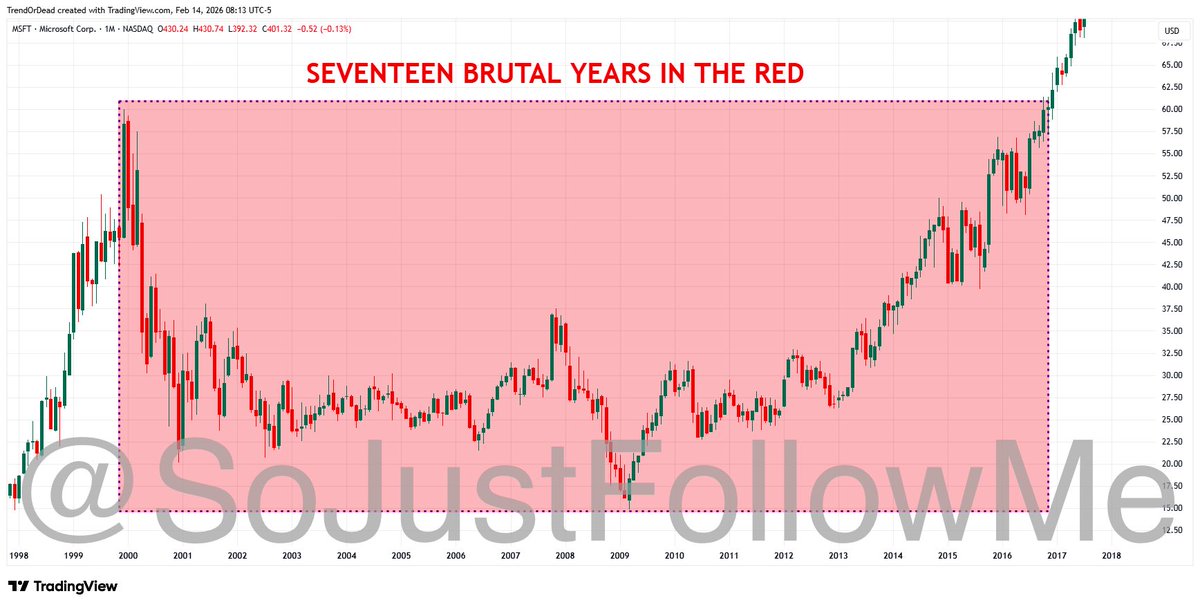
At the peak of the dot-com bubble, Microsoft reached a high of $59.97 in 1999.
What followed was a sharp decline, a prolonged sideways range, and another leg down.
The bottom was set only in 2009 – at $14.87.
Ten years after the peak.
And only in October 2016 was the 1999 high finally surpassed.
Seventeen long years stuck in the red.
The Microsoft example is relatively lucky.
Two other late-90s superstars – General Electric recovered by September 2025, and Cisco Systems by February 2026.
To put this into perspective: back then, these were the three premier blue-chip stocks of the market – the top blue chips of today – $NVDA, $AAPL and $GOOGL.
Most stocks, however, never clawed their way back to previous highs.
The conclusion is simple.
Where a bubble has formed, one should not expect a quick recovery after the decline.
It is entirely possible that former highs will never be seen again.
The theme is exhausted. A new bubble will be inflated somewhere else.
Think this only happened long ago? Think again. This is a standard market cycle.
How are the pandemic-era stars of five years ago doing today?
$ZM, $PYPL, $SE, $XYZ, $ROKU, $ETSY, $CHWY, $DOCU, $SEDG, $ENPH, $UPST, $RIVN, $PATH, $U, $W, $MRNA, $PINS, $OPEN, $PTON, $FSLY, $PLUG, $RUN, $DLO, $UUUU, $LSID, $BYND …
And how many “successful” finfluencers (25-year-old small clerks in real life, barely 2-3 years in the market) on @X are still waiting for their recovery?
And how many are now assuring you that with $CRWV, $NBIS, $IREN, $SNDK, $SEZL, $OKLO, $DUOL, $HIMS “this time will be different”?
Only one thing will change – others will swoop in and take their place.
I have always been extremely skeptical of those who say, “Nothing to worry about, it will bounce back anyway.”
How do they know that?
They don’t.
Or worse – they understand everything, but keep shoving this crap down your throat.
Because the alternative is losing your attention.
And attention – it’s all they’ve got.
What worries them more is the few thousand they’ll miss on @X – not that you’ll be left completely screwed.
- - - - - - - - - - - - - - - - - - - - - - - - - - - - - - - -
Please like, share or comment if you found this post useful. Every action helps this reach more people – and together, we can help them see how the stock market actually works, and guard themselves against losses and the nonsense spread by incompetent bloggers.
Want to know more about me and what I do? Check the pinned post on my profile.
Follow me: @SoJustFollowMe
- - - - - - - - - - - - - - - - - - - - - - - - - - - - - - - -
12 Oct 2025
INVESTING IN BLUE-CHIP STOCKS AND LONG-TERM HOLDING – WHAT’S THE CATCH
To my surprise, X is full of popular accounts making, in my view, dangerously misleading claims – like “10 Dividend Stocks to Buy and Hold Forever” @dividendology.
I clearly see how this could cause harm in the stock market, but it’s hard to imagine how it could help – it’s like going into a fight with Conor McGregor after watching a 5-minute YouTube video on the most effective UFC chokeholds.
There’s a persistent myth: to make money in the stock market, you need to buy the best stocks of the best companies and hold them as long as possible. Some even suggest holding them… indefinitely.
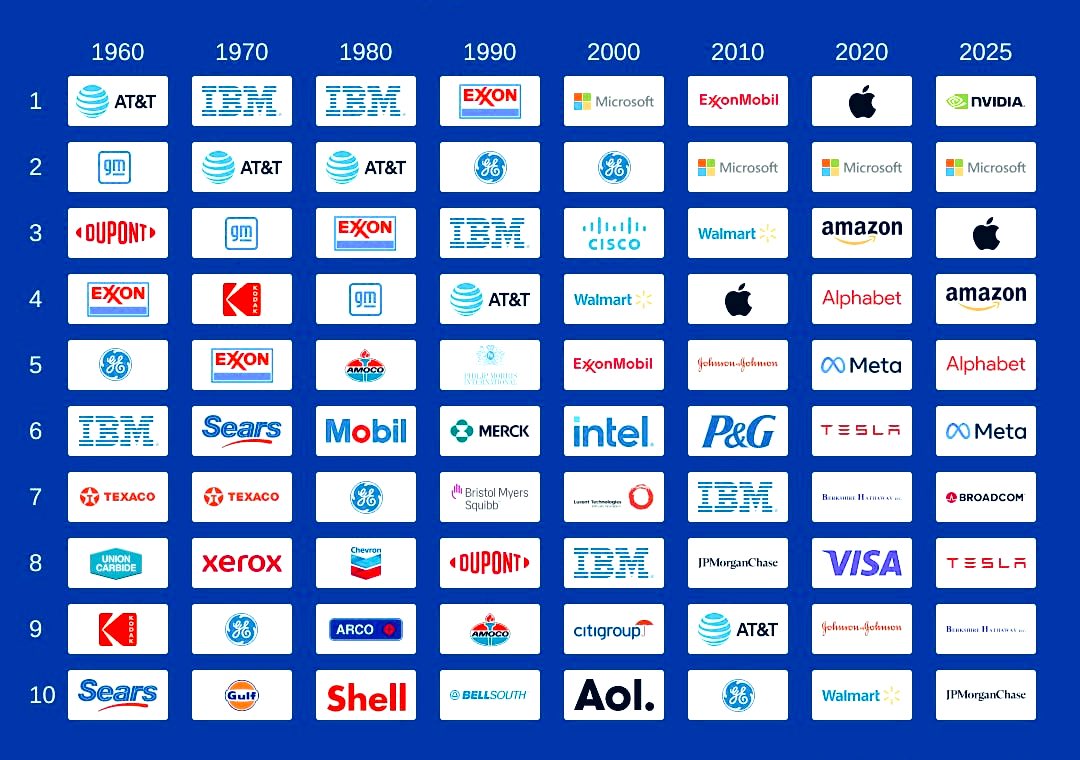
The main flaw in this theory is that the list of blue-chip stocks constantly changes. For illustration, here’s an infographic of the top 10 US stocks since 1960.
Investors who bought blue-chip stocks 60, 30, or 15 years ago often missed the mark. Among the past top companies, five went bankrupt, some were acquired, and many of the remaining ones are now in poor shape.
NOTABLE EXAMPLES
🔹 General Motors $GM – a global auto industry leader of the 20th century, producing up to 40% of all cars worldwide. In 2009, the company went bankrupt and was restructured with US government support. Today its market cap is around $53B, less than Maruti Suzuki India Ltd at about $58B. Symbolically, the American giant now ranks below the Indian subsidiary of a Japanese brand.
🔹 Xerox $XRX – the icon of the 1970s office era, whose name became a verb. Today its market cap is $399M.
🔹 AOL – the largest internet provider of the 1990s with 30M users. In 2000, it acquired Time Warner for $165B. Today AOL no longer exists.
🔹 Kodak $KODK – controlled 90% of the film market in the 1990s, missed the digital revolution, went bankrupt in 2012. Today it survives in niche markets like printing and retro products. Market cap: $513M.
🔹 Sears Roebuck – $AMZN of its time: catalogs delivered to every American village. It couldn’t survive the e-commerce shift and finally went bankrupt in 2018.
Which of the “untouchables” – $MSFT, $V, $MA, $ASML, $AVGO, $COST, $CNI, $WM, $MPLX, $JPM – will still be thriving in 20 years? Which ones will disappear completely?
What do you think?
29
25
244
55,631
Feb 12
Definitely happy with the quarter. Fell short on some metrics, but overall hit where it was most important.
Happy to continue holding and building my position

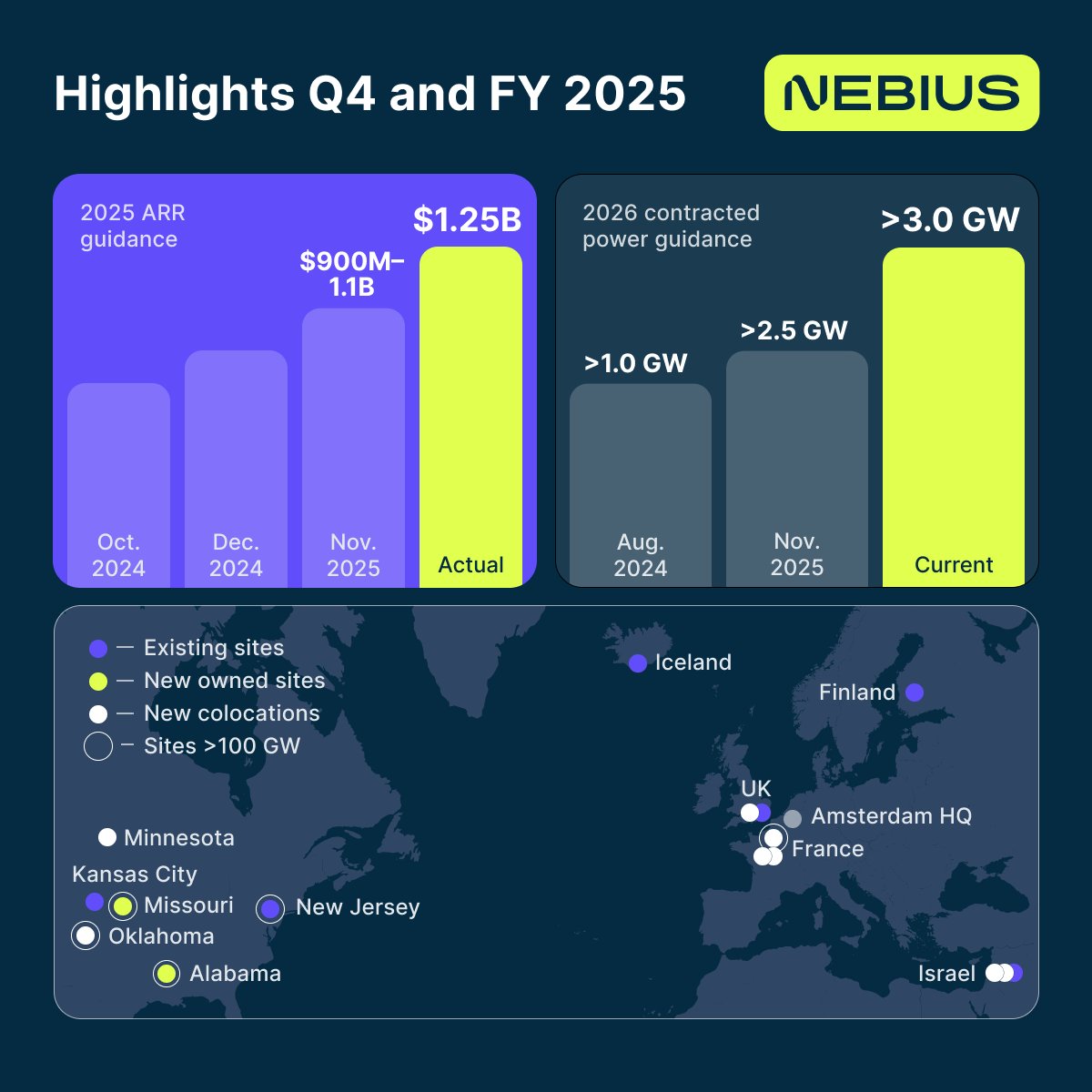
Today, we reported our Q4 and full-year 2025 financial results. The highlights include:
- ARR as of year-end was $1.25B, ahead of our most recent guidance of $900M–$1.1B
- This paves the way for significant continued growth. We are on track to end 2026 with ARR of $7B–$9B
1
141
Carter Investing retweeted
Feb 10
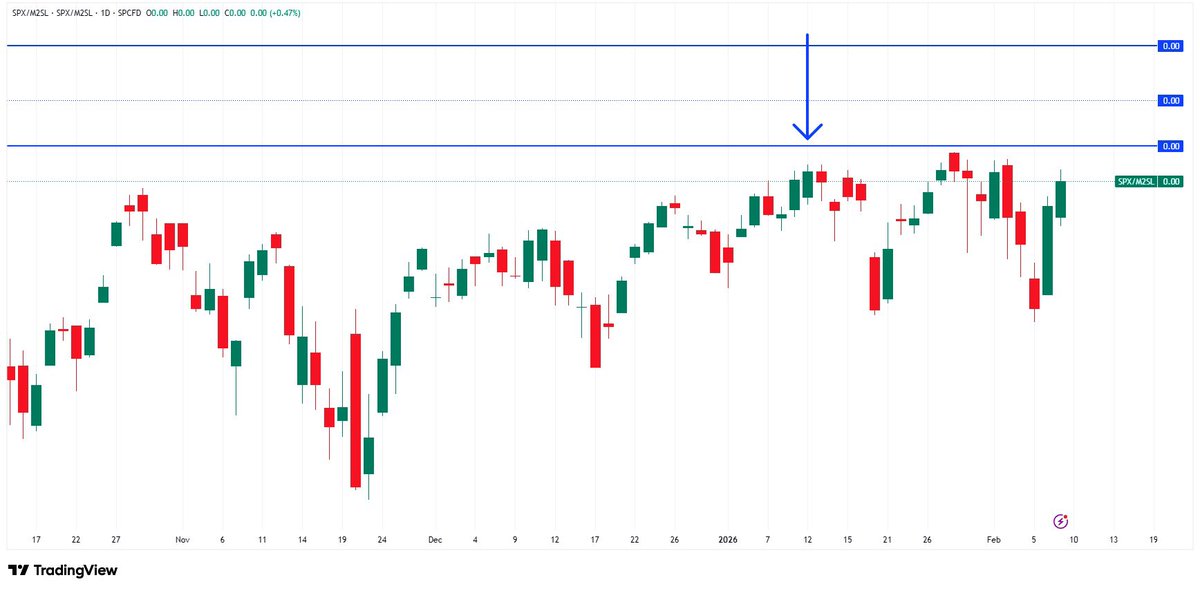
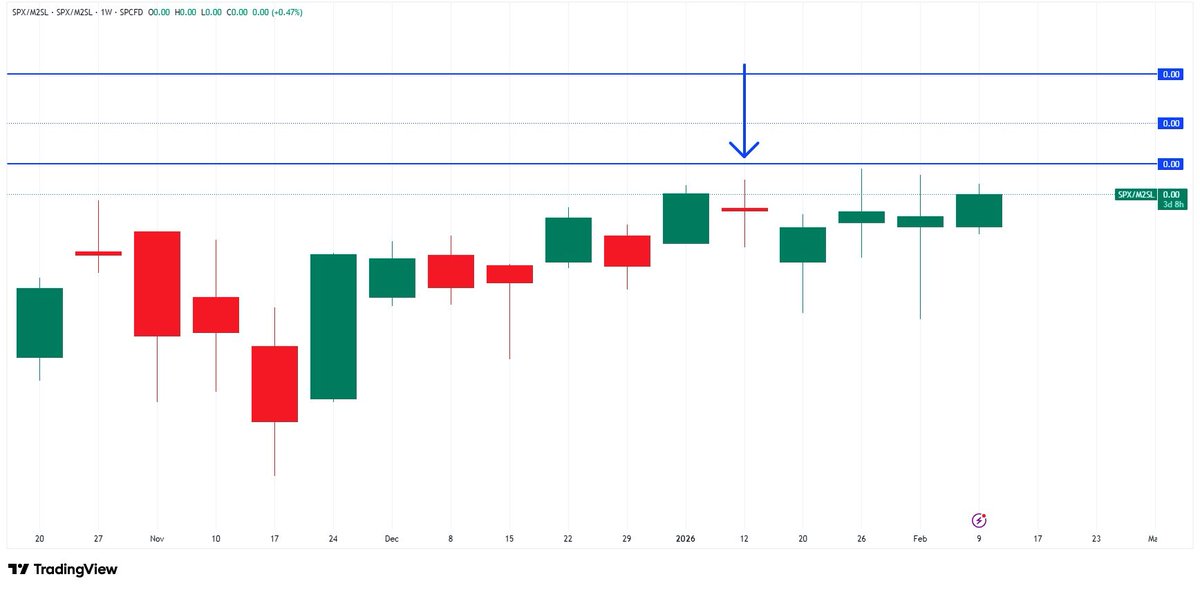
In early February, I noticed that the $SPX / #M2SL chart had changed. I’ve been tracking it for almost two decades and know every single point on the left side of the chart where the lines are drawn – those reference points had remained unchanged.
My team and I tried to find a reasonable explanation, including direct correspondence with the data providers. In short, we did not get an answer that satisfies us.
It’s important to understand that trading algos do not operate in a vacuum. They are calibrated precisely on these same data inputs.
At the same time, the fact that algos reacted to these data did occur.
I’m attaching the post below – also pay attention to the four posts pinned under it.
As I mentioned before, this is the first time in my 21 years in the equity market that I’ve encountered something like this (although I know similar cases have occurred in crypto markets – but there’s no real point in comparing them, the difference in scale is like that between a guppy and a blue whale).
I have a clear view of what this might be related to, but after consulting with my legal team, I made the decision not to comment on it in any way – not now, not in a week, not in a month, not in a year, etc.
Each of you will have to decide for yourselves whether this is some kind of manipulation on my part, an absurd misunderstanding or something else entirely.
As of today, the fact remains that, technically, there was no touch of the 25-year-old ATH. All coincidences related to algorithmic reactions to it appear to be random.
My view on the market outlook remains unchanged (scroll below), but strategy and tactics are changing fundamentally.
If this post gets 250 likes, I will clearly demonstrate what exactly is causing my concerns and will also introduce another indicator – one that explains why I was in cash, with no positions, during the March-April 2025 drawdown.
p.s. Attached is how $SPX / #M2SL currently looks on the daily and weekly timeframes.
⚠️ NFA | General info only | Personal view
Feb 6
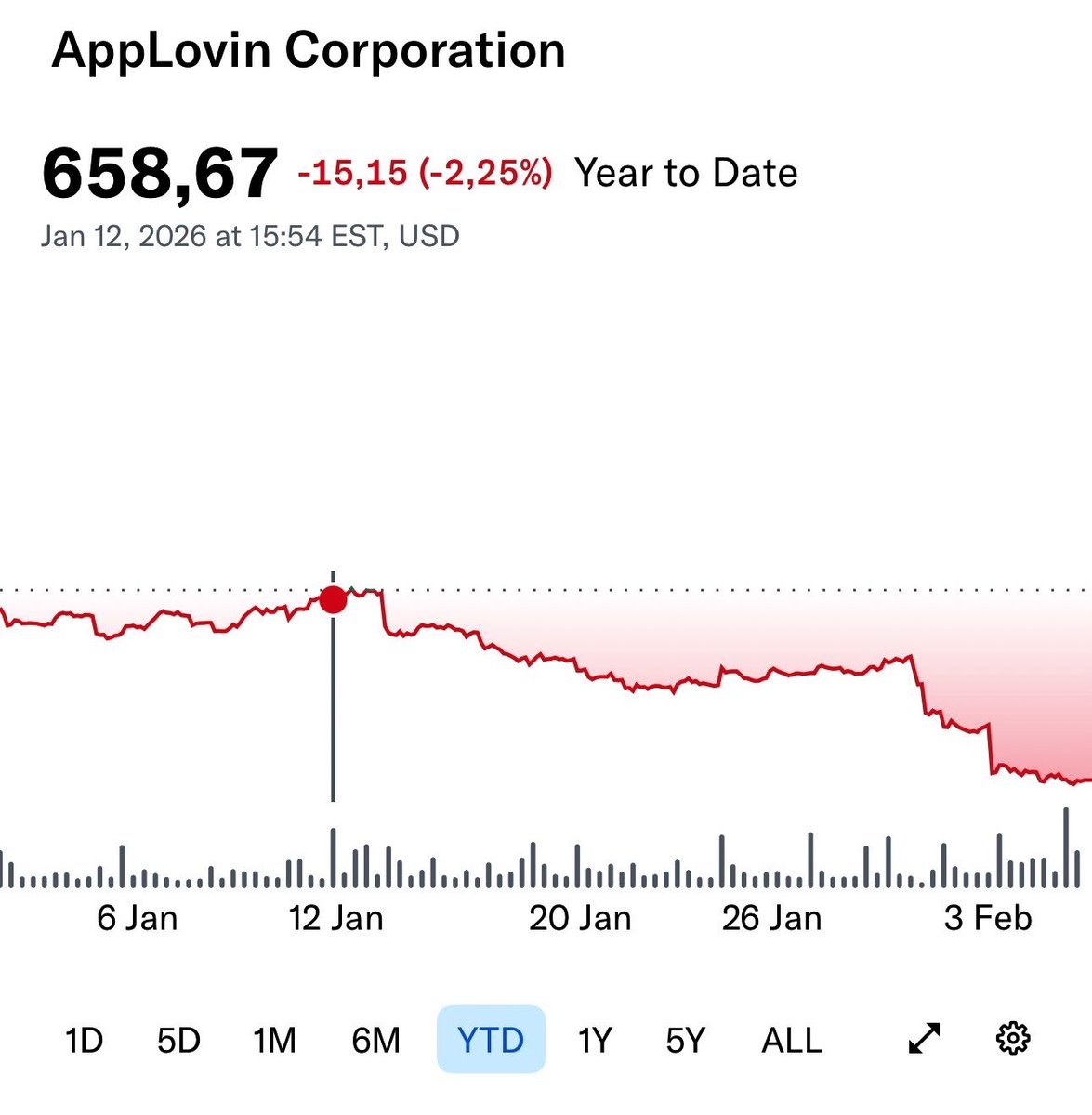
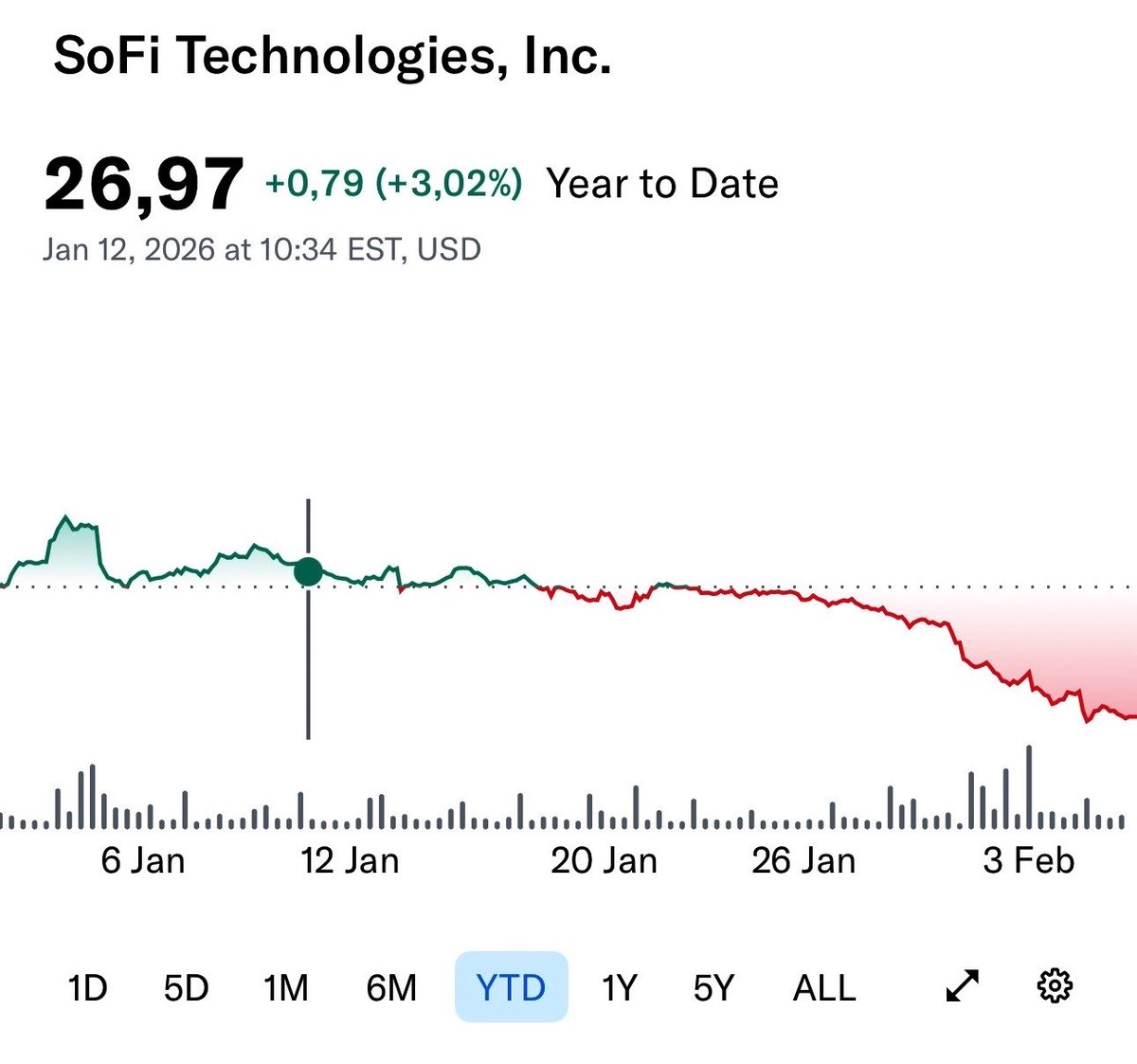
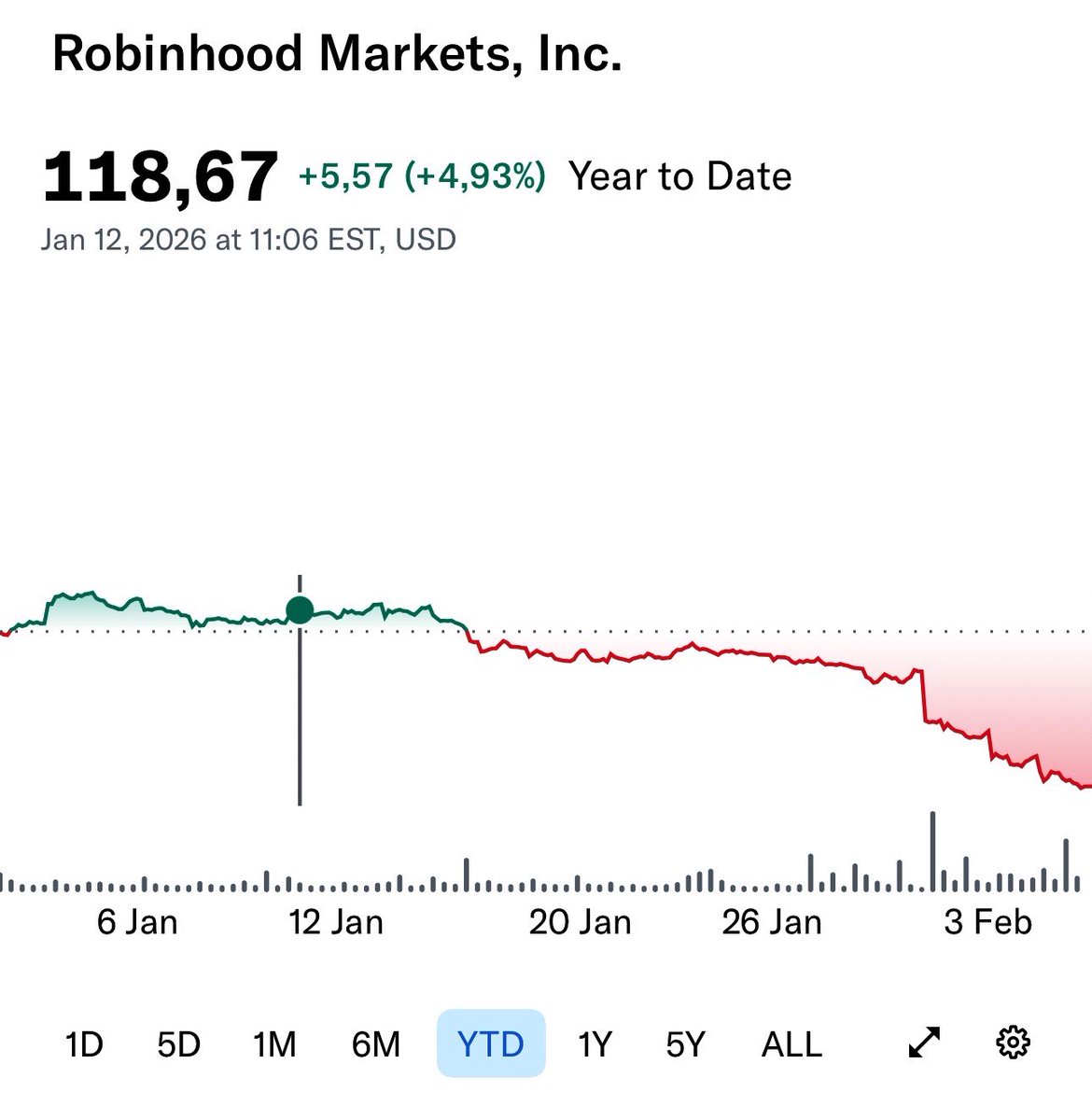
Yesterday I was asked about $SPX / #M2SL.
While answering, it hit me – not everyone actually sees the essence of what I write.
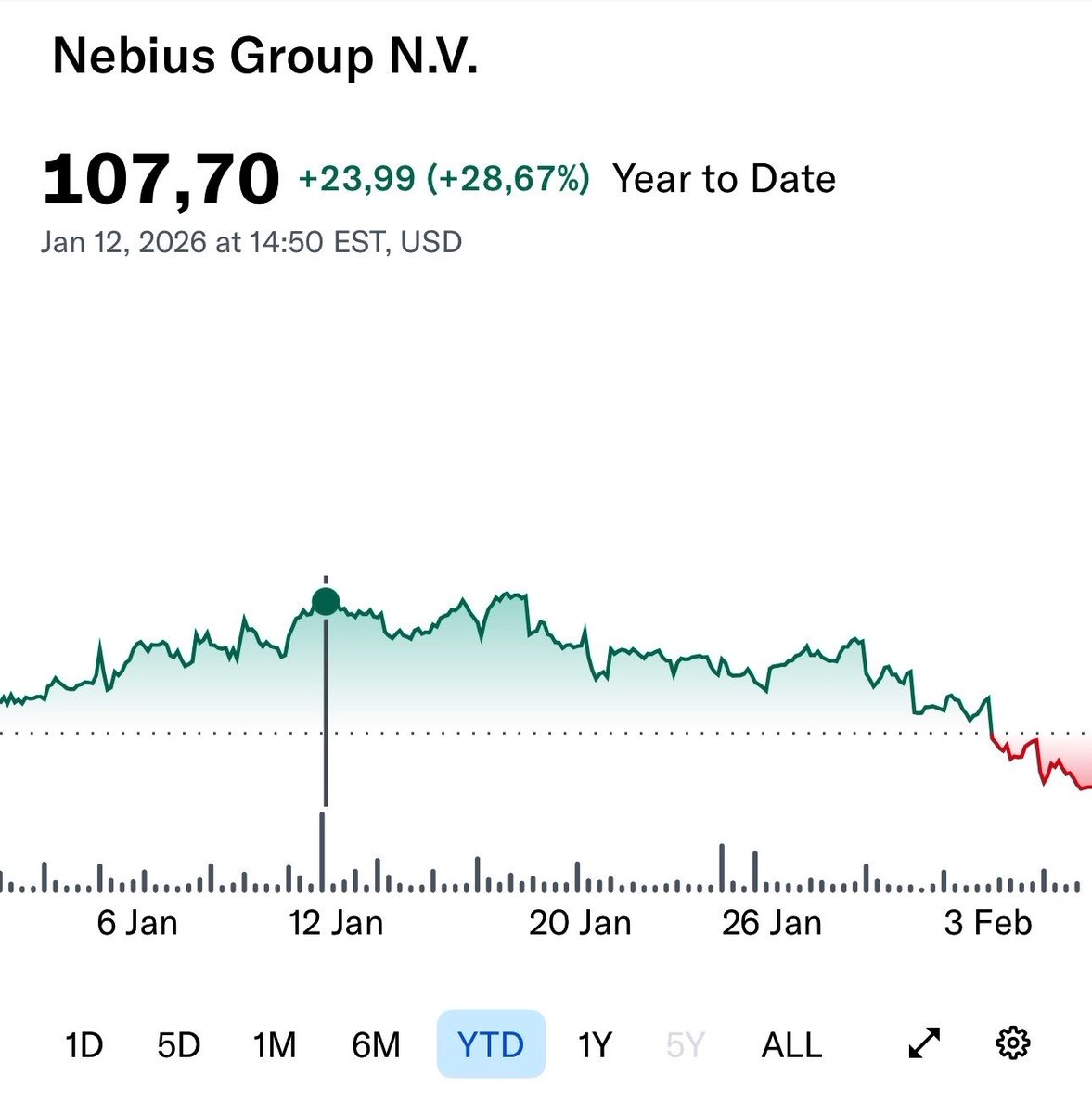
When was the first touch? January 12.
Take high-risk assets like $NBIS, $APP, $HOOD, $SOFI – when did their corrections actually start?
The second touch was January 27.
Check the charts yourself for any asset you follow.
We are now in a correction tied to a “two-touch” all-time high from 25 years ago.
And I warned about this more than 3 months ago.
Below are two pinned posts from January 12 and 27 – about the touch itself.
Even further down are two November posts explaining the $SPX / #M2SL indicator.
If you want to understand what’s happening, start there.
Please be honest in the comments – did you read all four posts before?
Is the content difficult?
First – even when I explain things as simply as possible, the subject itself is comparable to open-heart surgery. By definition, it can’t be easy.
Second – the problem isn’t how I explain it (I almost convinced myself it was). The problem is that many simply aren’t familiar with the underlying material.
You don’t build a skyscraper starting from the 14th floor.
You start with the foundation.
Everything you need for that foundation is in the pinned post.
Missed it? Time to catch up.
24
10
259
42,925
Jan 31
Life advice. Never pass on a Jim Simon’s video
104
Carter Investing retweeted

Jan 31
UFC 324 straights: Szalay ML -135 2 units
Dom Mar ML -135 2 units
Micallef ml -125 2 units
Malkoun -155 2.5 units
Volk -148 2 units
Mullarkey over 1.5 rounds 1.25 units
Texiera by KO 1.5 units
BSD inside the distance 1 unit
Parlays out soon and POTD soon
1
1
382
Jan 30
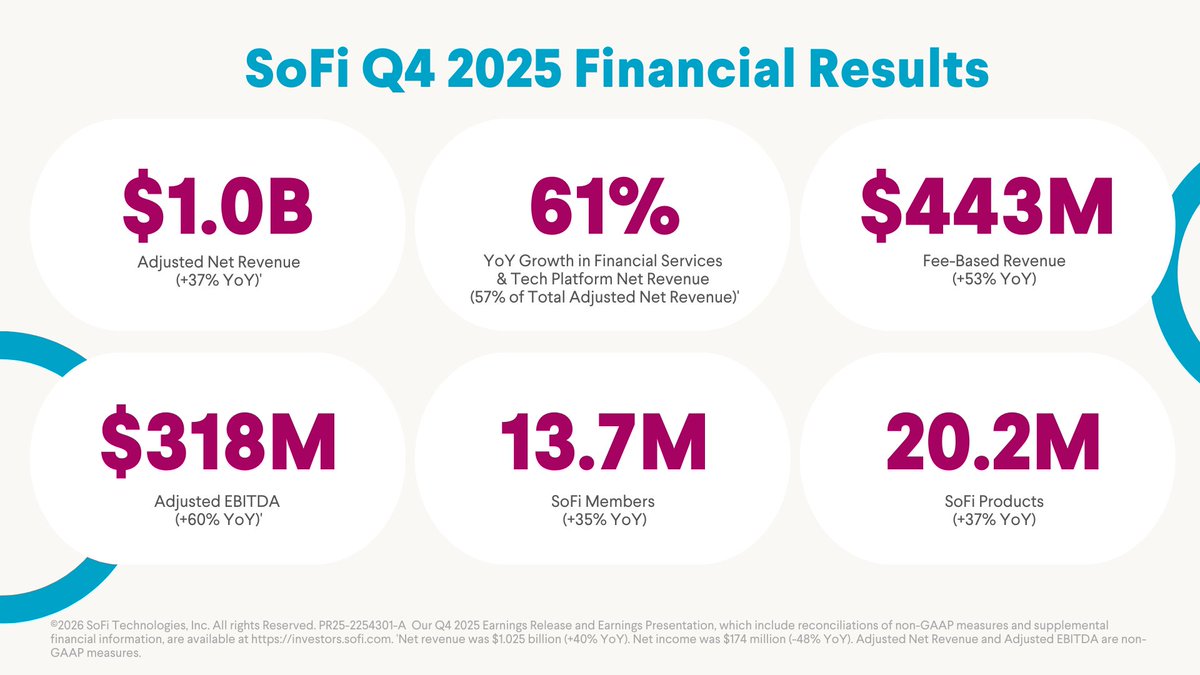
Undeniable at this point

📣 SoFi delivers another record-breaking quarter! In Q4 we delivered a record $1 billion in adjusted net revenue and had the biggest increase in new members and new products in SoFi history. This is durable growth, powered by our one-stop shop.
Full results here: businesswire.com/news/home/2…
318
Carter Investing retweeted
Jan 25
Late add: Silva parlay!
-108 2 units
1
1
1
77